
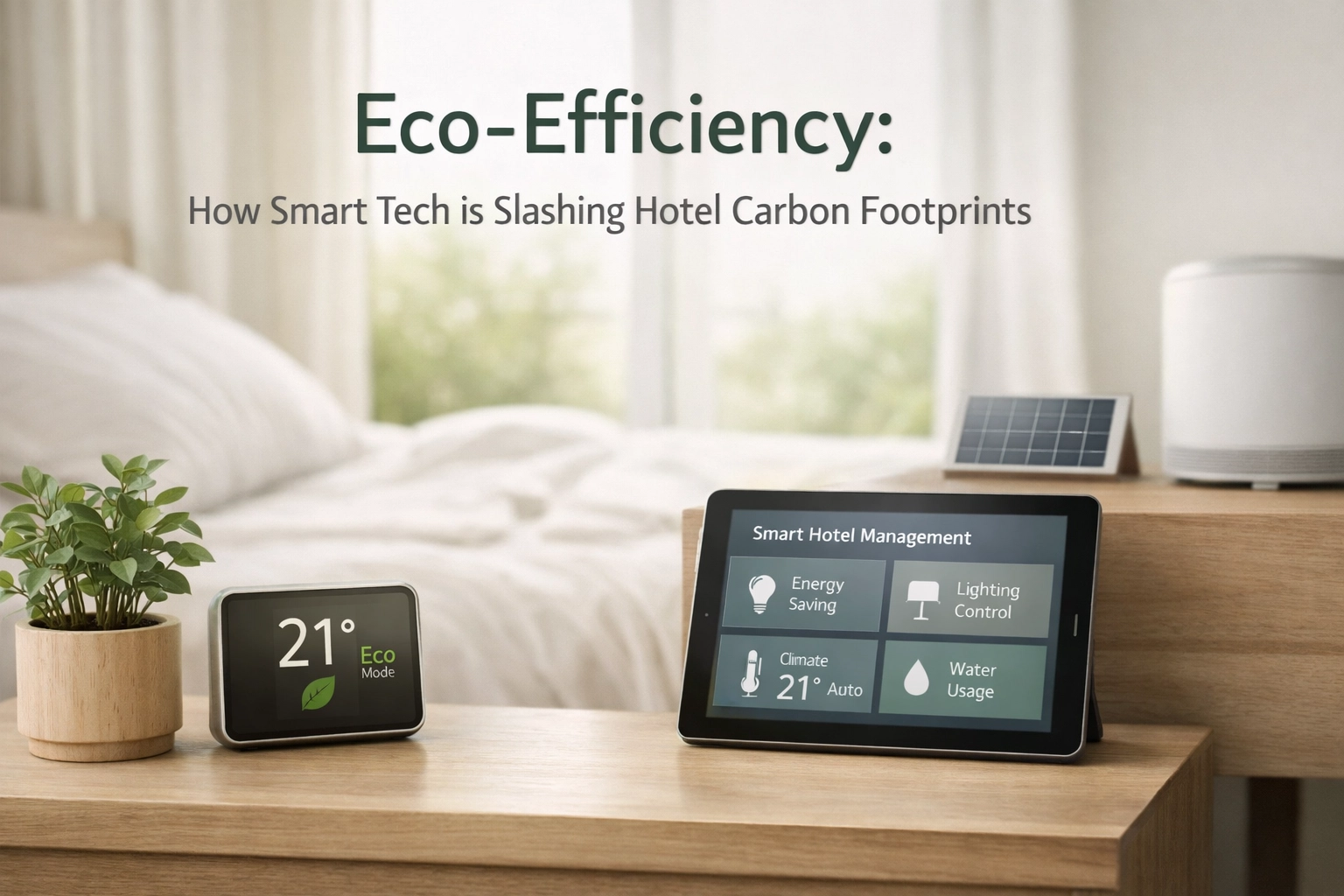
Cut emissions. Automate operations. Scale sustainability.
In 2026, a hotel’s carbon footprint is more than just an environmental metric, it’s a direct reflection of its operational intelligence. We’ve moved past the era of "greenwashing" and "please reuse your towels" signs. Modern guests expect more, and the planet requires it. Leading properties are now achieving a 27% reduction in total energy consumption while simultaneously improving the guest experience.
They’re doing it through a unified approach to hospitality technology. By connecting smart hardware with an intelligent property management system, hotels are transforming from passive buildings into active, breathing ecosystems that respond to occupancy in real-time. It’s about doing more with less, all from one innovative platform.
The Heart of the Green Machine
We believe that sustainability shouldn't be a secondary department. It should be baked into the very core of your operations. When your PMS talks to your building management system (BMS), magic happens. You stop guessing and start knowing exactly where every kilowatt is going.
- Real-time energy tracking via centralized dashboards.
- Seamless integration between guest check-in status and room climate.
- Automated reporting that makes ESG compliance effortless.
The modern tech stack acts as the central nervous system for your property. When a guest checks out early, the PMS doesn’t just update the room status for housekeeping; it tells the HVAC system to go into "eco-mode" and ensures the lights stay off until the next arrival.
Intelligent HVAC: The Heavy Hitter
Heating, ventilation, and air conditioning (HVAC) are usually the biggest energy hogs in any hotel. They can account for over 40% of a building's total energy spend. But here's the reality: many of those rooms are cooling or heating empty air for 12 hours a day.
Occupancy-driven HVAC systems use smart thermostats and PIR (passive infrared) sensors to detect human presence. If the room is empty, the temperature drifts to a pre-set "efficient" range. The moment the guest opens the door, the system ramps back up to their preferred setting.
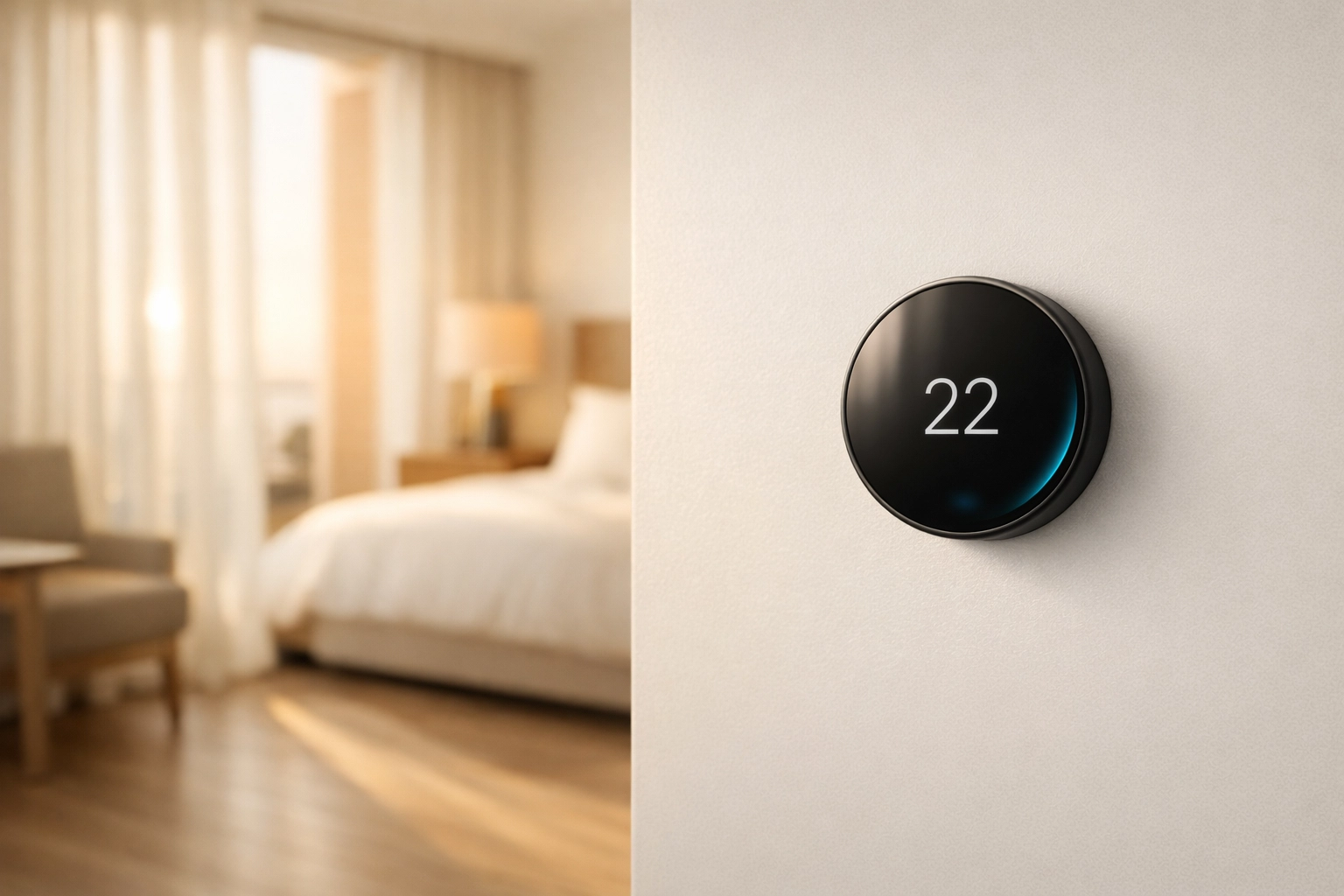
- 18% average energy savings from HVAC optimization alone.
- Zone-based control for public spaces and corridors.
- Predictive cooling based on local weather forecasts.
"We saw our electricity bill drop by 20% in the first quarter after syncing our thermostats with our guest data," says one general manager. "The best part? The guests didn't even notice a change in comfort."
Lighting the Way (Only When Necessary)
Why are the lights on in the 4th-floor hallway at 3:00 AM when nobody is there? In the old days, the answer was "safety" or "it’s too hard to change." In 2026, the answer is "inefficiency."
Smart lighting control uses motion sensors and ambient light detectors to ensure that bulbs are only burning when they need to be. Digital signage has replaced the endless reams of paper menus and brochures, cutting down on scope 3 emissions from printing and physical transport.
- LED transitions combined with motion activation reduce lighting costs by 9%.
- Automated dimming schedules for lobby and dining areas.
- Instant content updates across all digital displays, no paper required.
Predictive Analytics and the Power of Data
Data is the new oil, but it’s a lot cleaner. When you capture energy data across an entire estate, you start to see patterns. You see that certain rooms lose heat faster than others (maybe a window seal is failing). You see that your laundry peak hours coincide with peak utility pricing.
Smart systems use predictive analytics to anticipate these moments. They can pre-cool a building an hour before a heatwave hits or shift high-energy tasks to off-peak hours. It’s not just about saving the planet; it’s about outsmarting the market.
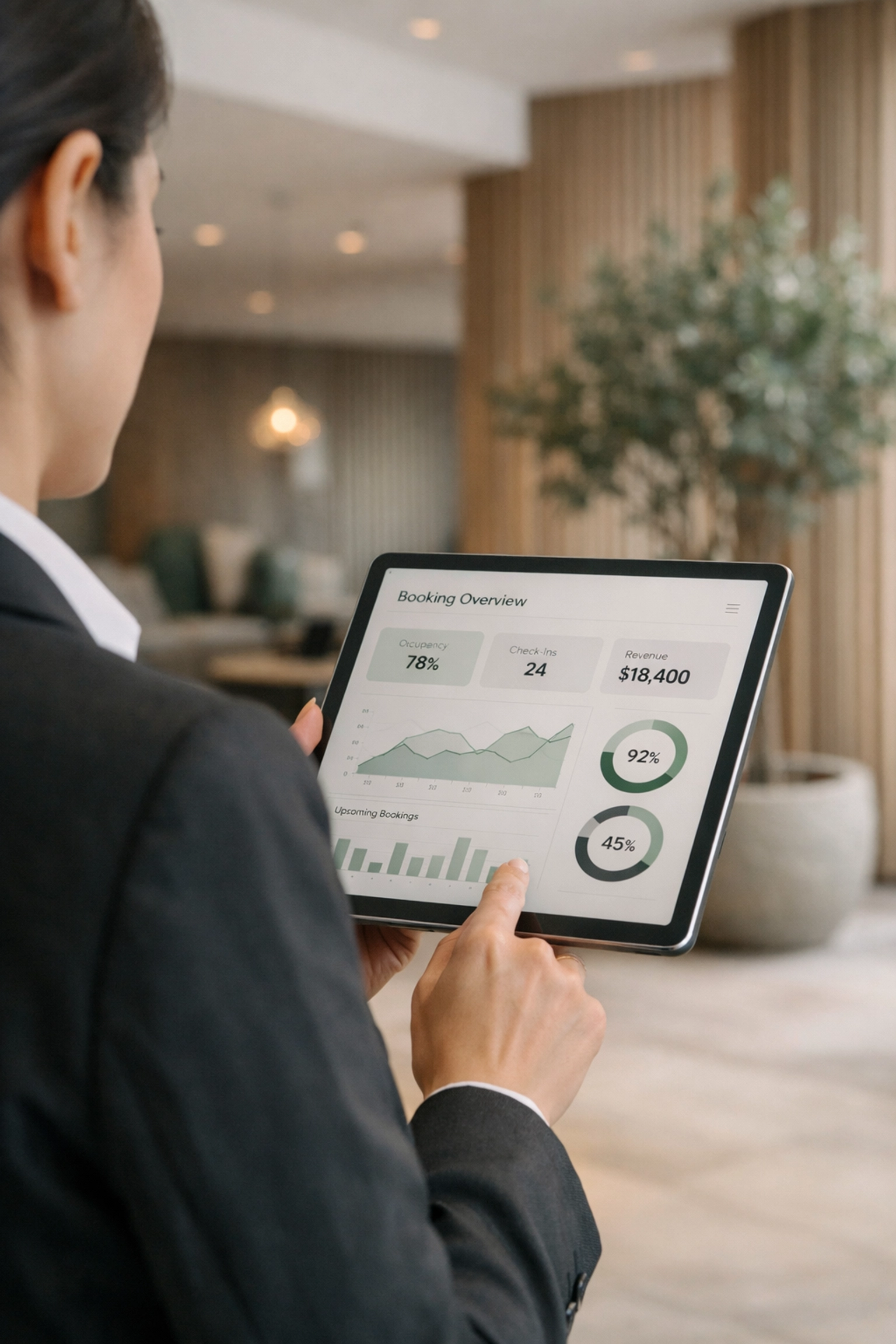
We think the smartest hotels are the ones that let the software do the heavy lifting. By using AI to forecast occupancy rates, the system can "hibernate" entire wings of a hotel during low-season periods, essentially turning off the carbon footprint for those areas completely.
Beyond Energy: Water and Waste
Eco-efficiency isn't just about the power grid. Water scarcity is a growing concern for global hospitality. Smart showers and taps now use aerators and sensors to reduce water flow without sacrificing the "rain shower" feel that guests love.
- Leak detection sensors that alert maintenance before a drip becomes a flood.
- Smart irrigation systems that check the weather before watering the gardens.
- Digital guest journeys that eliminate plastic key cards and paper registration forms.
By moving your guest journey to a digital-first model, you're not just being modern, you're being responsible. Every digital check-in is one less piece of plastic or paper that ends up in a landfill.
The Business Case for Being Green
Let's talk numbers. Sustainability is often framed as a cost, but the data tells a different story. For a typical 200-room property, implementing these smart technologies can lead to annual savings of $150,000 to $300,000.
With an estimated payback period of just 18 to 24 months, the ROI is undeniable. Beyond the direct savings, there’s the brand value. Today's travelers are actively searching for "eco-friendly" hotels. They are willing to pay a premium for properties that can prove their commitment to the environment with hard data, not just vague promises.
- Verified Scope 2 carbon credits through reduced consumption.
- Lower operational costs that go straight to the bottom line.
- Increased guest loyalty from the growing "conscious traveler" demographic.
How to Get Started
Transitioning to an eco-efficient model doesn't happen overnight, but it is easier than you think. You don't need to rip out your walls. You need to start with the "brain" of your hotel, your software.
- Audit your current stack. See which systems are siloed and which can talk to each other.
- Connect your PMS. Ensure your guest data is driving your building's behavior.
- Install smart sensors. Start with HVAC and lighting in guest rooms, the areas with the highest impact.
- Monitor and iterate. Use the data from your first month to find the next "quick win" for energy reduction.
We believe that the most innovative hotels are the ones that see technology as a tool for a better world. It’s about creating a stay that feels indulgent for the guest but is invisible to the planet.
Ready to slash your footprint?
The tech is here. The guests are waiting. The planet needs it. Transforming your property into an eco-efficient powerhouse is the smartest move you can make in 2026.
If you’re looking to see how a modern, cloud-native platform can help you manage your energy, your guests, and your growth, we’re here to help.
Explore the future of hospitality with Mews
It’s time to stop managing rooms and start managing an ecosystem. Let’s get you on the path to net-zero while driving your revenue higher than ever. It’s a win-win, no, it’s a win-win-win. One for you, one for your guests, and one for the world. 🚀🏨