8:14 AM.
You’re staring at a customer support ticket. Your new, expensive AI chatbot just promised a customer a free lifetime subscription because they asked "pretty please."
☕ The coffee in your hand is getting cold.
You thought ai business automation was supposed to be your ticket to a four-hour work week. Instead, it feels like you’ve just hired a very fast, very confident toddler to run your operations.
We’ve all been there. You see the headlines. You hear the buzzwords. You jump in headfirst because you don't want to be the "Kodak" of your niche. But here’s the cold, hard truth: AI doesn’t fix a messy business. It just makes the mess happen at the speed of light.
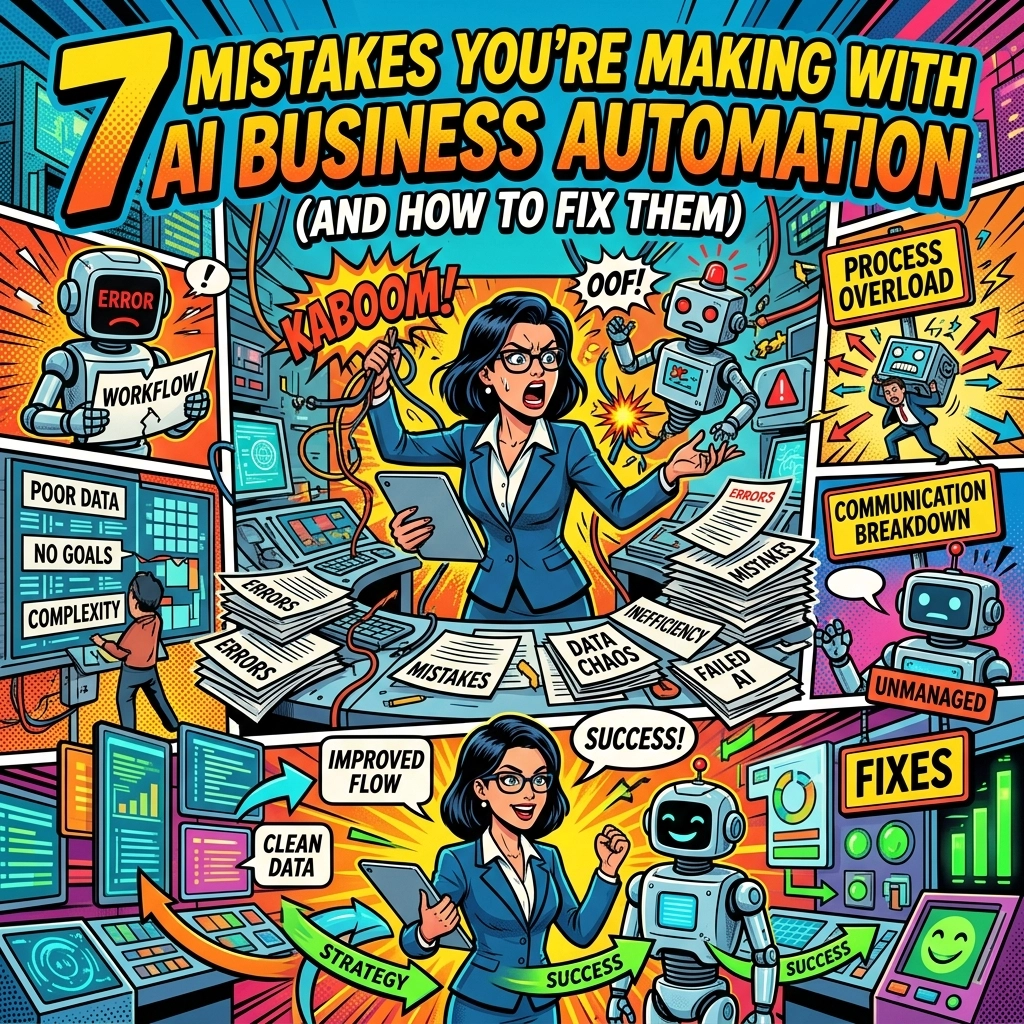
If you’re feeling more stressed than streamlined, you’re probably making one of these seven common mistakes. Let’s fix that before your bot promises someone your car.
1. YOU’RE AUTOMATING A TRAIN WRECK
Here is the golden rule of business automation tools: If your process is broken, automating it just makes it broken faster.
Think about your lead follow-up. If your current manual process is "I’ll email them when I remember," and you automate that, you’re just consistently forgetting people at scale. Or worse, you’re sending "Hey [Name]" emails to people whose name is actually "RE: Invoice #402."
AI is a multiplier. 0 x 100 is still zero.
THE FIX:
Before you touch a single line of code or sign up for a new SaaS, map it out. Draw your workflow on a napkin. If it doesn’t make sense on paper, it won’t work in the cloud. Audit your steps. Remove the fluff. Fix the leaks. Then, and only then, let the AI take the wheel.
2. THE "SET IT AND FORGET IT" DELUSION
You saw the demo. It looked like magic. You hit "deploy" and went to lunch.
Six months later, you realize your AI-powered pricing tool has been slowly lowering your margins to zero because it "learned" that lower prices get more clicks. This is what the pros call "Model Drift," and it’s how companies like Zillow lost $500 million in half a year.
AI isn't a slow cooker. You can't just set it and walk away.
THE FIX:
Build a "Check-In" ritual. Once a week, look at the outputs. Is the AI still doing what you intended? Is it hallucinating? Is it still aligned with your brand voice? You need a dashboard, not a blindfold. If you want to see how to actually build a system that stays on track, check out Marblism.

3. IGNORING THE "GARBAGE IN, GARBAGE OUT" PRINCIPLE
85% of AI projects fail. Why? Because the data they’re fed is hot garbage.
If your CRM is filled with duplicate entries, outdated emails, and notes that say "Talked to this guy at the thing," your AI is going to be confused. It’s like trying to bake a Michelin-star cake with expired milk and salt instead of sugar.
Roughly 60% of small businesses struggle with AI because their data is a junk drawer.
THE FIX:
Clean your room. Before you launch your next ai business automation project, do a data scrub. Delete the duplicates. Standardize your formatting. If your data is clean, your AI will be a genius. If it’s dirty, your AI will be a liability.
4. THE INTEGRATION MAZE
AI doesn't live on an island. It needs to talk to your CRM, your help desk, your Slack, and your calendar.
Remember that story about the Chevy dealership chatbot that sold a $70,000 SUV for $1? That happened because the bot wasn't properly integrated with the actual inventory and pricing guardrails. It was just a fancy text generator with no connection to reality.
If your tools aren't talking to each other, you’re just creating more work for yourself manually moving data between them.
THE FIX:
Focus on your tech stack connectivity. Use business automation tools that play well with others. If a tool doesn’t have a robust API or a Zapier integration, it’s probably not worth your time. Plan your connections before you build your features.
5. OVER-AUTOMATING THE HUMAN TOUCH
11:45 AM.
Your phone buzzes. It’s a high-value client who is upset. Your AI bot responds with: "I understand you are frustrated. Please select from the following three options."
…You just lost that client.
There is a "Uncanny Valley" in business. If a customer feels like they’re being handled by a script when they need a human, they’ll bounce. AI should be your assistant, not your replacement.
THE FIX:
Keep a "Human in the Loop." Use AI to draft the response, but have a human hit "send." Use AI to summarize the meeting, but have a human verify the action items. Start with supervised modes for at least 30-60 days before you even think about full autonomy.

6. SHOOTING WITHOUT A TARGET
"We need AI because everyone else has AI."
That’s not a strategy. That’s FOMO.
When you deploy AI without clear, measurable goals, you end up with "shiny object syndrome." You spend thousands on tools that look cool in a demo but don't actually move the needle on your ROI or save you any real time.
THE FIX:
Pick one metric. Just one. "I want to reduce lead response time by 50%." Or "I want to automate 30% of my basic support tickets." When you have a target, you can actually tell if the AI is working or just taking up space.
Scaling shouldn't be a guessing game. Get a clear roadmap at Marblism.
7. FORGETTING THE "CONTEXT"
AI is great at patterns. It is terrible at context.
A pattern says: "You sold 500 umbrellas last July."
Context says: "There was a record-breaking hurricane last July, and this year is a drought."
If you follow the AI’s pattern without checking the context, you’re going to end up with a warehouse full of umbrellas and no one to buy them. AI doesn’t know your industry trends, your local news, or your gut feeling.
THE FIX:
Treat AI outputs as "Strong Suggestions," not "Absolute Truths." Review the data. Cross-check recommendations against what you actually know about your business. You’re the captain; the AI is just the GPS.
STOP JUGGLING. START SCALING.
3:30 PM.
The sun is starting to dip. Usually, this is when the "afternoon slump" hits and you realize you still have four hours of admin work left.
But imagine this instead…
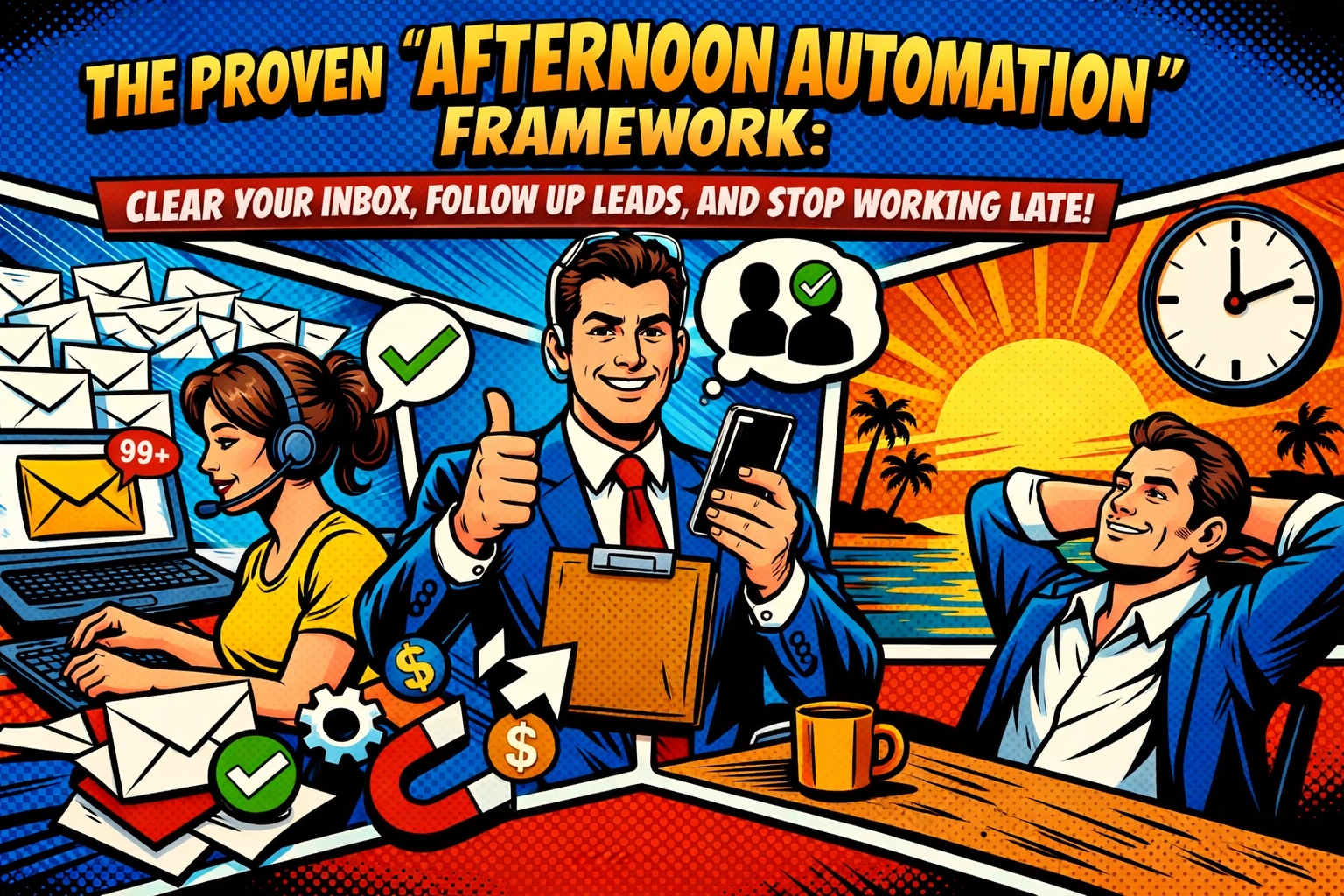
You open your laptop. The AI has already sorted your leads. It’s flagged the high-priority ones. It’s drafted the follow-ups based on clean data. It’s updated your CRM.
And because you didn't automate a broken process, it all actually works.
The chaos is gone before you even take your last sip of coffee.
Scaling a business is hard. But it’s a lot harder when you’re making these seven mistakes. Stop treating AI like a magic wand and start treating it like the powerful business tool it is.
You don't need more tools. You need a better system.
Ready to stop making mistakes and start seeing results? See how the pros handle ai business automation without the headache.
👉 Build your dream AI business right here.
Scaling shouldn't be this hard. But here we are.
Let’s get to work.
FAQ: YOUR QUESTIONS, UNFILTERED
Is AI going to replace my small team?
No. It’s going to make your small team act like a massive corporation. It replaces the "boring stuff" so your people can do the "human stuff."
How much does it cost to fix these mistakes?
Usually, it’s cheaper to fix them than to ignore them. A $500/month tool that fails is a waste. A $1,000 setup that works is an investment.
Can I really automate my lead gen?
Yes. But only if you have a clear funnel first. AI can find the leads, but you have to know what a "good lead" looks like.
Do I need to know how to code?
Not anymore. Most modern business automation tools are no-code or low-code. You just need to know how your business works.
Where do I start?
Start with the biggest bottleneck in your day. Whatever makes you sigh the loudest when you open your laptop: automate that first.

🌙 The day ends. The lights are off. But your business is still moving.
That's the power of doing it right.