
So, you’re opening a coffee shop. Congratulations! You’ve probably spent hours scrolling through Instagram looking at beautiful espresso machines with wood-panelled sides and shiny chrome levers. It’s easy to get distracted by the "Ferrari" of the coffee world, but we need to have a serious talk about the engine room: the grinder.
To be honest, the grinder is arguably more important than the espresso machine itself. You can have a £15,000 machine, but if your grinder is producing inconsistent, clumpy, or overheated dust, your coffee will taste like a sad, bitter disappointment. We’ve seen it happen too many times, and it’s just a real shame.
Before you drop your hard-earned cash on the first shiny burr-box you see, here are 10 things we think you absolutely need to know.
1. Calculate Your Peak-Hour Demands (Be Honest!)
How many coffees do you actually think you’ll serve? Not on a slow Tuesday afternoon, but during the "I-need-caffeine-now" morning rush.
We always suggest assessing your peak-hour shot count. A high-volume espresso bar might need to crank out 200+ shots in an hour, while a small bakery or boutique might only do 50. If you buy a "home-pro" grinder for a high-volume shop, the motor will overheat, the burrs will expand, and your grind setting will drift faster than a kite in a gale.
If you're unsure where your volume sits, we have a handy coffee brewing calculator that can help you visualise your needs. Always over-spec rather than under-spec; a grinder working at 50% capacity is a happy grinder.
2. Flat Burrs vs. Conical Burrs: The Consistency Battle
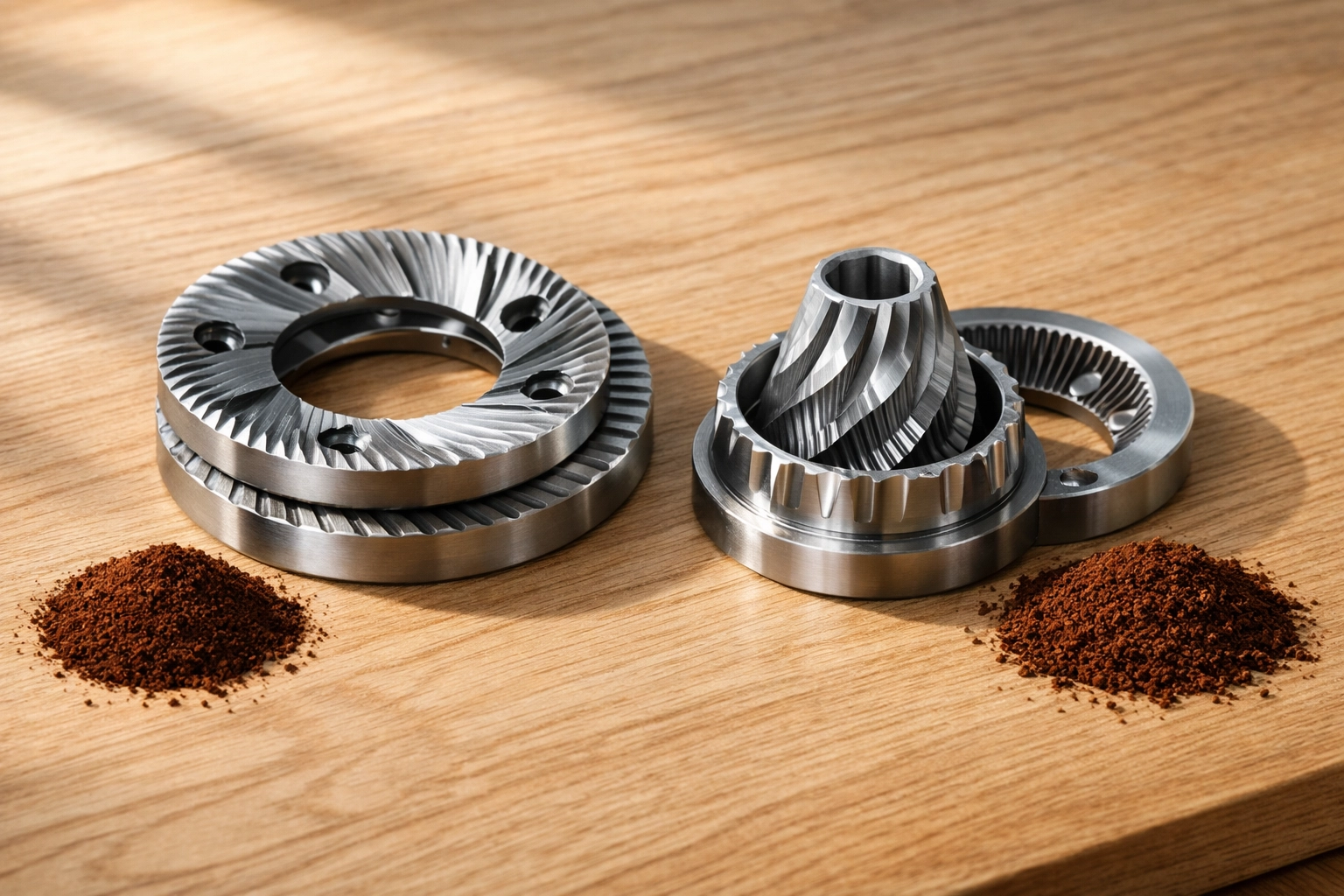
This is a classic debate in the barista world. To be honest, we haven't noticed a massive difference in "flavour profiles" for most milk-based drinks, but when it comes to consistency, the flat burr is king.
Flat burr grinders are our top choice for commercial settings because they produce a very uniform particle distribution (the size of the coffee bits). Uniformity means even extraction. Conical burrs, while often quieter and cheaper, produce a "bimodal" distribution, essentially a mix of two different sizes. This can make your espresso taste "complex," but it also makes it much harder to dial in consistently during a rush.
3. Grind Accuracy is a Profit Issue
Let’s talk money. If your grinder’s timer is inconsistent and it fluctuates by just 0.5 grams per shot, you are literally throwing money into the knock-box.
Imagine you’re serving 200 cups a day. A 0.5g variance on every shot adds up to 100g of wasted coffee per day. Over a year, that’s 36.5kg of speciality beans. At wholesale prices, that’s a holiday you’re not taking because your grinder can’t count. This is why we are so passionate about precision. If you want to see the kind of quality we’re talking about, have a look at our wholesale speciality coffee to see what you should be protecting with a good grinder.
4. Think About Workflow and Physical Space
We’ve visited shops where the barista has to do a literal dance just to get from the grinder to the machine. It looks fancy, but after eight hours, it’s exhausting.
When you’re building a coffee shop and looking at shop fitting, you need to diagram your workflow. Ideally, your grinder should sit directly to the right (or left, if you're a rebel) of your espresso machine. You want the movement from "grind" to "tamp" to "group head" to be a straight line.
Keep in mind that some commercial grinders are huge. Check the height of your overhead shelves! There's nothing more embarrassing than buying a top-tier Mahlkönig only to find it doesn't fit under your cabinets.
5. Grind-by-Weight (GbW) is the Future
If you have the budget, we cannot recommend Grind-by-Weight technology enough. Historically, grinders used timers (e.g., "grind for 3.2 seconds"). The problem? As the hopper gets emptier, the beans grind at a different rate.
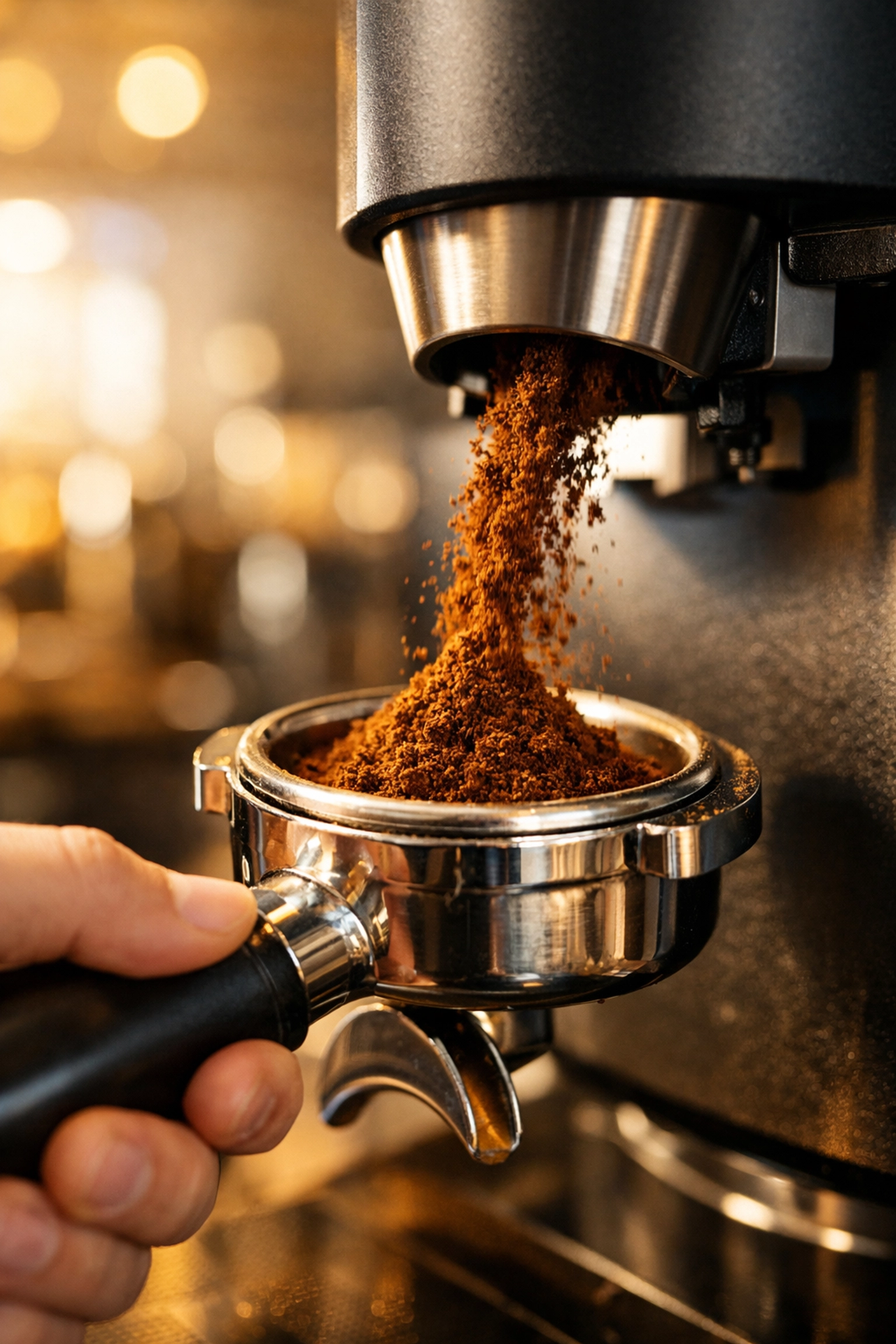
GbW technology uses high-precision load cells that measure the coffee 6,000 times per second as it falls into the portafilter. It stops exactly at 18.0g (or whatever you set). It eliminates the need for baristas to constantly weigh shots on separate scales, which speeds up service immensely. It’s like having cruise control for your espresso.
6. Match the Equipment to Your Staff’s Expertise
Are you hiring seasoned pro baristas, or are you training students who just want a part-time job?
If your team is less experienced, you want a grinder that is "plug and play." Complicated menu systems and manual micro-adjustments can lead to "dial-in dread." We’ve found that intuitive equipment leads to happier staff and better coffee. We actually cover a lot of this "human element" in our barista training courses, where we show you how to manage the equipment without losing your mind.
7. Consider Your Service Model
Are you a "one blend" kind of shop, or do you want to offer rotating single origins?
If you’re doing the latter, you might need a dedicated "single-dose" grinder or at least a second espresso grinder. Using one grinder for two different beans is a nightmare, you’ll waste half a bag of coffee just trying to clear the "old" beans out of the system.
If you're just starting out, we'd suggest focusing on one amazing house blend. If you're looking for recommendations, Scott has some great insights over at Limini Coffee that could get you started on the right foot.
8. Motor Size and Heat Management
Grinding coffee creates friction, and friction creates heat. Heat is the enemy of fresh coffee. When coffee beans get hot during the grinding process, they start to release their oils and aromas too early. By the time the water hits them, the "soul" of the coffee is already gone.
Larger motors with larger burrs (think 75mm or 80mm+) grind faster and stay cooler. They have more torque, meaning they don't have to work as hard. If you’re planning on being a busy spot, don’t settle for a small 50mm burr set; it will "cook" your coffee during the lunch rush.
9. Retention: The "Old Coffee" Problem
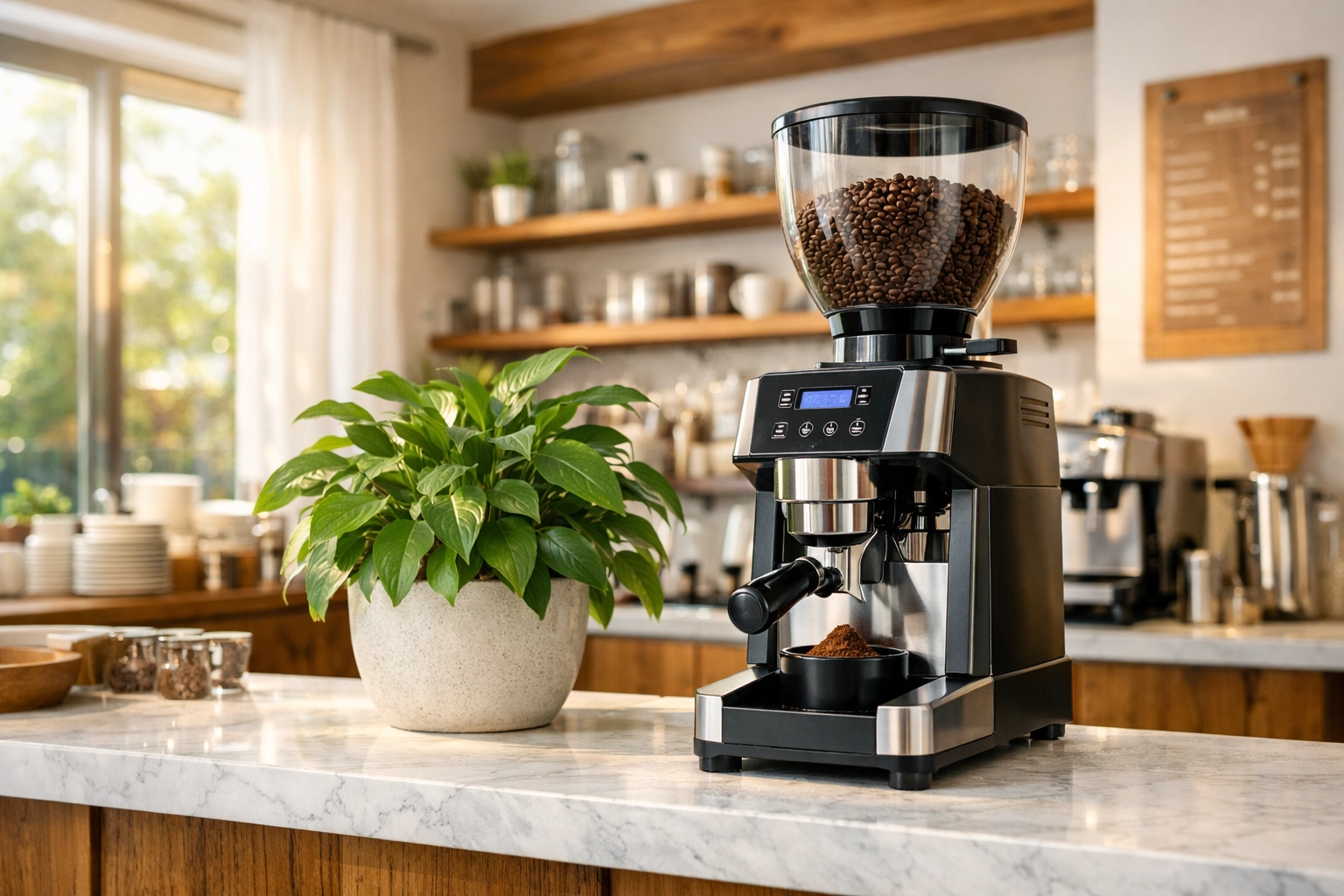
Retention refers to the amount of ground coffee that stays inside the grinder’s "chute" or internal chambers after the motor stops. In some old-school grinders, this can be as much as 5g to 10g!
Why is this bad? Because if nobody orders a coffee for 20 minutes, that 10g of coffee sits there, goes stale, and then gets dumped into the next customer's cup. You want a "low retention" grinder (ideally under 1g). This ensures every shot is as fresh as possible. Freshness is everything, especially when you're trying to achieve that perfect espresso crema.
10. Maintenance and Durability
Commercial grinders are workhorses, but even the best horse needs a vet sometimes. Before you buy, ask:
- How easy is it to change the burrs?
- Can I get spare parts in the UK?
- Is there a local technician who knows this brand?
You’ll need to clean your grinder daily (vacuuming out the crumbs and using cleaning pellets) and deep-clean it weekly. If the machine is a puzzle to take apart, your staff simply won’t do it. We always emphasize looking after your espresso equipment because a well-maintained grinder can last a decade, while a neglected one will die in two years.
Summary: Don't Skimp on the Grind
It’s tempting to save £500 on the grinder so you can get the prettier espresso machine. Please, don't do it. The grinder is the gatekeeper of flavour.
If you’re feeling overwhelmed by all the options: La Spaziale, Mahlkönig, Victoria Arduino: don’t worry. We’ve spent years testing these machines. You can read our reviews and thoughts here to see what's actually working in the wild.
Basically, choose a grinder that fits your space, matches your volume, and won't make your baristas cry during a rush. If you get the grinder right, the rest of the coffee-making process becomes a whole lot easier.
If you’re ready to take the next step and want to chat about coffee, equipment, or training, we’re always here for a bit of a brew and a chat. Feel free to check out Scott’s recommended setups to see what we're loving right now. Happy brewing! 🙂