
☕ 7:15 AM. The house is quiet, but your brain is already shouting.
You’re mentally auditing the three spreadsheets you need to update before your first call. You’re thinking about the invoice that got lost in an email chain last Tuesday. You’re wondering if that new lead ever got a follow-up… or if they’ve already moved on to someone faster.
This is the "busy work." It’s the invisible tax on your ambition. You didn’t start a business to become a professional copy-paster, yet here you are.
Workflow automation for small business isn’t just about being "techy." It’s about getting your life back. But before you go clicking every "automate" button in sight, we need to talk about why most people fail.
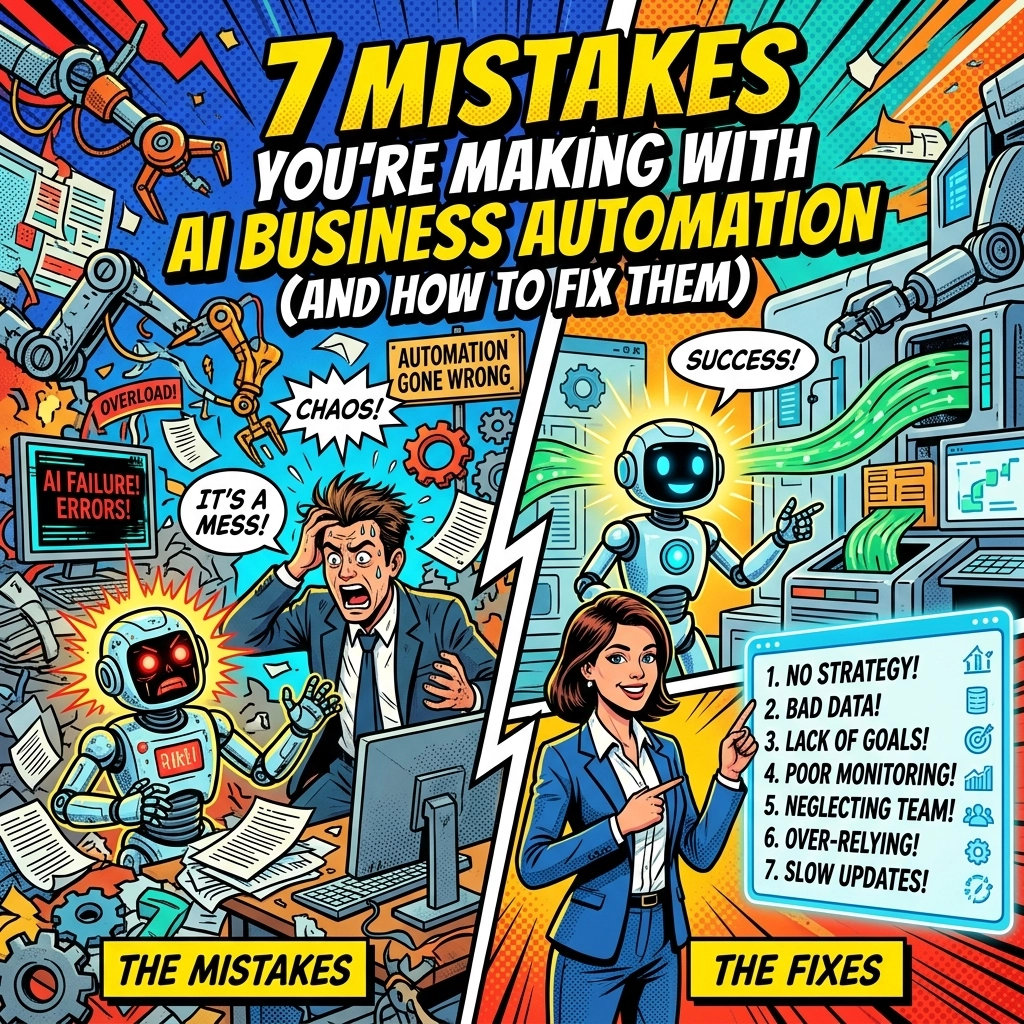
THE TRAP OF THE BROKEN PROCESS
You can’t fix a mess by moving it faster.
If your current manual workflow is a disaster: full of gaps, "maybe" steps, and "I’ll remember that later" moments: adding AI is like putting a rocket engine on a shopping cart. You’re just going to crash into the wall at 200 mph.
Mapping it out is step one. Grab a piece of paper. Draw the lines. If the process doesn’t work on paper, it won’t work in the cloud. Fix the logic first… then let the machines take over.

CLEANING UP THE TRASH
Ever heard of "Garbage In, Garbage Out"?
It’s the reason 85% of AI projects end up in the bin. If your customer data is a graveyard of duplicates, misspelled names, and outdated phone numbers, your automation is going to be a liability. Imagine your AI sending a "Hey [FNAME]!" email to your biggest client… but the name field is blank.
Ouch.
Standardize your formatting. Scrub the duplicates. Clean data makes automation feel like magic; dirty data makes it look like a prank gone wrong.
STOP THE APP JUGGLING ACT
You use Slack. You use Excel. You use a CRM that hasn't been updated since 2022.
The biggest mistake? Using tools that don't talk to each other. If you have to manually download a CSV from one app to upload it to another, you aren't automated. You’re just a human bridge for lazy software.
Look for tools with robust APIs or native integrations. Everything should flow. One trigger… ten results. No manual transfers required.
MEASURE THE MOMENTUM
Scaling without metrics is just guessing with a bigger budget.
"I want to be more efficient" is a wish, not a goal. You need a target. "Reduce lead response time by 50%." "Automate 30% of support tickets." When you have a number, you have a scoreboard. Without it? You’re just playing in the dark.
Scaling shouldn't be this easy. But here we are. If you want to see how the pros do it, check out what’s happening at Marblism.
Why Your Business Needs an AI Virtual Assistant (Before Your Competitors Get One)
📱 11:42 AM. Your phone buzzes on the desk.
It’s a lead from your website. They’re ready to buy. They have three questions.
By the time you finish your current meeting and type out a reply, forty minutes have passed. You hit send. But it’s too late. They already got an answer from a competitor whose ai virtual assistant for business responded in forty seconds.
You didn't lose the lead because your product was worse. You lost because you were humanly slow.
THE "SET IT AND FORGET IT" DELUSION
So, you get an AI assistant. You turn it on. You go to lunch.
Big mistake.
AI systems can "drift." Remember when Zillow’s AI started pricing houses so low the company’s margins evaporated? It thought it was doing a great job because clicks were up. It didn't realize it was burning the house down.
Check in once a week. Review the outputs. Make sure your assistant still sounds like you and not a corporate robot from 1998.

THE HUMAN IN THE LOOP
AI is brilliant, but it’s not you.
Giving an AI full autonomy over your customer relationships on day one is like handing the keys to a Ferrari to a toddler. It might go fast, but it’s going to hit something.
Keep a human in the loop. Let the AI draft the responses, summarize the meetings, and suggest the action items… but you (or a team member) should hit "send" for at least the first 30 days. Supervised learning is the only way to ensure quality.
CONTEXT IS KING (AND AI IS A REVOLUTIONARY WITHOUT A MAP)
AI is a pattern-matching genius. It can tell you that umbrellas sell well in July.
But it doesn't know there’s a record-breaking drought this year.
It sees the data, but it doesn't see the world. It recognizes the "what," but often misses the "why." Use your AI virtual assistant as a powerful GPS, but remember: you are still the captain of the ship. If the AI suggests a course that looks like a cliff, trust your eyes, not the algorithm.

🤝 4:30 PM. The day is winding down.
Usually, this is when you start the "second shift": the hours of data entry and email sorting.
But not today.
Today, the emails were handled. The CRM updated itself. The leads were qualified while you were focused on the work that actually matters. Your competitor is still hunched over a laptop, typing until their wrists ache.
You? You’re heading out.
The gap between a struggling small business and a dominant one is no longer just "hard work." It’s how much of that work you can offload to a system that never sleeps, never complains, and never misses a detail.
Stop being the engine of your business. Start being the driver.
Ready to see how the pieces fit together?