So, you’ve decided to take the plunge into the world of home espresso. Maybe you’re tired of the watery stuff from your pod machine, or perhaps you’ve spent a bit too much time watching world-class baristas on YouTube and thought, "I can do that."
Well, we have some good news and some bad news. The bad news? Espresso is arguably the most difficult way to brew coffee. It’s temperamental, scientific, and occasionally frustrating. The good news? When you nail it: when that rich, syrupy liquid flows into your cup with a perfect hazelnut crema: it is absolutely glorious.
At Limini Coffee, we live and breathe this stuff. We want your home setup to be more than just a shiny kitchen ornament. We want it to be a source of genuine joy. So, grab a cup (of filter coffee, for now) and let’s dive into everything you need to succeed in the wonderful world of home espresso.
The Foundation: It’s All About the Beans
Before we even talk about shiny stainless steel machines, we need to talk about the most important ingredient: the coffee. You can have a £5,000 machine, but if you’re using stale beans from a supermarket shelf, your espresso will taste like disappointment.
Freshness is everything. When coffee is roasted, it starts releasing CO2. This "degassing" is vital for espresso because it's those gases that help create the crema (that beautiful golden foam on top). However, if the beans are too fresh (less than 3-4 days old), they can be a bit wild. If they are too old (more than a month), they lose their oils and the shot will be thin and bitter.
We always recommend choosing a speciality roast from Limini Coffee to ensure you're getting the best possible start. Whether you prefer a chocolatey, nutty blend or a fruity single origin, starting with high-quality beans is non-negotiable.
Why Water Quality Matters
Did you know that an espresso is about 90% water? If your tap water tastes like chlorine or is "hard" (full of limescale), your coffee will suffer. Hard water doesn't just make the coffee taste "chalky": it also kills your machine. Scale buildup is the number one cause of espresso machine death.
Ideally, you want water with a mineral content of about 50-175 ppm (parts per million). If you aren't sure, using a simple filter jug or bottled water with low mineral content can make a massive difference in flavour and machine longevity.

The Gear: Choosing Your Weapons
When it comes to equipment, the espresso world is a bit of a rabbit hole. It’s easy to get overwhelmed by boilers, PIDs, and group heads. Let's simplify it.
The Grinder: The Most Important Part
We’re going to be honest here: the grinder is more important than the espresso machine. If you have a budget of £1,000, we’d suggest spending £400 on the grinder and £600 on the machine. Why? Because espresso requires a "burr grinder" that can produce an incredibly fine and consistent powder.
A "blade" grinder (the kind with the spinning metal wings) is essentially a blender. It chops the coffee into some big chunks and some tiny dust. This leads to "uneven extraction": half your coffee is sour and the other half is bitter. Not something we would recommend. You need a dedicated espresso burr grinder to get the precision required.
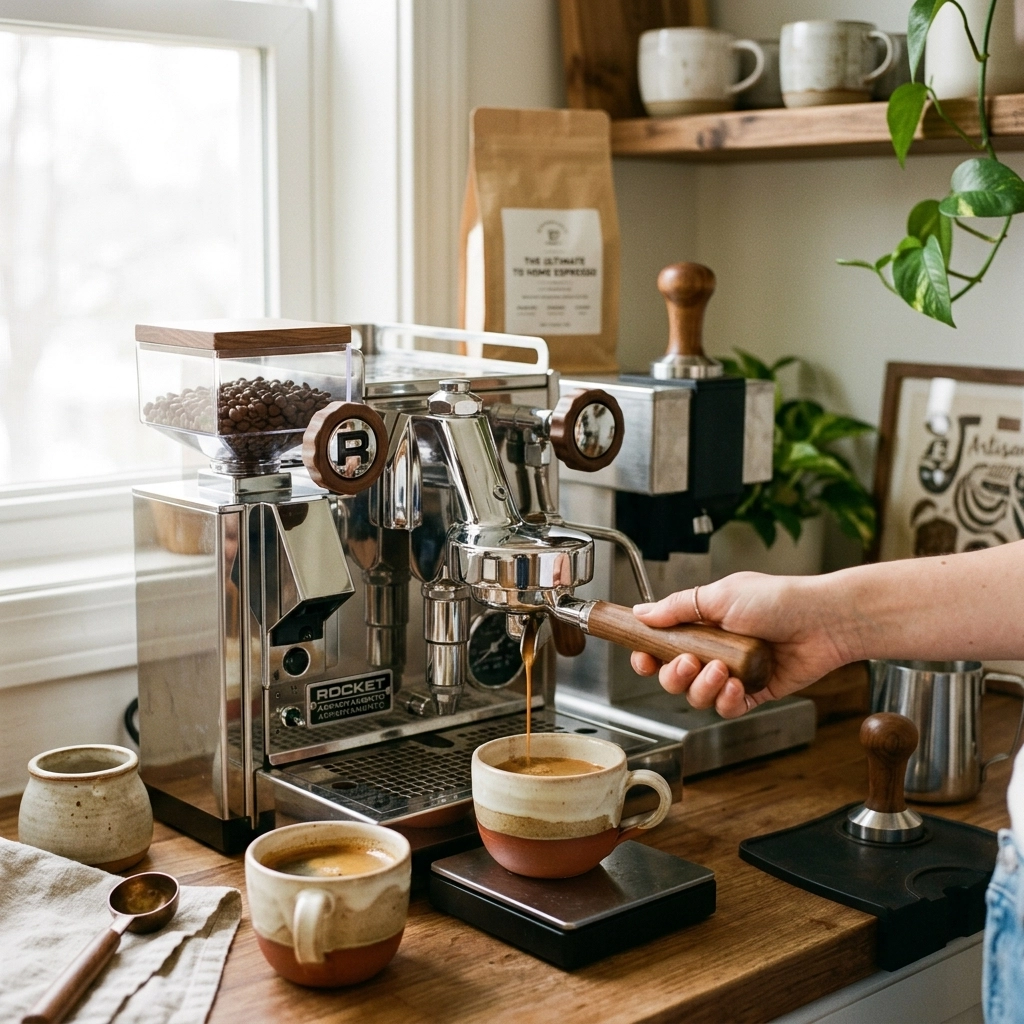
The Espresso Machine
There are three main types you’ll encounter:
- Manual (Lever): You provide the pressure. It’s beautiful and tactile, but hard to master.
- Semi-Automatic: The machine provides the pressure (usually via a pump), but you start and stop the shot. This is the sweet spot for most home baristas.
- Automatic: The machine stops the shot for you based on a programmed volume.
If you’re feeling a bit lost on which one to pick, we have a handy guide on choosing espresso equipment that breaks down the nitty-gritty.

The Scientific Bit: Understanding Extraction
Espresso is basically a game of physics. You are forcing hot water through a tightly packed "puck" of coffee at high pressure (usually 9 BAR).
To get it right, you need to follow a "recipe." In the coffee world, we call this the Brew Ratio. For a standard double espresso, we usually aim for a 1:2 ratio.
- Dose (Input): 18g of ground coffee.
- Yield (Output): 36g of liquid espresso.
- Time: 25 to 30 seconds.
If your shot comes out in 15 seconds, it’s going to taste sour and thin (under-extracted). This means your grind is too coarse: the water just flew through it. If it takes 45 seconds, it’ll be bitter and burnt (over-extracted). This means your grind is too fine.
Basically, the grinder is your "speed controller." You change the grind size to hit that 25-30 second window. It’s like magic, but with more caffeine.
The Art of Tamping
Tamping is the act of compressing the coffee grounds into a flat, even disc. It sounds simple, but it’s easy to get wrong. If you tamp at an angle, the water will find the easiest path through the coffee (this is called "channeling") and ruin the flavour.
You don’t need to be a bodybuilder: just firm, level pressure until the coffee stops compressing. You can read more about the fine art of tamping here.

Milk: Turning Coffee into Silk
If you’re a fan of lattes, flat whites, or cappuccinos, the espresso is only half the battle. You also need to master the steam wand.
What we’re looking for is "microfoam." This is milk that has been aerated so finely that you can't see any individual bubbles. It should look like wet paint: shiny, glossy, and thick.
- Stretch: Place the tip of the steam wand just below the surface of the milk to introduce air. You should hear a "chirping" or paper-tearing sound.
- Roll: Submerge the wand slightly deeper and tilt the jug to create a vortex. This integrates the air into the milk, making it silky smooth.
- Temperature: Stop when the jug is too hot to hold comfortably (around 60 ºC to 65 ºC). If you go higher, you’ll scald the milk and lose the sweetness.
For a deeper dive into the science of the white stuff, check out our understanding milk guide. And don't forget to practice your latte art! It’s the ultimate way to show off your new skills.

Looking After Your Setup
We hate to be the bearer of bad news, but coffee machines get dirty. Coffee oils are sticky and they go rancid very quickly. If you don't clean your machine, your expensive Limini Coffee beans will end up tasting like old charcoal.
- Daily: Flush the group head with water after every shot. Wipe the steam wand immediately after use.
- Weekly: Perform a "backflush" with specialized espresso cleaner to remove oils from the internal valves.
- Monthly: Clean your grinder. Coffee oils build up on the burrs and can affect the flavour of your grind.
A clean machine is a happy machine. If you want your gear to last for years, looking after your espresso machine is the best investment you can make.
Why It’s All Worth It
You might be thinking, "Penny, this sounds like a lot of work." And you're right, it is! But that’s the beauty of it. Home espresso is a craft. It’s a moment in your morning where you slow down, focus on the details, and create something truly special.
There is a real sense of pride when you serve a guest a flat white that looks and tastes better than what they’d get in a high-street chain. It’s about the theatre, the aroma, and ultimately, the incredible taste of speciality coffee brewed perfectly.
If you’re feeling inspired but want a bit of hands-on help, we offer barista training that can take you from a total beginner to a pro in no time. We love sharing our passion for coffee, and we’d love to help you on your journey.
So, are you ready to start pulling shots? Remember: use fresh beans, get a good grinder, and don’t be afraid to make a mess. That’s how you learn!
And if you need to stock up on the essentials, you know where to find us. Head over to Limini Coffee and let's get brewing. Happy extracting!