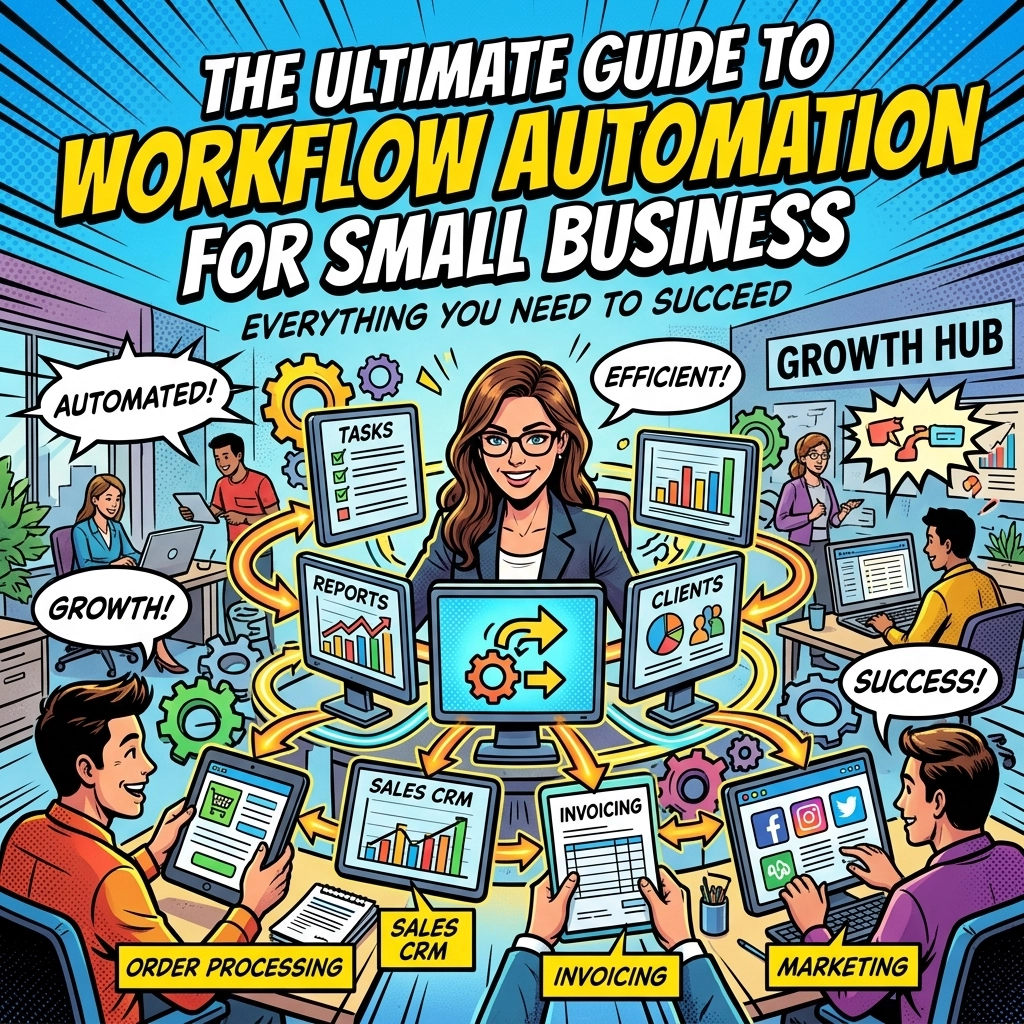
WORKFLOW AUTOMATION FOR SMALL BUSINESS: STOP DOING THE BUSY WORK
☕ 8:30 AM.
You’re sitting at your desk, the steam from your coffee hitting your face, and you’re already behind. You’ve got 47 new emails, three invoices to send, and a spreadsheet that needs "cleaning up."
You didn't start a business to become a professional copy-paster…
But here you are. Moving data from one tab to another. Manually sending "Thanks for reaching out!" emails to leads who probably won't reply for three days. It’s tedious. It’s draining. And honestly? It’s a waste of the brainpower that should be focused on growing your empire.
Workflow automation for small business isn't a "nice to have" anymore. It’s your survival kit.
THE TRAP OF THE "HUSTLE"
We’ve been lied to. We’re told that if we aren’t grinding 18 hours a day, we aren't trying hard enough. But there’s a difference between working hard and working on things that matter.
If you're still manually:
- Adding leads from your website to your CRM.
- Sending follow-up texts to people who booked a call.
- Generating invoices after a project closes.
- Moving files from Gmail to Dropbox.
…then you’re not a business owner. You’re an unpaid intern for your own company.

THE "IF THIS, THEN THAT" MAGIC
Think of workflow automation as a series of digital dominos. You knock the first one over, and the rest happen while you’re out grabbing lunch.
- The Trigger: A customer fills out a form on your site.
- The Action: They get an instant SMS, their details are added to your sales pipeline, and a "Welcome" PDF is emailed to them.
All while you were literally doing nothing.
It sounds complex, but it’s just rules. If X happens, do Y. Once you set these rules, they never get tired. They don't take lunch breaks. They don't forget to CC the accountant. They just… work.
AUDIT THE BOREDOM
You don’t need to automate your entire life on day one. That’s how you get overwhelmed. Start with the things that make you want to scream into a pillow.
- Document the flow: Write down every step you take when a new lead comes in.
- Identify the friction: Where do you spend the most time clicking?
- Delete the manual: If a computer can do it, let it.
Most small businesses find that 60% of their "admin time" is just moving data from Point A to Point B. Tools like Zapier or Make are great, but if you want something that actually understands your business goals, you need a strategy. That’s where we come in. You can see how we handle the heavy lifting over at Marblism.
STOP JUGGLING. START SCALING.
The moment you stop doing the busy work is the moment your business actually starts to grow. You have more time to talk to customers. More time to innovate. More time to actually live.
Stop being the bottleneck in your own success.
WHY YOUR BUSINESS NEEDS AN AI VIRTUAL ASSISTANT (BEFORE YOUR COMPETITORS GET ONE)
📱 11:15 PM.
The house is quiet. You’re finally about to close your eyes. And then… buzz.
A lead just hit your website. They have a question about your pricing. If you answer now, you’re "that guy" who works at midnight. If you wait until morning, they’ve already moved on to your competitor who has a faster response time.
It’s a lose-lose. Unless you have an AI virtual assistant for business.
THE SECRET WEAPON NEXT DOOR
Have you noticed that some of your competitors seem to be everywhere at once? They’re posting content, answering every query, and closing deals while you’re still trying to figure out your Tuesday schedule.
They aren't superhuman. They just stopped hiring humans for tasks that AI can do better.
An AI virtual assistant isn't just a chatbot that says "Sorry, I didn't understand that." In 2026, these assistants are sophisticated, empathetic, and: most importantly: smart. They don't just follow a script; they understand intent.

THE DIFFERENCE: AUTOMATION VS. INTELLIGENCE
Standard automation is a straight line. "If they click this, send that."
An AI virtual assistant is a brain.
- The Intelligence: It reads a customer's frustrated email, senses the tone, and prioritizes it for you while drafting a helpful response based on your previous successful interactions.
- The Execution: It looks at your calendar, finds a gap, and offers a meeting time to the client without you ever opening Google Calendar.
It’s the difference between a microwave and a private chef. Both get the food warm, but only one knows exactly how you like your steak.
WHY YOUR COMPETITORS ARE WINNING (FOR NOW)
Business is a game of speed. The person who responds first usually wins.
By the time you wake up and check your inbox, an AI assistant could have already:
- Answered three FAQs.
- Qualified a lead (making sure they actually have the budget for you).
- Booked two discovery calls.
- Updated your CRM with the lead's social media profiles.
If you’re still doing this manually, you’re racing a Ferrari on a bicycle. It’s not a fair fight.
THE "SET IT AND FORGET IT" MYTH
Let's be real: nothing is truly "set it and forget it." But an AI virtual assistant is as close as it gets. It learns from your business. The more it interacts with your customers, the better it gets at sounding like you.
It’s like having a 24/7 employee who never asks for a raise, never gets sick, and has a perfect memory.
🤝 Meet your new team member.
You don't need a massive HR department to scale. You just need the right tech in your corner. If you’re ready to stop being the one who has to answer every single "How much do you charge?" message, it’s time to look at what Scott is doing over at Marblism.
THE COST OF WAITING
Every day you wait is a day your competitors get better data. AI models thrive on information. The sooner you start, the more "trained" your AI becomes on your specific brand voice and customer needs.
You can either be the person who embraced the future, or the one wondering why the phone stopped ringing.
🌙 Go to sleep.
Your AI assistant has it from here.

FREQUENTLY ASKED QUESTIONS (NO BS EDITION)
Q: Is workflow automation for small business expensive?
A: No. What’s expensive is paying yourself $100/hr (in value) to do $15/hr data entry. Most tools have free tiers to get you started.
Q: Will an AI virtual assistant sound like a robot?
A: Only if you set it up poorly. Modern AI can be trained on your specific emails and tone. It’ll sound more like you than you do before your morning coffee.
Q: Do I need to know how to code?
A: Not anymore. If you can drag and drop a file on your desktop, you can set up basic automation. For the complex stuff, you just need a partner who knows the ropes.
Q: How long does it take to set up?
A: You can have your first high-impact workflow running in about 20 minutes. A full AI assistant takes a bit longer to train, but you'll see the time savings in week one.
Q: What if the AI says something wrong?
A: You set the guardrails. You decide what it’s allowed to talk about and when it needs to "hand over" the conversation to a human. You’re always the boss.
THE BOTTOM LINE
The world isn't slowing down. Small businesses that thrive in 2026 are the ones that treat their time as their most precious resource.
Stop clicking. Start growing.