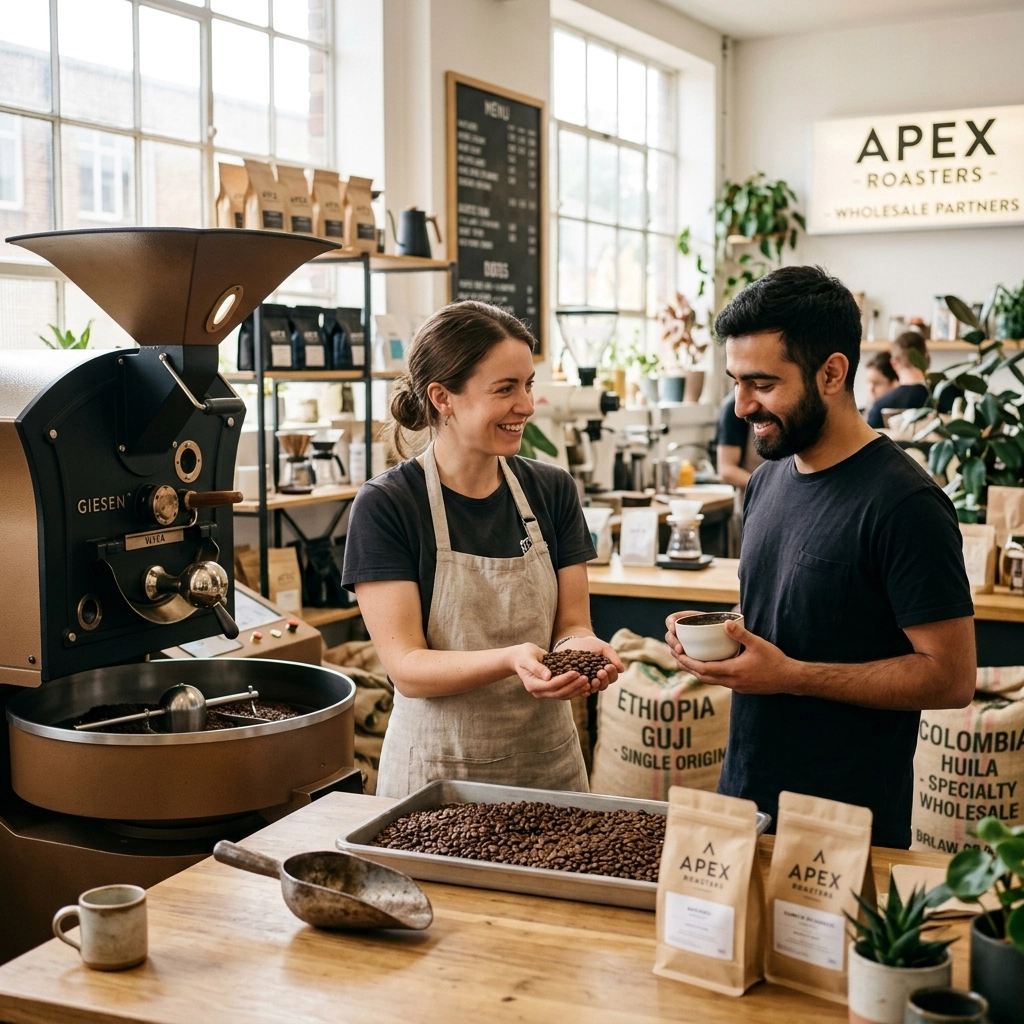
Let’s be real for a second. It’s 2026, and the world is a different place than it was five or ten years ago. We’ve seen trends come and go, tech takeover nearly every part of our lives, and the cost of basically everything go through the roof.
If you’re running a cafe or thinking about starting one, you’ve probably stared at your spreadsheet and wondered: "Does wholesale specialty coffee actually matter anymore? Or can I just buy the cheap stuff, put it in a pretty bag, and call it a day?"
It’s a fair question. With inflation biting and customers being more careful with their cash, the temptation to cut corners is real.
But here’s the straight talk. Choosing the right coffee suppliers for coffee shops isn't just about being a "coffee snob." It’s about survival.
So, let’s dig into why specialty coffee is more relevant now than ever.
The "Good Enough" Trap
You’ve seen it. That big, dusty bag of commodity beans sitting in a warehouse for six months. It’s cheap. It’s consistent in its… well, its mediocrity.
The problem is that "good enough" doesn't cut it in 2026. Why? Because your customers have leveled up. They aren't just looking for a caffeine hit; they can get that from a pill or a neon-colored energy drink.
When people walk into a coffee shop today, they are looking for an experience.
They want to know where the beans came from. They want to see that glossy, beautiful crema on their espresso. They want to taste notes of blueberry or chocolate, not burnt rubber and disappointment.
If you serve commodity coffee, you’re competing on price. And guess what? You will never win a price war against the giant chains. They have deeper pockets and better lawyers. Your only weapon is quality.
What Specialty Actually Means in 2026
We use the term "specialty" a lot, but what does it actually mean for your business right now?
It’s not just a fancy label. It’s a score. In the industry, coffee is graded on a 100-point scale. Anything above 80 is specialty. But in 2026, the "middle tier", those 82-84 point coffees, is getting harder to find because of climate change and supply chain shifts.
This means you need wholesale specialty coffee that hits that sweet spot of 85+ points. This is coffee that has been grown, harvested, and processed with extreme care.

Transparency is the New Luxury
Back in the day, a "dark roast" was a personality trait. Now, transparency is the flex.
Your customers want to know about the farmer. They want to know if the sourcing of the coffee was ethical. In 2026, "ethical" isn't a buzzword; it's a requirement.
If you can’t tell your customer why your coffee costs £3.50 a cup, they’ll go somewhere that can. Specialty coffee provides that story. It connects the person drinking the cup to the person who grew the beans. That connection creates loyalty.
The Science of the Sip (and the Math of the Margin)
You might think specialty coffee is too expensive for your margins. We get it. Every penny counts.
However, consider this: the difference in cost per cup between "cheap" coffee and high-end specialty coffee is often only a few pence.
Let's say you use 18g of coffee for a double shot. If your wholesale price goes up by £3 per kilo, your cost per drink only goes up by about 5p.
Can you charge an extra 20p or 50p for a drink that tastes significantly better, looks better, and has a better story? Absolutely.
Basically, specialty coffee allows you to increase your margins by providing a premium product that justifies a premium price. Commodity coffee keeps you stuck in a race to the bottom.
Consistency is Your Best Friend
One of the biggest myths is that specialty coffee is "fussy."
While some ultra-light roasts can be a bit temperamental, a good wholesale partner (like us here at Limini) focuses on consistency. We want your first shot of the day at 8:00 AM to taste exactly like the last one at 4:00 PM.
We achieve this through precise roasting profiles and rigorous quality control. We’re talking about monitoring bean temperature to within 0.1 degrees and ensuring the moisture content is spot on.
The Gear Matters (But Only If You Know How to Use It)
You can buy the most expensive La Spaziale machine in the world, but if you put bad beans in it, you’ll get bad coffee out. It’s like putting low-grade fuel into a Ferrari.

We often see shops spend £10k on choosing espresso equipment and then try to save money on the beans. It’s heartbreaking, really.
If you’re going to invest in the hardware, you have to invest in the software (the beans) and the operator (the barista).
Don't Ignore the Training
This is where many shops fall down. They get the great beans, they have the shiny machine, but the coffee still tastes… off.
In 2026, the standard of home brewing is so high that your baristas need to be genuine experts. People have high-end grinders and scales at home now. They know what a good flat white should look like.
That’s why we put such a massive emphasis on barista training. If your team doesn't understand the "theatre" of coffee, the tamping, the milk texture, the pouring, then the quality of the wholesale specialty coffee is wasted.
Sustainability: Not Just a Green Leaf on a Bag
We have to talk about the planet. By 2026, climate change isn't a "future problem" for coffee; it’s a right-now problem.
Traditional coffee growing regions are moving higher up mountains. Some are disappearing entirely. Specialty coffee roasters are at the forefront of supporting regenerative agriculture and climate-resilient bean varieties.
When you choose specialty, you’re often supporting farmers who are planting shade trees, protecting soil health, and using less water.
Your customers in 2026 are savvy. They can spot "greenwashing" from a mile away. They want to see real action. Supporting coffee suppliers for coffee shops that actually care about the planet is a major selling point for your brand.
The Verdict: Does it Matter?
So, back to the original question. Does wholesale specialty coffee really matter in 2026?
Yes. More than ever.
It matters because:
- Customer Expectations: People know what good coffee tastes like, and they won't pay for anything less.
- Brand Identity: It gives you a story to tell that differentiates you from the "big guys."
- Financial Reality: The margin on specialty is better because you can justify the price point.
- Future-Proofing: It supports the sustainable practices required to keep coffee growing for another 100 years.
If you’re just selling caffeine, you’re a commodity. If you’re selling specialty coffee, you’re a destination.

How to Make the Switch
If you’re currently using a generic supplier and feel like your coffee is just "okay," it might be time for a change.
We believe that the relationship between a roaster and a cafe should be a partnership, not just a transaction. You need someone who will help you with the shop fitting, teach your staff how to understand milk, and ensure your equipment is running at the perfect temperature (usually between 190 ºF / 88 ºC and 203 ºF / 95 ºC, depending on the roast).
Don't settle for "good enough." Your customers deserve better, and honestly, your business deserves better too.
If you want to see what a real difference specialty coffee can make, take a look at our wholesale options. We’ve spent years perfecting our roasting and sourcing so that you don’t have to worry about the quality: you can just focus on running your shop.
Let’s make 2026 the year your coffee finally lives up to your ambitions.
Ready to level up? Check out our latest reviews to see how we’ve helped other shops find their feet, or dive into our training overview to get your team up to scratch.