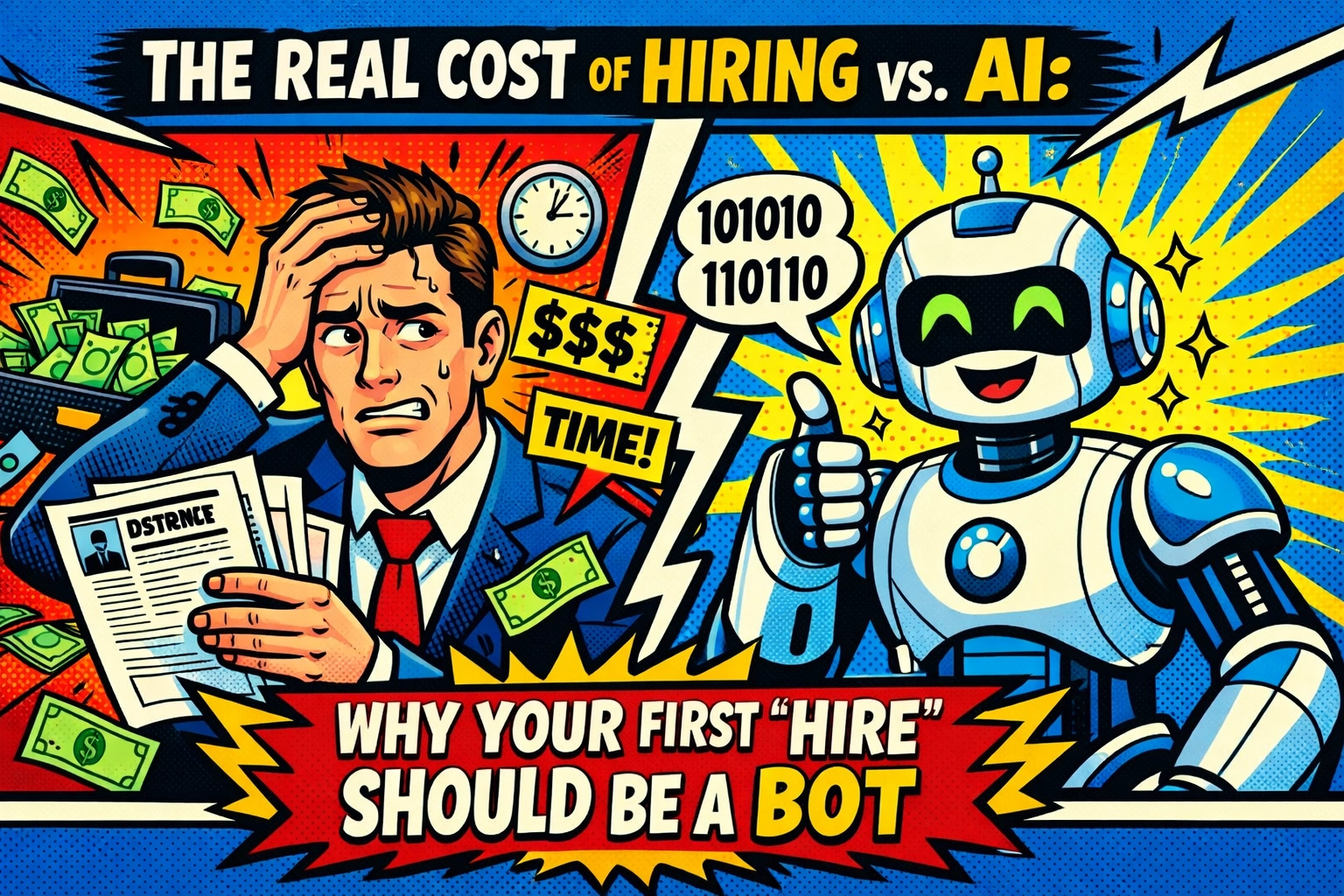
You need help. Your business is growing, and you're drowning in admin tasks, customer emails, social media scheduling, and data entry. The solution seems obvious: hire someone.
But then you do the math… and your stomach drops.
Salary. Benefits. Training. Management time. Recruitment fees. And that's just Year One.
What if I told you there's a better first "hire"? One that costs 80-90% less, never calls in sick, and starts delivering ROI in weeks instead of months?
THE REAL COST OF HIRING A HUMAN (SPOILER: IT'S BRUTAL)
Let's break down what that first hire actually costs you:
Base Salary: $40,000-$50,000 for entry-level admin or customer support
Benefits & Payroll Taxes: Add another 25-40% on top ($10,000-$20,000)
Recruitment: Agency fees, job board postings, your time interviewing ($3,000-$16,000)
Onboarding & Training: Equipment, software licenses, productivity ramp-up time ($2,000-$5,000)
Management Overhead: Your time managing, reviewing, correcting mistakes (conservatively 5-10 hours/week)
Total Year One Cost: $55,000-$91,000
And here's the kicker , that salary increases 3% annually. By Year Five, you're paying $62,000-$105,000 annually for that same role.

WHAT AN AI "EMPLOYEE" ACTUALLY COSTS
Now let's look at AI business automation:
Setup Investment: $5,000-$20,000 (one-time)
Monthly Subscription: $50-$500 depending on usage
Training Time: Basically none. It learns your business in days, not months.
Management Time: Maybe an hour a week to check in and optimize
Annual Cost: $600-$26,000 (setup year), then $600-$6,000 ongoing
The math is stupid simple. You're looking at 70-90% cost savings compared to a human hire.
But it gets better.
THE ROI BREAKDOWN (WHERE THIS GETS REALLY FUN)
Let's say you're running a small business and need help with customer support, email management, and social media scheduling. Here's the real comparison:
Human Hire:
- 30-40 hours spent per week on these tasks
- Cost: ~$50,000/year (conservative)
- Time to productivity: 2-3 months
- Error rate: 3-5%
AI Solution:
- Same tasks automated 24/7
- Cost: ~$3,000-$6,000/year
- Time to productivity: 1-2 weeks
- Error rate: <1%
Your savings: $44,000-$47,000 in Year One alone.
And here's what most people miss : that AI "employee" works while you sleep. It handles customer inquiries at 2 AM. It schedules social posts on weekends. It processes orders on holidays.
You're not just saving money. You're getting 24/7 coverage for less than the cost of a part-time human.

"BUT WHAT ABOUT THE HUMAN TOUCH?"
I hear you. And look : AI isn't replacing your entire team. It's replacing the mind-numbing, repetitive tasks that burn your team out.
Customer onboarding emails? AI handles it.
Data entry from forms? AI's got it.
Social media posting? Already scheduled.
Appointment reminders? Done before you even wake up.
This frees up your actual human employees (or you, if you're solo) to do what humans do best: strategic thinking, relationship building, creative problem-solving.
The best businesses in 2026 aren't choosing between humans OR AI. They're using AI to automate admin tasks so their humans can be more… human.
THE HIDDEN COSTS NOBODY TALKS ABOUT
Here's what really makes the AI math work:
Turnover: The average employee turnover cost is 40% of their annual salary. Contact centers see 30-45% annual turnover. Your AI assistant? Zero turnover risk.
Sick Days: Average employee takes 7-10 sick days per year. That's 3-4% of your investment just… gone.
Scaling: Need to 2x your support capacity? With humans, you need to double your hiring, training, and management time. With AI, you just… scale up your subscription.
Opportunity Cost: That role you need filled? It takes 30-45 days on average to hire someone. During that time, you're either doing the work yourself (losing focus on revenue-generating activities) or the work isn't getting done. AI is operational in days.
A healthcare provider recently cut their annual cost for 1.5 full-time employees from $159,671 to $2,985 using AI automation. That's a 98.1% reduction.
Let that sink in.
THE "BUT I'M JUST STARTING OUT" SCENARIO
You're bootstrapping. You're doing everything yourself. You can't afford a $50K hire, but you're drowning in busywork that's keeping you from actually growing your business.
This is exactly when AI makes the most sense.
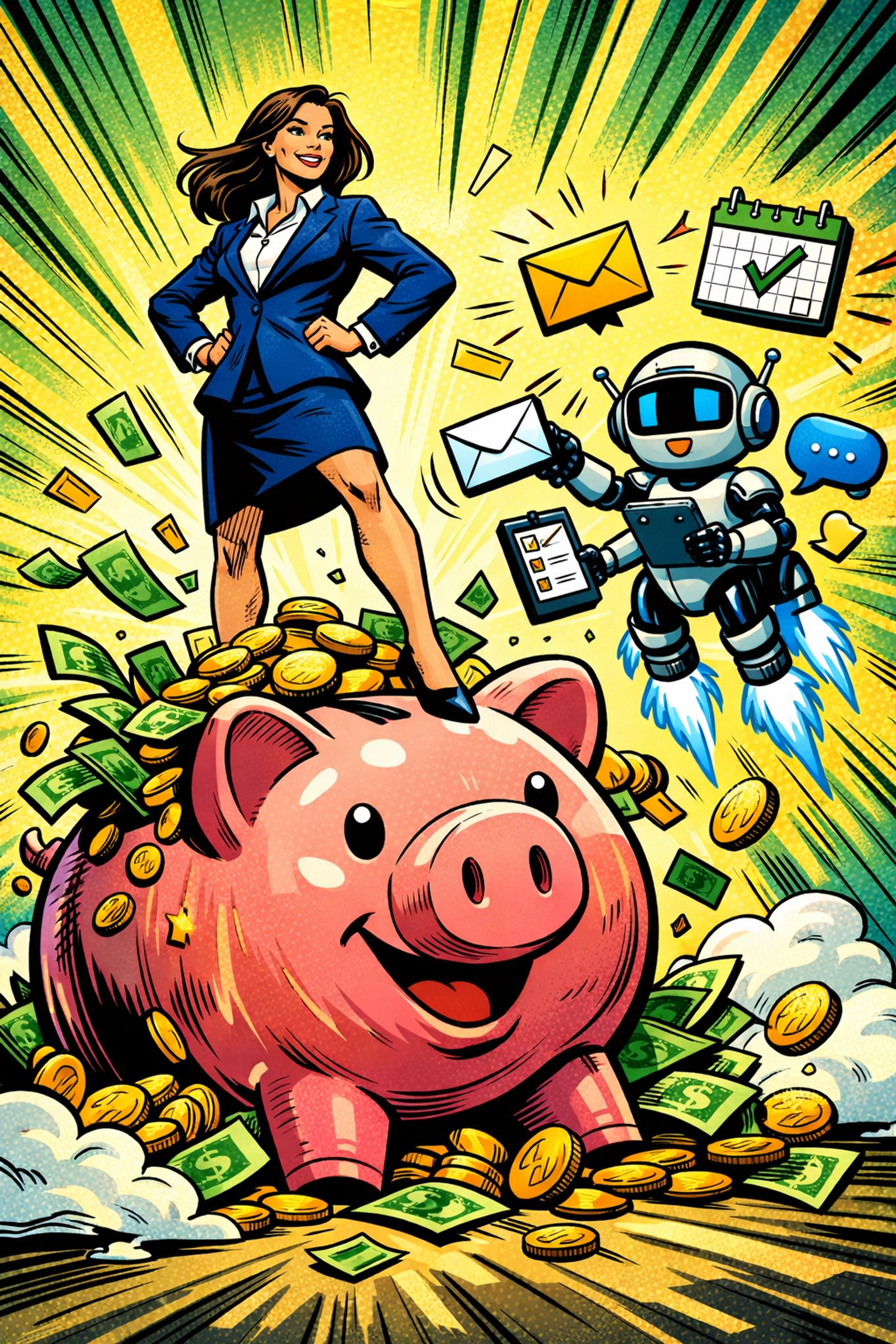
Instead of spending your evenings responding to customer emails, scheduling social posts, and updating spreadsheets, you automate it. For the cost of a nice dinner out each month.
You get your nights and weekends back. You get to focus on sales, product development, and strategy. The work still gets done : it just doesn't require YOU to do it anymore.
That's not just cost savings. That's lifestyle change.
REAL TALK: WHEN DOES THIS PAY OFF?
Most AI automation solutions hit ROI in 3-9 months. Here's a conservative scenario:
Month 1-2: Setup and integration. You're investing time and the initial cost.
Month 3: Things are humming. You're getting 20-30 hours back per week.
Month 4-6: You've fully optimized. The AI is handling 70-80% of your repetitive tasks.
Month 6-9: You've hit ROI. Everything from here is pure savings and freed-up time.
By Year Two, you're not just saving money. You're scaling faster than competitors who are still stuck in the "hire more people" mindset.
YOUR NEXT MOVE
Look, I'm not saying AI replaces every human role. But if you're a small business owner or solopreneur staring down the cost of your first hire : or your second, third, or fourth : the math is undeniable.
AI business automation isn't the future. It's right now. And the businesses figuring this out first are the ones who'll still be standing when everyone else has burned through their runway on hiring costs.
Want to see what this actually looks like for your business? Take a look at Marblism : it's built specifically for small businesses and solopreneurs who need the power of a full team without the cost of actually hiring one.
Your first "hire" should be a bot. Your second one probably should be too.
The question isn't whether AI automation makes financial sense. It's whether you can afford to keep doing things the old way.