
So… you want café-level espresso at home? The good news: you absolutely can. The slightly annoying news: espresso is basically a tiny science experiment you repeat daily, except the variables fight back.
The trick is learning what matters (and what doesn’t), getting a repeatable workflow, and then making small, deliberate adjustments. If you do that, your shots stop being “random” and start being reliable. And reliability is what makes espresso fun.
If you need fresh beans, home gear, and a place to nerd out, we’ve built all of that into Limini Coffee, start here: https://www.liminicoffee.co.uk/?af=1471531379787
The 6 variables that make (or break) espresso
What’s the difference between “wow” and “why is this sour and bitter”? Usually one of these:
- Grind size (particle size = flow rate)
- Dose (how much coffee in the basket)
- Distribution + tamp (even resistance across the puck)
- Water temperature (how easily flavours dissolve)
- Time (contact time, measured from pump on)
- Brew ratio / yield (how much liquid espresso you produce)
Basically… espresso is controlled resistance. Water will always take the path of least resistance. If your puck is uneven, water will “channel” through weak spots and you’ll taste it immediately.
Want a quick deep-dive on puck prep and tamping? We’ve got a dedicated piece here: https://www.liminicoffee.co.uk/article_tamping
And if you’re after coffee and gear to practise with, this is our home base: https://www.liminicoffee.co.uk/?af=1471531379787
What you actually need at home (and what’s optional…)
Let’s keep this real. You can spend a fortune. You can also spend sensibly and get 90% of the results.
The essentials:
- Espresso machine (stable temperature helps a lot; PID is a bonus)
- Burr grinder (this matters more than the machine, honestly)
- Tamper matched to your basket size
- Scales accurate to 0.1 g
- Timer (phone is fine)
- Fresh beans (non-negotiable)
Nice-to-have (but very useful):
- WDT tool (thin needles for declumping and distribution)
- Bottomless portafilter (diagnostic tool + messy truth-teller)
- Knock box (your bin will thank you)
- Milk jug + thermometer if you’re steaming milk
If you’re choosing a setup right now, we’d genuinely start with this guide: https://www.liminicoffee.co.uk/choosing_espresso_equipment
And when you’re ready for beans worth dialling in, you know where we are: https://www.liminicoffee.co.uk/?af=1471531379787
Coffee freshness… the part most people ignore (and it’s a real shame)
Question: are you pulling shots with coffee that’s been open for 6 weeks?
Unfortunately, that’s one of the fastest ways to make espresso feel impossible.
Our rule of thumb:
- Best window for espresso is often 7–30 days post-roast (depending on roast level and how it was stored).
- Keep beans in a cool, dry place, sealed.
- Grind right before you pull the shot. Always.
Fresh is best. Not “freshly opened supermarket bag” fresh, roasted recently fresh.
If you want to know how we think about sourcing and roasting, here’s a good read: https://www.liminicoffee.co.uk/sourcing_our_coffee
And if you just want to grab fresh coffee and get brewing: https://www.liminicoffee.co.uk/?af=1471531379787
Your go-to espresso recipe (a repeatable starting point)
So what should you aim for?
Here’s a classic baseline for a modern double espresso:
- Dose: 18 g (0.63 oz) in
- Yield: 36 g (1.27 oz) out
- Ratio: 1:2
- Time: 25–30 seconds
- Temperature: ~200 °F / 93 °C
- Pressure: ~9 bar (on most machines)
You don’t worship these numbers, they’re just a stable “home base” to adjust from.
If you like using a calculator to stay consistent (we do), this is handy: https://www.liminicoffee.co.uk/coffee_brewing_calculator
And yes, you can absolutely run this recipe with any good espresso from: https://www.liminicoffee.co.uk/?af=1471531379787
Temperature: a practical guide by roast level
Water temperature sounds nerdy… because it is. But it also saves shots.
General ranges that work well:
- Light roasts: 199–205 °F / 93–96 °C
- Medium roasts: 194–200 °F / 90–93 °C
- Dark roasts: 188–194 °F / 87–90 °C
Why is this important? Lighter roasts are harder to extract (they’re less soluble), so they usually like hotter water and/or slightly longer contact time. Darker roasts extract quickly and can taste harsh if you push them too hot.
If you’re shopping for a single origin specifically to explore this stuff (highly recommended), browse and experiment from: https://www.liminicoffee.co.uk/?af=1471531379787
Step-by-step workflow… from cold machine to great shot
This is the part that makes your espresso consistent.
1) Warm everything up properly
Yes, your machine needs time. Many machines perform best after 20–30 minutes of heat soak.
Do this:
- Lock the portafilter in while heating
- Flush a little water through the group head to stabilise heat
- Preheat your cup (hot water in the cup, then dump it)
Cold portafilter + cold cup = sad espresso. Thin body, muted sweetness.
2) Dose and grind (fresh, every time)
- Place your portafilter on scales
- Dose 18.0 g (0.63 oz) of beans
- Grind fine: espresso fine (think: somewhere around powdered sugar, but not clumpy)
If your grinder is inconsistent, everything downstream becomes guesswork. That’s why we always prioritise grinder quality when helping people build setups via: https://www.liminicoffee.co.uk/choosing_espresso_equipment
And yep, fresh beans matter just as much: https://www.liminicoffee.co.uk/?af=1471531379787
3) Distribute (don’t skip this)
Question: do you tamp and still get random fast shots?
That’s usually distribution. Clumps and voids create weak spots and channeling.
A simple method:
- Tap the portafilter gently to settle grounds
- Use a WDT tool (or careful finger distribution) to break clumps
- Level the bed before tamping
4) Tamp level, not “insanely hard”
We see this all the time: people think harder tamp = slower shot. Not really.
- Aim for 20–30 lb / 9–14 kg of pressure
- The real goal is level and consistent
- A tiny “polish” twist at the end is fine (lovingly called “polishing”), but don’t overdo it
If you want the full tamping rabbit hole, it’s here: https://www.liminicoffee.co.uk/article_tamping
Then come back and pull shots with coffee that behaves properly: https://www.liminicoffee.co.uk/?af=1471531379787
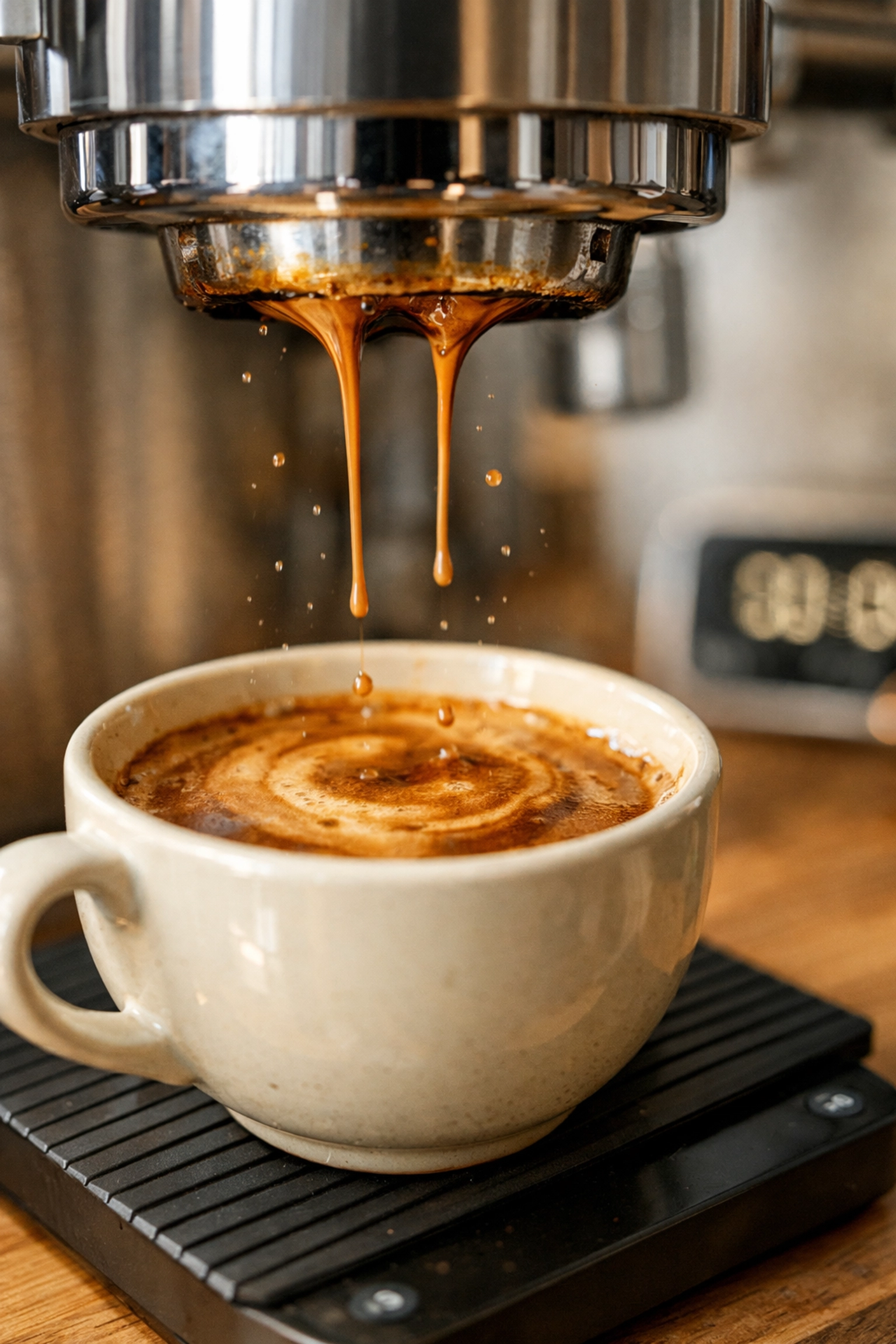
5) Pull the shot (and actually watch it)
Lock in, start the pump, and start the timer immediately.
What you’re looking for:
- A steady, even flow after initial drips
- A stream that resembles little “mouse tails”
- Stop the shot when it starts to blonde (turn pale/yellow and watery), often around your target yield
Target: 36 g (1.27 oz) out in 25–30 seconds.
Dialling in: the simple adjustment rules we use every day
So your shot didn’t land. Good. That means you have information.
If it runs too fast (e.g., 36 g out in 15–20s)
You’re under-extracting and likely tasting sourness, sharpness, thin body.
Fixes:
- Grind finer (first move, almost always)
- Or increase dose slightly (e.g., 18.5–19 g), if your basket allows
- Check for channeling (uneven distribution, cracked puck)
If it runs too slow (e.g., 36 g out in 35–45s)
You’re over-extracting and likely tasting bitterness, dryness, harsh finish.
Fixes:
- Grind coarser
- Or reduce dose slightly (e.g., 17.5 g)
- Make sure you’re not tamping unevenly (level matters)
If it tastes both sour and bitter
This is the classic “channeling” signature.
Fixes:
- Improve distribution (WDT helps a lot)
- Keep tamp level
- Consider a paper filter at the bottom of the basket (optional, but can improve flow)
And if you want to keep your experiments structured, use a consistent ratio and log it. This calculator makes that easy: https://www.liminicoffee.co.uk/coffee_brewing_calculator
Then treat yourself to a bag that’s worth the effort: https://www.liminicoffee.co.uk/?af=1471531379787
Crema: what it is… and what it isn’t
Crema is that golden foam on top of espresso. It’s a mix of emulsified oils and trapped gases (mostly CO₂) from freshly roasted coffee.
But… crema is not a quality guarantee. You can have loads of crema on a shot that tastes awful. And you can have less crema on a shot that tastes beautifully sweet and balanced (especially with certain coffees and roast styles).
If you want the full crema breakdown, we’ve got it here: https://www.liminicoffee.co.uk/article_crema
And if you want to see how different coffees behave in the cup, our reviews are a fun rabbit hole: https://www.liminicoffee.co.uk/reviews
Grab beans to test your theory on: https://www.liminicoffee.co.uk/?af=1471531379787
Milk drinks at home: silky microfoam without the stress
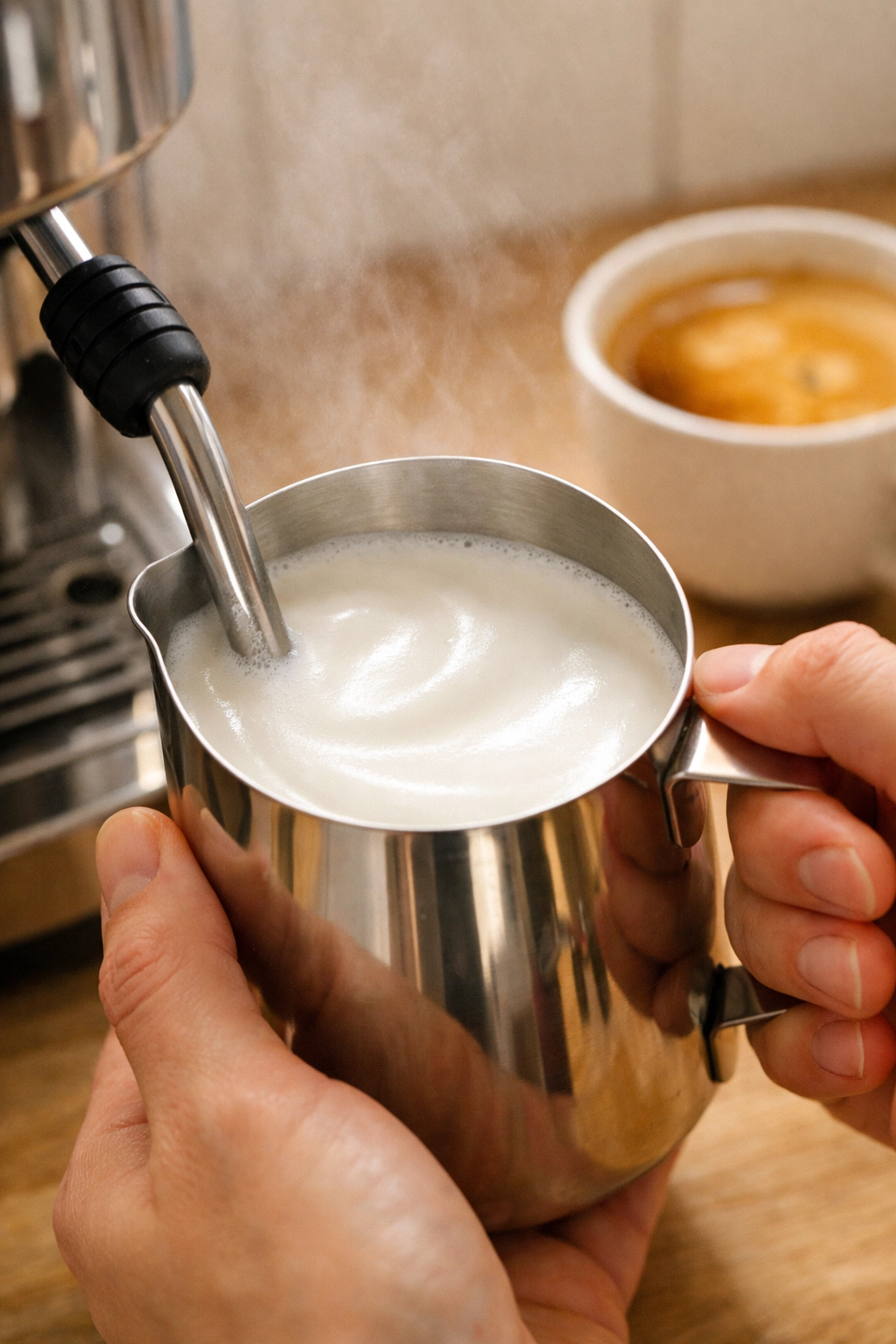
If you’re doing cappuccinos and lattes, espresso is only half the game. Milk texture is the other half… and it’s where home setups can feel “not quite café”.
Good milk is about:
- Stretching (adding air early)
- Texturing (breaking bubbles into microfoam)
- Temperature control (sweet spot, not scalded)
Targets we like:
- Heat milk to 140–150 °F / 60–65 °C for sweetness and texture
- Stop before 160 °F / 71 °C (beyond that, it starts tasting “cooked”)
If you want a clear breakdown, start here: https://www.liminicoffee.co.uk/article_understanding_milk
And if you want the differences between latte / cappuccino / flat white spelled out properly: https://www.liminicoffee.co.uk/article_latte_cappuccino_etc
Common home espresso problems (and the quick fixes)
“My shots are inconsistent day to day”
Totally normal… at first. Here’s why it happens:
- Beans age (degassing changes flow)
- Humidity changes grind behaviour
- Grinder retention adds randomness
- Prep varies (distribution is often the culprit)
Fix: change one variable at a time, and weigh everything (dose and yield). Keep the rest constant.
“My machine feels weak / pressure seems off”
The problem is sometimes not you: it can be the machine needing a service, a gasket replacement, or a scale build-up clean.
If your machine is acting up, we do repairs too: https://www.liminicoffee.co.uk/espresso_machine_repair
And while it’s getting sorted, you can still plan your next coffee order here: https://www.liminicoffee.co.uk/?af=1471531379787
“My puck is soupy”
A wet puck isn’t automatically bad, but it can indicate:
- Too coarse a grind (fast flow)
- Low dose for the basket size
- Basket/headspace mismatch
Focus on taste and shot metrics first. Puck aesthetics are… entertaining, but not always diagnostic.
A simple “espresso at home” checklist we swear by
Before you blame your grinder, your machine, or the universe:
- Machine fully warmed up (20–30 mins)
- Portafilter + basket dry and hot
- Fresh beans (ideally 7–30 days post-roast)
- Dose weighed (e.g., 18.0 g / 0.63 oz)
- Yield weighed (e.g., 36.0 g / 1.27 oz)
- Timer running (aim 25–30s)
- Distribution tidy, tamp level
- Adjust grind first, then dose, then temperature (if you have PID)
And when you want to stock up on coffee that makes dialling in feel rewarding, not frustrating, we’ve got you: https://www.liminicoffee.co.uk/?af=1471531379787
Want to go further? Lever vs automatic machines… and why it matters
Question: do you want espresso to feel like a craft ritual or a push-button repeatable process?
- Automatic/pump machines give you consistency and convenience
- Lever machines give you tactile control (and a very satisfying workflow), but they demand more technique
We’ve put together thoughts on lever vs automatic here: https://www.liminicoffee.co.uk/lever_automatic
And if you’re shopping for coffee to match your style: chocolatey, fruity, classic, experimental: start browsing here: https://www.liminicoffee.co.uk/?af=1471531379787