☕ 7:03 AM.
You’re staring at your phone. The screen is a glowing rectangle of demands. 14 unread Slack messages, 42 emails that "could have been a meeting," and a calendar that looks like a game of Tetris played by someone who’s losing. Badly.
You haven’t even touched your coffee yet, and you’re already behind.
This is the "small business owner" experience we don't talk about in the glossy brochures. It’s not just hard work; it’s a relentless grind of soul-sucking, repetitive tasks that make you wonder why you started this business in the first place. You wanted to build something great… not spend four hours a day copy-pasting lead data into a spreadsheet.
But imagine this for a second.
Imagine waking up, and the leads are already sorted. The follow-up emails? Sent. The data entry? Handled by a machine that doesn't need sleep, caffeine, or a dental plan.
That’s not a fever dream. It’s ai business automation. And no, you don't need a PhD in computer science or a billion-dollar budget to make it happen. You just need a plan.
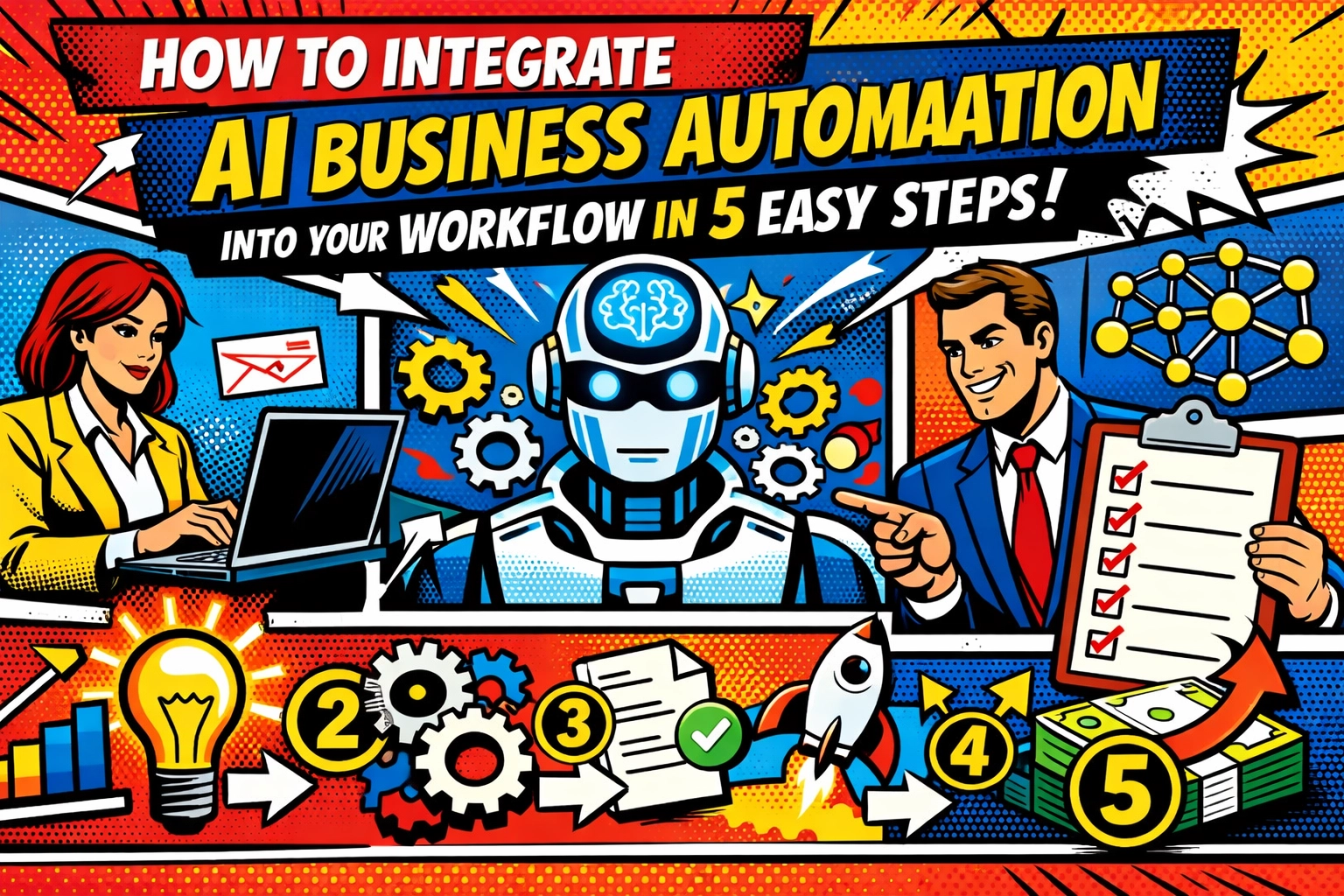
Let's break down how you can reclaim your time in five easy steps.
STEP 1: FIND THE SUCKING SOUND (THE AUDIT)
🔍 9:15 AM.
You’re mid-task, and you realize you’ve clicked the same three buttons 50 times in the last hour. That? That’s the sound of your time being sucked into a black hole.
Before you go buying every shiny new tool on the market, you need to audit your misery. You can't automate everything at once, and frankly, you shouldn't. You need to look for the "High Volume, Low Brainpower" tasks.
Ask yourself:
- Is this task repetitive? (Does it happen every day/week?)
- Is it rule-based? (If X happens, do Y?)
- Does it make you want to scream into a pillow?
These are your prime candidates for business automation tools. Think lead generation, data entry, social media scheduling, or basic customer support. If you can explain it to a five-year-old in two sentences, an AI can probably do it.

Stop trying to automate your "creative genius" moments. Focus on the plumbing. Once the plumbing works, you have more room for the genius stuff.
STEP 2: ORGANIZE YOUR DIGITAL LANDFILL
📂 11:30 AM.
You’ve identified the problem, but now you realize your data is… a mess.
AI is incredibly smart, but it’s also a literalist. If you give it messy, inconsistent data, it will give you high-speed, automated garbage. This is the part most people skip because it’s not "sexy," but it’s the difference between a workflow that scales and one that breaks.
Clean your "data junk drawer."
- Are your customer names formatted correctly?
- Is your CRM updated?
- Where does your lead info actually live?
Think of this as prepping the ingredients before you start cooking. You wouldn't try to bake a cake with eggshells in the batter, right? Get your data in order so your AI tools have a clear map to follow. Quality data equals quality automation.
It’s about being intentional. If you’re ready to see how this looks in practice without the headache, check out what we’re doing over at https://marblism.link/scott-bowen. We handle the heavy lifting so you don't have to.
STEP 3: PICK YOUR TEAM (CHOOSE YOUR TOOLS)
🛠️ 1:45 PM.
Now for the fun part. It’s time to pick your weapons.
The market for business automation tools is exploding. You have tools that write, tools that code, tools that talk to your customers, and tools that connect other tools. It’s easy to get overwhelmed.
Don't buy 50 apps. Look for tools that play well with others. You want an ecosystem, not a series of isolated islands.
- CRM Automation: Keep your leads warm without lifting a finger.
- Content AI: Draft blogs (like this one!) or social posts in seconds.
- Workflow Connectors: The "glue" that links your email to your spreadsheet to your task manager.
The goal isn't to replace your team; it's to give them superpowers. When you use the right AI business automation stack, you aren't just working faster, you're working better.

STEP 4: THE SANDBOX PHASE (TEST AND TWEAK)
🧪 3:20 PM.
You’ve got the tools. You’ve got the data. Now, whatever you do… don't turn it all on at once.
Run a pilot program. Pick one tiny, specific workflow, maybe it’s just the "thank you" email sent after someone fills out a contact form. Set it up, run it, and watch it like a hawk.
Does it sound human? Does the link work? Did it accidentally send the email to the wrong person 400 times? (It happens to the best of us).
Validation is key. You want to build trust in your system. If you don't trust the automation, you’ll end up "double-checking" it every five minutes, which defeats the entire purpose of saving time.
Start small. Measure the impact. Did it save you 20 minutes? Great. Now do the next thing.
STEP 5: DEPLOY AND CHILL (SORT OF)
🚀 4:55 PM.
The system is live. You’re watching the notifications pop up, and for once, you aren't the one doing the clicking.
But here’s the secret: AI isn't "set and forget." It’s "set and refine."
Your business changes. Your customers change. Your AI should evolve too. Check in once a week. Look at the analytics. Is the automation still solving the problem, or has it created a new one?
Continuous improvement is the name of the game. The more you refine, the more time you claw back. Eventually, you’ll reach that glorious state where the business runs while you’re actually enjoying your life.
Scaling shouldn't be a struggle. It should be a system.

THE AFTERMATH: A DIFFERENT KIND OF 5:00 PM
🌆 5:00 PM.
The day is ending, but you aren't exhausted.
Your inbox isn't a disaster zone. Your leads are tagged and followed up with. Your "to-do" list for tomorrow actually looks manageable.
You close your laptop. You don't feel that nagging sense of "I forgot something." Because the system didn't forget. The AI handled it.
You step out of the office, and for the first time in a long time, you’re actually present. No mental spreadsheets. No frantic mental reminders. Just… quiet.
That’s the power of integrating AI into your workflow. It’s not about the tech: it’s about the freedom.
FAQ: THE STUFF YOU’RE WONDERING ABOUT
Q: Is AI going to make my business feel cold and robotic?
A: Only if you let it. Use AI for the "robotic" tasks (data entry, scheduling) so you have more time to be "human" with your clients. It’s about offloading the boring stuff, not the heart of your brand.
Q: Do I need to know how to code?
A: Nope. Most modern business automation tools are "no-code" or "low-code." If you can drag and drop, you can automate.
Q: Is it expensive?
A: It’s way cheaper than hiring a full-time assistant to do data entry. Most tools have "pay-as-you-go" models that grow with you.
Q: Where do I even start?
A: Start by looking at your biggest bottleneck. Or, better yet, let someone show you the ropes. Head over to https://marblism.link/scott-bowen and let’s see how we can turn your chaos into a well-oiled machine.
STOP JUGGLING. START GROWING.
You didn't start a business to be a professional email-replier. You started it to make an impact, to build something, and maybe to have a little bit of freedom.
AI is the lever that lets you move the world. Stop doing the $10/hour tasks when you should be doing the $1,000/hour thinking.
The future is automated. Are you coming along?
See how easy it can be right here: https://marblism.link/scott-bowen.
Because honestly… that coffee isn't going to drink itself, and you’ve got better things to do than data entry.
Scaling Shouldn't Be This Easy. But Here We Are.