Author: admin

  • Finding Your Perfect Match: How to Vet Coffee Suppliers for Coffee Shops

    Finding Your Perfect Match: How to Vet Coffee Suppliers for Coffee Shops

    So, you’re opening a coffee shop. Or maybe you’ve been running one for a while and your current setup just isn't hitting the mark anymore. You’ve got the perfect location, the decor is looking sharp, and you’ve picked out some stunning coffee cups. But now comes the most critical decision of all: who is going to supply your beans?

    Choosing between various coffee suppliers for coffee shops is a lot like dating. In the beginning, everyone puts their best foot forward. The packaging is beautiful, the sales pitch is polished, and the initial samples taste like heaven. But will they still show up for you at 8:00 AM on a rainy Tuesday when your grinder breaks down? Will the coffee still taste as good six months from now?

    Finding the right coffee roaster wholesale partner is about more than just a price list. It’s about building a relationship with someone who cares as much about your success as you do. Here is our guide on how to vet your potential partners to ensure you find "the one."


    1. Quality and Consistency: Beyond the Pretty Bag

    It sounds obvious, but the coffee has to be good. However, "good" is subjective. What you really need is "consistently excellent." Anyone can roast one amazing batch of coffee once. The real pros can do it week in, week out, year-round.

    When vetting a supplier, don’t just take their word for it. Request multiple samples over a period of a few weeks. This allows you to see if the roast profile stays stable. We always recommend asking for composite samples, this means beans drawn from multiple bags of an actual production run, rather than a "gold-standard" sample specifically roasted to impress you.

    What to ask:

    • How do you monitor roast profiles? Look for roasters who use software-controlled systems to track time and temperature curves. This ensures that the batch you buy today tastes exactly like the batch you bought last month.
    • What is your cupping process? A serious roaster should be cupping (tasting) every single batch they produce to check for defects or inconsistencies.
    • Where does the coffee come from? Transparency is key. They should be able to tell you the origin, varietal, elevation, and processing method. If they’re vague about sourcing, that’s a red flag.

    A professional coffee cupping session at a wholesale coffee roaster for quality and sourcing evaluation.


    2. Training: The Secret Ingredient to Success

    You can buy the most expensive, award-winning beans in the world, but if your baristas don't know how to dial them in, the coffee will taste mediocre at best. This is where a lot of shops fall down.

    A great supplier shouldn't just drop off bags of coffee at your door and vanish. They should be an educational resource. When we look at coffee suppliers for coffee shops, we believe the quality of their training is just as important as the quality of their roasting.

    Do they offer barista training? Is it included in the wholesale price, or is it an extra cost? We think it's vital that your team understands the "why" behind what they do, from understanding milk textures to the physics of tamping.

    Why this matters:

    If your supplier provides comprehensive training, they are investing in your brand. They want your customers to have an amazing experience because that reflects well on their coffee. It’s a win-win.


    3. Equipment Support: When Things Go Wrong

    Coffee machines are high-pressure environments. They deal with scale, heat, and constant use. Eventually, something will need a bit of TLC.

    When you are vetting a coffee roaster wholesale partner, ask about their technical support. Do they have their own engineers? What is their lead time on repairs? If your machine goes down on a Saturday morning and your supplier doesn't answer the phone until Monday, you’ve lost two days of revenue. That hurts.

    We often suggest looking for suppliers who are experts in specific machinery, like the La Spaziale range. Knowing how a machine works, down to the PID controllers and boiler systems, means they can often troubleshoot issues over the phone, saving you a costly call-out fee.
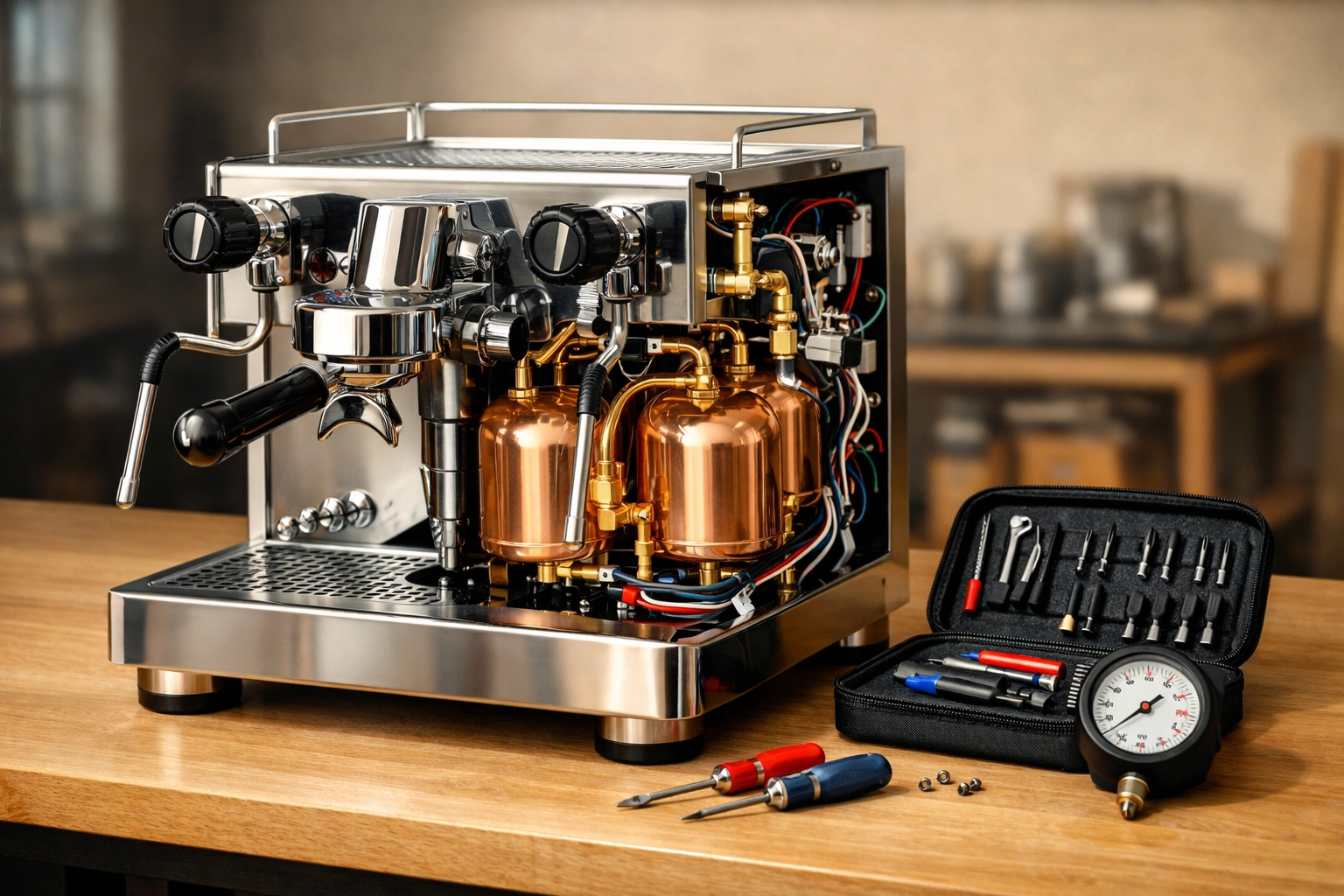
    Technical maintenance of a commercial espresso machine showing internal boiler systems and expert support.


    4. Reliability and Operations: The "Boring" Stuff

    Logistics aren't sexy, but they are the backbone of your business. You need to know that when you place an order, it arrives on time and in full.

    During your vetting process, try to visit their roasting facility. Is it clean? Is it organized? Do they use a First-In, First-Out (FIFO) inventory system? Freshness is everything in speciality coffee. You want coffee that was roasted recently, not something that has been sitting in a warehouse for three months.

    Operational check-list:

    • Lead times: How long between ordering and delivery?
    • Delivery methods: Do they use their own vans or a courier?
    • Minimum order quantities (MOQs): Does the MOQ fit your storage space and turnover?
    • Financial stability: It might feel awkward, but asking for references or checking their industry reputation is smart. You don't want your supplier disappearing overnight because they couldn't manage their overheads.

    5. The "Theatre" and Brand Alignment

    Your coffee supplier is an extension of your brand. If you are running a high-end, speciality-focused shop, you want a roaster that reflects that. If you are a high-volume, fast-paced cafe, you need a partner who understands efficiency.

    There is a certain theatre to coffee. The way the beans are presented, the story you tell your customers about the farmer, and the perfect crema on top of an espresso all contribute to the "wow" factor.

    Does the supplier’s brand vibe with yours? Do you like their people? You’re going to be talking to these guys a lot, so a good cultural fit is essential. We pride ourselves on being warm and approachable at Limini Coffee, and we think that's a big part of why our wholesale partners stay with us for years.

    A skilled barista pouring intricate swan latte art in a warm speciality coffee shop setting.


    6. Spotting the Red Flags

    Sometimes, it’s easier to know what you don’t want. Here are a few warning signs that a supplier might not be the right fit:

    • The "Radio Silence": If they take three days to reply to a sales inquiry, imagine how long they’ll take to help with a broken grinder.
    • Vague Sourcing: If they can't tell you exactly where the coffee comes from or when it was roasted, keep walking.
    • The "One-Trick Pony": They have one amazing coffee but everything else is mediocre. You need a consistent range to keep your menu interesting.
    • Pushy Sales Tactics: If they are more interested in signing a contract than hearing about your business goals, they aren't looking for a partnership; they’re looking for a transaction.

    Putting it All Together

    Choosing from the many coffee suppliers for coffee shops out there is a big task, but it doesn't have to be overwhelming. Focus on quality, check their training credentials, and make sure their technical support is rock solid.

    Remember, the cheapest price per kilo is rarely the best value. A slightly more expensive bean that comes with free training, 24/7 tech support, and a guaranteed 24-hour delivery window will save you thousands of pounds in the long run.

    If you’re looking for a partner who truly lives and breathes coffee, and wants to help your shop thrive, we’d love to chat. You can learn more about us and our approach to speciality roasting right here.

    And hey, if you want to see what our current partners think, have a look at our reviews. We believe in total transparency because, at the end of the day, we’re all on the same team: the team that wants to serve the best coffee possible.

    If you are ready to take the next step in your coffee journey, check out what we offer at Limini Coffee. Whether you need help choosing espresso equipment or you’re just starting to build your coffee shop, we’re here to help you pull the perfect shot every time.

    A perfect double espresso shot with rich crema, representing a successful coffee shop and supplier partnership.

    So, what’s your next move? Are you ready to find your perfect match? Just remember to keep your standards high and your water temperature around 92 °C (197.6 °F). The rest will fall into place! 🙂
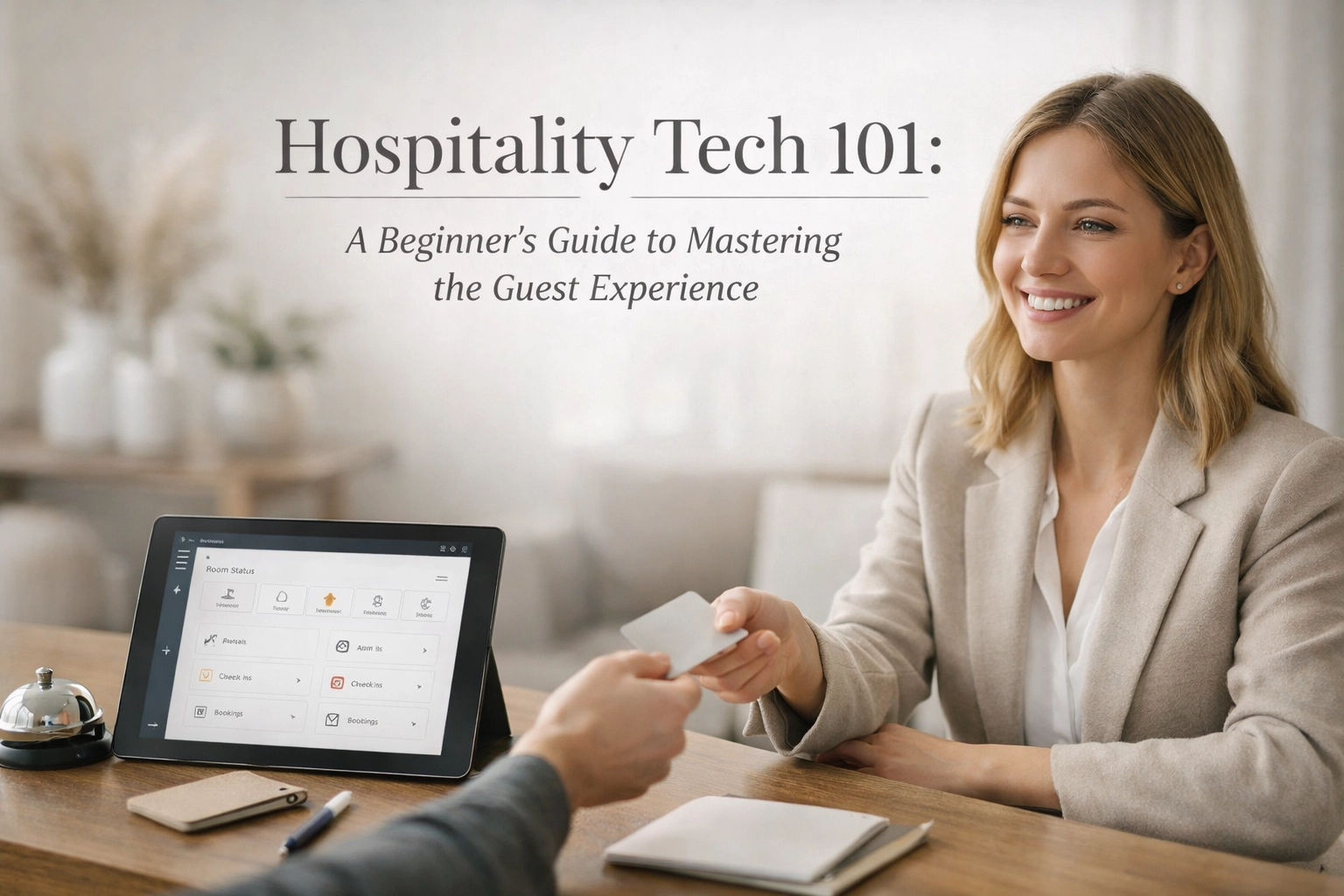

  • Hospitality Tech 101: A Beginner’s Guide to Mastering the Guest Experience

    Hospitality Tech 101: A Beginner’s Guide to Mastering the Guest Experience

    Streamline your operations. Delight every guest. Reclaim your time.

    The hospitality industry is undergoing a massive shift. While the core of great service: making people feel welcome: hasn't changed, the tools we use to deliver it have evolved completely. Today, hospitality technology isn't just about having a website or a digital calendar. It’s about building a seamless ecosystem where data flows, automation handles the heavy lifting, and you get to focus on the human side of the business.

    We believe that technology should be invisible. It should work quietly in the background, removing friction for both your staff and your guests. Over 12,500 properties worldwide are already moving toward this tech-first future, seeing up to a 20% increase in staff efficiency. It’s time to stop thinking about your Property Management System (PMS) as a digital ledger and start seeing it as the heart of your guest experience.

    All from one innovative platform.

    The layers of the tech stack

    To master hospitality tech, you first need to understand what’s happening under the hood. It isn't just a bunch of random apps. It’s a structured stack of layers that talk to each other to make the magic happen.

    • The Data Layer. This is the brain. It holds guest names, preferences, and reservation history.
    • The Logic Layer. This is the rulebook. It calculates your dynamic pricing and manages room availability.
    • The API Layer. This is the bridge. It allows your PMS to "talk" to your door locks, your restaurant system, and your cleaning apps.

    When these layers work together, you stop being a data entry clerk and start being a host. You don't need to manually update a spreadsheet when someone checks in; the system does it for you.

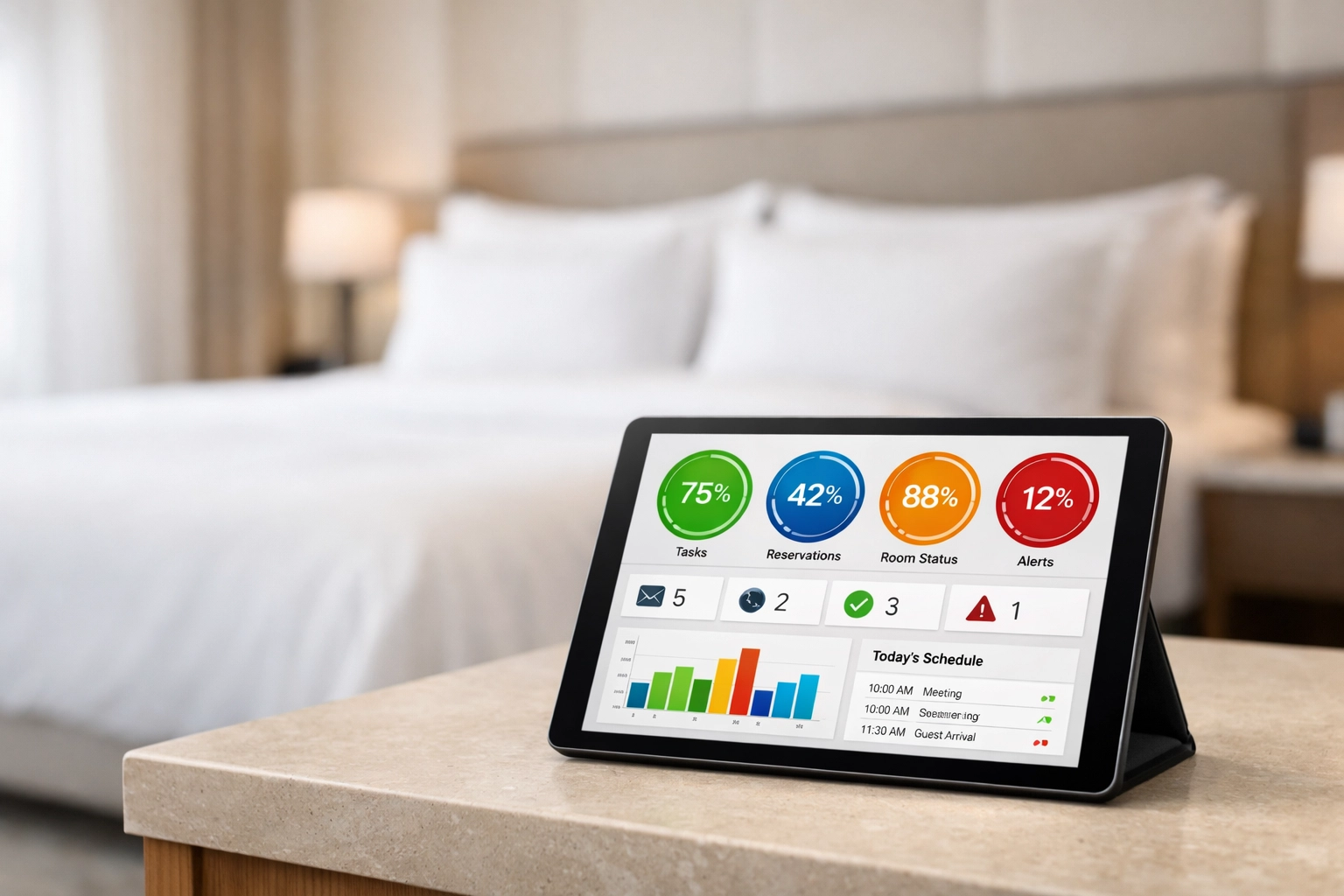
    Modern tablet on an oak desk showing how hospitality software streamlines hotel operations.

    Elevate the guest journey

    Modern travelers don't want to wait in line at a front desk for 15 minutes after a long flight. They want speed, autonomy, and personalization. We think the best check-in experience is the one that happens on a smartphone while the guest is still in a taxi.

    Smart room controls and IoT

    Imagine a guest walking into their room. The lights dim to their preferred setting, the AC is already at a crisp 21 degrees, and their favorite playlist is humming softly. This isn't science fiction: it’s the Internet of Things (IoT). By integrating smart controls into your room management, you provide a level of comfort that feels like home, only better.

    Dynamic QR codes

    The humble QR code has had a massive glow-up. Use them for more than just a digital menu. Place them on the bedside table for instant Wi-Fi access, or on the bathroom mirror to let guests request extra towels with a single tap. It’s about removing the "ask" and replacing it with "click."

    Integrated guest apps

    We believe guests should be able to manage their entire stay from their own device. A dedicated guest app allows them to chat with the concierge, book a spa treatment, or check out: without ever picking up the dusty room phone.

    "Since we moved to a mobile-first check-in, our guest satisfaction scores jumped by 15% and my front desk team saves 10 hours a week on admin," says one of our long-time partners.

    The AI revolution in the lobby

    AI in hospitality is no longer just a buzzword; it’s a functional necessity. We’re seeing a shift from reactive service to predictive hospitality. If you aren't using AI to streamline your communication, you’re already behind the curve.

    AI chatbots can handle the 80% of guest queries that are repetitive ("What time is breakfast?" or "Do you have a gym?"). This frees up your human staff to handle the 20% of interactions that actually require empathy and creative problem-solving. This isn't about replacing people; it’s about giving them the freedom to do what they do best: care for guests.

    Beyond chatbots, AI-powered concierges can provide hyper-personalized recommendations based on guest data. If the system knows a guest loves craft beer, it can suggest the best local brewery before they even ask. This is how you turn a standard stay into a memorable experience.

    Hotel guest using a mobile app in a luxury lobby for personalized guest services.

    Operational excellence behind the scenes

    Mastering the guest experience starts with mastering your internal operations. If your back-of-house is a mess, your front-of-house will eventually show the cracks.

    We think operational excellence comes down to three things:

    • Automation. Let the machine handle the night audit and the billing.
    • Visibility. Real-time data that tells you exactly which rooms are dirty and which are ready.
    • Integration. A tech stack where the restaurant POS talks to the PMS without any manual intervention.

    When your systems are integrated, you eliminate human error. No more "forgetting" to charge a guest for that extra bottle of wine at dinner because the restaurant system didn't sync with the room bill. It’s all there, updated in real-time, all from one central platform.

    Empower your staff through simplicity

    The biggest hurdle to adopting new tech is often the fear of complexity. But here’s the secret: the best technology is actually the easiest to use. If your team needs a three-week training course just to check someone in, the tech has failed.

    Look for platforms with intuitive, user-friendly interfaces. You want your new hires to be confident using the system within their first day. When the software is easy to navigate, staff feel empowered rather than frustrated. This directly translates to better guest interactions. Happy staff, happy guests.

    Empowered hotel receptionist using simple hospitality tech to improve guest service.

    How to get started

    Don't try to change everything overnight. The path to mastering hospitality tech is a marathon, not a sprint. Start small and scale as you go.

    1. Identify your pain points. Is your check-in process too slow? Are you losing revenue on manual errors? Start there.
    2. Audit your current tools. If your systems don't talk to each other, it’s time for an upgrade.
    3. Prioritize integration. Choose a PMS that has an open API and a marketplace of integrations.
    4. Invest in the human element. Train your team to use the data to provide better service, not just to click buttons.

    Technology is the foundation, but your hospitality is the house. By building on a modern, innovative platform like Mews, you give yourself the freedom to focus on the things that really matter: like making sure your guests have the stay of a lifetime.

    Ready to see how the right tech can transform your property?
    Get started with Mews today.

    Looking ahead: The future of travel

    The future of hospitality is personalized, automated, and incredibly exciting. We’re moving toward a world where the "hotel" is just one part of a broader travel ecosystem. From biometrics that allow for "face-scan" room entry to AI that predicts your next vacation based on your previous coffee orders, the possibilities are endless.

    Staying ahead of these trends doesn't require a degree in computer science. It just requires a willingness to innovate and the right partners by your side. (And maybe a slightly better Wi-Fi connection).

    Mastering the guest experience isn't about having the most expensive gadgets. It’s about using the right tools to create moments of delight. It’s about making the guest feel seen, heard, and valued: all while your operations run like a well-oiled machine.

    Transform your guest journey.
    Automate your operations.
    Join the future of hospitality.

    A luxury hotel room at twilight representing the future of high-tech guest experiences.

    If you’re ready to take the first step toward operational excellence and a world-class guest experience, we’re here to help you get there. Check out how we can help you scale your business and reclaim your time at https://referrals.mews.com/umqhyito. It’s time to stop managing software and start managing hospitality.

  • Hospitality Tech Secrets Revealed: What High-Growth Hotel Groups Don’t Want You to Know

    Hospitality Tech Secrets Revealed: What High-Growth Hotel Groups Don’t Want You to Know

    Unlock hidden growth. Streamline every operation. Scale with confidence.

    The hospitality landscape in 2026 isn't just about providing a bed and a breakfast; it’s about mastering the invisible architecture of technology that sits beneath the guest experience. While mid-market hotels are often stuck manual-tasking their way through a Tuesday afternoon, high-growth hotel groups are operating on a different plane. They aren’t necessarily working harder, they’re just using a deck that’s stacked in their favor.

    Success in modern hospitality is often measured by a 14% increase in RevPAR or a 25% boost in staff retention, all from one unified hospitality platform. But how are the big players actually doing it? It’s not about keeping "secrets" in the traditional sense; it’s about the execution of strategies that most operators simply overlook.

    The end of the "Frankenstein" tech stack

    High-growth groups have realized something the rest of the industry is still catching up to: fragmented technology is a silent profit killer. We believe your tech stack shouldn’t look like a game of Tetris played by someone who doesn't know the rules.

    For years, hotels have layered legacy PMS systems with third-party booking engines, separate CRM tools, and disconnected housekeeping apps. The result? Data silos that make it impossible to see the "big picture." The secret isn't a specific tool; it's the consolidation of those tools into a single, fluid ecosystem.

    • Centralized guest profiles across multiple properties.
    • Real-time data synchronization that eliminates overbookings.
    • A single source of truth for financial reporting.

    When your systems talk to each other, your staff spends less time playing translator and more time focusing on the guest standing in front of them. It turns out that when you remove the friction from your operations, growth happens almost by accident.

    Hospitality tech integration on a minimalist desk showing seamless property management for hotel groups.

    Becoming a predictive enterprise

    We think the term "Property Management System" is actually a bit of an understatement. In the hands of a high-growth group, the PMS becomes a crystal ball. By leveraging AI-driven analytics, these groups are moving away from reactive management and toward becoming "predictive enterprises."

    What does that look like in practice? It’s the ability to anticipate guest needs before the guest even realizes they have them.

    "We used to spend hours guessing our weekend occupancy," says one operations manager at a fast-growing boutique chain. "Now, the platform tells us exactly who is coming, why they're coming, and what they’re likely to buy while they’re here. It’s saved us 10 hours a week in pure administrative guesswork."

    High-growth groups use AI to:

    1. Dynamic Pricing: Automatically adjust rates based on hyper-local demand, not just seasonal averages.
    2. Hyper-Personalization: Send the right offer to the right guest at the moment they are most likely to book.
    3. Preventative Maintenance: Use IoT data to fix an AC unit before the guest even checks in.

    The automation of empathy

    There’s a common misconception that more technology equals less soul. The high-growth secret is actually the opposite: they use automation to buy back the time needed for genuine human connection.

    Think about the traditional check-in process. It’s a series of administrative hurdles, ID checks, credit card swipes, signing forms, all while the guest just wants to get to their room. High-growth groups have automated these "low-value" touches. By moving check-in to the guest’s mobile device, the front desk transforms from a processing center into a welcome hub.

    We believe that technology should handle the "how" so your team can focus on the "why." When a guest doesn't have to wait in line, their first interaction with your staff is a conversation, not a transaction. That’s how you build brand loyalty that survives the next economic cycle.

    • 70% of guests prefer hotels that offer tech-enabled check-in.
    • 30% increase in upsell revenue via mobile guest journeys.
    • 0 minutes spent standing behind a desk for administrative tasks.

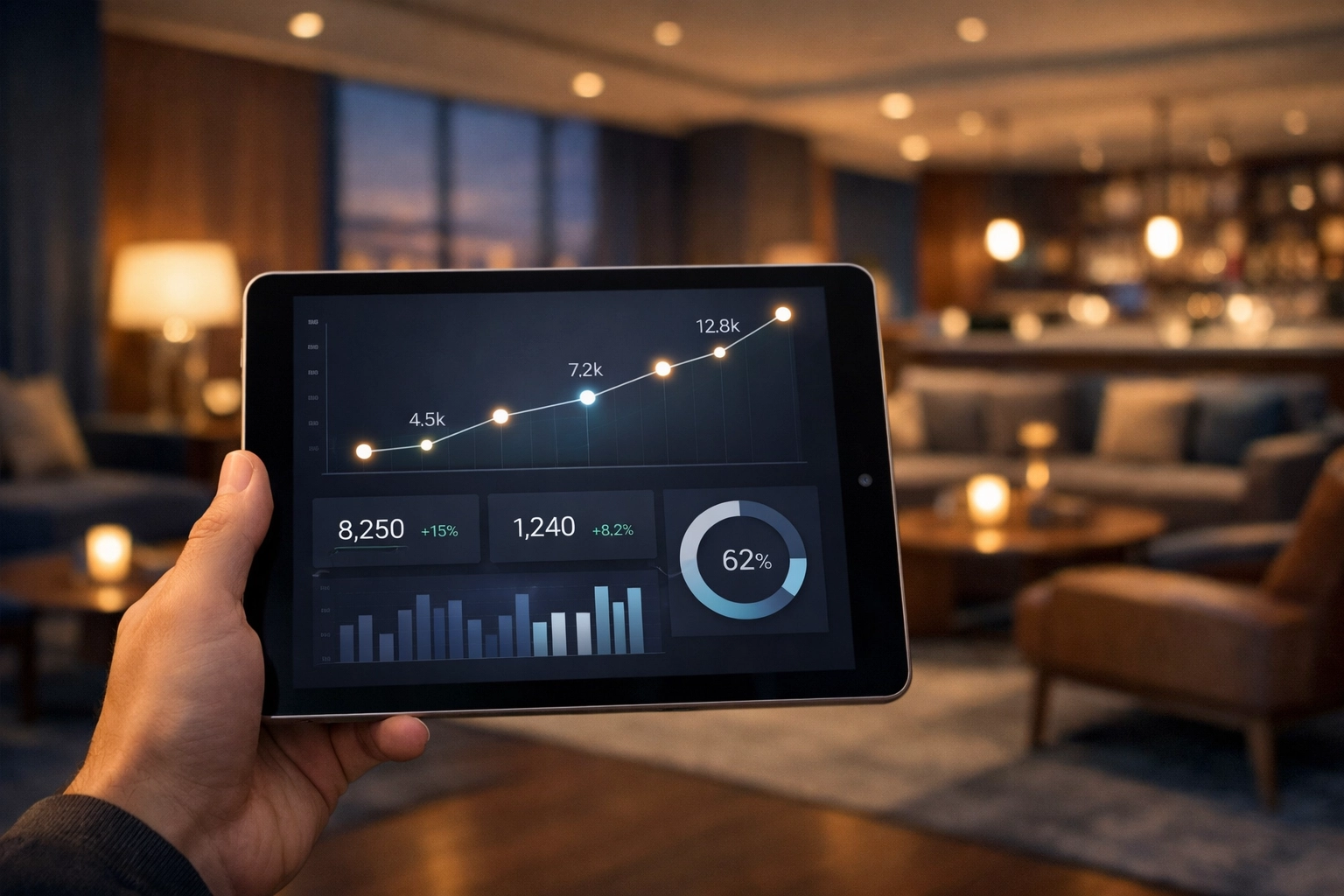
    High-growth hotel group manager tracking revenue data and guest trends on a tablet dashboard.

    Robotics and the new labor reality

    Let’s be real: the labor crisis in hospitality isn’t going away. High-growth groups aren't just complaining about it; they’re engineering their way around it. We’re seeing a massive shift toward robotics and automated service layers that handle the repetitive, heavy lifting.

    From automated luggage storage to delivery robots that bring extra towels to Room 402, these aren't just gimmicks. They are operational necessities. By offloading these tasks to machines, hotels can maintain luxury service levels with leaner, more specialized teams. This isn't about replacing people; it's about elevating the roles people play.

    If your staff is spent running towels back and forth across a 200-room property, they don't have the energy to provide a "wow" moment. High-growth groups protect their staff's energy like it’s their most valuable asset (because it is).

    Sustainability as a revenue driver, not a cost center

    For a long time, "going green" was seen as an expensive PR move. Today’s industry leaders have flipped the script. They’re using smart energy management systems and water recycling tech to slash operational costs while simultaneously attracting the modern, eco-conscious traveler.

    It’s a win-win that the high-growth crowd keeps quiet about because it’s such a massive competitive advantage. When you reduce your utility overhead by 20% through smart sensors and automated climate control, that money goes straight to your bottom line.

    • Automated lighting that knows when a room is empty.
    • Smart thermostats that adjust based on real-time occupancy.
    • Digital-only guest directories that save thousands in printing costs.

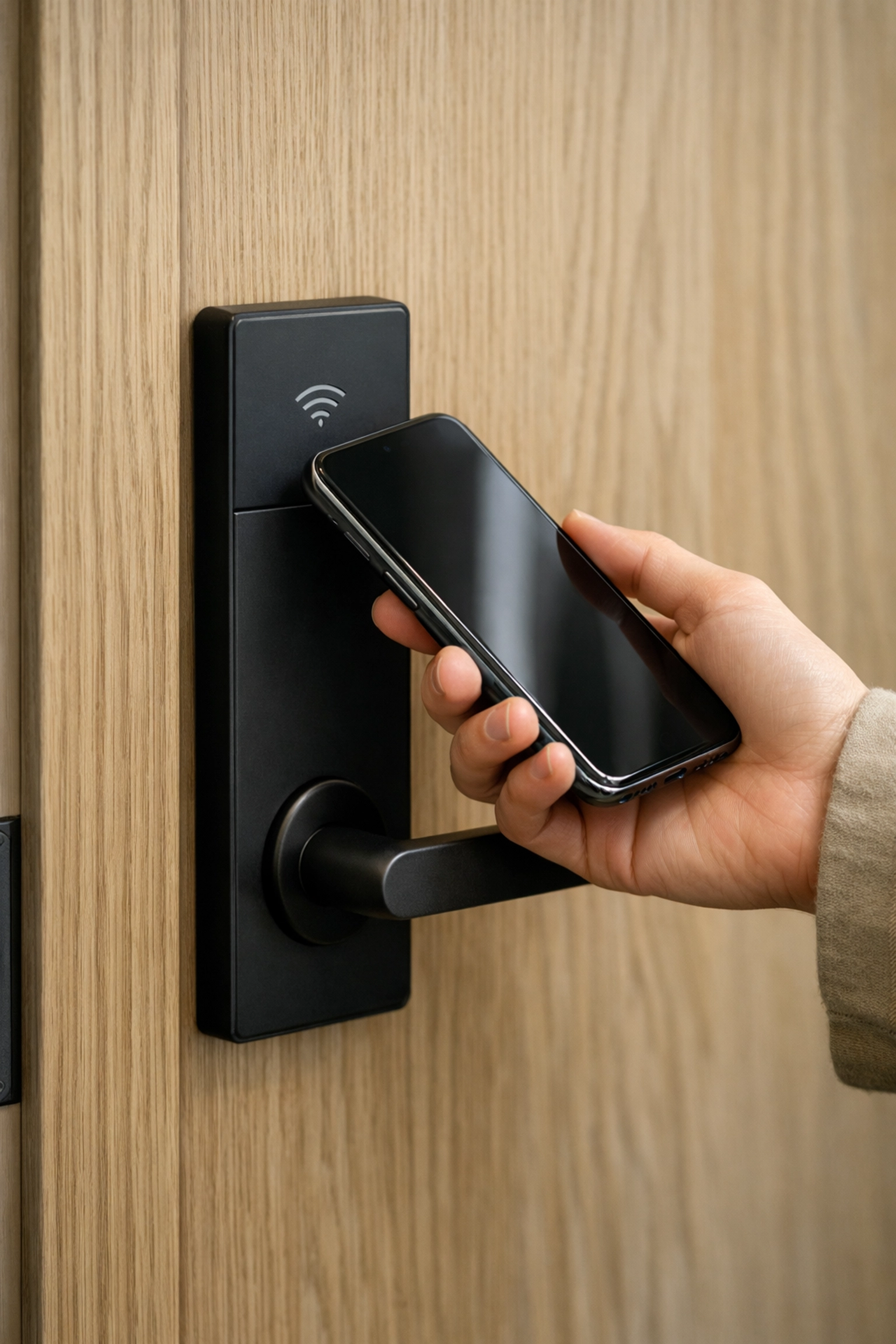
    Modern hotel guest using mobile key technology for a contactless and automated check-in experience.

    The execution gap: Why "knowing" isn't "doing"

    The real reason some hotel groups scale while others stall isn't because one has access to "secret" software. It’s because the winners prioritize execution. They choose platforms that are easy to implement and even easier to use.

    They don't get bogged down in six-month training cycles. They choose intuitive, cloud-native solutions that their staff actually enjoys using. In an industry with high turnover, having a system that a new hire can learn in 30 minutes isn't just a "nice-to-have": it's a survival strategy.

    Schedule a demo. Get your team onboard. Start scaling today.

    The path to high growth is shorter than you think. It starts with moving away from the "way we've always done it" and toward the way the future is already working. If you're ready to see how a unified platform can transform your property from a management headache into a revenue engine, it might be time to look at what Mews can do for you.

    Visit Mews to see the future of hospitality

    See what the right platform can do

    The difference between a hotel that survives and a hotel that thrives is often just the quality of the data at their fingertips. High-growth groups treat data as their most important guest. They track everything, analyze everything, and use those insights to pivot faster than their competitors.

    We believe the future of hospitality is open, integrated, and incredibly fast. You don't need a secret code to get there; you just need the right partner to help you navigate the journey.

    Don't let your technology be the ceiling of your success. Let it be the floor that you build your empire on. Whether you’re managing a single boutique gem or a global portfolio of 12,500 properties, the principles remain the same: simplify the back end, amplify the front end, and never stop innovating.

    Ready to unlock your group's full potential? Explore how Mews is redefining the guest experience and operational excellence at https://referrals.mews.com/umqhyito and get you earning revenue in no time.

    Sustainable hospitality technology featuring a smart thermostat in an eco-friendly hotel room.

    A final thought on the "Secrets"

    The biggest secret of all? There are no secrets. There is only the willingness to adapt. The high-growth hotel groups of tomorrow are being built today by the people who aren't afraid to let go of legacy systems and embrace the era of AI, automation, and unified data.

    The question isn't whether the technology exists: it’s whether you’re ready to use it. (And honestly, your guests are already waiting for you to catch up.)

  • Stop Wasting Time on Manual Admin: 7 Automation Hacks for Your Hotel Staff

    Stop Wasting Time on Manual Admin: 7 Automation Hacks for Your Hotel Staff

    Reclaim your day. Delight your guests. Grow your revenue.

    The modern hotelier is often buried under a mountain of paper, endless email threads, and repetitive data entry. We believe that technology should be the engine of your growth, not the anchor holding you back. In fact, properties switching to an automated hotel pms like Mews see a 15% increase in staff productivity within the first six months.

    It is time to move beyond the traditional "front desk" mentality. By shifting your operations to a cloud-native, automation-focused platform, you transform your staff from administrative clerks into experience curators.

    See what a truly connected ecosystem can do for your bottom line: all from one innovative platform.

    1. Let Your Guest Communication Run on Autopilot

    Manual emails are the silent killer of productivity. Sending confirmation messages, check-in instructions, and post-stay "thank you" notes one by one is an inefficient use of your team’s talent.

    We think that every touchpoint should be meaningful, not just functional. By deploying automated messaging triggered by specific booking events, you ensure that no guest is ever left in the dark.

    • Triggered Templates: Use dynamic placeholders to pull guest names and stay details automatically.
    • Omnichannel Reach: Send updates via SMS or WhatsApp alongside traditional email.
    • Pre-arrival Engagement: Automate the upsell of breakfast or room upgrades 48 hours before arrival.

    Guest receiving automated SMS messages on a smartphone via a modern hotel pms platform.

    When your hotel pms handles the routine "Where is the parking?" and "Can I have the Wi-Fi code?" queries, your staff can focus on the guest standing right in front of them. It’s about being proactive, not reactive.

    2. Deploy an AI Agent in Your Booking Engine

    The era of waiting on hold is over. Today’s traveler expects instant answers. Research shows that nearly 75% of traveler interactions now occur via chat, and half of those relate to basic booking questions.

    Integrating an AI-powered reservation agent directly into your booking engine ensures you never miss a lead, even at 3:00 AM. These intelligent agents handle the heavy lifting:

    1. Answering routine FAQs about pet policies and check-in times.
    2. Checking real-time availability and pricing.
    3. Capturing guest data for your CRM before the human team even logs on.

    "Our AI agent handles 40% of our direct inquiries without a human ever touching a keyboard," says one Mews partner. "It’s like having a 24/7 sales team for the price of a coffee."

    3. Centralize Task Management for Housekeeping

    The gap between the front desk and housekeeping is where mistakes happen. "Is room 302 ready?" should never be a question shouted over a radio or scribbled on a sticky note.

    Automate your recurring operational tasks: daily cleaning, maintenance checks, and welcome basket placements: through your property management system.

    • Real-time Status: Housekeeping updates the room status on a mobile app; the front desk sees it instantly.
    • Auto-assignment: Tasks are distributed based on staff location and room priority.
    • Accountability: Track progress from a single dashboard to identify bottlenecks.

    By removing the manual follow-up, you reduce friction and ensure that guests are never walking into a room that isn't quite ready. It's seamless, simple, and incredibly effective.

    Housekeeping management dashboard on a tablet showing real-time room status in a luxury suite.

    4. Kill the Queue with Self-Check-In Kiosks

    No one travels halfway across the world to stand in a line at a mahogany desk. We believe the lobby should be a place of arrival, not a place of waiting.

    Implementing self-check-in kiosks is the ultimate hack for busy periods. These kiosks allow guests to scan their IDs, sign registration cards, and cut their own room keys in under 60 seconds.

    • Reduced Friction: Guests choose their own pace and language.
    • Upsell Opportunities: Kiosks are remarkably good at suggesting late check-outs or room upgrades without feeling "pushy."
    • Staff Mobility: Instead of being trapped behind a desk, your staff can roam the lobby with a tablet, acting as hosts rather than clerks.

    This isn't about replacing people; it's about elevating them. When the machine handles the data entry, the human provides the hospitality.

    5. Synchronize Your Channel Manager and Revenue Strategy

    If you are still manually updating rates on Expedia, Booking.com, and your own website, you are losing money. Manual updates are slow, and in the world of dynamic pricing, slowness is expensive.

    Your channel manager should be an extension of your brain. By integrating it directly with your PMS and an automated revenue management tool, you can:

    1. Adjust rates based on local demand and competitor movements in real-time.
    2. Close out inventory across all channels simultaneously to prevent overbookings.
    3. Maximize occupancy by automatically suggesting optimal room assignments.

    "We used to spend three hours a day on rate parity. Now, the system does it in seconds," notes a boutique hotel manager. This is the power of a cloud-native ecosystem.

    Automated revenue management data and channel manager sync displayed on a professional laptop.

    6. Build Relationships via Your CRM (While You Sleep)

    A guest isn't just a booking number; they are a person with preferences. However, remembering that Mr. Jones likes a high floor and extra pillows shouldn't rely on your memory.

    Your CRM should work in tandem with your hotel pms to build a comprehensive guest profile. Automation allows you to:

    • Segment Your Audience: Send specific offers to locals for your spa, while sending international guests a guide to the city.
    • Automate Loyalty: Send a birthday discount or a "one year since your stay" reminder automatically.
    • Personalize the Journey: Use past behavior to suggest services the guest actually wants, increasing your RevPAR without manual outreach.

    Great hospitality is about making people feel seen. Automation provides the data you need to do that at scale.

    7. Embrace the Unified Cloud Ecosystem

    The biggest time-waster in any hotel is the "disconnected system." When your payments don't talk to your front desk, and your front desk doesn't talk to your marketing, your staff becomes the "human bridge" between software.

    We believe in a unified platform. Mews is designed to be the central nervous system of your hotel, where information flows seamlessly across every department.

    • Automated Payments: No more manual credit card swipes; payments are processed securely and automatically.
    • Open API: Connect to over 1,000 industry-leading apps with a few clicks.
    • Zero Downtime: Updates happen in the cloud, so you're always using the latest, fastest version of the software.

    By consolidating your tech stack, you eliminate double-entry, minimize errors, and give your team the gift of time.

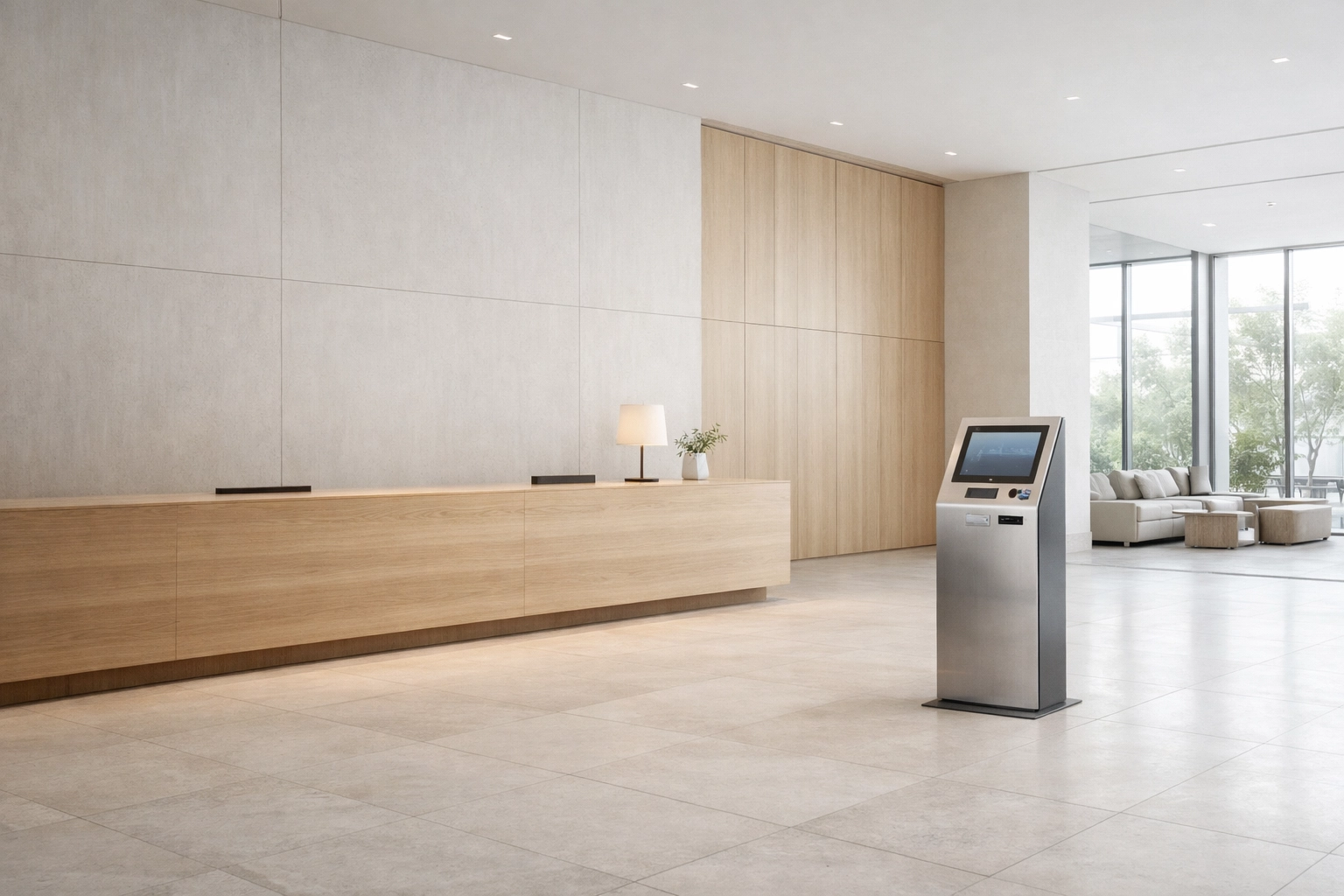
    Minimalist self-check-in kiosk in a modern hotel lobby using cloud-native automation software.

    Time to Make the Switch?

    The transition from manual to automated isn't just a technical upgrade: it’s a cultural one. It’s about deciding that your staff's time is too valuable to spend on spreadsheets. It’s about prioritizing the guest experience above all else.

    Modern hospitality moves fast. Your technology should move faster. With a cloud-native, easy-to-use platform like Mews, you aren't just managing a property; you're building a future.

    Ready to see how much time you can save?

    Get started with Mews today and join over 12,500 properties that have already ditched the manual admin.

    Explore Mews and transform your operations here.

    It’s time to stop managing software and start managing hospitality. Get your team back to what they love, and let us handle the rest. It’s a 30-minute conversation that could save you 10 hours a week: get you earning revenue and delighting guests in no time.

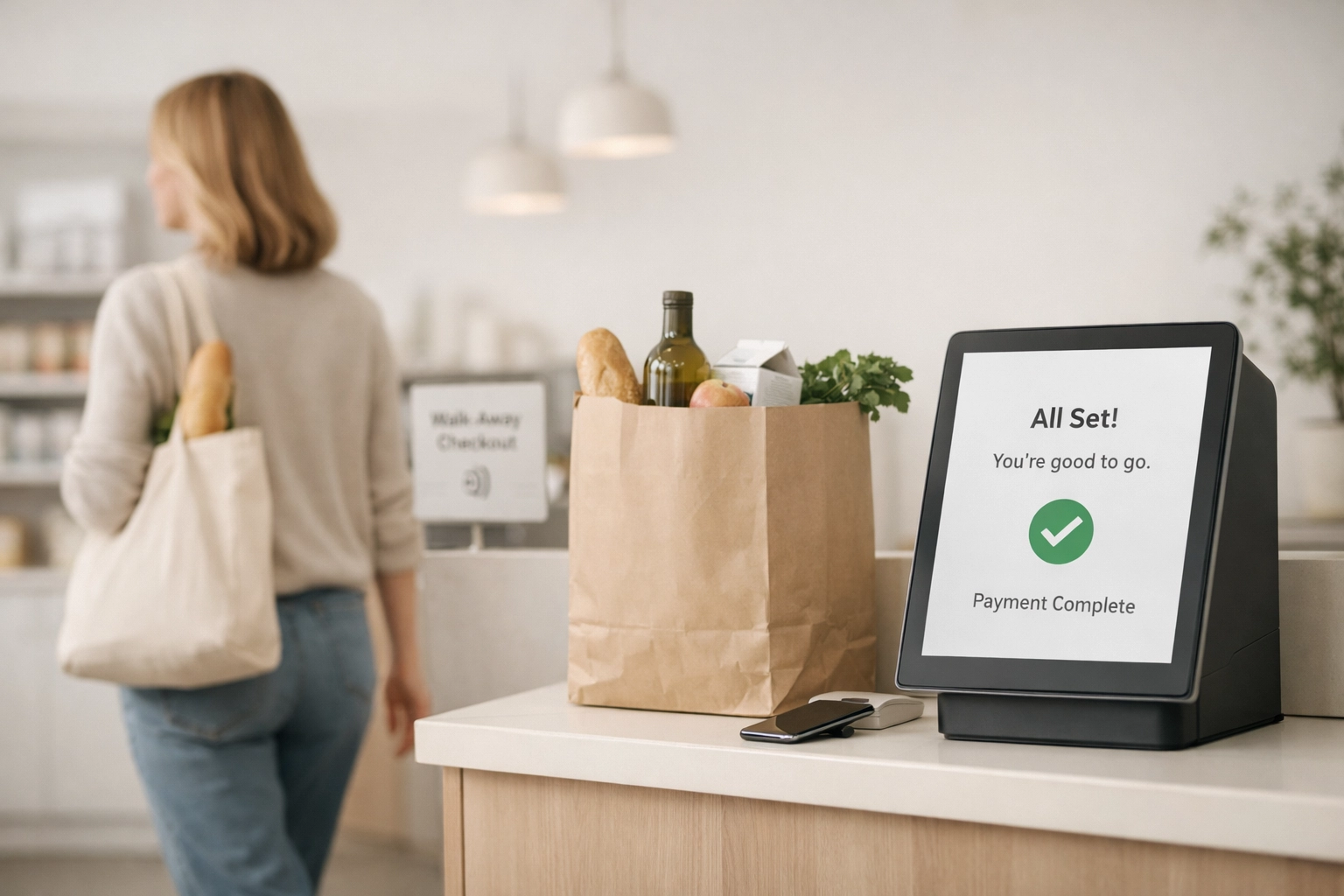
  • The Magic of the ‘Walk-Away’ Checkout: How Automated Payments Win Fans

    The Magic of the ‘Walk-Away’ Checkout: How Automated Payments Win Fans

    Check out. Walk out. Carry on.

    The traditional hotel departure is often a comedy of errors. You're late for a flight. The guest in front of you is disputing a mini-bar charge for a Snickers bar they definitely ate. The printer is jammed. The card machine is having a mid-life crisis. It’s the final memory your guest has of your property, and it’s usually the most stressful.

    We think there’s a better way. We believe hospitality should feel like magic, not a trip to the DMV.

    Enter the "walk-away" checkout. It’s the seamless, invisible, and utterly delightful process of ending a stay without ever touching a terminal. It’s the future of hospitality technology, and it’s winning fans across the globe.

    The Tragedy of the Traditional Line

    Picture the scene. It’s 10:00 AM on a Sunday. The lobby is a sea of rolling suitcases and frustrated sighs. Your front desk team is buried under a mountain of paper receipts and "did you use the telephone?" questions.

    This is friction. It’s the enemy of the guest experience.

    According to recent consumer data, 6 out of 10 people cite waiting in lines as the absolute worst part of in-person shopping or travel. It’s a bottleneck that serves no one. It burns out your staff. It irritates your guests. It’s a relic of a pre-digital age that we simply don’t need anymore.

    An elegant leather suitcase in a hotel lobby, representing the friction of traditional checkout lines.

    The Magic of Invisibility

    What if the checkout didn't exist at all? What if it was just a natural conclusion to a great story?

    With automated payments and modern hotel management software, the "transaction" moves to the background. It becomes part of the infrastructure, like the electricity or the Wi-Fi. It just works.

    • Seamless. No stopping at the desk.
    • Secure. No physical card swapping.
    • Silent. No awkward small talk about the bill.

    The guest simply gathers their bags, waves a mental goodbye, and heads to their next adventure. Behind the scenes, the Mews platform has already calculated the total, applied the authorized payment method, and sent a digital receipt to their inbox before they’ve even hit the sidewalk.

    This isn't just a convenience. It’s a transformation. It’s taking a moment of high friction and turning it into a moment of pure freedom.

    Why the 'Walk-Away' Method Wins

    When you remove the physical barriers to payment, you change the psychology of the stay. You move from a "vendor-customer" relationship to a "host-guest" relationship.

    We’ve seen it time and time again. Properties that switch to automated, embedded payments see a massive spike in guest satisfaction scores. Why? Because you’re giving them back the one thing they can’t buy: time.

    A guest walking freely through a bright hotel lobby, illustrating a seamless walk-away checkout experience.

    See what a truly modern platform can do for your property. Check out the Mews Referral Program to get started.

    The Science Behind the Magic

    How does it actually work? It’s not just smoke and mirrors. It’s a sophisticated blend of AI-powered recognition, secure payment tokens, and integrated cloud systems.

    1. Tokenization. The card is captured securely at the time of booking or check-in.
    2. Integration. Every point of sale: the bar, the spa, the room service: talks to the central brain.
    3. Automation. Pre-defined rules trigger the final settlement based on the guest's departure time.

    It’s five to ten times faster than a traditional checkout. While a manual process might take five minutes per guest, an automated system handles hundreds of transactions in milliseconds. It’s the difference between a dial-up modem and a fiber-optic connection.

    Freeing Your Team to Be Human

    The biggest winners in the "walk-away" revolution aren't just the guests. It’s your staff.

    When your team isn't tethered to a card machine or a printer, they are free to actually be hospitable. They can step out from behind the desk. They can offer a local recommendation for coffee. They can help with a heavy bag.

    • Empowerment. Staff focus on guests, not data entry.
    • Efficiency. No more manual reconciliation at the end of the shift.
    • Engagement. Interactions become meaningful rather than transactional.

    We believe that technology should enable humanity, not replace it. By automating the boring stuff: like processing a payment: you give your team the space to do the brilliant stuff.

    Hotel staff engaging with a smiling guest in a lounge, freed from tasks by automated payment systems.

    The "Silent Guest" Experience

    We’re living in the age of the "silent guest." These are the travelers who value autonomy above all else. They want to book on their phone, check in on the train, unlock their door with a digital key, and leave without ever saying a word to a human if they don't want to.

    This isn't because they’re rude. It’s because they’re busy. They’re efficient. They’re used to the "Amazon-ification" of the world, where things just happen.

    If your hotel still requires a 15-minute standing session at a mahogany desk just to pay for a night's sleep, you're losing the "silent guest." And the "silent guest" is the most loyal guest you’ll ever have: if you get the technology right.

    Data Without the Drama

    One of the hidden superpowers of automated payments is the data. When every transaction is captured digitally and instantly, your analytics become a goldmine.

    • Real-time revenue. See exactly what’s happening, as it happens.
    • Error reduction. No more fat-fingered typos on the card reader.
    • Guest insights. Understand spending patterns without digging through paper files.

    This data allows you to optimize your inventory, tweak your marketing, and schedule your staff more effectively. It’s not just a payment; it’s a pulse check on your entire business.

    A minimalist workspace with a tablet, symbolizing data-driven insights from hotel management software.

    Making the Leap

    Switching to a "walk-away" checkout model might feel like a big jump, but it’s the most rewarding move a modern hotelier can make. It’s about looking at the guest journey and asking, "Where does it hurt?" and then applying the digital bandage.

    We think you’ll find that once the lines disappear, the magic reappears.

    Ready to make your checkout experience disappear?
    Schedule a 30-minute chat with us.
    Get your property running on the world’s most innovative platform.

    Start your journey here: https://referrals.mews.com/umqHYIto.

    A Final Thought on Hospitality

    At the end of the day, guests don't remember the brand of the card reader you used. They remember how they felt when they left. They remember if they felt rushed, or if they felt cared for.

    By embracing automated payments, you’re telling your guests that you value their time. You’re telling them that you trust them. And you’re telling them that you’re focused on the future.

    The "walk-away" checkout isn't just a tech feature. It’s a promise. A promise of a stay that’s all about the experience and none of the administrative overhead.

    It’s time to stop processing guests and start hosting them. The magic is waiting.

    Fast. Frictionless. Functional.

    That’s the Mews way. All from one innovative platform.

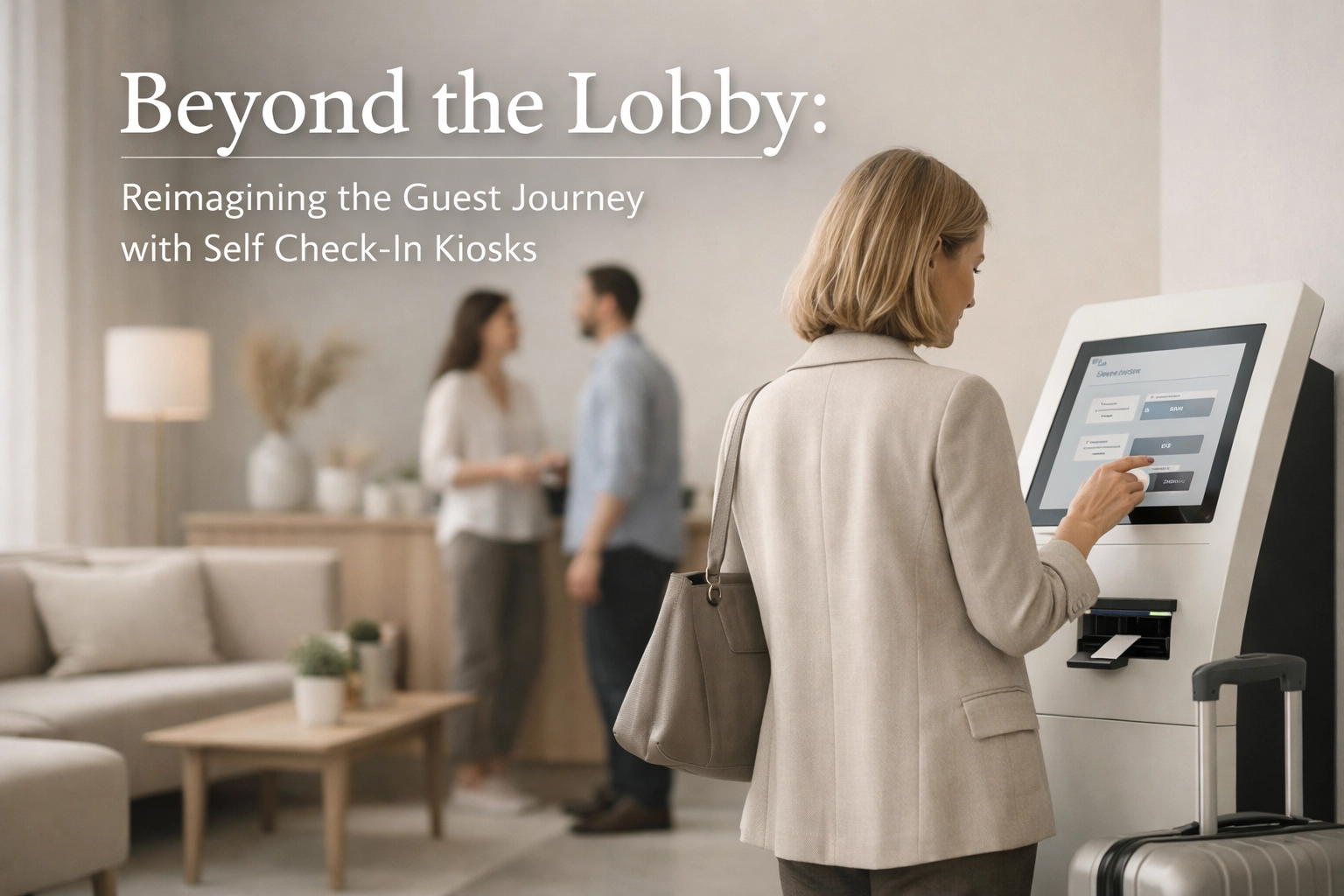
  • Beyond the Lobby: Reimagining the Guest Journey with Self Check-In Kiosks

    Beyond the Lobby: Reimagining the Guest Journey with Self Check-In Kiosks

    Self-check-in kiosks aren't just about skipping the front desk line.

    They're about transforming every touchpoint of your guest experience. From the moment someone walks through your door to the second they check out, these digital stations serve as 24/7 concierges that free up your staff, boost revenue, and give guests the control they actually want.

    Let's break down how these sleek machines are reshaping the entire guest journey, not just the first three minutes of it.

    The Speed Factor Everyone Talks About

    Sure, the numbers are impressive. Three minutes for check-in. Thirty seconds for check-out. But speed is just the baseline benefit here.

    What really matters is what happens when you eliminate those front desk queues. Your early morning business travelers get their keys at 5 AM without waking anyone. Your late-night arrivals breeze through without waiting for a tired night auditor. And your staff? They're no longer stuck processing ID after ID during the 3 PM rush.

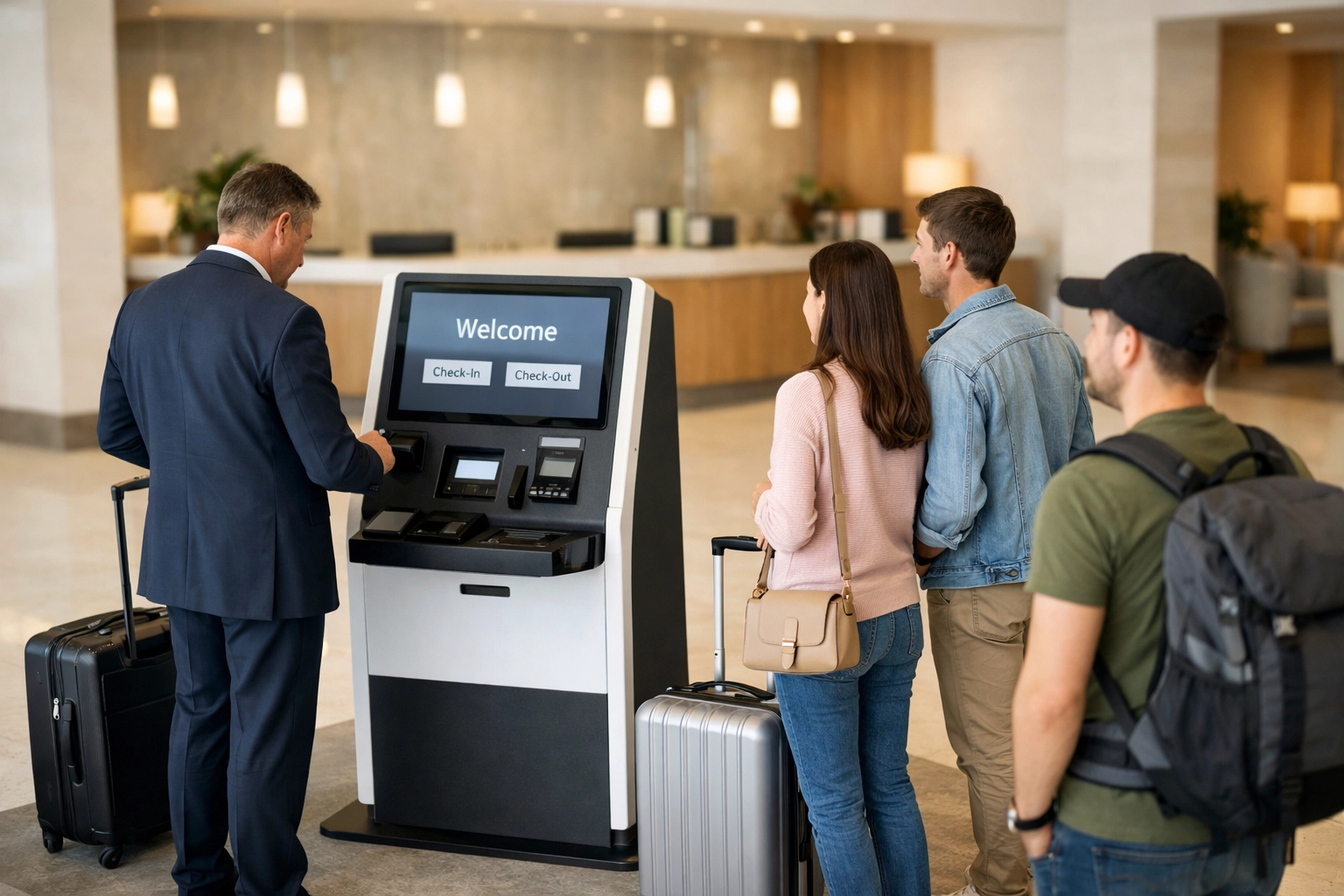
    Hotel guests using self-check-in kiosk in modern lobby with empty front desk in background

    The kiosks handle identity verification through confirmation numbers, government IDs, or even biometrics like fingerprints. Keys get issued automatically. Guests move on with their lives. It's that straightforward.

    Beyond the Check-In Transaction

    Here's where it gets interesting. Self-check-in kiosks positioned in your lobby aren't just one-and-done devices.

    They become continuous service hubs throughout a guest's entire stay. While checking in, guests can book a table at your restaurant, order room service for later, or request extra towels before they even see their room. Need a late checkout? Handle it at the kiosk. Want to make a spa reservation at 11 PM? The kiosk doesn't sleep.

    This 24/7 accessibility changes the game. You're not limited by front desk hours or staff availability. Guests get what they need, when they need it, without picking up a phone or waiting in line.

    Your Staff, Unleashed

    Automating routine check-in tasks doesn't replace your team. It redirects them.

    Think about what your front desk staff could do if they weren't verifying IDs and printing key cards all day. They could actually talk to guests. They could solve real problems. They could upsell experiences that matter, not just room upgrades, but local recommendations, exclusive packages, and personalized touches that create memorable stays.

    Hotel staff member providing personalized guest service while self-service kiosk handles routine tasks

    This staffing flexibility addresses one of hospitality's biggest challenges right now: labor shortages. You're doing more with the same team, but nobody's burning out because you've eliminated the tedious parts of their job.

    The Guest Experience Transformation

    We believe guests should choose how they interact with your hotel.

    Some people want the personal touch, a warm greeting, a conversation about their day, maybe some local tips from someone who knows the area. Others want to grab their key and disappear into their room as fast as humanly possible. Both preferences are valid.

    Self-check-in kiosks give you the flexibility to serve both types of guests without compromise. Your extroverts can head straight to the desk for that personal connection. Your introverts can use the kiosk and skip the small talk. Everyone wins.

    And here's the thing: offering self-service doesn't make you cold or impersonal. It makes you considerate. You're acknowledging that different guests have different needs, and you're equipped to handle all of them.

    Data That Actually Drives Decisions

    When kiosks integrate with your property management system, they become data collection powerhouses.

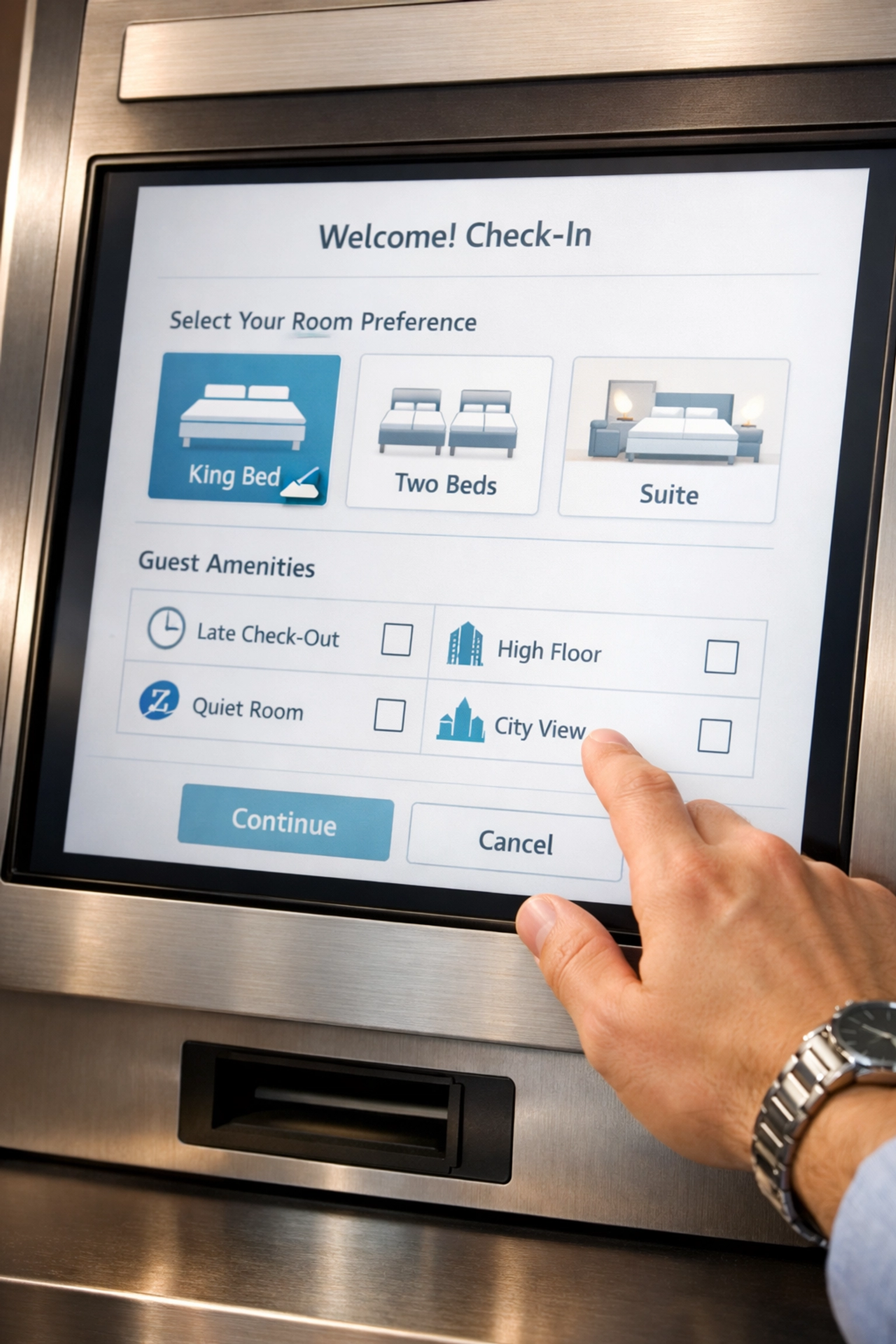
    Every interaction captures valuable information: room preferences, accessibility needs, previous purchases, special requests, peak usage times. This isn't creepy surveillance, it's the foundation for genuine personalization.

    Guest using hotel self-check-in kiosk touchscreen to select room preferences and amenities

    You start to see patterns. Maybe 40% of your guests skip housekeeping on short stays. Maybe room service orders spike at 2 PM. Maybe your executive suite guests consistently request extra pillows. Armed with this knowledge, you can anticipate needs before guests even articulate them.

    That's where loyalty comes from. Not from generic "welcome back" messages, but from knowing someone prefers a ground-floor room or always orders the club sandwich.

    The Revenue Opportunity Nobody Sees Coming

    Hotels that implement self-service kiosks report considerable revenue growth. Not because the kiosks magically make guests spend more, but because they create perfect upsell moments.

    When guests check in, they're in decision mode. They're open to improvements. A kiosk can suggest monetized early check-in, late checkout, room upgrades, or package deals right at that moment, without any awkwardness or pressure from a staff member.

    The conversion rates on these digital upsells often outperform traditional front desk pitches because there's no social pressure. Guests can consider the options privately, make their choice, and move on. No guilt about saying no to a friendly desk agent.

    Some systems even send room numbers via SMS during the upsell process, creating an additional privacy layer that guests appreciate. It's hospitality that respects boundaries.

    Security and Modern Expectations

    Contactless check-in isn't just a pandemic leftover: it's now an expectation.

    Contemporary kiosk systems offer encrypted data transmission, secure payment processing through credit cards, QR codes, and NFC, plus compliance with data protection regulations. Your guests' information stays protected while they get the convenience they want.

    Hotel management analytics dashboard showing guest data and operational insights on laptop

    The technology has matured beyond those clunky airport check-in machines from 2010. Today's hotel kiosks are sleek, intuitive, and actually pleasant to use. They don't feel like settling for a lesser experience: they feel like an upgrade.

    Real Implementation, Real Results

    One hotel operator put it this way: "We went from dreading peak check-in times to barely noticing them. The kiosks handle 70% of arrivals now, and my team focuses on the guests who need something beyond a room key."

    That shift from transactional to meaningful interactions changes everything about how your property operates. Your staff morale improves. Your guest satisfaction scores climb. Your operational costs decrease. And your revenue opportunities multiply.

    The technology pays for itself faster than most hotel investments because it touches so many aspects of your business simultaneously.

    Making the Jump

    If you're ready to reimagine your guest journey, modern property management systems make kiosk integration seamless.

    Mews offers hospitality technology that connects self-check-in kiosks with every other aspect of your operations: reservations, payments, guest profiles, housekeeping coordination. It's a unified platform where kiosks become part of your ecosystem, not a separate system you're managing.

    The setup is straightforward. The training is minimal. And the impact is immediate.

    The Bottom Line

    Self-check-in kiosks represent the evolution of hotel service: not its replacement.

    They free your staff to be hosts instead of administrators. They give guests control over their own experience. They generate data that drives better decisions. And they create revenue opportunities that didn't exist when everything flowed through a single front desk.

    The question isn't whether kiosks belong in your lobby. It's whether you can afford to keep operating without them.

  • The Ultimate Guide to Home Coffee Brewing: Everything You Need to Succeed

    The Ultimate Guide to Home Coffee Brewing: Everything You Need to Succeed

    Let’s be honest: there is something remarkably satisfying about brewing a world-class cup of coffee in your pajamas. We’ve all been there: standing in the kitchen at 7:00 AM, waiting for the kettle to whistle, hoping that today’s brew hits that sweet spot of clarity and body.

    Brewing coffee at home is part science, part art, and a whole lot of trial and error. But here’s the secret: you don’t need a degree in chemistry or a £10,000 commercial setup to get incredible results. What you need is a solid understanding of the variables and a bit of respect for the bean. Whether you are a pour-over purist or an espresso enthusiast, we’ve put together this guide to help you master the craft.

    And if you’re looking to stock up on the essentials, you can find everything from brewing gear to the freshest beans right here at Limini Coffee.


    The Holy Trinity of Brewing: Water, Ratio, and Grind

    Before we even talk about fancy gadgets, we have to talk about the foundation. If these three things aren't right, the most expensive gooseneck kettle in the world won't save your morning.

    1. Water Temperature and Quality

    Coffee is roughly 98% water. If your water tastes like a swimming pool, your coffee will too. We always recommend using filtered water to ensure a clean slate for those delicate coffee flavours to shine.

    Temperature is equally critical. You want to aim for between 195°F to 205°F (90°C to 96°C). Why? Because water that is too hot will scorched the grounds, resulting in a bitter, ashy cup. Water that is too cool simply won't have the energy to extract the delicious oils and acids, leaving you with a sour, thin mess. A temperature-controlled kettle is a game-changer here, but if you don't have one, just let your kettle sit for about a minute after it boils.

    2. The Golden Ratio

    How much coffee should you use? We’ve found that a ratio of 1:16 (one part coffee to 16 parts water) is the perfect starting point for most methods. This translates to roughly 60 grams of coffee per litre of water.

    If you want to get precise (and you should!), check out our coffee brewing calculator to dial in your specific recipe.

    3. The Grind Size

    Think of grind size like a faucet. A coarse grind (like sea salt) lets water flow through quickly, while a fine grind (like powdered sugar) slows it down.

    • Coarse: French Press
    • Medium: Drip machines and some pour-overs
    • Fine: Espresso and Moka Pot

    Comparison of coarse, medium, and fine coffee grounds for different home brewing methods.


    Choosing Your Method: Which One Is Right for You?

    Not all brewing methods are created equal. Some are forgiving and rustic, while others require the precision of a watchmaker.

    The Pour-Over (The Purist’s Choice)

    Pour-over brewing, using a V60 or Chemex, is perhaps the best way to experience the nuance of single-origin beans. It produces a clean, tea-like body and highlights acidity.

    The Technique:

    1. Place your filter in the dripper and rinse it with hot water. This removes the "papery" taste and warms your vessel.
    2. Add your medium-fine grounds.
    3. The Bloom: Pour just enough water (about 50g) to wet the grounds and wait 30 seconds. You’ll see bubbles: this is the CO2 escaping. We call this "degassing," and it's essential for a better extraction.
    4. Slowly pour the rest of your water in concentric circles, avoiding the very edges. Aim for a total brew time of 3 to 4 minutes.

    The French Press (The Reliable Classic)

    If you like a heavy mouthfeel and a rich, bold cup, the French Press is your best friend. It’s an immersion method, meaning the coffee sits in the water for the duration of the brew.

    The Technique:

    1. Use a coarse grind.
    2. Add your coffee, then pour in your hot water.
    3. Let it steep for 4 minutes.
    4. Give it a gentle stir at the top to break the "crust," then plunge slowly.
    5. Pro Tip: Pour the coffee out immediately after plunging. If it sits in the press, it will continue to extract and turn bitter.

    The AeroPress (The Versatile Travel Buddy)

    We love the AeroPress. It’s indestructible and incredibly versatile. You can make anything from a concentrated "espresso-style" shot to a clean filter cup. It’s also very forgiving of grind size.

    Espresso (The Final Frontier)

    Making espresso at home is a hobby in itself. It requires pressure (usually around 9 BAR) to force water through a compact "puck" of finely ground coffee. If you’re just starting out, choosing espresso equipment can feel overwhelming, but focusing on a quality burr grinder is the most important step.

    For those serious about the craft, understanding tamping and the role of crema will help you move from "okay" shots to café-quality brilliance.

    Fresh espresso extraction with rich golden crema filling a glass cup from a portafilter.


    Why Freshness Matters (And Where to Get It)

    You can have the best technique in the world, but if your beans are six months old and from a supermarket shelf, your coffee will taste like cardboard. Coffee is a fresh agricultural product.

    At Limini Coffee, we believe that coffee should be roasted to order. Freshness isn't just a buzzword; it’s the difference between a cup that tastes like "coffee" and a cup that tastes like blueberries, chocolate, or jasmine. When you buy through this link, you’re getting beans that have been handled with care from the farm to the roaster.

    If you’re curious about where our beans actually come from, take a look at our process for sourcing our coffee. We take it quite seriously, so you don't have to worry about anything other than the taste.


    Troubleshooting Your Brew

    Is your coffee not tasting quite right? Don’t panic. Most issues can be fixed with a simple adjustment.

    "My coffee is too bitter!"

    • The Cause: Over-extraction. You've taken too much out of the bean.
    • The Fix: Use a coarser grind, lower your water temperature slightly, or shorten your brew time.

    "My coffee is too sour/weak!"

    • The Cause: Under-extraction. You haven't taken enough out.
    • The Fix: Use a finer grind, make sure your water is hot enough (at least 195°F / 90°C), or extend your brew time.

    "My coffee feels 'thin' or watery."

    • The Cause: Your ratio is off.
    • The Fix: Use more coffee or less water. Check your measurements on a scale.

    Pouring water from a gooseneck kettle for a coffee bloom during home pour-over brewing.


    The Importance of the Ritual

    Beyond the caffeine, the beauty of home brewing is the ritual. It’s that five-minute window where you aren't checking emails or worrying about the day ahead. You’re just focused on the weight of the water, the smell of the grounds, and the slow drip of the brew.

    We’ve spent years exploring different methods, and honestly, we haven't noticed a difference in "quality" between a perfectly executed French Press and an expensive pour-over: they are just different expressions of the same bean. That is the beauty of coffee 🙂
    If you find yourself getting really into the "theatre" of it all, you might enjoy reading about the theatre of coffee service or even considering some professional barista training to sharpen those skills.


    Wrapping It Up

    Mastering home brewing is a journey, not a destination. You’ll have days where you pull the perfect shot and days where you forget to put the filter in (it happens to the best of us). The key is to keep experimenting. Change one variable at a time, take notes, and trust your palate.

    Ready to start your next brewing adventure? Head over to Limini Coffee to find your next favorite roast. Whether you’re looking for a chocolatey blend for your morning latte or a bright single-origin for your V60, we’ve got you covered.

    Happy brewing!

    A steaming ceramic mug of fresh black coffee as part of a relaxing morning brewing ritual.

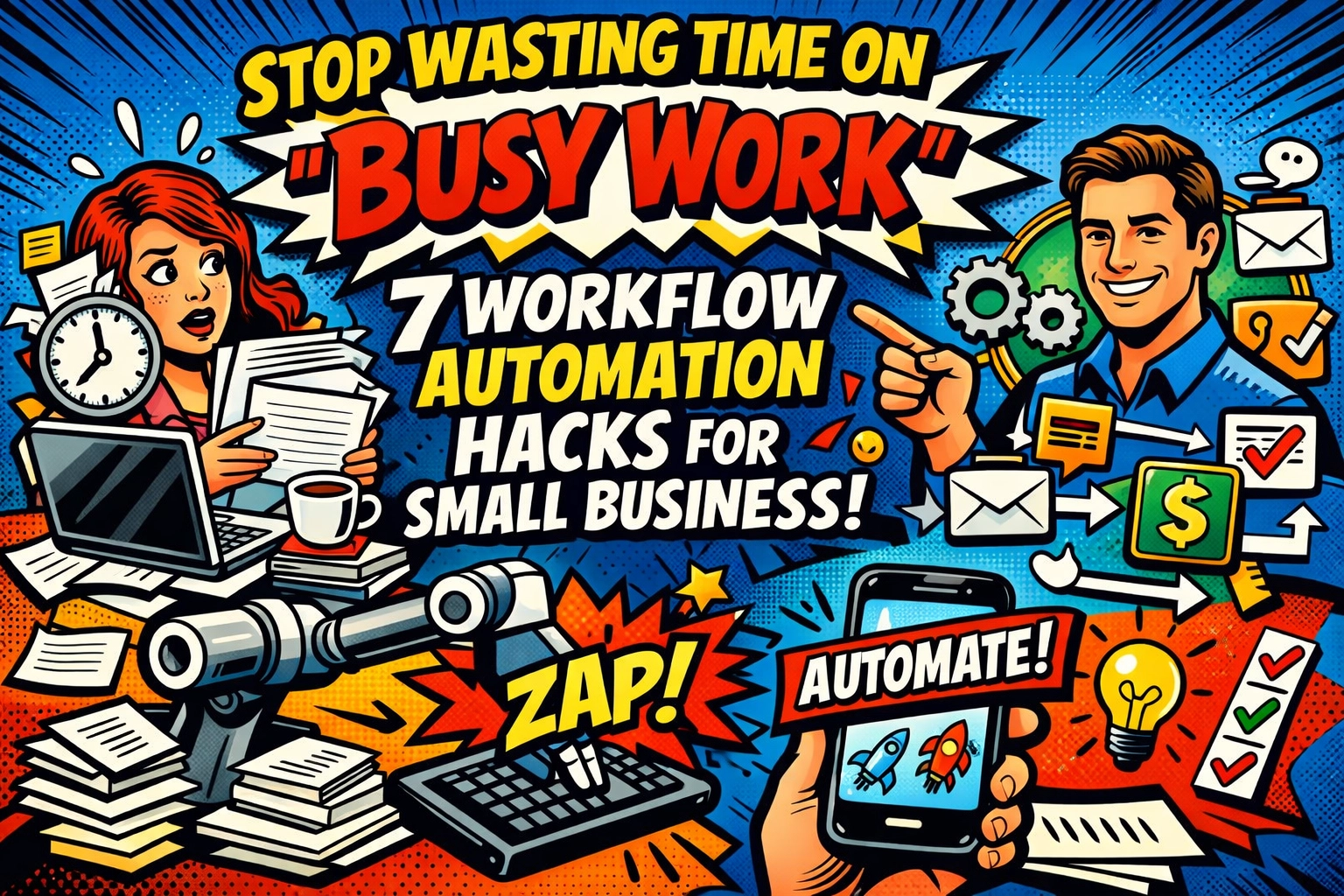
  • Stop Wasting Time on “Busy Work”: 7 Workflow Automation Hacks for Small Business

    Stop Wasting Time on “Busy Work”: 7 Workflow Automation Hacks for Small Business

    WORKFLOW AUTOMATION FOR SMALL BUSINESS: STOP DOING THE BUSY WORK

    ☕ 7:00 AM.
    You’re staring at your phone.
    The screen is a blurred mess of notifications, unread emails, and Slack pings.
    Your thumb hovers over the mail app. You know what’s in there…
    Leads that need sorting. Invoices that need chasing. Data that needs to be moved from one spreadsheet to another.

    It’s called "busy work."
    It feels like progress, but it’s actually a trap.
    While you’re busy being a human router, your competitors are growing.
    They aren’t smarter than you. They’ve just stopped doing the boring stuff.

    Scaling shouldn't be this hard. But here we are.

    If you want to reclaim your Sunday mornings (and your sanity), you need workflow automation for small business. It’s not about replacing yourself, it’s about replacing the version of you that spends three hours a day on copy-paste.

    1. STOP CHASING LEADS (LET THEM FIND THE RIGHT PERSON)

    📱 9:30 AM.
    A lead comes in. It’s a big one.
    But you’re in a meeting. By the time you see it at noon and forward it to your sales rep, the lead has already gone to the guy who replied in five minutes.

    Stop being the middleman.
    Use lead routing automation to instantly assign inbound leads based on territory or capacity.
    Tools like HubSpot or Salesforce can trigger an alert the second someone hits "submit."
    No more manual forwarding. No more "who’s taking this?"
    You just see the deal move through the pipeline while you finish your coffee.

    2. INVOICES THAT PROCESS THEMSELVES

    💰 11:00 AM.
    You’re staring at a pile of receipts.
    Manual data entry is where joy goes to die.
    OCR-based invoice processing (Optical Character Recognition) is your new best friend.
    It "reads" your emails, pulls out the numbers, and syncs them directly to your accounting software like Xero or QuickBooks.

    Business owner using automated invoice processing to convert messy receipts into organized digital records.

    The days of typing "14.99" into a spreadsheet are over.
    The system flags the weird stuff. You just approve the rest.
    It’s quiet. It’s organized.

    3. DATA ENRICHMENT ON AUTOPILOT

    🔍 1:30 PM.
    Who is this person?
    You spend twenty minutes on LinkedIn trying to find out a lead’s company size and tech stack.
    Stop.
    Set up automatic data enrichment.
    When a lead drops an email, tools like Clearbit or ZoomInfo can instantly append their industry, employee count, and even their favorite color (probably).
    Your team gets a full profile without lifting a finger.
    You’re not guessing. You’re closing.

    4. ONBOARDING WITHOUT THE HEADACHE

    🤝 3:00 PM.
    You just hired a superstar.
    Now comes the mountain of paperwork, system access requests, and software setups.
    Usually, you’d spend your whole afternoon on this.
    Instead, trigger an employee lifecycle workflow.
    One click and the system sends the contracts, orders the laptop, and creates the Slack account.
    The new hire feels like they joined a professional outfit.
    You feel like a CEO, not an IT guy.

    5. THE CLEAN PIPELINE (NO MORE GHOSTING)

    🧹 4:15 PM.
    Your CRM is full of "dead" leads from 2023.
    It’s messy. It’s distracting.
    Set up automated pipeline maintenance.
    If an opportunity hasn’t moved in 30 days, the system automatically closes it or triggers a "one last try" email.
    It keeps your forecast honest.
    You only see the deals that actually matter.

    Sales pipeline automation removing dead leads to help small businesses focus on high-value deals.

    6. FROM FORMS TO TASKS

    📝 5:00 PM.
    Someone fills out a contact form.
    Instead of it sitting in an inbox, the system converts it into a task in Asana or Trello.
    It assigns an owner. It sets a deadline.
    It even adds a checklist of what needs to happen next.
    Nothing slips through the cracks.
    The work does itself.

    7. DASHBOARDS THAT DON'T NEED YOU

    📊 6:00 PM.
    The day is ending.
    Usually, you’d spend an hour cobbling together a report for the team.
    Now? Your executive dashboard updates itself every night.
    It highlights the risks. It celebrates the wins.
    It lands in your inbox while you’re winding down.
    You step back into your life knowing exactly where the business stands.

    You can see how this works for you by checking out Scott's personal recommendations.


    WHY YOUR BUSINESS NEEDS AN AI VIRTUAL ASSISTANT (BEFORE YOUR COMPETITORS GET ONE)

    🌙 8:00 PM.
    The office lights are off.
    You’re home, but your brain is still at the desk.
    You’re thinking about that email you forgot to send.
    The problem with small business isn't a lack of ideas, it’s a lack of hands.
    But hiring a human assistant is expensive, slow, and they (rightfully) want to sleep at night.

    This is why an ai virtual assistant for business is no longer a luxury.
    It’s a survival tactic.

    THE COMPETITIVE MOAT

    Your competitors are already looking at AI.
    If they can respond to leads 10x faster and handle 5x the volume because they have an AI VA like Penny behind them… where does that leave you?
    An AI assistant doesn't just "help."
    It creates a moat.
    It processes data while you sleep. It organizes your calendar without asking questions.

    SHE NEVER SLEEPS (AND SHE’S ALWAYS SMART)

    📱 10:00 PM.
    A customer asks a complex question on your site.
    Normally, they’d wait until 9:00 AM for an answer.
    But your AI assistant is awake.
    She knows your business documentation. She knows your pricing.
    She answers. The customer buys.
    You’re asleep.
    That’s the difference.

    An AI virtual assistant managing customer support and data while the small business owner sleeps.

    THE COST OF DOING NOTHING

    We see it all the time.
    Business owners wait until they are totally burnt out before looking for help.
    By then, you’re making mistakes. You’re losing money.
    An AI virtual assistant is the "Employee of the Month." Every month.
    She doesn't need a desk. She doesn't need health insurance.
    She just needs a job to do.

    STOP JUGGLING. START LEADING.

    You didn't start a business to be a professional scheduler.
    You started it to build something.
    Marblism is designed to give you that time back.
    By automating the "busy work," you move from the engine room to the captain’s chair.

    "I used to spend half my day just keeping my head above water. Now, Marblism handles the routine stuff and I actually get to talk to my customers again." , Mark, Founder.

    "The AI virtual assistant isn't a tool, it's a team member. She knows my business better than I do sometimes." , Sarah, Agency Owner.

    SEE FOR YOURSELF

    Scaling shouldn't be this easy. But here we are.
    You don't need a 20-person team to look like a global corporation.
    You just need the right systems.
    Stop wasting your life on tasks that a machine can do better.

    Ready to see how Marblism can fix your workflow?
    Check out Scott's latest automation tips here.

    FAQ

    Is it hard to set up?
    No. Most automations are "plug and play." You can start with one and scale up as you feel the relief.

    Does it replace my current staff?
    No. It makes them better. It removes the tasks they hate so they can focus on the work they love.

    Is AI safe for my data?
    Yes. We prioritize security and privacy. Your data is your business.

    How much time will I actually save?
    Most users report saving 10-15 hours a week within the first month.

    The chaos is gone before you even take your first sip of coffee.
    You just send a thumbs-up.
    The day is yours.

    STOP DOING THE BUSY WORK.

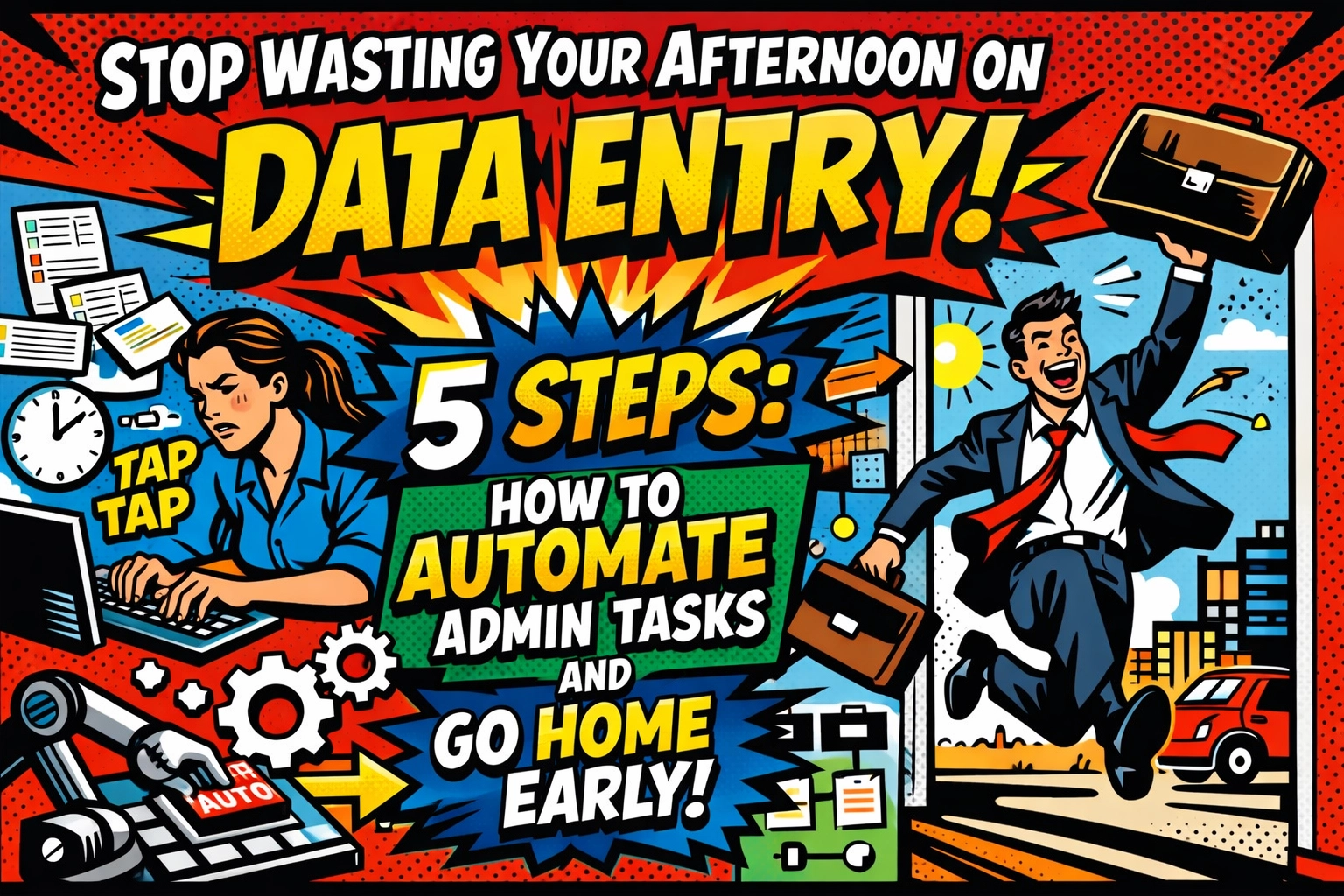
  • Stop Wasting Your Afternoon on Data Entry: 5 Steps How to Automate Admin Tasks and Go Home Early

    Stop Wasting Your Afternoon on Data Entry: 5 Steps How to Automate Admin Tasks and Go Home Early

    It’s 2:42 PM.

    The sun is hitting your monitor at that awkward angle that makes you squint, and you’re currently staring at a stack of digital invoices that need to be "manually reconciled."

    You know the drill…

    Highlight name. Copy. Alt-Tab. Paste. Highlight amount. Copy. Alt-Tab. Paste.

    Your neck is stiff. Your third coffee of the day has gone cold. And the worst part? You’re a business owner, not a professional copy-paster. Every minute you spend moving data from Point A to Point B is a minute you’re not growing your empire, talking to customers, or, heaven forbid, actually enjoying your life.

    But it doesn't have to be this way.

    Imagine a world where the data moves itself while you’re out grabbing a lunch that doesn't involve a keyboard. That’s the power of an ai virtual assistant for business.

    Let's break down the five steps to stop the madness and start automating.


    STEP 1: STOP PLAYING "MIDDLEMAN" WITH YOUR DATA

    ☕ 7:15 AM: The day begins.

    You’re scrolling through your inbox while the kettle boils. There are three new leads. That’s great news, right? Except now you have to manually enter their details into your CRM.

    Why? Because you’re still using a "Contact Us" email instead of a smart form.

    The first step to freedom is connecting your intake forms directly to your spreadsheets or database. If a customer is willing to type their name and email into a box on your website, that data should never touch your clipboard.

    Use tools like Google Forms or Typeform and link them directly to Google Sheets. The moment they hit "Submit," the row populates. No human intervention required.

    Business owner enjoying coffee while automating data entry for admin tasks.

    You just saved ten minutes. That’s enough time to actually drink your coffee while it’s hot.


    STEP 2: LET AI CLEAN UP THE MESS

    🔍 10:30 AM: The data is… messy.

    Someone typed their phone number as (555) 123-4567. Someone else typed 5551234567. Another person forgot to capitalize their own last name.

    If you’re the one going in and fixing those little errors, you’re losing the war. This is where you automate customer support with ai.

    Modern AI tools (like the ones we specialize in at Marblism) can act as your digital janitor. You can set up logic that says: "Hey, look at this column. If it looks like a phone number, format it like this. If a name isn't capitalized, fix it."

    Instead of cell-by-cell editing, you’re just supervising.

    "Is this right?" the AI asks.
    "Yes," you say.
    Done. Hundreds of rows cleaned in seconds.

    If you want to see how this looks in the real world, check out what we're building over at https://marblism.link/scott-bowen. It’s basically magic, but with more logic and less top hats.


    STEP 3: CONNECT YOUR APPS (THE "GLUE" STRATEGY)

    📱 1:15 PM: Your phone buzzes.

    It’s a notification from Shopify. A new order.
    Then a notification from Slack. A team member asking about the order.
    Then an email from the customer asking for a tracking number.

    You’re currently the "Glue" holding these apps together. You’re manually moving info from Shopify to Slack to Gmail.

    Stop. Just stop.

    Use automation platforms like Zapier or Make to build "Zaps." Think of them as simple If/Then statements for your business.

    • IF a new order comes in on Shopify…
    • THEN send a message to Slack…
    • AND add the customer to our mailing list…
    • AND create a draft reply in Gmail.

    Most of these setups take about ten minutes to build. Once they’re live, they run 24/7. They don’t take lunch breaks. They don’t get bored. They just work.


    STEP 4: USE THE "BRAIN" INSIDE THE SPREADSHEET

    📊 3:00 PM: The afternoon slump hits.

    This is usually when you start making mistakes. You miss a digit. You skip a row.

    But spreadsheets have built-in brains you’re probably not using. Functions like ARRAYFORMULA() or IMPORTRANGE() can move data across different sheets automatically.

    Instead of typing "Pending" next to 50 different orders, you can write one formula that looks at the payment status and fills the column for you.

    AI virtual assistant for business managing an automated spreadsheet to organize data.

    It feels like cheating. It’s not. It’s just being smart. When you combine these formulas with an ai virtual assistant for business, you aren't just managing data, you're presiding over an automated kingdom.


    STEP 5: DEPLOY THE HEAVY LIFTERS (RPA)

    🌙 4:45 PM: The lights are almost off.

    For the really complex stuff, like moving data between old-school software that doesn't "talk" to other apps, you need Robotic Process Automation (RPA).

    This sounds fancy, but it just means a script that records your mouse movements and clicks. It mimics exactly what you do.

    • Open the ERP.
    • Click the "Export" button.
    • Wait for the download.
    • Upload to the CRM.

    You record it once, and then you tell the robot to do it every day at 5:00 PM.

    While the robot is grinding away at the system-to-system transfers, you’re already in your car. You’re heading home. You’re actually going to see your family or hit the gym or finally watch that show everyone’s talking about.


    WHY DOES THIS MATTER RIGHT NOW?

    The world is moving fast. Your competitors aren't hiring more people to type faster; they’re building systems to type for them.

    If you stay stuck in the "manual" lane, you’ll eventually run out of gas.

    Automating your admin tasks isn't just about "saving time." It's about mental bandwidth. When you stop worrying about data entry, you start thinking about strategy. You start thinking about scale.

    "I used to spend three hours a day just moving lead info from our site to our sales tracker," says Mark, a small business owner. "Now, I don't even look at the tracker until it's time to make calls. The AI handles the rest. I feel like I got my life back."

    Scaling shouldn't be this easy. But here we are.


    YOUR NEW AFTERNOON ROUTINE

    🤝 5:00 PM: You step back into your day.

    The chaos is gone before you even take your first sip of water.

    You look at your to-do list. Everything is checked off. Not because you worked harder, but because you worked smarter.

    Your customer support is being handled. Your data is structured. Your apps are talking to each other.

    You smile.

    You don't have to be a tech genius to make this happen. You just need to decide that your time is worth more than $15 an hour (which is what you’re effectively paying yourself when you do manual data entry).

    Ready to see how an ai virtual assistant for business can transform your workflow? We’ve got the tools to help you build your own automated dream team.

    A person leaving work at sunset while an AI virtual assistant automates admin tasks.

    Check out the future of business automation here: https://marblism.link/scott-bowen.


    FREQUENTLY ASKED QUESTIONS

    Q: Is automation expensive to set up?
    No. Many of the tools mentioned, like Google Sheets and basic Zapier tiers, have free versions. You can start small and scale as you grow.

    Q: Do I need to know how to code?
    Not at all. Most modern automation is "no-code." If you can drag and drop an icon, you can automate a workflow.

    Q: Will AI replace my assistants?
    No. It will free them up to do more important work. Instead of your assistant spending 4 hours on data entry, they can spend 4 hours talking to high-value clients.

    Q: How long does it take to see results?
    Immediately. The moment your first "Zap" or formula goes live, you’ve saved time that you’ll never have to spend again.


    THE FINAL WORD

    Stop fighting the spreadsheets. They’re winning, and they don’t even have feelings.

    Take your afternoons back. Build a business that runs while you sleep. The tools are ready. The question is… are you?

    Go home early today. You’ve earned it.

    START AUTOMATING NOW
    https://marblism.link/scott-bowen

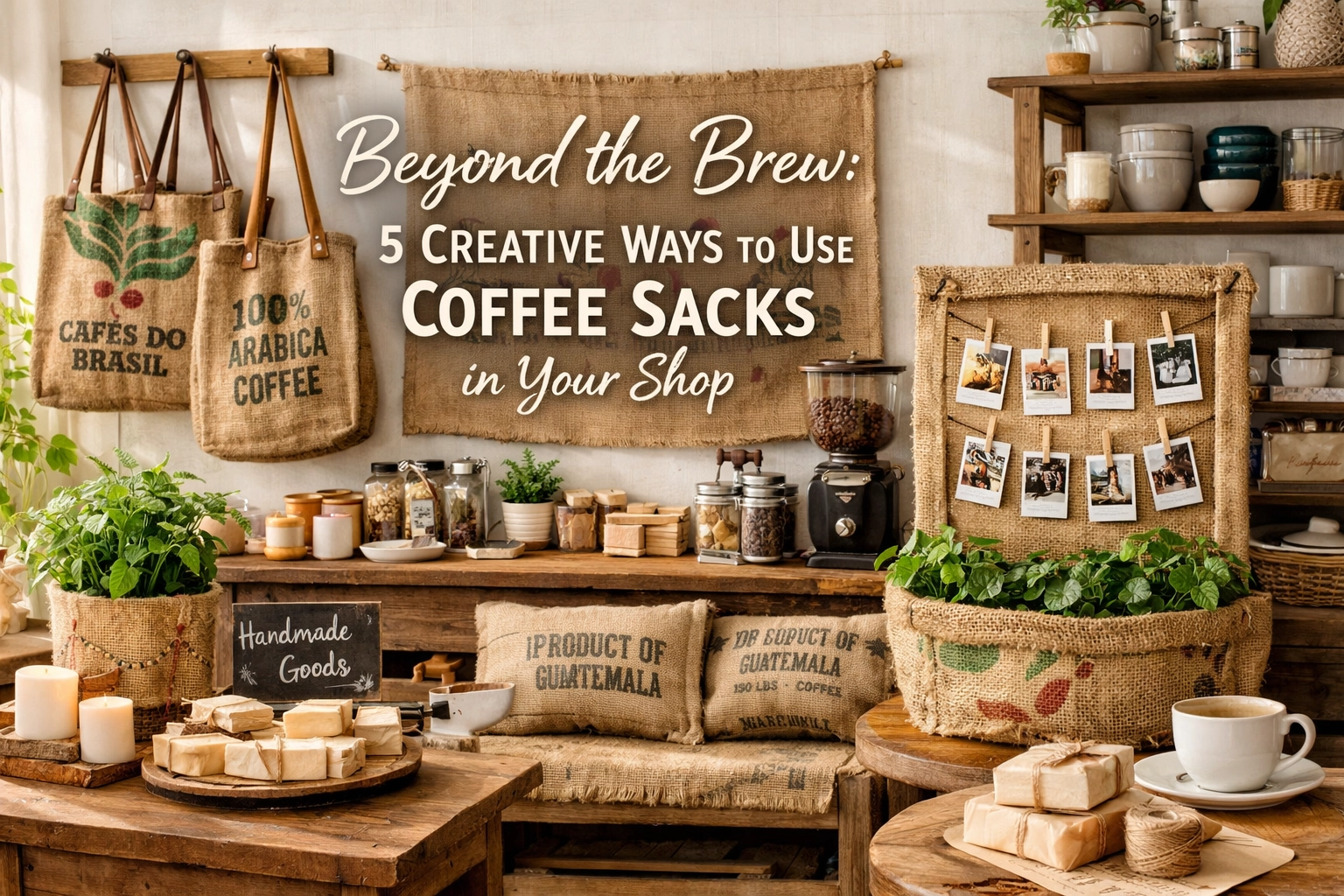
  • Beyond the Brew: 5 Creative Ways to Use Coffee Sacks in Your Shop

    Beyond the Brew: 5 Creative Ways to Use Coffee Sacks in Your Shop

    Let’s be honest: there is something undeniably romantic about a stack of burlap coffee sacks sitting in the corner of a roastery. They smell like earth, jute, and the promise of a truly spectacular morning. But once those green beans have been lovingly roasted here at Limini Coffee and moved into their valved bags, those beautiful, hand-stamped hessian sacks often end up forgotten in a storeroom or, worse, the bin.

    What a waste of good "theatre," right?

    In the world of specialty coffee, the "vibe" of your shop is almost as important as the TDS of your espresso. Customers aren't just buying a caffeine hit; they’re buying into a story. They want to feel the connection between the farm in Ethiopia and the ceramic cup in their hand. Upcycling your old coffee sacks is one of the easiest, cheapest, and most visually striking ways to tell that story.

    So, before you toss those bags, let’s talk about how to turn "trash" into high-end cafe decor. Here are five creative ways to give your coffee sacks a second life.


    1. The Gallery Wall: Statement Art with a Story

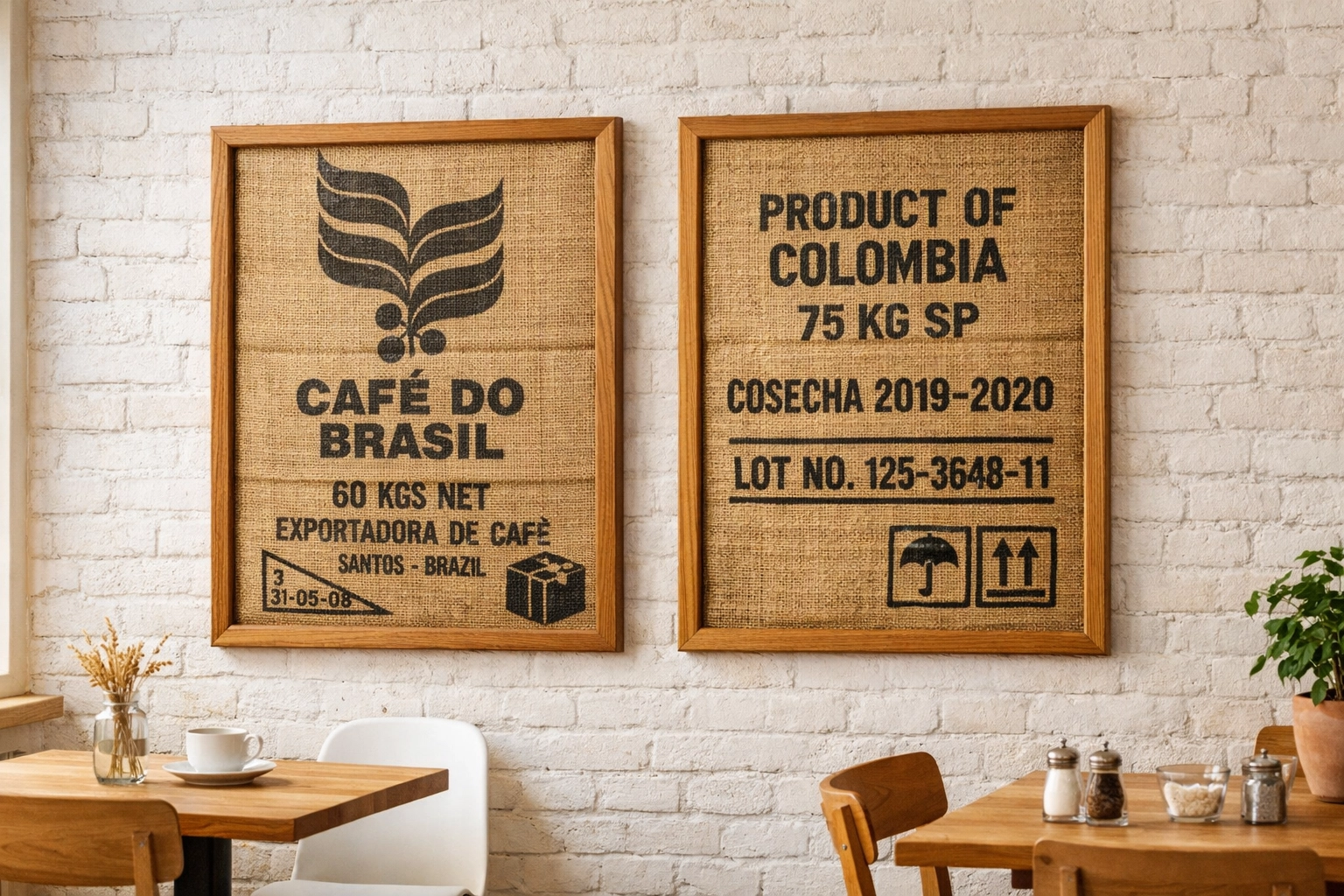
    If you’ve ever looked closely at a coffee sack, you’ll know they are essentially giant pieces of graphic design. From the bold, black stencil work of Brazilian estates to the colourful, intricate crests found on Colombian exports, these bags are art in their own right.

    Instead of hiding them, why not frame them?

    Framing a section of a sack creates an instant focal point. It screams "Specialty Coffee" without you having to say a word. We recommend using FSC-certified wooden frames to keep that natural, earthy aesthetic going.

    Pro Tip: Don’t just frame the whole bag. Look for the most interesting part, the "Product of Peru" stamp, the shipping marks, or the weight indicators.

    Framed burlap coffee sacks with origin stamps used as wall art in a modern cafe.

    If you’re feeling extra brave, you can create a collage. Mix and match different origins to show off the global nature of your menu. It’s a great conversation starter for customers waiting for their flat white. While they wait, they might even ask about your sourcing, giving you the perfect opening to talk about the quality of the beans you’re using.


    2. Industrial Chic: Burlap Cushion Covers

    Let’s talk about the "cosy factor." If your shop has a seating area with benches or booths, you probably need cushions. But standard retail cushions can look a bit… well, boring. They don’t exactly scream "artisan roastery."

    Enter the coffee sack cushion.

    The rough, textured weave of the jute pairs beautifully with the industrial aesthetic that most modern cafes go for. Think exposed brick, hanging Edison bulbs, and reclaimed wood.

    But wait, isn't burlap itchy?
    Yes, it can be. If you’re worried about your customers' comfort, we suggest a "hybrid" approach. Use the coffee sack for the front of the cushion (where the cool branding is) and a soft cotton or canvas for the back. That way, it looks rugged but feels like a cloud.

    This is also a fantastic way to reinforce your brand. If you use wholesale specialty coffee from us, you’ll likely have a steady supply of these bags. Using them for seating makes the whole shop feel cohesive. It says, "We know coffee, from the farm to the furniture."


    3. Setting the Stage: Rustic Table Runners

    When you’re building a coffee shop, the display area for your retail bags and equipment is crucial. You want your bags of beans to look enticing, but placing them on a cold, hard shelf can sometimes feel a bit clinical.

    A coffee sack table runner adds immediate warmth and texture. It acts as a backdrop that makes your retail packaging pop.

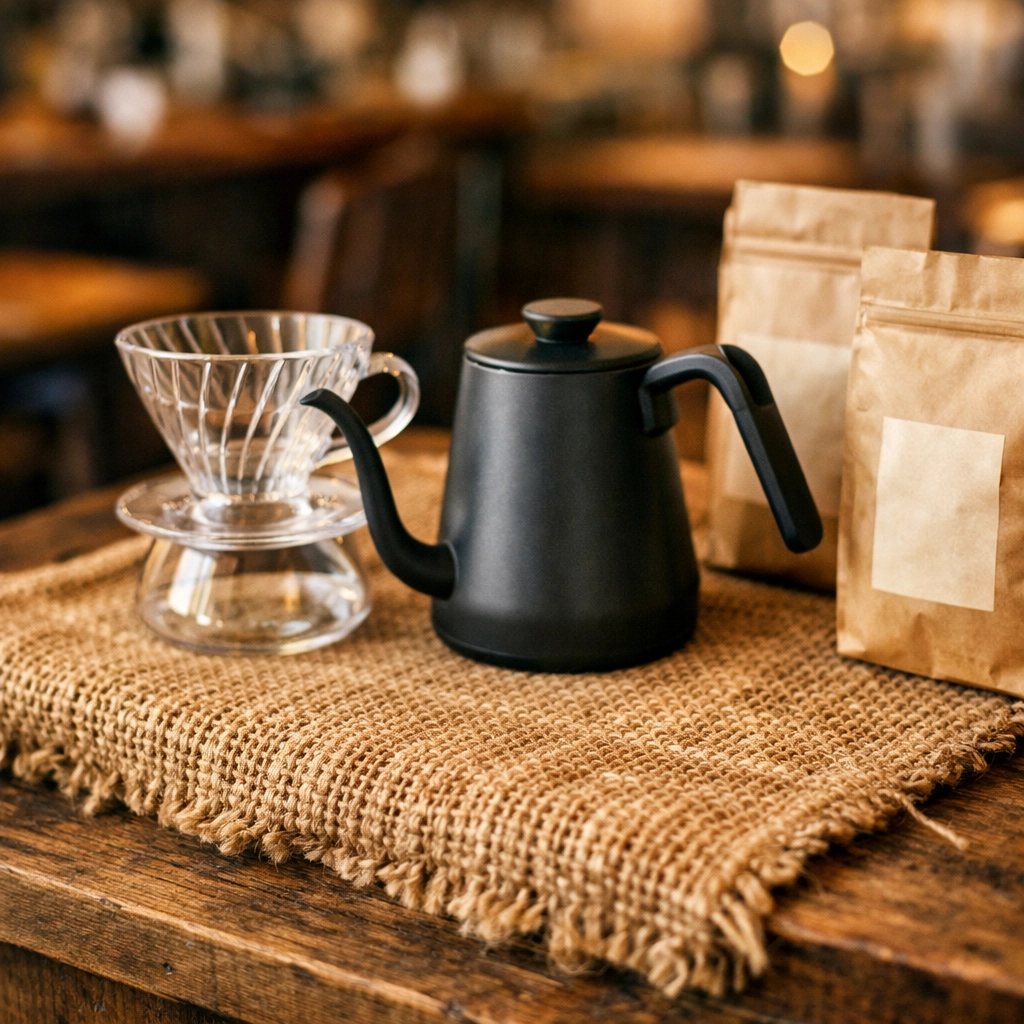
    Rustic coffee sack table runner displaying a V60 dripper and kettle on a wooden table.

    To do this, simply cut the sack along the side seams to create a long flat piece of fabric. Give it a quick hem (or leave it frayed if you’re going for that "shabby chic" look) and drape it over your merchandise table. It’s a subtle nod to the raw materials of the trade.

    It works especially well if you’re displaying brewing gear like V60s or AeroPresses. It reminds people that coffee starts in the dirt and ends in the cup. If you need to brush up on how to explain that process to your customers, our training overview might be just what you need to get the staff on the same page.


    4. Hiding the "Ugly" Bits: Cafe Curtains and Screens

    Every shop has them. The area under the counter where you keep the backup jugs, the boiler area, or the storage cupboard that doesn't have a door.

    Instead of expensive cabinetry, why not use coffee sacks?

    Using clip-style curtain rings on a simple tension rod, you can create "cafe curtains" in minutes. They are incredibly functional for hiding clutter while maintaining the theme of the shop.

    We’ve seen this used effectively to screen off the espresso machine maintenance area or to cover up stacks of coffee cups. It’s practical, it’s cheap, and it looks intentional rather than like a last-minute fix.


    5. Functional Decor: Storage Baskets and Totes

    Coffee sacks are incredibly durable. They are designed to hold 60kg to 70kg of green beans, so they aren’t going to rip easily. This makes them perfect for creating storage baskets.

    You can stiffen the fabric with a bit of interfacing or simply fold the tops down to create a "bucket" shape. These are great for:

    • Holding rolled-up blankets for outdoor seating.
    • Organising your retail bags of Limini Coffee.
    • Creating "gift hampers" for your regulars.

    Imagine a customer being able to buy a "Coffee Lover's Kit" that comes in a miniature, hand-sewn coffee sack. It’s the kind of detail that turns a one-time visitor into a loyal fan.

    Upcycled burlap coffee sack repurposed as a cozy storage basket for blankets in a cafe.


    The "Dirty" Truth: How to Prep Your Sacks

    Before you go grabbing the sewing machine, we need to talk about hygiene. Coffee sacks have travelled halfway across the world. They’ve been in shipping containers, on trucks, and on warehouse floors. They are dusty, and sometimes they smell a bit… well, like a warehouse.

    Don't skip the prep work:

    1. Shake it out: Go outside and give the sack a vigorous shake. You’ll be surprised how much "origin dust" (and maybe a stray green bean or two) comes out.
    2. The Soak: We don't recommend putting these in a standard washing machine straight away: the jute fibres can clog up your filter and ruin the machine. Instead, soak them in a tub of lukewarm water with a mild detergent.
    3. The Vinegar Trick: Adding a splash of white vinegar to the rinse water helps neutralise that "hessian" smell.
    4. Air Dry: Never put burlap in the dryer. It will shrink, warp, and potentially catch fire if it gets too hot. Hang it out in the sun. The UV rays also help kill off any lingering bacteria.
    5. Ironing: If you want that crisp "art gallery" look, iron the sack while it’s still slightly damp. Use a high heat setting but put a thin cloth between the iron and the sack to prevent scorching the ink.

    Why Bother? (The Bigger Picture)

    You might be thinking, "Penny, I'm trying to run a business here, I don't have time to sew cushions." And we get it. Running a cafe is a marathon of tamping, steaming, and cleaning.

    But here’s the thing: customers in 2026 care about sustainability. They care about where their products come from. When they see you upcycling coffee sacks, they see a business that cares about its footprint. They see a business that values the craft.

    It’s all part of the theatre of coffee. When a customer walks in and sees the origin stories literally woven into the furniture, they are more likely to appreciate the nuances of that crema or the precision of your espresso equipment.

    At Limini Coffee, we put a huge amount of effort into sourcing the best beans and roasting them to perfection. We think those beans deserve a home that looks as good as they taste.

    So, next time you finish a bag of our Brazil Fazenda or Ethiopian Yirgacheffe, don't just chuck the sack. Grab a pair of scissors, a frame, or a needle and thread, and bring a bit of the farm into your shop.

    Have you created something cool with your coffee sacks? We’d love to see it! Tag us in your photos or drop us a message. And if you’re looking to stock up on some fresh beans (and get some new sacks in the process), you know where to find us.

    Happy upcycling! ☕️✨