Author: admin

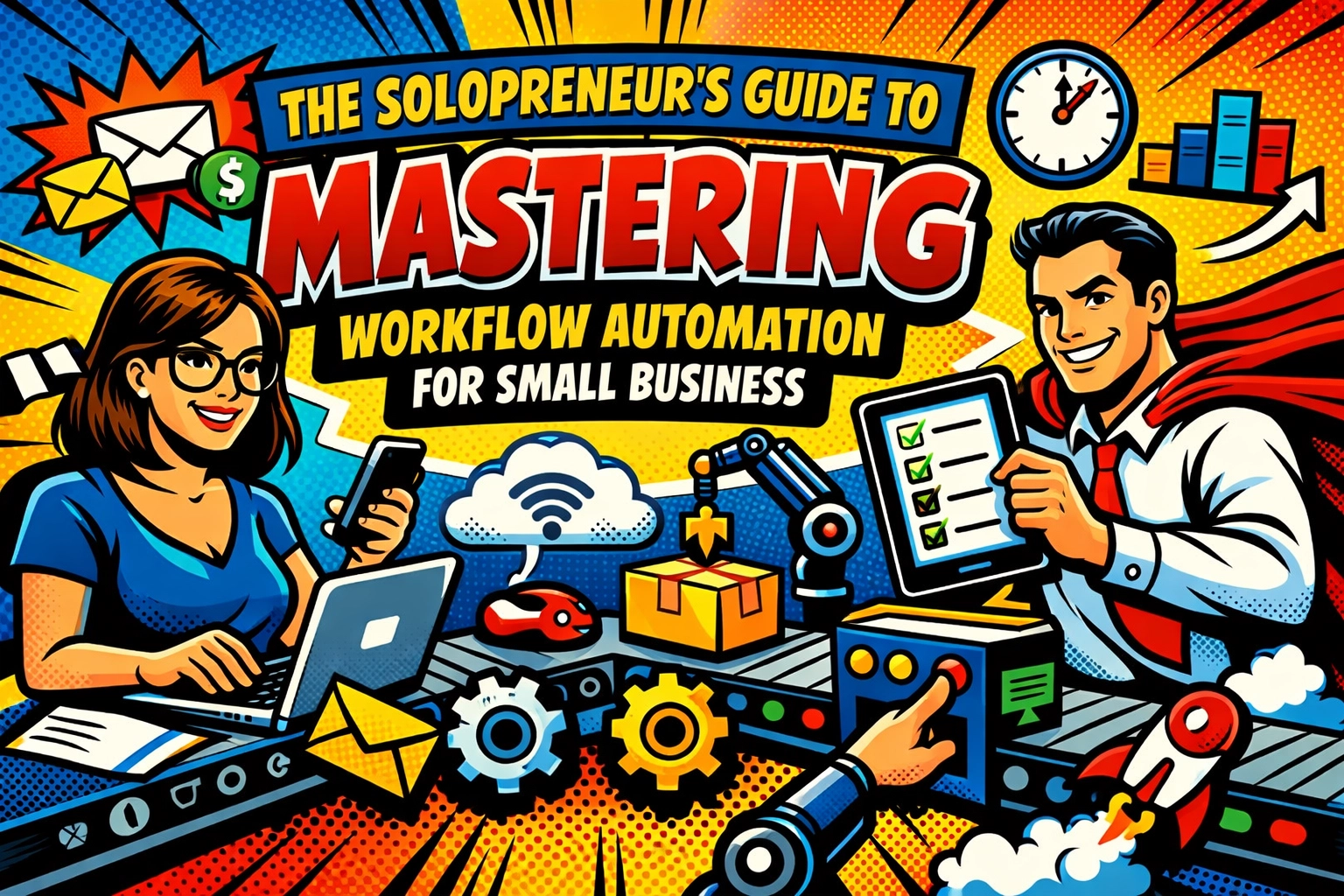
  • The Solopreneur’s Guide to Mastering Workflow Automation for Small Business

    The Solopreneur’s Guide to Mastering Workflow Automation for Small Business

    You’re doing it again.

    It’s 9:00 PM. Your dinner is a sad, lukewarm memory on the kitchen counter, and you’re hunched over a laptop, manually copying data from an email into a spreadsheet. Again.

    You started this business for freedom. You wanted to be the visionary, the strategist, the one calling the shots. Instead, you’ve become a glorified data entry clerk for your own company. You’re the CEO, the intern, and the IT department all rolled into one, and the intern is exhausted.

    Being a solopreneur shouldn’t feel like running a marathon in sand.

    But there’s a way out. It’s quiet. It’s efficient. And it doesn’t require hiring a single human being. It’s about building a digital nervous system that handles the "boring stuff" while you focus on what actually makes money.

    Let’s talk about how you reclaim your time with workflow automation.

    8:00 AM: THE INBOX AVALANCHE

    The day begins. You reach for your phone before you’ve even had a sip of coffee.

    47 new emails.

    Three are potential leads. Twelve are "quick questions" from current clients. The rest? Pure noise. Usually, this is where your productivity goes to die. You spend two hours triaging, replying to the same questions for the thousandth time, and manually adding names to your CRM.

    But today is different.

    An ai virtual assistant for business is already on it. While you were sleeping, an AI layer filtered the noise. It tagged the leads, drafted initial responses based on your previous emails, and updated your CRM.

    … You just send a thumbs-up to the drafts and take your first sip of coffee. The chaos is gone before you’ve even left the bedroom.

    AI virtual assistant for business managing digital tasks and inbox for a solopreneur.

    STOP JUGGLING. START AUTOMATING.

    Most solopreneurs think automation is for the big guys. They think you need a dev team and a six-figure budget to make things "talk" to each other.

    They’re wrong.

    In 2026, automation is the great equalizer. If you can describe a task, you can probably automate it. The goal isn't just to "save time", it’s to remove the cognitive load of repetitive tasks. Every time you have to remember to "send that follow-up" or "generate that invoice," you’re burning mental fuel you should be using for growth.

    Before you dive into the tools, you need to map the madness.

    MAP THE MADNESS: THE 3-STEP AUDIT

    You can’t automate a mess. If your current process is "I just wing it," an AI tool will just help you wing it faster (and worse).

    1. The Repetition Audit: For one week, track everything you do. Every time you perform a task, ask: Does this happen more than three times a week? Is the process exactly the same every time? If the answer is yes, that task is a prime candidate for execution by a digital clone.
    2. The Decision Point Check: Automation loves "If This, Then That." If a task requires deep, creative human judgment, keep it. If it requires following a set of rules (e.g., "If a client pays, send them the onboarding PDF"), give it to the bots.
    3. The App Map: List every tool you use. Your email, your calendar, your invoicing software, your CRM. These are the puzzle pieces. Automation is the glue.

    📱 10:30 AM: THE CUSTOMER SUPPORT CHAOS

    Your phone buzzes.

    It’s a customer asking about your pricing for the third time. Then another asking how to log in. These are "low-value" interactions, not because the customers don't matter, but because the answers are already on your website.

    In the old days, you’d stop your deep-work session, lose your flow, and type out the same response.

    Now? You automate customer support with ai.

    A custom-trained AI agent, let's call her your Front Desk, scans the incoming message. She knows your pricing, your FAQ, and your tone of voice. She answers the question in seconds.

    … You don't even see the notification. You’re busy closing a $5,000 deal.

    Solopreneur closing a sales deal while AI software automates customer support responses.

    EMPLOYEE OF THE MONTH. EVERY MONTH.

    When people hear "ai virtual assistant for business," they often think of a person in another time zone. But the modern version is a suite of integrated AI agents that never sleep, never take a sick day, and never forget a follow-up.

    Marblism specializes in this kind of seamless business automation. We don't just give you a tool; we give you a system that works while you’re at the gym or playing with your kids.

    If you're tired of being the bottleneck in your own business, you need to see what's possible. Check out how we're changing the game for solopreneurs here: https://marblism.link/scott-bowen.

    THE 30-DAY SOLOPRENEUR ROADMAP

    Don't try to automate your entire life in one weekend. You’ll burn out and go back to your spreadsheets. Follow this timeline instead:

    Days 1-7: The Triage
    Pick one task. Just one. Maybe it’s your meeting scheduling. No more "Does Tuesday at 2 PM work for you?" emails. Set up an automated scheduler that syncs with your calendar and sends the Zoom link automatically.

    Days 8-14: The Lead Machine
    Connect your contact form to your CRM. Use an AI tool to summarize the lead’s request and provide you with a "cheat sheet" before you jump on a discovery call.

    Days 15-21: The Support Shield
    This is where you automate customer support with ai. Set up a simple AI chatbot trained on your docs to handle the "Where is my stuff?" and "How do I…" questions.

    Days 22-30: The Admin Clean-up
    Automate your invoicing. When a project is marked "Done" in your task manager, the invoice should trigger automatically. No more chasing checks manually.

    A solopreneur enjoying free time while a business workflow automation system runs efficiently.

    🌙 6:00 PM: THE CLEAN BREAK

    The sun is setting.

    In the "Before Times," this is when you’d start your second shift, the "admin shift." But today? Your dashboard shows that 14 customer queries were resolved, 3 invoices were sent, and your leads for tomorrow are already researched and waiting.

    You close your laptop.

    The house is quiet. The work is done. Not because you worked harder, but because you built a machine to work for you.

    … You actually have time for a hobby. Or a nap. Or a life.

    FAQ: FREQUENTLY ASKED QUESTIONS (OR, THE STUFF YOU'RE WORRIED ABOUT)

    Q: Won’t my customers hate talking to a bot?
    A: Not if the bot is actually helpful. People hate bad bots. They love getting the right answer in 5 seconds instead of waiting 5 hours for a human to email them back.

    Q: Is this going to be expensive?
    A: Think of it this way: How much is one hour of your time worth? If you save 10 hours a week with automation, and your rate is $100/hr, you just found $4,000 a month in "lost" time. The software costs a fraction of that.

    Q: Do I need to know how to code?
    A: No. Modern tools are drag-and-drop. If you can use a smartphone, you can build a workflow.

    Q: What if the AI says something stupid?
    A: You set the guardrails. You decide what the AI can and can't say. It’s your business; you stay in control.

    SCALING SHOULDN'T BE THIS EASY. BUT HERE WE ARE.

    The difference between a "freelancer" and a "business owner" is systems. A freelancer is the engine. A business owner builds the engine.

    Workflow automation is how you stop being the parts and start being the architect. It’s how you scale without losing your mind: or your weekends.

    The tools are ready. The question is: Are you ready to stop being your own most expensive employee?

    Take the first step toward a business that runs itself.

    Discover the Marblism way to automate your success.

    Scaling is inevitable when the busywork is invisible.

    … Go ahead. Take that nap. The bots have it from here.

  • 10 Reasons Your Home Coffee Doesn’t Taste Like a Café’s (And How to Fix It)

    10 Reasons Your Home Coffee Doesn’t Taste Like a Café’s (And How to Fix It)

    We have all been there. You wake up, stroll into the kitchen, and lovingly prepare your morning brew. You’ve got the bag of beans, the kettle is whistling, and the aroma fills the room. But then you take that first sip and… it’s just okay. It’s fine. But it isn't that cup you had at the local speciality shop yesterday. You know the one, the coffee that was syrupy, sweet, and had that perfect "how did they do that?" finish.

    So, why the gap? Is it magic? Is it the expensive beard the barista is sporting? Surprisingly, no.

    At Limini Coffee, we spend our days obsessing over the tiny details that turn a "fine" cup of coffee into an extraordinary one. The difference between home brewing and café brewing isn't usually down to one big secret; it's a combination of ten small variables that add up to a massive difference in the cup.

    Let's dive into why your home brew might be falling short and, more importantly, exactly how you can fix it.


    1. Your Beans Aren't as Fresh as You Think

    This is the big one. Most coffee bought from a supermarket has been sitting on a shelf for weeks, if not months. Even if the bag is sealed, coffee starts to lose its vibrant aromatic compounds the moment it leaves the roaster.

    When we roast coffee here at Limini, we’re looking for that "sweet spot", usually between 5 and 21 days after roasting. If your beans are older than a month, they’ve likely gone stale. Stale beans taste flat, woody, and bitter.

    The Fix: Buy fresh. Look for a "Roasted On" date, not a "Best Before" date. We recommend ordering small batches frequently so you’re always using beans at their peak. You can find our latest seasonal roasts over at Limini Coffee.

    Freshly roasted speciality coffee beans spilling from a craft paper bag onto a rustic wooden surface.

    2. The Water Quality (It’s 98% of your cup!)

    If you’re using water straight from the tap, you’re already at a disadvantage. Depending on where you live, your tap water might be full of chlorine, fluoride, or heavy minerals (hard water). These minerals don't just scale up your machine; they physically block the water from extracting the delicious oils and flavours from the coffee grounds.

    On the flip side, water that is too soft (like distilled water) will result in a flat, sour extraction because it lacks the minerals needed to "grab" the flavour.

    The Fix: Use a simple charcoal water filter jug (like a Brita) at the very least. If you want to get serious, look into third-wave water mineral packets. Basically, if your water tastes "hard" or chemical, your coffee will too.

    3. Grind Consistency: The Burr vs. Blade Battle

    Are you using a blade grinder? The kind that whirrs around like a blender? If so, that’s likely your biggest hurdle. Blade grinders chop coffee into uneven shards, some are dust (fines), and some are boulders. When you brew, the dust over-extracts and tastes bitter, while the boulders under-extract and taste sour.

    Cafés use professional burr grinders that ensure every single coffee particle is the exact same size. This leads to an even, balanced extraction.

    The Fix: Invest in a decent burr grinder. Even a high-quality manual hand grinder will beat a cheap electric blade grinder any day. It’s the single best investment you can make for your home setup.

    4. You’re Not Using a Scale

    "Two scoops" is not a measurement. Coffee beans vary in density; a scoop of a dark roast will weigh significantly less than a scoop of a light roast. If you aren't weighing your coffee and your water, you’re playing a guessing game every morning.

    Precision is the hallmark of a great barista. We use ratios, usually 1 gram of coffee to 16 or 17 grams of water for filter coffee.

    The Fix: Buy a digital scale that measures to 0.1g. Weigh your beans before grinding and weigh the water as you pour. Consistency is the only way to repeat a great cup. You can even use our coffee brewing calculator to get your ratios perfect.

    A digital coffee scale weighing fresh beans next to a pour-over dripper for precise home brewing.

    5. Water Temperature is Too High (or Too Low)

    We’ve all heard the myth that you should use "boiling water." Please, don't. Boiling water (100 °C / 212 °F) can scorch the delicate grounds, resulting in a harsh, ashy taste. Conversely, if your water is too cool (below 85 °C / 185 °F), you won't extract enough sweetness.

    The Fix: Aim for a temperature between 88 °C and 95 °C (190 °F to 203 °F). If you don't have a temperature-controlled kettle, simply let your kettle sit for about 2 minutes after it boils before you start pouring.

    6. Dirty Equipment = Dirty Flavour

    Coffee is oily. Over time, those oils sit on your portafilter, your shower screen, or the bottom of your French press and go rancid. If you haven't cleaned your equipment with a dedicated coffee detergent recently, you're likely tasting last month's old, burnt oils.

    The Fix: Clean your gear! For espresso machines, "backflushing" with a cleaning powder is essential. For filter brewers, a simple scrub with hot, soapy water isn't enough: use a coffee-specific cleaner once a week to strip those stubborn oils. You can see how we keep things shiny in our training overview.


    7. Milk Handling and Microfoam

    If you're a latte or cappuccino lover, the milk is often where things go wrong. Most home steam wands are underpowered, leading to "bubble bath" foam: large, dry bubbles sitting on top of hot milk. Cafés produce microfoam, which has a texture like wet paint.

    Furthermore, many people overheat their milk. If you go past 70 °C (158 °F), the proteins break down and the sweetness disappears, replaced by a "cooked" or "scalded" taste.

    The Fix: Aim for a milk temperature between 60 °C and 65 °C (140 °F to 150 °F). This is the sweet spot where the lactose is most perceived as sweet. If you’re struggling with technique, check out our guide on understanding milk.

    Silky microfoam being poured into espresso to create a professional café-quality latte at home.

    8. The "Dose" is Too Small

    Did you know that many high-end cafés use "triple" baskets? While a standard home double shot might be 14g of coffee, many pros are using 18g, 19g, or even 22g of coffee for a single drink. This creates a much higher concentration of flavour and a richer mouthfeel.

    If your home espresso feels "thin," you might just need more coffee in the basket.

    The Fix: Check your basket size. If you can fit 18g in there without it hitting the shower screen, try it! A larger dose often leads to a more "café-like" intensity. For more on this, our choosing espresso equipment guide can help.

    9. Lack of "Dialling In"

    In a café, the barista tastes the coffee several times a day. As the temperature and humidity in the room change, the coffee changes too. They adjust the grind size (dialling in) to ensure the shot is pouring at the perfect rate.

    At home, we often set the grinder once and leave it for a month. But as the beans age, they require a finer grind to maintain the same extraction.

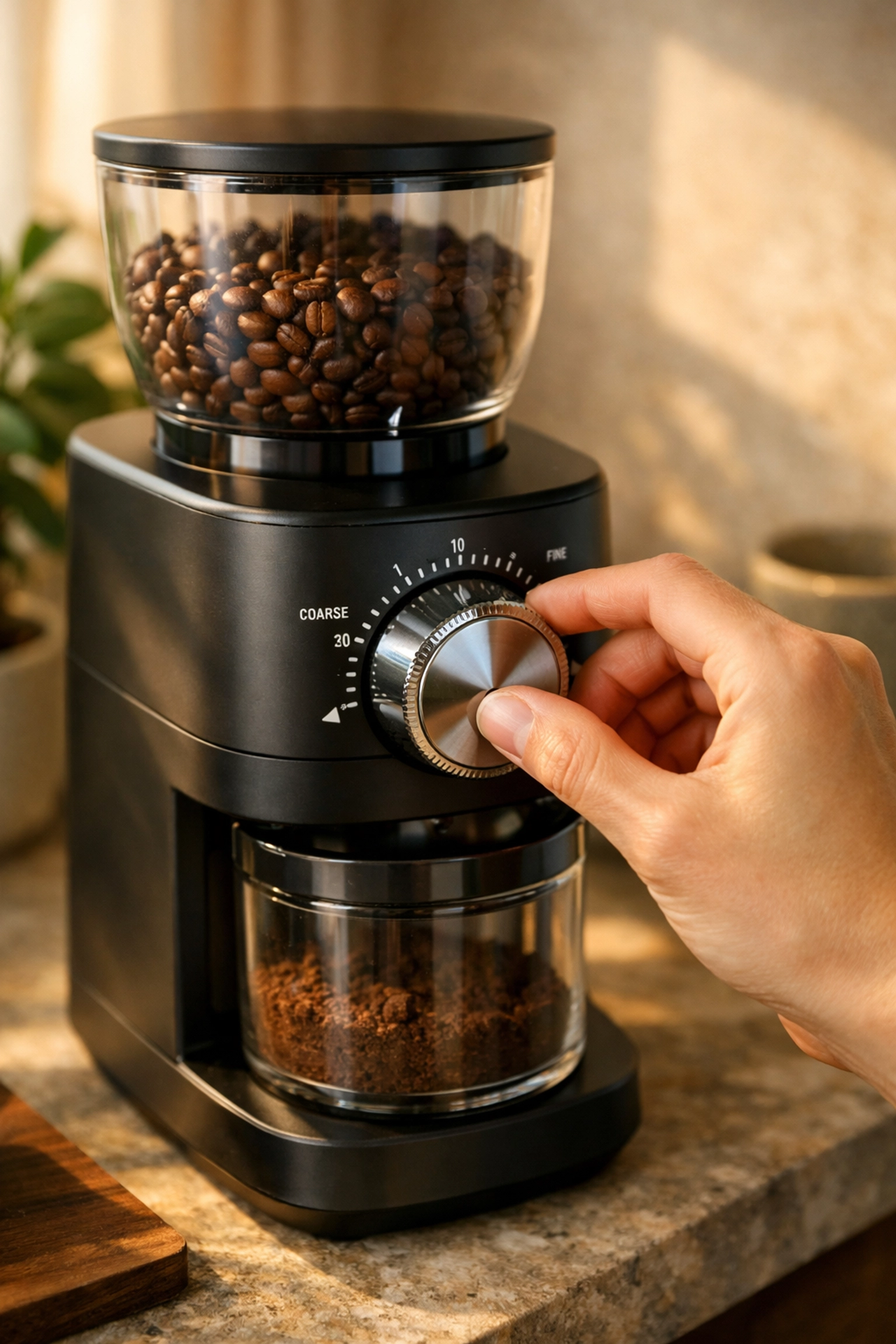
    The Fix: If your coffee starts tasting sour or watery, grind a little finer. If it's becoming bitter or taking too long to brew, go coarser. Don't be afraid to move that dial!

    Adjusting the grind size dial on a burr coffee grinder to dial in the perfect espresso extraction.

    10. The Equipment Bottleneck

    We hate to say it, but sometimes the gear really does matter. A £50 espresso machine from a department store simply cannot produce the 9 BAR of consistent pressure or the thermal stability required for true speciality espresso. These machines often use "pressurised baskets" to create fake crema, which masks the true flavour of the bean.

    The Fix: You don't need to spend £5,000, but moving to a machine with a non-pressurised basket and a PID (Proportional-Integral-Derivative) controller for temperature stability makes a world of difference. If you're looking for the gold standard, we often recommend looking at La Spaziale machines for their incredible reliability and temperature control.


    How to Start Improving Today

    It can feel overwhelming to change everything at once. If we were to give you a roadmap, it would look like this:

    1. Buy fresh beans. Head over to the Limini Coffee shop and grab a bag of something roasted this week.
    2. Use a scale. Stop guessing. Start weighing.
    3. Filter your water. It's cheap and makes a massive difference.

    Coffee is a journey, and honestly, that's the beauty of it. Each cup is an opportunity to learn something new about extraction, origin, and technique. If you ever feel like you've hit a wall, we offer barista training to help you bridge that gap between "home enthusiast" and "pro."

    The difference between your kitchen and your favorite café is usually just a few grams, a few degrees, and a little bit of practice. Keep brewing, keep tasting, and most importantly, keep enjoying the process!

    If you want to ensure you're starting with the best possible foundation, don't forget to check out our latest single-origin beans and blends at Limini Coffee. Happy brewing!

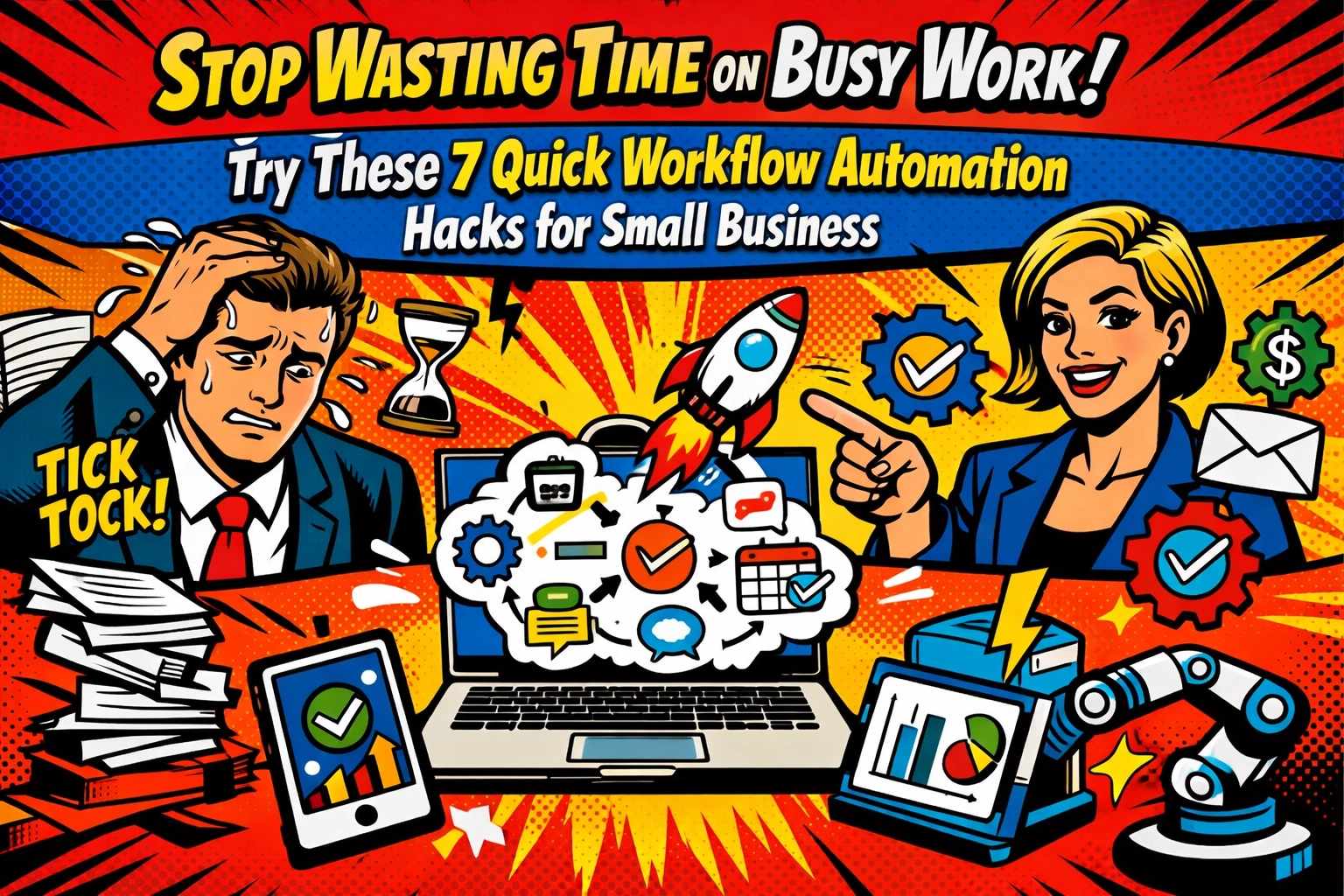
  • Stop Wasting Time on Busy Work: Try These 7 Quick Workflow Automation Hacks for Small Business

    Stop Wasting Time on Busy Work: Try These 7 Quick Workflow Automation Hacks for Small Business

    Workflow Automation for Small Business: Stop Doing the Busy Work

    ☕ 7:00 AM.

    You haven’t even finished your first cup of coffee, and your phone is already screaming at you. 42 unread emails. Three "urgent" Slack messages. A calendar that looks like a game of Tetris played by someone who hates you.

    You started this business to build something great, not to spend four hours a day copy-pasting data from a spreadsheet into an invoice. But here you are. Juggling. Scrambling. Slowly losing your mind to the "busy work" monster.

    It’s time to stop.

    Workflow automation for small business isn’t some futuristic dream for Silicon Valley giants. It’s for you. It’s for the person who wants their weekends back.

    1. KILL THE MANUAL TASK ASSIGNMENT

    You shouldn't have to tell your team what to do every single morning. Use tools like Trello or Asana to set up triggers. When a lead moves to "Signed," a task is automatically created for your onboarding team. No emails. No "did you see this?" messages. Just flow.

    Entrepreneur and robot high-five over desk, symbolizing efficient workflow automation for small business.

    2. ZAPIER IS YOUR NEW BEST FRIEND

    Think of Zapier as the digital glue of the internet. It connects over 8,000 apps. Want your Typeform entries to automatically create a new row in Google Sheets and then send a "Welcome" email via Gmail? Done. You don't need to write code. You just need to stop doing it yourself.

    3. GET AN AI FRONT DESK

    Your phone rings. You’re in a meeting. You miss the call. That’s a lost client. Using an AI-powered receptionist like My AI Front Desk means every call is answered. It schedules appointments, syncs with your Google Calendar, and even answers basic questions about your pricing. It’s like having a receptionist who never sleeps and doesn't need a lunch break. 🤝

    4. AUTOMATE THE DOCUMENT CHASE

    Waiting for clients to send over IDs or signed contracts is a special kind of hell. Set up an automated workflow that sends a reminder every 48 hours until the document is uploaded. Once it's there, the system flags it as "Complete." You just step back and watch the files roll in.

    5. SET UP "PANIC" ALERTS

    You can’t be everywhere at once. Set up threshold-based alerts. If a customer service ticket hasn't been answered in four hours, or if a project budget hits 80%, you get a ping. It’s management by exception. If everything is fine, your phone stays quiet. 📱

    6. LET AI SORT YOUR MAIL

    Use Microsoft Power Automate’s AI Builder to categorize incoming requests. Is it a billing issue? Route it to accounting. A technical bug? Straight to the dev team. Stop being the human routing station for your own company.

    7. NO-HANDS REPORTING

    Stop spending Friday afternoons building dashboards. Use a platform like Moxo to pull data from your CRM and your accounting software into one real-time view. You wake up, you look at one screen, you know exactly where the money is.

    Scaling shouldn't be this hard. But here we are. Luckily, you don't have to do it alone. Check out what we're doing over at Marblism to see how deep the rabbit hole of efficiency really goes.


    Why Your Business Needs an AI Virtual Assistant (Before Your Competitors Get One)

    🔍 11:00 AM.

    You’re staring at a spreadsheet. Your eyes are blurring. Your competitor just posted a LinkedIn update about their record-breaking quarter. They’re at the beach. You’re in a swivel chair that squeaks every time you breathe.

    The difference? They aren’t doing the work. Their AI is.

    An AI virtual assistant for business isn't just a chatbot that says "Hello, how can I help you?" It’s a silent partner that lives in your infrastructure, handling the heavy lifting while you focus on the big picture.

    THE EMPLOYEE THAT NEVER QUITS

    Traditional VAs are great, but they have limits. They need sleep. They have bad days. They quit for better offers. An AI virtual assistant is always on. 24/7/365. Whether a customer pings you at 3 AM or 3 PM, the response is instant, accurate, and on-brand. 🌙

    AI virtual assistant for business providing 24/7 support in a modern office at night.

    SCALING WITHOUT THE GROWING PAINS

    Usually, more business means more hiring. More hiring means more management, more payroll, and more headaches. AI breaks that cycle. Whether you have 10 customers or 10,000, your AI assistant handles the load without demanding a raise or a bigger office.

    THE SPEED OF RELEVANCE

    In 2026, speed isn't a luxury, it's a requirement. If you take two hours to respond to a lead, they’ve already moved on to the next guy. Your AI virtual assistant catches them in seconds. It qualifies the lead, books the call, and does the research before you even know they exist.

    DATA WITHOUT THE DRAMA

    Your AI doesn't just "do things", it learns. It sees patterns in customer questions. It knows which products are trending before you do. It turns your daily operations into a goldmine of insights.

    • "Is this lead worth my time?" The AI already checked their LinkedIn and company size. Yes, they are.
    • "What’s the status of the Smith project?" The AI pulled the latest logs. We're 2 days ahead of schedule.
    • "Can we afford a new hire?" The AI crunched the Q3 projections. Not yet, wait until October.

    DON'T GET LEFT BEHIND

    Your competitors are already integrating these tools. They are becoming leaner, faster, and more profitable. If you’re still manually answering "What are your hours?" via email, you’re losing.

    The barrier to entry is gone. You don't need a team of engineers. You just need to start.

    Stop being the bottleneck in your own success. See how you can transform your workflow right now at Marblism.

    FAQ: THE "REAL TALK" VERSION

    Is it hard to set up?
    No. Most tools are plug-and-play. If you can use a smartphone, you can automate your business.

    Will my customers hate talking to an AI?
    Only if the AI is bad. Modern AI assistants are conversational, helpful, and: most importantly: fast. People hate waiting more than they hate bots.

    Is it expensive?
    It’s significantly cheaper than a human salary. Think of it as an investment that pays for itself in saved hours within the first month.

    Do I lose control?
    Quite the opposite. You gain control because you finally have time to look at the data instead of being buried in the tasks.

    Successful business owner monitors growth data using workflow automation while relaxing.

    The chaos is gone before you even take your first sip of coffee. You smile. You step back into your day.

    Scaling shouldn't be this easy. But here we are.

    STAY AHEAD. START NOW.
    Get started with Marblism

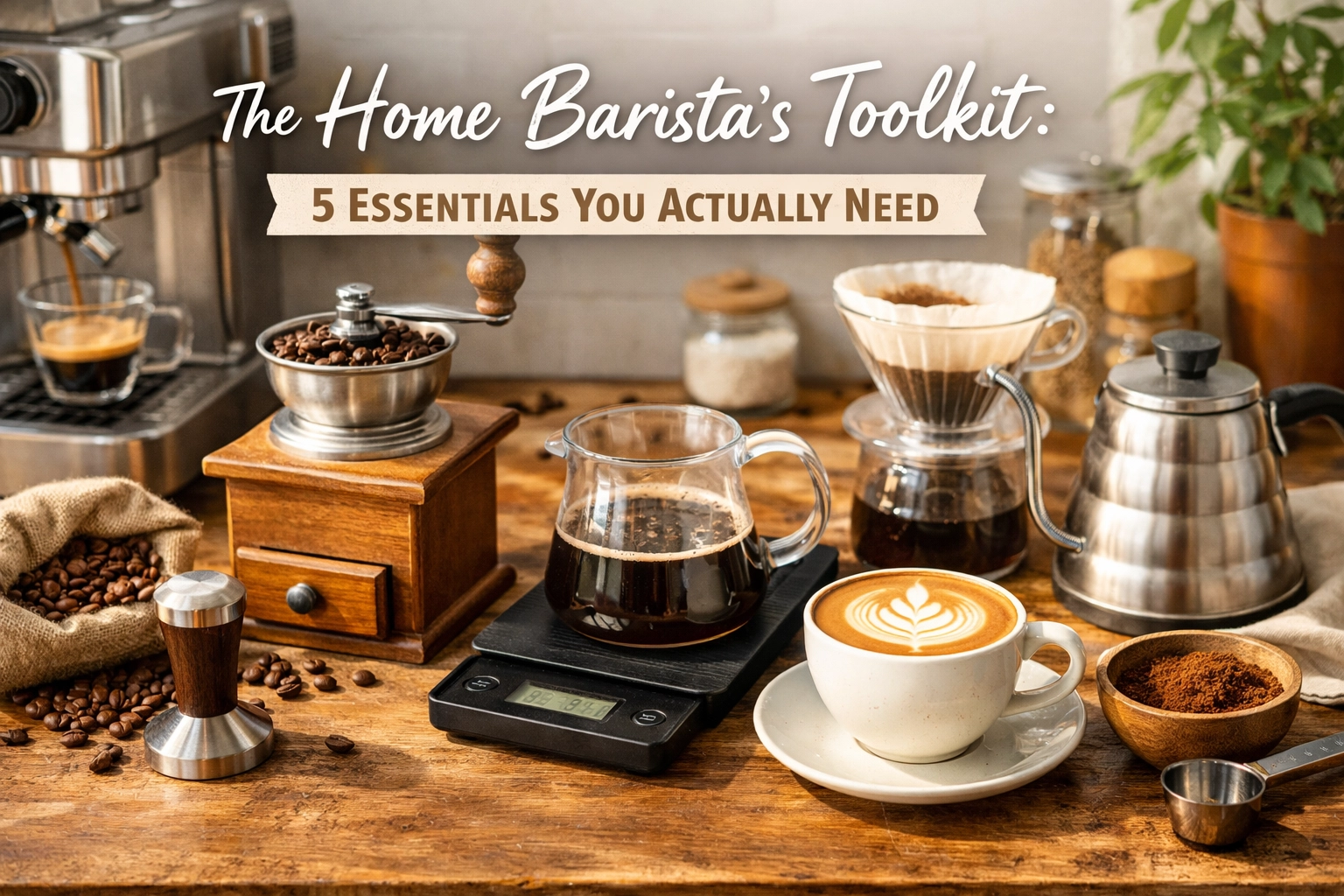
  • The Home Barista’s Toolkit: 5 Essentials You Actually Need

    The Home Barista’s Toolkit: 5 Essentials You Actually Need

    So, you’ve decided to take the plunge into the world of home espresso. You’ve probably spent hours scrolling through forums, watching YouTube videos of people in aprons performing what looks like actual chemistry, and wondering if you really need a £2,000 machine to get a decent caffeine fix.

    The truth? You don't. While a shiny machine is lovely to look at, the secret to that "coffee shop quality" brew at home isn't just about the pump and the boiler. It’s about the toolkit surrounding it. We see it all the time here at Limini Coffee, people spend their entire budget on a machine and then try to use pre-ground coffee and a plastic spoon to measure it out. Honestly, it’s a bit of a shame, because you’re missing out on about 80% of the potential flavour.

    If you’re ready to stop guessing and start brewing, we’ve narrowed down the absolute essentials. These are the five things you actually need to turn your kitchen counter into a pro-level coffee bar.


    1. The Burnt-Orange Elephant in the Room: A Quality Grinder

    We’re going to say something controversial: the grinder is more important than the espresso machine. There, we said it.

    If you use pre-ground coffee, it’s already losing its soul the moment the bag is opened. Coffee is a fresh agricultural product. Once those beans are crushed, the surface area increases exponentially, and oxygen starts stripping away the delicate aromatics. By the time it gets to your portafilter, it’s often flat and lifeless.

    But it’s not just about freshness; it’s about particle size. A "blade" grinder (the kind that looks like a tiny food processor) chops coffee into uneven boulders and dust. When water hits that mess, it flows through the dust too slowly (bitter!) and around the boulders too quickly (sour!).

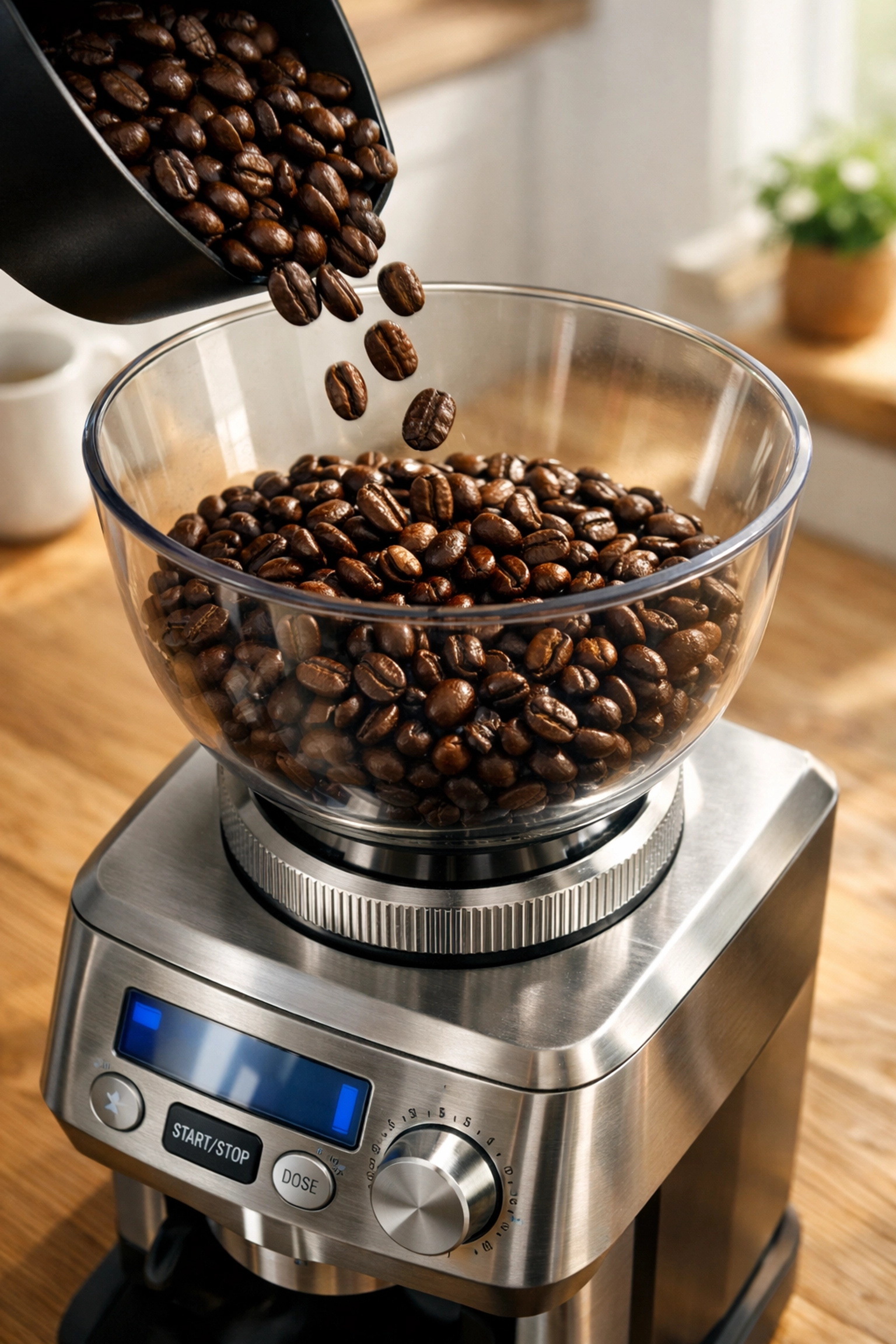
    You need a burr grinder. Burrs crush the beans to a specific, uniform size. This allows for even extraction. Whether you are looking at manual hand grinders or electric ones, ensure it has a fine enough adjustment range for espresso. If you are still in the research phase, it's worth checking out our guide on choosing espresso equipment to see how the grinder fits into the bigger picture.

    A premium burr coffee grinder on a wooden counter with fresh beans being poured into the hopper.

    2. The Digital Scale (Because "Eyeballing It" Is a Lie)

    "I just use a scoop." We hear this a lot. The problem is that different coffees have different densities. A scoop of a dark roast might weigh 14g, while a scoop of a dense, light-roast Ethiopian might weigh 18g. In the world of espresso, a 4g difference is the difference between a syrupy masterpiece and a watery disaster.

    Consistency is the king of coffee. To get the same result every morning, you need to measure:

    1. The Dose: How much dry coffee goes into the basket.
    2. The Yield: How much liquid coffee comes out.
    3. The Time: How long the water takes to pass through.

    We recommend a scale that measures to 0.1g accuracy. Why 0.1g? Because even a half-gram variance can change the resistance of the coffee puck, leading to "channeling", where water finds a weak spot and blasts through it rather than saturating the coffee evenly. If you want to get really nerdy with your numbers (and we hope you do), have a play with our coffee brewing calculator to see how these variables interact.


    3. A Proper Tamper

    Most entry-level machines come with a flimsy plastic "spoon-tamper" hybrid. Using one of these is like trying to paint a masterpiece with a toothbrush. It just doesn't work.

    Tamping is the process of compressing the coffee grounds into a flat, level "puck." This creates resistance so the water has to work hard to get through, extracting all those lovely oils and flavours along the way. If your tamp is crooked or uneven, the water will take the path of least resistance (there’s that channeling again).

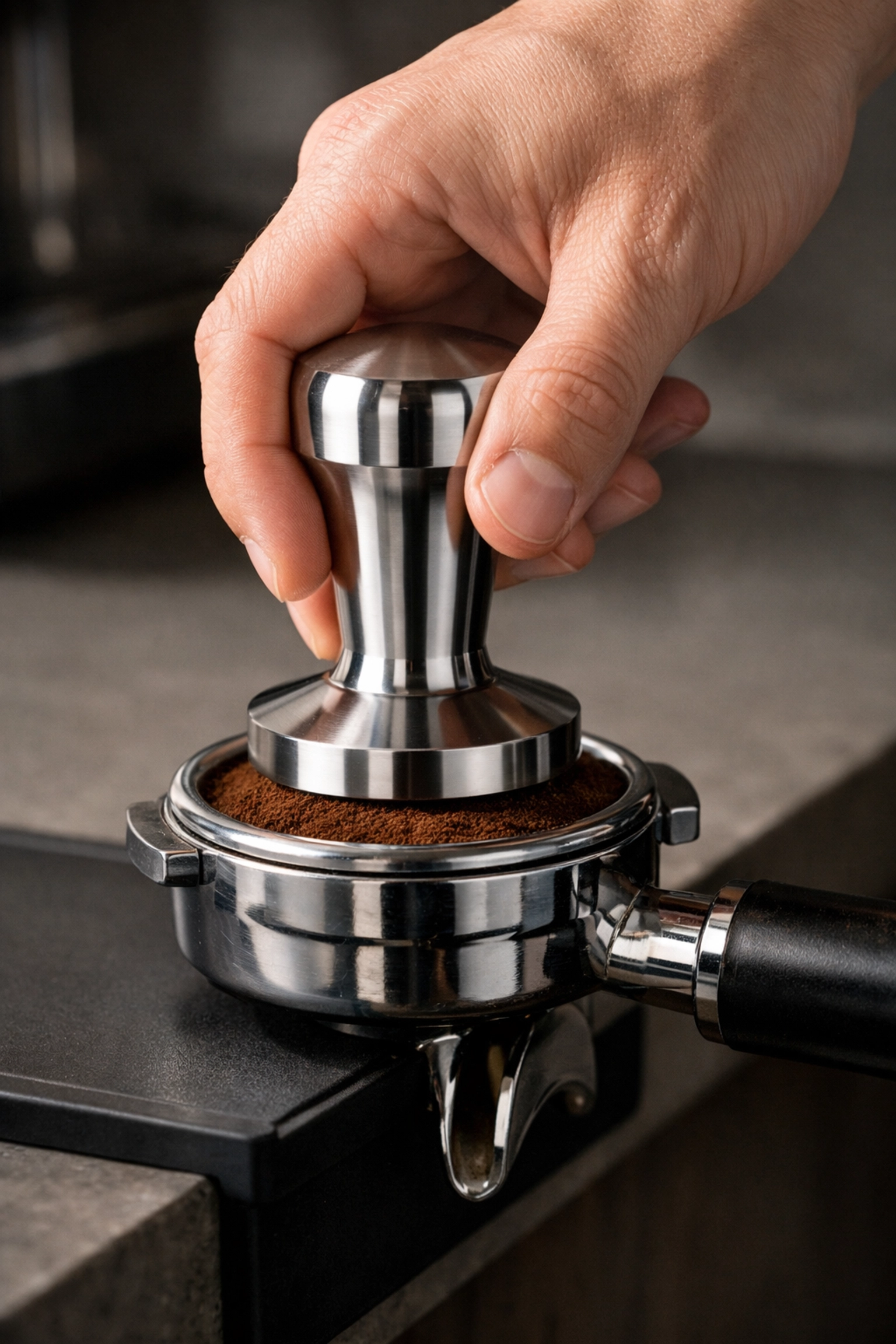
    You want a heavy, stainless steel tamper that fits your basket perfectly (usually 58mm for most pro-sumer machines, but check yours!). The goal isn't to press with all your body weight, about 15kg of pressure is plenty, but to ensure it is perfectly level. We’ve actually written a whole piece on the art of tamping if you want to master the technique.

    Using a stainless steel coffee tamper to compress espresso grounds in a portafilter.

    4. The Milk Pitcher (The Secret to Silky Microfoam)

    If you’re a fan of lattes or flat whites, you cannot overlook the pitcher. You might think any jug will do, but the shape and material of a dedicated stainless steel milk pitcher are designed for one thing: vortex creation.

    To get that glossy, "wet paint" texture we call microfoam, you need to spin the milk. A good pitcher has a spout designed for precision pouring (hello, latte art!) and a handle that lets you feel the temperature of the milk.

    Speaking of temperature, this is where most home baristas go wrong. You’re aiming for about 140 °F / 60 ºC. Anything higher and you start to scald the proteins, losing the natural sweetness of the milk and creating that "burnt" smell you get in bad high-street chains. If you’re struggling with your froth, take a look at our deep dive into understanding milk. It’s a game-changer.


    5. The Knock Box

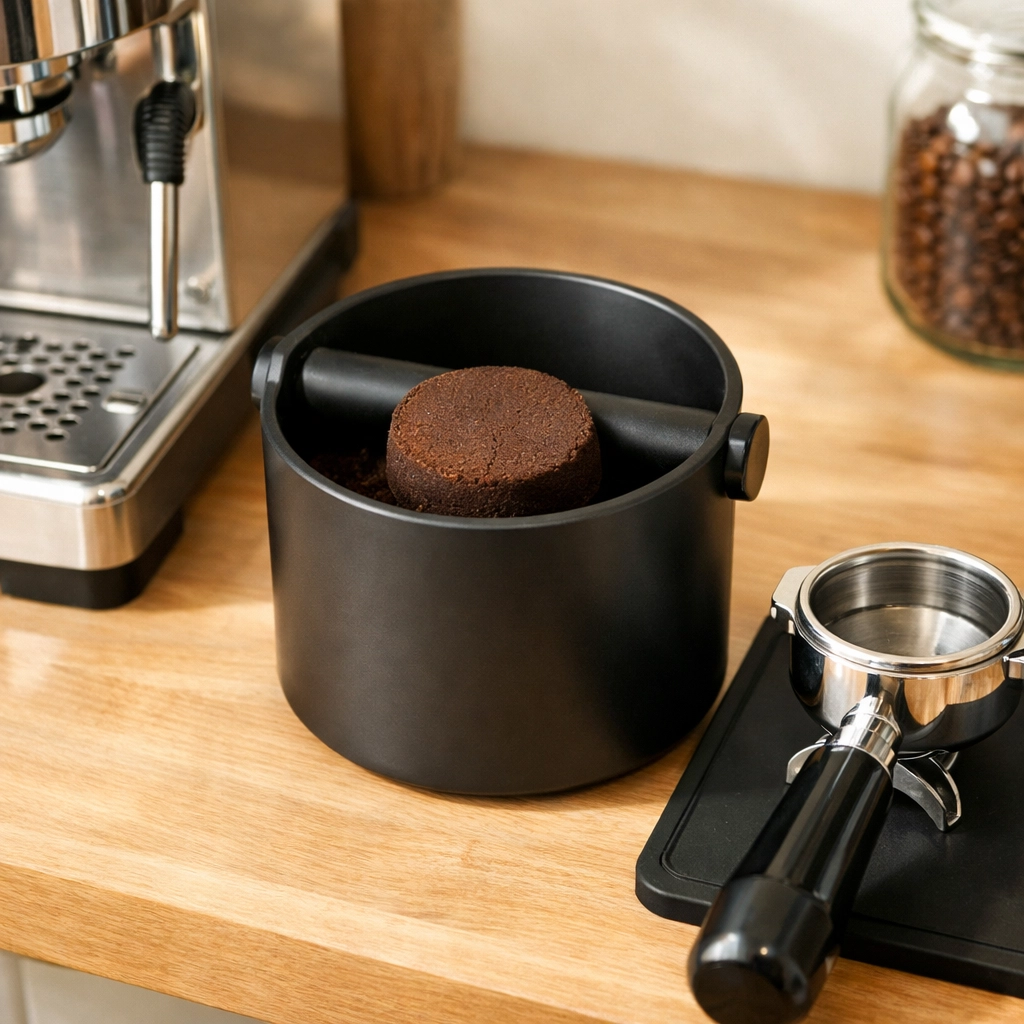
    This is the most underrated tool in the kit. Where do you put the used coffee grounds (the "puck") after you’ve brewed? If you’re digging it out with a spoon or banging your expensive portafilter against the side of your kitchen bin, please stop. You’ll eventually dent the basket or, worse, break the handle.

    A knock box is a simple container with a sturdy, rubber-coated bar across the middle. One firm "thwack" and the puck drops out cleanly. It keeps your workspace tidy, protects your gear, and honestly, there is something deeply satisfying about the sound of a perfect puck hitting the box. It’s the official sound of "mission accomplished."

    A modern coffee knock box with a solid espresso puck and portafilter on a tidy counter.

    Workflow: Bringing It All Together

    So, you’ve got the gear. How does it look in practice?

    Imagine it’s Tuesday morning. You weigh out 18.0g of fresh Limini Coffee beans. You grind them fresh, the aroma filling the kitchen. You distribute them in your portafilter, give them a level, firm tamp with your weighted tamper, and lock it in.

    You place your scale under the spout, tare it, and start the shot. You watch the dark, viscous liquid: the crema: pour out like warm honey. At exactly 36g and 30 seconds, you stop the pump. While that’s resting, you steam your milk in your stainless pitcher to a perfect 60 ºC, swirl it until it shines, and pour it into your cup. Finally, you knock the puck into your knock box with a single tap.

    That is the "theatre" of coffee. It’s a ritual. And while it might seem like a lot of steps, once you have the right tools, it becomes second nature.

    A perfect home-brewed latte with heart latte art in a ceramic cup held by a home barista.

    A Final Word on the Beans

    We can give you the best tamper in the world and a grinder that costs as much as a small car, but if the coffee beans are old or poorly roasted, it’s all for nothing. Specialty coffee is about the journey from the farm to your cup.

    At Limini, we obsess over the sourcing of our coffee because we know that the home barista’s toolkit is only as good as the ingredient you put into it. We recommend starting with a versatile espresso roast that's forgiving to work with while you're learning the ropes.

    If you ever feel overwhelmed or your shots are coming out a bit wonky, don't panic. Coffee is a journey, not a destination. We even offer barista training if you want to skip the trial-and-error phase and get straight to the good stuff.

    So, what’s the first upgrade you’re making to your home setup? Whatever it is, make sure it’s something that makes the process more enjoyable. Because at the end of the day, the best cup of coffee is the one you enjoyed making.

    Ready to stock up? Grab your essentials and some fresh beans over at Limini Coffee and let’s get brewing!

  • 7 Mistakes You’re Making with Your Hotel Booking Engine (and How to Fix Them)

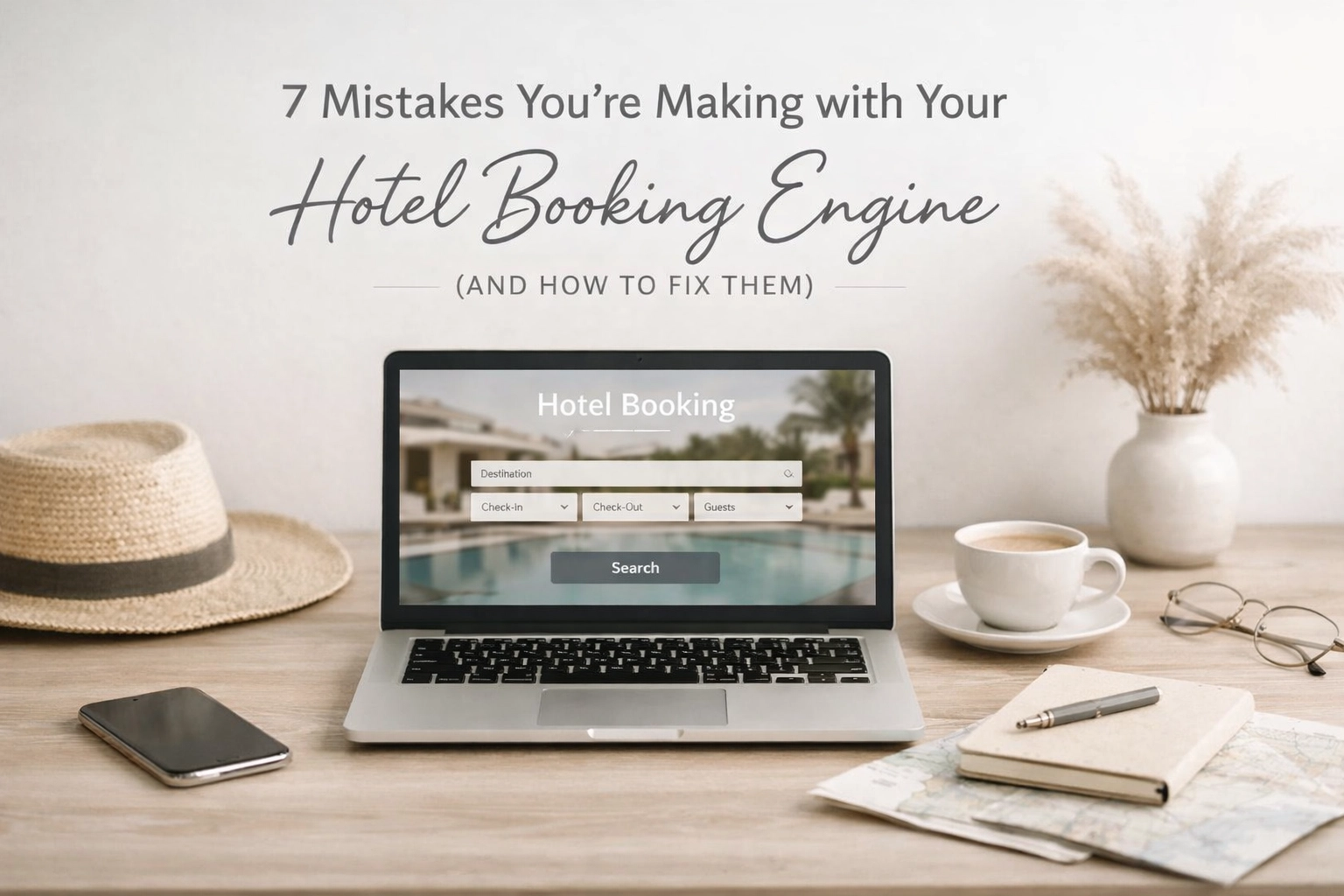
    7 Mistakes You’re Making with Your Hotel Booking Engine (and How to Fix Them)

    Capture more revenue. Simplify the guest journey. Build brand independence. Your booking engine shouldn’t just be a functional tool: it should be a high-performance sales machine.

    In a world where 60% of travel bookings happen on a mobile device, your digital storefront needs to be more than just "online." It needs to be exceptional. Most hoteliers are leaving money on the table because of friction points they don't even know exist. We believe that guest technology should feel invisible: a seamless extension of your hospitality that drives results from the first click.

    Here is how to transform your booking engine from a static form into a powerful revenue driver, all from one innovative hospitality platform.

    1. Prioritize the Mobile-First Mindset

    Most booking engines were built for desktops. Most guests book on phones. When these two realities collide, your conversion rate suffers. A non-responsive design is the fastest way to send a potential guest straight to an OTA.

    We think mobile optimization is non-negotiable. It isn't just about resizing images: it’s about the "thumb-friendly" experience.

    • Implement a fully responsive design.
    • Reduce vertical scrolling requirements.
    • Ensure button sizes are optimized for mobile taps.

    When the booking process feels as native as a social media app, guests stay engaged. A mobile-first approach doesn't just look better: it builds immediate trust. It shows your guests that you understand their needs before they even check in.

    Guest using a mobile-responsive hotel booking engine on a smartphone in a modern lobby.

    2. Eliminate Integration Friction

    A booking engine that doesn't talk to your Property Management System (PMS) is a liability. Manual updates lead to human error. Human error leads to overbookings. Overbookings lead to unhappy guests and stressed-out staff.

    Seamless synchronization is the heart of operational excellence. You need a ecosystem where your availability, rates, and guest data flow in real-time across every channel.

    • Connect your booking engine directly to your PMS.
    • Automate inventory updates to prevent double bookings.
    • Centralize guest profiles for personalized service.

    By choosing a platform like Mews, you eliminate the "middleman" of manual data entry. You get a single source of truth that keeps your team focused on the guest, not the spreadsheet. It’s about working smarter, not harder.

    3. Reflect Your Unique Brand Identity

    A generic booking engine is a conversion killer. If a guest clicks "Book Now" on your beautiful, boutique website and is suddenly transported to a white-label page that looks like a 1998 tax form, they get nervous. They lose confidence. They close the tab.

    Your booking engine should be a visual continuation of your hotel's soul.

    • Customize colors, fonts, and imagery to match your site.
    • Use high-quality, lifestyle-driven room photos.
    • Maintain a consistent tone of voice throughout the checkout.

    We believe that every digital touchpoint is an opportunity to tell your story. When the transition from your homepage to the booking engine is seamless, you reduce the perceived risk for the guest. It’s about creating a unified journey that feels professional and intentional.

    4. Choose Value Over Cost

    The "cheapest" booking engine often ends up being the most expensive. If a low-cost solution lacks basic analytics or fails to convert at the same rate as a premium platform, you aren't saving money: you’re losing revenue.

    Think of your booking engine as your most important salesperson. You wouldn't hire a salesperson based solely on who asks for the lowest salary; you hire based on who can close the most deals.

    • Analyze the long-term ROI of conversion-focused features.
    • Prioritize platforms with robust customer support.
    • Look for scalability that grows with your property.

    Investing in a leader like Mews means you're investing in a platform designed for growth. It’s the difference between a tool that "works" and a tool that wins.

    Modern laptop displaying an innovative hotel management system in a boutique hotel setting.

    5. Master the Art of the Minimalist Form

    Complexity is the enemy of conversion. Every unnecessary field in your booking form is an exit ramp for your guests. If you’re asking for their home address and their favorite color before they’ve even seen a price, you’ve already lost.

    We believe in the "Two-Click Rule." The path from room selection to confirmation should be as short as possible.

    • Adopt a form field reduction strategy.
    • Use clear progress indicators (e.g., "Step 2 of 3").
    • Remove distractions like unnecessary pop-ups or sidebars.

    "The process was so easy, I was done in 30 seconds," is the best compliment a guest can give your booking engine. Streamlining the checkout process isn't just a technical fix: it’s a courtesy to your guests. Respect their time, and they’ll reward you with their business.

    6. Champion Radical Transparency

    Hidden fees are the fastest way to ruin a guest relationship before it starts. If the price on the search results page doesn't match the price on the confirmation page, the guest feels misled.

    Clarity is a conversion catalyst. When guests can see exactly what they are paying for, they feel empowered to book.

    • Show all taxes and surcharges upfront.
    • Highlight clear, easy-to-read cancellation policies.
    • Use a real-time availability calendar to avoid "sold out" surprises.

    Transparency builds a bridge between you and your guest. It replaces doubt with certainty. By providing a clear, honest breakdown of costs, you aren't just selling a room: you’re establishing the foundation of a long-term relationship.

    7. Speak the Global Language of Hospitality

    If you want international guests, you have to meet them where they are. Forcing a traveler from Tokyo to calculate their room rate in Euros while reading a English-only form is a hurdle they shouldn't have to jump.

    A truly modern booking engine removes the barriers of geography.

    • Offer multi-currency support for instant price clarity.
    • Provide multilingual interfaces for a localized experience.
    • Support regional payment methods (e.g., Apple Pay, WeChat Pay).

    When a guest can navigate the booking process in their native language and see prices in their own currency, the "fear of the unknown" disappears. It’s about making the world feel a little smaller and your hotel feel a lot more welcoming.

    Travel essentials and a hotel key card symbolizing a frictionless international guest journey.

    The Future is AI-Driven and Guest-Centric

    The hospitality landscape is shifting. We aren't just selling rooms anymore; we’re selling experiences. The next generation of booking engines will use AI to suggest the perfect room type based on guest behavior or offer hyper-personalized upsells at the exact moment a guest is most likely to buy.

    Staying ahead of the curve means choosing a partner that lives and breathes innovation. Mews isn't just a software company; we’re a community of hoteliers and technologists obsessed with the guest experience.

    Ready to transform your digital storefront?

    The right technology doesn't just manage your hotel: it liberates your team to focus on what matters most: your guests. See how the Mews platform can help you reclaim your time and maximize your direct revenue.

    Schedule your 30-minute discovery call today and get you earning revenue in no time.

  • Managing Multiple Properties Without Losing Your Mind

    Running multiple hotels used to mean juggling multiple systems. Different logins. Different dashboards. Different headaches.

    Not anymore.

    Cloud-native technology has changed how groups and chains operate. One login. One platform. Complete visibility across your entire portfolio.

    The Multi-Property Nightmare (That You're Probably Living)

    You know the drill. Property A uses one system. Property B has a different setup. Your boutique hotel downtown? That's running on something else entirely.

    Every morning starts the same way. Log into system one. Check reservations. Log out. Log into system two. Pull reports. Repeat until you've cycled through all your properties.

    Want to see how your portfolio performed last night? You'll need to compile data from five different sources, export to Excel, and pray your formulas are correct.

    There's a better way.

    Single Sign-On: Your New Best Friend

    We think logging in should happen once. Not ten times. Not five times. Once.

    Mews gives you access to your entire portfolio from a single dashboard. Whether you're managing three boutique properties or thirty hotels across multiple countries, it's all there when you log in.

    • Check occupancy across all properties simultaneously
    • Switch between locations with one click
    • Maintain consistent guest data across your entire chain
    • No more password fatigue or security risks from multiple systems

    The average hotel manager using traditional systems spends 45 minutes daily just logging in and out of different platforms. That's nearly four hours per week. Gone.

    Hotel manager viewing unified multi-property dashboard on laptop for centralized management

    Centralized Reporting That Actually Makes Sense

    Revenue managers love this part. Instead of stitching together reports from different systems, you get unified analytics across your entire portfolio.

    See which properties are performing. Identify trends before they become problems. Compare metrics in real-time without waiting for someone to compile spreadsheets.

    Here's what you get:

    Real-time performance dashboards showing occupancy, revenue, and booking pace across all locations. Filter by property, region, or view everything at once.

    Automated financial reporting that consolidates revenue data automatically. Your accountant will thank you. So will your investors.

    Guest behavior insights that track preferences across properties. When a guest who stayed at your London location books your Paris hotel, you'll know exactly what they liked last time.

    Standardization Without Losing Your Identity

    Each property has its personality. We get that. But your backend systems? Those should be consistent.

    With Mews, you create processes once and apply them everywhere. Train your staff on one system instead of three. When someone transfers from your beach resort to your city center hotel, they're already proficient in the PMS.

    This matters more than you think. Staff turnover in hospitality averages 73% annually. Every new hire costs 6-9 months' salary in training and lost productivity. Cut the learning curve, cut the costs.

    Hotel operations center displaying real-time analytics and performance data across properties

    Automation That Scales With You

    Managing one property means handling dozens of daily tasks. Managing ten properties means hundreds.

    Unless you automate.

    Mews handles the repetitive stuff automatically across all your locations:

    • Automated pre-arrival emails sent from each property's branded templates
    • Dynamic pricing updates applied consistently across your entire chain
    • Housekeeping assignments distributed based on real-time check-ins and check-outs
    • Inventory management synchronized across properties

    Opening a new property? Clone your existing setup. You'll be operational in days instead of weeks.

    The Group Booking Game-Changer

    Corporate clients booking room blocks across multiple locations used to require coordinating between separate properties. Phone calls. Emails. Confusion.

    Now it's handled from one screen.

    A conference organizer needs rooms in three cities? Create the group booking once, allocate inventory across properties, and manage it all from a single interface. Your sales team can see availability across the entire portfolio instantly.

    No more "let me check with the other property and get back to you." Just yes, booked, confirmed.

    Hotel staff member using tablet to manage multi-property bookings in modern lobby

    Your Data, Actually Accessible

    Cloud-native means your data lives online, not trapped in a server room at one property. Access everything from anywhere: your office, your home, or while you're on-site at one of your locations.

    This changed how operators work during the pandemic, and it's not going back. Your revenue manager in New York can optimize pricing for your property in Barcelona. Your director of operations can spot maintenance issues across the entire portfolio before they escalate.

    It's not about working remotely. It's about working intelligently.

    Real Results From Real Operators

    Property groups using Mews report saving an average of 15 hours weekly on administrative tasks. That's not because they're working faster: it's because they're not duplicating effort across multiple systems.

    One boutique hotel group cut their month-end closing process from three days to four hours. Another chain reduced their new property onboarding time by 60%.

    The ROI isn't just in time saved. It's in opportunities captured. When you can see your entire portfolio's performance in real-time, you make better decisions faster.

    Making The Switch

    Moving from multiple systems to one platform sounds daunting. It's not.

    Mews migration typically takes 30 days from contract to go-live. You'll have a dedicated implementation team that understands multi-property setups. They've done this hundreds of times.

    Your data transfers automatically. Your staff gets trained on one system instead of maintaining knowledge of several. Your guests experience seamless service whether they're staying at property one or property ten.

    The Bottom Line

    Managing multiple properties doesn't have to mean multiplying your workload. The right technology consolidates complexity instead of adding to it.

    Single sign-on. Centralized reporting. Automated processes. These aren't luxury features: they're operational necessities for any group serious about scaling efficiently.

    Want to see how Mews handles multi-property management? Check out our platform at https://referrals.mews.com/umqhyito and get a demo tailored to your portfolio's specific needs.

    Because you didn't get into hospitality to spend your days logging into different systems. You got into it to create exceptional guest experiences.

    Let the technology handle the complexity. You handle the hospitality.

  • Stop Wasting Time on Admin: How to Save 10+ Hours Every Week with These 7 Hacks

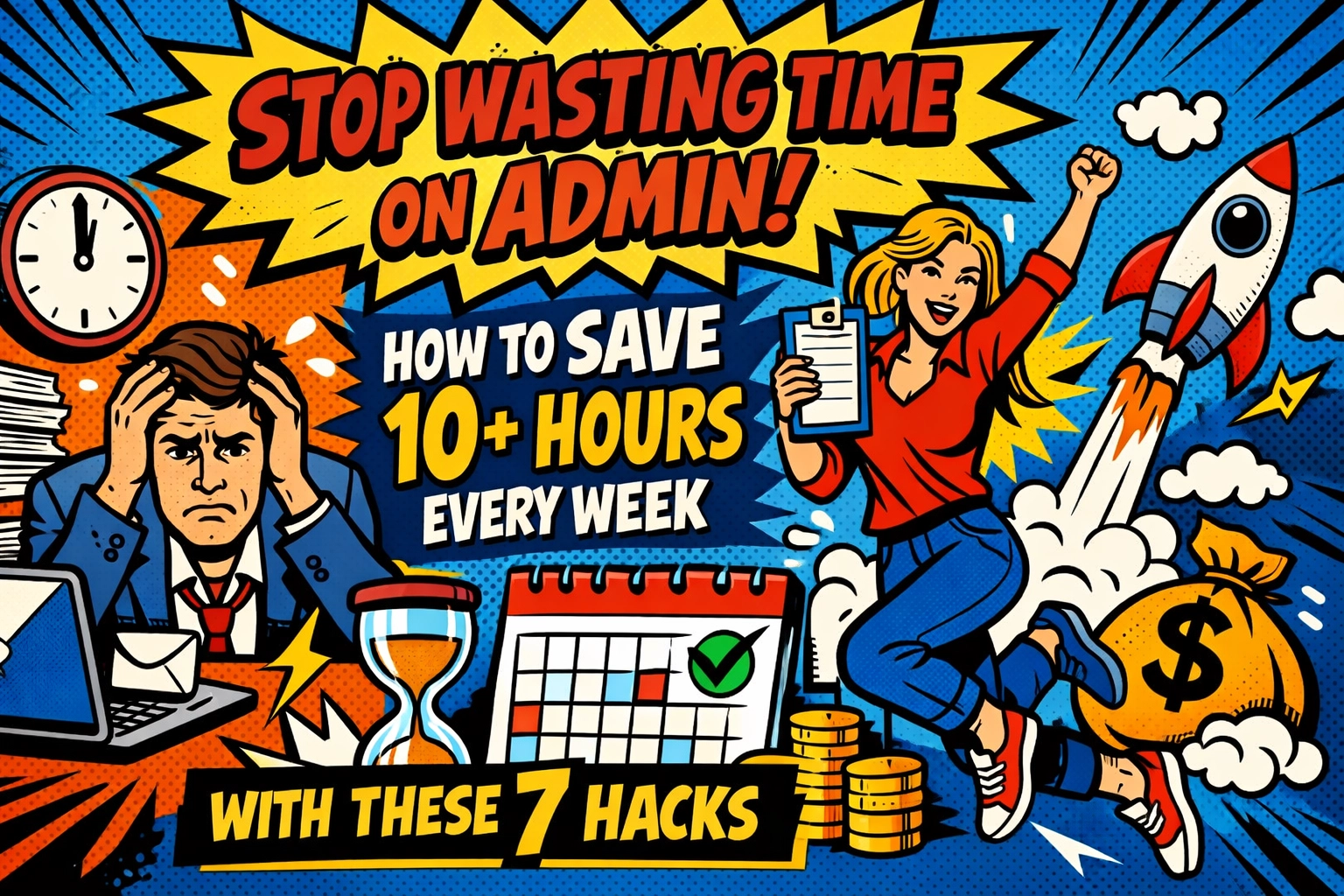
    Stop Wasting Time on Admin: How to Save 10+ Hours Every Week with These 7 Hacks

    ☕ 7:00 AM.

    The sun is barely up, but your phone is already screaming. Notifications from people you don't remember meeting, asking for things you haven't had time to think about. Your inbox looks like a game of Tetris where you’re losing… badly.

    You’re not a business owner anymore. You’re a high-paid secretary for your own life.

    It’s exhausting. It’s draining. And honestly? It’s completely unnecessary.

    If you feel like you’re drowning in "the small stuff," you’re not alone. Most small business owners spend over 30% of their week on pure administrative overhead. That’s 10 to 15 hours of your life gone. Every. Single. Week.

    But it doesn't have to be this way. Imagine reclaimng those hours. Imagine finishing your work by 3:00 PM because the "admin monster" has been tamed.

    Here are the 7 hacks to make it happen.

    1. KILL THE EMAIL PING-PONG

    Stop it. Just stop.

    "Does Tuesday at 2:00 PM work?"
    "No, how about Wednesday at 10:00 AM?"
    "I can do Wednesday, but only after 4:00 PM."

    It’s 2026. If you are still manually scheduling meetings, you are burning money. Use business automation tools like Calendly or let your AI handle the back-and-forth. You send one link. They pick a slot. Your calendar updates.

    📱 9:30 AM.
    You check your phone. Three new meetings are booked. You didn't send a single email. You just sip your coffee.

    2. THE 60-MINUTE BATCH

    Context switching is the silent killer of productivity. Every time you jump from a creative task to "just checking one email," it takes your brain nearly 20 minutes to fully refocus.

    Stop juggling.

    Group your admin tasks. Do all your invoicing, email replies, and data entry in one 60-minute sprint. Outside of that hour? The admin world doesn't exist.

    3. THE "THIS COULD HAVE BEEN AN EMAIL" FILTER

    We’ve all been there. A 45-minute Zoom call that could have been a three-sentence Slack message.

    If a meeting doesn't have a clear agenda and a required outcome, don't show up. Better yet, don't schedule it. Your time is the most expensive asset your company has. Treat it that way.

    Small business owner using automation tools to reclaim time from chaotic administrative tasks.

    4. CONSOLIDATE YOUR STACK

    You have a tool for tasks. A tool for chat. A tool for CRM. A tool for your lunch order.

    By the time you’ve logged into everything, half your morning is gone. You don't need more apps; you need better ones. Centralize your workflow. When your business automation tools talk to each other, you stop being the middleman.

    5. THEMED DAYS ARE YOUR SECRET WEAPON

    Mondays for Marketing. Tuesdays for Client Work. Wednesdays for Admin.

    When you know exactly what "mode" your brain should be in, the resistance to starting disappears. You don't have to decide what to do: the day has already decided for you.

    6. THE DIGITAL DETOX WINDOW

    From 8:00 AM to 11:00 AM, the internet is dead to you. No emails. No LinkedIn. No "quick checks" on the news.

    This is your deep work zone. This is where the real growth happens. The admin can wait until the afternoon when your brain is too tired for the big stuff anyway.

    7. LET THE ROBOTS DO THE HEAVY LIFTING

    The biggest hack of all? Realizing you don't have to do any of this yourself.

    The modern ai assistant for small business isn't just a chatbot; it’s an engine. It organizes your files, drafts your follow-ups, and keeps your business running while you’re at your kid’s soccer game.

    Scale shouldn't be painful. If you're ready to stop the grind and start the growth, check out what we're building at Marblism.


    The Best AI Assistant for Small Business in 2026

    🤝 11:00 AM.

    Your "to-do" list is staring you down. It’s long. It’s messy. It’s got tasks on it from three weeks ago that you’re "definitely getting to today."

    Spoiler: You won't.

    But what if you had a partner? Not a freelancer you have to manage. Not a virtual assistant you have to train. But a digital brain that already knows your business better than you do.

    In 2026, the term "AI" has changed. We’ve moved past the "type a prompt and hope for the best" phase. Now, the ai assistant for small business is about agency.

    IT'S NOT ABOUT CHAT. IT'S ABOUT ACTION.

    Most people think an AI assistant is just a place to ask questions.
    "What's the capital of France?"
    "Write me a poem about a toaster."

    Cool, but that doesn't pay the bills.

    A real assistant: a Marblism-style assistant: does the work.
    "Find the three most urgent emails from this morning and draft replies based on my previous tone."
    "Organize my project folders for the Smith account."
    "Remind me why I haven't followed up with that lead from Tuesday."

    Heroic AI assistant for small business organizing digital folders, emails, and calendars effortlessly.

    WHY 2026 IS THE YEAR OF THE AGENT

    We used to spend hours teaching software how to work for us. Now, the software learns by watching.

    You don't need to be a prompt engineer. You just need to be a business owner. Your ai assistant for small business picks up on your patterns. It sees that you always invoice on Fridays. It sees that you prefer a casual tone with your long-term clients.

    And then? It just does it.

    THE "SET IT AND FORGET IT" LIFESTYLE

    The goal isn't to work with AI all day. The goal is to let the AI work so you don't have to.

    You step back. You breathe. You focus on the vision.

    🌙 8:00 PM.
    The lights are off in the office. You’re sitting on the couch, scrolling through your phone. You see a notification: "Weekly admin completed. 14 hours saved."

    You smile. You didn't even notice the work was happening.

    Scaling shouldn't be this easy. But here we are. See how it works at Marblism.


    AI Content Generator for Small Business: Your Secret Marketing Weapon

    🔍 2:00 PM.

    The "Blinking Cursor of Death."

    You know you need to post. You know the "algorithm" demands blood, sweat, and a 1,500-word blog post every week. But you’re tired. You’ve got a business to run. You aren't a novelist.

    You start typing.
    "Our company is excited to announce…"
    Delete.
    "Why you should choose us…"
    Delete.

    Marketing shouldn't feel like a chore. It should feel like a megaphone.

    THE CONTENT TRAP

    Most small businesses fail at marketing because they can’t stay consistent. You write three great posts, get busy for a month, and your social media feed becomes a ghost town.

    This is where an ai content generator for small business changes the game.

    Creative business owner using an AI content generator to produce high-quality marketing ideas fast.

    HIGH QUALITY, ZERO FRICTION

    We’ve all seen the "bad" AI content. It’s stiff. It’s robotic. It sounds like a textbook from 1994.

    But that’s because the tools were basic. Today, an ai content generator for small business can capture your specific "vibe."

    Whether you’re:

    • Punchy and aggressive 🥊
    • Warm and inviting ☕
    • Professional and steady 🏛️

    The AI learns your voice. It doesn't just "generate content"; it narrates your brand’s story.

    BEYOND THE BLOG POST

    It’s not just about writing articles. It’s about the entire ecosystem.
    One great idea can become:

    • A long-form blog.
    • Three LinkedIn updates.
    • Five Twitter (X) posts.
    • A script for a 60-second video.

    And it happens in seconds, not hours.

    YOUR SECRET WEAPON

    While your competitors are struggling to find the right words, you’re already hitting "publish." While they’re staring at a blank screen, you’re closing deals with the leads your content generated.

    You aren't "faking it." You’re just using better tools.

    Stop being a writer and start being a founder. Let the generator handle the heavy lifting while you handle the strategy.

    Scaling your brand is just one click away. Don't believe me? See for yourself over at Marblism.

    The chaos is gone before you even take your first sip.

    Welcome to the future of work.

  • Looking for a Coffee Roaster Wholesale Partner? Here Are 10 Things You Should Know

    So, you’re diving into the world of specialty coffee? Whether you’re a seasoned hospitality pro opening a new spot or a complete newcomer to the cafe scene, finding the right coffee supplier is arguably the most important decision you’ll make. Honestly, it’s about more than just getting a bag of beans delivered to your door once a week. It’s about a partnership.

    At Limini Coffee, we’ve spent years working alongside cafe owners, and we’ve seen it all. We know that the relationship between a roaster and a wholesale partner can either make your life a dream or be the source of your biggest headaches. You aren’t just looking for "coffee suppliers": you’re looking for a backbone for your business.

    Here are 10 things you absolutely need to know before you sign on the dotted line with a wholesale coffee roaster.


    1. Quality and Sourcing Are Non-Negotiable

    It sounds obvious, doesn't it? But "quality" is a word that gets thrown around a lot in this industry. When we talk about specialty coffee, we’re talking about coffee that has been graded 80 points or above on a 100-point scale. This means it’s free of primary defects and offers a distinct, delicious flavor profile.

    You should ask your potential partner where their beans come from. Are they transparent about their sourcing practices? A good roaster will be able to tell you about the farms, the altitudes, and the processing methods. If they’re vague, that’s usually a red flag. We believe that knowing the story behind the bean makes it easier for you to sell that story to your customers.

    And remember, consistency is king. You need a partner who can provide the same high-quality profile roast after roast, so your customers get the same great latte every Tuesday morning. If you're looking for that kind of reliability, check out what we offer at Limini Coffee.

    2. Barista Training is the Secret Sauce

    You can buy the most expensive, ethically sourced, perfectly roasted beans in the world, but if your barista doesn't know how to dial in the grinder or texture milk correctly, it’s all for nothing. It’s actually a real shame to see beautiful coffee ruined by poor technique.

    Does the roaster offer comprehensive barista training? And we don’t just mean a one-hour session on how to press a button. We’re talking about understanding extraction, learning the science of milk (getting that perfect 140 °F / 60 ºC temperature), and mastering the art of the pour.

    A great wholesale partner should feel like an extension of your team, providing ongoing education to keep your staff’s skills sharp. We take this so seriously that we’ve built an entire training program to ensure our partners succeed.

    Professional barista training showing expert milk steaming for specialty coffee shop partners.

    3. Equipment Support and Maintenance

    Coffee machines are sophisticated pieces of kit. They work hard, and eventually, they need some love. Imagine it’s a busy Saturday morning, the queue is out the door, and your espresso machine starts acting up. Who are you going to call?

    When choosing a supplier, find out if they provide equipment and: more importantly: if they can fix it. Some roasters are just "box movers." They sell you a machine and disappear. We prefer a much more hands-on approach. Whether it's a lever machine or an automatic, you need someone who understands the internals, like the workings of a La Spaziale.

    Having a partner who offers technical support can save you thousands in lost revenue and repair bills.

    4. Transparency and Shared Values

    The modern coffee consumer is savvy. They care about sustainability, fair pay for farmers, and ethical business practices. Your roaster’s values will reflect on your brand.

    Ask them: Do they use recyclable packaging? How do they support the communities they source from? If your brand is built on being eco-friendly and warm, you don't want a partner who feels cold and corporate. We’ve always aimed to be warm and approachable, and we find that our best partnerships are with people who feel the same way.

    5. Be Wary of "Free" Equipment and Long Contracts

    In the wholesale world, you’ll often see "free machine" deals. So, what’s the catch? Usually, it’s a very long contract and a much higher price per kilo of coffee. Basically, you’re paying for the machine anyway: just through your beans.

    We aren't fans of trapping people in long-term contracts. We believe our coffee and service should be good enough to make you want to stay, not force you to stay. Always do the math. Sometimes buying or leasing your equipment separately gives you more freedom and better margins in the long run. If you're curious about the costs, it’s worth checking out our wholesale options to see a different way of doing things.

    High-end espresso machine and fresh coffee, illustrating wholesale equipment options and support.

    6. Freshness and Delivery Logistics

    Roasted coffee is a fresh product. While it needs a few days to degas (letting off CO2 so you don't get a mouthful of "fizz" or sourness), it definitely shouldn't be sitting in a warehouse for months.

    Check the roaster’s delivery schedule. Do they roast to order? How quickly can they get the beans to you? If they only deliver once every two weeks, you’re going to struggle with inventory management. You want a partner who is nimble and reliable.

    7. Customization and Menu Development

    Your cafe shouldn't look or taste exactly like the one down the street. Does the roaster offer different blends or single origins to help you stand out? Can they help you design a drink menu that makes sense for your target audience?

    Maybe you want to focus on the "theatre" of coffee: the visual appeal and the experience. A good partner will help you with everything from choosing the right cups to understanding how to create great crema.

    8. Direct Relationship vs. Distributors

    There’s a big difference between buying from a roaster and buying from a distributor. A distributor sells everything from beans to cleaning supplies to toilet paper. They are convenient, sure, but they usually lack the deep, nerdy coffee expertise that a dedicated roaster has.

    When you work directly with a roaster like Limini Coffee, you’re talking to the people who actually sourced and roasted the beans. This direct line of communication is invaluable when you have technical questions or need advice on a specific coffee's flavor profile.

    9. Responsiveness and Customer Service

    This is the "gut feeling" part of the decision. When you email them, do they get back to you quickly? Do they seem genuinely interested in your business plan?

    A wholesale partner should be invested in your success. If you grow, they grow. Look for someone who is available, empathetic, and actually knows your name. You can often get a feel for this by reading reviews from other business owners.

    Cafe owners discussing a business partnership with their wholesale specialty coffee roaster.

    10. Visit the Roastery

    Before you commit, go see them! Have a coffee with the team. See the roasting process. Try the espresso. If you can’t see yourself sitting down for a chat with these people, you probably shouldn't be in a long-term business relationship with them.

    We love it when people visit us. It’s the best way to understand our passion and see the care that goes into every bag. Plus, you get to drink some pretty great coffee while you're at it.


    Putting It All Together

    Choosing a coffee roaster wholesale partner is a big step, but it doesn't have to be overwhelming. Focus on the quality of the product, the level of support they offer, and whether their "vibe" matches yours.

    If you're in the middle of a shop fitting or just starting to dream about your future cafe, we’d love to help. We don't just provide beans; we provide the expertise to help you build a thriving business.

    So, why not start the conversation today? You can check out our range and see what we’re all about at Limini Coffee. Let’s make some incredible coffee together. 🙂

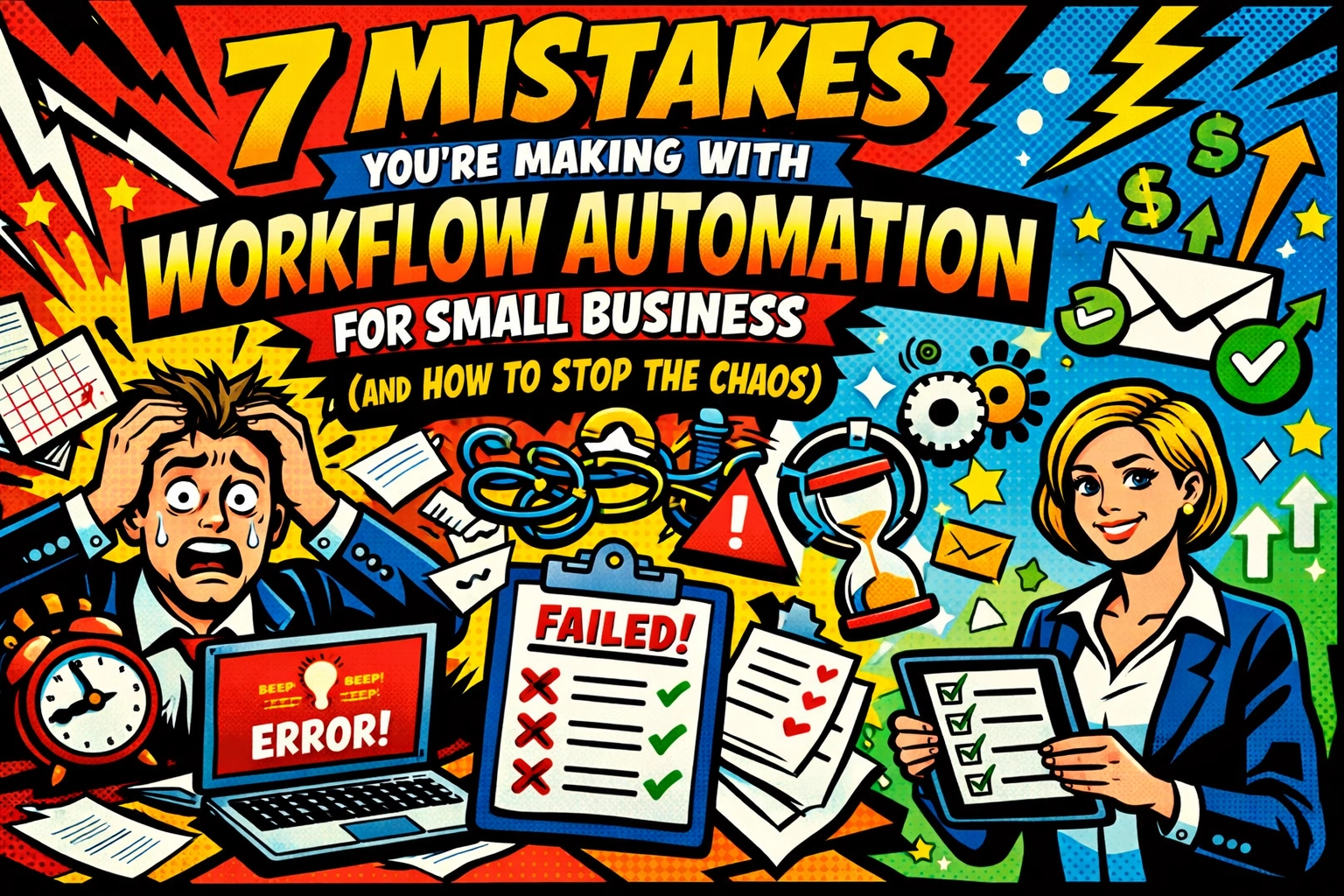
  • 7 Mistakes You’re Making with Workflow Automation for Small Business (and How to Stop the Chaos)

    7 Mistakes You’re Making with Workflow Automation for Small Business (and How to Stop the Chaos)

    ☕ 7:00 AM.

    Your alarm hasn’t even finished its first cycle, and you’re already squinting at your phone.

    Three "urgent" Slack messages. A dozen new emails. A notification that a lead form on your website just broke, again. You were promised that ai business automation would be your ticket to freedom. You thought you’d be sipping an artisanal latte while robots did the heavy lifting.

    But instead? You’re just a highly paid janitor for a bunch of digital tools that don't talk to each other.

    The truth is, most small business owners aren't failing at automation because they aren't smart enough. They're failing because they've built a "Rube Goldberg" machine out of software and called it a strategy.

    Let’s look at the seven ways you’re accidentally sabotaging your own peace of mind, and how to fix it before your brain short-circuits.

    1. YOU'RE AUTOMATING A "DUMPSTER FIRE" PROCESS

    Digitizing a mess just gives you a faster mess.

    If your manual process for onboarding a client involves three spreadsheets, a sticky note, and "remembering to check that one folder," automating it will only make the errors happen at light speed.

    You cannot automate what you haven't defined.

    Before you touch a single piece of software, grab a piece of paper. Map out the steps. If a step says "and then I hope I remember to do X," you aren't ready for automation. You need to fix the logic first.

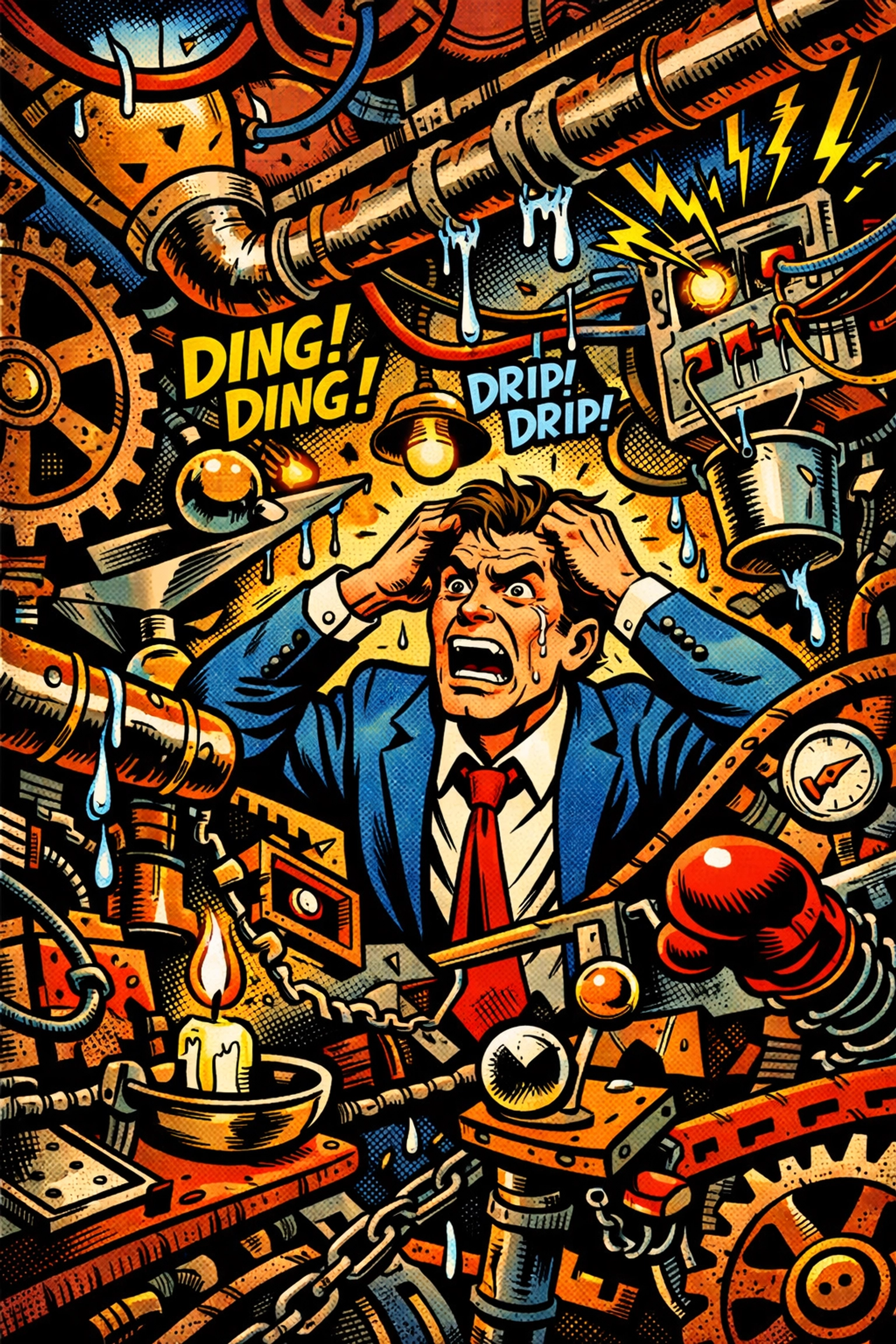
    A frustrated business owner trapped in a complex machine, representing the chaos of a broken workflow.

    2. THE "SHINY OBJECT" OVERLOAD

    📱 10:00 AM.

    You’ve got fifteen tabs open. One for your CRM. One for your email sequencer. One for a tool that supposedly "enriches" your leads but mostly just sends you LinkedIn profiles of people who retired in 2012.

    You’re suffering from Tool Fatigue.

    Small businesses often think more business automation tools equals more efficiency. It doesn't. It equals more subscription fees and more "integration debt." Every time you add a new tool, you create two new potential breaking points.

    Stop looking for the newest app on Product Hunt. Start looking for a platform that consolidates your world.

    If you want to see how to actually streamline things without the headache, check out what we're doing over at Marblism.

    3. SHOOTING IN THE DARK (NO CLEAR GOALS)

    Why are you automating that specific task?

    "Because it feels like I should" is not a goal.

    Without measurable objectives, your automation project is just a hobby. Are you trying to save 10 hours a week? Are you trying to increase lead response time by 50%?

    If you don't know the destination, don't be surprised when your automation takes you to the middle of nowhere. Define the "Win" before you build the "How."

    4. DATA IS THE DIRTY SECRET

    🔍 1:00 PM.

    Your automated email sequence just went out. Great, right?

    Except it addressed your top client as "First_Name_Placeholder" and sent it to an email address they haven't used since the Obama administration.

    Automation is only as good as the data you feed it. If your CRM is a digital hoarder's basement, your ai business automation will behave like a drunk robot.

    Clean your lists. Standardize your fields. If your data is "dirty," your automation will be embarrassing.

    An overwhelmed business owner surrounded by spinning gadgets, showing the stress of disconnected business automation tools.

    5. THE "SET IT AND FORGET IT" MYTH

    You built the workflow. You pressed "Live." You walked away.

    Three weeks later, you realize that a change in a third-party API has caused every new lead to be sent directly into a black hole.

    Automation is not a crock-pot. You cannot just "set it and forget it." Processes evolve. Your team grows. Software updates happen.

    You need a pilot for the plane. Even if the autopilot is doing 90% of the work, someone needs to be looking at the dashboard once a week to make sure you aren't headed for a mountain.

    6. NOBODY OWNS THE ROBOT

    🤝 4:00 PM.

    An automation breaks. Your marketing person thinks the IT guy is fixing it. The IT guy thinks the owner (that’s you) changed the password.

    In the end? Nobody fixes it.

    Every automated workflow needs an "Owner." A human being who is responsible for its health. When things go sideways, and they will, everyone should know exactly whose door to knock on.

    Without ownership, automation creates a "not my job" culture.

    Business team pointing fingers after an ai business automation failure, illustrating a lack of clear ownership.

    7. TESTING IN "PRODUCTION" (AKA THE DANGER ZONE)

    We’ve all done it. You think you’ve fixed the trigger. You press "Live" and figure you’ll see if it works when the next lead comes in.

    And then the next lead is your biggest potential contract of the year, and the automation sends them a "Welcome to our Newsletter" email instead of a "Booking Link."

    Always. Test. Every. Step.

    Run through the automation as if you are the customer. Use a burner email. Use a fake phone number. Break it on purpose before your customers break it for you.


    STOP JUGGLING. START SCALING.

    You didn't start a business to become a full-time software administrator.

    The chaos you’re feeling, the missed leads, the broken triggers, the "where did that data go?" panic, it isn't a requirement of growth. It's a symptom of bad systems.

    You need tools that don't require a computer science degree to manage. You need a partner that understands that "automation" should mean "peace of mind," not "more work."

    Scaling shouldn't be this hard. But here we are.

    If you're ready to stop the bleeding and actually start using ai business automation the way it was intended, it's time to change your approach.

    The robots are ready. They just need a better boss.

    A relaxed robot with smooth gears, representing peace of mind through effective ai business automation.

    MEET THE TEAM THAT DOES THE HEAVY LIFTING

    Imagine a world where your lead generation happens while you sleep. Where your data cleans itself. Where your tools actually talk to each other without you needing to play translator.

    That’s not a pipe dream. That’s what happens when you stop making these seven mistakes and start using the right platform.

    Stop the chaos. Start the growth.

    See how Marblism can transform your workflow right here.


    FAQ: YOUR AUTOMATION QUESTIONS, ANSWERED

    Q: Is automation too expensive for a small business?
    No. In fact, doing things manually is what’s costing you. You’re paying for "human errors" every single day. Start small, and the ROI will pay for the tools ten times over.

    Q: Do I need to know how to code?
    Not anymore. The best business automation tools today are "no-code" or "low-code." If you can drag and drop, you can automate.

    Q: Can I automate my customer service?
    Yes, but don't lose the "human" touch. Use AI to handle the repetitive "Where is my order?" questions so your humans can handle the complex "I need help with this specific problem" moments.

    Q: How do I know which tool to choose?
    Look for integration. If a tool doesn't play well with others, it's a trap. Choose platforms that are built to be the "brain" of your business.

    🌙 8:00 PM.

    The lights are off in the office. Your phone is on the nightstand.

    But it’s quiet.

    No frantic buzzing. No "everything is broken" alerts.

    The system is running. The leads are being nurtured. The data is exactly where it’s supposed to be.

    You just send a thumbs-up to your team and close your eyes.

    Finally. The machines are working for you.

    Scaling shouldn't be this easy. But here we are.

    Build your future at https://marblism.link/scott-bowen

  • Looking For Coffee Suppliers? Here Are 10 Things You Should Know

    Looking For Coffee Suppliers? Here Are 10 Things You Should Know

    So, you’re opening a coffee shop. Or maybe you’ve been running one for years and you’ve realized your current beans just aren’t hitting the mark anymore. Picking a coffee supplier is probably the biggest decision you’ll make for your business: besides the location and the name on the door, of course.

    It’s not just about who has the prettiest packaging or the cheapest price per kilo. It’s about finding a partner who actually gives a toss about your success. We’ve seen it all here at Limini Coffee, and we know that the relationship between a roaster and a shop owner can either be a dream or a total nightmare.

    To help you navigate these murky waters, we’ve put together a list of 10 things you absolutely need to know before you sign on the dotted line.


    1. Quality and Consistency are Non-Negotiable

    This sounds obvious, doesn't it? But you’d be surprised how many people get swayed by a flashy brand and forget to actually taste the coffee across a few different batches. You need 100% Arabica, high-quality beans with full traceability.

    But here is the kicker: consistency. Anyone can roast a decent batch of coffee once. Can they do it fifty weeks a year? You need a supplier who uses high-end roasting tech and strict quality control to ensure that the espresso your customers love on Monday is exactly the same as the one they buy on Friday. If the flavor profile is jumping all over the place, your baristas will be constantly chasing the grind, and your customers will get frustrated. We take this very seriously, and you can see more about how we handle sourcing our coffee here.
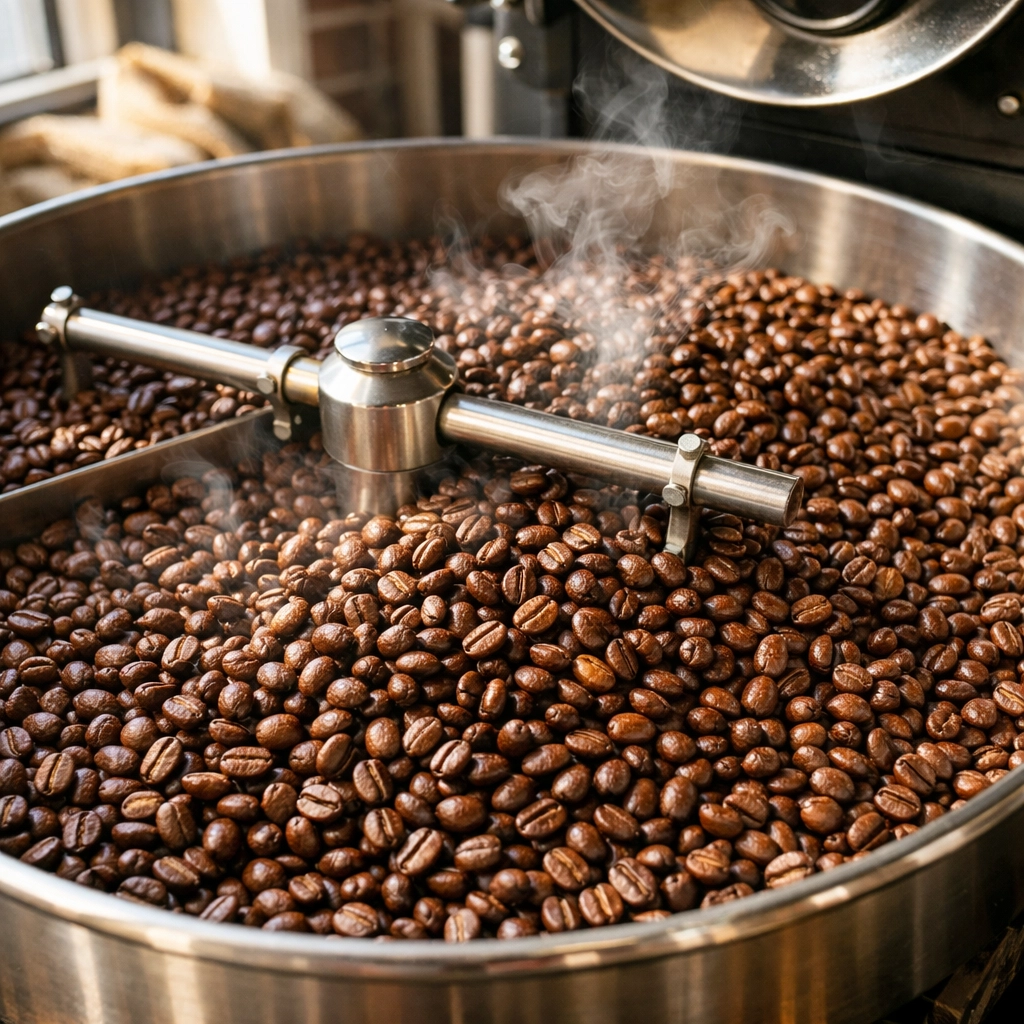
    Freshly roasted specialty coffee beans cooling in an artisanal roastery setting.

    2. The Power of Ethical Sourcing

    Did you know that roughly 70% of UK consumers say sustainability influences where they choose to drink their coffee? People care. They want to know that the farmers are being paid a fair wage and that the environment isn’t being destroyed for their morning flat white.

    When you’re chatting with potential suppliers, ask the hard questions. Where does the coffee come from? What are their relationships with the farmers? A good roaster should be able to tell you the story behind the bean. It’s not just about having a badge on the bag; it’s about genuine transparency. If you’re looking for a partner who values this as much as you do, check out our wholesale options where we lay it all out.

    3. Variety is the Spice of (Coffee) Life

    While having a solid house blend is the backbone of any shop, you might eventually want to branch out. Does the supplier offer single origins? Do they have seasonal rotations?

    Having a range of products allows you to keep things fresh for your "coffee geek" regulars while keeping your "milk-and-two-sugars" crowd happy with a reliable, chocolatey blend. If a supplier only does one thing, you might find yourself outgrowing them pretty quickly.

    4. Pricing vs. Real Value

    Let’s be honest: price matters. You have margins to protect. However, choosing the cheapest supplier is often the fastest way to go out of business.

    Think about what’s included in that price. Does it include delivery? Is there a minimum order quantity (MOQ) that’s going to force you to store stale beans? What about the support you get? Sometimes paying an extra pound per kilo is worth it if it comes with free equipment maintenance or emergency tech support. We always tell our partners to look at the "total cost of ownership," not just the invoice for the beans. If you want to see how we stack up, you can read our reviews here.

    A modern coffee shop interior with a steaming cup of coffee on a sunny wooden counter.

    5. Reliability and the "I’ve Run Out of Beans" Panic

    Imagine it’s a sunny Saturday morning, your shop is packed, and you realize your delivery hasn't arrived. That is the stuff of nightmares.

    You need a supplier with a robust supply chain and a proven track record of delivering on time. Ask about their lead times. If you order on Tuesday, when does it arrive? Do they use reliable couriers? A supplier who is local or has a very efficient distribution network is worth their weight in gold when you’re in a pinch.

    6. Training is Your Secret Weapon

    You can buy the best beans in the world, but if your staff doesn't know how to dial in the grinder or steam milk properly, the coffee will taste like rubbish. It’s a harsh truth, but someone has to say it.

    A great supplier shouldn't just drop off bags of coffee and vanish. They should offer comprehensive training. We’re talkin’ barista basics, milk chemistry, and workflow management. We’re big believers in this at Limini, which is why we offer extensive barista training to help our wholesale partners stay at the top of their game. It’s about building a culture of excellence, not just making a drink.

    Close-up of professional barista training pouring latte art into a ceramic cup.

    7. Equipment and Technical Support

    What happens when your espresso machine starts leaking at 8:00 AM? If your coffee supplier doesn’t offer technical support or have a network of engineers, you’re in trouble.

    Many suppliers (including us!) can help you with equipment leasing or purchases. Whether you’re looking at La Spaziale machines or need help choosing espresso equipment, your supplier should be your first port of call. They should know the machines inside out and be able to guide you on looking after your espresso machine to prevent those morning meltdowns in the first place.


    8. Transparency and Quality Control Systems

    Ask potential suppliers how they test their coffee. Do they cup every batch? What are their tolerances for flavor deviation?

    A professional roaster will have detailed records of every roast. They should be able to provide you with "cupping scores" or at least very detailed flavor profiles. This isn't just for show; it’s so you can explain to your customers why the coffee tastes like blueberries or dark chocolate. This level of detail helps you build authority as a shop owner.

    9. Don’t Buy Blind: Request Samples

    Never, ever commit to a supplier without tasting the coffee on your own equipment first. A reputable roaster will be more than happy to send you samples.

    When you get them, don't just do a fancy cupping. Put them through your grinder, pull shots, and: crucially: test them with milk. A coffee might taste amazing as a black filter but get completely lost in a 12oz latte. Since understanding milk is a huge part of the UK coffee scene, you need to know how those beans behave when paired with dairy (or dairy alternatives).

    10. The Relationship Factor

    At the end of the day, you’re entering a partnership. You want to work with people you actually like and trust.

    Do they answer the phone when you call? Are they proactive in offering advice, or do they only contact you when they want to sell something? Spend some time learning about who they are. We think the "warmth" of a brand matters just as much as the heat in the roaster. You want a supplier who feels like an extension of your team, someone who is just as excited about your shop's growth as you are.


    A coffee shop owner and roaster discussing wholesale coffee samples and partnership.


    Choosing a supplier is a big step, but it doesn’t have to be overwhelming. If you focus on quality, support, and a shared vision for great coffee, you’ll find the right fit.

    If you’re currently on the hunt and want to chat about how we do things, we’d love to help. We’ve helped hundreds of shops get off the ground, from shop fitting advice to finding the perfect coffee cups.

    The journey to great coffee starts with a single conversation. Why not check out our wholesale page and see if we’re the right partner for your next adventure? ☕️