Author: admin

  • Troubleshooting Your Espresso: Common Issues and Quick Fixes

    Troubleshooting Your Espresso: Common Issues and Quick Fixes

    You're in the middle of the morning rush. The queue is eight deep. And your espresso machine decides now is the perfect time to start pulling wonky shots.

    We've all been there. And honestly? Most espresso problems have quick fixes that don't require calling a technician or cancelling service. The trick is knowing what to look for and having a mental checklist ready when things go sideways.

    So let's walk through the most common espresso issues we see in cafés, and more importantly, how to fix them fast.

    When Your Shots Are Running Too Slow

    Slow extraction is probably the most common complaint we hear. Your shot takes 40+ seconds, tastes over-extracted and bitter, and your customers are tapping their feet.

    First things first: check your grind. If you've recently adjusted your grinder or changed beans, you might have gone too fine. Make it slightly coarser and pull another shot. This should speed things up to that sweet spot of 25-30 seconds.

    But if the grind isn't the issue, you're likely dealing with clumping or channeling. Ground coffee can stick together, creating dense pockets that water struggles to push through. The fix? Use a distribution tool or try the Weiss Distribution Technique (WDT) – basically just stirring the grounds with a thin needle or paperclip before tamping. Sounds simple because it is.
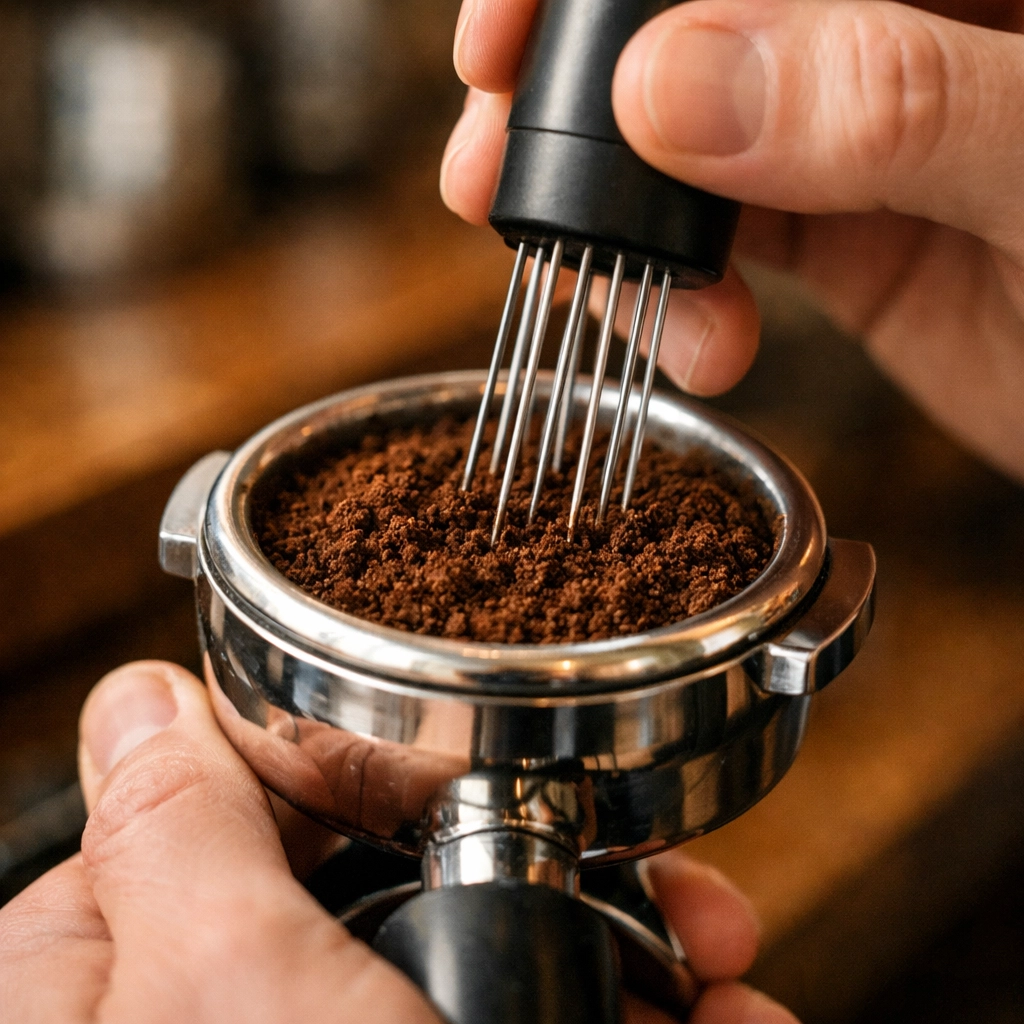
    Barista using WDT tool to distribute espresso grounds evenly in portafilter basket

    Also check your tamp. Are you applying pressure evenly, or are you tilting slightly? An uneven tamp creates channels where water finds the path of least resistance, leaving some coffee under-extracted and other parts drowning. Tamp straight down with consistent pressure – around 30 pounds of force works for most baskets.

    And here's one that catches people out: when did you last clean your shower screen? Coffee oils build up quickly, especially during busy periods. A blocked screen restricts water flow before it even hits your puck. Give it a proper clean with a brush and some espresso machine cleaning solution.

    When Shots Gush Through Too Fast

    On the flip side, maybe your shots are racing through in 15 seconds and tasting sour and weak. This usually means you've gone too coarse on your grind, or you're not dosing enough coffee into the basket.

    Adjust your grind finer. But also check your dose – are you actually filling the basket properly? Most double baskets need 18-20g depending on the basket size. Weigh it. Don't eyeball it, especially when you're troubleshooting.

    Fast shots can also happen with old beans. Coffee starts to degas after roasting, and if your beans are more than a few weeks old (or, heaven forbid, months), they've lost their freshness. The CO2 that helps create resistance during extraction is gone. Fresh beans make a massive difference, which is why we're such sticklers about roast dates at Limini Coffee.

    If you've checked all that and shots are still running fast, your machine's brew temperature might be too low. Some machines allow manual temperature adjustment – try raising it by a degree or two. Typically you want to be in the 90-96°C range for most coffees.

    Clogging and Flow Issues

    Water should flow through your machine consistently. If it's stuttering, barely trickling, or if you're getting odd pressure gauge readings, you're probably dealing with a blockage somewhere in the system.

    Start with the obvious stuff. Is your water tank full and seated properly? Check your water supply hoses for kinks or disconnections. These simple things happen more often than you'd think, especially after moving machines or doing deep cleans.
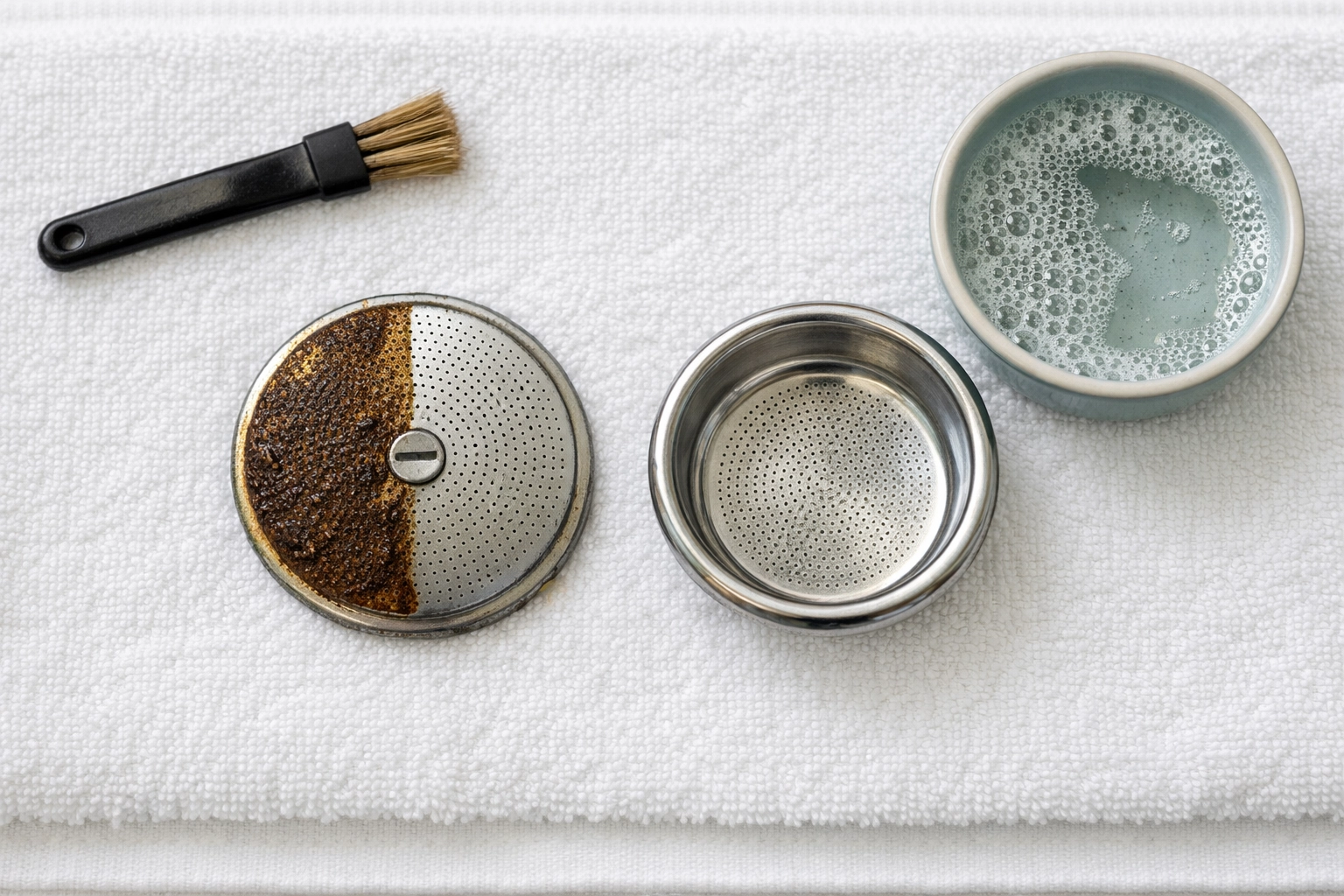
    Espresso machine shower screen and portafilter basket laid out for cleaning and maintenance

    Scale buildup is the silent killer of espresso machines. If you're in a hard water area, you're basically growing rock formations inside your machine. This blocks internal passages, clogs valves, and eventually kills your pump. The solution? Regular descaling. Use a proper commercial descaling product every few months, or more frequently if your water is particularly hard.

    Your portafilter basket and shower screen need attention too. Remove the basket and hold it up to the light – can you see through all the holes clearly? If not, soak it in espresso machine cleaning solution overnight. Same goes for the shower screen and dispersion plate. These collect coffee oils and micro-particles that gradually restrict flow.

    Don't forget your water filter. Replace it every 2-3 months minimum, or sooner if you're in a high-volume café. A clogged filter reduces water flow to the pump, which affects everything downstream.

    Temperature Problems

    Inconsistent temperature is trickier to diagnose but absolutely critical to fix. If your shots taste different from morning to evening, or you're getting sour shots followed by bitter ones with no changes to your process, temperature fluctuation is often the culprit.

    First, are you warming up properly? Most commercial machines need at least 20-30 minutes to reach stable brewing temperature. The boiler might be hot, but the group head takes time to heat through. Pull and dump a few shots before you start serving to get everything up to temperature.

    If you've got temperature stability issues beyond that, you might be looking at a failing thermostat, temperature probe, or heating element. These require professional attention. But before you call an engineer, check if your machine has PID temperature control that might need recalibrating – it's sometimes a simple menu adjustment rather than a hardware problem.

    Barista inspecting commercial coffee grinder burrs for wear and residue buildup

    Grinder Troubles

    Your grinder is just as important as your machine. Maybe more so, actually. An uneven grind means uneven extraction, which means inconsistent shots no matter how perfect your machine is running.

    If you're getting both slow and fast shots seemingly at random, your grinder might be producing inconsistent particle sizes. This usually means your burrs are worn or misaligned. Burrs typically need replacing every 6-12 months in a busy café – it depends on your volume, but if you've never replaced them, that's probably your problem.

    Keep your grinder clean. Old coffee oils go rancid and create a coating that affects grind consistency. Vacuum out the chamber regularly and use grinder cleaning tablets every month or so. We cover proper grinder maintenance in our barista training sessions because it's that important.

    Check your grinder's retention too. If you're getting stale coffee from several shots ago mixed into your current dose, you'll get unpredictable results. Some grinders hold onto quite a bit of ground coffee. Purge a few grams between adjustments to clear out the old grounds.

    Steam Wand Problems

    Low steam pressure makes it impossible to texture milk properly, which is a disaster for any milk-based drinks. If your steam is weak or sputtering, start by purging the wand before and after every use. Milk gets sucked back into the wand and dries, creating blockages.

    Clean the steam wand thoroughly at the end of every shift. Remove the tip if possible and soak it in water mixed with espresso machine cleaning solution. Use a pin or steam wand cleaning tool to clear the holes. Blocked holes reduce pressure and create uneven steam jets.

    If the pressure has dropped suddenly, check whether you're trying to steam while pulling shots. On heat exchanger machines especially, you might not have enough boiler capacity to do both simultaneously. Let the boiler recover between tasks.

    When to Call for Professional Help

    Some problems are beyond quick fixes. If your pump sounds strained or unusually loud, if water is leaking from places it shouldn't (especially around seals and gaskets), or if you're getting very slow flow even with coarse grounds and fresh baskets, you need a technician.

    Same goes if your steam pressure has dropped significantly despite cleaning, or if you're getting temperature swings that don't resolve with warm-up time. These typically indicate failing components – thermoblocks, heating elements, pumps, or seals – that need professional replacement.

    Don't try to take apart your machine beyond basic cleaning unless you know what you're doing. Espresso machines operate under high pressure and temperature, and there are safety mechanisms in place that shouldn't be tampered with. Plus, you might void your warranty.

    For more detailed guidance on maintaining your espresso equipment, we've got resources that go deeper into preventive care and long-term maintenance strategies.

    Prevention Is Better Than Cure

    Most espresso problems are avoidable with consistent maintenance routines. We recommend:

    • Backflush with cleaning solution daily (if your machine supports it)
    • Clean shower screens and portafilter baskets daily
    • Purge and wipe steam wands after every use
    • Replace water filters every 2-3 months
    • Descale every 3-6 months depending on water hardness
    • Replace grinder burrs every 6-12 months
    • Service machines annually by a qualified technician

    Keep a logbook of maintenance tasks. It sounds tedious, but it helps you spot patterns and prevents problems from sneaking up on you during busy periods.

    The reality is that café equipment works hard. You're asking your machine to pull hundreds of shots per day, steam gallons of milk, and maintain precise temperatures throughout. A bit of preventive care goes a long way toward avoiding those mid-service meltdowns.

    And if you're ever unsure about something, reach out. Whether it's to your equipment supplier, Limini Coffee, or a trusted technician, getting advice early prevents small issues from becoming expensive disasters. We'd much rather help you troubleshoot over the phone than have you limping through service with wonky espresso.

    Keep those shots flowing. You've got this.
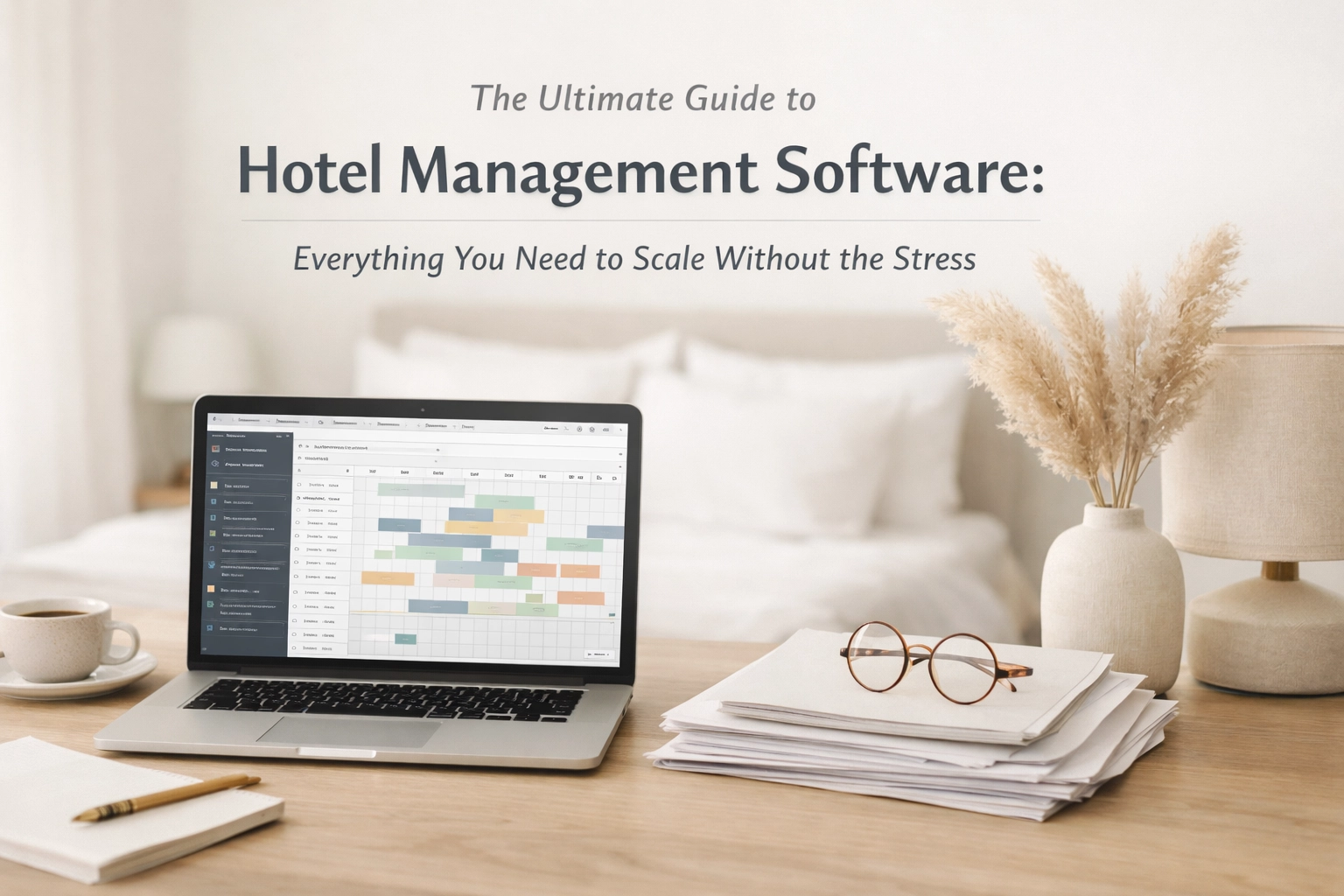
  • The Ultimate Guide to Hotel Management Software: Everything You Need to Scale Without the Stress

    The Ultimate Guide to Hotel Management Software: Everything You Need to Scale Without the Stress

    Scale smarter. Automate faster. Breathe easier.

    Running a modern hotel shouldn't feel like an endless cycle of manual spreadsheets and frantic front-desk phone calls. If you're looking to grow your portfolio: or simply get your current property running like a well-oiled machine: you need a platform that does the heavy lifting for you. We believe technology should be the silent engine behind your success, not a hurdle your staff has to jump over every day.

    Most hoteliers see a 20% increase in operational efficiency within the first few months of switching to a modern, cloud-native system. That’s not just a statistic; that’s hours of time returned to your team to focus on what actually matters: the guest. By centralizing your operations into one innovative platform, you move from reactive firefighting to proactive hospitality.

    The Heart of the Operation: The Hotel PMS

    Everything starts with the Property Management System (PMS). In the past, this was a clunky box sitting under a desk, prone to crashes and requiring an IT degree to update. Today, we think differently. A modern hotel pms should be cloud-native, accessible from your phone while you're at a conference or from a tablet while you're walking the floor.

    Why does cloud-native matter? It means 99.95% uptime. It means automatic security updates. It means you can scale across five, ten, or fifty properties without ever buying a new server. We believe in providing a system that is as intuitive as the apps on your smartphone, drastically reducing the time it takes to train new staff.

    Three Pillars of a Modern PMS:

    • Centralized Data: One source of truth for every reservation, guest preference, and billing detail.
    • Real-time Access: Manage your inventory and rates from anywhere in the world.
    • Open API: Connect to the tools you already love without the technical headache.

    Sync Your Sales: Booking Engine and Channel Manager

    If your hotel pms is the heart, your booking engine and channel manager are the lungs. They keep the revenue flowing. Without seamless integration between these three, you’re constantly at risk of the dreaded overbooking.

    A high-converting booking engine lives on your website, offering guests a frictionless way to book directly. This isn't just about saving on OTA commissions (though that’s a massive plus); it’s about owning the guest relationship from second one. When your booking engine talks directly to your channel manager, your availability is updated across Expedia, Booking.com, and Airbnb in milliseconds.

    A guest in a minimalist lounge using a tablet to experience a seamless hotel booking engine and check-in.

    We think the "set it and forget it" mentality is the goal. Automation handles the inventory distribution, so you can spend your time on strategy rather than data entry.

    The New Front Desk: Self-Check-In Kiosks

    Let’s be honest: nobody travels across the world because they’re excited to stand in a queue at a front desk. Modern guests crave autonomy. This is where self-check-in kiosks change the game. By moving the administrative part of the arrival to a kiosk or a guest’s own mobile device, you transform your lobby from a waiting room into a social hub.

    Implementing kiosks doesn't mean removing the human touch. It means freeing your staff from typing in passport numbers so they can actually greet guests and offer a local recommendation. It’s about hospitality, not data entry.

    Why Guests Love Automation:

    • Zero Wait Times: They go straight from the airport to their room.
    • Digital Keys: Their phone is their room access: no plastic cards to lose.
    • Personalization: Guests can add breakfast or a room upgrade at their own pace.

    Personalization at Scale: The Power of CRM

    Scaling your business doesn't mean losing the personal touch. In fact, with a robust CRM (Customer Relationship Management) integrated into your software stack, you can be more personal than ever.

    We believe every guest should feel like a regular, even on their first stay. A CRM tracks preferences, past stays, and special requests automatically. When "Guest A" returns, the system alerts your team that they prefer a high floor and extra pillows. This isn't magic; it’s just smart data. Using these insights allows you to send automated, personalized pre-arrival emails that drive upsell revenue and build lasting loyalty.

    Housekeeping and Ops: The Efficiency Engine

    The biggest stressor in scaling a hotel is often the "back of house." How do you know if Room 302 is actually clean? If your housekeeping team is still using walkie-talkies and paper lists, you’re losing money.

    Integrated housekeeping tools allow staff to update room status in real-time on their mobile devices. The moment a room is marked "clean," it’s live in the PMS and ready for check-in. This reduces the "turnaround gap" and allows you to get guests into rooms faster, directly impacting your bottom line. Hotels using integrated mobile tools often see a 30% improvement in turnover speed.

    Data-Driven Decisions Without the Spreadsheet Stress

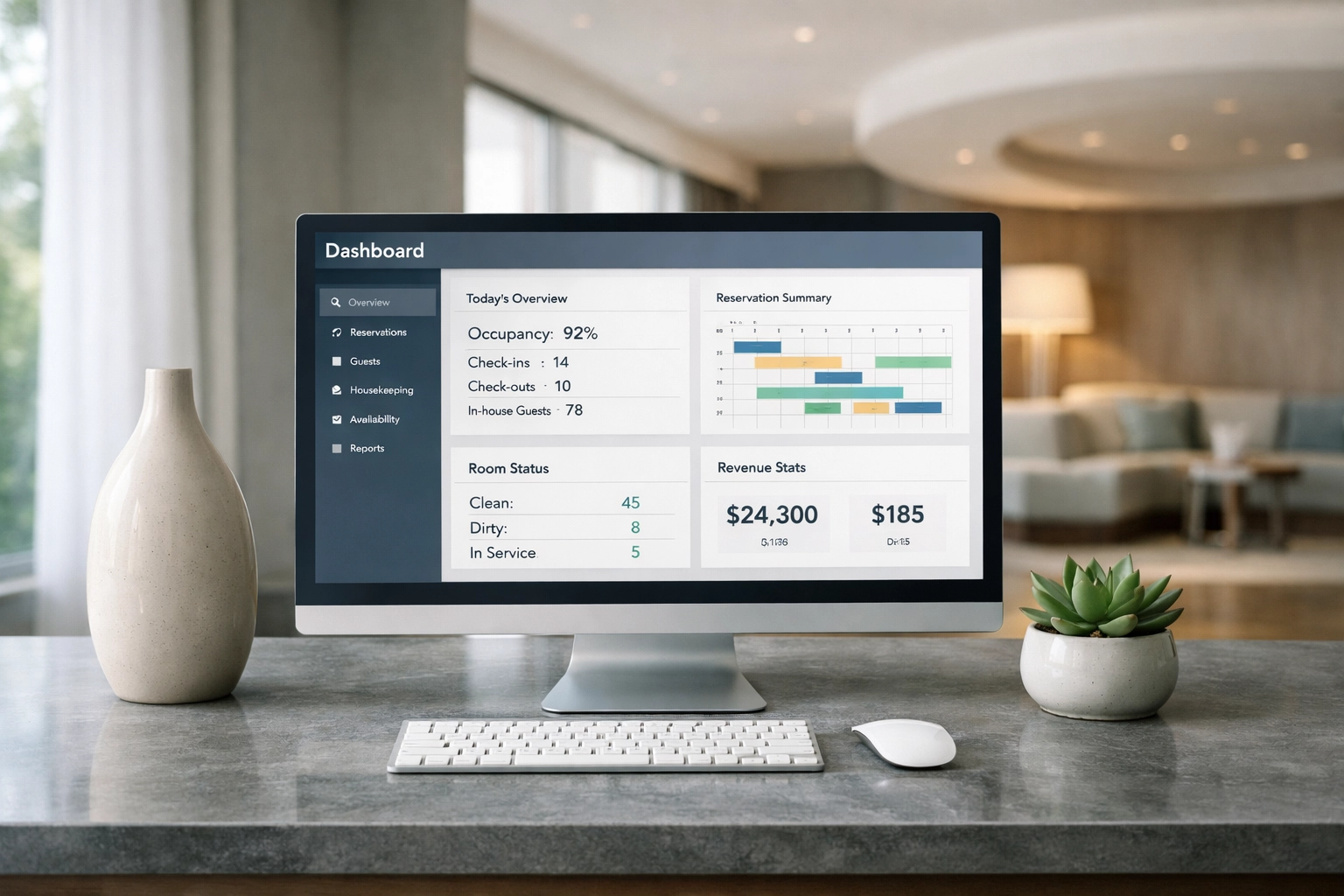
    You can’t manage what you don’t measure. But you shouldn't have to spend your Sunday nights building pivot tables. An innovative hotel management system provides real-time dashboards that show you the metrics that matter: RevPAR, occupancy rates, and average daily rate (ADR).

    We think you should be able to see the health of your entire portfolio in one glance. This level of visibility allows you to make dynamic pricing adjustments based on market trends and competitor data, ensuring you never leave money on the table during peak season.

    A modern hotel management workspace displaying real-time data and revenue analytics on a high-res monitor.

    Payments and Security: The Invisible Shield

    Handling money shouldn't be stressful. Integrated payment processing means no more manual card entries and no more "did they pay?" questions at check-out. By automating pre-authorized charges and secure transactions, you significantly reduce the risk of chargebacks and human error.

    Security is paramount. A cloud-native system ensures that guest data and payment information are stored with enterprise-level encryption. You get to focus on being a host; we’ll handle the PCI compliance.

    Scaling Without the Technical Burden

    The beauty of a modern, automation-focused platform like Mews is that it grows with you. Whether you’re adding ten rooms or a hundred properties, the infrastructure remains the same. You don't need a larger IT team; you just need a better system.

    "We used to spend hours every week just trying to get our different systems to talk to each other. Now, it just works. I’ve regained 10 hours a week to focus on growing my business." : This is the kind of transformation we live for.

    See What Mews Can Do for You

    We believe that hospitality is about people, not processes. Our goal is to automate the mundane so you can focus on the extraordinary. If you’re ready to ditch the legacy stress and embrace a cloud-native, easy-to-use platform that’s built for the future of travel, we’re here to help.

    Scaling your hotel shouldn't be a headache. It should be an adventure. With the right tools in your kit: from a powerful hotel pms to seamless self-check-in kiosks: you're not just managing a building; you're crafting an experience.

    Ready to see how the most innovative hotels are winning?

    Hotel staff providing personalized hospitality in a lobby equipped with innovative hotel PMS technology.

    Join the Mews Community

    Take the first step toward a more automated, profitable, and stress-free hotel operation.

    Get started with Mews today.

    It’s time to spend less time on software and more time on your guests. Let's get you earning more revenue in no time.

  • Why AI Business Automation Will Change the Way You Run Your Empire (Without Hiring an Army)

    You wake up.

    Before you’ve even reached for your coffee, you reach for your phone. It’s a reflex. A survival instinct.

    📱 6:45 AM.

    The screen glows with the cold light of 42 unread emails, three "urgent" Slack messages, and a notification that a customer in a different time zone is annoyed because their login isn't working.

    Your heart does that little caffeine-free skip. Not the fun kind. The "I’m drowning in my own success" kind.

    You built this empire. You wanted the freedom. But right now, it feels like the empire owns you. You’ve thought about hiring. You’ve looked at the resumes. But then you think about the payroll… the training… the management… the inevitable "I’m sick today" texts.

    So you stay small. You stay tired. You stay the bottleneck.

    But there’s a second option. One that doesn’t require a 10-person HR department or a massive office lease.

    It’s called AI business automation. And it’s about to give you your life back.

    STOP JUGGLING. START COMMANDING.

    The problem isn't that you have too much work. The problem is that you’re doing work that a machine can do faster, cheaper, and without complaining about the office temperature.

    When people hear "AI," they think of robots taking over the world. When you hear "AI," you should think of a silent, invisible army that lives in your browser and handles the "boring stuff" while you sleep.

    We’re talking about an ai virtual assistant for business. Not a chatbot that gives canned, useless answers. A system that learns your voice, understands your workflows, and executes tasks with the precision of a Swiss watch.

    An ai virtual assistant for business managing multiple tasks and documents for an organized business owner.

    7:00 AM , THE INBOX IS ALREADY CLEANED

    ☕ You finally take that first sip of coffee.

    Normally, this is when you’d spend 45 minutes archiving spam and flagging "real" emails. But today is different.

    While you were dreaming, your AI assistant was working. It sorted the junk. It categorized the leads. It even drafted replies to the five most common questions you get every single morning.

    You look at your screen. The 42 emails are gone. In their place is a neat summary:

    "3 new leads sent to CRM. 2 meeting requests added to your calendar. 1 urgent tech issue resolved by the support bot."

    You didn't do a thing. You just drank your coffee.

    This isn't magic. It's efficiency. By using an ai virtual assistant for business, you aren't just saving time, you're saving your mental energy for the big decisions. The "empire-building" decisions.

    11:00 AM , THE ANGRY MOB IS SILENT

    ☎️ It’s the middle of your morning sprint.

    In the old days, this is when the support tickets would start flooding in. A bug in the software. A shipping delay. A question about pricing.

    You’d stop what you’re doing, open a ticket, type out the same response you’ve typed 1,000 times, and lose your flow.

    Not anymore.

    When you automate customer support with ai, you aren't just putting up a "Leave a Message" sign. You’re deploying a brain.

    Your AI knows your knowledge base. It knows your return policy. It knows how to talk to a frustrated customer with the patience of a saint. It handles the 80% of repetitive questions that used to eat your day alive.

    The best part? It never gets tired. It never has a "bad day." It just solves problems.

    And if things get truly complicated? It flags you. But by then, the "angry mob" has already been shrunk down to a single, high-priority conversation that actually needs your human touch.

    Automate customer support with ai using a friendly robot to resolve queries and improve satisfaction.

    2:00 PM , THE ADMIN MOUNTAIN HAS LEVELED OUT

    🔍 You’re looking at your to-do list for the afternoon.

    Usually, this is the "slump." Data entry. Moving info from Stripe to your accounting software. Checking if invoices were paid. Following up with that guy who promised to send his contract three days ago.

    It’s soul-crushing work. It’s why people quit their jobs to become goat farmers.

    But Marblism handles the heavy lifting.

    Imagine a world where your documents organize themselves. Where your AI recognizes an invoice, extracts the data, and files it where it belongs. Where follow-up emails are sent automatically based on triggers you set months ago.

    You aren't a data entry clerk. You’re a CEO. It’s time you started acting like one.

    The "army" you thought you needed to hire? They were just going to do this manual labor anyway. Why pay for four salaries when one smart system can do it for the price of a few lattes?

    Check out how we make this happen at https://marblism.link/scott-bowen.

    5:00 PM , THE DOORS ARE SHUT (BUT THE LIGHTS ARE ON)

    🌙 The workday is technically over.

    In your old life, this is when you’d start "Catch Up Season." You’d stay late to finish the admin you ignored all day while you were busy putting out fires.

    But the fires never started.

    Your ai virtual assistant for business kept the perimeter secure. Your support was handled. Your leads were nurtured.

    You look at your laptop. You don't feel that heavy weight in your chest. You feel… finished.

    You close the lid. You walk away.

    But behind the scenes, the empire is still growing. The AI is still talking to customers in Europe. It’s still processing orders from Asia. It’s still organizing your day for tomorrow.

    You are scaling. And your payroll stayed exactly the same.

    AI business automation running a 24/7 operation while the owner enjoys freedom outside the office.

    SCALING WITHOUT THE PAYROLL BLOAT

    Let’s talk numbers. Because at the end of the day, an empire is built on math.

    Hiring a full-time administrative assistant costs, on average, $40k–$60k a year. And that’s just one person. They sleep. They take vacations. They need health insurance.

    To run a 24/7 operation, you’d need at least three of them.

    When you automate customer support with ai and use virtual assistants for your admin, your costs don't scale linearly with your growth.

    If you get 10 times more customers tomorrow, your AI doesn't ask for a 10x raise. It just works 10 times harder.

    This is how the "solopreneur" becomes a "tycoon." Not by working 80 hours a week, but by building a system that doesn't need them.

    DON'T JUST TAKE OUR WORD FOR IT

    We’ve seen it happen. Real people, real businesses, real freedom.

    "I used to spend 3 hours a day just answering the same four questions on my site. Now? I don't even look at the support folder. The AI handles it better than I did, honestly." , Mark

    "The fear of hiring was keeping my business small. I didn't want the responsibility of employees. Marblism gave me the 'staff' I needed without the headaches. I've doubled my revenue in six months." , Sarah

    "It feels like I found a cheat code for business. I’m doing more work with less stress. I actually went to my kid’s soccer game without checking my phone once." , David

    A successful business owner standing on gears, symbolizing growth through efficient ai business automation.

    BUT IS IT COMPLICATED?

    Short answer: No.

    Longer answer: You’ve probably been told that AI is for "tech people." That you need to know how to code to make it work.

    That’s a lie.

    Modern business automation is designed for people who have better things to do than learn Python. It’s about "if this, then that." It’s about connecting the tools you already use, Gmail, Slack, Shopify, HubSpot, and letting them talk to each other through an AI brain.

    You don't need to be a developer. You just need to know what tasks you want to stop doing.

    THE EMPIRE WAITS FOR NO ONE

    The gap between the businesses that use AI and the businesses that don't is widening.

    The "Old Guard" is still hiring more people to solve problems. They are slow. They are expensive. They are prone to human error.

    The "New Empire" is lean. It’s fast. It’s automated.

    Which one are you building?

    If you’re ready to stop being the "Chief Everything Officer" and start being the actual leader of your business, it’s time to look at what Marblism can do for you.

    Stop the juggling. End the "Catch Up Season." Build the army that never sleeps.

    See how easy it is to start here: https://marblism.link/scott-bowen.

    FAQ: EVERYTHING YOU’RE WONDERING ABOUT

    Can AI actually sound human in customer support?
    Yes. Modern AI models can be trained on your specific brand voice. If you’re casual and witty, the AI will be too. If you’re professional and formal, it stays in line. Most customers won't even know they aren't talking to a person, they'll just be happy they got an answer in 30 seconds instead of 3 hours.

    Is it expensive to set up?
    Compared to a human salary? It’s practically free. Most businesses see a return on investment within the first 30 days simply by reclaiming the hours they used to spend on manual admin.

    Will I lose control of my business?
    No. You set the rules. Think of AI as the ultimate "Yes Man." It does exactly what you tell it to do, every single time. You have more control because you have better data and more time to look at the big picture.

    What if I’m not 'tech-savvy'?
    If you can use a smartphone, you can use Marblism. We’ve designed the process to be intuitive. No coding, no "dark magic," just simple automation that works.

    Does this mean I’ll never have to hire again?
    Maybe. Or maybe it means when you do hire, you’re hiring for high-level strategy and creativity, not just to have someone sit in a chair and move data between spreadsheets.

    THE FINAL WORD

    Scaling shouldn't be a punishment for success.

    You worked hard to build this. You shouldn't have to work even harder just to keep it running. The tools are here. The technology is ready.

    The only question left is: What are you going to do with all that extra time?

    Maybe take a nap. Or maybe… start building your next empire.

    The choice is yours.

    Build your invisible army today: https://marblism.link/scott-bowen

  • 7 Mistakes You’re Making with Your Home Brewing (and How to Fix Them)

    7 Mistakes You’re Making with Your Home Brewing (and How to Fix Them)

    We’ve all been there. It’s 7:00 AM, the kitchen is quiet, and you’re craving that perfect, syrupy, soul-warming cup of coffee you had at your favorite cafe last weekend. You go through the motions, kettle on, beans in, water poured, and then… sip. It’s okay. But it’s not that cup. It’s a bit thin, maybe a little bitter, or perhaps it just tastes a bit flat.

    Why does coffee at home often feel like a pale imitation of what professional baristas serve? To be honest, it’s rarely because they have "magic" machines (though a nice espresso machine certainly helps). More often than not, it’s because of a few tiny, easily fixable mistakes that creep into our home brewing routines.

    At Limini Coffee, we believe that everyone deserves exceptional coffee in their own kitchen. Whether you’re using a V60, a French Press, or a high-end espresso machine, small adjustments can lead to massive improvements. So, let’s look at the seven most common mistakes we see home brewers making and, more importantly, how you can fix them today.


    1. Using Coffee That is "Past Its Prime"

    The biggest mistake happens before you even turn on the kettle. If you are buying coffee from a supermarket shelf, there is a very high chance it was roasted months ago. Coffee is a fresh agricultural product; it’s more like baked bread than a shelf-stable spice. Once it's roasted, it begins to lose its aromatic compounds immediately.

    The Problem: Stale beans lead to a "hollow" or "woody" flavor. You lose all those beautiful floral or fruity notes that make speciality coffee so special. Even worse is using pre-ground coffee. Once coffee is ground, the surface area increases exponentially, causing it to oxidize (and go stale) in minutes rather than weeks.

    The Fix: Always buy fresh-roasted coffee from a reputable roaster. Look for a "Roasted On" date, not a "Best Before" date. Ideally, you want to use your beans within 2 to 4 weeks of roasting. If you want to experience what truly fresh coffee tastes like, we highly recommend checking out our latest single-origin roasts, which we roast to order to ensure you get the peak flavor.

    Close-up of freshly roasted coffee beans being cupped in hands on a rustic table.


    2. Eyeballing Your Measurements

    We love the romance of a "hand-crafted" cup of coffee, but coffee brewing is essentially chemistry. If you’re just "throwing a few scoops" of coffee into your brewer and filling the water to "somewhere near the top," your results will be inconsistent. One day it’s great, the next it’s a watery mess.

    The Problem: Inconsistent ratios. The ratio of coffee to water determines the strength and extraction level of your brew. Even a gram or two of difference can completely change the profile of the cup.

    The Fix: Buy a digital scale. They are inexpensive and will revolutionize your coffee more than almost any other piece of kit. We generally recommend a starting ratio of 60g of coffee per 1 litre of water (or a 1:16 ratio). If you find that math a bit tedious before your first caffeine hit, you can use our coffee brewing calculator to get the perfect numbers every time. Precision is the secret to repeatability.


    3. Boiling Your Water to Death

    This is a classic. You wait for the kettle to click off at a rolling boil and immediately dump that 100 °C (212 °F) water onto your delicate coffee grounds.

    The Problem: Water that is too hot can actually "scorch" the coffee, leading to an unpleasant, harsh bitterness. It extracts the tannins and bitter compounds far too quickly. Conversely, if your water is too cool, you won't extract enough flavor, leaving the coffee tasting sour or salty.

    The Fix: Aim for a water temperature between 92 °C and 96 °C. If you don't have a temperature-controlled kettle, simply let your kettle sit for about 30 to 60 seconds after it has finished boiling before you start pouring. This small pause allows the temperature to drop into that "sweet spot" where the best flavors are extracted.

    Matte black gooseneck kettle pouring hot water into a glass pour-over coffee brewer.


    4. Neglecting Water Quality

    Think about this: your cup of coffee is about 98% water. If your water tastes like chlorine or is "hard" (full of minerals like calcium), your coffee is going to taste like it.

    The Problem: Magnesium and calcium in hard water can interfere with the extraction process, often making the coffee taste dull or chalky. On the other hand, very soft water can lead to over-extraction and a sharp, biting acidity.

    The Fix: At the very least, use a basic water filter jug (like a Brita). It removes chlorine and balances the mineral content just enough to let the coffee shine. If you want to get really serious, some brewers use "third wave" water capsules to mineralize distilled water, but for most of us, a simple filter does wonders. Remember, if you wouldn't want to drink a glass of the water on its own, don't use it to make your coffee!


    5. The "Blade Grinder" Blues

    If you are still using a blade grinder (the ones with the spinning metal blade that looks like a tiny blender), we have some tough love for you: it’s time for an upgrade.

    The Problem: Consistency is everything in grinding. Blade grinders don't actually "grind", they "shatter" the beans. This leaves you with a mix of "fines" (microscopic dust) and "boulders" (huge chunks). When you brew, the dust over-extracts and becomes bitter, while the boulders under-extract and stay sour. You end up with a cup that is simultaneously bitter and sour. Not ideal.

    The Fix: Invest in a burr grinder. Burr grinders crush the beans between two abrasive surfaces, giving you a uniform particle size. This ensures that every bit of coffee extracts at the same rate. Whether you choose a manual hand-grinder or an electric one, the improvement in clarity and flavor is staggering.

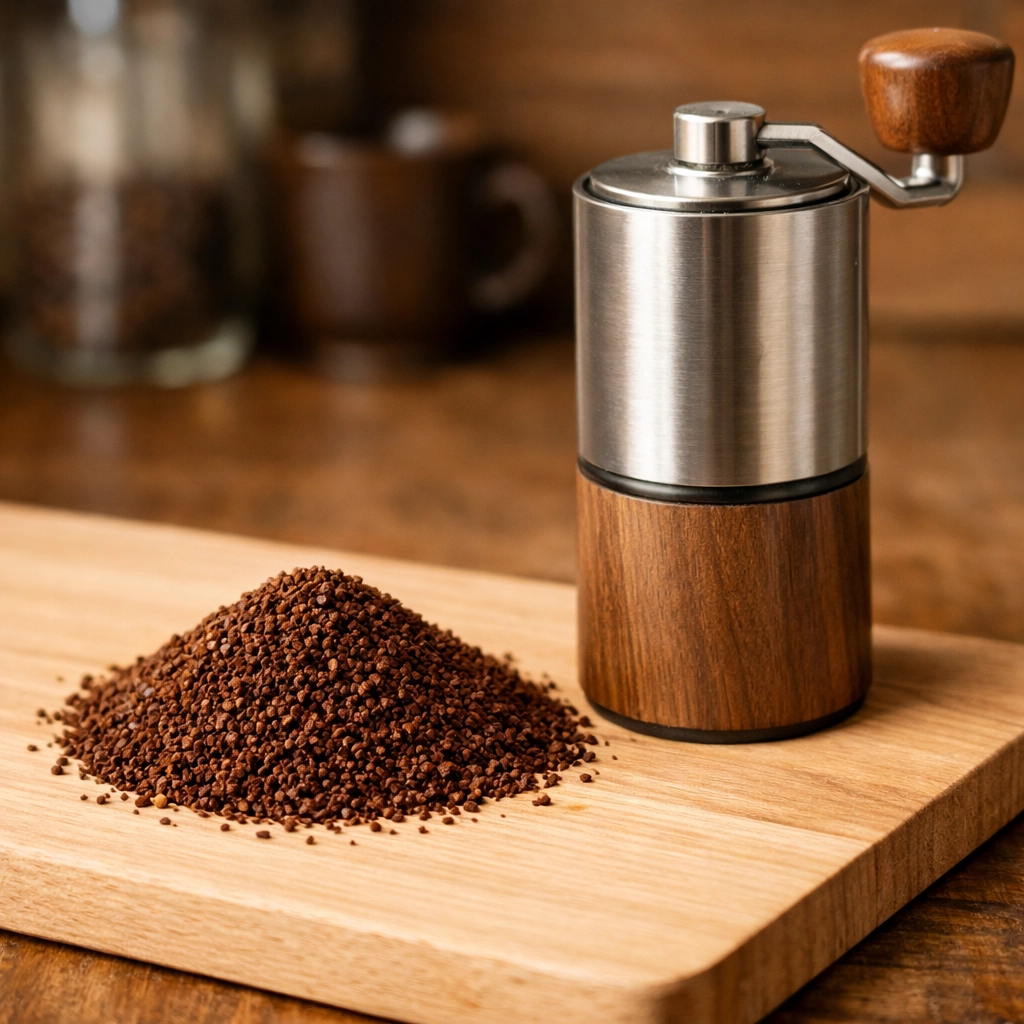
    Freshly ground coffee with uniform consistency next to a manual burr coffee grinder.


    6. Forgetting to Clean Your Kit

    Coffee beans contain a lot of oils. Over time, these oils build up on your equipment, inside your French Press mesh, on your espresso portafilter, and even in your grinder.

    The Problem: These oils eventually go rancid. If you haven't deep-cleaned your equipment lately, those old, stale, fishy-smelling oils are tainting every new brew you make. It’s a subtle bitterness that builds up so slowly you might not even realize it’s there until you clean it and taste the difference.

    The Fix: Give your equipment a proper "polishing" (as we lovingly call it). For espresso machines, this means backflushing regularly. For filter brewers, it means using a bit of specialized coffee cleaner or even just warm soapy water (and rinsing very thoroughly). Don't forget to wipe out your bean hopper too! A clean machine makes a clean cup. If you're interested in the finer details of machine maintenance, we cover a lot of this in our barista training sessions.


    7. Storing Beans in the Fridge or Freezer

    It sounds logical, cold keeps food fresh, so it should keep coffee fresh, right? Well, not exactly.

    The Problem: Coffee is porous. It acts like a sponge for smells and moisture. Every time you take the bag out of the freezer, condensation forms on the beans. This moisture starts to degrade the oils immediately. Plus, unless your bag is 100% airtight, your coffee will start to taste like that half-eaten onion or the leftover curry sitting next to it.

    The Fix: Store your coffee in a cool, dark, dry place. A kitchen cupboard away from the oven is perfect. Use an opaque, airtight container or just keep it in the original Limini Coffee bag, which comes with a one-way valve to let CO2 out while keeping oxygen away. Fresh is best, so buy smaller amounts more frequently rather than "stocking up" for months!

    Airtight ceramic canister on a wooden shelf for storing coffee beans away from sunlight.


    Why It Matters (The "So What?" of Brewing)

    You might be thinking, "Scott, this seems like a lot of work for a morning cup." And we get it. But the beauty of coffee is that once you fix these habits, they become second nature.

    When you use fresh beans, correctly measured, with filtered water at the right temperature, something magical happens. You stop needing to drown your coffee in sugar or milk to make it palatable. You start tasting the notes of chocolate, stone fruit, or jasmine that the farmers worked so hard to produce.

    Basically, coffee isn't just a caffeine delivery system: it’s an experience. It’s a moment of peace before the day starts. And you deserve to have that moment be as delicious as possible.

    If you’re ready to put these tips into practice, the first step is always the beans. Grab a bag of our freshly roasted speciality coffee right here and see if you can taste the difference for yourself. We think you'll be pleasantly surprised.

    A perfectly brewed cup of black speciality coffee in a handcrafted ceramic mug.

    Summary Checklist for a Better Brew:

    • Buy Fresh: Check for a roast date.
    • Use a Scale: Stop guessing, start weighing (1:16 ratio).
    • Temp Check: 92-96 °C (Wait a minute after the boil).
    • Filter Your Water: Your tap water is likely holding you back.
    • Burr Grinder Only: Consistency is king.
    • Keep it Clean: Rancid oils are the enemy of flavor.
    • Cool & Dry Storage: Keep the beans out of the fridge!

    Happy brewing! If you have any questions or you're struggling with a specific brewing method, feel free to reach out to us here at Limini Coffee. We love talking shop.

  • The Ultimate Guide to Workflow Automation for Small Business: Everything You Need to Scale Without the Stress

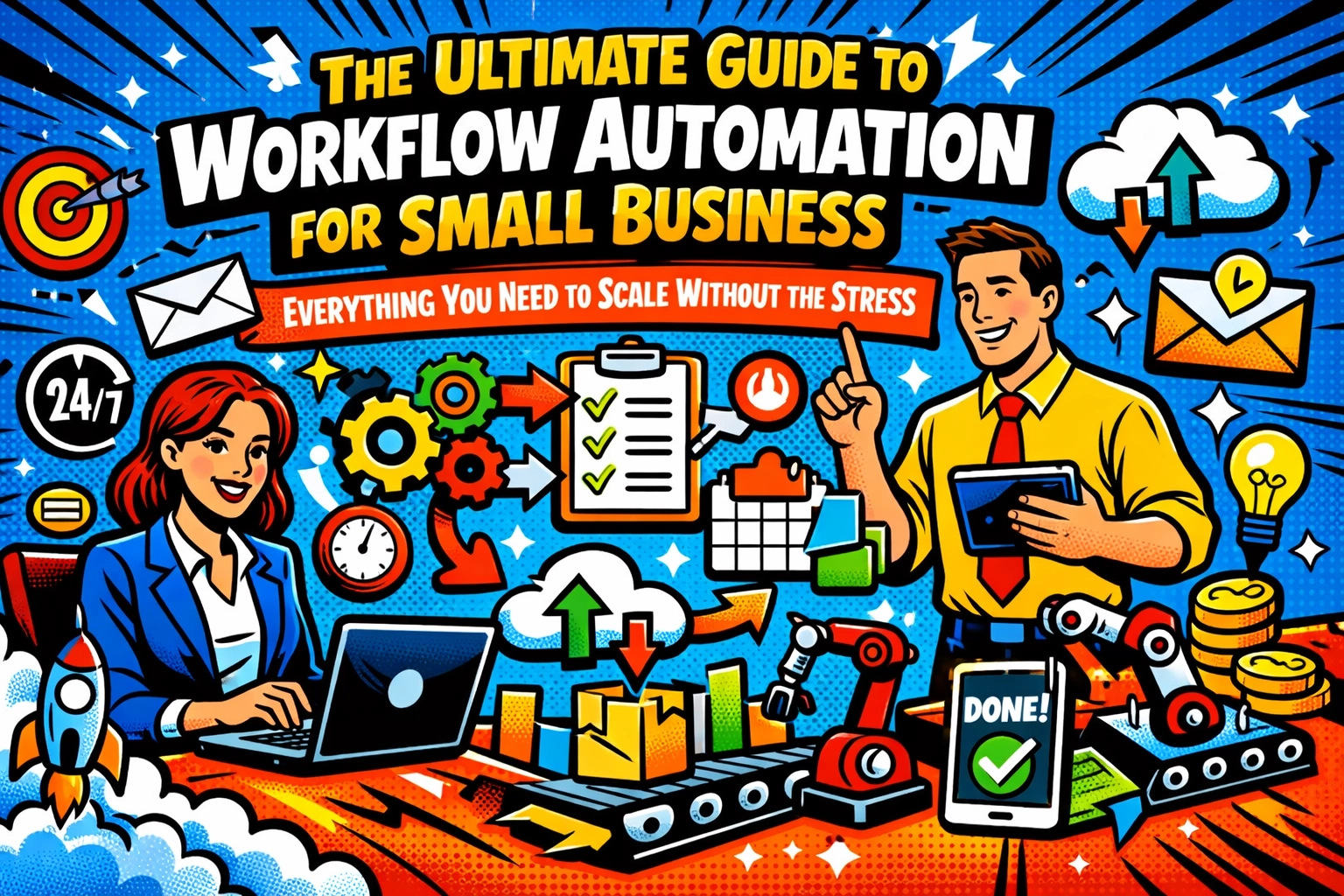
    The Ultimate Guide to Workflow Automation for Small Business: Everything You Need to Scale Without the Stress

    WORKFLOW AUTOMATION FOR SMALL BUSINESS: STOP DOING THE BUSY WORK

    ☕ 7:00 AM.

    You haven't even finished your first cup of coffee, and it’s already happening. Your phone buzzes. Three new leads from the website. An invoice that’s three days overdue. A customer asking, for the fifth time, what your pricing Tiers are.

    You haven’t even brushed your teeth, and you’re already behind.

    You spend the next four hours copy-pasting data from emails into spreadsheets. You manually send "Welcome!" notes. You hunt down missing attachments. It’s not "growing a business." It’s digital babysitting.

    But it doesn't have to stay this way. Imagine a world where the data moves itself… where the invoices chase themselves… and where you actually get to do the work you started this business for in the first place.

    That’s not a dream. It’s workflow automation. And for a small business, it’s the only way to scale without losing your mind.

    THE TRAP OF THE "HUSTLE"

    We’ve been lied to. We’ve been told that "hustle" means doing everything yourself. But doing everything yourself is the fastest way to hit a ceiling. You only have 24 hours. Your manual processes are the bottleneck.

    If you’re still manually moving data from Point A to Point B, you aren't the boss. You’re the bridge. And bridges get walked on.

    Overwhelmed business owner juggling manual tasks, illustrating the need for workflow automation.

    YOUR 30-DAY ESCAPE PLAN

    You don't need to automate your entire company overnight. That’s how things break. You need a roadmap.

    Days 1-7: The Audit
    Stop working for a second and look at what you’re doing. Every time you do a task, ask: Is this repetitive? Does it follow a set of rules? Do I hate doing it? If the answer is yes to all three, it’s a candidate for automation.

    Days 8-14: The Build
    This is where the magic happens. You don't need to be a coder. You just need to connect the dots. Use tools that play nice with each other. Look for "triggers" (the thing that happens) and "actions" (the thing the computer does for you).

    Days 15-21: The Test Drive
    Run your first automation alongside your manual process. See where it trips up. Maybe it’s a typo in an automated email or a missing field in your CRM. Fix it now.

    Days 22-30: The Expansion
    Now that you’ve automated one thing, you’ll see opportunities everywhere. Invoicing. Onboarding. Follow-ups. Suddenly, you’ve clawed back 10 hours a week.

    WHAT SHOULD YOU AUTOMATE FIRST?

    Start where the friction is highest.

    1. The Lead Machine: When someone fills out your contact form, they shouldn't wait for you to wake up. An automated system can tag them in your CRM, send a "Let's Chat" link, and notify your team instantly.
    2. The Paperwork Nightmare: Invoices should go out automatically. Reminders should be sent without you having to play "debt collector."
    3. The Onboarding Flow: When a new client signs, they should get their welcome packet, their login credentials, and their first-step instructions immediately.

    Scaling shouldn't be this stressful. If you’re ready to stop the busy work and start growing, check out how we handle the heavy lifting at Marblism.


    WHY YOUR BUSINESS NEEDS AN AI VIRTUAL ASSISTANT (BEFORE YOUR COMPETITORS GET ONE)

    📱 11:00 AM.

    You’re in a meeting. Your phone stays silent. But in the background, things are moving.

    A prospect asks a question on your site. An AI Virtual Assistant answers it instantly. A client wants to reschedule a call. The AI checks your calendar, moves the block, and sends the new invite. No "back and forth" emails. No "does 2 PM work for you?"

    Your competitors are still doing this manually. They’re slow. They’re tired. And they’re about to lose their market share to the businesses that don't sleep.

    THE TRUTH ABOUT HUMAN ASSISTANTS

    Human assistants are great. We love humans. But humans need sleep. Humans get sick. Humans have "off days" where they forget to BCC the right person.

    An AI virtual assistant for business doesn't need a lunch break. It doesn't get "bored" of data entry. It’s the employee of the month, every single month.

    An AI virtual assistant for business depicted as a superhero robot winning employee of the month.

    WHY NOW? (THE COMPETITIVE EDGE)

    We are in the middle of a shift. It’s like the transition from snail mail to email. You can stay with the old way, but you’ll be doing it alone.

    Your competitors are already looking at AI. They’re looking for ways to cut costs while increasing speed. If it takes you 24 hours to respond to a lead and it takes your competitor’s AI 24 seconds… who do you think gets the contract?

    Speed is the new currency.

    THE "SHADOW" EMPLOYEE

    Think of an AI VA as a shadow. It sits behind your existing tools, your email, your Slack, your CRM, and watches for patterns.

    • Customer Support: It handles the 80% of questions that are the same every day. "Where is my order?" "How do I reset my password?"
    • Data Accuracy: It moves info between apps without making a single typo.
    • Proactive Scheduling: It doesn't just wait for you to tell it what to do; it flags issues before they become disasters.

    IT’S NOT ABOUT REPLACING PEOPLE. IT’S ABOUT LIBERATING THEM.

    When you bring an AI Virtual Assistant into your business, you aren't firing your team. You’re giving them their brains back.

    You hired your marketing manager to be creative, not to spend three hours a day cleaning up mailing lists. You hired your sales rep to close deals, not to manually log every single phone call.

    Automation gives your people the space to do the work only humans can do, strategy, empathy, and high-level problem solving.

    THE BOTTOM LINE

    You can keep white-knuckling your way through the chaos. You can keep "grinding" until you burn out. Or you can build a system that works while you’re at dinner, while you’re at the gym, and while you’re sleeping.

    The tools are here. The tech is ready. The only thing missing is your decision to start.

    Stop being the bottleneck in your own success. See how an AI-driven approach can change your trajectory at Marblism.

    FAQ

    Q: Is workflow automation expensive?
    A: No. It’s an investment. The "cost" of your manual labor: and the errors that come with it: is almost certainly higher than the subscription for an automation tool.

    Q: Do I need to be a tech genius?
    A: Not anymore. If you can use a smartphone, you can set up basic automation. Most platforms are "drag and drop."

    Q: Will my customers hate talking to an AI?
    A: Only if the AI is bad. A well-configured AI assistant is helpful, fast, and polite. Most customers prefer a fast answer from a bot over a three-day wait for a human.

    Q: Where do I even start?
    A: Start with one single task. The one you hate the most. Automate it. Then do the next one.

    Scaling shouldn't be a struggle. It should be a system.

    The future of your business is waiting. Don't let your competitors get there first.

    High-speed rocket ship representing a business scaling fast with automation while leaving competitors behind.

    READY TO SCALE?
    Stop guessing. Start automating. Connect with Scott Bowen to see how Marblism can turn your manual mess into a streamlined machine.

    Scaling Shouldn't Be This Easy. But Here We Are.

  • The Ritual of the Roast: Understanding Light vs. Dark Roast Profiles

    The Ritual of the Roast: Understanding Light vs. Dark Roast Profiles

    So you're standing in front of a wall of coffee bags, squinting at labels that promise "bright citrus notes" on one side and "rich chocolatey depth" on the other. Light roast, dark roast, medium roast, what's the actual difference, and more importantly, which one belongs in your morning cup?

    Let's demystify the roast spectrum. Because once you understand what's happening inside that roaster, choosing your perfect coffee becomes less about guesswork and more about matching your taste buds to the right profile.

    What Actually Happens During Roasting?

    Before we dive into light versus dark, it's worth understanding what roasting does to a coffee bean. Raw coffee beans (we call them green coffee) are dense, grassy-smelling little pellets that would make a terrible cup of coffee. Roasting transforms these beans through carefully controlled heat, triggering hundreds of chemical reactions that develop the flavors, aromas, and colors we associate with coffee.

    The roasting process has distinct audible markers. The first is called, wait for it, the "first crack." This is when the beans have absorbed enough heat that moisture inside turns to steam and escapes with an audible pop. Think popcorn. The second crack happens at higher temperatures when the bean's cellular structure breaks down further.

    Where a roaster stops this process determines whether you're getting a light, medium, or dark roast. And that decision? It fundamentally changes everything about your coffee.

    Coffee beans arranged from light roast to dark roast showing color and texture differences

    Light Roasts: The Origin Storytellers

    Light roasts are finished just after that first crack, typically around 356-401°F (180-205°C). The beans are pulled from the heat before the roasting process can dominate the coffee's natural characteristics.

    What does this mean for your cup? Light roasts are all about origin transparency. The flavors you're tasting are direct expressions of where and how the coffee was grown, the soil composition, the elevation, the processing method, the specific coffee varietal. You'll often encounter bright acidity, complex fruit notes (think citrus, stone fruits, berries), floral aromatics, and sometimes tea-like or herbal qualities.

    Visually, light roast beans are, well, lighter in color: ranging from cinnamon to light brown. The surface stays dry because the oils haven't been drawn to the surface yet. These beans are also denser and heavier than their darker counterparts because they've retained more moisture.

    The body tends to be thinner and more delicate. This isn't a criticism: it's a feature. Light roasts offer clarity and nuance that would get buried under heavier roasting. We love light roasts for single-origin coffees where the terroir tells an interesting story.

    Dark Roasts: The Bold Simplifiers

    Dark roasts take the heat well past the second crack, typically above 430°F (220°C). At these temperatures, the roasting process itself becomes the dominant flavor creator. The bean's cellular structure breaks down, oils migrate to the surface, and you start developing those robust, straightforward flavors.

    What you'll taste in a dark roast: toasted nuts, baker's chocolate, caramel, smoky notes, and earthy depth. The acidity that defined the light roast? Gone. Replaced by a rich, bittersweet character with lower perceived acidity and a fuller, sometimes syrupy body.

    Light roast and dark roast coffee comparison in glass cups side by side

    Dark roast beans look dramatically different: they're deep brown to almost black, with a glossy, oily surface. Those natural oils that stayed inside the light roast beans have now emerged, creating that characteristic sheen. The beans are also noticeably lighter in weight and puffier, because extended roasting drives off more moisture and expands the cellular structure.

    Here's the thing about dark roasts: they're not trying to showcase origin. They're creating a consistent, bold flavor profile that many people find comforting and familiar. There's nothing wrong with that. Dark roasts have their place, especially in milk-based drinks where you want coffee flavor that can stand up to steamed milk.

    The Great Caffeine Myth

    Let's tackle this one head-on because it comes up constantly: dark roasts do not have significantly less caffeine than light roasts.

    The confusion comes from how we measure coffee. If you measure by volume (scoops), light roasts will give you slightly more caffeine because those dense beans pack more mass into the same space. One scoop of light roast might yield 70mg of caffeine versus 65mg from a scoop of dark roast.

    But if you're measuring by weight: which is what you should be doing anyway for consistent brewing: the difference becomes negligible. The extended roasting does degrade caffeine molecules slightly, but we're talking about such small variations that you won't notice in real life.

    So choose your roast based on flavor preference, not on some misguided attempt to optimize your caffeine intake. They're all going to wake you up just fine.

    Finding Your Perfect Match

    Here's where it gets personal. There's no "correct" roast level: only what works for your palate and your brewing method.

    Go lighter if you:

    • Love exploring different flavor notes and complexities
    • Enjoy bright, crisp acidity
    • Drink your coffee black or with minimal additions
    • Use pour-over, Chemex, or other filter brewing methods
    • Get excited about tasting the specific characteristics of different origins

    Go darker if you:

    • Prefer bold, straightforward coffee flavors
    • Add milk, cream, or non-dairy alternatives to your coffee
    • Like lower acidity and richer body
    • Make espresso drinks, cold brew, or iced coffee
    • Want consistency over complexity

    And honestly? You don't have to choose just one. We know plenty of coffee lovers who keep both a light roast Ethiopian and a dark roast Brazilian in their pantry, choosing based on mood and method.

    Pour-over coffee brewing method with light roast grounds and kettle

    Brewing Recommendations by Roast

    Your roast level should influence your brewing approach. Light roasts benefit from methods that highlight clarity and complexity: pour-over methods like V60 or Chemex work beautifully. These coffees shine when you can taste the distinct flavor notes without interference.

    Dark roasts are more forgiving and versatile. They work wonderfully in French press, where the fuller body comes through nicely. They're also excellent for espresso because those bold flavors cut through milk in cappuccinos and lattes. Cold brew with dark roast creates a smooth, chocolatey concentrate that's dangerously easy to drink.

    Medium roasts (which we haven't focused on here, but they're the comfortable middle ground) tend to be the most versatile, working well across virtually any brewing method.

    What We're Doing at Limini

    At Limini Coffee, we roast across the spectrum because we believe different coffees deserve different treatments. Some origins are so expressive and unique that we'd never dream of taking them past a light roast: that would be like painting over a masterpiece. Other coffees develop beautiful caramelized sweetness and body with a bit more heat.

    We're particularly passionate about showing people what specialty coffee can be at lighter roast levels. So much of the coffee world's default has been dark roasting, partly because it masks defects in lower-quality beans. When you start with exceptional green coffee: carefully sourced, properly processed, and freshly harvested: you can roast lighter and let those natural flavors shine.

    That said, we're not roast snobs. If you prefer darker roasts, brilliant. We'd rather you drink coffee you genuinely enjoy than force yourself through a light roast because someone told you it's "better." There's room for all of it.

    The Experimentation Invitation

    Here's our suggestion: grab a light roast and a dark roast of the same origin if you can find them. Brew them side by side using the same method and ratio. Taste them both black first, then try adding milk to see how they respond differently.

    You'll learn more about your preferences from this one exercise than from reading a dozen articles about cupping notes and roast profiles. Coffee is experiential. The best way to understand what you like is to taste, compare, and pay attention.

    And if you want to start that exploration with beans we're genuinely proud of, we'd love to have you browse what we're currently offering at Limini Coffee. We're roasting fresh every week, and we're always happy to chat about which of our coffees might suit your taste.

    The ritual of the roast isn't just about heat and time: it's about transformation and choice. Light or dark, bright or bold, the perfect roast is simply the one that makes you excited to wake up and brew another cup.

  • Stop Wasting Your Morning on Boring Admin: 7 Quick AI Business Automation Hacks

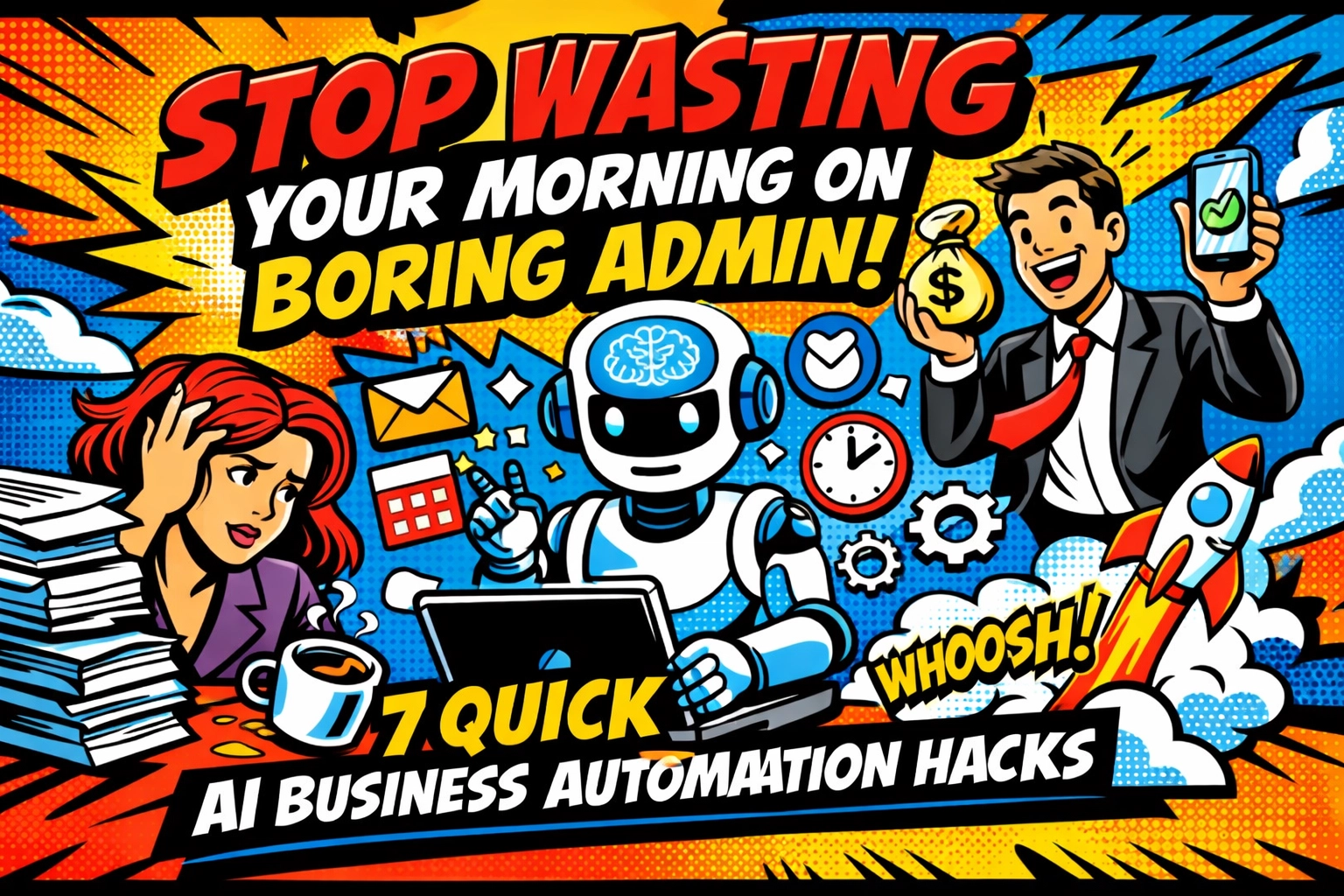
    Stop Wasting Your Morning on Boring Admin: 7 Quick AI Business Automation Hacks

    ☕ 6:45 AM.

    Your eyes crack open. The first thing you reach for isn’t your coffee… it’s your phone. And there it is. The wall of notifications. The unread emails. The "quick questions" that somehow take forty minutes to answer.

    Before you’ve even put your feet on the floor, you’re already behind.

    You’re a business owner, not a professional email-replier. You started this thing to build, to create, and to make money, not to spend your best morning hours playing digital Tetris with your calendar or wrestling with spreadsheets.

    The "Admin Tax" is real. It’s that invisible fee you pay every single morning in the form of lost focus and mental fatigue. But it doesn’t have to be this way.

    We live in the era of AI business automation. While your competitors are still manually typing "per my last email," you could be using these seven hacks to reclaim your morning.

    Let’s change your 9:00 AM forever.

    📧 7:15 AM: THE INBOX GHOSTWRITER

    You’re staring at an email from a client. They’re asking about a project timeline for the third time this week. You know the answer, but you have to find the right words to say "it's in progress" without sounding annoyed.

    That’s five minutes of your life you’ll never get back.

    The Hack: Use ChatGPT to draft your responses. Stop typing from scratch. Keep a folder of your most common scenarios, customer support, follow-ups, price inquiries, and feed them to ChatGPT.

    Give it a simple prompt: "You are my professional assistant. Here is a brief update on the Smith project. Write a warm, professional email explaining we are on track for Friday."

    Seconds later, you have a polished draft. You review it. You hit send. You move on.

    Imagine doing that for 20 emails. You just bought yourself an extra thirty minutes of sleep. Or coffee. Definitely coffee.

    📅 8:00 AM: THE CALENDAR THAT CLICKS

    The old way: Looking at a to-do list that looks like a CVS receipt and trying to figure out when you’ll actually do the work. You block out an hour for "deep work," then a meeting gets moved, and the whole house of cards collapses.

    The Hack: Let Motion build your schedule.

    Motion is one of those business automation tools that feels like magic. It analyzes your tasks, your deadlines, and your existing meetings. Then, it automatically builds your calendar for you.

    If a meeting runs over? It shifts your tasks. If a new priority pops up? It rebalances your day. You stop playing "calendar manager" and start being the "CEO."

    You don't need to think about what to do next. You just look at the screen and execute.

    A professional woman using AI business automation tools to automatically organize her digital calendar.

    🔗 9:15 AM: THE NO-CODE GLUE

    Your CRM doesn't talk to your email. Your email doesn't talk to your Slack. Your Slack doesn't talk to your billing software.

    You are the bridge. You are the one manually copying and pasting names, dates, and numbers between tabs. It’s tedious. It’s boring. And it’s exactly where human error creeps in.

    The Hack: Connect your world with Zapier AI.

    You don’t need to be a coder. You just need to speak English. With Zapier’s new AI features, you can describe the workflow you want: "When I get a new lead through my website form, add them to my CRM and send me a Slack notification."

    Zapier builds the bridge. Now, data flows through your business like water through a pipe. No manual handoffs. No "did I remember to add that guy to the list?"

    It just happens. While you’re focusing on the big picture, the robots are doing the heavy lifting. If you want to see how this looks in action for your specific niche, check out Marblism.

    🎙️ 10:30 AM: THE MEETING THAT DOCUMENTS ITSELF

    You’re in a Zoom call. You’re trying to listen, but you’re also trying to scribble down notes so you don’t forget that one specific detail about the budget.

    By the time the call ends, you have three pages of messy notes and a headache. Now you have to spend twenty minutes summarizing those notes for the rest of the team.

    The Hack: Invite Fireflies.ai to the party.

    Fireflies is an AI "notetaker" that joins your meetings. It records, transcribes, and, this is the best part, summarizes the entire conversation.

    Five minutes after the call ends, you get an email with the "Action Items" and a searchable transcript. Did someone mention a specific price on page 4? Just search for "price."

    You can finally stop being a stenographer and start being present in your own meetings.

    AI meeting transcription tool capturing a team discussion to eliminate manual note-taking and admin work.

    🤖 11:45 AM: THE VIRTUAL SIDEKICK

    Some tasks are too complex for a simple "Zap," but too boring for a human. Like research. Or multi-step coordination between five different apps.

    The Hack: Deploy an AI Agent with Lindy.ai.

    Lindy isn't just a tool; it's an "agent." You can give it complex instructions like: "Every Friday, look at my completed tasks, summarize them into a weekly report, and send it to the investors."

    It navigates the apps for you. It handles the back-and-forth. It’s like having a high-level executive assistant who never sleeps, never complains, and doesn't need a lunch break.

    This is the peak of ai business automation. You’re not just saving minutes; you’re saving brain power.

    📄 1:30 PM: THE INSTANT BRIEFING

    The afternoon slump hits. You have a 50-page PDF sitting in your inbox that you need to read before your 2:00 PM call. You start reading the first page, and your eyes glaze over.

    The Hack: Use Microsoft Copilot 365 or ChatGPT’s "File Upload" feature.

    Drop the document in. Ask: "What are the 3 biggest risks mentioned in this report?" or "Give me a bulleted summary of the financial projections."

    In ten seconds, you’ve digested an hour’s worth of reading. You walk into that 2:00 PM call looking like the smartest person in the room because you have the facts, without the fluff.

    Summarization is the ultimate time-hack for the modern executive.

    AI summarization tool transforming a mountain of messy paperwork into clear business insights and ideas.

    🧠 3:00 PM: THE BOT THAT RUNS THE PROJECT

    By mid-afternoon, projects usually start to drift. Someone forgot a deadline. A task is stuck in limbo because nobody knows whose turn it is.

    The Hack: Put ClickUp Brain to work.

    ClickUp’s AI doesn’t just store your tasks; it understands them. It can predict if a project is going to be late based on your team’s past performance. It can automatically assign sub-tasks to the right people.

    It even writes the status updates for you. Instead of you chasing people down for "Where are we on this?", ClickUp Brain just tells you.

    The chaos is gone. The project is moving. And you? You’re actually ahead of schedule for once.

    THE AFTERMATH: A DIFFERENT KIND OF 5:00 PM

    It’s the end of the day.

    Usually, this is when you’re staring at your screen with blurry eyes, wondering where the time went. But today is different.

    The admin didn't eat your morning. The "quick tasks" didn't snowball into a lost afternoon. You spent your day doing the work that actually moves the needle, the high-value, creative, strategic stuff that only you can do.

    The robots handled the rest.

    This isn't just about "tools." It's about a shift in mindset. It’s about realizing that your time is the most expensive resource your business has. Stop spending it on $15/hour admin tasks when you can automate them for the price of a Netflix subscription.

    If you’re ready to stop the grind and start the growth, you need to see what’s possible when you bake AI into the very foundation of your business.

    Don't let another morning disappear into the void of "boring admin." Take the first step toward a business that runs itself.

    Ready to see how AI can transform your specific workflow?

    Get started with Marblism right here.

    You’ve got the hacks. You’ve got the tools. Now, go get your morning back.


    ❓ FAQ: AI Business Automation

    Is it hard to set up?
    No. Most of these tools are designed for people who don't know how to code. If you can write an email, you can set up an AI automation.

    Will it replace my staff?
    It replaces the boring parts of their jobs. It allows your team to focus on things that require a human touch: like strategy and relationships: rather than data entry.

    Is my data safe?
    Most enterprise-level AI tools (like Microsoft Copilot and Zapier) have high-level security protocols. Always check the privacy settings, but for general admin, they are standard-issue.

    Where do I start?
    Pick one pain point. Is it emails? Is it scheduling? Start there. Once you feel the relief of that first automation, you’ll never want to go back. For a tailored approach, visit Marblism.

  • Automate Admin Tasks: How to Save 10+ Hours Every Week

    ☕ 7:00 AM.
    Your eyes aren’t even fully open, but your thumb is already scrolling.
    You’ve got 42 unread emails.
    Three of them are "urgent."
    Two are from a client who forgot their password for the fourth time this month.
    And one is a notification that a lead just filled out a form on your site… but you have to manually copy their info into your CRM.

    You start your day already behind.
    It’s not because you’re lazy.
    It’s because you’re playing a high-stakes game of digital Tetris with your own time.

    Stop juggling.

    The biggest lie we tell ourselves is that "it only takes a minute."
    But those minutes are thieves.
    Moving data from Stripe to your spreadsheet.
    Sending the "Welcome" email manually.
    Assigning tasks to your team one by one.
    Before you know it, it’s 2:00 PM and you haven’t actually done any real work.

    This is where business automation tools turn from a luxury into a survival kit.

    Imagine 9:30 AM…
    Instead of the "Click-Click-Sigh" cycle, your tools are talking to each other.
    The lead fills out the form.
    Marblism automatically creates the profile, sends a personalized intro, and pings your Slack.
    You didn't lift a finger.

    You’re not just saving time.
    You’re saving your sanity.
    By offloading the repetitive admin, you get those 10+ hours back to actually grow the business.
    Or, you know, actually eat lunch away from your desk.

    Ready to stop the manual madness?
    Check out how we simplify the chaos here.


    The Best AI Assistant for Small Business in 2026

    📱 11:30 AM.
    Your phone buzzes.
    It’s a potential client asking for a quote.
    Then it buzzes again.
    It’s your inventory system saying you’re low on stock.
    Then a third time: your social media post has a typo.

    You’re the CEO, the intern, the marketing director, and the janitor.
    It’s exhausting.

    Most people think an "AI assistant" is just a fancy chatbot that tells jokes.
    But in 2026, the ai assistant for small business isn’t a toy.
    It’s a silent partner.

    Relaxed business owner with a coffee while an ai assistant for small business handles digital workflows.

    Meet your new teammate.
    It doesn’t take lunch breaks.
    It doesn’t get "Monday brain."
    It sits in the background, watching your workflows, finding the gaps you missed.

    1:00 PM…
    A lead asks a question about your pricing while you're in a deep-work session.
    Your AI assistant doesn't just send a generic link.
    It looks at their history, understands their specific pain points, and crafts a response that sounds exactly like you: minus the stress-induced typos.

    The best part? It scales.
    When you have five leads, it handles them.
    When you have 500? It handles them just as easily.

    Stop being the bottleneck in your own company.
    You started this business to be free, not to be a slave to your notifications.
    Let the AI take the wheel for a bit.

    Experience the calm of a truly automated business:
    See what an AI partner can do for you.


    AI Content Generator for Small Business: Your Secret Marketing Weapon

    🔍 3:45 PM.
    The blinking cursor.
    It’s mocking you.

    You know you need to post to LinkedIn.
    You know your blog is gathering digital dust.
    But your brain feels like a dried-out sponge.
    "What do people even want to read?"

    You spend forty minutes writing two paragraphs.
    You hate them.
    You delete them.
    The sun starts to set.

    This is the "Marketing Tax": the heavy price small business owners pay in time and energy just to stay visible.

    But what if you had a secret weapon?
    An ai content generator for small business isn't about replacing your voice.
    It’s about amplifying it.

    Creative professional feeding ideas into an ai content generator for small business to create social posts.

    4:15 PM…
    You feed a simple idea into Marblism.
    Maybe it's just a rough thought about a customer success story.
    Suddenly, you have a blog post.
    A week’s worth of social captions.
    Three email subject lines that actually get clicks.

    The "before" state was quiet, overwhelming anxiety.
    The "after" state is organized competence.

    You’re not just "generating content."
    You’re building an authority machine.
    While your competitors are still staring at that blinking cursor, you’ve already published, engaged, and closed the laptop for the day.

    5:00 PM…
    The lights are off.
    The day’s marketing is done.
    And it’s actually good.

    Stop fighting the blank page.
    Start winning the content game with Marblism.

  • The New Café Owner’s Guide to Choosing a Coffee Roaster Wholesale

    The New Café Owner’s Guide to Choosing a Coffee Roaster Wholesale

    So, you’re opening a café. First off, congratulations! You’re about to embark on a journey filled with early mornings, the intoxicating scent of freshly ground beans, and probably a few more grey hairs than you started with. But we think it’s the best job in the world.

    One of the most critical decisions you’ll make during this startup phase, aside from your location and whether to go for those trendy Edison bulbs, is choosing your wholesale coffee roaster. This isn't just about buying a product; it’s about choosing a partner. Your roaster is the backbone of your business. If the coffee is bad, or if the delivery doesn't show up on a Friday morning, your café is in trouble.

    We’ve seen a lot of startups come and go, and the ones that thrive are almost always those that pick a roaster who offers more than just a bag of beans. Here is our guide to navigating the world of wholesale coffee suppliers to find the perfect fit for your new venture.


    1. Understand Your Own "Vibe" First

    Before you start calling up every roaster in the country, you need to look in the mirror. What kind of café are you? Are you a high-volume "grab-and-go" near a train station, or are you a boutique specialty shop where people spend twenty minutes discussing the notes of jasmine in their pour-over?

    Knowing your volume and your target audience is essential. If you’re pushing through 50kg of coffee a week, you need a roaster that is reliable, consistent, and offers a price point that keeps your margins healthy. If you’re a tiny specialty spot, you might prioritise unique single-origin micro-lots.

    Ask yourself:

    • How much coffee will I realistically use? (Hint: Be conservative at first).
    • What is my budget per kilo?
    • Do I need my supplier to provide equipment as well?

    If you're still figuring out the basics of the shop itself, it’s worth looking at building a coffee shop and shop fitting to see how your workflow will impact your coffee choice.

    A handful of fresh roasted specialty coffee beans being inspected at a wholesale coffee roastery.


    2. Quality and Consistency: The Non-Negotiables

    It goes without saying that the coffee has to be good. But more importantly, it has to be consistently good. We’ve all been to that café where the coffee is brilliant on Tuesday and bitter on Thursday. That’s usually a sign of either poor barista skills or a roaster with inconsistent quality control.

    When evaluating coffee suppliers, always ask for samples. But don't just drink one cup and decide. Try the coffee through different machines, with different milk types, and at different times of the day. You’re looking for a roast that is balanced and approachable.

    At Limini Coffee, we believe that roasting is a science as much as an art. We focus on bringing out the natural sweetness of the bean without the burnt bitterness often found in "traditional" commercial roasts. If you want to see what our customers think of our consistency, you can check out our reviews.

    And remember, fresh is best. Ideally, your coffee should be delivered within days of being roasted. Look for a "roasted on" date rather than a "best before" date. If a supplier can't tell you exactly when the beans were in the drum, keep walking.


    3. More Than Just Beans: Support and Training

    This is where the wheat is separated from the chaff. A lot of people can roast coffee, but not every roaster can help you run a successful business. For a new café owner, the support package offered by wholesale coffee roasters is often more valuable than the coffee itself.

    Think about it: who is going to train your staff? If your baristas don't know the difference between a flat white and a latte (yes, there is a big difference, and you can read about it in our article on latte vs cappuccino), your expensive beans are wasted.

    We highly recommend choosing a partner that offers comprehensive barista training. You need your team to understand:

    • Dosing and Tamping: The physics of how water moves through coffee. (Check out our guide to tamping for more).
    • Milk Science: How to achieve that perfect micro-foam. Understanding milk chemistry is key to a glossy, sweet drink.
    • Equipment Maintenance: How to keep the machines running so they don't break down mid-rush.

    If you’re looking for a full-service partner, you should definitely take a look at our wholesale coffee options. We don't just ship boxes; we help you build a brand.


    4. The Heavy Metal: Equipment Solutions

    Opening a café is expensive. The espresso machine is usually the single biggest investment. Many wholesale roasters offer equipment leasing or "free" machines in exchange for a higher coffee price.

    While a "free" machine sounds tempting, be careful. Often, these machines are basic and won't give you the control you need to produce top-tier espresso. We prefer a more transparent approach. Whether you want a modern La Spaziale with precise temperature control (PID) or the visual theatre of a lever machine, your roaster should be able to guide you.

    Close-up of a commercial espresso machine pouring fresh coffee for a new café business.

    When choosing espresso equipment, consider the following technical specs:

    • Boiler Size: Will it keep up with 50 coffees an hour?
    • Stability: Does it maintain a consistent 93 ºC (199 ºF)? Even a 2-degree drop can sour your shots.
    • Power: Does your shop have the 3000 watts required to run a commercial double-boiler?

    It’s a lot to take in, which is why having a roaster who understands the workings of these machines is a lifesaver when things (inevitably) need a little tweak.


    5. Ethics, Sourcing, and the "Why"

    Consumers today are savvy. They want to know where their coffee comes from. Is it ethically sourced? Are the farmers being paid a fair wage?

    Working with a specialty coffee roaster usually means you are getting coffee that has been sourced with care. We take sourcing our coffee very seriously, focusing on relationships with farms that prioritise quality and sustainability. When you can tell your customers the story of the farm in Brazil or the cooperative in Ethiopia, you’re not just selling a drink; you’re selling an experience.

    This "theatre" is a huge part of what makes a café successful. People come to you because they can't get that same quality or story at home. You can read more about creating that café theatre to keep your customers coming back.


    6. Reliability and the Boring (But Vital) Stuff

    Let’s talk about logistics. It’s not sexy, but it’s what keeps the doors open. When you are looking for wholesale coffee suppliers, ask about:

    • Lead Times: If you order on Monday, when does it arrive?
    • Minimum Order Quantities (MOQs): Do you have to buy 20kg at a time, or can you order smaller, fresher batches?
    • Shipping Costs: Are they hidden in the price or added at the end?

    A reliable roaster will have a system in place that ensures you never run out. At Limini, we pride ourselves on our wholesale service because we know that a late delivery isn't just an inconvenience: it’s lost revenue for you.

    Stacked bags of fresh coffee beans ready for delivery from a reliable wholesale coffee supplier.


    7. The Financials: Don't Just Look at the Per-Kilo Price

    It’s easy to get fixated on the price per kilo. "Roaster A is £15/kg and Roaster B is £18/kg." On paper, Roaster A looks like the winner. But wait.

    Does Roaster B include free barista training? Do they provide free espresso machine servicing? Do they offer a coffee brewing calculator to help you dial in your recipes and reduce waste?

    Often, the "cheaper" coffee ends up being more expensive because your staff wastes 20% of it due to poor training, or your machine breaks down and you have to pay a technician £100 an hour to fix it. We always advocate for the "total value" approach. Look for a partner who helps you lower your overall cost of operation, not just the cost of the raw material.

    If you’re ready to start looking at the real numbers, you can explore our wholesale partnership and see how we support our café owners from day one.


    Summary: How to Choose

    To wrap it up, here is your checklist for choosing a wholesale coffee roaster:

    1. Taste the Coffee: Request samples and test them with and without milk.
    2. Check the Roast Date: Ensure they roast to order.
    3. Evaluate Training: Do they offer ongoing training overview for your staff?
    4. Assess Equipment: Can they supply and look after your espresso machine?
    5. Alignment of Values: Do you like their philosophy and who they are?
    6. Reliability: Can they deliver when you need them?

    Choosing a roaster is the start of a long-term relationship. You want someone who is as passionate about your success as you are. We love nothing more than seeing a new café go from a construction site to a bustling community hub.

    If you’re just starting out and feeling a bit overwhelmed, don't worry: it’s part of the process. We’re here to help you navigate everything from the perfect crema to choosing the right cups for your shop.

    Opening a café is a big step, but with the right coffee supplier by your side, it’s a lot less scary. If you want to chat more about how we can help your business grow, head over to Limini Coffee and let’s get brewing!

  • Beyond the Cup: How to Create a Community Hub in Your Café

    Beyond the Cup: How to Create a Community Hub in Your Café

    Here's the thing about running a successful café in 2026: serving great coffee isn't enough anymore. You could have the best beans, the most dialed-in espresso, and picture-perfect latte art, but if your space feels like a soulless transaction hub, you're missing out on the real magic that keeps customers coming back week after week.

    We're talking about community. That intangible something that transforms your café from "a place to grab coffee" into "the place where I belong."

    So how do you actually create that? How do you design and operate a space that becomes the beating heart of your neighborhood? Let's dig into the practical stuff that makes a real difference.

    Why Community Actually Matters for Your Bottom Line

    Before we get into the how, let's be honest about the why. Building community isn't just feel-good fluff, it's smart business.

    Customers who feel connected to your space become regulars. They bring their friends. They forgive the occasional off day. They choose you over the chain down the street even when it's more convenient. And they spend more time (and money) in your café because they genuinely want to be there, not because they need their caffeine fix.

    The repeat customer who comes in three times a week is worth exponentially more than the tourist who stops by once. Community creates that loyalty.

    Design Spaces That Invite Connection

    Your layout speaks volumes before your staff says a single word. And the biggest mistake we see? Cafés that design every square meter for maximum turnover, with uncomfortable seating and fluorescent lighting that screams "drink your coffee and leave."

    Mix up your seating deliberately. You want communal tables that encourage strangers to share space and strike up conversations. Add cozy corners with softer seating for those who want intimate catch-ups with friends. Include high stools near the window for solo customers who want to people-watch. Put in some tucked-away spots for laptop workers who need to focus.

    The variety matters. Different personality types need different things from your space, and when you accommodate that, everyone feels welcome.

    Cozy café interior with communal table and mixed seating creating welcoming community atmosphere

    Communal tables, specifically, are your secret weapon. They're not just about fitting more people, they set the tone. They say "this is a place where we share space, where we're open to each other." We've seen cafés host everything from language exchanges to book clubs around their communal tables, all without organizing a single formal event.

    Lighting is criminally underestimated. Harsh overhead fluorescents make people want to leave. Warm, layered lighting, think pendant lights, table lamps, even candles in the evening, creates intimacy. It makes your café feel like someone's really lovely living room rather than a corporate coffee outpost.

    Use warm woods, brass accents, plants, and texture. If you've got exposed brick or interesting architectural features, celebrate them. The goal is warmth and character, not sterile minimalism.

    Make Your Space Work Hard (In a Good Way)

    Modern café customers want flexibility. The person camping out with a laptop for three hours has different needs than the parent with a toddler or the retired couple on their daily coffee date.

    Build in multifunctional features without overthinking it. Power outlets aren't optional anymore, they're expected. But think beyond the basics. USB charging ports at tables? Genius. Different table heights and configurations that can be rearranged for events? Even better.

    Create clear zones without building walls. Use furniture arrangement, lighting changes, and even subtle flooring variations to signal different areas. Your laptop warriors can coexist peacefully with your chatty regulars when the space is designed thoughtfully.

    Connect to Your Neighborhood's Soul

    Here's where it gets really interesting. The cafés that become true community hubs don't try to be everything to everyone, they lean into their neighborhood's specific character and needs.

    Display work from local artists. Stock products from nearby makers. If there's a community tradition or historical element to your area, acknowledge it in your décor or programming. This isn't about being a museum, it's about being rooted in place.

    Café corner featuring local art gallery wall and artisan products for neighborhood connection

    And speaking of coffee, if you're sourcing quality beans from roasters who care about their craft (we certainly hope you are, might we suggest exploring what we offer at Limini?), tell those stories. Customers increasingly want to know the journey from origin to cup, and sharing that creates connection to something bigger than their morning flat white.

    Program for People, Not Just Profit

    The word "programming" sounds corporate, but really we're just talking about giving people reasons to gather beyond the coffee itself.

    This doesn't mean you need to host events every night. Start small. A weekly acoustic music session. Monday morning sketching meet-ups. A community notice board where people can post about neighborhood happenings. Book swaps. Board game nights.

    The key is consistency and authenticity. Pick one or two things you can sustain and do them well. Customers will build these events into their routines, and suddenly your café becomes "the place where the folk music happens" or "where the book club meets."

    Create spaces that naturally accommodate these gatherings. A slightly cleared area that can fit a musician. A wall where art can be hung and changed monthly. Shelving for the community library exchange.

    Your Staff Are the Real Secret Ingredient

    You can have the most beautifully designed space in the world, but if your baristas are checked out or unwelcoming, the community vibe evaporates.

    Hire for personality and train for skill. You want people behind the bar who genuinely enjoy chatting with regulars, who remember orders and names, who make every customer feel seen. These are the relationships that transform casual visitors into devoted regulars.

    Barista engaging with regular customer at café counter building community relationships

    Invest in proper training, not just technical espresso skills, but customer service, community engagement, and the kind of comprehensive barista education that helps your team understand they're not just making drinks, they're facilitating experiences and connections.

    Empower your staff to make decisions that build community. If someone's short on cash, let your barista offer them a coffee anyway. If a customer's having a rough day, allow time for that conversation. These moments matter more than hitting exact transaction-per-hour targets.

    The Practical Stuff That Makes It All Work

    Let's get tactical for a minute. Here are the unsexy details that make community-focused cafés actually function:

    Think about acoustics. Hard surfaces make for terrible conversation spaces. Add sound-dampening elements, fabrics, acoustic panels, rugs, so your café doesn't turn into an echoing nightmare when it's busy.

    Create kid-friendly zones if that matches your neighborhood. A small play area or kids' corner means parents can relax properly, which means they stay longer and come back more often.

    Consider your opening hours strategically. Can you stay open slightly later to catch the after-dinner crowd? Open earlier for the pre-work community? Sometimes small schedule adjustments make you accessible to entirely different groups.

    Make your space bookable for private events during off-hours. Baby showers, small meetings, birthday gatherings, these deepen community ties and create another revenue stream.

    The Long Game

    Building a true community hub doesn't happen overnight. It takes consistent effort, genuine care, and patience. You're not just selling coffee, you're creating a third place, that essential space between home and work where people can truly relax and connect.

    The cafés that get this right don't just survive, they thrive. They weather economic downturns because their customers feel personally invested in their success. They attract the best staff because people want to work somewhere meaningful. They become landmarks in their neighborhoods.

    So yes, keep obsessing over your espresso extraction and milk technique. Keep sourcing excellent beans and perfecting your menu. But also think bigger. Think about the role your café plays in people's lives beyond the cup.

    Create spaces that invite lingering. Hire people who genuinely care. Program thoughtfully. Connect to your community's unique character. And watch as your café transforms into something far more valuable than a simple coffee shop.

    That's when the real magic happens.