Author: admin

  • How to Source Sustainable Coffee for Your Business

    How to Source Sustainable Coffee for Your Business

    Let's be honest: sustainability isn't just a buzzword anymore. It's what your customers are asking about, what your competitors are bragging about, and increasingly, what your business reputation depends on. If you're running a café, restaurant, or any business serving coffee, where your beans come from matters. A lot.

    But here's the thing: sourcing sustainable coffee doesn't have to be complicated or prohibitively expensive. It's about knowing what to look for, building the right relationships, and partnering with suppliers who genuinely care about the entire supply chain: not just their profit margins.

    So let's talk about how to source sustainable coffee for your business in a way that's ethical, profitable, and genuinely makes a difference.

    Why Sustainability Matters in Today's Coffee Market

    The coffee industry has a bit of a dark side. For decades, coffee farmers: particularly smallholders in developing countries: have been squeezed by volatile commodity prices, exploitative middlemen, and climate change that threatens their livelihoods. Meanwhile, consumers are becoming increasingly aware of these issues.

    Today's customers want to know their morning flat white isn't contributing to environmental degradation or poverty wages. They're reading labels, asking questions, and voting with their wallets. According to recent industry data, 55% of global coffee production was certified under voluntary sustainability standards in 2019/2020, and that number is only growing.

    When you source sustainable coffee, you're not just doing the right thing ethically. You're also building brand loyalty, differentiating yourself from competitors, and future-proofing your business against an increasingly conscious consumer base.

    Coffee farmer holding ripe red coffee cherries on sustainable plantation

    The Business Case: How Ethical Sourcing Strengthens Your Brand

    Let's talk bottom line for a moment. Sustainable sourcing isn't charity: it's smart business.

    When you commit to ethically-sourced coffee, you're telling a story your customers want to hear. You're showing them you care about more than just profit. And that emotional connection? It translates to loyalty, word-of-mouth marketing, and customers who'll pay a premium for your coffee because they trust what you stand for.

    Think about it: independent cafés and roasters thrive on authenticity. You can't compete with high street chains on price or convenience, so you compete on values. Your sustainable sourcing becomes part of your brand identity, something you can proudly display on your menu boards, website, and social media.

    Plus, building long-term relationships with sustainable suppliers often means more consistent quality, better traceability, and even input into the development of new coffees. You're not just buying a commodity: you're becoming part of a supply chain that values quality and relationships.

    Understanding Coffee Certifications: Your Starting Point

    If you're new to sustainable sourcing, certifications are your friend. They provide third-party verification that coffee has been produced according to specific environmental, social, and economic standards.

    Fair Trade is probably the most recognized certification. It ensures farmers receive a minimum price for their coffee, regardless of market fluctuations, and guarantees safe working conditions and community development funds.

    Rainforest Alliance focuses on environmental conservation, protecting biodiversity, and promoting sustainable farming practices that preserve ecosystems while supporting farmer livelihoods.

    Organic certification means the coffee was grown without synthetic pesticides, herbicides, or fertilizers: better for the environment, the farmers, and arguably the coffee itself.

    Direct Trade isn't a formal certification but a sourcing model where roasters work directly with farmers, cutting out middlemen and ensuring more money goes to the people actually growing your coffee. This is where things get really interesting.
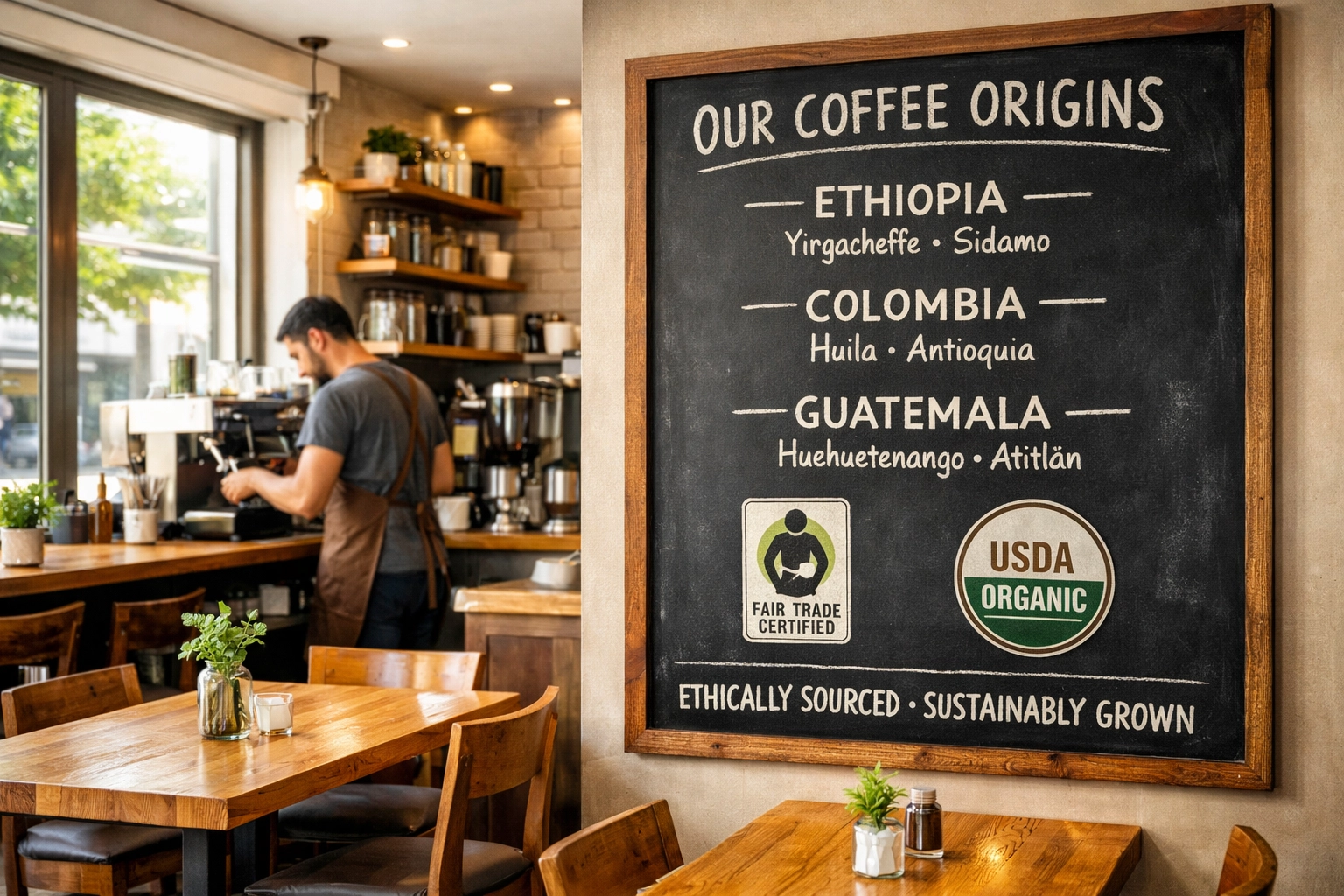
    Independent café displaying sustainable coffee origin information and certifications

    The Direct Trade Difference

    We've always believed that the best coffee comes from direct relationships. When you source through importers who actually know the farmers, visit the farms, and build multi-year partnerships, you get something special.

    Direct trade means transparency. You know exactly where your coffee comes from: not just the country or region, but the specific farm or cooperative. You know who grew it, how they processed it, and what they earned from it.

    This level of traceability isn't just feel-good marketing. It allows you to verify ethical practices, maintain consistent quality year after year, and tell your customers genuine stories about the people behind their coffee.

    At Limini, we've built our entire sourcing model around these direct relationships. We work with farmers and cooperatives who share our commitment to quality and sustainability, and we believe that approach produces not just better coffee, but a better industry.

    What to Look For in a Sustainable Coffee Supplier

    So you're ready to source more ethically. What should you actually be looking for?

    Transparency is everything. Your supplier should be able to tell you exactly where their coffee comes from, who grew it, and how it was processed. If they can't or won't, that's a red flag.

    Ask about pricing. Sustainable sourcing means farmers are paid fairly. Your supplier should be able to explain their pricing model and demonstrate that a meaningful portion of what you pay reaches the growers.

    Look at their long-term relationships. The best suppliers return to the same farms and cooperatives year after year, investing in quality improvement and sustainable practices. This consistency benefits everyone in the supply chain, including you.

    Consider their values beyond coffee. Do they invest in community development projects? Do they support women in coffee? Do they have environmental commitments around packaging and operations?

    And here's something we think is crucial: taste the coffee. Sustainable sourcing and exceptional quality aren't mutually exclusive: in fact, they usually go hand in hand. The best sustainable coffees we've encountered are among the most delicious.
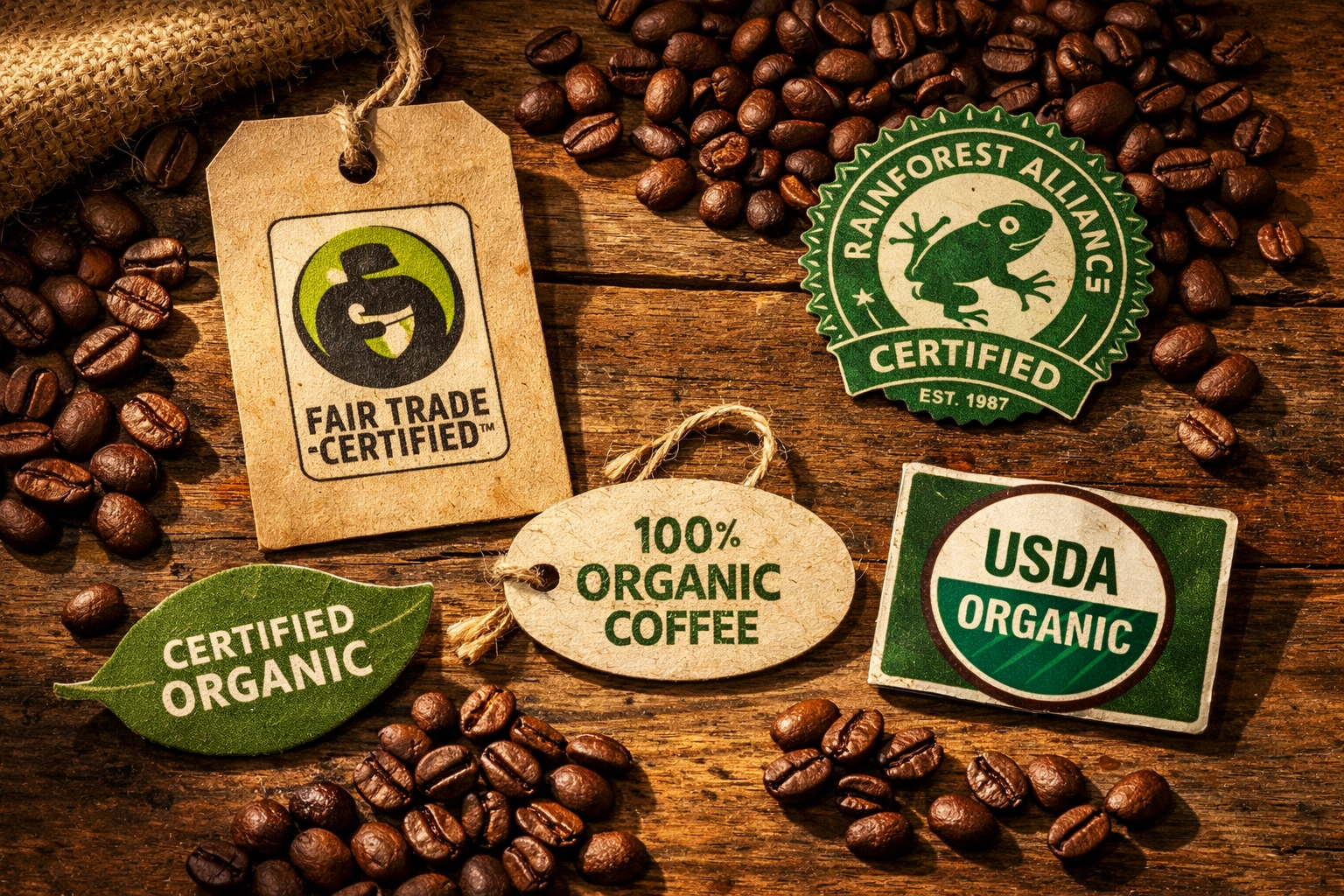
    Fair Trade and organic coffee certification labels with freshly roasted beans

    Defining Your Own Sustainability Criteria

    Every business is different, so your sustainability criteria should reflect your values and what matters most to your customers.

    Environmental factors might include organic farming, shade-grown cultivation, water conservation, and minimal use of agrochemicals. Coffee grown in harmony with existing ecosystems tends to be more resilient to climate change and supports biodiversity.

    Social factors cover fair wages, safe working conditions, gender equality, and community investment. Remember, coffee farming involves entire communities, so supporting farmers means supporting families and regions.

    Economic sustainability means farmers can actually make a living from coffee. This includes fair pricing, direct trade premiums, and long-term contracts that provide stability.

    The key is to work with your suppliers on continuous improvement rather than imposing impossible standards that exclude smallholder farmers. Sustainability is a journey, not a destination.

    How Limini Sources Sustainable Coffee

    We'll be honest with you: sourcing exceptional sustainable coffee is something we're genuinely passionate about. It's not a side project or a marketing angle; it's fundamental to who we are as a roaster.

    We've built relationships with farmers and cooperatives who produce some of the world's best specialty coffees while maintaining rigorous environmental and social standards. Every coffee we source meets our criteria for traceability, fair compensation, and sustainable farming practices.

    But we don't just tick boxes. We visit farms when we can, we maintain ongoing communication with our producing partners, and we're constantly working to improve our sourcing practices. Because sustainability isn't static: it's about continually doing better.

    If you're looking to upgrade your business's ethical footprint and serve genuinely exceptional coffee, we'd love to work with you. You can explore our wholesale options and discover more about our sustainably-sourced coffees at https://www.liminicoffee.co.uk/?af=1471531379787.

    Communicating Your Sustainable Sourcing

    Once you've established your sustainable sourcing, don't keep it a secret.

    Train your staff to talk knowledgeably about where your coffee comes from. Include origin stories on your menu or website. Share content on social media about the farmers and cooperatives you support. Make it part of your brand story.

    But keep it authentic. Customers can smell greenwashing a mile away. Focus on specific, verifiable facts rather than vague claims. "Our Colombian coffee comes from the Huila region, where we work directly with the El Paraíso cooperative" is more compelling than "We care about the planet."

    Your sustainable sourcing is a competitive advantage: use it.

    Coffee farmer and roaster examining beans together in direct trade partnership

    The Path Forward

    Sourcing sustainable coffee for your business isn't just ethically right: it's strategically smart. It builds customer loyalty, differentiates your brand, and ensures you're part of a coffee industry that values people and planet alongside profit.

    Start by identifying suppliers with strong transparency and direct relationships. Look for certifications as a baseline, but dig deeper into their actual practices. Define what sustainability means for your business, and find partners who share those values.

    And remember: you don't have to do this alone. Working with a roaster who's already established sustainable sourcing relationships means you get all the benefits without having to build those connections from scratch.

    The coffee industry is changing, and businesses that embrace sustainable sourcing now will be the ones thriving in five, ten, twenty years. Your customers are ready for it. The question is: are you?

    If you're ready to make the switch to sustainably-sourced, exceptionally delicious specialty coffee, let's talk. Visit us at https://www.liminicoffee.co.uk/?af=1471531379787 and discover how easy it can be to upgrade your coffee program while upgrading your values.


  • AI for Real Estate: Closing Deals While Your Bot Handles the Inquiries

    AI for Real Estate: Closing Deals While Your Bot Handles the Inquiries

    You're standing in a gorgeous open-concept kitchen, walking a young couple through their dream home. The lighting is perfect. They're leaning in, whispering to each other. This is the moment.

    Then your phone buzzes. Again. And again.

    Three new inquiries. A price question on the lakefront property. Someone asking if the condo is still available. Another lead wanting to schedule a viewing… for tomorrow morning.


    You slip the phone back in your pocket and refocus on the couple in front of you. But the damage is done. You're distracted. They notice. And those three leads? They're probably texting your competitor right now.

    THE REAL ESTATE DOUBLE BIND

    Here's the impossible choice you face every single day:

    Answer every inquiry immediately (and watch your showings fall apart), or focus on the clients in front of you (and watch leads evaporate into thin air).

    Most agents try to split the difference. You type quick responses between showing the master bedroom and the backyard. You excuse yourself to take "urgent" calls during walkthroughs. You stay up until midnight answering emails because that's when you finally have time.

    And you're still losing deals.

    Because here's the truth , in real estate, speed wins. The agent who responds first gets the showing. The agent who follows up fastest gets the signature. But you can't be in two places at once.

    Until now.

    Real estate agent overwhelmed by phone inquiries vs focused agent at property showing with AI assistant

    YOUR AI ASSISTANT IS ALREADY AT WORK (WHILE YOU'RE AT THE SHOWING)

    Imagine this instead:

    10:00 AM , You're walking the same couple through the same kitchen. Your phone stays in your pocket. Silent.

    But behind the scenes? Your ai assistant for small business is having three simultaneous conversations:

    "Hi! I'm the automated assistant for [Your Name]. I saw you're interested in the lakefront property at $485K. It's still available! The property features 3 beds, 2.5 baths, and 200 feet of private waterfront. Are you pre-qualified? I can get you scheduled for a viewing as early as tomorrow."

    "The condo is still on the market! Based on your search history, I noticed you've been looking at properties in the downtown area with parking. This one checks both boxes. Want to see it this week? I have Thursday at 2 PM or Friday at 10 AM available."

    "Great question about the school district. The property is zoned for Lincoln Elementary (rated 9/10) and Riverside High School (rated 8/10). I'm sending you a detailed neighborhood report now. When works best for a viewing?"

    Three leads. Three personalized responses. Three appointments being scheduled.

    And you? You're still focused on the couple in the kitchen. Because they just said the words every agent dreams of hearing: "We want to put in an offer."

    HOW AN AI LEAD GENERATION TOOL ACTUALLY QUALIFIES YOUR PROSPECTS

    Here's what most agents don't realize , not every inquiry deserves the same level of attention.

    The person asking about schools and neighborhood stats? High-intent buyer.

    The person asking "what's your lowest price?" on six different properties? Tire-kicker.

    Your brain knows this. But when you're manually responding to 50+ inquiries a day, you don't have time to analyze each one. You treat everyone the same, which means you're wasting hours on people who will never close.

    An ai lead generation tool doesn't have that problem.

    It's analyzing behavior patterns in real-time:

    • How many properties have they viewed?
    • How quickly do they respond to messages?
    • Are they asking detailed questions or generic ones?
    • Have they mentioned pre-qualification or financing?
    • What time of day are they reaching out?

    AI assistant handling multiple property inquiries simultaneously on three phones for real estate leads

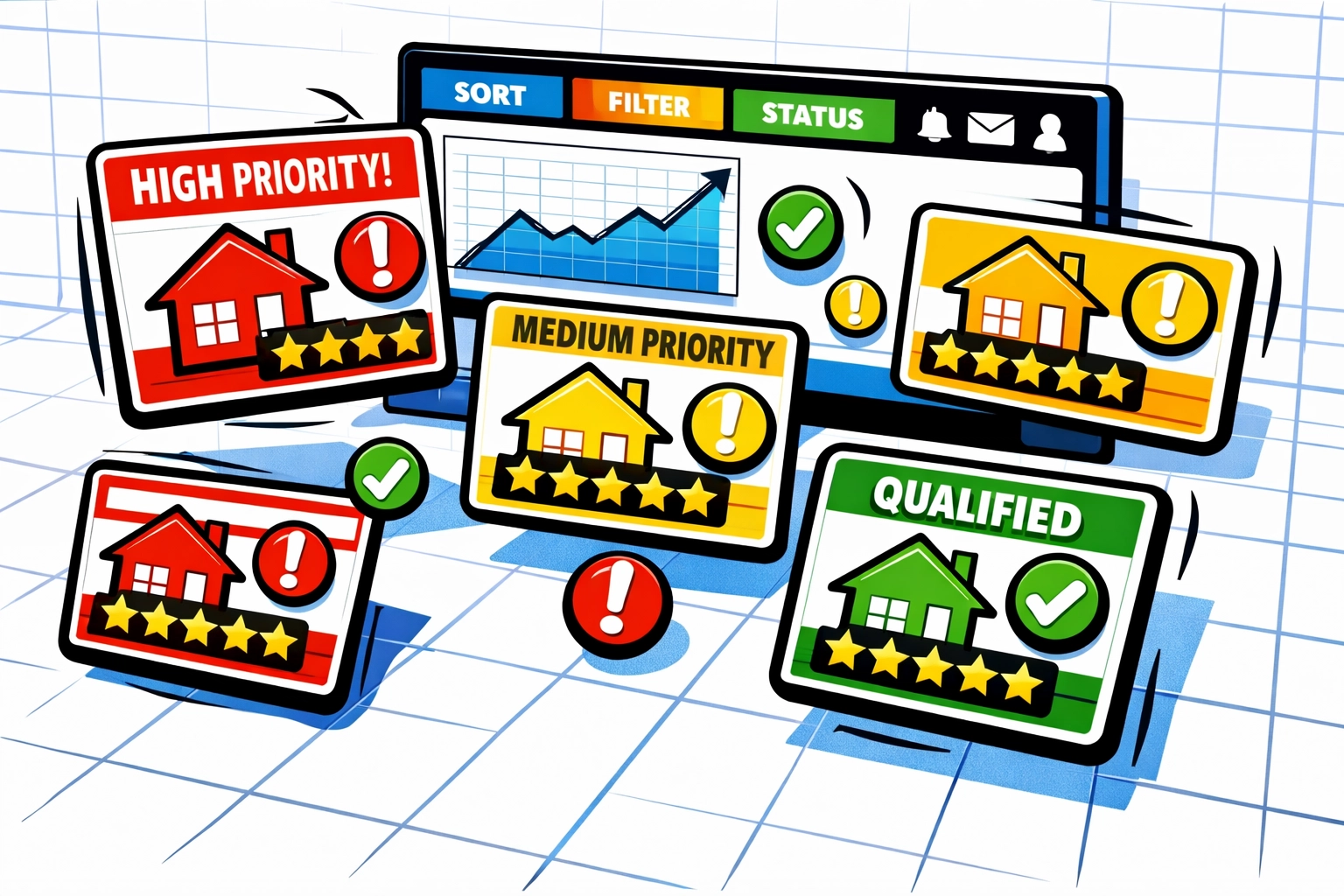
    Based on these signals, your AI automatically scores and prioritizes leads. The hot prospect who's been browsing listings for three weeks and just asked about HOA fees? That one gets escalated to you immediately. The person asking "is this available?" on 20 properties at 2 AM? Your AI handles that one and follows up intelligently without waking you up.

    The result: When you finally sit down to review your leads, you're not sorting through chaos. You're looking at a curated list of high-quality prospects who are actually ready to move forward.

    A DAY IN YOUR NEW LIFE

    Let me paint you a picture.

    7:00 AM ☕ , Your coffee's still hot when you check your dashboard. Five new appointments scheduled overnight. Three leads qualified and ready for follow-up calls. Two property questions answered and resolved. You didn't lift a finger.

    11:30 AM 📱 , You're between showings when a notification pops up: "High-priority lead , pre-qualified buyer interested in the Oakwood listing. Wants to view this week." Your AI has already confirmed their financing, shared property details, and offered three time slots. You just tap "Confirm Thursday 3 PM." Done.

    3:00 PM 🤝 , You're at a closing. Signatures are flowing. Your phone stays face-down on the table. Meanwhile, your AI is answering eight different inquiries, sending property photos, and scheduling next week's viewings. One lead asks a complex question about easements. Your AI immediately recognizes it's beyond its scope and flags it for your personal attention later. Perfect.

    6:00 PM 🏡 , Open house time. Twenty-three people walk through. Half of them ask the same questions: "What are the property taxes?" "When was the roof replaced?" "Is there an HOA?" Your AI has those answers ready before they even ask , visitors can scan a QR code to chat with your bot while they explore. The serious buyers? They self-identify by asking deeper questions, which your AI flags for your follow-up.

    9:00 PM 🌙 , You're winding down. But across town, a couple just finished dinner and started browsing listings. They find your property. They have questions. Your AI is there , instant responses, property comparisons, neighborhood data, viewing availability. By the time you wake up tomorrow, they're already on your calendar.

    THE NUMBERS DON'T LIE

    Agents using AI for inquiry handling save 1-3 hours per deal on routine tasks. But here's what matters more than time saved , it's deals earned.

    When you respond to inquiries in seconds instead of hours, you capture leads your competitors never even knew existed. When you follow up instantly instead of "when you get a chance," you're the agent who gets the showing. When you're available 24/7 without actually being available 24/7, you win the clients who make decisions at 10 PM on a Tuesday.

    One real estate team reported booking 47% more appointments in their first month with AI-powered inquiry handling. Another agent closed two additional deals per month simply by never missing a late-night inquiry again.

    AI lead generation dashboard organizing and prioritizing real estate property listings by urgency

    But here's the part that really matters: you're closing bigger deals, not just more deals.

    Why? Because you're spending your actual working hours on high-value activities , negotiations, relationship building, strategic pricing conversations, creative problem-solving for tough transactions. Not typing the same "Yes, it's still available" message for the hundredth time.

    WHAT HAPPENS WHEN YOU STOP JUGGLING

    The chaos doesn't disappear : it just stops being your problem.

    Inquiries still pour in. Leads still need qualifying. Appointments still need scheduling. Property questions still need answering.

    But now? It all happens in the background while you focus on what actually requires a human : reading a buyer's body language during a showing, negotiating a tricky inspection clause, calming a nervous seller before listing day, or closing the deal that's been three months in the making.

    Your AI handles the routine. You handle the revenue.

    And at the end of the day, when your competitors are finally sitting down to answer their backlog of messages, you're already done. Every inquiry answered. Every qualified lead followed up. Every appointment confirmed.

    Stop juggling. Start closing.

    READY TO LET AI HANDLE YOUR INQUIRIES?

    Real estate doesn't slow down. Neither should your response times.

    With Marblism, you get an ai assistant for small business that's built specifically for the way you actually work : fast, flexible, and always available when your clients are ready to move forward.

    See how it works at https://marblism.link/scott-bowen

    Because the best deals? They don't wait for you to finish your last showing.

  • 7 Mistakes You’re Making with Your Hotel Management Software (and How to Fix Them)

    7 Mistakes You’re Making with Your Hotel Management Software (and How to Fix Them)

    Automate your operations. Delight every guest. Grow your revenue. Modern hospitality isn’t about working harder: it’s about letting your technology do the heavy lifting for you. We’ve seen properties increase their operational efficiency by 30% just by making a few simple tweaks to how they use their hotel PMS. It’s all about moving away from fragmented tools and embracing a unified, cloud-native platform.

    1. Fighting the automation

    We believe that software should work for you, not the other way around. One of the biggest mistakes hoteliers make is manually overriding their system’s automated settings. Whether it’s pricing, availability, or stay restrictions, every manual tweak creates a ripple effect of inconsistency across your booking channels.

    Each time you step in to "fix" something manually, you risk a synchronization error. When your rates don't match your channel manager, you lose guest trust and revenue.

    How to fix it:

    1. Complete a full configuration during onboarding, including min/max rates.
    2. Trust your system’s rules to handle peak demand periods.
    3. Review your automation settings monthly rather than adjusting daily.

    Minimalist laptop on a desk representing efficient, automated hotel management software.

    2. Using a "Franken-stack" of disconnected tools

    If your booking engine, channel manager, and CRM aren't talking to each other in real time, you’re running a "Franken-stack." Disconnected systems lead to double bookings, rate discrepancies, and a lot of stressed-out staff.

    We think hospitality is better when everything is connected. A cloud-native hotel PMS ensures that when a room sells on Expedia, your direct booking engine updates instantly. No delays. No manual entry.

    Why a unified platform matters:

    • Real-time availability across all OTAs.
    • Seamless guest data flow from booking to check-out.
    • Reduced risk of overbookings and "sorry" emails.

    "Since moving to Mews, we’ve cut down on manual data entry by 10 hours a week," says one of our partners. That’s ten hours back in your day to actually talk to your guests.

    3. The "Set and Forget" trap

    Your channel manager is a powerful engine, but even the best engine needs a driver. Many hoteliers set their distribution rules once and never look back. This is a mistake. Demand shifts. Seasons change. Your distribution strategy should be as dynamic as your guests.

    Failing to adjust length-of-stay (LOS) rules or closing off high-commission channels during peak periods means you're leaving money on the table.

    Get proactive with your distribution:

    1. Apply LOS restrictions to protect your weekend occupancy.
    2. Monitor which channels deliver the highest-value guests.
    3. Shift inventory to your direct booking engine when demand is high to save on commissions.

    Travel wallet and room key card illustrating a streamlined hotel booking engine strategy.

    4. Operating in a data blackout

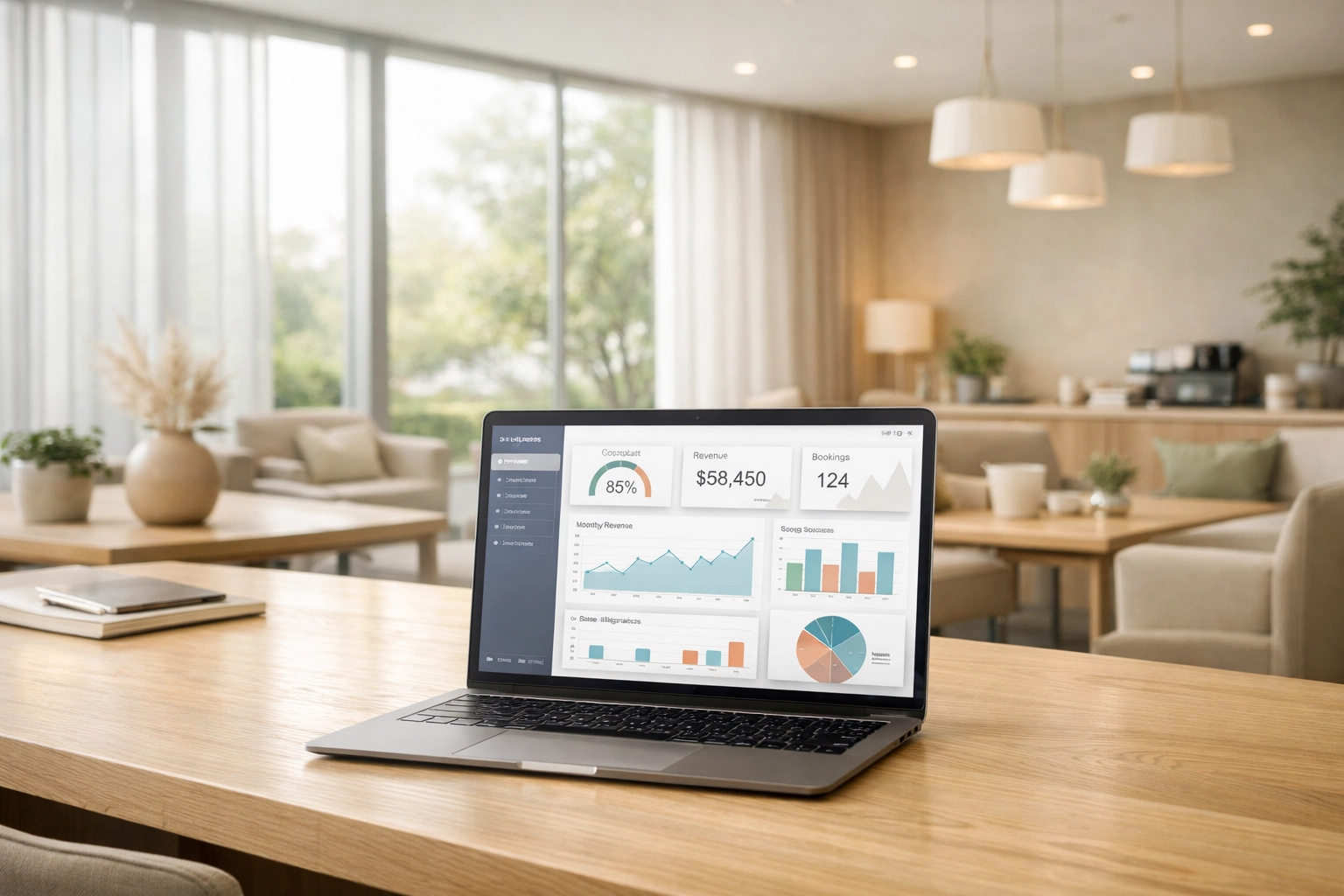
    If you don't know your RevPAR or ADR at the touch of a button, you’re flying blind. Many legacy systems bury your data in complicated reports that require a PhD to decode. Without real-time visibility into your performance, you can't react to market shifts until it's too late.

    We believe data should be beautiful and easy to understand. Modern hotel management software provides real-time dashboards that show you exactly how your business is performing (right now).

    The KPIs you should be watching:

    • Occupancy Rate: Is your house full?
    • RevPAR: Are you maximizing the value of every room?
    • Channel Mix: Where is your business coming from?

    Track these consistently at https://referrals.mews.com/umqHYIto to ensure your strategy is working.

    5. Ignoring the guest journey (and their feedback)

    Your software isn't just for back-office admin; it’s the heartbeat of your guest experience. Ignoring guest feedback stored in your CRM is a massive missed opportunity. If guests are constantly complaining about the check-in line, your software should be the solution.

    This is where self-check-in kiosks come into play. If your current system doesn't offer a way for guests to bypass the front desk, you're falling behind.

    Improve the guest experience today:

    1. Use your CRM to personalize guest stays based on past preferences.
    2. Implement self-check-in to eliminate lobby friction.
    3. Automate pre-arrival emails to set the tone for a great stay.

    Guest using a self-check-in kiosk tablet in a modern hotel lobby to improve experience.

    6. Fear of the "Update" button

    In the world of legacy software, updates were scary. They meant downtime, bugs, and calls to IT. In the cloud-native world, updates are a gift. They bring new features, tighter security, and better performance.

    Ignoring updates or failing to train your staff on new features is like owning a Ferrari and never shifting out of first gear. You’re paying for the power: you might as well use it.

    How to stay ahead:

    1. Schedule a 30-minute monthly "feature discovery" session with your team.
    2. Enable automatic updates to ensure you're always on the latest version.
    3. Use the Mews university or help center to master new automation tools.

    7. Over-complicating the simple stuff

    Hospitality is simple: give people a great place to stay. Sometimes, we get so caught up in the technicalities of our software that we forget the guest. If your staff is spending 90% of their time looking at a screen and 10% looking at the guest, your software is failing you.

    We think software should be invisible. It should run in the background, handling the payments, the bookings, and the emails, so your team can focus on the human side of the business.

    Make it easy for everyone:

    • Use a mobile-friendly PMS that lets staff work from anywhere.
    • Simplify your rate codes so they are easy for guests to understand.
    • Empower your team to solve guest issues without needing "manager approval" in the system.

    Hotel staff and guest interacting in a lobby, showing the human side of hospitality technology.

    See what Mews can do

    Ready to stop making these mistakes? It’s time to move to a platform designed for the future of hospitality. Mews is the cloud-native, automation-focused solution that helps you reclaim your time and focus on what matters: your guests.

    Get started with Mews:

    1. Schedule a demo to see our automation in action.
    2. Get your team trained in record time with our intuitive interface.
    3. Start earning more revenue with a smarter booking engine.

    Check out how we can transform your property here: https://referrals.mews.com/umqHYIto

    Hospitality is changing. The question is: is your software helping you lead the way, or is it holding you back? Stop the manual overrides, ditch the disconnected tools, and embrace the power of a unified platform. Your guests (and your sanity) will thank you.

  • 15 Pro Tips to Level Up Your Home Brewing Game This Weekend

    15 Pro Tips to Level Up Your Home Brewing Game This Weekend

    So, you’ve got the fancy dripper, you’ve bought the designer filters, and you’re standing in your kitchen on a Saturday morning ready to channel your inner barista. We’ve all been there. But sometimes, despite our best intentions and most expensive gear, the coffee in the cup just doesn't quite match the magic we experience at our favourite speciality cafe.

    Why is that? Usually, it isn't one big mistake. It is often a collection of tiny, overlooked details that separate a "good" cup from a "mind-blowing" one. We believe that everyone deserves to drink world-class coffee at home without needing a PhD in chemistry.

    Here at Limini Coffee, we spend our days obsessing over extractions and roast profiles so you don’t have to. But if you want to take your weekend ritual to the next level, we’ve rounded up 15 pro tips that will immediately improve your home brewing game. And if you’re looking for the perfect beans to practice with, you can find our latest seasonal roasts right here at Limini Coffee.


    1. Respect the Degassing Phase

    We often hear that "fresh is best," but there is actually such a thing as coffee that is too fresh. When coffee is roasted, carbon dioxide (CO2) is trapped inside the bean. If you brew it immediately, that gas escapes rapidly, creating a turbulent environment that prevents water from properly saturating the grounds.

    For espresso, we generally recommend waiting at least 7 to 10 days post-roast. For filter coffee, 3 to 5 days is usually the sweet spot. This allows the flavours to settle and the "sparkle" of the acidity to really shine through.

    2. The 98% Rule: It's All About the Water

    Your cup of coffee is roughly 98% water. If your tap water tastes a bit "chlorine-y" or is particularly hard (common in many parts of the UK), your coffee will never taste its best. Hard water minerals can over-extract coffee, leading to a chalky, bitter taste, while very soft water can leave it tasting flat.

    At the very least, use a basic charcoal filter jug. If you want to go pro, look into third-wave water mineral packets. Trust us, it’s a game-changer.

    3. Throw Away the Scoop and Use a Scale

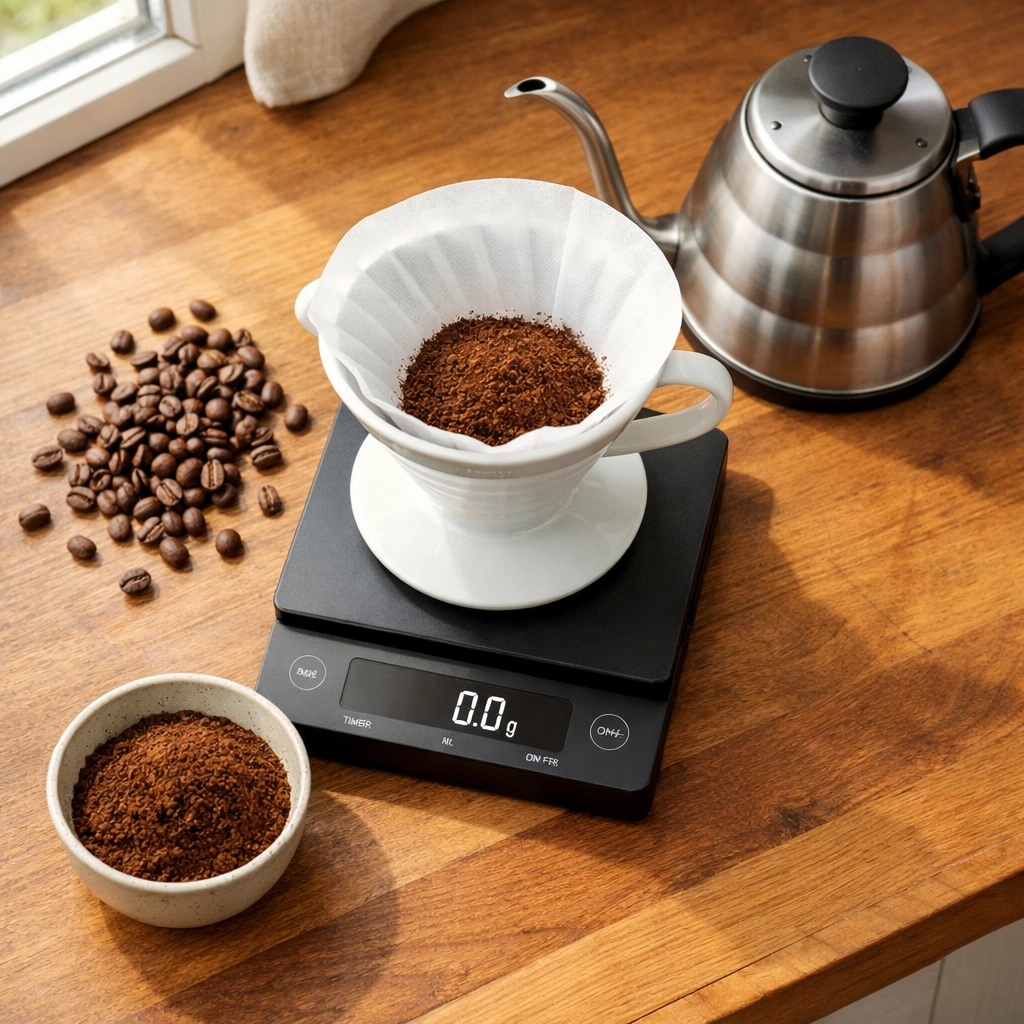
    If you take only one tip from this list, let it be this: weigh your coffee and your water. Volumetric measurements (like "two tablespoons") are wildly inaccurate because different beans have different densities. A dark roast is much less dense than a light roast, meaning a scoop of one will weigh significantly less than the other.

    Precision is the foundation of consistency. We recommend a starting ratio of 60g of coffee per 1 litre of water (or 1:16.6). If you’re unsure about the math, check out our coffee brewing calculator to get your ratios spot on.

    Coffee brewing ratio setup with digital scale, V60 dripper, beans and kettle on kitchen counter

    4. Grind Only What You Need (and Right Before You Brew)

    The moment you grind coffee, the surface area increases exponentially, exposing it to oxygen. Oxidation is the enemy of flavour. Within fifteen minutes of grinding, a significant portion of those delicate aromatics has literally vanished into thin air.

    Invest in a decent burr grinder. Avoid blade grinders: they don’t "grind" so much as they shatter the beans into uneven boulders and dust (fines), which leads to an uneven extraction.

    5. Thermal Management: Pre-heat Everything

    Have you ever poured a beautiful V60 only for it to be lukewarm by the time you sit down? Or noticed that your espresso tastes sour because the portafilter was cold?

    Heat loss is a silent killer of extraction. Before you put any coffee in your brewer, rinse your filter paper with hot water and fill your carafe or cup with boiling water. This stabilises the temperature of the equipment, ensuring the heat stays in the coffee bed where it belongs. This is especially important if you are choosing espresso equipment for home use; look for machines with good thermal stability.

    Preheating pour-over gear by rinsing paper filter with hot water over server for better extraction

    6. Master the "Bloom"

    When you first start pouring water over your grounds, you’ll see bubbles rising to the surface. This is the "bloom." It’s that CO2 we mentioned earlier finally making its exit.

    For filter coffee, pour about double the weight of the coffee in water (e.g., 30g of water for 15g of coffee) and wait 30–45 seconds. This "wets" the grounds and clears the way for the water to extract the delicious oils and sugars without interference from gas.

    7. Agitation is Your Friend (in Moderation)

    Sometimes a gentle stir or a swirl of the brewer can help ensure all the coffee grounds are being used. If you see dry pockets of coffee in your brewer, you're leaving flavour on the table. A quick, gentle stir during the bloom phase ensures every grain is participating in the party.

    Stirring the coffee bloom in a pour-over dripper to improve saturation and even extraction

    8. Don't Use Boiling Water (Usually)

    While we want things hot, "off the boil" is usually better. For most light to medium roast speciality coffees, a temperature between 92 °C and 96 °C (198 °F to 205 °F) is ideal.

    If you use water that is too hot, you risk extracting harsh, bitter compounds. If it's too cool (below 88 °C / 190 °F), the coffee may taste sour or underdeveloped. If you’re brewing a darker roast, you can actually drop the temperature even further to around 85 °C / 185 °F to keep the bitterness in check.

    9. Understand the "Draw Down"

    In pour-over brewing, the time it takes for the water to finish dripping through the coffee is called the draw-down time. If it’s taking five minutes for a single cup, your grind is likely too fine. If it rushes through in ninety seconds, it’s too coarse.

    Aim for a total brew time of around 2:30 to 3:30 for most single-cup drippers. Keeping an eye on the clock is just as important as keeping an eye on the scale.

    10. Cleanliness is Next to Godliness

    Coffee is oily. Those oils eventually go rancid and stick to your equipment. If your French press or portafilter smells like old coffee, your new brew will taste like old coffee.

    Use a dedicated coffee cleaner (like Puly Caff or Cafiza) regularly. If you have an espresso machine, backflushing is non-negotiable. If you need help with your machine, we have a guide on espresso machine repair that covers the basics of keeping things running smoothly.

    11. Explore Single Origins

    If you’ve been drinking "House Blends" your whole life, treat yourself to a Single Origin this weekend. Blends are designed for consistency, but Single Origins are designed to showcase the unique terroir of a specific farm or region.

    You might find a Kenyan coffee that tastes like blackcurrants or an Ethiopian that smells like jasmine. We take great pride in sourcing our coffee from farmers who prioritise quality and sustainability. Trying a new origin is the fastest way to develop your palate. Check out our latest arrivals at Limini Coffee.

    Home coffee cupping setup with ceramic tasting cups and single origin beans to compare flavours

    12. Take Notes (Seriously)

    You don’t need a fancy lab notebook, but jotting down your recipe (coffee weight, water weight, grind setting, and time) will help you replicate your successes. If a coffee tastes amazing, you want to know how to do it again. If it tastes like battery acid, you want to know what to change.

    13. The "One Variable" Rule

    When you are trying to "dial in" a coffee, only change one thing at a time. If you change the grind size and the water temperature and the ratio all at once, you won’t know which change actually fixed the flavour. Be methodical.

    Usually, the grind size is the first thing you should adjust. If it's too bitter, go coarser. If it's too sour, go finer.

    14. Perfect Your Tamping (for Espresso Lovers)

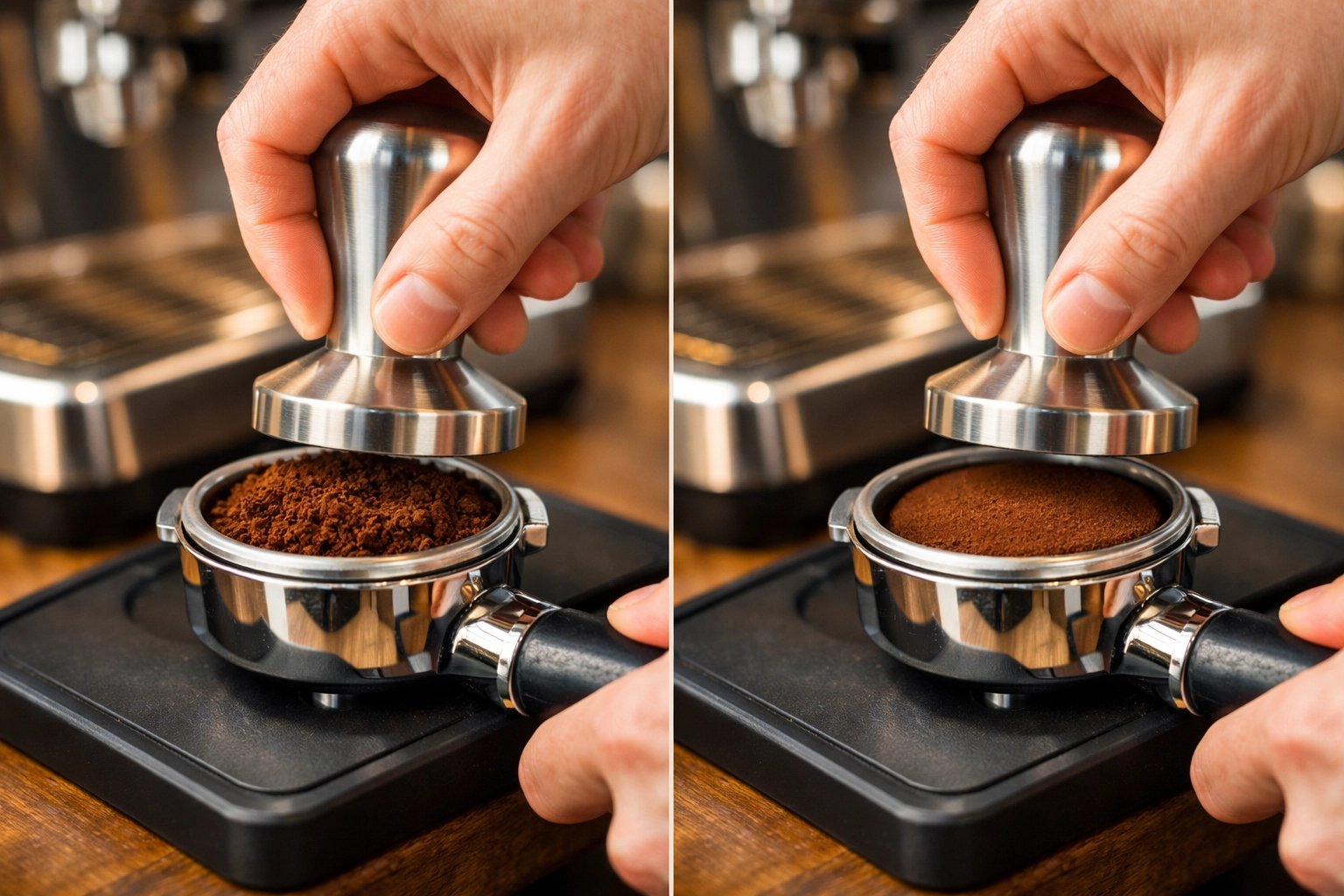
    If you’re pulling shots on a home machine, your tamp needs to be level. It’s not about how hard you press: you don't need to be a bodybuilder: it’s about being consistent and perfectly horizontal. If your tamp is slanted, the water will find the path of least resistance (channeling), leading to a shot that is both sour and bitter at the same time. Not a vibe.

    For more on this, check out our deep dive into the art of tamping.

    Level tamping espresso in a portafilter to prevent channeling and improve shot consistency

    15. Drink What You Love

    At the end of the day, coffee is subjective. While we follow these "rules" to get the best out of the bean, the "best" cup is the one you enjoy most. If you like a dash of milk in your single-origin pour-over, go for it. If you prefer a darker roast even though the "pros" are drinking light roasts, that’s fine too!

    We believe the beauty of coffee lies in the exploration. Whether you are interested in barista training to go professional or just want to make a better latte for your partner on Sunday morning, the journey is what matters.


    So, there you have it. Fifteen ways to transform your kitchen into a high-end coffee bar this weekend. It doesn't take much: just a little precision, some fresh beans, and a bit of patience.

    If you're ready to start your brewing journey or just need to restock your pantry, head over to Limini Coffee and grab a bag of our fresh-roasted speciality beans. Your taste buds will thank you. Happy brewing!

  • How to Set Up AI Business Automation in 5 Minutes (Before Your Next Meeting)

    How to Set Up AI Business Automation in 5 Minutes (Before Your Next Meeting)

    You’re staring at the clock. It’s 10:55 AM.

    Your next meeting starts in exactly five minutes. Your inbox is currently sitting at 47 unread messages… and three of them are potential clients asking for a quote you haven’t finished yet.

    Your coffee is cold. Your stress levels are hot.

    You know you need to "automate," but that sounds like a project for next quarter. Or next year. You envision weeks of coding, expensive consultants, and a headache that won’t quit.

    But what if you didn't need weeks?

    What if you could reclaim your sanity before your Zoom camera even turns on?

    It’s possible. And honestly… it’s easier than you think.

    THE CHAOS OF THE "MANUAL" LIFE

    ☕ 8:15 AM. You sit down with the best intentions.

    You open your laptop, ready to move the needle on that big project. But then the notifications start. A customer wants to know your pricing. Another one can’t find their login. A lead is asking if you're available for a call next Tuesday.

    You spend the next two hours copy-pasting the same answers.

    By the time you look up, it’s almost 11:00 AM, and you haven’t actually "worked" yet. You’ve just been a human router.

    This is the hidden tax of being a small business owner. It’s the "admin fatigue" that kills creativity and stalls growth. You’re acting like a personal assistant to your own business… but you’re not getting paid the assistant’s salary.

    Overwhelmed business owner needing an AI virtual assistant for business to handle admin fatigue.

    STOP JUGGLING. START DELEGATING (TO THE ROBOTS).

    You don't need a new hire. You need an ai virtual assistant for business.

    Think of it as a digital twin that never sleeps, never complains about cold coffee, and actually likes answering the same question 50 times a day.

    When you automate customer support with ai, you aren't just saving time. You’re buying back your freedom. You’re giving yourself the space to be the CEO again, instead of the Chief Troubleshooting Officer.

    And here’s the kicker: You can start right now.

    Yes, in the five minutes before your next meeting.

    THE 5-MINUTE AUTOMATION BLUEPRINT

    Let’s get tactical. We’re not building a rocket ship here. We’re building a bridge.

    MINUTE 1: IDENTIFY THE ONE REPETITIVE MONSTER 🔍

    Don't try to automate your entire life in one go. That’s how people end up crying over spreadsheets.

    Pick the one thing that annoys you most.

    • Is it answering "How much does it cost?"
    • Is it scheduling discovery calls?
    • Is it sending a "Welcome" email to new leads?

    Pick one. Just one. For this example, let’s say it’s responding to those basic "getting started" inquiries that eat up your morning.

    MINUTE 2: CHOOSE YOUR COMMAND CENTER 📱

    You need a tool that speaks "human" but thinks in code. This is where Marblism comes in.

    Instead of building complex workflows from scratch, you use a platform designed to handle the heavy lifting for you. You need something that integrates with your existing tools, your email, your Slack, your website.

    Go to https://marblism.link/scott-bowen and see how quickly the pieces fit together.

    MINUTE 3: THE BRAIN DUMP 🧠

    Your AI is only as smart as the info you give it. But don't worry, you don't need to write a manual.

    Take your most common FAQ response, the one you’ve typed a thousand times, and paste it into your AI assistant's knowledge base.

    "Our pricing starts at $99. We don't offer refunds on digital goods. We’re available Mon-Fri."

    Boom. That’s it. Your AI now knows more than most of your interns.

    A robot and human hand connecting to set up an AI virtual assistant for business automation.

    MINUTE 4: THE CONNECTION 🤝

    Link your AI to your "inbound" channel. Whether it’s a chat bubble on your site or an auto-responder on your contact form.

    This is the "handshake" moment. You’re essentially telling your business, "Hey, when a human asks a question, let the AI try to solve it first."

    If the AI gets stuck? It passes it to you. But for 80% of the noise… it's handled.

    MINUTE 5: THE "SET AND FORGET" TEST 🚀

    Send a test message.
    "Hi, what are your hours?"
    Watch the AI respond in three seconds.

    You smile. You take a sip of that (now lukewarm) coffee.

    The chaos is gone before you even take your first sip.

    THE DAY AFTER: A NEW REALITY

    🌙 6:00 PM. The day is ending.

    Usually, this is when you’d be catching up on the 30 emails you missed while you were in meetings. But today? The "Unread" count is… zero.

    While you were presenting to your board, your ai virtual assistant for business was busy. It handled four pricing queries, scheduled two demos, and sent a "thank you" note to a new subscriber.

    You didn't lift a finger.

    This isn't just about efficiency. It’s about the "Quiet."

    The Quiet is that feeling when you know your business is running even when you aren't. It’s the ability to sit through a meeting without checking your phone under the table because you’re worried a lead is going cold.

    Scaling shouldn't be this easy. But here we are.

    Relaxed business owner using automation to manage tasks with an AI virtual assistant for business.

    REAL TALK FROM THE TRENCHES

    Don't just take my word for it. Here is what people are saying when they finally stop doing the manual grunt work:

    "I thought I needed to hire a part-time VA. Then I set up the AI support flow. It does 90% of the work for 1% of the cost. I feel like I cheated the system."
    , Jason, E-commerce Founder

    "The 5-minute setup is real. I did it between calls and by the end of the day, it had already closed a lead for me while I was at lunch."
    , Sarah, Consultant

    FAQ: THE STUFF YOU’RE WONDERING ABOUT

    Q: Is it going to sound like a robot?
    No. Modern AI is surprisingly human. You can set the tone: casual, professional, or even "witty" (my personal favorite). It sounds like you, just faster.

    Q: What if it gives the wrong answer?
    You set the guardrails. You tell it exactly what it can and can't say. If it’s unsure, it marks the conversation for your review. It’s a helper, not a loose cannon.

    Q: Do I need to know how to code?
    Not even a little bit. If you can send an email, you can automate customer support with ai.

    Q: Is it expensive?
    Compared to the cost of your time? It’s practically free. It’s an investment that pays for itself in the first week of saved hours.

    A helpful robot with a headset used to automate customer support with AI and save time.

    THE CLOCK IS TICKING

    It’s now 10:59 AM.

    You have one minute left.

    You could spend it worrying about your inbox, or you could take the first step toward a business that runs itself.

    The "perfect time" to automate doesn't exist. There will always be another meeting, another fire to put out, and another reason to stay busy.

    But busy isn't the same as productive.

    Stop being the bottleneck in your own success. Let the AI handle the repetitive, the mundane, and the boring.

    Your next meeting is starting. Go in there with a clear head, knowing that while you’re talking, your business is growing.

    See how it works for yourself. Start your 5-minute clock right here: https://marblism.link/scott-bowen.

    Scale smarter. Not harder.

    You’ve got this. Now, get to that meeting. ☕

  • Delighting Customers in Real-Time: Why AI is the Future of Customer Support

    Delighting Customers in Real-Time: Why AI is the Future of Customer Support

    It's 2:00 AM.

    Your customer in Tokyo has a question. Your support team in Denver is asleep. The ticket sits there… waiting. By morning, that customer's frustration has already turned into a negative review.

    You've been there. The inbox that never empties. The phone that won't stop ringing. The chat widget lighting up while you're trying to close a deal. Every "quick question" pulls you away from actually growing your business.

    And here's the thing : your customers don't care that you're a team of three. They expect Amazon-level support on a solopreneur budget.

    The old answer was "hire more people." But that's expensive, complicated, and honestly… still doesn't solve the 2:00 AM problem.

    The new answer? Let AI do what it does best while you focus on what only you can do.

    THE SUPPORT BOTTLENECK YOU KNOW TOO WELL

    📞 Picture your typical Tuesday.

    You're deep in work. Creating. Building. Strategizing. Then the first support request comes in. Then another. Then five more. Before you know it, three hours have vanished answering the same questions you answered yesterday.

    "Where's my order?"
    "How do I reset my password?"
    "Can you walk me through this feature?"

    Each one matters. Each deserves a real answer. But each one also steals time from the work that actually moves your business forward.

    Your options used to be pretty grim. Ignore customers and watch your reputation crumble. Or answer everything and watch your productivity die. Some choice, right?

    Business owner overwhelmed by support requests transformed by AI customer support automation

    WHAT HAPPENS WHEN SUPPORT RUNS 24/7

    Here's where it gets interesting.

    Companies using AI for customer support are seeing 87% faster resolution times. Not 8%. Not 17%. Eighty-seven percent faster. That's the difference between a customer waiting three hours and getting an answer in minutes.

    And it's not just speed. It's accuracy. An AI virtual assistant for business doesn't get tired at 4:00 PM. Doesn't misread a ticket because it's handling twelve conversations at once. Doesn't forget what Customer A asked three days ago.

    It remembers everything. Cross-references instantly. Delivers consistent answers whether it's the first inquiry of the day or the hundredth.

    Your customers notice. Response times drop. Satisfaction scores climb. And suddenly, people are telling their friends about your "amazing support team" when really… it's just you and some very smart software.

    THE MIDNIGHT ADVANTAGE

    🌙 Let's talk about what happens while you sleep.

    Your competitor's customer sends a question at 11:00 PM. Gets an auto-reply: "We'll get back to you during business hours." That customer goes to bed frustrated, wakes up still waiting, and by lunch has already started looking at alternatives.

    Your customer sends a question at 11:00 PM. Gets an immediate, helpful response. Problem solved before they close their laptop. They wake up impressed, not irritated.

    That's the retention game-changer nobody talks about enough. It's not about replacing human connection : it's about being there when your customers need you, even when you physically can't be.

    When you automate customer support with AI, you're not choosing robots over people. You're choosing to show up for every customer, every time, regardless of time zones or working hours.

    AI virtual assistant handling multiple customer conversations simultaneously at night

    FREEDOM FOR THE COMPLEX STUFF

    Here's what happened when one business implemented AI support:

    Their team stopped drowning in "How do I…?" questions. Those got handled instantly by AI. Their actual support agents suddenly had time for the complicated stuff : the edge cases, the frustrated customers who needed empathy, the feedback that turns into product improvements.

    Burnout dropped. Turnover stopped. Agent satisfaction went up because they were finally doing meaningful work instead of copy-pasting answers from a knowledge base all day.

    And the business saved 35% on support costs while improving response times.

    That math doesn't just work. It works beautifully.

    REAL-TIME INTELLIGENCE THAT LEARNS

    The smartest part? Modern AI doesn't just answer questions. It pays attention.

    It notices when a customer's getting frustrated and alerts you before they churn. It spots patterns : "Ten people asked about this feature this week, maybe we need better documentation." It learns from every interaction, getting better at understanding what customers actually mean, not just what they type.

    One customer writes: "This thing won't work."

    Old support system: ¯_(ツ)_/¯

    AI support: Checks their account, sees they're using Safari, knows there's a known Safari bug, provides the workaround immediately, and flags the issue for your dev team.

    That's not just automation. That's intelligence.

    Customer satisfaction metrics and happy customers using AI support automation

    THE PROACTIVE SHIFT

    But here's where it gets really interesting.

    AI doesn't just respond. It predicts. It sees a customer struggling with setup and proactively offers help before they even ask. It notices someone's been inactive for two weeks and sends a personalized check-in. It identifies customers who might be great fits for your premium tier and flags them for your sales team.

    You move from reactive support (putting out fires) to proactive support (preventing fires from starting). That shift changes everything about how customers experience your business.

    They stop thinking "I hope I can figure this out" and start thinking "These people really get it."

    WHAT THIS LOOKS LIKE IN PRACTICE

    ☕ 9:00 AM: You check your dashboard. AI handled 47 inquiries overnight. Customers in Australia, Japan, and Europe all got immediate help. Zero tickets waiting for you.

    📱 2:00 PM: A customer asks a complex question. AI provides the basics instantly, then routes the conversation to you with full context. You jump in with the human touch where it matters most.

    🤝 5:00 PM: Your AI flags three customers showing signs of frustration. You reach out personally before they become problems. Two become testimonials instead.

    This isn't science fiction. It's Tuesday for businesses using Marblism.

    THE RETENTION MULTIPLIER

    Here's the thing about customer support that nobody wants to admit: most businesses lose customers not because their product fails, but because their support does.

    A customer has a question. Can't get an answer. Gets frustrated. Cancels. Posts a review. Tells five friends.

    Or.

    A customer has a question. Gets an instant, accurate response. Problem solved. Stays subscribed. Becomes an advocate.

    The difference between those two scenarios isn't the quality of your product. It's the quality of your support. And increasingly, the quality of your support depends on your ability to be everywhere, instantly, accurately.

    That's not humanly possible.

    But it's exactly what AI does.

    24/7 AI customer support operating across global time zones in real-time

    STARTING IS SIMPLER THAN YOU THINK

    You might be thinking this sounds expensive. Complicated. Like something enterprise companies do.

    It's not.

    Setting up an AI virtual assistant for business used to require developers, custom code, and a five-figure budget. Now? It's plug-and-play. Connect your knowledge base, set your brand voice, and you're handling support inquiries while you're literally doing anything else.

    The businesses winning at support in 2026 aren't the ones with the biggest teams. They're the ones smart enough to let AI handle what AI does best : instant, accurate, 24/7 responses : while humans focus on what humans do best: empathy, creativity, and building relationships.

    YOUR SUPPORT TEAM IS SLEEPING

    Right now, somewhere in the world, a potential customer is evaluating you against a competitor.

    They both have a question. It's 3:00 AM your time.

    Your competitor's customer is still waiting.

    Yours just got an answer.

    Guess who's making the purchase?

    That's the game. And it's not about working harder. It's about working smarter.

    Ready to see what real-time support looks like in action? Check out how Marblism helps businesses automate customer support without losing the human touch.

    Because your customers don't sleep. Your support shouldn't either.

  • Decaf Without the Compromise: How Limini Does Decaf Differently

    Decaf Without the Compromise: How Limini Does Decaf Differently

    Let's address the elephant in the room: decaf coffee has a terrible reputation.

    For years, ordering a decaf has been met with eye rolls, half-hearted espresso pulls, and the assumption that you don't really care about coffee. It's been treated like the disappointing younger sibling of "real" coffee, something you settle for rather than something you actually want to drink.

    We're here to tell you that's complete rubbish.

    At Limini Coffee, we've made it our mission to prove that decaf can be just as delicious, complex, and satisfying as any caffeinated coffee. The secret? It all comes down to how the coffee is decaffeinated and how we roast it afterwards. And spoiler alert: we do things differently.

    Why Does Decaf Have Such a Bad Reputation?

    The decaf stigma didn't come from nowhere. Early decaffeination methods were, frankly, awful. We're talking benzene, an actual carcinogen, being used to strip caffeine from coffee beans. Not exactly appetizing, is it?

    Even after safer methods emerged, many roasters treated decaf as an afterthought. They'd use lower-quality beans (because why waste the good stuff on decaf drinkers, right?) and apply generic roasting profiles that didn't account for how decaffeination changes the bean structure. The result? Flat, lifeless coffee that tasted like disappointment in a cup.

    So yeah, decaf earned its dodgy reputation. But here's the thing: it doesn't have to be that way.

    Freshly roasted specialty decaf coffee beans showing rich color and quality texture

    Our Non-Negotiable: Chemical-Free Decaffeination Only

    We only offer decaf coffee that has been decaffeinated using chemical-free processing methods. Full stop.

    This isn't just a nice-to-have for us: it's a fundamental part of our commitment to quality and your health. While some decaffeination processes use chemical solvents like methylene chloride or ethyl acetate, we've chosen to work exclusively with water-based methods that preserve both the coffee's flavor and your peace of mind.

    Think about it: you wouldn't compromise on the quality of your caffeinated coffee, so why should decaf be any different? We source specialty-grade beans and process them using methods that keep all the good stuff (flavor, aroma, complexity) while removing what you don't want (caffeine).

    Meet Our Two Champions: Swiss Water and Mountain Water Process

    We offer two exceptional decaf options, each with its own personality and processing story.

    Swiss Water Decaf: Full-Bodied Brazilian Brilliance

    Our Swiss Water Decaf comes from Brazil and goes through one of the most respected decaffeination processes in the specialty coffee world. The Swiss Water method uses only water and activated charcoal filtration to remove caffeine: no chemicals whatsoever.

    Here's how it works: green coffee beans are soaked in pure water, which dissolves the caffeine along with the coffee's flavor compounds. This caffeine-rich water (called Green Coffee Extract) is then passed through activated charcoal filters that trap the caffeine molecules but let the smaller flavor molecules pass through. The now-caffeine-free but flavor-rich water is used to soak new batches of beans, pulling out caffeine without stripping away taste.

    Brilliant, right?

    Swiss Water decaffeination process using pure water and activated charcoal filters

    The result is a full-bodied coffee with gorgeous dark chocolate notes. It's rich, smooth, and perfect for milk-based drinks like lattes, cappuccinos, and flat whites. Honestly, if someone served this to you without mentioning it's decaf, you probably wouldn't guess.

    Mountain Water Process Decaf: Mexican Magic

    Our Mountain Water Process decaf is sourced from Mexico and uses water from the country's highest mountain to naturally remove caffeine. This method achieves 99.9% caffeine removal while maintaining the coffee's inherent character.

    Similar to Swiss Water, this process uses pure water to dissolve and filter out caffeine without touching a single chemical solvent. The difference is in the water source and the specific filtration process, which gives this coffee its own unique profile.

    This one's a bit mellower and easier-drinking, with nutty flavors and sweet notes of milk chocolate. If you're after a gentle, approachable decaf that you can enjoy any time of day without thinking too hard about it, this is your coffee.

    How We Roast Decaf Differently (Because It Matters)

    Here's something most people don't realize: decaffeinated beans behave differently during roasting than their caffeinated cousins.

    The decaffeination process changes the bean's physical structure and moisture content. This means if you roast decaf using the same profile as regular coffee, you'll end up with uneven results and muted flavors. It's a bit like trying to bake gluten-free bread with a regular recipe: the fundamentals are different.

    Coffee roaster carefully examining decaf beans during the roasting process

    We adjust our roasting profiles specifically for decaf beans. We're paying attention to how heat transfers through the bean, how quickly we want to develop certain flavors, and where to stop the roast to maximize sweetness and complexity without developing bitter or flat notes.

    It's more work. It requires more attention. But that's precisely why our decaf doesn't taste like an afterthought: because it isn't one.

    When Decaf Actually Makes Sense (Hint: More Often Than You Think)

    Let's talk about when you might actually want to reach for decaf. And we're not just talking about the obvious "it's 9 PM and I want to sleep tonight" scenario.

    After Lunch: You love your morning ritual, but a second or third shot of caffeine after 2 PM leaves you wired at midnight. Decaf lets you enjoy that afternoon coffee break without sacrificing your sleep.

    Multiple Cups a Day: Some of us genuinely want to drink four or five cups of coffee throughout the day. Decaf lets you do that without turning into a jittery mess.

    Pregnancy or Caffeine Sensitivity: Life circumstances change. Decaf means you don't have to give up the ritual and taste you love when caffeine isn't an option.

    Evening Entertainment: Hosting friends for dinner? Offering quality decaf with dessert is actually thoughtful, not boring. Your guests will appreciate being able to enjoy excellent coffee without lying awake replaying the conversation at 3 AM.

    Simply Because You Want To: Here's a radical thought: you don't need a reason. If you want delicious coffee without caffeine, that's reason enough.

    The Taste Test Challenge

    We genuinely encourage you to do a blind taste test. Brew our Swiss Water or Mountain Water decaf alongside a similar caffeinated option. Take your time. Pay attention to the body, the sweetness, the finish.

    We're confident you'll be impressed. Not in a "that's good…for decaf" way, but in a "that's genuinely excellent coffee" way.

    The chocolate notes in the Swiss Water? They're there because we've sourced quality Brazilian beans and roasted them with care. The nutty sweetness in the Mountain Water? That's Mexican terroir coming through, preserved by a gentle decaffeination process and thoughtful roasting.

    Cup of freshly brewed decaf coffee for a peaceful afternoon break

    Your Invitation to Rethink Decaf

    Look, we get it. If you've been burned by disappointing decaf in the past, you might be skeptical. But here's the thing: specialty coffee has evolved massively over the past decade, and decaf has evolved right along with it.

    Chemical-free processing methods like Swiss Water and Mountain Water have changed the game. Combined with quality sourcing and proper roasting, decaf can absolutely stand alongside any coffee in your cupboard.

    We've put the work in to prove it. We've sourced exceptional beans, chosen processing methods that prioritize flavor, and developed roasting profiles that bring out the best in these coffees. Now we're inviting you to taste the difference for yourself.

    Ready to challenge your assumptions about decaf? Browse our decaf range at Limini Coffee and discover what you've been missing.

    Whether you're looking for a rich, chocolatey Swiss Water option or a mellower Mountain Water coffee, we've got something that'll make you genuinely excited about decaf. No compromise necessary.

    And if you're still not convinced? Fair enough. But at least now you know that when we say "decaf without the compromise," we actually mean it. The beans, the process, the roasting: it all matters, and we've refused to cut corners on any of it.

    Your evening coffee ritual is calling. And this time, you'll actually sleep afterwards. ☕️

  • 7 Mistakes You’re Making with Manual Housekeeping (and How to Fix Them with Automation)

    7 Mistakes You’re Making with Manual Housekeeping (and How to Fix Them with Automation)

    Clean rooms faster. Empower your team. Delight your guests.

    Housekeeping is the heartbeat of your hotel. It’s also the department most likely to get stuck in the "we've always done it this way" trap. If your team is still roaming the halls with clipboards, paper lists, and walkie-talkies, you’re losing more than just time: you’re losing revenue.

    At Mews, we believe housekeeping shouldn't be a black box. We’ve seen how moving from manual chaos to automated clarity can transform a property. In fact, our partners often see a 20% increase in cleaning efficiency within the first few months.

    It all starts with a cloud-native platform that connects your front desk to your floor staff in real-time. Everything is synced, everyone is informed, and the guest experience is seamless. All from one innovative platform.

    1. The Paper Trail Trap

    Still printing out room lists every morning? By the time that paper hits the executive housekeeper’s hand, it’s already out of date. A guest checks out early, another requests a late departure, and suddenly your team is cleaning rooms that don't need to be touched yet while VIPs wait in the lobby.

    The Fix: Mobile-First Management
    Switch to a mobile-friendly hotel PMS. When your team has the Mews app on their smartphones or tablets, they see updates the second they happen. No more walking back to the office for a new list.

    • Real-time status updates.
    • Instant task reassignment.
    • Zero paper waste.

    Hotel housekeeping staff using a mobile PMS app for real-time room status updates.

    2. Cleaning in the Wrong Order

    Manual housekeeping usually follows a linear path: Room 101, then 102, then 103. But hospitality isn't linear. If a guest used your booking engine to request an early check-in for Room 205, but your team is stuck on the first floor because "that's the order," you’ve already failed the guest experience.

    The Fix: Intelligent Prioritization
    Automate your task logic. An innovative PMS can automatically prioritize rooms based on guest arrival times, VIP status, or specific requests.

    • Prioritize arrivals over stay-overs.
    • Highlight "Early Bird" guests automatically.
    • Keep the flow moving based on actual demand.

    3. The "Wait and See" Communication Lag

    The front desk calls housekeeping: "Is 304 ready?" Housekeeping checks their list, walks to the room, or calls the floor supervisor. This "telephone game" creates a massive bottleneck at the front desk, especially during peak hours.

    The Fix: Real-Time Room Sync
    When a room is marked "Clean" on a housekeeper's mobile device, it should instantly turn "Ready" on the hotel PMS dashboard. This allows your team to utilize self-check-in kiosks more effectively. If a guest arrives and their room is ready, the kiosk can issue a key immediately without a single staff member having to pick up a phone.

    • Instant visibility for front office.
    • Faster guest turnarounds.
    • Reduced stress for reception staff.

    4. Neglecting Maintenance Reporting

    In a manual system, a housekeeper spots a leaky faucet. They finish the room, move to the next, and maybe remember to tell the supervisor at lunch. The supervisor then writes it down to tell maintenance later. Meanwhile, the room gets assigned to a new guest who walks into a puddle.

    The Fix: Integrated Maintenance Tickets
    We believe your housekeepers are your best inspectors. Give them the tools to report issues instantly. With an automated system, a housekeeper can snap a photo of the leak and upload it directly to the system.

    • Maintenance is notified immediately.
    • The room is automatically taken out of order if necessary.
    • Issues are fixed before the next guest arrives.

    Staff reporting a maintenance issue in a hotel room using an automated housekeeping app.

    5. Overusing (or Underusing) Supplies

    Manual inventory tracking is a nightmare. You either have a mountain of tiny shampoos taking up space or you’re scrambling because you’re out of towels on a busy Friday night. Without data, you’re just guessing.

    The Fix: Inventory Automation and CRM Integration
    By connecting your housekeeping data to your CRM and inventory management tools, you can predict exactly how much product you’ll need based on occupancy.

    • Track usage patterns over time.
    • Automate reordering triggers.
    • Reduce waste and overhead costs.

    6. Rigid Scheduling vs. Dynamic Staffing

    Manual scheduling often relies on "gut feeling" or static rotas. But guest behavior changes. A Tuesday in November looks different than a Saturday in July. If you aren't using data from your channel manager and PMS to forecast staffing needs, you’re either overstaffed (wasting money) or understaffed (killing morale).

    The Fix: Data-Driven Forecasting
    Use your PMS data to see exactly how many check-ins, check-outs, and stay-overs you have scheduled for the next 14 days.

    • Adjust staffing levels based on real occupancy.
    • Optimize labor costs.
    • Prevent staff burnout during surprise peaks.

    Hotel management software on a laptop showing occupancy data and staffing forecasts.

    7. Ignoring the "Green" Guest

    Modern guests care about sustainability. Many would happily skip a daily sheet change to save water. In a manual system, communicating these preferences to the specific housekeeper on that floor is nearly impossible.

    The Fix: Guest Preference Automation
    Let your guests choose their level of service via your guest journey app or self-check-in kiosks. If they opt out of daily cleaning, that room is automatically removed from the housekeeper’s daily task list.

    • Personalized service for every guest.
    • Significant savings on water, energy, and chemicals.
    • Improved brand reputation as a sustainable property.

    Why Automation is the Only Way Forward

    We’ve moved past the era of "good enough." In today’s competitive landscape, efficiency is your greatest competitive advantage. When you remove the friction of manual tasks, you free your staff to do what they do best: provide hospitality.

    Mews is designed to be the brain of your hotel. Our cloud-native platform is:

    1. Easy to use: Your team can learn the mobile interface in minutes.
    2. Automation-focused: We handle the boring stuff so you can focus on the guests.
    3. Connected: From your booking engine to your laundry room, everything talks to each other.

    We think the best technology is the kind that disappears into the background because it works so well. When your housekeeping is automated, the rooms are ready faster, the staff is happier, and the reviews are better. It’s that simple.

    See how Mews can transform your operations

    Ready to ditch the clipboards and embrace the future of hospitality? We’d love to show you how our automation-focused PMS can streamline your housekeeping and boost your bottom line.

    Get started with Mews today

    Stop making the same manual mistakes. Start managing your property with the precision and innovation it deserves. It only takes a 30-minute demo to see the difference.

    Whether you’re managing a boutique hotel or a multi-property group, the path to better guest experiences starts with better operations. Let’s get you earning more revenue and wasting less time.

    Join the 12,500+ properties thriving with Mews

  • How to Integrate AI Business Automation With Your Daily Routine (Even if You’re Tech-Challenged)

    How to Integrate AI Business Automation With Your Daily Routine (Even if You’re Tech-Challenged)

    You wake up.

    Before you’ve even had a sip of water, your phone buzzes. Then it pings. Then it vibrates off the nightstand. 147 unread emails. Three LinkedIn DMs. A calendar that looks like a high-stakes game of Tetris played by someone who is losing.

    You’re not running a business. The business is running you.

    You’ve heard about ai business automation. You’ve seen the headlines about robots taking over the world (or at least the paperwork). But you? You still struggle to figure out why your printer won't connect to the Wi-Fi. The idea of "integrating AI" sounds like trying to build a rocket ship in your backyard with a blunt screwdriver.

    But here’s the secret: It’s not about becoming a coder. It’s about becoming a conductor.

    Let’s walk through a day where you actually own your time again.

    7:02 AM , THE SILENT INBOX ☕

    The sun is barely up. Usually, this is when you’d be frantically flagging emails while your coffee gets cold.

    But today is different.

    While you were sleeping, an AI filter, your new digital bouncer, was hard at work. It didn't just move spam to a folder. It categorized your leads, drafted polite "not right now" replies to cold pitches, and highlighted the one email that actually matters: a contract signature from your biggest client.

    Business owner checking automated email leads on a tablet while enjoying morning coffee.

    Instead of scrolling for an hour, you see a summary.
    "3 hot leads. 1 meeting confirmed. 12 newsletters archived."

    You take a sip of coffee. It’s still hot.

    This isn't magic. It's just simple business automation tools doing the heavy lifting. You didn't have to write a single line of code. You just set the rules once, and now the AI follows them. Every. Single. Morning.

    10:15 AM , THE LEAD MAGNET THAT NEVER SLEEPS 📱

    You’re in the middle of a deep-work session. Usually, this is when a "quick question" from a prospect would derail your entire brain.

    Ping.

    Someone on your website wants to know if you offer Saturday consultations.

    In the old days, you’d stop what you’re doing, hunt for your calendar link, and type out a manual response. By the time you get back to your work, the flow is gone.

    Now? A smart chatbot, the kind that doesn't sound like a broken toaster, handles it. It checks your availability, answers the FAQ, and books the call.

    The prospect feels heard. You stay in the zone.

    Scaling shouldn’t be this hard. But here we are, making it look easy. If you want to see how this works in the real world, check out what we’re building at https://marblism.link/scott-bowen.

    1:30 PM , CONTENT WITHOUT THE CRIPPLING ANXIETY ✍️

    It’s Tuesday. You know what that means. You need a blog post. You need three LinkedIn updates. You need a newsletter.

    You stare at the blinking cursor. The cursor wins.

    This is where most small business owners hit a wall. You’re an expert at what you do, but you’re not a full-time content creator.

    Enter your AI drafting partner. You feed it a voice note of your thoughts from your morning walk.
    "Hey, talk about why customer service matters more than fancy logos."

    Seconds later, you have a draft. It’s not perfect, it needs your voice, but the "blank page" problem is dead. You spend ten minutes tweaking, hit "schedule," and the AI distributes it across your socials at the exact time your audience is actually awake.

    One hour of work turned into ten minutes. That’s the power of ai business automation.

    AI business automation tools transforming a voice note into social media content on a phone.

    4:45 PM , THE WRAP-UP (WITHOUT THE MENTAL FOG) 🌙

    The day is winding down. Usually, this is when you’d be staring at a messy spreadsheet trying to figure out which of your marketing efforts actually worked.

    "Did that Facebook ad lead to a sale? Or was it the referral from Stan?"

    Your AI dashboard doesn't guess. It tracks the journey. It tells you exactly where your leads are coming from and, more importantly, who is likely to buy next. It suggests a follow-up for a client who hasn't opened your last three emails.

    You don't have to be a data scientist. You just have to be able to read a simple chart.

    The chaos is gone before you even pack your bag.

    STOP JUGGLING. START AUTOMATING. 🤝

    "But Scott," you say, "I don't even know where to start."

    I get it. The tech world loves to use big words to make simple things sound expensive. You don't need a "comprehensive enterprise digital transformation strategy." You just need to fix the things that make you want to scream.

    Here is your 3-step, tech-challenged-proof plan:

    1. Identify the "Ugh" Tasks.
      What do you do every day that makes you roll your eyes? Copy-pasting data? Scheduling meetings? Sending the same "Welcome" email for the 500th time? That’s your starting line.
    2. Pick One Tool.
      Don't try to automate your whole life in a weekend. Pick one area, like lead generation or email management.
    3. Pilot and Pivot.
      Try it for a week. See where it trips up. Adjust the settings. AI isn't a "set it and forget it" robot; it's a digital intern. It needs a little guidance at first.

    Small business owner successfully scaling using AI analytics and business automation software.

    WHY MARBLISM IS YOUR SECRET WEAPON

    At Marblism, we believe that the best technology is the kind you don't have to think about. You’re busy running a business. You don’t have time to learn a new language just to get your software to talk to each other.

    We specialize in taking the complex world of business automation tools and turning them into a seamless part of your routine.

    Whether you're looking to generate more leads while you sleep or simply want to stop spending four hours a day on admin, we’ve got the roadmap.

    You don't have to do this alone. In fact, you shouldn't.

    EMPLOYEE OF THE MONTH. EVERY MONTH. 🏆

    Imagine having an employee who never sleeps, never takes a lunch break, and never forgets to follow up with a lead. That’s what a properly integrated AI system feels like.

    It doesn't replace you. It empowers you.

    It takes the "robotic" parts of your job, the data entry, the scheduling, the repetitive replies, and handles them, so you can do the "human" parts. The strategy. The creativity. The actual coaching or selling that made you start this business in the first place.

    Business owner partnering with AI tools to handle repetitive workflow automation tasks.

    FAQ: FOR THE SKEPTICAL AND THE BUSY

    "Is this going to be expensive?"
    It’s a lot cheaper than hiring a full-time assistant. Most AI tools have free or low-cost tiers for small businesses. The real question is: what is an extra 10 hours of your week worth?

    "Will I lose the 'personal touch' with my clients?"
    Only if you let it. Use AI to handle the logistics so you have more energy to be personal when it actually matters. A robot schedules the call; you show up with the brilliance.

    "Do I need to know how to code?"
    No. If you can use a smartphone, you can use modern ai business automation. Most of it is "drag and drop" or "point and click."

    "What if it makes a mistake?"
    It might. Just like a human intern. That’s why you start small and keep an eye on things until you trust the process.

    THE NEXT STEP IS SIMPLE

    You’ve spent enough time being the bottleneck in your own business. The tools are here. The path is clear. And the best part? You don't have to be a tech genius to start.

    You just have to be tired of the chaos.

    If you're ready to see how a custom AI setup can transform your specific workflow, don't wait for another 147 emails to pile up.

    Visit https://marblism.link/scott-bowen and let’s get your life back.

    Scaling shouldn't be a struggle. With the right tools, it’s just the natural next step.

    See you on the other side of the automation.

    ( Scott)

  • Wholesale Specialty Coffee: 20 Tips to Get You Started

    Wholesale Specialty Coffee: 20 Tips to Get You Started

    So, you’ve decided to take the plunge into the world of wholesale specialty coffee? That is a bold, exciting, and occasionally caffeinated-to-the-point-of-jitters move. Whether you’re a roaster looking to expand your reach or a café startup trying to navigate the complex web of coffee suppliers, getting the foundations right is the difference between a thriving business and one that’s just, well, lukewarm.

    At Limini Coffee, we’ve spent years working alongside wholesale partners, helping them navigate the highs and lows of the industry. It’s not just about roasting beans; it’s about building a sustainable ecosystem. To help you on this journey, we’ve put together 20 essential tips to get you started on the right foot. And if you’re looking for a partner who lives and breathes this stuff, you can always find us right here at Limini Coffee.


    1. Master the Coffee Fundamentals

    You can’t sell what you don’t understand. Before you even think about signing a wholesale contract, you need to understand the journey from seed to cup. This means learning about coffee botany, harvesting methods, and the drying process. Why? Because when a potential client asks why your Ethiopian Yirgacheffe is more expensive than the "Italian Blend" from the local supermarket, you need to be able to explain the value of high-altitude growing and hand-sorting without breaking a sweat.

    2. Research Your Market Segments

    Not every coffee shop is your target customer. Some businesses want the cheapest possible beans to serve in 16oz paper cups with three pumps of syrup. Others want to highlight the floral notes of a light-roast washed Gesha. Decide who you are for. Are you looking to supply high-end boutique retailers, or are you aiming for high-volume restaurants? Knowing your segment helps you tailor your sales pitch and your roast profiles.

    Barista brewing specialty coffee at a minimalist bar, highlighting quality for cafe startups.

    3. Develop a Bulletproof Business Plan

    "Roast good coffee and they will come" is a lovely sentiment, but it isn’t a business plan. You need to conduct deep market research. Who are the existing wholesale coffee roasters in your area? What is their pricing? What are they missing? Your plan should outline your sourcing strategy, your marketing budget, and your growth milestones. It keeps you grounded when things get hectic.

    4. Choose Your Specialty Focus

    In the beginning, it’s tempting to try and be everything to everyone. You’ll want to offer twenty different origins and five roast levels. Don't. It’s a recipe for wasted stock and inconsistent quality. Instead, pick a few standout origins, perhaps a solid Brazilian for espresso and a rotating African single-origin, and master them. Specialization builds authority.

    5. Decide on Your Product Format

    Are you selling whole beans, ground coffee, or both? In the specialty world, whole bean is king because it preserves freshness. However, some wholesale clients (like small delis or offices) might require pre-ground options. Just remember: once coffee is ground, the clock starts ticking much faster. We generally recommend pushing whole beans whenever possible to ensure the end customer gets the best experience.

    6. Strategy Behind Roast Profiles

    Roasting is as much a science as it is an art. You need to determine which roast levels your target market prefers. If you’re targeting traditional cafés, they might want a medium-dark roast that cuts through milk. If you’re targeting "third-wave" shops, they’ll likely want something lighter and more acidic. Conduct cupping sessions with potential buyers to see what actually resonates with their palates.

    7. Partner with Quality Suppliers Directly

    Cutting out the middleman is a great way to ensure quality and better margins. We believe in building long-term relationships with coffee farms and reputable importers. This allows you to tell a story about where the coffee comes from, which is a massive selling point in the specialty industry. If you want to see how we handle this, take a peek at how we're sourcing our coffee.

    Close-up of hands holding raw green specialty coffee beans at a farm for wholesale sourcing.

    8. Understand Cupping Scores

    Specialty coffee isn’t just a buzzword; it’s a technical grade. Anything scored above 80 points by a Q-Grader is considered specialty. Knowing these scores helps you justify your pricing. If you’re selling an 86-point coffee, you’re selling a premium product. Learn to cup coffee professionally so you can verify the quality of the green beans you’re buying.

    9. Invest in Proper Storage

    Green coffee is a seasonal, organic product. It doesn’t like humidity, and it definitely doesn’t like heat. You need a warehouse or storage area that is temperature-controlled and dry. If your green beans age too quickly or pick up "baggy" taints from a damp floor, your roast quality will suffer regardless of how good your roaster is.

    10. Master Green Coffee Pricing

    Green coffee prices fluctuate based on the "C Market" (the global commodity price) plus a "specialty premium." You need to understand how this works so you aren't caught out by price spikes. Bulk inventory is usually your biggest cost, so managing it wisely is crucial for cash flow.


    11. Calculate Your Total Costs

    It’s easy to look at the price of green coffee and think you’re making a fortune. But have you factored in the weight loss during roasting (usually 12-18%)? What about packaging, labels, energy costs, and delivery? And don't forget the manpower. To stay profitable, you need a clear grasp of your gross profit margins. If you’re struggling with the math, tools like our coffee brewing calculator can help you understand ratios, though the business side requires even more scrutiny!

    12. Set Clear Pricing Guidelines

    Don’t make up prices on the fly. Establish a clear price list for different volume tiers. If a café buys 20kg a week, they should get a better rate than a small office buying 2kg. Having these guidelines in place prevents awkward negotiations and ensures all your clients feel they are being treated fairly.

    13. Professional Ordering Systems

    In the early days, you might take orders via WhatsApp or a scribbled note. That won't scale. Set up a professional system, whether it’s an online portal or a dedicated ordering email. Reliability is the number one thing wholesale clients look for in coffee suppliers. If you’re easy to work with, they’ll stay with you for years.

    14. Start Local and Small

    Don’t try to land a national supermarket chain in your first month. Start with the independent grocery store down the road or the local bistro. These businesses often love supporting local roasters, and the logistics are much easier to manage. It’s also a great way to get feedback and refine your product.

    15. Cold Calling with Samples

    Yes, cold calling is terrifying, but it works. When you visit a potential client, don't go empty-handed. Bring fresh samples and a "sell sheet", a one-page document that explains who you are, what your coffee tastes like, and why it will make their customers happy. Let the coffee do the heavy lifting.

    Specialty coffee samples and a business notebook for building wholesale coffee roaster partnerships.

    16. Craft a Compelling Brand Story

    In a crowded market, your story is your edge. Why did you start? What do you believe in? Maybe you’re focused on ethical sourcing, or perhaps you’re obsessed with technical roasting precision. Whatever it is, weave it into your branding. People don't just buy coffee; they buy into the people behind it. Check out our about us page to see how we tell our story.

    17. Target Quality-Focused Businesses

    If a business is fighting over a 50p difference in price per kilo, they might not be the right fit for specialty coffee. Target the businesses that prioritize the "in-cup" quality. These are the partners who will appreciate your expertise and work with you to ensure the coffee is brewed correctly.

    18. Understand Different Client Needs

    A high-volume café needs consistency and fast delivery. A boutique hotel might need beautiful packaging and staff training. A restaurant might need help with their equipment. Tailor your service to solve their specific problems. This turns you from a "supplier" into a "partner."

    19. Buy Green Coffee Forward

    Once you know which coffees are your best sellers, talk to your importers about "buying forward." This means committing to a certain amount of coffee from a future harvest. It locks in the price and ensures you won't run out of your flagship espresso blend halfway through the year.

    20. Emphasize Reliability and Service

    At the end of the day, you can have the best coffee in the world, but if the delivery is late or the bags are leaking, you’ll lose the client. Success in wholesale is built on trust. Be the roaster who answers the phone, who helps calibrate the grinder when it’s acting up, and who never misses a delivery.


    Starting a wholesale specialty coffee business is a marathon, not a sprint. It requires patience, a lot of cupping, and a genuine love for the craft. If you’re feeling overwhelmed, remember that you don't have to do it alone. Whether you need barista training for your team or you're looking for high-quality wholesale coffee roasters to supply your new venture, we’re here to help.

    If you’re ready to take the next step and want to partner with a team that actually cares about your success, check out what we do at Limini Coffee. And hey, if you want to support more content like this, feel free to use Scott's link right here: https://www.liminicoffee.co.uk/?af=1471531379787.

    Now, go forth and brew something amazing!