Author: admin

  • The Secret to Better Staff Retention: Barista Training & Culture

    The Secret to Better Staff Retention: Barista Training & Culture

    Let's talk about something that keeps café owners up at night: staff retention.

    You've just trained up a brilliant barista. They're nailing the latte art, they know your menu inside out, and your regulars love them. Then they hand in their notice. Again.

    Sound familiar?

    The coffee industry has a staff turnover problem. It's exhausting, expensive, and it disrupts the rhythm you've worked so hard to build. But here's the thing , it doesn't have to be this way.

    We've worked with hundreds of cafés over the years, and the ones with loyal, happy teams all have two things in common: they invest properly in barista training, and they've built a culture that makes people actually want to stay.

    Let's break down exactly how you can do the same.

    Training Isn't an Expense , It's Your Best Investment

    Professional barista trainer demonstrating espresso techniques to staff during hands-on training session

    When you bring a new barista on board, what does your training look like? A quick rundown of the espresso machine? A crash course in milk steaming during the morning rush?

    We get it. You're busy. But inadequate training is one of the fastest ways to lose staff.

    Here's why proper training matters so much: it tells your team that you're genuinely invested in them. Not just as extra hands during peak hours, but as professionals who deserve to develop real skills.

    Think about it from their perspective. If you throw someone in at the deep end with minimal guidance, they're going to feel stressed, undervalued, and out of their depth. That's not a recipe for someone who wants to stick around.

    Comprehensive training does the opposite. It builds confidence, reduces anxiety, and gives your staff the tools they actually need to excel. When a barista can consistently pull beautiful shots and steam silky microfoam, they feel proud of their work. That pride translates directly into job satisfaction.

    And it doesn't stop at the basics. Advanced training , whether that's deeper education about coffee origins, cupping sessions, or even involving staff in conversations about roasting and sourcing , shows clear pathways for growth. It tells your team there's somewhere to go, not just something to do.

    At Limini Coffee, we've seen firsthand how transformative proper barista training can be. When café owners bring us in for structured training sessions, the change isn't just in the quality of the coffee , it's in the energy of the team.

    Culture Eats Strategy for Breakfast

    You can offer decent wages and good training, but if your café culture is toxic or non-existent, people will still leave.

    Culture is everything. And the brilliant thing? It's completely under your control as a café owner.

    So what does a winning culture actually look like?

    First, it means creating a work environment that's healthy , both physically and mentally. That's hot, cramped kitchens with proper ventilation. It's manageable shift patterns that don't burn people out. It's a zero-tolerance policy for customer abuse and a team that has each other's backs when things get hectic.

    Second, it means respect. Sounds obvious, but you'd be surprised how many cafés operate with a top-down, "just do what you're told" approach. Your baristas are on the front line every single day. They know your customers, they spot problems you might miss, and they often have brilliant ideas for improvement.

    Listen to them.

    Regular team meetings where everyone's voice is genuinely heard make a huge difference. When staff feel like contributors rather than cogs in a machine, they're invested in the success of your business.

    The Power of Recognition

    Happy café team celebrating together behind coffee bar after successful service shift

    Here's something we don't talk about enough: celebrating wins.

    When a barista nails a new technique, when someone handles a difficult customer brilliantly, when the team smashes a Saturday rush , acknowledge it. Out loud. In front of everyone.

    Recognition costs you nothing, but it means everything.

    And it doesn't just apply to work achievements. Did someone just run their first 10k? Is it their birthday? Did they pass their driving test? These moments matter to your staff, and when you show you care about their lives outside work, you build genuine loyalty.

    Creating an inclusive, diverse environment also strengthens culture. When new team members walk in and immediately feel welcome , regardless of background, identity, or experience level , you're building the kind of place where people naturally want to stay.

    Beyond the Paycheck: Perks That Actually Matter

    Let's be honest about wages. Coffee is a tough industry with tight margins. You might not be able to match corporate salaries, but you can offer things that genuinely improve your team's working lives.

    Free coffee during shifts? That should be a given. But what about meal provisions when someone's working a long shift? A contribution to gym membership or travel costs? Schedule flexibility for students or parents?

    These aren't frivolous extras , they're investments in your team's wellbeing that show you understand they have lives outside your four walls.

    Consider the unsociable hours your staff work. Early starts, late finishes, weekends and holidays. Acknowledging this with practical support makes a real difference. Whether that's ensuring people get two consecutive days off, being flexible about shift swaps, or giving advance notice of schedules so people can actually plan their lives.

    Building Career Pathways

    Barista practicing latte art with career development materials showing professional growth

    One of the biggest reasons baristas leave? They can't see a future.

    If your café structure offers no room for progression, your best people will eventually move on to find it elsewhere. That's just reality.

    But you can change this by creating clear career pathways. What does the journey from junior barista to head barista look like in your business? What about moving into management, or learning about wholesale and supply chain?

    Regular conversations with your team about their long-term goals are crucial. Maybe someone's interested in roasting. Perhaps another wants to develop their skills in café management or even open their own place one day.

    When you know where people want to go, you can help them get there , even if that means eventually they'll leave to pursue bigger opportunities. Counter-intuitive? Maybe. But the reputation you build as a place that genuinely develops talent will attract brilliant people in the first place.

    We regularly work with wholesale partners who've started as baristas and developed into café managers and owners themselves. That knowledge transfer strengthens the entire coffee community.

    The Real Cost of Getting This Wrong

    Replacing a single barista costs around £3,000 when you factor in recruitment, training, and the productivity loss during that transition period.

    Lose three or four staff members a year? You're looking at serious money walking out the door.

    But the financial cost is only part of it. There's also the impact on team morale (remaining staff have to pick up the slack), customer experience (regulars notice when their favourite barista disappears), and your own stress levels as you're constantly back in recruitment mode.

    Compare that to investing in training and culture. Yes, there's an upfront cost. But the return : in terms of team stability, customer satisfaction, and your own quality of life : is substantial.

    How We Can Help

    At Limini Coffee, we understand that running a successful café is about so much more than just serving great coffee (though obviously, that helps).

    Our barista training programmes are designed to give your team real, applicable skills they can be proud of. We cover everything from foundational espresso techniques to advanced milk work, coffee theory, and equipment maintenance.

    But more than that, we work with café owners to think strategically about team development and culture. Because we've been in the industry long enough to know that the cafés with the happiest, most loyal teams are the ones doing the best business.

    Your Next Step

    If you're struggling with staff retention, start by asking yourself two questions:

    1. What does training look like in my business, really?
    2. If I was working here, would I want to stay?

    Be brutally honest with your answers.

    Then make changes. Invest in proper training. Build a culture where people feel valued, heard, and supported. Create pathways for growth. Celebrate wins.

    Your team will notice. And they'll stay.

    If you'd like to chat about how we can support your café's team development, get in touch. We've helped countless businesses transform their staff retention, and we'd love to do the same for you.

    Because at the end of the day, your café is only as good as the people behind the bar. Invest in them, and everything else falls into place.
  • Stop Wasting Time on Manual Tasks: 7 Quick Hotel Automation Hacks

    Stop Wasting Time on Manual Tasks: 7 Quick Hotel Automation Hacks

    Your staff is drowning in repetitive tasks. Check-ins pile up. Emails go unanswered. Housekeeping gets confused about room status.

    Here's the thing: you don't need to hire more people. You need smarter systems.

    Hotel automation isn't some futuristic concept anymore. It's how top properties free up their teams to focus on what actually matters: creating memorable guest experiences. And you can start implementing these hacks today.

    1. Ditch the Front Desk Queue with Self-Check-In Kiosks

    Nobody wants to wait in line after a long journey. Not your guests. Not your staff who are juggling multiple tasks.

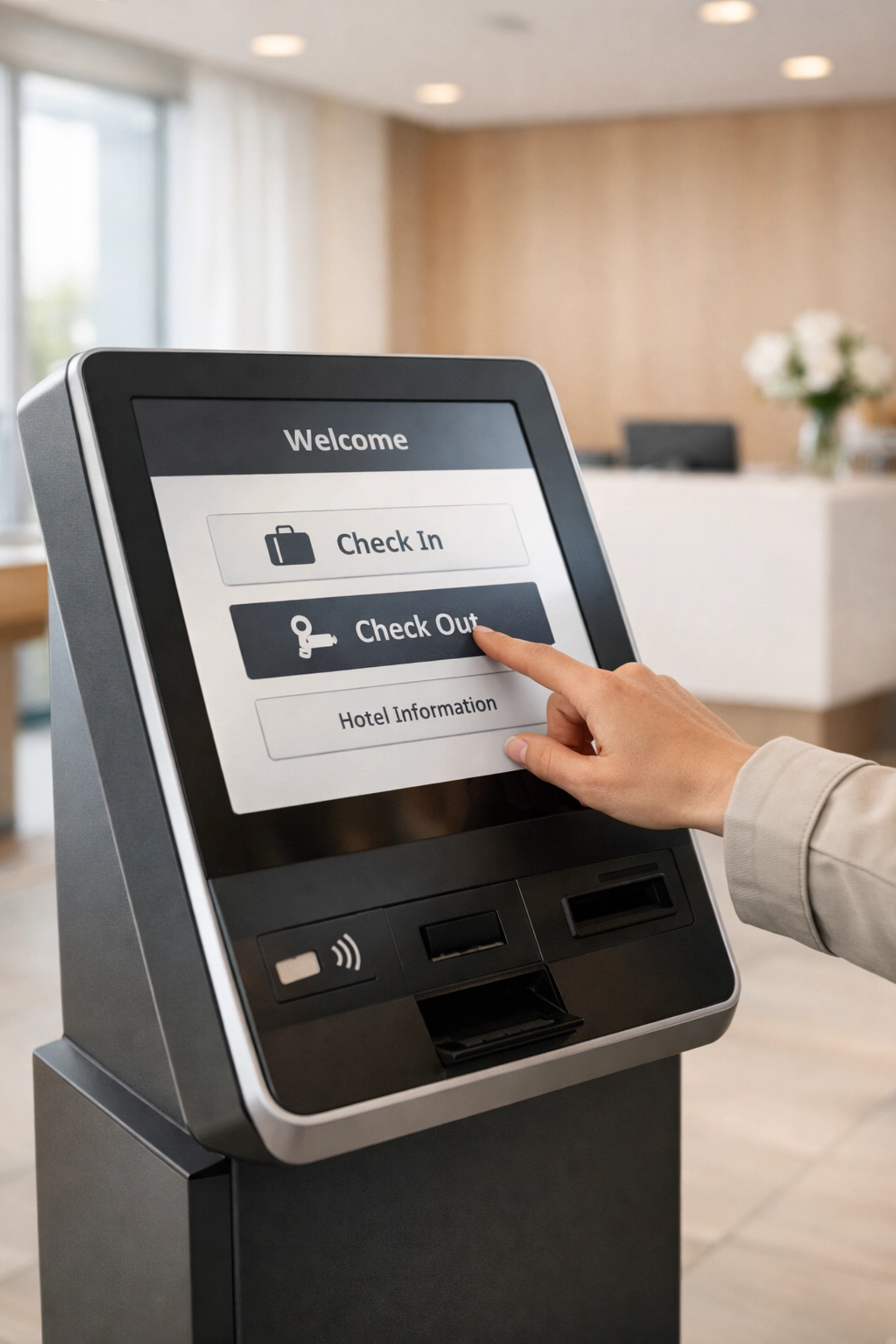
    Self-check-in kiosks let guests bypass the desk entirely. They scan their ID, confirm their reservation, and get their room key in under two minutes. Your front desk team? They're now available for guests who actually need personalized assistance.

    The best part: modern self-check-in kiosks integrate directly with your hotel PMS. No manual entry. No double-checking reservation details. No room assignment confusion.

    Properties using automated check-in report 40% faster processing times and significantly happier guests who appreciate the convenience. Your night audit team especially benefits: they're no longer stuck processing late arrivals manually.

    Guest using self-check-in kiosk in modern hotel lobby for automated check-in process

    2. Put Your Guest Communication on Autopilot

    You're sending the same emails dozens of times daily. Booking confirmations. Pre-arrival instructions. Post-stay surveys. It's eating up hours.

    Automated messaging systems handle this entirely. Set up templates once, and the system sends personalized messages at exactly the right moment: confirmation immediately after booking, check-in instructions 24 hours before arrival, satisfaction surveys after checkout.

    Smart automation goes beyond basic email blasts. Modern systems can:

    • Send SMS reminders for upcoming reservations
    • Trigger upsell messages based on booking type
    • Deploy targeted promotions to past guests
    • Request reviews automatically after positive feedback

    One hotel manager told us they recovered 10 hours weekly just from automating guest communication. That's an entire workday returned to your schedule.

    3. Deploy AI Chatbots for Instant Guest Support

    Your guests have questions at 2 AM. About WiFi passwords. Pool hours. Restaurant recommendations. They're not waiting until morning for answers.

    AI-powered chatbots provide instant responses 24/7. They handle common questions automatically, freeing your team from repetitive inquiries. When something requires human touch, the bot routes the conversation to the appropriate staff member.

    The sophisticated chatbots even translate responses automatically to guests' preferred languages. No more scrambling to find someone who speaks Mandarin at midnight.

    These systems integrate with your hotel PMS and CRM to provide personalized responses based on guest profiles and booking details. A returning guest gets different recommendations than a first-timer.

    Properties report that chatbots handle 70% of guest inquiries without human intervention. Your team focuses on complex requests and personal interactions.

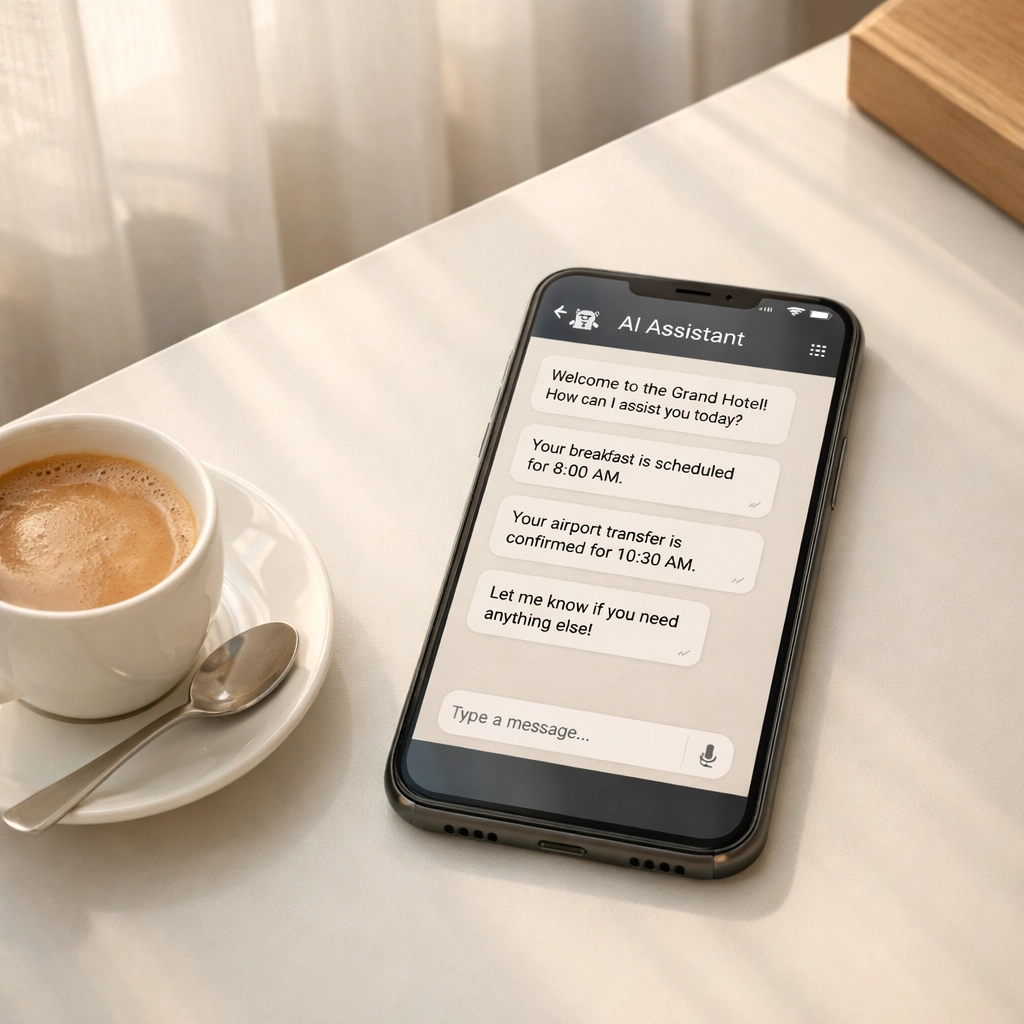
    Smartphone displaying automated hotel chatbot messages for instant guest communication

    4. Automate Your Entire Front Desk Operation

    Your hotel PMS should work for you, not the other way around.

    Cloud-native systems like Mews automate everything from reservation confirmations to dynamic pricing updates. No more manual rate adjustments across multiple platforms. No more forgetting to update availability after a direct booking.

    Here's what gets automated:

    • Rate changes pushed to all channels simultaneously
    • Housekeeping schedules generated based on actual occupancy
    • Invoices created and sent automatically at checkout
    • Night audit processes running without staff intervention

    The difference between legacy systems and modern automation? Hours of daily work vanished. Your staff stops being data entry clerks and becomes hospitality professionals.

    Cloud-native means updates happen instantly across all devices. Your team accesses real-time information whether they're at the desk, in the back office, or helping guests in the restaurant.

    5. Let Your Channel Manager Do the Heavy Lifting

    Managing availability across Booking.com, Expedia, Airbnb, and your direct booking engine manually? You're setting yourself up for double bookings and overbooking nightmares.

    A proper channel manager automates inventory distribution across every platform. Book one room, and availability updates everywhere instantly. Change a rate, and it pushes to all channels simultaneously.

    This isn't just convenience: it's revenue protection. One double booking costs you money, reputation, and hours of problem-solving. Automation eliminates that risk entirely.

    The sophisticated systems also pull performance data from each channel automatically. You see which platforms drive the most revenue without building complicated spreadsheets.

    Your booking engine benefits too. Direct bookings get the same real-time availability updates as OTA channels. Guests never see rooms that aren't actually available.

    Hotel housekeeping cart with fresh linens in corridor for automated room management

    6. Transform Housekeeping with Smart Room Management

    Your housekeeping team shouldn't be guessing which rooms need cleaning.

    Automated room status systems detect when guests check out and immediately notify housekeeping. Priority cleaning lists generate automatically based on upcoming check-ins. Your team always knows exactly where to focus.

    Modern systems go further:

    • Generate optimal cleaning routes based on room locations
    • Track inventory levels and trigger reorder alerts
    • Monitor cleaning times to identify bottlenecks
    • Coordinate with maintenance for repairs

    One property manager reported their housekeeping team cleaned 30% more rooms daily after implementing automated scheduling. Not because they worked harder: because they stopped wasting time on confusion and miscommunication.

    Integration with your hotel PMS means rooms become available for sale the moment they're marked clean. No lag time. No missed revenue from rooms sitting empty when they're ready.

    7. Make Your CRM Actually Useful

    Guest profiles sitting unused in your system? That's money left on the table.

    CRM automation turns guest data into actionable intelligence. The system tracks preferences, spending patterns, and stay history automatically. When guests book again, your team sees everything relevant instantly.

    But automation does more than organize data. It triggers personalized marketing:

    • Birthday promotions sent automatically
    • Anniversary package offers for returning couples
    • Targeted campaigns based on booking behavior
    • Re-engagement messages for guests who haven't visited recently

    One boutique hotel increased repeat bookings by 45% after implementing automated CRM campaigns. They weren't spending more on marketing: they were reaching the right people at the right time with relevant offers.

    Your CRM should also prevent duplicate guest profiles. Automation catches potential duplicates during booking and merges records intelligently, keeping your database clean without manual scrubbing.

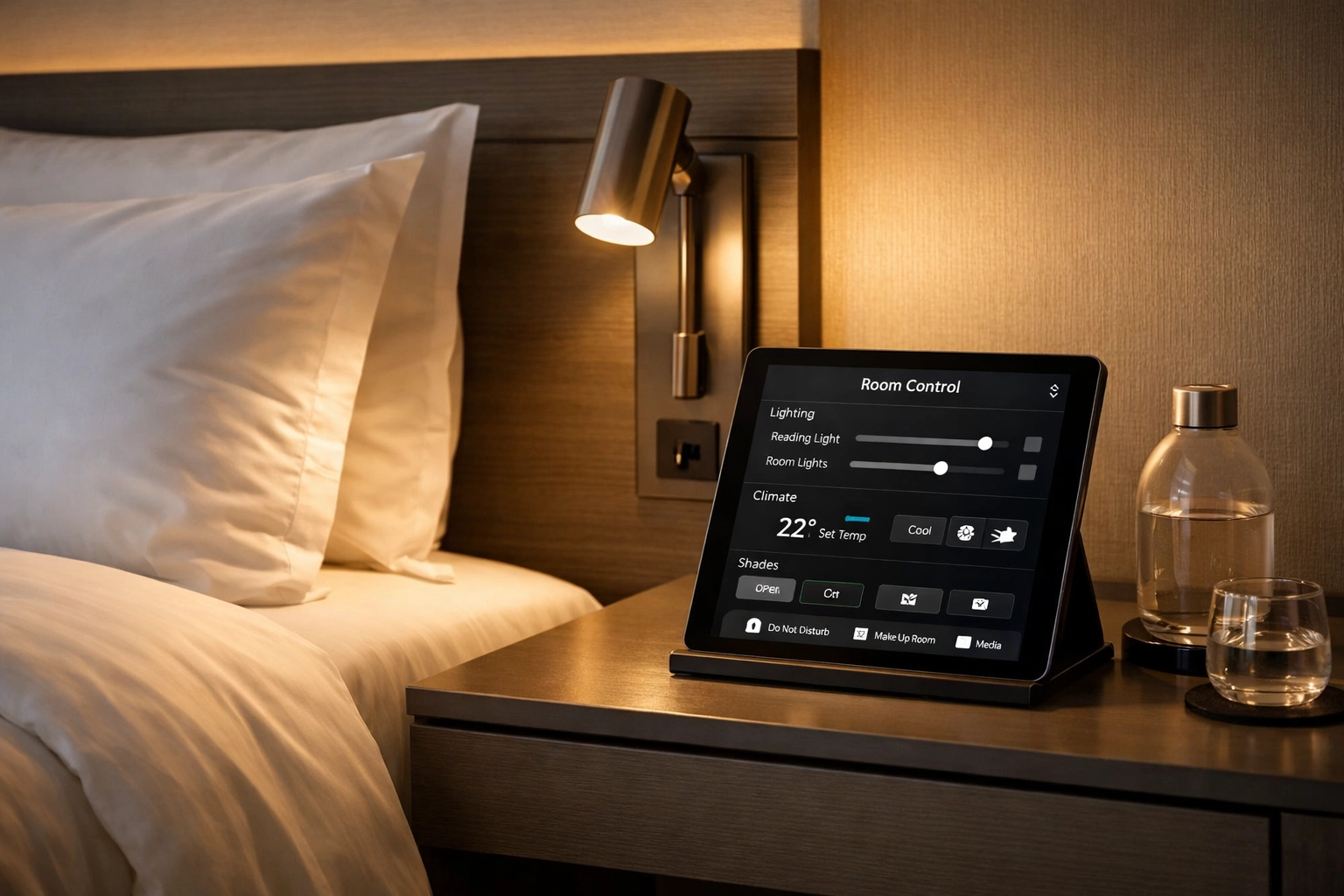
    Smart room control tablet on hotel nightstand for automated guest room technology

    Making Automation Work for Your Property

    These hacks share one critical characteristic: they work 24/7 without breaks, sick days, or training periods.

    Start with the automation that solves your biggest pain point. Front desk overwhelmed? Implement self-check-in. Drowning in guest emails? Deploy automated messaging. Managing multiple OTAs manually? Get a proper channel manager.

    The right platform brings these automations together seamlessly. Mews offers cloud-native hotel management software designed specifically for properties ready to stop wasting time on manual tasks. From PMS to booking engine to channel management: all automated, all integrated, all working while you focus on guests.

    Want to see how much time your property could save? Check out Mews through our affiliate program and discover why thousands of properties have ditched manual processes for good.

    Your staff shouldn't be robots doing repetitive tasks. Let actual automation handle that. Your team becomes what they're meant to be( hospitality professionals creating experiences that keep guests coming back.)

  • Workflow Automation for Small Business: 10 Tasks You Can Automate Right Now (No Tech Skills Required)

    You're doing it all.

    Manually sending welcome emails to new clients. Copying and pasting invoice details. Chasing down expense reports. Posting the same blog to three different social platforms because you forgot the first time. Scheduling meetings through seventeen back-and-forth emails with people who apparently live in different time zones.

    Your to-do list has a to-do list.

    And somewhere between "respond to customer inquiry" and "remember to eat lunch," you're supposed to… run a business?

    Here's the thing: most of the tasks stealing your time don't need you. They just need to get done. And that's where automation changes everything: without you needing to learn coding, hire a developer, or sacrifice your weekend to YouTube tutorials.

    Let's talk about 10 tasks you can automate right now. No tech degree required.

    The Tasks That Are Quietly Draining Your Day

    1. New Client Onboarding

    Someone just signed up. Amazing.

    Now you need to send them a welcome email. Grant access to your client portal. Schedule a kickoff call. Send over those documents. Add them to your project management system…

    Stop.

    With workflow automation, the moment a new client signs a contract, everything happens automatically. They get a personalized welcome email. Access credentials arrive in their inbox. Documents get shared in a secure space. You get a notification that it's done.

    No copy-paste. No wondering if you forgot something. Just smooth, professional onboarding while you're doing literally anything else.

    Automated workflow connecting laptop to business tasks like email, calendar, and documents

    📧 2. Customer Follow-Ups and Surveys

    You know you should follow up. Check in after the purchase. Send that satisfaction survey. Ask for a review.

    But you're already three weeks behind on everything, so… it doesn't happen.

    Automated follow-ups fix this. Set triggers based on customer actions: purchase completed, service delivered, milestone reached: and the right message goes out at exactly the right time. Your customers feel cared for. You don't have to remember to care for them manually.

    Stop Playing Calendar Tetris

    📅 3. Event and Meeting Scheduling

    "What works for you?"
    "How's Tuesday?"
    "Actually, Wednesday is better."
    "Morning or afternoon?"
    "Wait, which time zone are you in?"

    Twelve emails later, you have a 30-minute meeting scheduled.

    Meeting automation tools sync with your calendar, show your actual availability, and let people book time with you directly. No coordination required. The meeting appears on your calendar. They get a confirmation. Both of you get a reminder.

    You just saved yourself 15 minutes and the silent frustration of calendar chaos.

    Marketing That Runs While You Sleep

    ✉️ 4. Email Marketing Campaigns

    Your email list is growing. That's great.

    Segmenting contacts, writing sequences, tracking who opened what, following up with engaged subscribers, updating contact status…

    That's a full-time job you don't have time for.

    Automated email campaigns handle all of it. Someone downloads your guide? They get added to a nurture sequence. They click a specific link? They move to a different segment. They haven't engaged in 90 days? A re-engagement email goes out.

    Your marketing works around the clock. You don't.

    Small business workspace with social media management and email marketing automation tools

    📱 5. Social Media Management

    You wrote a blog post. Now you need to share it on Twitter, LinkedIn, and Facebook.

    And then you need to do it again next week. And the week after. And also remember to engage with comments, track what's working, and add engaged followers to your retargeting list because someone told you that's important…

    Social automation platforms post your content across channels automatically. New blog published? It goes live on all your platforms. They schedule follow-up posts. Monitor engagement. Flag high-value interactions.

    Your social presence stays consistent. You stay sane.

    Sales Workflows That Actually Close Deals

    🎯 6. Lead Scoring and Qualification

    Your CRM is full of leads. Some are hot. Some are cold. Most are somewhere in the mysterious middle, and you have no idea who to call first.

    Automated lead scoring tracks everything: email opens, website visits, content downloads, demo requests: and assigns points. When someone hits your threshold, your sales team gets notified instantly. High-intent leads get immediate attention. Low-engagement contacts get nurtured automatically.

    No more guessing. No more missed opportunities because someone got buried in your inbox.

    Financial Tasks That Don't Need Your Attention

    💰 7. Invoice Generation and Payment Processing

    Project complete? Time to create an invoice. Fill in the details. Calculate the total. Send it via email. Wait for payment. Process it. Update your accounting software. Send a receipt.

    Or… automation handles all of it.

    Project marked complete in your system? Invoice created automatically. Email sent. Payment processed when it arrives. Accounting software updated. Receipt delivered. You get a notification that money just landed in your account.

    That's it. You didn't touch a single field or send a single email.

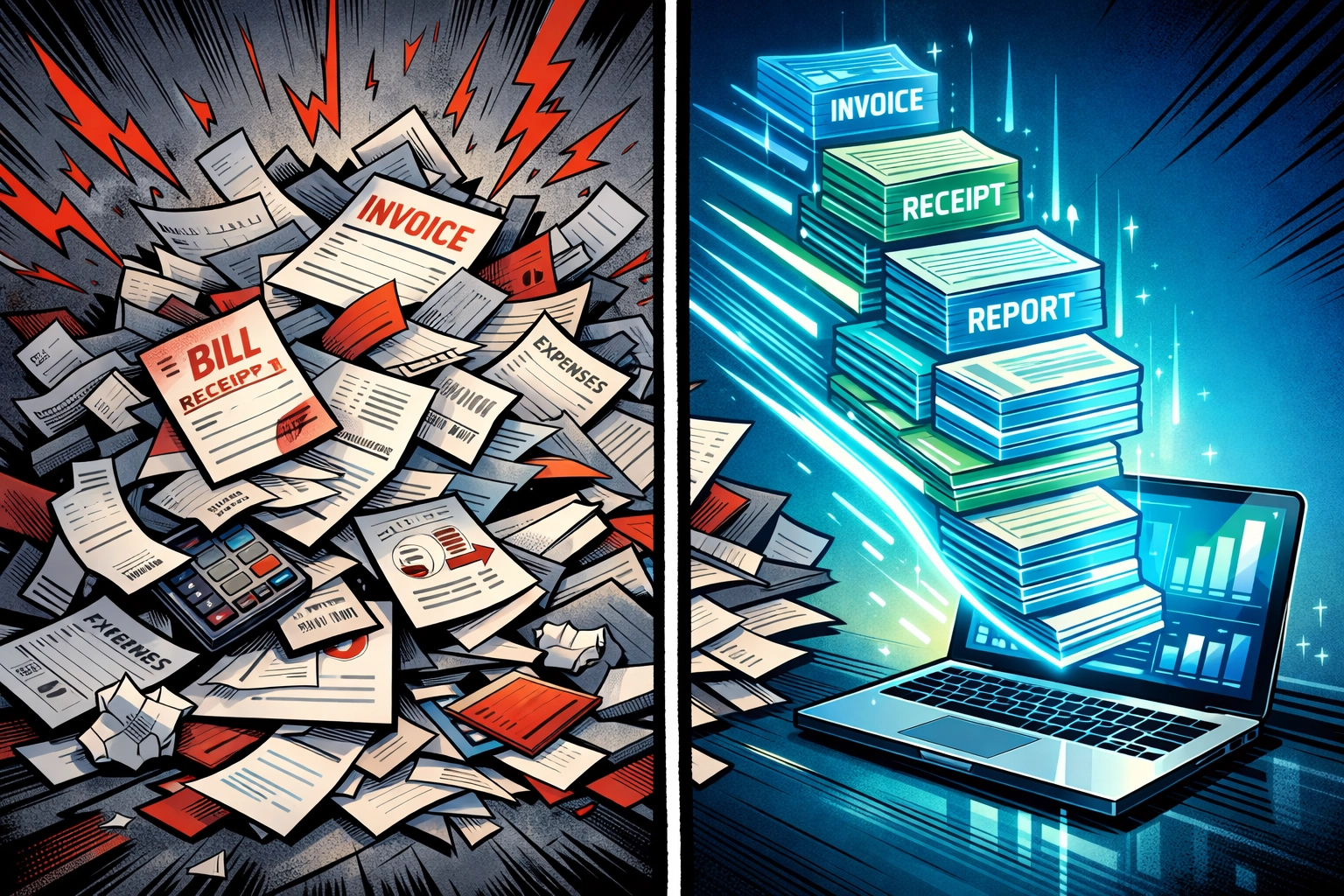
    Before and after comparison of manual invoice chaos versus automated digital payment processing

    📊 8. Expense Tracking and Approval

    Your team submits expense reports. Someone needs to review them. Check policy compliance. Approve or flag issues. Process reimbursement. Update records.

    It's tedious. It's time-consuming. It's ripe for automation.

    Expense workflows route reports to the right managers automatically. Check submissions against policy rules. Approve straightforward claims instantly. Flag questionable ones for human review. Process approved reimbursements without manual data entry.

    Your team gets paid faster. You get your time back.

    The Admin Tasks You Didn't Know You Could Automate

    📄 9. Document Signing and File Management

    Contracts sitting in email threads. Signed PDFs scattered across inboxes. Files requested three times because no one can find the original.

    Document automation solves this mess. Contracts get sent for signature automatically when triggered by specific actions. Completed documents route to the right folders. File requests go to clients with clear instructions. Everything lives in one organized location.

    No more "Can you resend that?" emails.

    The Big One: Customer Support

    🎧 10. Customer Support Workflows

    Support tickets arrive at all hours. Simple questions. Complex problems. Everything in between.

    And somehow, they all need answers.

    This is where an AI virtual assistant for business transforms everything. Automate customer support with AI and routine inquiries get instant responses. Tickets route to the right team members based on issue type. Common questions get resolved without human intervention. Your support team focuses on complex issues that actually need their expertise.

    Your customers get faster help. Your team stops drowning in repetitive questions.

    Ready to see what this looks like in action? Check out how Marblism handles all of this: no coding required, no complicated setup, just automation that actually works.

    Getting Started Without the Tech Headache

    Here's what you're not hearing: you don't need to automate everything tomorrow.

    Start with one task. The one that bugs you most. The repetitive thing you do every single day that makes you think, "There has to be a better way."

    Modern automation platforms use drag-and-drop interfaces. Pre-built templates. Visual workflow builders that make sense to actual humans, not just developers.

    Pick your highest-frequency pain point: maybe it's lead capture, or customer onboarding, or invoice generation: and automate that first. See how it feels to have that task just… handled.

    Then add another.

    What Happens Next

    You get your time back. Not all at once. Not in some dramatic movie moment where you suddenly have empty calendars and peaceful mornings.

    But slowly, quietly, the chaos loosens its grip.

    Tasks complete themselves. Follow-ups happen without your involvement. Your business runs smoother while you focus on the work that actually needs your brain, your creativity, your expertise.

    The stuff only you can do.

    Everything else? That's what automation is for.

    And you don't need to be technical to make it happen. You just need to start.

  • How to Store Coffee Beans Like a Pro (And Keep Them Fresh for Weeks)

    How to Store Coffee Beans Like a Pro (And Keep Them Fresh for Weeks)

    You've just bought a bag of beautiful speciality coffee. Maybe it's from Limini Coffee, roasted fresh that very morning. The aroma when you open it? Incredible. But here's the thing, that freshness won't last forever if you don't store it properly.

    Most people don't realise how quickly coffee can lose its magic. Within days of improper storage, those complex flavours and aromas start fading. The good news? With a few simple practices, you can keep your beans tasting fantastic for weeks after opening.

    So let's talk about how to store coffee beans like a proper coffee geek (without actually needing to be one).

    The Four Enemies of Fresh Coffee

    Think of coffee beans as little flavour treasure chests. Inside each bean are hundreds of aromatic compounds and oils that create all those delicious notes you love, chocolate, berries, caramel, nuts. But these compounds are incredibly vulnerable.

    There are four main culprits that destroy coffee freshness:

    Air (Oxygen) is the biggest villain. When oxygen comes into contact with your beans, it triggers oxidation. This is the same process that makes apples turn brown or metal rust. For coffee, it means those precious volatile compounds break down and disappear. The result? Flat, stale coffee that tastes like cardboard.

    Light accelerates the degradation process. UV rays break down the organic compounds in coffee beans, much like how sunlight fades furniture or photographs. Even indirect light over time will dull your coffee's character.

    Four enemies of coffee freshness: water moisture, sunlight, heat, and air exposure on marble counter

    Heat speeds up all chemical reactions, including the breakdown of flavour compounds. Coffee stored in warm environments loses its freshness significantly faster. Those lovely oils become rancid, and delicate aromatics evaporate.

    Moisture is perhaps the sneakiest enemy. Coffee beans are porous and will absorb moisture from the air. This doesn't just make them stale, it can actually cause mould growth. Plus, wet beans extract poorly and taste absolutely terrible.

    Understanding these enemies is half the battle. Now let's talk about how to protect your beans.

    Choose the Right Container

    Not all containers are created equal when it comes to coffee storage.

    Your first priority is finding something airtight. We're talking a proper seal here, not just a lid that sits on top. Every time air gets in, oxygen attacks your beans. So after each use, make sure that lid clicks or seals properly.

    Opaque containers are better than clear ones. If you love those glass jars for aesthetic reasons (and honestly, whole beans do look gorgeous), at least store them inside a dark cupboard away from any light source.

    The best storage containers have one-way valves. These clever designs let CO2 escape (fresh roasted beans release carbon dioxide for days after roasting) while keeping oxygen out. If you're serious about coffee, investing in one of these containers is worth every penny.

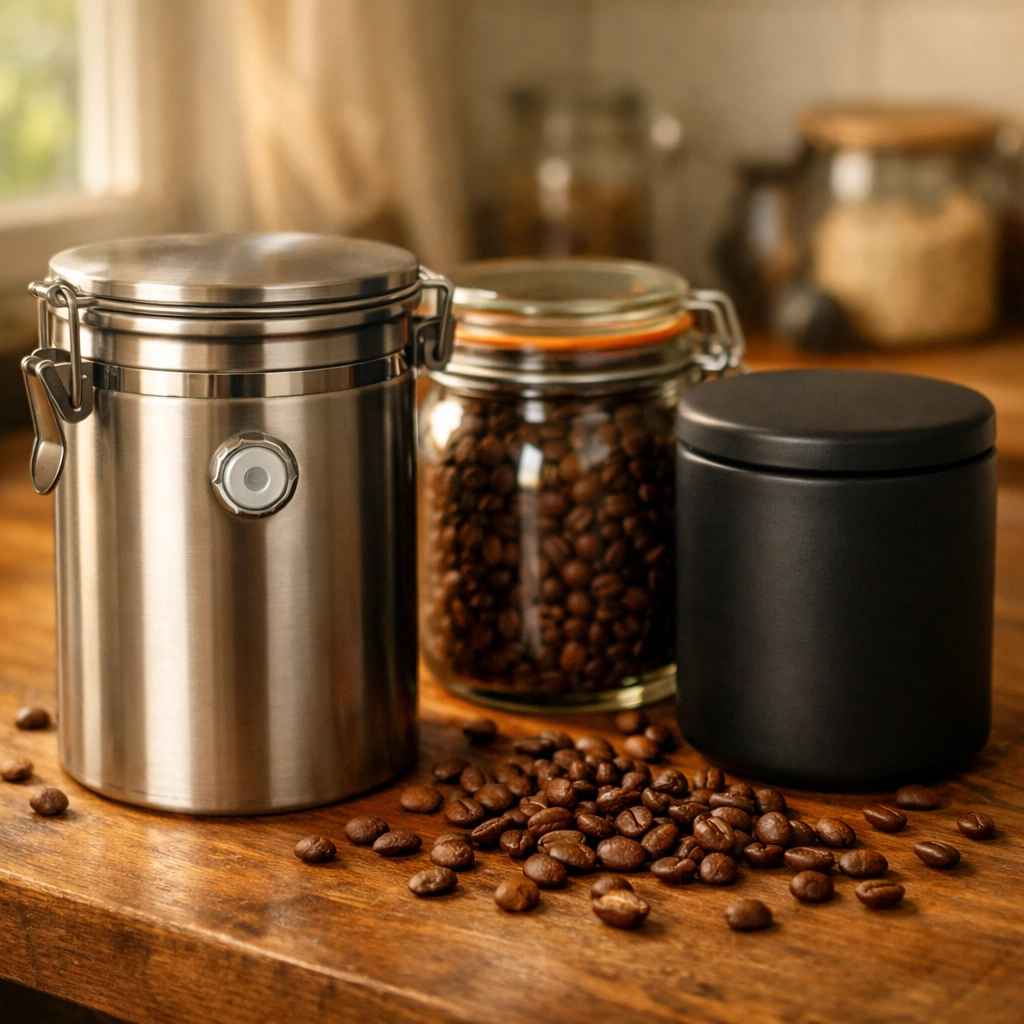
    Airtight coffee storage containers with one-way valves and whole coffee beans on wooden counter

    Mason jars work in a pinch, as do stainless steel canisters with rubber seals. Even the bag your coffee came in can work well initially, many roasters use bags with one-way valves and zip seals. Just make sure you squeeze out excess air before sealing it up.

    What doesn't work? Those decorative tins with loose lids, open bowls, or anything that lets air flow freely. And please, never store beans in the grinder hopper. We know it's convenient, but those beans are sitting there exposed to air 24/7.

    Location, Location, Location

    You've got the right container. Now where do you put it?

    Cool and dark is the golden rule. Think pantry, cupboard, or drawer: somewhere away from windows and heat sources. The ideal temperature is between 15-24°C (that's roughly 60-75°F).

    Here's where people often go wrong: storing coffee near the stove, oven, or coffee machine itself. These appliances radiate heat, and even that subtle warmth degrades your beans faster than you'd think. So find a spot that maintains a stable, moderate temperature.

    Avoid anywhere humid. This means not in the bathroom (obviously), but also be cautious with cupboards above dishwashers or near sinks. If you live in a particularly humid climate, you might need to be extra vigilant about airtight storage.

    Coffee beans stored in dark cupboard away from heat and light for optimal freshness

    And keep your coffee away from strong-smelling foods. Coffee beans are incredibly absorbent: they'll happily soak up the aromas of garlic, onions, spices, or whatever else is nearby. Unless you fancy a cumin-flavoured latte, give your beans their own dedicated space.

    The Fridge and Freezer Debate

    Let's address this head-on: Don't put your daily coffee in the fridge.

    The fridge is full of moisture and odours: two of coffee's worst enemies. Every time you take the bag out, condensation forms on the cold beans. That moisture seeps in, and your coffee quality plummets.

    What about the freezer? This is contentious in the coffee world, and honestly, it's rarely necessary for home use.

    If you absolutely must freeze coffee: maybe you bought way too much or received a huge gift: here's how to do it properly. Divide your beans into small, weekly portions in airtight containers or freezer bags. Remove as much air as possible. Freeze once, and when you're ready to use a portion, let it thaw completely (overnight is best) before opening the container. Never refreeze.

    But here's the thing: if you're buying fresh coffee in sensible quantities, you shouldn't need to freeze anything. Which brings us to…

    The Best Storage Strategy: Buy Fresh, Buy Often

    The absolute best way to ensure fresh coffee? Don't store it for too long in the first place.

    Coffee is at its peak from about 7-30 days after roasting. After that, it's still drinkable, but you're gradually losing flavour complexity. So instead of buying a massive bag that'll last three months, buy smaller amounts more frequently.

    This is where roasters like Limini Coffee really shine. They roast daily, which means when you order, your beans are incredibly fresh to begin with. Starting with peak freshness gives you the longest possible window to enjoy your coffee at its best.

    Think about it this way: would you buy fresh bread for the month and expect it to taste great on day 30? Coffee is similar. It's a fresh product, and treating it that way makes all the difference.

    A 250g bag typically makes about 16-18 cups of coffee. If you drink one or two cups daily, that's a perfectly sized portion to finish within 2-3 weeks while the coffee is still singing.

    Practical Day-to-Day Habits

    Beyond the big-picture storage stuff, a few simple habits will keep your coffee tasting great:

    Grind right before brewing. Whole beans stay fresh exponentially longer than ground coffee. Once you grind, you've massively increased the surface area exposed to air. Those aromatics start escaping immediately. So if you want the freshest cup possible, grind your beans right before you brew.

    Keep the bag sealed. It sounds obvious, but we all get busy. Make it a habit to properly reseal your coffee container or bag after every use. Those few seconds matter.

    Label your coffee. Write the roast date and the date you opened it on the bag or container. This helps you track freshness and rotate through your stash if you're one of those people who has multiple bags on the go (no judgment).

    Use a clean, dry scoop. Never dig into your beans with wet hands or a damp scoop. Even tiny amounts of moisture can cause problems over time.

    What Fresh Coffee Actually Tastes Like

    When you store coffee properly and drink it fresh, you'll notice the difference immediately.

    Fresh coffee has clarity. Each flavour note is distinct rather than muddled together into a generic "coffee" taste. You might pick up on berries, florals, citrus, chocolate, or nuts: whatever characteristics that particular coffee is known for.

    The aroma is intoxicating. When you open a bag of fresh, properly stored beans, the smell should make you pause and appreciate it. If you're just getting a faint, flat scent, that's a sign of staleness.

    Fresh coffee has body. It feels fuller in your mouth, with a silky or creamy texture depending on the origin and roast. Stale coffee often tastes thin and hollow by comparison.

    And perhaps most importantly, fresh coffee has a clean finish. Old, improperly stored coffee can leave an unpleasant, lingering bitterness or dusty aftertaste. Fresh coffee finishes cleanly, leaving you wanting another sip rather than reaching for water.

    It All Starts With Quality Beans

    Of course, proper storage only works if you're starting with quality coffee in the first place.
    This is why we think buying from speciality roasters who roast frequently makes such a difference. When beans come to you days (not weeks or months) after roasting, you're already ahead of the game. Combine that fresh start with proper storage, and you're in for consistently excellent coffee.

    Whether you're brewing espresso, pour over, French press, or any other method, freshness is the foundation. You can have the most expensive equipment and perfect technique, but if your beans are stale, the cup will disappoint.

    So treat your coffee with respect. Give it the storage it deserves. And maybe stock up a little less, a little more often. Your taste buds will thank you.

    After all, life's too short for stale coffee.

  • The Hidden Cost of ‘Doing It All Yourself’ (And How AI Frees You Up)

    The Hidden Cost of ‘Doing It All Yourself’ (And How AI Frees You Up)

    You're wearing too many hats.

    There's the CEO hat. The marketing hat. The bookkeeper hat. The IT troubleshooter hat. The customer service hat. The social media manager hat…

    You get the idea.

    And here's what nobody tells you when you start your business: Doing it all yourself isn't scrappy hustle. It's a silent business killer.

    Sure, you're saving money on salaries. But while you're editing invoices at 11 PM and formatting spreadsheets instead of closing deals, your business is paying a price you can't see on any expense report.

    Let's talk about what this DIY approach is actually costing you.

    THE TIME TAX YOU'RE PAYING YOURSELF

    Here's a brutal truth: Business owners spend an average of 41% of their time on tasks that could be delegated.

    Think about that. Nearly half your workweek.

    Now do this math. What's your hourly rate worth? Let's say $100 (and if you're running a successful business, it's probably more). You spend 20 hours this week on admin tasks , invoicing, email management, social media scheduling, customer follow-ups, data entry.

    That's $2,000 worth of your time spent on back-office work.

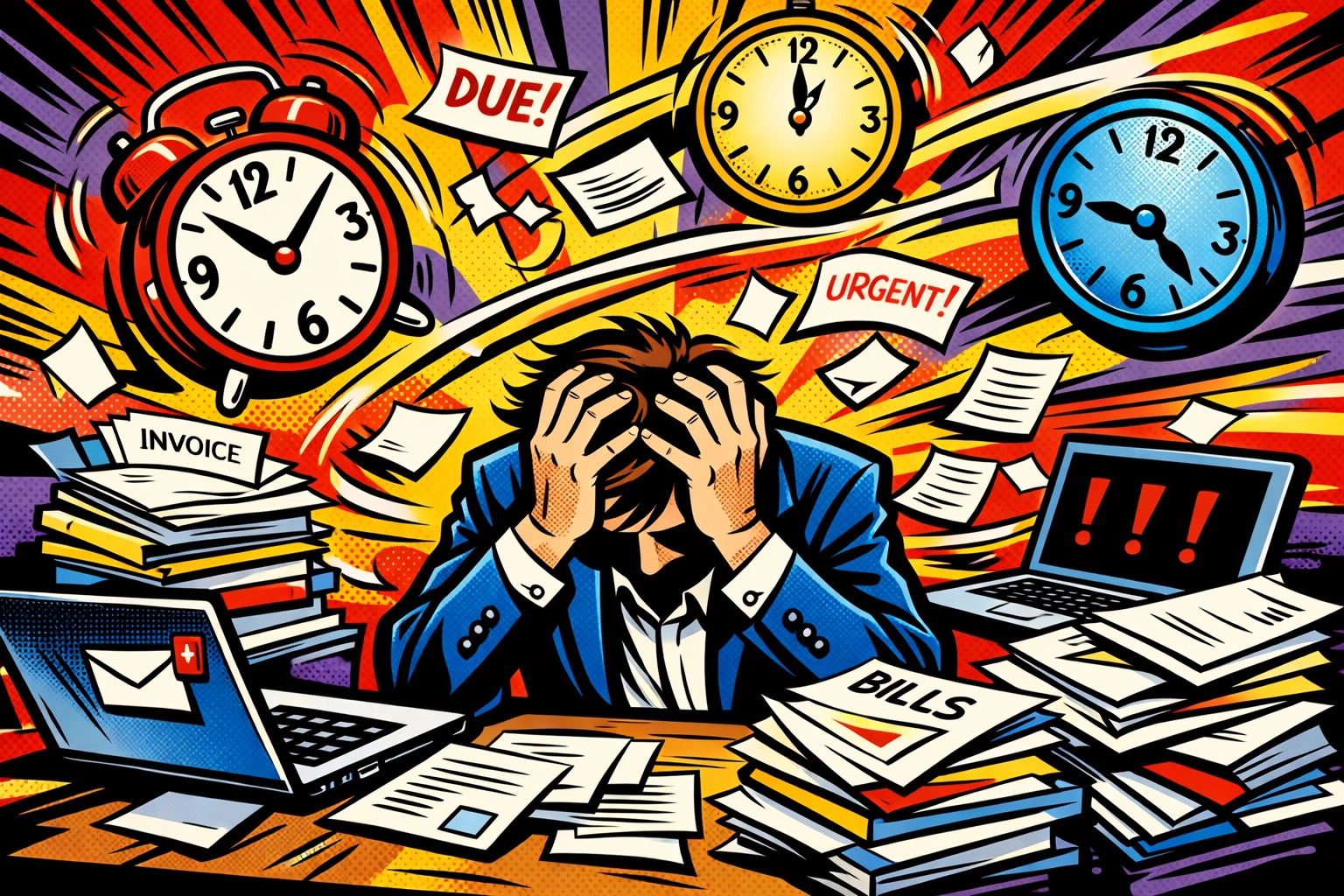
    Overwhelmed small business owner surrounded by clocks, paperwork, and admin tasks

    An ai assistant for small business could handle those same tasks for a fraction of that cost. But more importantly… what could you have done with those 20 hours?

    Closed that partnership deal you've been nurturing. Developed that new product line. Had actual conversations with your best customers. Built the strategy that takes your business from six figures to seven.

    Every hour you spend executing tasks instead of leading strategy is an hour your business isn't growing. And your competitors? They're not in the weeds formatting documents.

    THE QUALITY GAP (AND THE ERRORS THAT COMPOUND)

    Let's be honest about something uncomfortable.

    You're probably not great at everything you're doing.

    That's not an insult , it's reality. You're a skilled entrepreneur, but you're likely not a trained bookkeeper, a copywriter, a graphic designer, an SEO specialist, and an IT security expert all rolled into one.

    And the mistakes add up faster than you think.

    Common DIY bookkeeping errors alone include:

    • Missed tax deductions costing thousands annually
    • Poor cash flow visibility that blindsides you with money problems
    • Incorrect categorization that triggers IRS audits
    • Messy records that triple your accounting fees at tax time

    Then there's DIY IT security. One breach costs small businesses an average of $2.98 million. One phishing email you didn't catch because you were handling 47 other things that day.

    DIY marketing? You waste budget on the wrong audience because you don't have time to analyze the data properly. Poor results lead to smaller budgets, which lead to worse results… the spiral continues.

    These aren't hypothetical scenarios. This is what happens when you're spread too thin to do anything well.

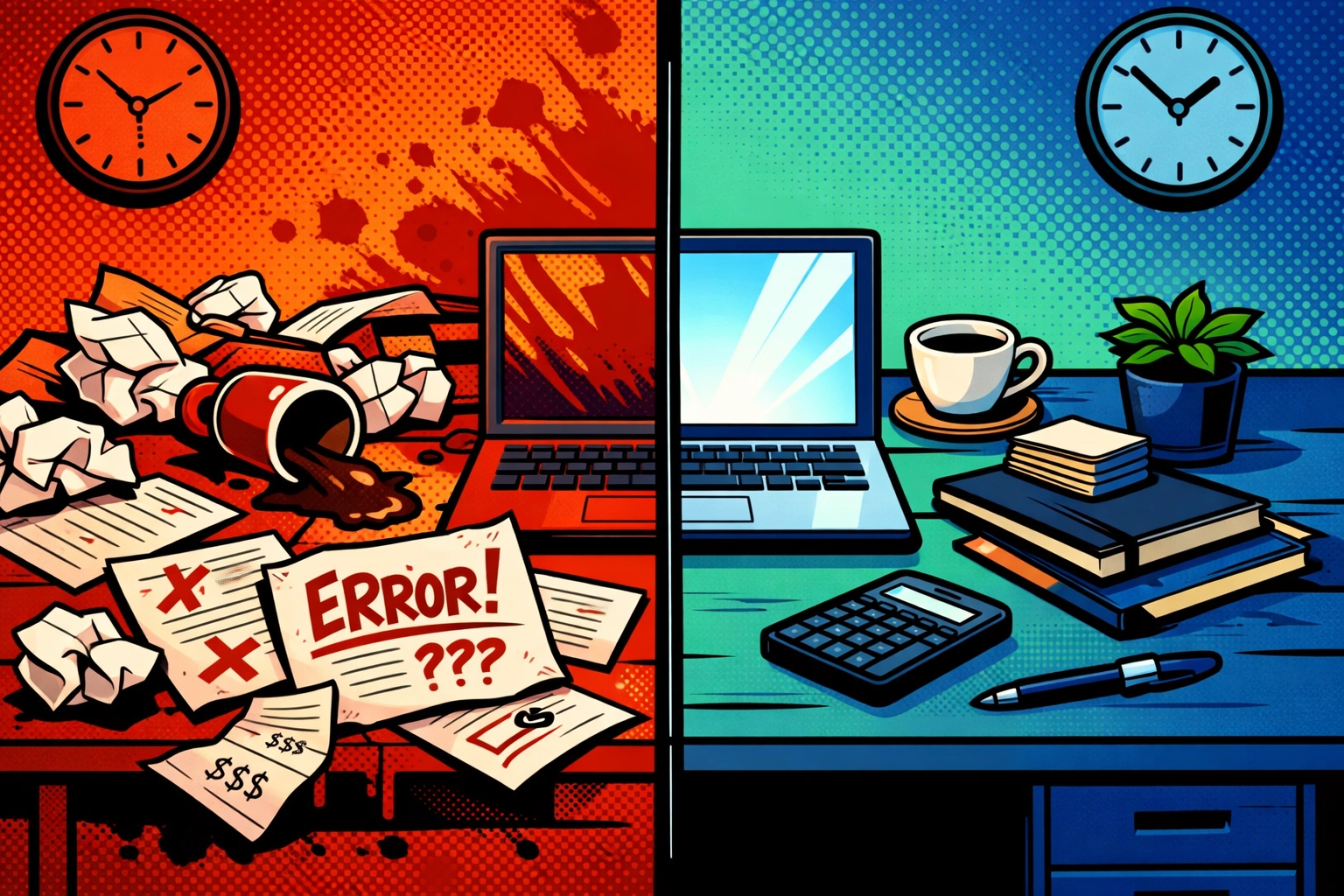
    Before and after comparison showing chaotic desk versus organized workspace with automation

    THE GROWTH CEILING YOU CAN'T SEE

    Here's where it gets really expensive.

    Your business can only scale as far as your personal capacity.

    When you're the one doing everything, you become the bottleneck. You can't take on new clients because you're still onboarding the last batch manually. You can't pursue that strategic partnership because you're busy automate admin tasks that ate your Tuesday.

    Growth doesn't stall because the market isn't there. It stalls because you're trapped in execution mode.

    And burnout? That's not just a buzzword. It's the inevitable endpoint of trying to do it all. You can't innovate when you're exhausted. You can't make good decisions when you haven't slept properly in three weeks because you're answering emails at midnight.

    THE SMARTER WAY: AI THAT WORKS WHILE YOU LEAD

    Here's what's different in 2026.

    Delegating doesn't mean hiring a $50K employee anymore. It means bringing on an ai assistant for small business that handles the execution while you handle the strategy.

    Let's talk real numbers.

    A human assistant costs $35K–$50K annually, plus benefits, plus training time, plus management overhead. They work 40 hours a week. They need vacation days. They get sick. They might leave in six months, and you start over.

    AI? It works 24/7. Never takes a day off. Doesn't need training on your systems. Learns your business faster than any human onboarding process. And costs a fraction of a single salary.

    But here's what really matters , it's not about replacing humans. It's about freeing you up to be human.

    Business owner trapped by paperwork while growth opportunities wait outside

    WHAT IT ACTUALLY LOOKS LIKE

    7:30 AM : Your AI has already sorted your inbox, flagged the three emails that actually need your attention, drafted responses to the routine stuff, and scheduled follow-ups for the rest. The chaos is handled before your coffee's ready.

    10:00 AM : Instead of formatting that proposal yourself, you spent the morning on a call with a potential partner that could double your revenue. Your AI polished the proposal, incorporated the pricing you mentioned yesterday, and sent it with perfect timing.

    2:00 PM : A customer question comes in. Your AI pulls from your knowledge base, crafts a response that sounds like you, and resolves it before you even see the notification. Customer's happy. You didn't break focus from your deep work.

    5:30 PM : While you're wrapping up, your AI is analyzing this week's data, prepping tomorrow's social content, and organizing your calendar for maximum productivity. No overtime needed.

    11:00 PM : You're actually asleep. Not answering emails. Not "just quickly" fixing something. Because your business is running smoothly without you micromanaging every detail.

    That's not a fantasy. That's what delegating to AI actually looks like.

    THE REAL COST OF WAITING

    You know what's more expensive than investing in automation?

    Spending another year doing it all yourself.

    Another year of late nights and missed opportunities. Another year watching competitors scale while you're stuck in the weeds. Another year closer to burnout, further from the business you actually wanted to build.

    The math is simple: Your time is your most valuable asset. Stop spending it on tasks that don't require your genius.

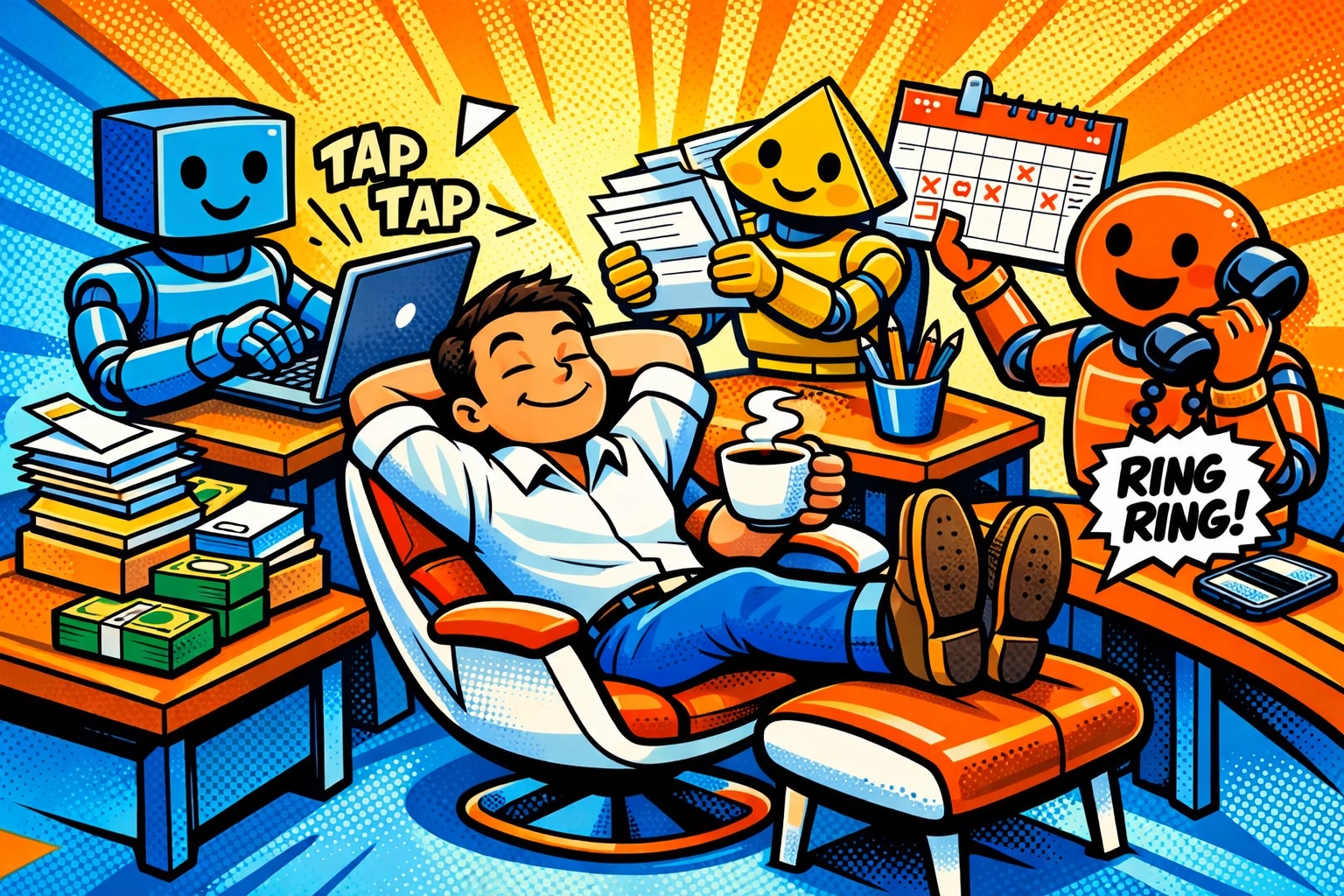
    Small business owner relaxing while AI assistants handle admin tasks and operations

    AI isn't about replacing your hustle. It's about directing it where it actually matters. It's about automate admin tasks so you can focus on the work only you can do : building relationships, making strategic decisions, creating the vision that drives your business forward.

    YOUR NEXT MOVE

    You've read this far because you know something needs to change.

    You're tired of doing it all. You're ready to scale smarter, not harder. You're ready to reclaim your time and your sanity without hiring an entire team.

    See exactly how an AI assistant handles your daily chaos

    Try it for your business. Watch it handle the tasks you've been drowning in. See what it feels like to focus on growth instead of execution.

    No complicated setup. No learning curve that eats another week of your time. Just immediate relief from the grind that's been holding you back.


    The businesses that win in 2026? They're not the ones doing everything themselves.

    They're the ones smart enough to delegate the execution and focus on what actually builds empires.

    Your move.

  • AeroPress vs. Moka Pot: The Battle of the Strong Brews

    AeroPress vs. Moka Pot: The Battle of the Strong Brews

    If you're the type who takes their coffee seriously: we're talking bold, intense, wake-you-up-properly coffee: then you've probably looked at both the AeroPress and the Moka Pot and wondered which one deserves a spot on your kitchen counter.

    Both brew strong, concentrated coffee using pressure. Both have cult followings. And both can make an absolutely brilliant cup when you know what you're doing.

    So which one's right for you?

    Let's settle this once and for all.

    The Basics: What Are We Actually Comparing?

    The Moka Pot is that classic Italian stovetop brewer your nonna might have used. It's been around since the 1930s, brewing coffee through steam pressure. Water heats in the bottom chamber, creates pressure, and forces itself up through the coffee grounds into the top chamber. The result? A rich, espresso-style coffee that's been the backbone of Italian home brewing for nearly a century.

    The AeroPress, on the other hand, is the new kid: invented in 2005 by the same bloke who created the Aerobie flying disc. It uses manual air pressure. You push down a plunger, forcing hot water through coffee grounds and a micro-filter. It's lightweight, plastic, and looks a bit like something from a science lab.

    But don't let appearances fool you. Both can produce seriously good coffee.

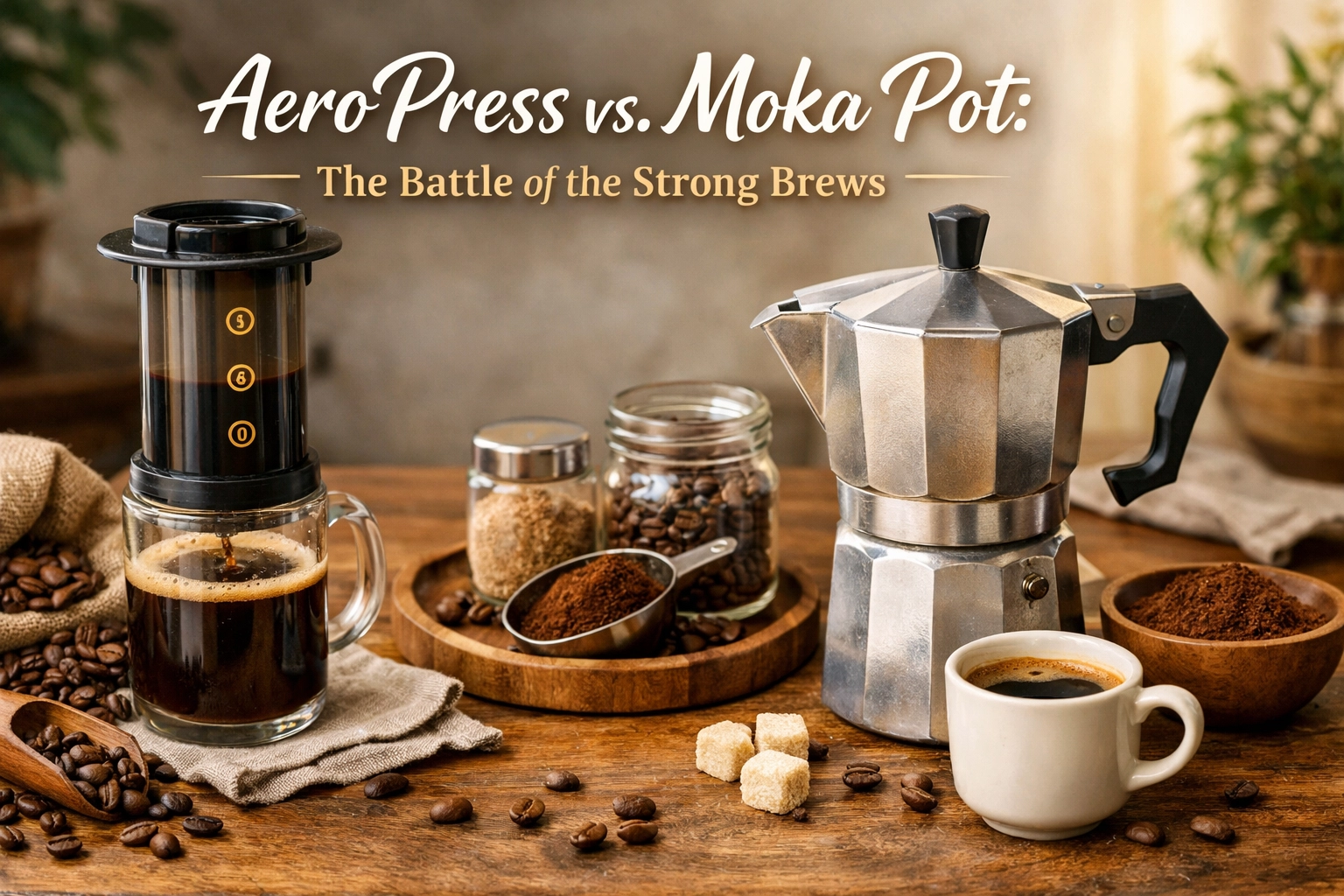
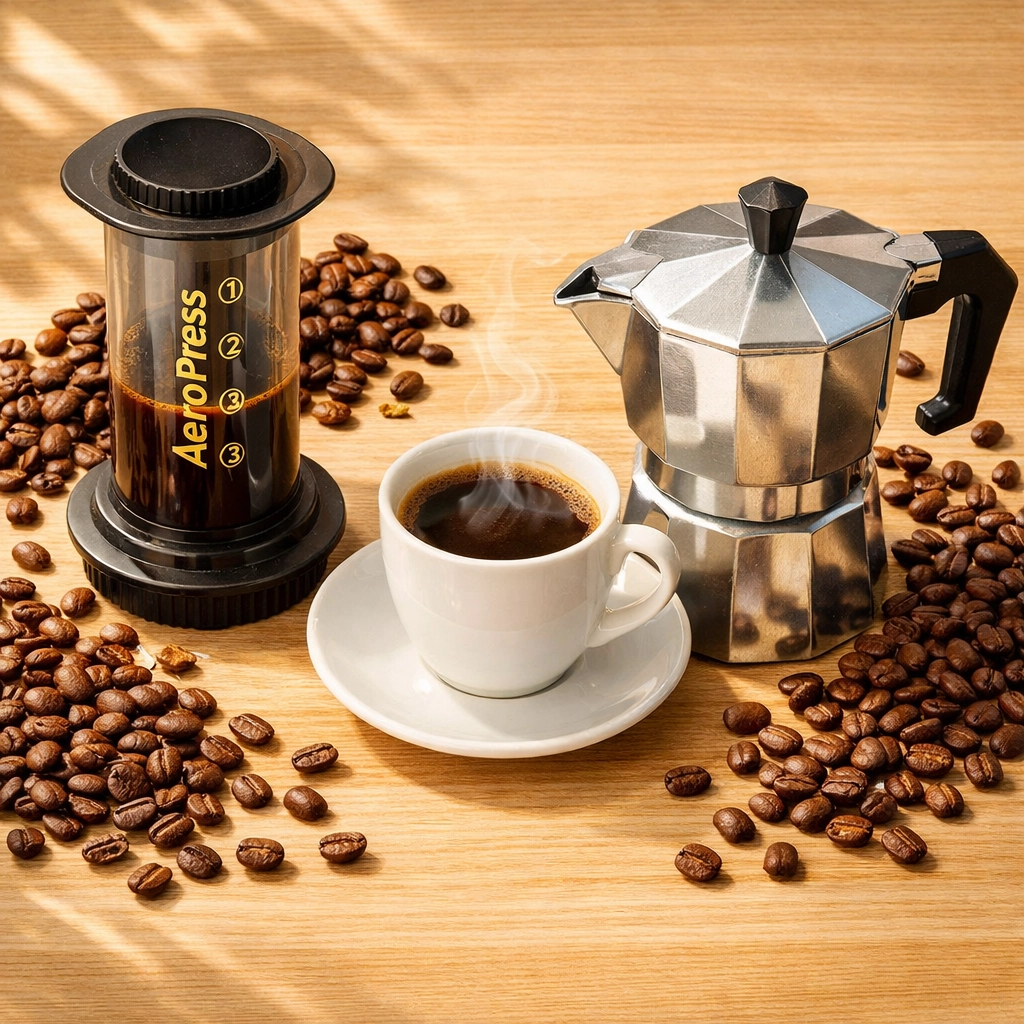
    AeroPress and Moka Pot side by side with fresh coffee beans on wooden table

    The Brewing Method: Steam vs. Manual Pressure

    Here's where things get interesting.

    The Moka Pot generates about 1-2 bars of pressure using steam. You fill the bottom with water, add coffee to the middle basket, screw on the top, and put it on the hob. As the water heats and boils, steam pressure builds and pushes the water up through the grounds. You'll hear that distinctive gurgling sound when it's done: music to any coffee lover's ears.

    The AeroPress uses roughly 2 bars of pressure, but you're creating it manually. You add coffee to the chamber, pour in hot water (which you've heated separately), stir, then press down the plunger with your hands. The whole process takes about two minutes from start to finish.

    The key difference? Control.

    With the Moka Pot, you're somewhat at the mercy of your heat source. Too hot and you'll burn the coffee. Too cool and extraction stalls. There's a sweet spot, but finding it takes practice.

    With the AeroPress, you control the water temperature, brewing time, grind size, and pressing speed. You can dial in your recipe with precision. Want a longer extraction? Steep longer before pressing. Prefer it stronger? Use more coffee or a finer grind. It's incredibly forgiving for experimentation.

    Flavour Profile: Bold vs. Clean

    Let's talk about what ends up in your cup.

    The Moka Pot produces a bold, rich, intense coffee that sits somewhere between espresso and drip coffee. It's got body, it's got punch, and it definitely wakes you up. The coffee has a syrupy thickness and assertive flavor that works brilliantly with milk if you're making a home cappuccino.

    However: and this is important: the Moka Pot lacks effective filtration. You'll often get some sediment in the cup, which can make it taste a bit muddy or silty. And because the water has to reach boiling point to create pressure, there's a risk of extracting bitter, burnt-tasting compounds if you're not careful. Some people love that intense, slightly harsh edge. Others find it a bit much.

    The AeroPress delivers a smoother, cleaner cup with bright, clear flavors. The paper micro-filter (or reusable metal filter if you prefer) removes oils and fine particles, giving you a grit-free coffee with lower acidity. The result is balanced and nuanced: you can actually taste the distinct characteristics of the beans rather than just "strong coffee."

    This is where using quality beans really shines. Both methods work beautifully with freshly roasted specialty coffee, but the AeroPress especially lets you appreciate the subtleties of origin and roast profile.

    Brewing coffee with AeroPress plunger press and Moka Pot steaming on stovetop

    Ease of Use: Simple vs. Simpler

    The Moka Pot requires a bit of babysitting. You need to watch the heat, listen for the gurgling, and remove it from the hob at just the right moment. Leave it too long and you'll over-extract bitter nastiness. The multiple components also get extremely hot, so you're handling everything with tea towels or waiting for it to cool.

    Cleanup involves disassembling the three parts: bottom chamber, filter basket, and top chamber: and washing each one. Not difficult, but more faff than some people want first thing in the morning.

    The AeroPress is dead simple. Grind your coffee, add it to the chamber, pour hot water, wait, press, done. Total time? About two minutes. Cleanup is equally straightforward: unscrew the cap, press out the coffee puck straight into the bin, rinse the plunger. You're done in thirty seconds.

    For bleary-eyed mornings when you need coffee to function enough to make coffee, the AeroPress wins on convenience.

    Capacity: One Cup Wonder vs. Family Sized

    Here's a practical consideration that might make or break your decision.

    The AeroPress brews one cup at a time. That's it. You can make a concentrated brew and dilute it (Americano-style), but fundamentally, it's designed for individual servings. If you're making coffee for yourself, brilliant. If you're making coffee for three or four people, you'll be standing there pressing away for ages.

    Moka Pots come in various sizes: from single cup models to 12-cup beasts. If you're regularly brewing for multiple people, the Moka Pot is far more practical. Make one batch, pour it out, job done.

    Portability: Kitchen Tool vs. Travel Companion

    The AeroPress absolutely dominates when it comes to portability. It's lightweight plastic, compact, and requires nothing but hot water. Camping? Bring the AeroPress. Office? AeroPress. Hotel room with a kettle? You know the answer.

    The Moka Pot requires a heat source: stovetop, camping stove, whatever: making it bulkier and less versatile for travel. It's also typically aluminum or steel, so it's heavier. That said, it's incredibly durable. Drop a Moka Pot and it'll probably dent. Drop an AeroPress and it might crack.

    Two cups comparing AeroPress and Moka Pot coffee showing different brew clarity

    Cost: Initial Investment and Ongoing Expenses

    Both are similarly priced initially: you can get a decent Moka Pot or AeroPress for £25-40.

    However, the AeroPress requires paper filters, which you'll need to replace regularly. They're cheap: about £5 for 350 filters: but it's an ongoing cost. You can use reusable metal filters, though they produce a different cup profile with more oils and sediment.

    The Moka Pot has basically zero ongoing costs once you've bought it. No filters, no replacement parts unless you're incredibly rough with it. From a long-term economics perspective, it's slightly cheaper.

    Though honestly, we're talking pennies per cup. If you're drinking quality coffee, the beans will always be your biggest expense.

    Versatility: One Trick Pony vs. Coffee Chameleon

    The Moka Pot does one thing: brew strong, espresso-style coffee. It does it well, but that's your only option.

    The AeroPress is ridiculously versatile. Standard method, inverted method, different recipes for different beans, cold brew, pseudo-espresso for lattes: there are literally championship competitions dedicated to finding new AeroPress brewing techniques. If you like experimenting and tweaking your coffee, the AeroPress is a playground.

    So Which One Should You Choose?

    Here's the honest answer: it depends what you value.

    Choose the Moka Pot if:

    • You want that classic, bold, Italian-style coffee
    • You're brewing for multiple people regularly
    • You prefer low-maintenance gear with no ongoing costs
    • You like the ritual and romance of traditional brewing
    • You're making milk-based drinks at home

    Choose the AeroPress if:

    • You value clarity and complexity in your coffee
    • You're brewing for one or two people
    • You want maximum control over the brewing process
    • You need something portable for travel or office
    • You enjoy experimenting with different techniques
    • You want quick, easy cleanup

    Honestly? If you're serious about coffee, you might end up with both. We do. They serve different purposes and different moods.

    The Bean Factor

    Regardless of which brewer you choose, the quality of your beans matters enormously. Both the AeroPress and Moka Pot are unforgiving with stale, poorly roasted coffee: they'll amplify every flaw.

    That's why we always recommend starting with freshly roasted specialty beans. Whether you're pressing or percolating, fresh beans with clear roast dates make all the difference between a mediocre cup and something genuinely special.

    Both methods really let you taste the origin characteristics and roasting skill. A bright, fruity Ethiopian will taste completely different from a rich, chocolatey Colombian: and both brewers will showcase those differences beautifully when you're working with quality coffee.

    Final Verdict

    There's no clear winner here because these are fundamentally different tools for slightly different jobs.

    The Moka Pot is traditional, bold, and practical for larger quantities. It rewards practice and produces that classic strong coffee that millions of Italians have relied on for generations.

    The AeroPress is modern, versatile, and exceptionally clean-tasting. It's forgiving for beginners but offers endless depth for coffee geeks who want to experiment.

    Try both if you can. Brew the same beans on each and taste the difference. You might be surprised which one clicks with your personal preferences.

    And whatever you choose, fill it with freshly roasted beans. That's the real secret to strong brews that actually taste good, not just strong.

  • 5 Steps How to Automate Your Hotel Operations and Save 20 Hours Per Week

    5 Steps How to Automate Your Hotel Operations and Save 20 Hours Per Week

    Twenty hours. That's how much time the average hotel staff spends each week on repetitive, manual tasks that could be automated. Tasks like updating room availability across booking channels. Assigning housekeeping schedules. Responding to the same guest questions over and over.

    What if you could get those 20 hours back?

    Hotel automation isn't about replacing your team: it's about freeing them from grunt work so they can focus on what actually matters: creating memorable guest experiences. The right hotel PMS and automation tools can eliminate the tedious stuff while improving accuracy and guest satisfaction.

    Here's how to do it in five strategic steps.

    Step 1: Identify Your Biggest Time Drains

    Start with the obvious stuff. The tasks that eat up hours but don't require human judgment or creativity.

    Walk through your daily operations and ask: Where does your team spend the most time on repetitive work? Common culprits include:

    • Processing online reservations and updating availability manually across platforms
    • Coordinating housekeeping schedules based on check-ins and check-outs
    • Answering the same guest questions about Wi-Fi, checkout times, and amenities
    • Managing room assignments and handling last-minute changes
    • Reconciling payments and running end-of-day reports

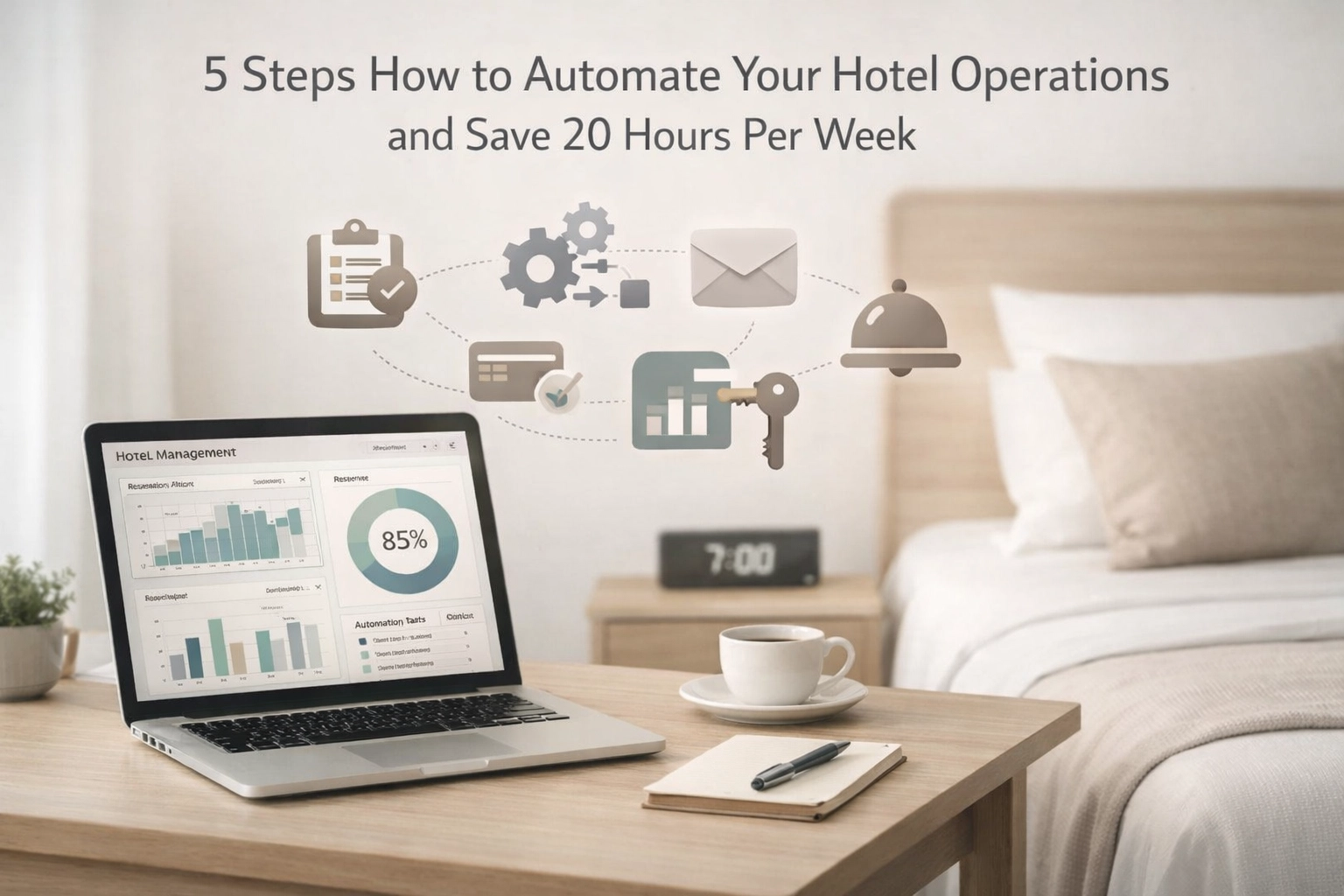
    Hotel front desk workspace with laptop displaying automation dashboard and scheduling tools

    These high-volume, structured tasks are your low-hanging fruit. They're time-consuming, error-prone, and perfect candidates for automation.

    Audit one week of operations. Track where your staff spends their time and note which tasks follow predictable patterns. Those patterns are automation opportunities. Focus on the activities that take the most time and happen most frequently: that's where you'll see the fastest ROI.

    Step 2: Get Your Team On Board

    Automation fails when staff don't buy in.

    Your team needs to understand that automation isn't a threat: it's a gift. It eliminates the boring stuff so they can spend more time with guests, solving real problems, and doing work that actually matters.

    Start the conversation early. Explain what you're planning to automate and why. Show them the hours they'll get back. Frame it as freeing them from repetitive tasks, not replacing their jobs.

    Then assign clear ownership. Who's responsible for managing the booking engine? Who oversees the automated guest communications? When everyone knows their role, adoption becomes smoother and accountability stays high.

    Provide hands-on training before launch. Let your team test the new systems, ask questions, and get comfortable with the tools. The more they understand how automation helps them, the more they'll embrace it.

    Step 3: Choose Tools That Actually Work Together

    Here's where most hotels mess up: they buy separate systems that don't talk to each other. You end up with a channel manager that doesn't sync with your PMS. A booking engine that requires manual data entry. Guest messaging tools that operate in isolation.

    That's not automation: that's chaos with more software.

    The right approach is to build your tech stack around a cloud-native hotel PMS that integrates everything. Your PMS should connect to:

    • Your channel manager to automatically update availability across all OTAs
    • Your booking engine for direct reservations that flow straight into your system
    • Guest communication tools for automated pre-arrival messages, check-in instructions, and post-stay follow-ups
    • Housekeeping systems that trigger cleaning assignments based on real-time occupancy
    • Payment processing to eliminate manual reconciliation

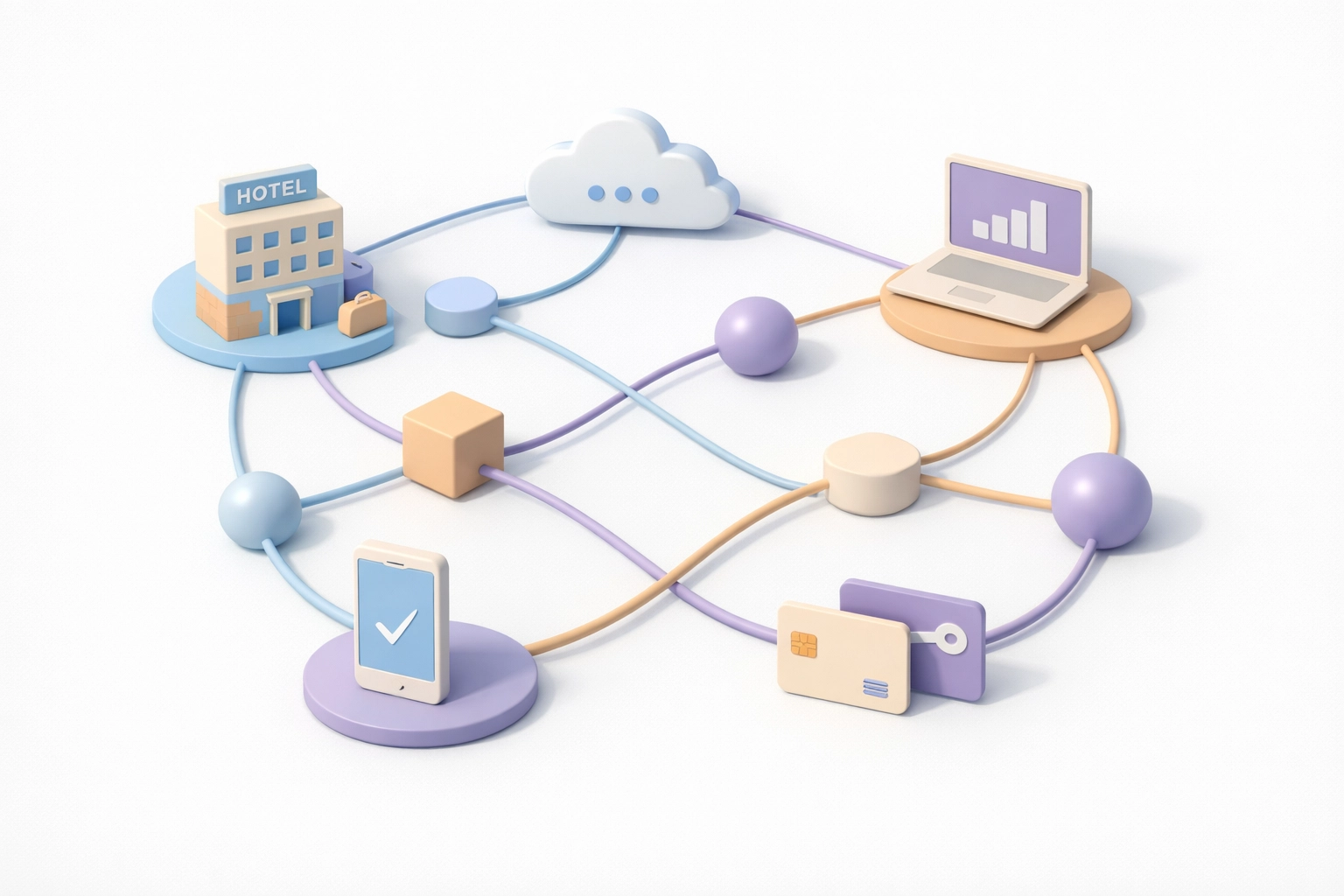
    Integrated hotel PMS system connecting booking engine, channel manager, and operations

    A cloud-native platform like Mews brings all these pieces together in one place. When your systems communicate automatically, you eliminate double-entry, reduce errors, and save hours every single day. Everything syncs in real-time: no manual updates required.

    Want to see how a truly integrated system works? Check out Mews here and discover what connected operations actually feel like.

    Step 4: Start Small and Expand Strategically

    Don't try to automate everything at once. That's a recipe for poor adoption and frustrated staff.

    Pick one or two high-impact processes to automate first. Front-desk operations are usually the best starting point because they're highly repetitive and consume the most staff time.

    Start with reservation management. Let your booking engine and channel manager automatically update availability across all platforms. No more logging into each OTA individually. No more double-bookings or manual corrections.

    Once that's running smoothly, expand to guest communications. Automate pre-arrival emails with check-in instructions. Set up automatic upsell messages for room upgrades or early check-in. Schedule post-stay review requests.

    Then move to housekeeping automation. Let your PMS automatically assign cleaning tasks based on check-outs and departures. Send mobile notifications to housekeeping staff so they know exactly which rooms need attention and when.

    Hotel housekeeping staff using mobile tablet for automated task management

    This phased approach gives your team time to adjust. It lets you catch issues early and make adjustments before they become bigger problems. And it builds confidence: once your staff sees automation working in one area, they'll be eager to expand it to others.

    Monitor everything closely during rollout. Track time savings, error rates, and guest satisfaction scores. Use those metrics to prove ROI and identify your next automation opportunity.

    Step 5: Optimize, Measure, and Scale

    Automation isn't set-it-and-forget-it. You need to continuously monitor performance and make adjustments.

    Set up dashboards in your PMS to track key metrics:

    • How much time are you saving on front-desk tasks?
    • Are automated messages improving guest satisfaction scores?
    • Is your channel manager reducing booking errors?
    • How many manual tasks have been eliminated?

    Review these metrics monthly. Look for patterns. If automated upsells aren't converting, tweak the messaging or timing. If housekeeping schedules still require manual intervention, adjust your triggers.

    As you establish success with initial automations, identify additional expansion opportunities. Maybe it's automating your inventory management. Or integrating self-check-in kiosks to eliminate front-desk bottlenecks entirely. Or deploying chatbots to handle routine guest inquiries 24/7.

    The key is to scale deliberately. Add new automations when your team is comfortable with existing ones. Maintain system stability while continuously improving efficiency.

    The 20-Hour Payoff

    Here's what 20 hours per week actually means for your hotel:

    • Your front desk handles more guests without adding headcount
    • Your housekeeping team works more efficiently with real-time task assignments
    • Your managers spend less time firefighting and more time on strategy
    • Your staff feels less burned out because they're not drowning in repetitive work
    • Your guests get faster, more accurate service

    That's the real benefit of automation. Not just time savings: though those are significant: but better operations across the board. Fewer errors. Happier staff. More satisfied guests.

    And it all starts with the right foundation: a cloud-native hotel PMS that brings your entire operation together.

    Modern hotels don't succeed by working harder. They succeed by working smarter. By automating the routine stuff so their teams can focus on what humans do best: creating exceptional guest experiences.

    The five steps are straightforward. Identify your biggest time drains. Get your team on board. Choose integrated tools. Start small. Optimize and scale.

    The hard part isn't knowing what to do: it's actually doing it. But the hotels that embrace automation are the ones saving 20 hours per week. Reducing errors. Improving guest satisfaction. And giving their teams the freedom to do meaningful work.

    Your competitors are already automating. The question is: will you lead or follow?

  • 7 Mistakes You’re Making with Business Automation Tools (and How to Fix Them)

    7 Mistakes You’re Making with Business Automation Tools (and How to Fix Them)

    You finally pulled the trigger on business automation tools.

    The promise was beautiful: less manual work, more time for strategy, workflows that run themselves while you sleep. You watched the demo, signed up for the trial, and felt that surge of excitement.

    But three months later?

    You're still drowning in tasks. Your team is confused. The tool that was supposed to save you 20 hours a week is… saving you maybe two. And you're wondering if you just wasted money on another overhyped solution.

    Here's the thing: Business automation tools aren't the problem. How you're using them is.

    Let's fix that. Here are the seven biggest mistakes small business owners make with ai business automation, and exactly how to turn things around.

    Mistake #1: You're Automating the Wrong Processes

    You automated your Instagram posting schedule. Cool.

    But you're still manually responding to every single lead inquiry, scheduling every client call by hand, and copy-pasting data between three different spreadsheets.

    The problem: You automated what was easy, not what was eating your time.

    Most business owners automate the tasks that feel good to check off, the visible, simple stuff. Meanwhile, the real time-vampires (lead qualification, follow-ups, data entry) keep sucking hours out of your week.

    The fix: Spend one week tracking where your time actually goes. Write down every repetitive task. Then ask yourself: "Which of these tasks happens most often and creates the biggest bottleneck?"

    That's what you automate first.

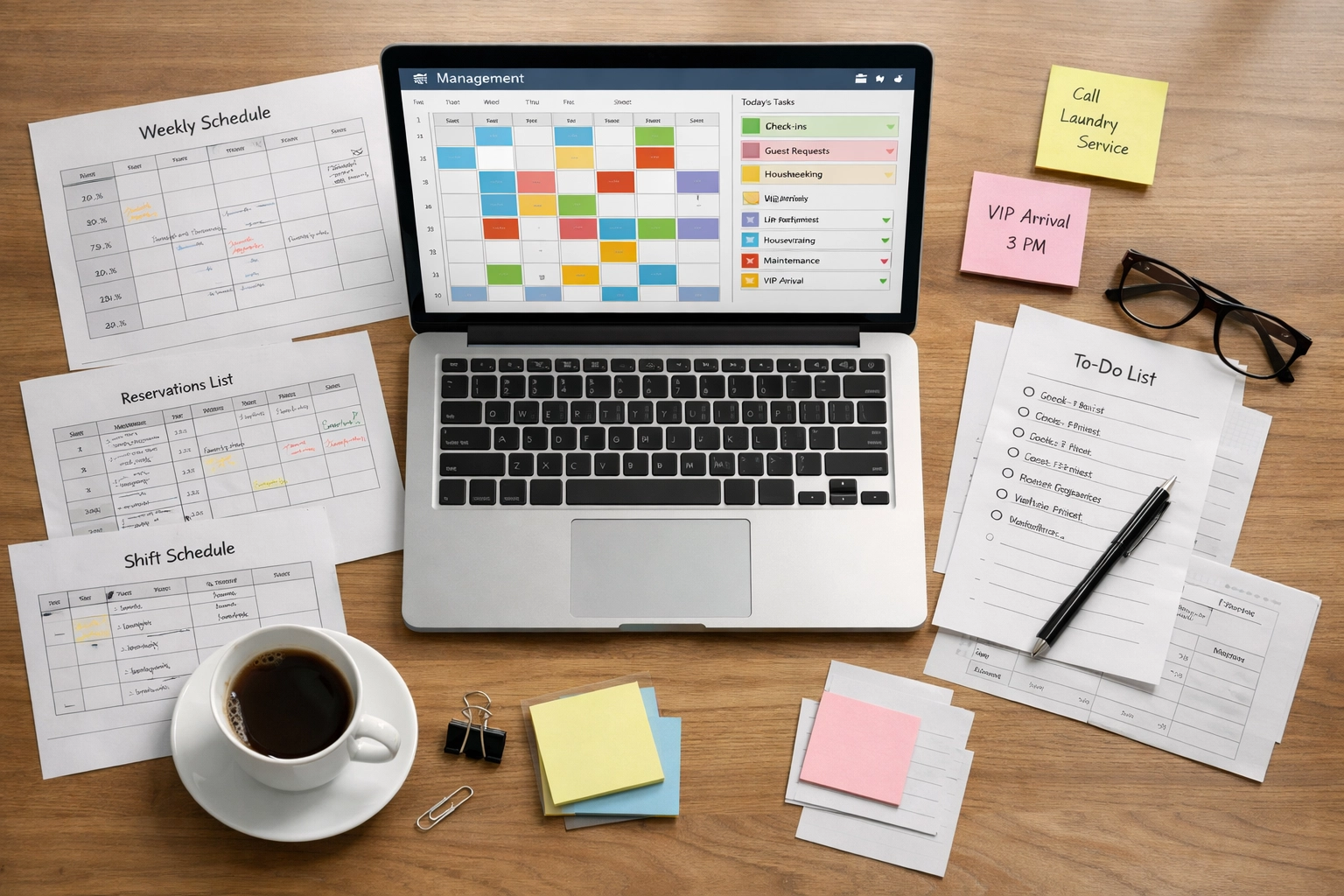
    Chaotic desk vs organized workspace showing business automation workflow prioritization

    Your Instagram captions can wait. Your lead response time can't.

    Mistake #2: You Automated a Broken Process

    Let's say your client onboarding is a mess. Seven different steps, three people involved, information gets lost, clients get confused.

    So you automated it.

    Congratulations, you just made your messy process happen faster. 🎉

    The problem: 38% of automation failures happen because businesses automate workflows that were never efficient to begin with. You can't fix dysfunction by speeding it up.

    The fix: Map out your current process on paper. Every single step. Then ask:

    • Which steps are redundant?
    • Where does information get lost?
    • What causes the most confusion?

    Optimize first. Automate second.

    Fix the leak before you turn up the water pressure.

    Mistake #3: You Tried to Automate Everything at Once

    You got excited. You wanted the full AI business automation experience, lead capture, email sequences, CRM updates, social media, customer support, invoicing, all of it.

    So you built one massive automation that touches every corner of your business.

    Now when something breaks… the entire thing breaks. And you have no idea where the problem is.

    The problem: Big, independent automations create silos. They're rigid, hard to troubleshoot, and nearly impossible to scale.

    The fix: Break big tasks into smaller components. Automate one piece at a time, test it, refine it, then move to the next.

    Start with lead capture. Get that dialed in. Then add email follow-up. Then CRM integration.

    Small wins compound. Giant automations collapse.

    Complex tangled workflow representing broken business automation processes

    Mistake #4: You Never Calculated the Real ROI

    You saw a shiny tool. It promised results. You bought it.

    But did you ever actually calculate whether it would save you more than it costs?

    The problem: Most small business owners adopt business automation tools because they're trending, not because they make financial sense. Then they're shocked when the monthly subscription feels like dead weight.

    The fix: Before you buy another tool, answer these questions:

    • What's the total cost (setup + monthly subscription + training time)?
    • How many hours will this actually save per week?
    • What's your time worth per hour?
    • Does the math work?

    If a tool costs $200/month but only saves you 2 hours a week (and your time is worth $50/hour), you're losing money.

    Do the math. Then decide.

    Mistake #5: You Didn't Bring Your Team Along

    You decided automation was the answer. You bought the tools. You set everything up.

    Then you announced it to your team.

    Now half of them are confused, the other half are resistant, and nobody's actually using it.

    The problem: Automation fails when employees feel like it's being done TO them, not WITH them. They don't see the value, so they quietly sabotage it by reverting to old methods.

    The fix: Involve your team from day one. Ask them:

    • What tasks do they hate doing?
    • Where do they feel stuck?
    • What would make their day easier?

    When employees help design the automation, they become champions of it. When you force it on them, they become obstacles.

    People support what they help create.

    Building blocks arranged incrementally showing step-by-step automation strategy

    Mistake #6: You Set It… and Forgot It

    Your automation is live. It's running. You checked it once, it worked, and you moved on.

    Six months later, you realize it's been sending the wrong email template to new leads. For half a year.

    The problem: 62% of organizations report declining ROI from automation within two years because nobody's monitoring performance. Automation isn't "set it and forget it", it's "set it and supervise it."

    The fix: Schedule monthly automation audits. Check:

    • Are workflows still triggering correctly?
    • Are response rates what you expected?
    • Has anything broken or changed?
    • Are there new bottlenecks forming?

    Automation drifts. Processes evolve. Business needs change.

    If you're not watching, you're not optimizing. And if you're not optimizing, you're wasting money.

    Mistake #7: You Ignored Your Data Quality

    Your CRM is a disaster. Duplicate contacts. Misspelled names. Outdated email addresses. Inconsistent formatting.

    Then you automated email campaigns using that data.

    Now you're sending "Hi {First_Name}" emails to people named "N/A" and wondering why your open rates are terrible.

    The problem: Automation multiplies whatever you feed it. Clean data becomes efficient workflows. Dirty data becomes embarrassing mistakes at scale.

    The fix: Before you automate anything, clean your data:

    • Delete duplicates
    • Standardize formatting (all caps vs. title case)
    • Validate email addresses
    • Fill in missing fields

    Then set up automated data validation to catch issues before they spread.

    Good automation runs on good data. There's no shortcut.

    Here's What Actually Works

    Look: business automation tools aren't magic. They're amplifiers.

    They amplify good processes and bad ones. They amplify clean data and messy data. They amplify thoughtful strategy… and careless mistakes.

    The businesses winning with ai business automation aren't the ones with the fanciest tools. They're the ones who:

    • Automate the right tasks (not just the easy ones)
    • Optimize before they automate
    • Start small and scale smart
    • Calculate real ROI
    • Bring their team along
    • Monitor and adjust constantly
    • Keep their data clean

    Do those things, and automation becomes your unfair advantage.

    Skip them, and you're just burning money faster.

    Ready to see how AI business automation should actually work? Check out how Marblism helps small businesses automate the right way: without the guesswork, without the headaches, and without wasting time on tools that don't deliver. See it in action here.

    Your future self (the one who's not manually responding to emails at 11 PM) will thank you.

  • The Hidden Costs of Cheap Coffee: Why Premium Beans Save You Money in the Long Run

    The Hidden Costs of Cheap Coffee: Why Premium Beans Save You Money in the Long Run

    When you're running a coffee shop, it's tempting to look at your wholesale coffee invoice and think "if I could just shave a few pounds off per kilo, imagine what that would do to my bottom line."

    We get it. Margins are tight, rent keeps climbing, and every penny counts.

    But here's the thing about cheap coffee that nobody tells you upfront: it costs you far more than you save. And we're not talking about some vague ethical argument here (though that matters too). We're talking about real, measurable costs that hit your bank account every single day.

    The Waste Factor You're Not Calculating

    Let's start with something most café owners don't track closely enough: waste.

    Cheap coffee beans are inconsistent. That's just how it works. When roasters are working with lower-grade greens: often mixing different origins, processing methods, and crop years to hit a price point: you end up with wildly variable beans in every bag.

    Comparison of cheap inconsistent coffee beans versus premium specialty coffee beans on café counter

    What does that mean for your baristas? They're constantly adjusting. Grind size gets tweaked multiple times per shift. Extraction times drift. Channeling happens more often. And every single dialled-in shot that suddenly pulls wrong? That's waste.

    We've seen cafés lose 15-20% more coffee through dialling-in and mistakes when using budget beans compared to consistent, premium single-origin or specialty blends. At 4kg of coffee per day, that's nearly an extra kilo wasted weekly. Over a year? That "cheap" coffee just cost you 50kg in pure waste.

    Do the maths on that and suddenly your savings don't look quite so appealing.

    The Hidden Cost of Unhappy Customers

    Here's something even more expensive than waste: customers who don't come back.

    When someone orders a flat white on Monday and it tastes completely different to the one they had on Friday, they notice. Maybe they don't say anything. Maybe they even come back once or twice more. But eventually, they find a café where the coffee tastes the same every single time, and you've lost them.

    Customer acquisition costs real money. Whether it's through social media marketing, loyalty programmes, or just the general overhead of running an inviting space, you're investing to get people through your door. Cheap, inconsistent coffee undermines all of that investment.

    Premium specialty coffee, on the other hand, gives you a fighting chance at consistency. When beans are freshly roasted, properly sourced, and quality-controlled, your baristas can dial them in once and maintain that profile for the life of the bag. Your customers get the same excellent cup every visit.

    That consistency builds trust. Trust builds loyalty. And loyalty is what keeps your café profitable in year three, not just month one.

    Barista Time Is Money

    Barista adjusting espresso grinder settings during morning rush hour at coffee shop

    Let's talk about labour costs for a moment.

    Your baristas are (hopefully) skilled professionals. You're paying them £11-14 per hour, maybe more if they're experienced. Every minute they spend fiddling with the grinder settings because the beans are behaving differently today is a minute they're not serving customers, cleaning equipment, or doing literally anything else productive.

    With consistent, high-quality beans, your team spends less time troubleshooting and more time doing what they do best: making beautiful coffee and connecting with customers. We've heard from dozens of café partners who've switched to premium specialty coffee from Limini and reported that their morning rush goes smoother, their baristas are less stressed, and their throughput actually increases.

    When you're slammed at 8am with a queue out the door, you cannot afford to have your barista wrestling with unpredictable coffee. That lost time translates directly to lost sales.

    The Yield Game

    Here's something the cheap coffee suppliers don't advertise: you get fewer cups per kilo.

    Premium, freshly roasted beans are denser, richer, and more potent. You actually use less coffee per shot because the extraction is more efficient. Cheap, stale, or lower-grade beans? You need to dose higher to get anything resembling a proper flavour profile.

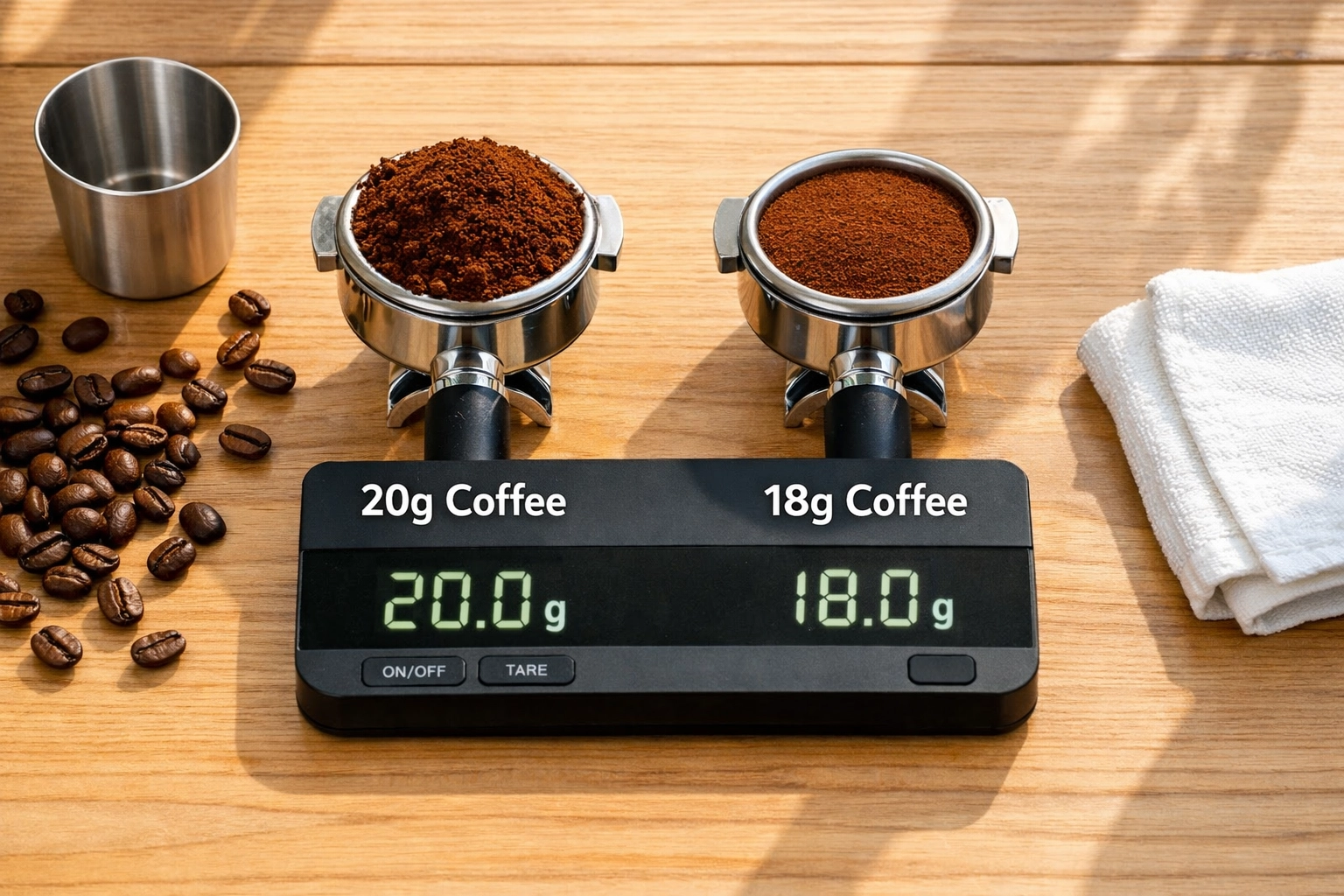
    We've seen cafés reduce their dose from 20g to 18g per double shot simply by switching to fresh specialty coffee. That's a 10% reduction in coffee used. On 4kg per day, that's 400g saved daily: an extra 146kg per year you're not buying.

    Suddenly those "expensive" beans are looking rather economical, aren't they?

    Professional barista pouring latte art with premium specialty coffee beans

    The Reputation Multiplier

    In 2026, people review everything. Your coffee doesn't exist in a vacuum: it exists on Google reviews, Instagram, TikTok, and in a thousand casual conversations between friends.

    Serve mediocre coffee and at best you get ignored. At worst you get roasted online (pun absolutely intended). Serve genuinely excellent coffee and people talk about it. They bring friends. They post about it. They become unpaid marketing agents for your business.

    Premium coffee gives you something worth talking about. You can tell customers about the origin, the processing method, the tasting notes. You can build a story around your coffee programme. Try doing that with commodity beans from a price-focused supplier who can't tell you where this month's blend even came from.

    The coffee shops that thrive in the specialty era aren't competing on price: they're competing on quality, consistency, and story. Cheap coffee leaves you with none of those advantages.

    Why Limini Coffee Is a Smarter Investment

    Look, we're biased. Of course we are. But here's why we believe Limini offers something genuinely different for wholesale partners.

    First, freshness. Our coffee is roasted to order and delivered within days. You're not getting beans that have been sitting in a warehouse for weeks. Fresh coffee is easier to dial in, tastes better, and stays consistent longer.

    Second, transparency. We can tell you exactly where your coffee comes from, how it was processed, and what to expect from it. That information matters when you're training staff and building trust with customers.

    Third, support. We're not just dropping off bags and disappearing. Need help with dialling in? Barista training? Equipment advice? We're here for it. Your success is our success, and we treat our wholesale relationships as genuine partnerships.

    You can explore our wholesale offerings here and see how we work with cafés across the UK to deliver consistent quality without the premium price tag that corporate roasters charge.

    Coffee portafilters showing 20g versus 18g dose comparison for better yield efficiency

    The Long-Term Calculation

    So let's bring this full circle with some real numbers.

    Say cheap coffee costs you £16 per kilo and premium specialty costs £22. That's a £6 difference. On 120kg per month, you're looking at an extra £720 per month, or £8,640 per year.

    Sounds like a lot. But now factor in:

    • 15% reduction in waste (saving you £2,304 per year at £16/kg)
    • 10% better yield (saving you another £2,304)
    • Reduced barista time troubleshooting (conservatively worth 30 minutes per day at £12/hour = £2,190 per year)
    • Customer retention improvements (nearly impossible to quantify, but even a 5% improvement in repeat visits is worth thousands)

    Suddenly that £8,640 investment is returning £6,798 in direct, measurable savings: and that's before we even account for the reputational and customer loyalty benefits that genuinely matter for long-term success.

    The question isn't whether you can afford premium coffee. The question is whether you can afford not to invest in it.

    Making the Switch

    If you've been using cheaper beans and wondering why your café isn't quite hitting its potential, maybe this is your sign to try something different.

    It doesn't have to be a massive leap. Start with a single blend, see how your team responds, track the results over a month. Talk to your baristas. Watch your waste. Listen to customer feedback.

    We think you'll notice the difference within the first week.

    At Limini, we're always happy to chat through your specific situation and find a coffee solution that works for your business model, your customers, and your budget. Because at the end of the day, we're not here to sell you the most expensive beans: we're here to help you build a successful, sustainable coffee business.

    And that starts with beans that deliver real value, not just a low price per kilo.

    Get in touch with our wholesale team and let's talk about what premium coffee can do for your café.

  • Stop Chasing Leads, Let AI Do the Legwork While You Sleep

    Stop Chasing Leads, Let AI Do the Legwork While You Sleep

    [HERO] Stop Chasing Leads, Let AI Do the Legwork While You Sleep

    It's 11:47 PM.

    You're still awake, scrolling through LinkedIn profiles. Researching. Qualifying. Copy-pasting into spreadsheets. Your eyes hurt. Your coffee's gone cold. And tomorrow, you'll wake up and do it all over again.

    Somewhere in the back of your mind, you know there's a lead you forgot to follow up with. Someone who visited your site three times last week. Someone who opened your email but never replied.

    They're gone now.

    This is what manual lead generation looks like in 2026 , and it's killing your growth.

    But what if I told you the entire process could run without you? While you're sleeping. While you're with your family. While you're doing literally anything else.

    THE 24/7 SHIFT

    Here's what most business owners don't realize: the best ai lead generation tool doesn't just save you time. It works when you don't.

    Traditional lead gen has office hours. AI doesn't.

    While you're offline, an intelligent system is scanning, identifying, and engaging prospects across multiple channels. It's responding to website visitors within seconds. It's scoring leads based on behavior patterns you'd never catch manually. It's nurturing relationships through personalized touchpoints.

    And it never gets tired.

    Manual lead generation chaos versus automated AI working overnight on lead qualification

    A DAY IN THE LIFE (WHEN AI DOES THE HEAVY LIFTING)

    Let me show you what this actually looks like.

    🌙 11:30 PM , You're Asleep

    Your AI lead generation system is wide awake.

    Someone in a different timezone just landed on your website. They're browsing your pricing page. Reading case studies. The AI chatbot notices the pattern and engages: "Looking for a solution that handles X? I can show you exactly how we do it."

    The visitor replies. The bot asks qualifying questions. Collects their email. Books a demo slot for next Tuesday. Adds them to your CRM with a lead score of 87 (high intent, great fit).

    You're dreaming about literally anything else.

    ☕ 7:00 AM , You Wake Up

    Your phone buzzes. Not with an alarm , with a notification.

    "5 new qualified leads overnight."

    You open your dashboard. Each lead has a complete profile: company size, pain points, budget signals, engagement history. One prospect even scheduled a call for this afternoon. Your AI already sent them a calendar invite and a personalized pre-call email.

    The chaos is gone before you even take your first sip of coffee.

    📊 9:15 AM , While You're In A Meeting

    Your business automation tools are doing what they do best: automating.

    The AI is scraping LinkedIn for prospects that match your ideal customer profile. It's enriching their data , job titles, company revenue, tech stack. It's cross-referencing with intent signals: Did they download a whitepaper? Visit a competitor's site? Post about a problem you solve?

    Every qualified prospect gets added to a nurture sequence. Personalized. Timely. Relevant.

    You're still in that meeting about Q2 goals. You haven't touched your keyboard once.

    Business owner checking qualified leads on smartphone dashboard generated by AI overnight

    🔍 2:00 PM , The Silent Qualifier

    Here's where traditional lead gen falls apart: qualification.

    You've probably wasted hours on calls with people who weren't ready to buy. Wrong budget. Wrong timeline. Wrong fit entirely.

    AI lead generation tools eliminate that waste.

    Through conversational interactions and behavioral analysis, the system identifies who's actually ready to convert. It's tracking engagement patterns: Are they visiting multiple pages? Returning to your site? Opening every email? That's a hot lead.

    Someone who bounced after 10 seconds? Cold. The system knows not to waste your sales team's time.

    By mid-afternoon, you have a pipeline full of prospects who've already been vetted. You're not chasing maybes anymore. You're closing deals.

    ☎️ 4:30 PM , The Follow-Up You'd Forget

    Remember that lead from three days ago who said "maybe next month"?

    You'd forget. The AI doesn't.

    At exactly the right moment , not too soon, not too late , it sends a personalized follow-up. No generic "just checking in" nonsense. It references their specific concern, shares a relevant case study, and offers a low-friction next step.

    The lead responds. They're ready to talk.

    You smile. You didn't lift a finger.

    HOW IT ACTUALLY WORKS (WITHOUT THE TECH JARGON)

    Let's get practical.

    Predictive Lead Scoring

    Your AI analyzes thousands of data points: past customer behavior, website activity, engagement patterns, market signals. It learns what a "good lead" looks like for your specific business.

    Then it automatically scores every new prospect. High scores go to your sales team immediately. Medium scores get nurtured. Low scores… well, they're not worth your time anyway.

    The system gets smarter with every interaction. It's constantly adjusting, learning, optimizing.

    Always-On Engagement

    The average response time for online inquiries is 42 hours. By then, the lead has already contacted three of your competitors.

    AI-powered chatbots respond in seconds. They're on your website, your social channels, even your email inbox. They answer questions, qualify prospects, and book meetings , all without making the interaction feel robotic.

    Because modern conversational AI doesn't sound like a bot anymore. It sounds human. It understands context. It adapts to tone.

    Your prospects get instant answers. You get qualified leads.

    AI lead generation network automatically qualifying and organizing business prospects

    Smart Automation Workflows

    This is where business automation tools truly shine.

    You set the rules once: "Find prospects in B2B SaaS with 50-200 employees who visited our pricing page twice in the last week." The AI builds the workflow, executes it continuously, and delivers results straight to your CRM.

    No more manual scraping. No more copy-paste. No more "I'll get to it tomorrow."

    The system runs 24/7, pulling leads from LinkedIn, industry databases, website traffic, and intent signals across the web.

    THE QUIET TRANSFORMATION

    Here's what changes when you stop chasing and start automating:

    Your mornings feel different. No panic. No scrambling. Just a steady flow of qualified prospects who've already been vetted.

    Your sales calls are shorter. Because the person on the other end is actually ready to buy. They've been educated, engaged, and warmed up by the time you talk.

    Your pipeline is predictable. You're not wondering where next month's revenue will come from. The system is feeding leads consistently, day after day.

    And you're sleeping through the night. Because you know the AI is awake, working, finding opportunities while you rest.

    THE PART THAT MATTERS MOST

    This isn't about replacing your sales team. It's about giving them superpowers.

    Imagine your best salesperson , the one who always follows up, never forgets a lead, and somehow knows exactly when to reach out. Now imagine they could clone themselves and work around the clock.

    That's what an ai lead generation tool does. It handles the repetitive, time-consuming parts so your humans can focus on the high-value stuff: building relationships, closing deals, growing accounts.

    The leads are qualified. The data is enriched. The timing is perfect. Your team just shows up and wins.

    Before and after comparison of manual lead generation versus automated AI workflow

    WHAT THIS LOOKS LIKE IN YOUR BUSINESS

    You wake up to opportunities, not tasks.

    You spend your day on strategy, not spreadsheets.

    You grow without grinding.

    The best part? You don't need a massive budget or a technical team to make this happen. Modern business automation tools are built for real businesses : the ones running lean, moving fast, and trying to compete with players ten times their size.

    You just need to stop doing it the old way.

    YOUR NEXT MOVE

    If you're still manually prospecting in 2026, you're not just working harder. You're actively losing to competitors who automated months ago.

    The gap is widening. Every day you wait is another day of missed opportunities.

    But here's the good news: you can flip the switch tonight. Set up your AI lead generation tool. Define your ideal prospect. Let the system start working while you sleep.

    By this time tomorrow, you'll have a pipeline full of qualified leads you didn't have to chase.

    Want to see exactly how this works for your business? Check out how Marblism handles lead generation automatically : no more late nights, no more cold leads slipping through the cracks.

    The leads are out there right now.

    The only question is: will you find them, or will your AI?