Author: admin

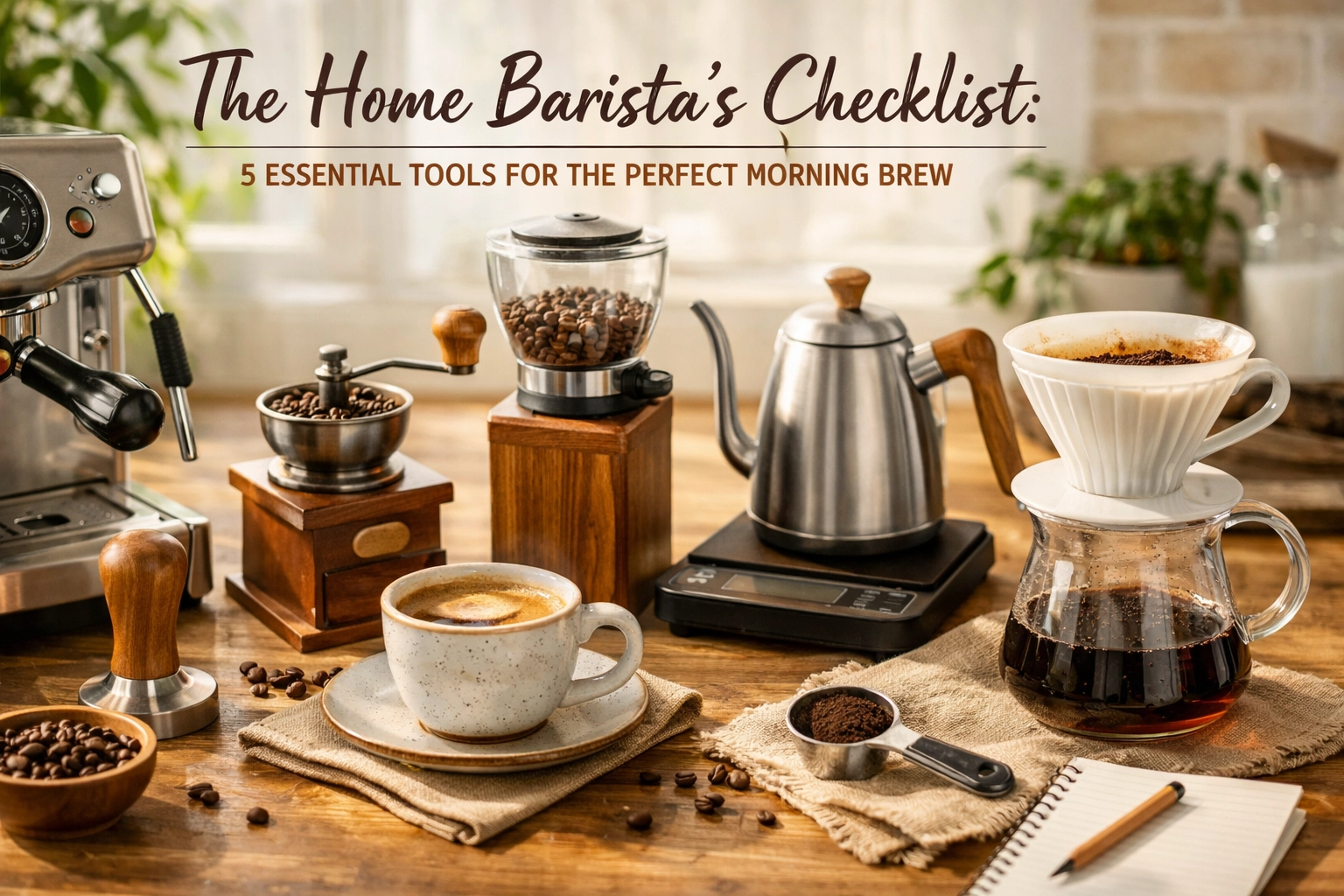
  • The Home Barista’s Checklist: 5 Essential Tools for the Perfect Morning Brew

    The Home Barista’s Checklist: 5 Essential Tools for the Perfect Morning Brew

    Look, we get it. Walking into a specialty coffee shop and seeing rows of equipment can be intimidating. There's the grinder making that satisfying whirr, the scales measuring to the tenth of a gram, the barista wielding a gooseneck kettle like a conductor's baton.

    But here's the thing: creating exceptional coffee at home doesn't require a commercial setup or a second mortgage. What it does require is understanding which tools actually make a difference to your daily brew.

    So let's cut through the noise. We've spent years working with home brewers and professional baristas alike, and we can tell you with absolute certainty that these five tools will transform your morning routine from "meh" to magnificent.

    1. A Quality Burr Grinder (This Is Non-Negotiable)

    If you're going to invest in one thing, and we mean just one, make it a burr grinder.

    Why? Because coffee starts losing its flavour the moment you grind it. Those pre-ground bags at the supermarket? They were ground weeks or even months ago. By the time they reach your cup, most of the aromatics and nuanced flavours have already escaped.
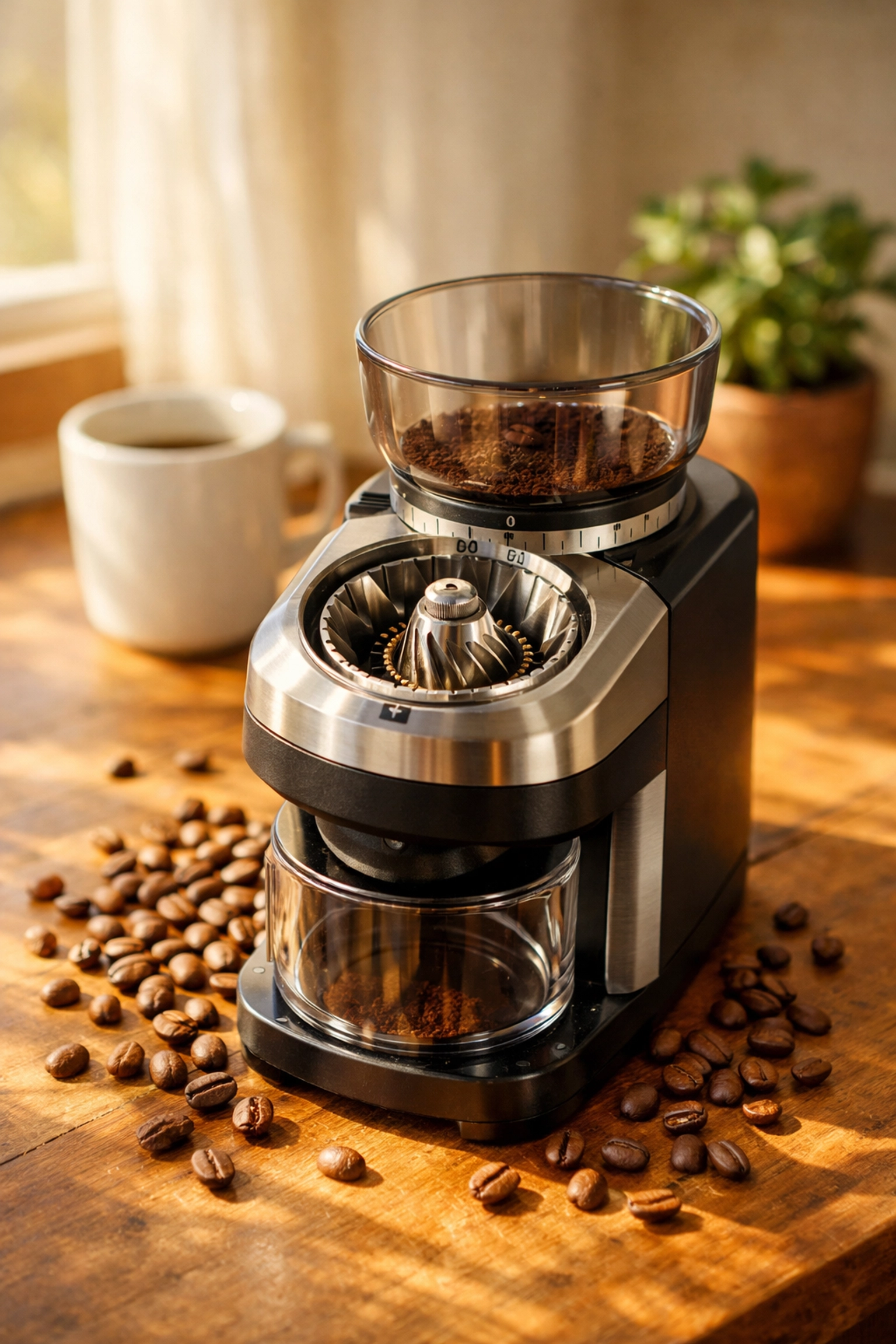
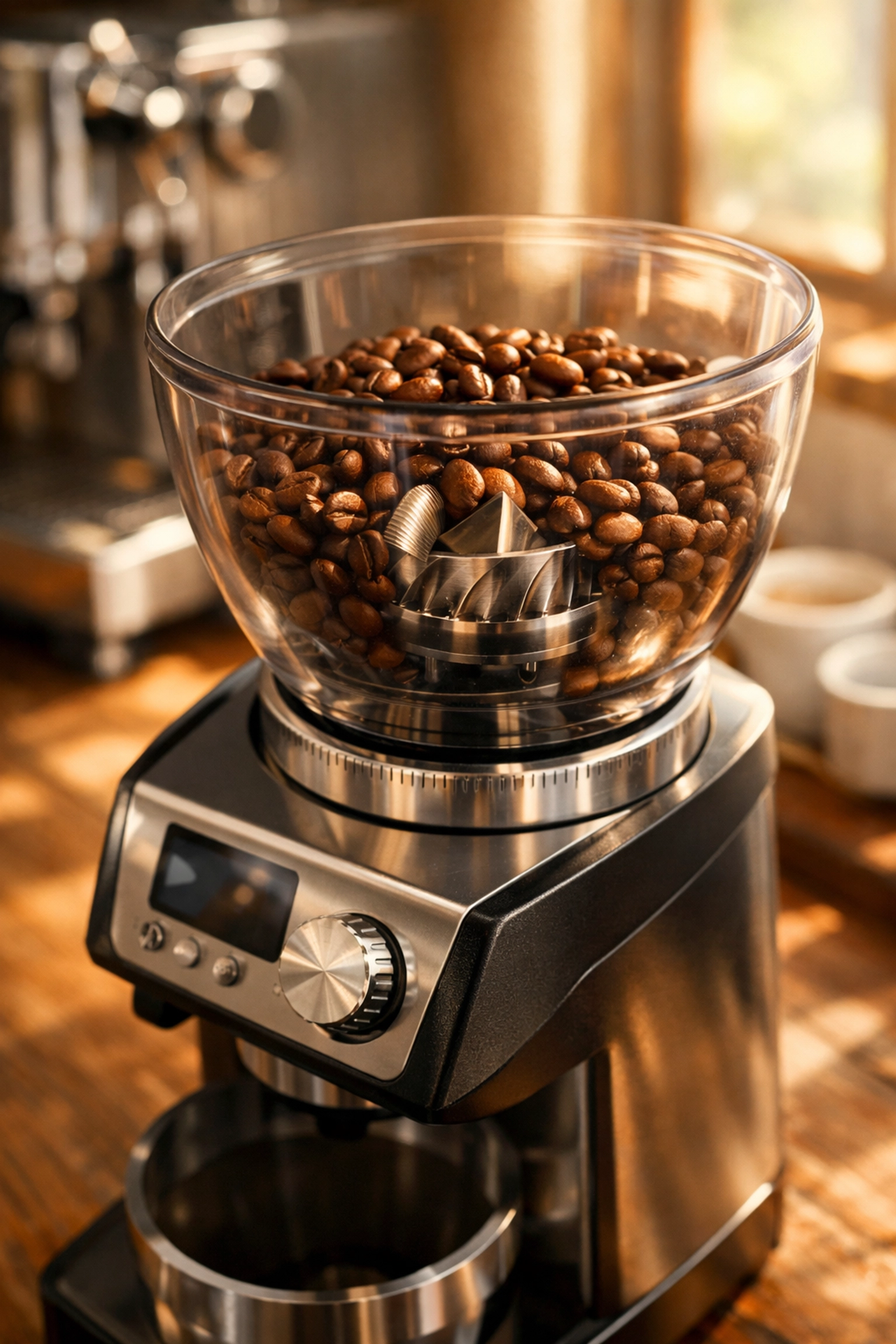
    Quality burr coffee grinder with whole beans on wooden counter for home brewing

    A burr grinder gives you freshly ground coffee every single time, which means you're capturing all those volatile compounds that make specialty coffee so brilliant. But here's where it gets important: not all grinders are created equal.

    Blade grinders, the ones that look like miniature food processors, are cheap, but they produce wildly inconsistent particle sizes. You end up with boulders and dust in the same batch, which leads to uneven extraction. Some of your coffee is over-extracted and bitter, while other bits are under-extracted and sour.

    Burr grinders, on the other hand, crush coffee beans between two abrasive surfaces (the burrs) to create uniform particle sizes. This consistency is absolutely crucial for repeatable, delicious coffee. Whether you're brewing espresso, V60, or French press, a burr grinder will give you the control you need.

    We recommend starting with a manual burr grinder if budget is a concern (they're surprisingly affordable), or investing in an electric burr grinder if you're brewing for multiple people daily. Either way, you'll taste the difference immediately.

    2. Digital Scales (Your Secret Weapon for Consistency)

    Want to know the difference between home brewers who make occasionally good coffee and those who nail it every single time?

    Scales.

    Seriously. A digital scale is perhaps the most underrated tool in home brewing. It costs less than a couple of bags of beans, but it transforms your coffee game entirely.
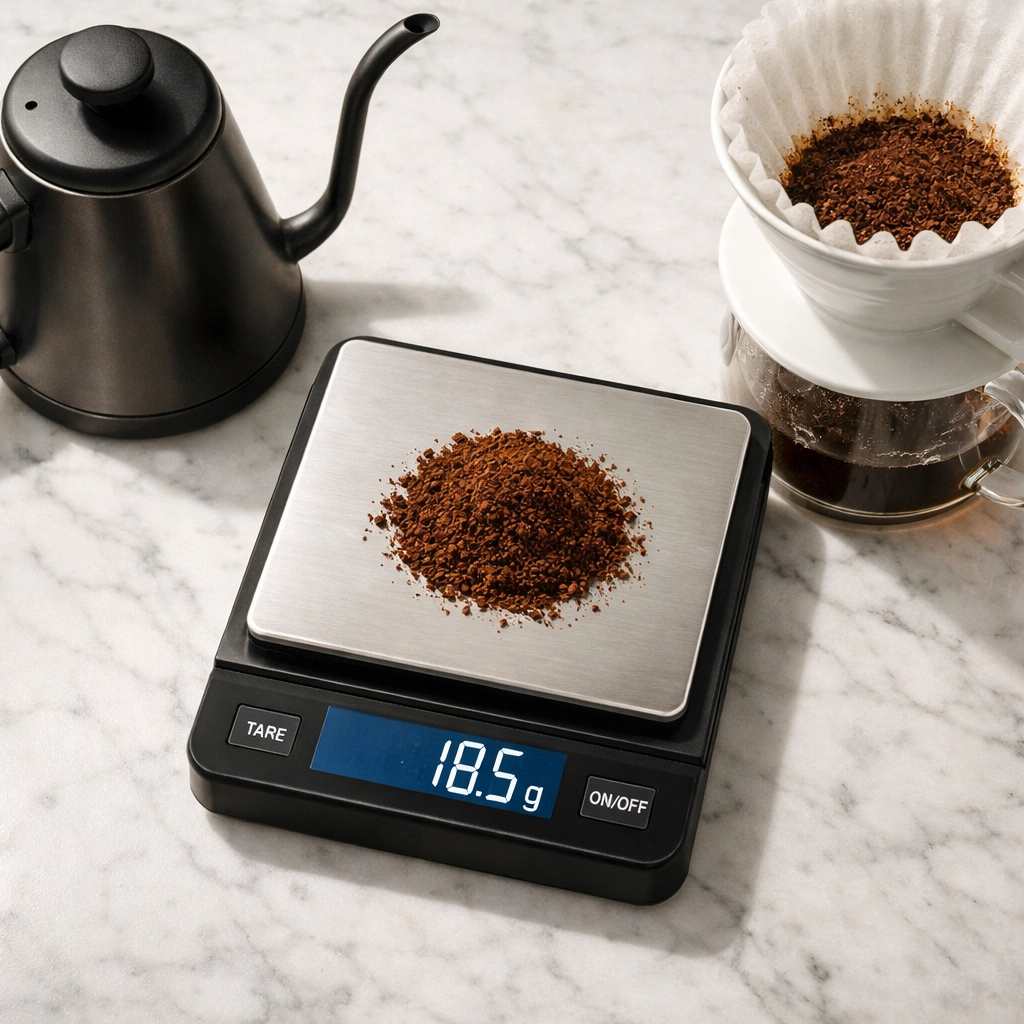
    Digital scales measuring ground coffee for precise home barista brewing ratios

    Here's why: coffee brewing is fundamentally about ratios. The ratio of coffee to water determines the strength and flavour of your cup. Measuring by scoops or eyeballing it might work some days, but you'll never achieve consistency. And consistency is what turns a morning routine into a reliable ritual.

    With a scale, you can measure both your coffee dose and your water precisely. Most home brewers use a ratio somewhere between 1:15 and 1:17 (that's 1 gram of coffee to 15-17 grams of water). Once you dial in your perfect ratio, you can recreate that same delicious cup every morning.

    Look for a scale that measures to 0.1g accuracy and has a timer function. The timer is brilliant for pour-over methods where you want to control your brewing time. Bonus points if it's water-resistant, coffee brewing can get splashy.

    Pro tip: weigh your water rather than measuring with a jug. Water doesn't always measure accurately in volume, but weight never lies.

    3. A Gooseneck Kettle (Precision Meets Elegance)

    If you're brewing with a pour-over method like V60 or Chemex, a gooseneck kettle isn't just nice to have, it's essential.

    The long, curved spout gives you complete control over your pour rate and placement. This matters more than you might think. When you're blooming your grounds or executing a controlled pour, you need to be able to direct water exactly where you want it, at the flow rate you want.

    A regular kettle with a wide spout? That's like trying to draw with a paintbrush the size of a broom. Sure, you'll get water on the coffee, but you'll have zero finesse.

    With a gooseneck kettle, you can pour slowly and steadily, saturating all your grounds evenly. This leads to better extraction and, ultimately, a more balanced cup.

    Many gooseneck kettles now come with built-in thermometers or variable temperature settings, which is brilliant for dialing in your brew temperature. Different coffees and brewing methods work best at different temperatures (generally between 88°C and 96°C), and having that control available is genuinely useful.

    Even if you're using an AeroPress or French press, a gooseneck kettle makes pouring easier and more elegant. There's something quietly satisfying about the ritual of a controlled pour.

    4. A Reliable Brewer (Find Your Favorite)

    Now we're getting to the fun part: choosing your brewing method.

    The beauty here is that there's no single "best" brewer: it depends entirely on what kind of coffee you enjoy and how much time you want to spend on the process. We think every home setup should have at least one reliable brewer that matches your lifestyle.

    V60: This is the darling of the pour-over world. It's simple, affordable, and capable of producing absolutely stunning cups of coffee when you nail the technique. The conical shape and spiral ribs promote even extraction, and you have complete control over every variable. It does require practice and attention, but that's part of the appeal. The ritual becomes meditative.

    AeroPress: If you want versatility and convenience, the AeroPress is tough to beat. It's forgiving, quick (total brew time under 2 minutes), and virtually indestructible. You can experiment with different techniques: standard, inverted, cold brew: and it travels brilliantly. We've seen baristas use AeroPress to make everything from espresso-style concentrates to clean, tea-like brews.

    French Press: The classic. If you prefer a fuller-bodied coffee with more oils and texture, French press is your friend. It's dead simple to use, requires zero paper filters, and makes multiple cups at once. The immersion brewing method is very forgiving, making it ideal for lazy weekend mornings.

    Chemex: For those who appreciate design as much as flavour, the Chemex offers both. The thick paper filters produce an exceptionally clean cup, and it looks gorgeous on your counter. Great for brewing larger quantities when you have guests.

    Pick one that matches your morning vibe. You can always add more brewing methods to your arsenal later: many of us have a small collection because different coffees shine with different brewing methods.

    5. Fresh, Specialty Coffee Beans (This Is Where the Magic Happens)

    Here's the truth that no amount of fancy equipment can overcome: if your beans are stale or low-quality, your coffee will be disappointing. Full stop.

    All those tools we've just discussed? They're designed to extract and highlight the flavours that already exist in your beans. If those beans are old, poorly roasted, or made from low-quality coffee, there's nothing to highlight.

    This is where specialty coffee from roasters like Limini makes all the difference.

    Fresh roasted specialty coffee beans spilling from bag onto wooden surface

    Specialty coffee means beans that have been carefully sourced, expertly roasted, and delivered fresh. We're talking about coffee that was roasted days or weeks ago, not months. When you open a bag of freshly roasted specialty beans, the aroma alone will tell you you're dealing with something special.

    Freshly roasted beans are alive with flavour compounds: fruity, chocolatey, floral, nutty notes that change and develop over the first few weeks after roasting. This is what you're paying for when you choose specialty coffee, and honestly, it's transformative.

    At Limini Coffee, we source our beans carefully and roast them in small batches to ensure they're at their peak when they reach you. Whether you're brewing a bright, fruity Ethiopian natural or a rich, chocolatey Brazilian, fresh beans from a quality roaster will elevate every cup.

    Store your beans properly too: in an airtight container, away from light and heat. Don't freeze them (despite what your uncle insists), and buy in quantities you'll use within 3-4 weeks of roasting.

    Bringing It All Together

    So there you have it: the five essential tools that will genuinely transform your home brewing game.

    Start with the burr grinder and scales: these two alone will make the biggest immediate impact on your coffee quality. Add a gooseneck kettle when you're ready to explore pour-over methods, choose a brewer that matches your lifestyle, and most importantly, source fresh specialty beans from roasters who care about quality.

    The beauty of building your home barista setup gradually is that you learn as you go. Each tool teaches you something new about coffee and how different variables affect the final cup. Before long, you'll be brewing coffee that rivals your favorite café: and you'll understand exactly why it tastes so good.

    That's the real magic. It's not just about the tools; it's about the knowledge and confidence that comes with using them consistently. And honestly? That's what makes the morning ritual so satisfying.
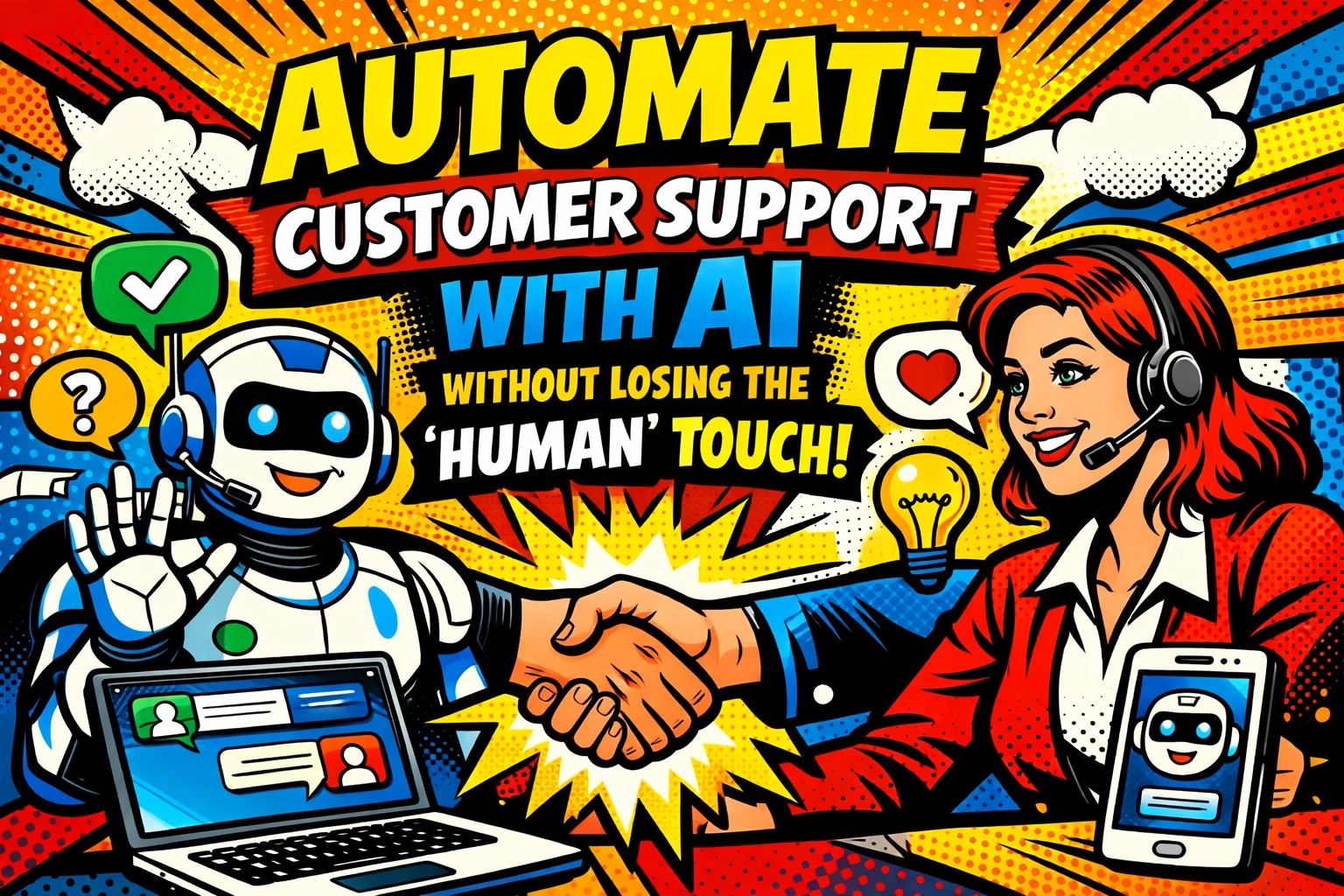

  • Automate Customer Support with AI Without Losing the ‘Human’ Touch

    Automate Customer Support with AI Without Losing the ‘Human’ Touch

    You know the nightmare, right?

    A customer reaches out with a problem. They're frustrated. Maybe a little angry. And instead of getting help, they're stuck talking to a chatbot that keeps repeating "I don't understand" like some kind of digital broken record.

    Your brand? It feels cold. Robotic. Soulless.

    And the worst part… that's YOUR business they're getting frustrated with.

    This is why you've been putting off automation. You've built your reputation on actually giving a damn about your customers. On knowing their names. On remembering that Sarah always orders the blue one, and that James needs his invoices by the 15th.

    But you're also drowning.

    Every morning starts with 47 support tickets. Every evening ends with you answering "Where's my order?" emails at 11 PM. And somewhere in between, you're supposed to actually… grow your business?

    Here's what you need to know: automation doesn't have to mean losing your soul.

    THE ROBOT TRAP (AND WHY MOST BUSINESSES FALL INTO IT)

    Let me paint you a picture of what bad automation looks like.

    Customer: "Hi, I received the wrong item in my order."

    Bot: "Thank you for contacting us! I can help with order tracking, returns, or product information. Please select one."

    Customer: "I need to return this and get the right item."

    Bot: "I don't understand. Please rephrase your question."

    Customer: leaves a 1-star review

    You've seen this. You've probably BEEN this customer.

    Frustrated customer with robotic AI responses vs happy customer with helpful support

    The problem isn't automation itself , it's treating AI like it's supposed to replace human judgment completely. It's the "set it and forget it" approach where every single customer interaction gets funneled through the same rigid script, regardless of context or complexity.

    Research shows that while 80% of routine queries can be handled by AI, trying to automate EVERYTHING is where businesses tank their customer satisfaction scores.

    Your customers don't hate talking to AI. They hate talking to STUPID AI that doesn't know when to step aside.

    WHAT YOUR CUSTOMERS ACTUALLY WANT

    Here's the thing , your customers don't care whether they're talking to a human or an AI.

    They care about getting their problem solved. Fast. Without having to repeat themselves seven times.

    Think about your last great customer service experience. Was it great because a human answered? Or was it great because someone (or something) understood your problem immediately, had all your information ready, and solved it in under two minutes?

    Yeah.

    Your customers want:

    • Quick answers to simple questions (not a three-day email chain about a tracking number)
    • A real person when things get complicated or emotional
    • To feel like you actually remember them and their history with your business

    The sweet spot? AI handles the routine. Humans handle the relationship.

    THE MARBLISM WAY: SMART ESCALATION, NOT STUPID AUTOMATION

    9:00 AM , A customer emails about a refund

    Your AI agent (let's call her Eva) reads the email. She checks the order history. Sees it's a straightforward return within your 30-day policy. She processes the refund, sends a warm confirmation email with your return label, and marks the ticket resolved.

    Time spent: 90 seconds.
    Customer satisfaction: High.
    Your involvement: Zero.

    10:30 AM , A different customer emails about a refund

    This one's trickier. They're outside the return window, but they're also a repeat customer who's spent £2,000 with you over the past year. The product arrived damaged, and they're clearly upset.

    Eva reads the situation. Recognizes this needs a human touch. Automatically escalates it to you , but here's the magic: she sends you a complete summary. Order history. Customer lifetime value. Previous interactions. The whole context.

    You hop in, read Eva's summary in 30 seconds, and make the call to extend an exception. You write a personal note. The customer feels heard. Problem solved.

    Time YOU spent: 3 minutes.
    Customer satisfaction: Through the roof.
    Your sanity: Intact.

    AI assistant and human support agent working together on customer tickets

    This is smart escalation. The AI doesn't try to be everything , it knows its lane. It handles what it can handle brilliantly. And when it can't? It passes the baton to you with all the context you need to be the hero.

    YOUR AI SUPPORT TEAM KNOWS WHEN TO SHUT UP

    The companies crushing customer support automation right now aren't using AI to replace empathy , they're using it to CREATE MORE SPACE for empathy.

    H&M uses this exact approach. Their AI resolves 80% of basic queries (tracking, sizing, returns). The other 20%? Straight to humans who now have time to actually solve complex problems instead of answering "Where's my package?" for the hundredth time.

    Your Marblism AI agents learn your brand voice. They study your previous customer interactions. They understand the difference between:

    "Hey, my order hasn't shipped yet" → Eva handles it

    "I'm really disappointed with this purchase and considering returning everything" → Eva brings you in

    It's not magic. It's just intelligent routing based on complexity, emotion, and customer value.

    THE REAL SECRET: AI AS YOUR COPILOT, NOT YOUR REPLACEMENT

    🤝 Here's what changes when you automate the RIGHT way:

    Your AI agent becomes your real-time assistant. A customer writes in with a complaint. Before you even open the ticket, the AI has:

    • Pulled their complete order history
    • Identified they're a VIP customer
    • Summarized their previous three interactions
    • Suggested three possible solutions based on similar cases
    • Drafted a response in your voice (that you can edit or send as-is)

    You're not spending 10 minutes digging through records and trying to remember who this person is. You're spending 2 minutes making the actual decision and adding your personal touch.

    Lyft did this with their customer support and saw an 87% drop in resolution time. Not because they removed humans , because they removed all the tedious information-gathering that bogs humans down.

    Your customers get faster responses. Your team (or you) focuses on the complex stuff. Everyone wins.

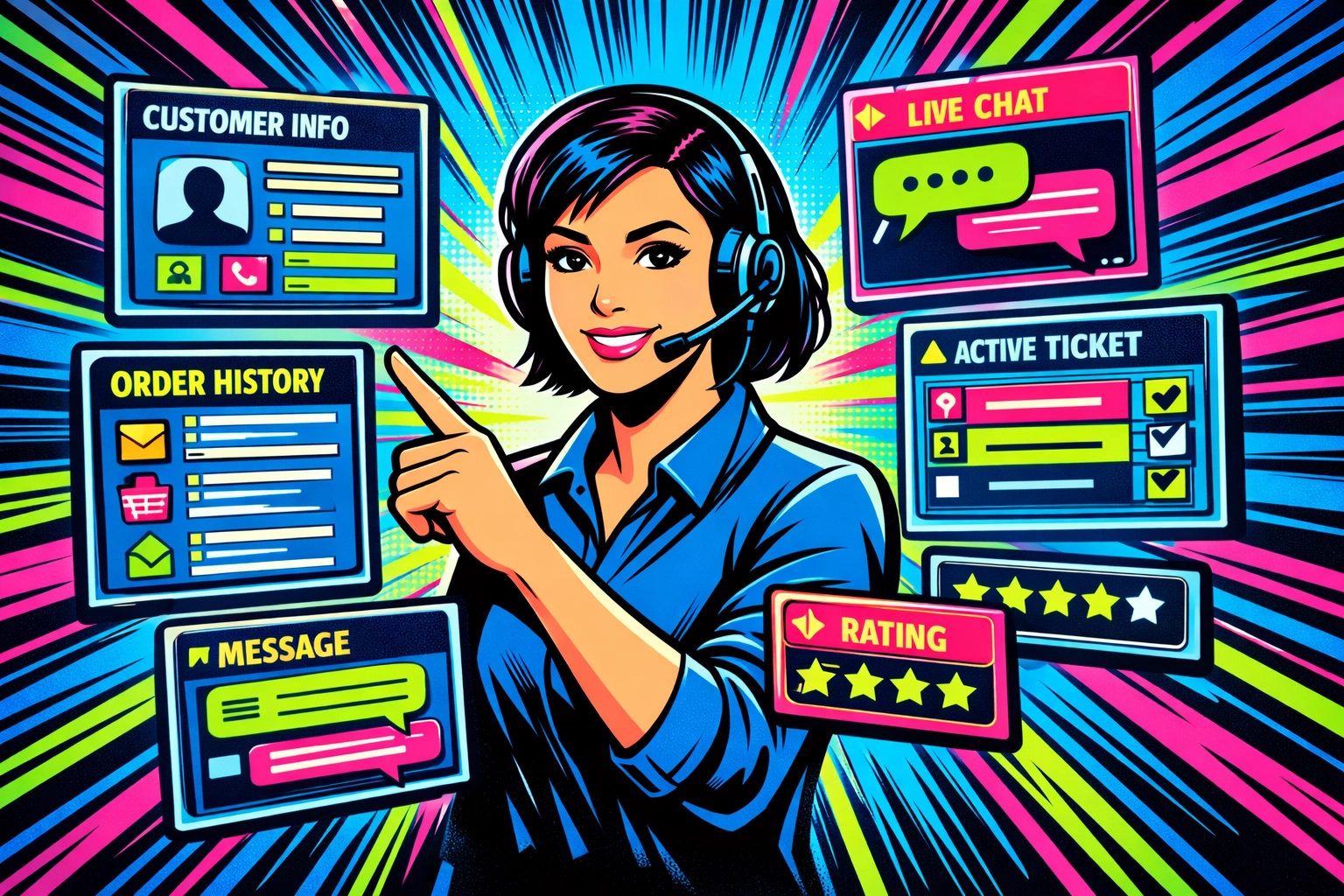
    Customer service agent using AI to access customer history and order data

    PERSONALIZATION AT SCALE (WITHOUT THE CREEPY ROBOT VIBES)

    Remember Sarah who always orders the blue one?

    Your AI remembers too.

    When Sarah emails asking about restocking, your AI agent doesn't send a generic "we'll restock soon" message. It sends: "Hi Sarah! We know you love the blue version , great news, we're getting more in stock next Tuesday. Want me to reserve one for you?"

    Same automation. Different feeling entirely.

    Natural language processing means your AI understands intent and context. It's not keyword matching. It's actually reading between the lines. And because it has access to your entire customer database, it can personalize at a scale that would be physically impossible for you to do manually.

    The customer doesn't feel like Ticket #4,872. They feel like Sarah.

    PROACTIVE SUPPORT (BEFORE THEY EVEN ASK)

    📱 The ultimate move? Solving problems before your customers know they have them.

    Your AI notices a customer's subscription is about to lapse. Sends a friendly reminder two days early.

    It sees a pattern of failed login attempts. Proactively sends a password reset link.

    It detects a shipping delay on an order. Reaches out first with an update and a discount code for the inconvenience.

    This isn't being creepy , it's being attentive. Your customers don't have to chase you down. You're already three steps ahead.

    And here's what's wild: companies using predictive support like this report customers feeling MORE cared for, not less. Because you're demonstrating you're paying attention without them having to demand it.

    THE RESULTS SPEAK FOR THEMSELVES

    Businesses using smart automation report:

    • 37% faster response times on average
    • 20-40% reduction in ticket volume (because AI deflects repetitive questions)
    • Higher customer satisfaction scores (because humans only handle what humans do best)
    • Support teams that actually enjoy their jobs again

    One small business owner told us: "I was terrified automation would make us feel corporate. Instead, I finally have TIME to be personal with the customers who need it most."

    That's the difference.

    YOUR CUSTOMERS WON'T KNOW (AND WON'T CARE)

    Here's what they'll notice:

    • You respond faster
    • You seem to remember everything about them
    • Complex issues get solved without endless back-and-forth
    • They rarely have to explain themselves twice

    They won't know Eva handled their tracking inquiry. They won't know the AI drafted the first version of your thoughtful response. They won't know predictive support flagged their account issue.

    They'll just think: "Damn, these guys really have their act together."

    And isn't that exactly the reputation you've been killing yourself to maintain?

    READY TO AUTOMATE WITHOUT LOSING YOUR SOUL?

    The choice isn't between drowning in support tickets or becoming a faceless robot business.

    There's a third option: intelligent automation that amplifies your humanity instead of replacing it.

    Marblism gives you AI agents that handle the noise so you can focus on the notes that matter. Smart escalation. Real-time support. Your brand voice, just working 24/7.

    See exactly how it works for your business : check it out here and watch your support transform without losing what makes you, you.

    Because the future of customer support isn't choosing between human or AI.

    It's using both exactly where they belong.

  • Grinder Secrets: Why Your Home Setup Needs a Professional Coffee Grinder

    Grinder Secrets: Why Your Home Setup Needs a Professional Coffee Grinder

    Here's a truth that might sting a little: if you've invested in a fancy espresso machine or a beautiful pour-over setup but you're still using that blade grinder you got as a gift five years ago, you're doing it wrong.

    We know, we know. Grinders don't have the same sexy appeal as a gleaming espresso machine. They're not the Instagram star of your coffee corner. But here's the thing: your grinder is actually the most important piece of equipment in your entire setup. Not your machine. Not your kettle. Your grinder.

    Let us explain why.

    The Grinder Matters More Than Your Brewer

    You could have a £3,000 espresso machine sitting on your counter, but if you're grinding your beans inconsistently, you're still going to pull mediocre shots. An exceptional grinder can actually compensate for a less expensive espresso machine or brewing device. But the reverse? Not true.

    Even the most expensive, temperature-stable, PID-controlled espresso machine cannot produce a decent shot if your grinder is churning out inconsistent particle sizes.

    Professional burr coffee grinder with whole beans in hopper on home coffee station countertop

    So what's happening here? It comes down to extraction. When you brew coffee, you're extracting soluble compounds from ground beans. The size and uniformity of those ground particles directly determine how evenly water can extract flavor. If your grind is all over the place: some dust, some boulders, everything in between: you get uneven extraction.

    The tiny particles over-extract and turn bitter. The large chunks barely extract any flavor at all. What you end up with is a muddled, confused cup that's simultaneously sour and bitter. Not ideal.

    Why Blade Grinders Are Sabotaging Your Coffee

    Let's talk about blade grinders for a moment. You know the ones: they look like a little food processor, with a spinning blade that chops your beans into submission.

    They're cheap. They're compact. And they're absolutely ruining your coffee.

    Blade grinders don't actually grind coffee: they chop it. Randomly. Violently. With no regard for consistency whatsoever. You get powder mixed with chunks, and there's no way to control the outcome. You just hold down the button and hope for the best.

    Plus, that spinning blade generates heat, which can actually start cooking your coffee before you even brew it. The result? Flat, stale-tasting coffee that lost its nuance somewhere between the bean and the cup.

    What Makes a Professional Grinder Different

    Professional-grade grinders: or prosumer grinders designed for home use: use burrs instead of blades. There are two revolving burrs (either flat or conical) that crush the beans evenly between them, creating uniform particle sizes.

    This is where the magic happens.

    Comparison of inconsistent blade grinder grounds versus uniform burr grinder coffee particles

    Consistency and Uniformity

    Burr grinders deliver remarkably consistent particle sizes. Whether you're going for a coarse grind for French press or a fine grind for espresso, the burrs ensure that every particle is roughly the same size. This means even extraction, balanced flavor, and a cup that actually tastes like the coffee you paid for.

    Manual burr grinders use hand-cranked burrs and generate virtually no heat during grinding, which preserves the delicate aromatics and oils in your beans. They're brilliant for pour-over, AeroPress, or French press methods where you have a bit more time and want maximum control.

    Electric burr grinders do the same job at the push of a button. They're essential if you're pulling espresso shots, where grind precision can make or break your extraction.

    Precision Control

    A quality grinder gives you granular control over your grind size. We're talking dozens: sometimes hundreds: of adjustment settings. The Baratza Vario, for example, offers 230 easily repeatable grind settings with both macro and micro adjustments. That's the kind of precision that rivals what you'd find in a commercial café.

    Why does this matter? Because different brewing methods require different grind sizes. Espresso needs a fine, almost powdery consistency. Pour-over sits somewhere in the middle. French press wants a coarse, chunky grind. If you can't dial in your grind size precisely, you're guessing. And guessing rarely leads to great coffee.

    The Real-World Benefits You'll Actually Notice

    Let's get practical. What does investing in a professional grinder actually do for your daily coffee routine?

    Better Flavor, Immediately

    This is the big one. The first time you brew coffee with freshly, evenly ground beans from a quality burr grinder, you'll taste the difference. It's not subtle. You'll notice clarity, sweetness, and complexity that simply wasn't there before. Those tasting notes on the bag that seemed like marketing nonsense? You'll actually start tasting them.

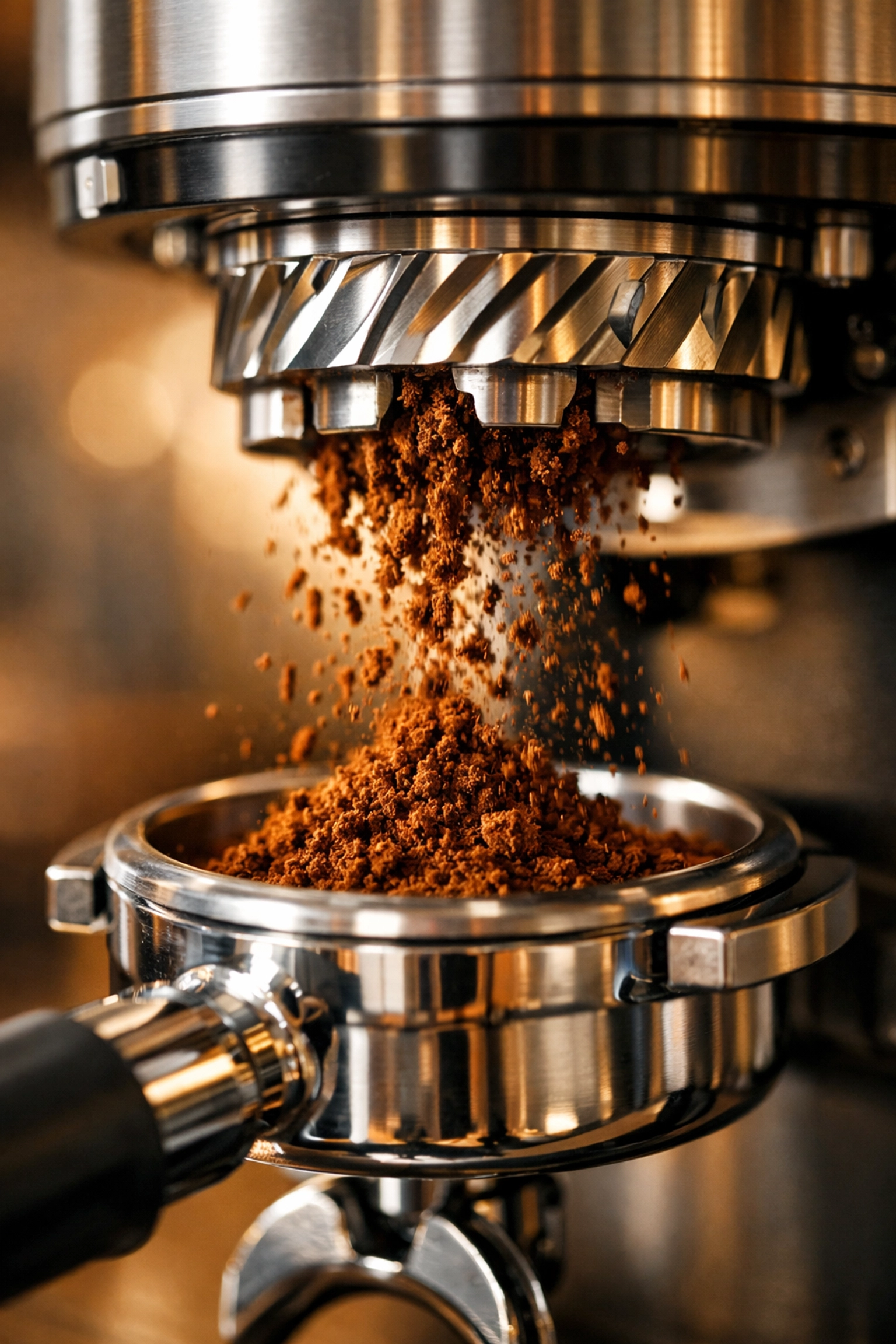
    Close-up of burr grinder mechanism grinding fresh coffee beans into portafilter

    Faster, Fresher Results

    Electric burr grinders are fast. You dose your beans, press a button, and within seconds you have a perfectly consistent grind ready to brew. No more shaking a blade grinder for 30 seconds hoping you've hit the right consistency.

    Some advanced grinders even weigh as they grind, eliminating the need for a separate scale. They'll dose to within 0.1 grams, which is the kind of accuracy that serious home baristas dream about.

    Consistency, Day After Day

    Once you dial in your grind setting for a particular coffee and brewing method, you can return to it again and again. This repeatability means you're not starting from scratch every morning. You know exactly where to set your grinder, and you get the same excellent results every single time.

    That's the kind of convenience that makes investing in a professional grinder worth it.

    It's About Respecting Your Beans

    Here's something we think about a lot: specialty coffee doesn't just happen. It's the result of farmers, processors, exporters, and roasters all doing their jobs exceptionally well. Those beans have traveled thousands of miles and passed through dozens of hands before landing in your kitchen.

    If you're buying freshly roasted, traceable specialty coffee: say, from Limini Coffee: you're already investing in quality. You're supporting better farming practices, better roasting, and ultimately better flavor.

    But if you grind those beautiful beans in a blade grinder, you're undoing all of that work. You're taking a meticulously crafted product and obliterating it into inconsistent dust.

    A professional grinder respects your beans. It treats them with the care they deserve and unlocks the flavors that the roaster worked so hard to develop.

    What to Look For

    So you're sold on the idea. What should you actually look for in a professional-grade home grinder?

    Burr Type: Flat burrs or conical burrs both work brilliantly. Flat burrs tend to produce slightly more uniform particles, while conical burrs generate less heat and are often quieter. Both will absolutely transform your coffee compared to a blade grinder.

    Grind Settings: Look for a grinder with stepless or micro-adjustable settings. The more control you have, the better you can dial in each coffee and brewing method.

    Grind Retention: This is how much coffee gets stuck inside the grinder after grinding. Low retention is ideal: it means less waste and fresher grounds every time.

    Build Quality: A grinder is an investment. Look for metal burrs, solid construction, and a motor that can handle daily use without overheating or wearing out.

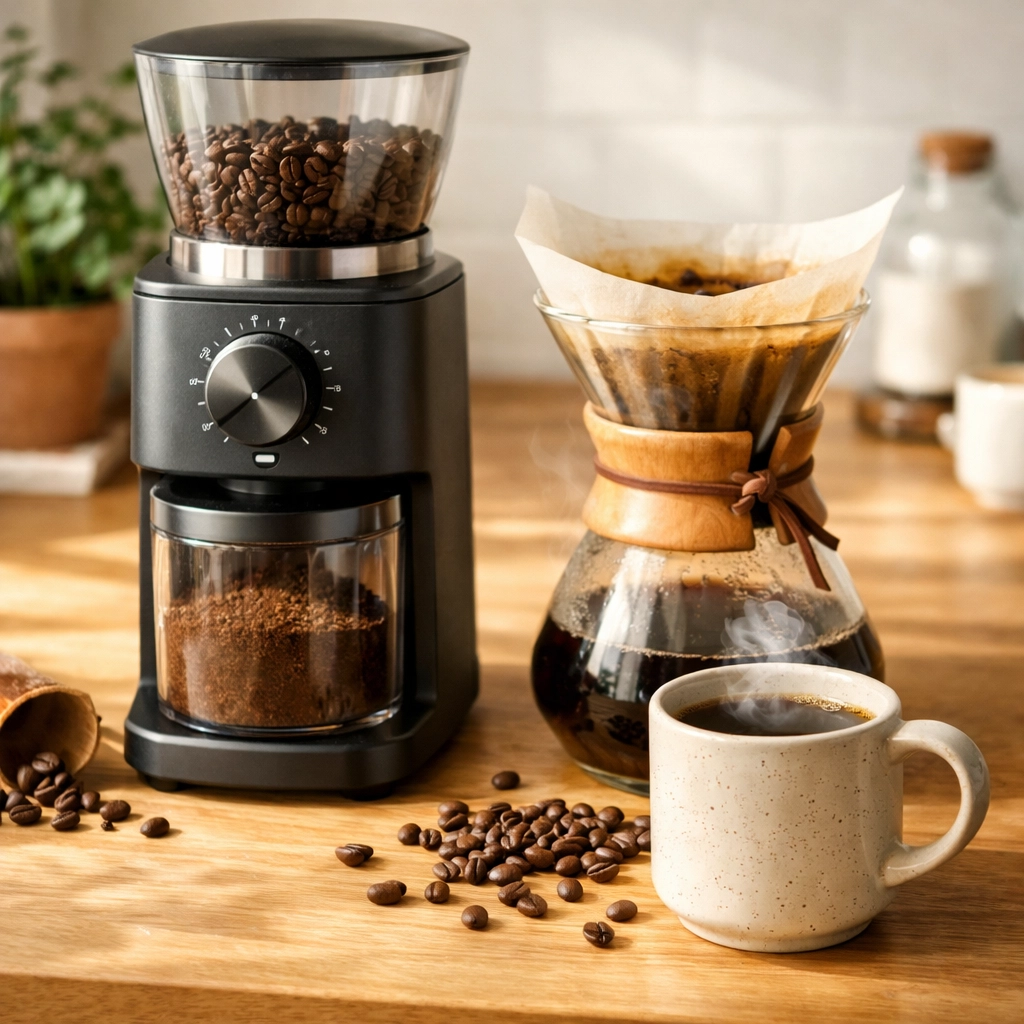
    Home coffee brewing setup with professional grinder and pour-over equipment on kitchen counter

    Ease of Cleaning: Coffee oils and fines build up inside grinders over time, which can affect flavor. Choose a grinder that's easy to disassemble and clean periodically.

    The Investment That Changes Everything

    We get it: professional grinders aren't cheap. You're looking at anywhere from £150 to £600+ depending on features and build quality. That's a significant investment.

    But here's the thing: your grinder will outlast most other pieces of coffee equipment. A well-maintained burr grinder can serve you for a decade or more. And unlike an espresso machine, which might be overkill if you prefer pour-over or AeroPress, a quality grinder benefits every single brewing method.

    It's the one piece of equipment that universally improves your coffee, no matter how you brew it.

    And honestly? Once you experience what freshly ground, consistently sized coffee tastes like, there's no going back. You'll wonder how you ever tolerated anything less.

    Start With the Grinder

    If you're building a home coffee setup from scratch, or you're looking to upgrade what you already have, start with the grinder. Not the machine. Not the kettle. The grinder.

    Pair that grinder with freshly roasted beans from a reputable roaster, and you're 90% of the way to café-quality coffee at home. Everything else is just refinement.

    Your coffee deserves better than a blade grinder. And so do you.

  • How to Automate Your Hotel Operations in 5 Minutes (Cloud-Native Magic)

    How to Automate Your Hotel Operations in 5 Minutes (Cloud-Native Magic)

    You've heard the promises before. "Automate everything!" "Go paperless overnight!" "Transform your operations!"

    Here's the truth: you can start automating your hotel in about 5 minutes. But that doesn't mean flipping a switch and walking away. It means choosing the right cloud-native hotel PMS, one that's actually designed for automation from the ground up.

    Let's talk about what that really looks like.

    What Cloud-Native Actually Means (And Why It Matters)

    Cloud-native isn't just software that lives in the cloud. It's an entirely different architecture.

    Traditional hotel management systems were built for on-premise servers. They're clunky. They require IT teams. They break when you need them most. Cloud-native platforms like Mews are built specifically for the cloud, meaning they're designed to be fast, flexible, and ridiculously easy to use.

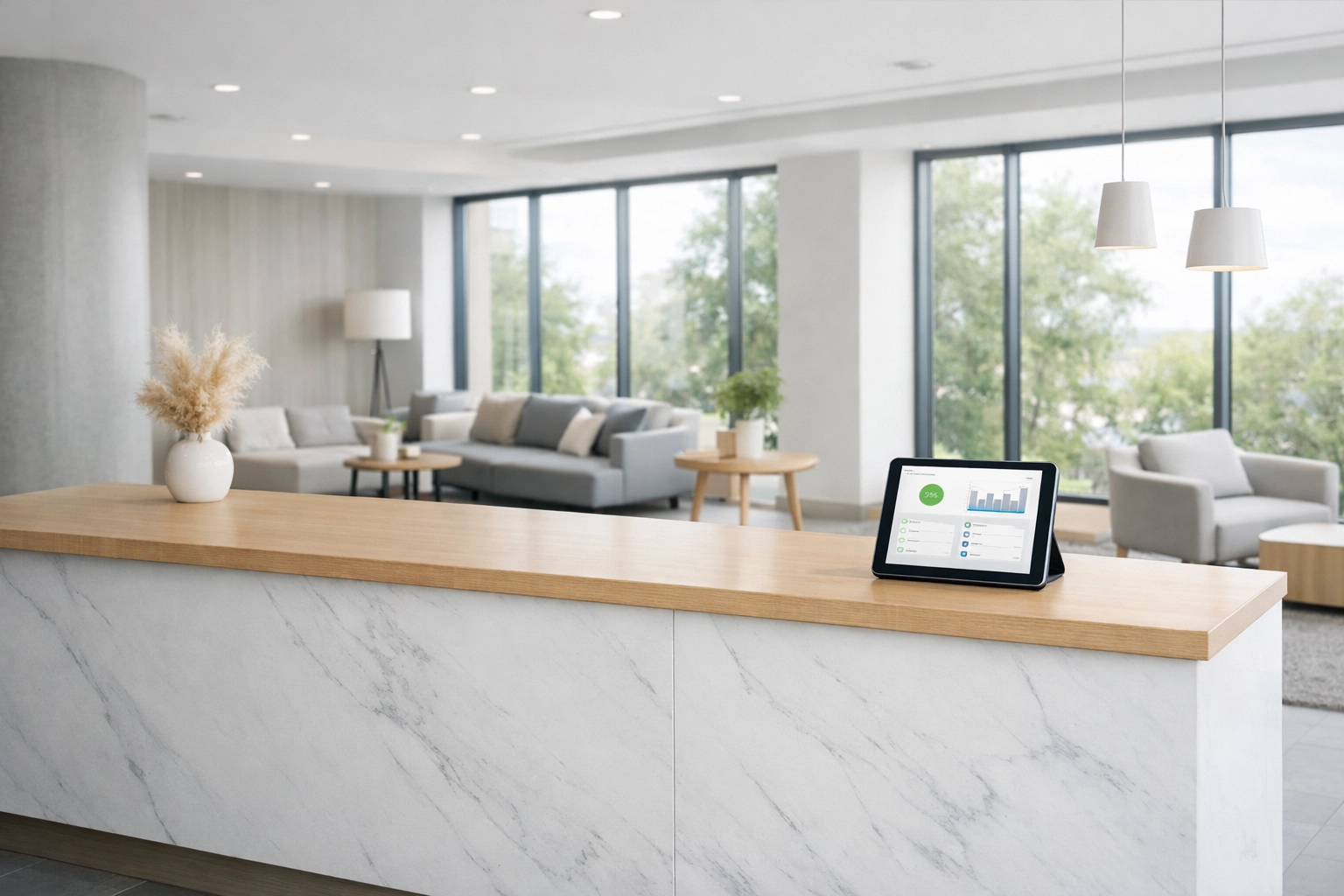
    Modern hotel lobby with cloud-native PMS tablet at reception desk

    Here's what that gives you:

    Instant access from anywhere. Desktop. Mobile. Tablet. Your staff can check someone in from the lobby or the pool bar. No VPN required.

    Automatic updates. No downtime. No maintenance windows. You wake up to new features without lifting a finger.

    Zero IT headaches. No servers to manage. No security patches to install. No expensive infrastructure investments. Just a subscription and you're operational.

    That's the foundation. Now let's talk about the automation magic that sits on top.

    The 5-Minute Setup (Seriously)

    When we say 5 minutes, here's what we mean: you can start automating key operations almost immediately after choosing a modern hotel PMS.

    Step 1: Connect your booking engine. Direct bookings flow straight into your system: no manual entry, no duplicate records.

    Step 2: Sync your channel manager. Rates and availability update automatically across OTAs. No more double bookings or rate parity nightmares.

    Step 3: Activate automated emails. Confirmation. Pre-arrival. Check-out. Review requests. All triggered based on guest journey touchpoints.

    Step 4: Enable self-check-in kiosks. Guests bypass the front desk entirely if they want. Your team handles the humans who need attention.

    Step 5: Turn on housekeeping automation. Room status updates in real-time. Staff get assignments on their phones. No more walkie-talkies or paper lists.

    Does it take longer to customize everything perfectly? Sure. But the core automation framework? That's live in minutes.

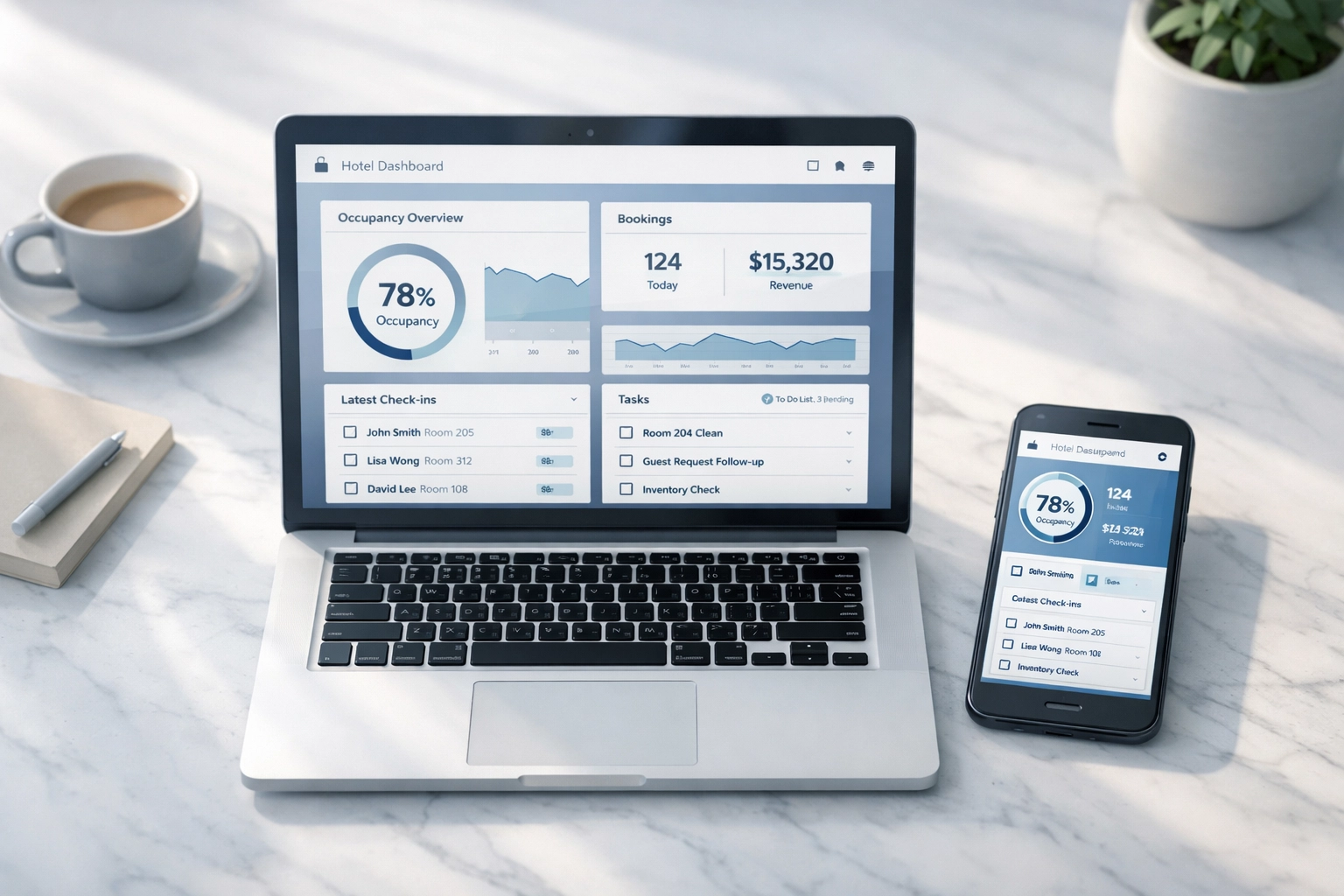
    Hotel management dashboard on laptop and smartphone showing automation features

    What Gets Automated (And What It Means For Your Team)

    Let's break down the heavy hitters: the operations that eat up hours every single day.

    Reservations and Channel Management

    Your booking engine talks to your channel manager. Your channel manager talks to your PMS. Rates update everywhere, instantly. You adjust pricing once, and it flows to Booking.com, Expedia, your website: everywhere.

    No more logging into six different platforms to update availability. No more panic when someone books the same room twice because your rate wasn't synced.

    Guest Communication and CRM

    Automated emails go out at the right moments. But here's where it gets interesting: your CRM tracks every interaction. Guest preferences. Past stays. Special requests. All in one place.

    Your team sees this data instantly. They know Mrs. Johnson hates feather pillows before she even arrives. That's not magic. That's automation meeting smart data management.

    Hotel housekeeper using smartphone for automated room status updates

    Housekeeping and Maintenance

    Housekeepers update room status from their phones. Front desk sees it live. No radio calls. No guessing. A guest checks out at 10:47 AM? Housekeeping knows by 10:48.

    Maintenance issues get flagged immediately. A broken shower in room 302 doesn't slip through the cracks because someone forgot to write it down.

    Revenue Management

    Dynamic pricing isn't just for airlines anymore. Cloud-native revenue management tools analyze demand, competitor rates, and your historical data: then adjust pricing automatically.

    You set the parameters. The system optimizes. You make more money without constantly monitoring 12 different dashboards.

    Payment Processing and Billing

    Payments happen automatically. Pre-authorizations. Charges for room service. Final checkout. All without manual credit card terminals or paper receipts (unless someone really wants one).

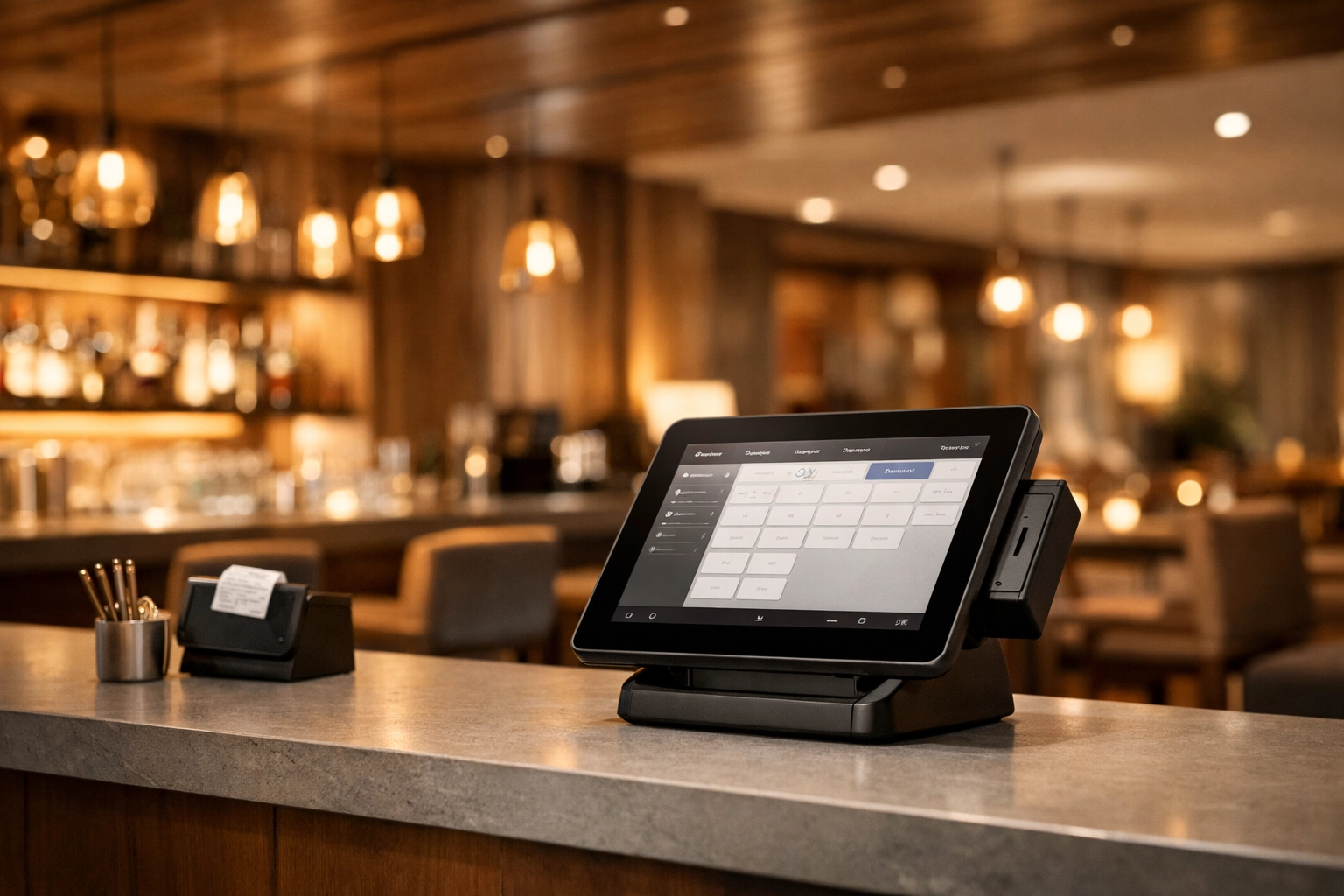
    Your POS system at the restaurant? It talks to your hotel PMS. That cocktail at the bar shows up on the guest's room bill without anyone typing anything.

    The Real Benefits (Beyond "It's Faster")

    Let's get specific. Properties using modern, automated systems see measurable improvements:

    85% reduction in manual data entry. Your team stops being data processors and starts being hospitality professionals.

    40% faster check-in times. Guests don't wait. Your front desk doesn't feel like a bottleneck during peak arrivals.

    30% increase in direct bookings. When your booking engine is seamlessly connected, guests actually use it. Fewer OTA commissions. More profit per booking.

    Real-time reporting. No more end-of-month surprises. You see revenue, occupancy, and performance data as it happens.

    Clean hotel room interior showcasing automated hospitality operations

    One hotel manager told us: "I used to spend 10 hours a week just reconciling bookings and fixing errors. Now I spend that time training my team and talking to guests."

    That's the point. Automation doesn't replace people. It frees them to do the work that actually matters: the human stuff that makes hotels special.

    What About Implementation?

    Here's where most hotel tech fails. You buy the system. Then you spend six months trying to get it working. Training sessions. Migration headaches. Consultants charging by the hour.

    Cloud-native platforms flip that script. Because everything's already integrated, because there's no on-premise installation, because the interface is actually intuitive: implementation happens in days, not months.

    You'll spend time configuring preferences and customizing workflows. But you're operational fast. You're seeing benefits almost immediately. Not "eventually, once we figure this out."

    The Mews Difference

    We believe hotel technology should work for you: not the other way around. That's why Mews is built cloud-native from day one.

    Everything connects. Booking engine. Channel manager. CRM. Self-check-in kiosks. Payment processing. It's one platform, not 17 different tools held together with duct tape and hope.

    And automation? It's baked into every feature. You don't need to be a tech wizard to make it work. You just need to want your operations to run smoother.

    Modern hotel restaurant with automated POS system on counter

    Over 5,000 properties use Mews to automate operations, reduce manual work, and actually focus on guests. From boutique hotels to large chains. From London to Sydney. They're all running leaner, faster, and smarter.

    Getting Started Is The Hard Part (Except It's Not)

    Most hotels put off upgrading their tech because it feels overwhelming. "We'll do it next year." "After the busy season." "When we have more time."

    But here's the thing: staying with outdated systems costs you every single day. Lost bookings. Wasted staff hours. Guest frustration. That adds up way faster than any implementation timeline.

    With a cloud-native hotel PMS, you can literally start seeing benefits within days. Connect your existing tools. Turn on automation. Train your team on an interface that actually makes sense.

    Is it perfect on day one? No. But it's better than what you're doing now: and it gets better every week as you fine-tune it.

    Start Automating Today

    Five minutes might sound like marketing hype. But when you choose the right platform, that's genuinely how fast you can start seeing automation kick in.

    Check out Mews and see what modern hotel operations actually look like. Cloud-native. Automated. Built for hospitality professionals who want to spend less time on admin and more time on what actually matters.

    Your operations won't transform overnight. But they'll transform. And that transformation starts with one decision: choosing a platform that's designed for automation, not retrofitted with it.

    The magic isn't in the software. It's in what the software lets your team do.

  • How to Automate Your Morning Admin Tasks in 5 Minutes (Before Your First Coffee)

    How to Automate Your Morning Admin Tasks in 5 Minutes (Before Your First Coffee)

    You open your laptop.

    Before you've even tasted your coffee, you're staring at 47 unread emails. Three meeting requests that conflict with each other. A Slack thread with 89 messages. Someone needs last month's report… which is buried somewhere in Google Drive.

    It's 7:15 AM.

    You haven't even started your actual work yet.

    THE MORNING TAX YOU PAY EVERY DAY

    Most small business owners spend the first 90 minutes of their day doing the same repetitive tasks. Sorting emails. Updating calendars. Moving tasks around. Responding to the same questions you answered yesterday.

    It's called "morning admin", and it's quietly stealing your most productive hours.

    By the time you actually get to real work, you're already exhausted. Your best thinking hours? Gone. Spent on digital housekeeping that could've been automated while you slept.

    But here's what nobody tells you…

    You don't need a complicated system to fix this. You don't need to spend three hours watching YouTube tutorials or hire a VA.

    You need five minutes. And maybe not even your first cup of coffee.

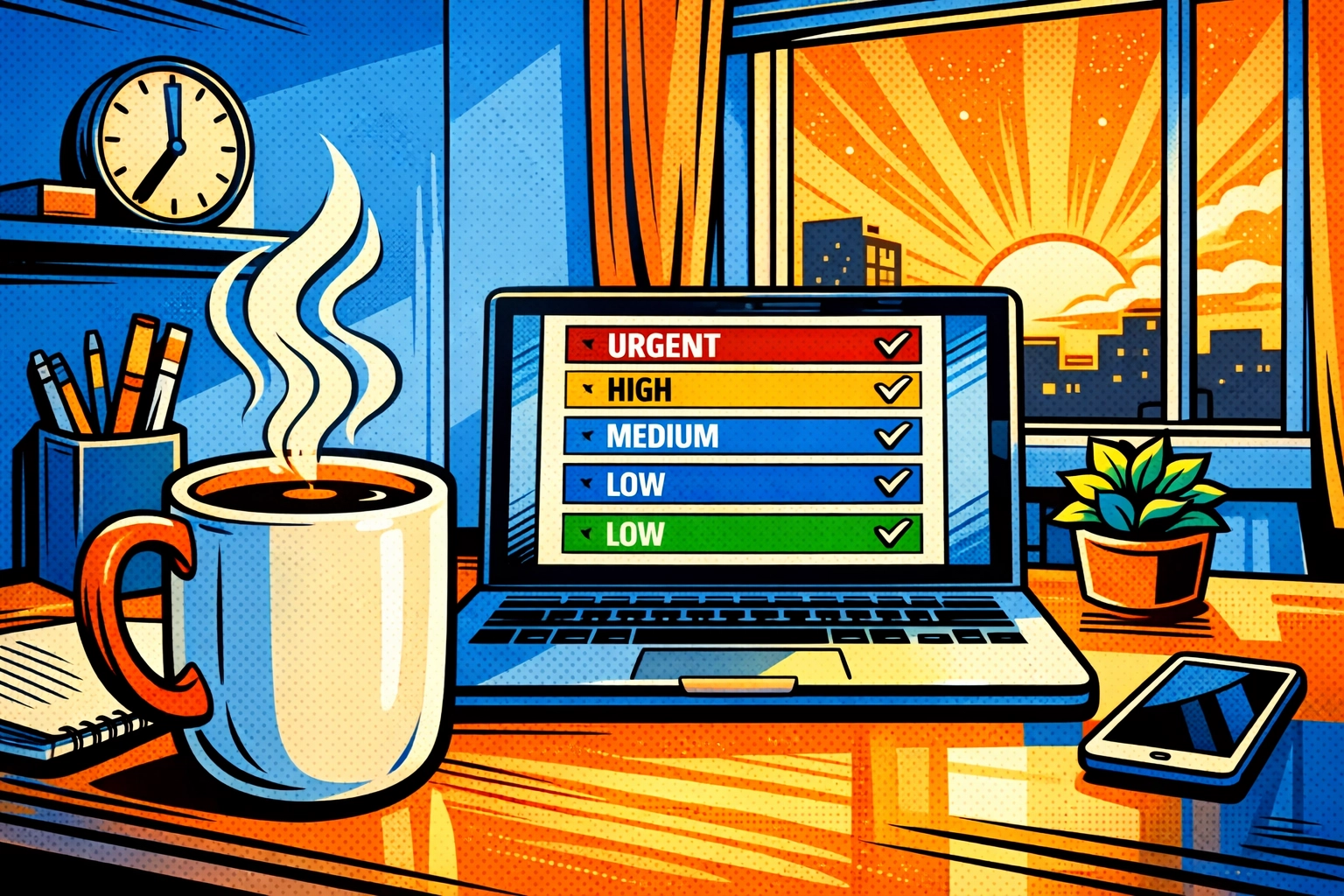
    Organized morning workspace with coffee and automated task list showing productivity before work begins

    THE 5-MINUTE SETUP THAT CHANGES EVERYTHING

    Stop trying to revolutionize your entire workflow in one afternoon. That's where most people fail, they build these elaborate automation systems that take longer to maintain than just doing the work manually.

    Instead, start lean. Automate just three things that eat your morning alive.

    Here's the exact setup:

    Minute 1-2: Pick your task capture tool

    Use something stupid-simple. Todoist or Google Tasks both understand natural language, you can literally type "Email John tomorrow at 10 am" and they'll schedule it automatically. No dropdown menus. No clicking through calendars.

    If you're on iPhone and you want zero learning curve, Apple Reminders does the same thing. Type like you're texting a friend. The AI figures out the rest.

    The goal here isn't to find the perfect tool. It's to pick one that won't make you think.

    Minute 3-4: Connect one automation

    This is where ai business automation actually saves you time instead of creating more work.

    Connect your task tool to IFTTT or use something like Reclaim that automatically drops your tasks onto your calendar. Reclaim's particularly clever, it doesn't just add tasks, it defends them. When someone tries to book a meeting during your focus time, it automatically suggests alternative slots.

    Your calendar becomes a bouncer. It protects your time without you lifting a finger.

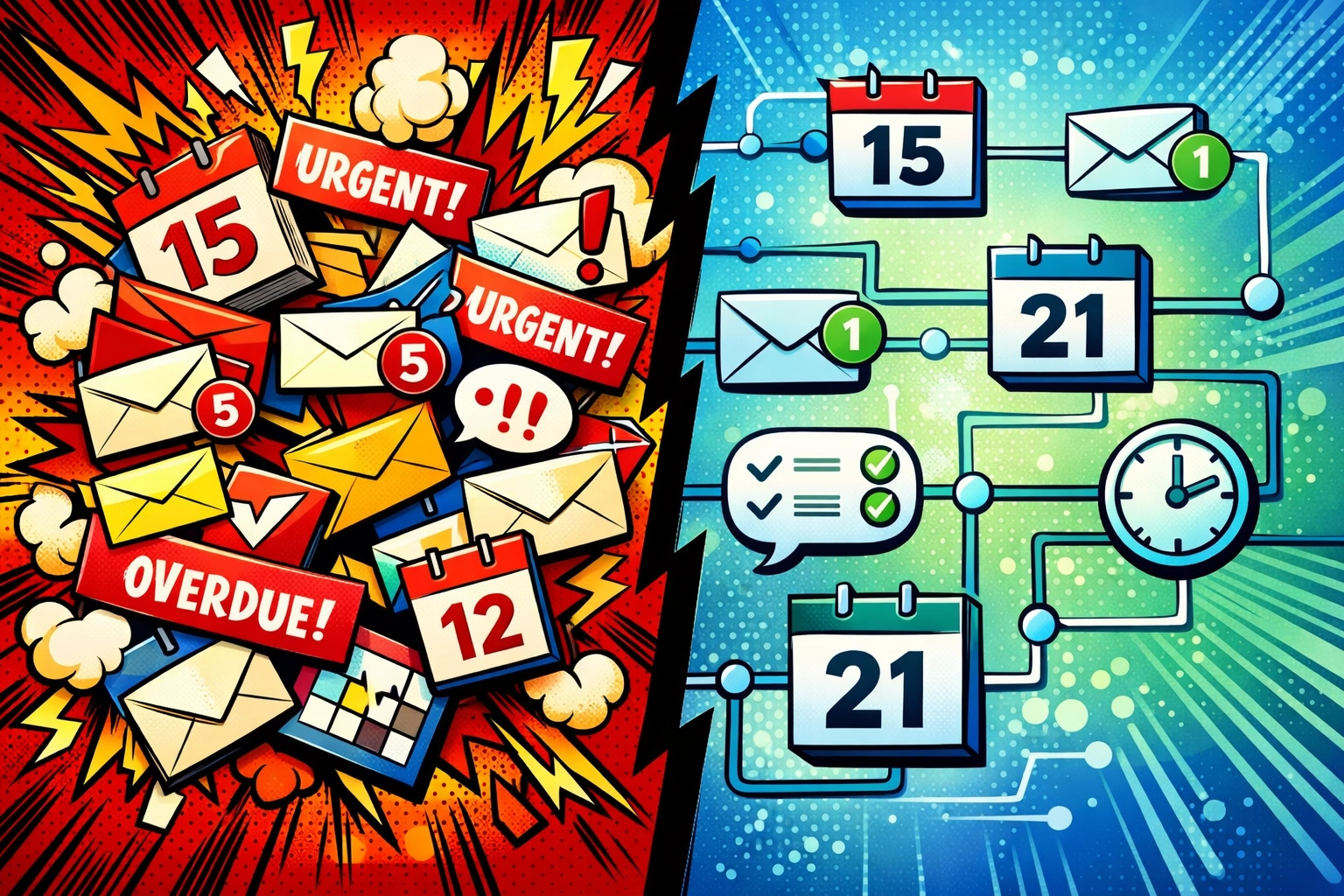
    Before and after comparison of chaotic vs. automated calendar and email management system

    Minute 5: Set one recurring pattern

    This is the secret most business automation tools don't tell you about.

    Type "Check quarterly reports every third Monday" in natural language. Tools like Morgen's AI translate that into a recurring task automatically. You never have to remember it again.

    No more "Oh crap, I forgot to send the monthly update" moments at 11 PM.

    One sentence. Five seconds. Never think about it again.

    WHAT YOUR MORNING LOOKS LIKE NOW

    7:00 AM: You open your laptop with your coffee.

    Your inbox is already sorted. AI has categorized urgent emails from noise, drafted responses to routine questions, and flagged the three things that actually need your attention.

    The calendar conflicts? Already resolved. Your AI scheduling tool moved that 9 AM call to Thursday (when both of you are actually free) and sent the updated invite while you were asleep.

    The chaos is gone before you even take your first sip.

    7:15 AM: You check your task list.

    Everything from yesterday that you didn't finish is already rescheduled for today: but not randomly. Your AI looked at your calendar, found your open blocks, and dropped them in during your most productive hours.

    You didn't move a single task manually.

    7:20 AM: You start actual work.

    Not email. Not admin. Not "getting organized."

    The work that actually grows your business.

    Relaxed business owner at organized desk at 7:20 AM ready for productive work after automation

    THE PART NOBODY TALKS ABOUT

    Here's what happens after a week of this setup…

    You stop checking your phone every five minutes. Because you know the important stuff is handled. The urgent emails get answered. The meetings get scheduled. The recurring tasks happen without you remembering them.

    Your mornings become weirdly… quiet.

    Not in a boring way. In an "I can finally think" way.

    You start noticing how much mental energy you were burning on task management. On remembering what needs to happen when. On manually moving calendar blocks around like you're playing Tetris.

    All that energy? It's yours again.

    WHY MOST AUTOMATION FAILS (AND HOW TO AVOID IT)

    Most people try to automate everything at once. They connect 47 different apps, build elaborate Zapier workflows, and create systems so complex they need a manual to remember how they work.

    Three weeks later, they're back to doing everything manually because the automation broke and they don't remember how to fix it.

    Here's the move: Start with these three morning tasks. Just tasks, calendar, and email sorting.

    Get comfortable with that for two weeks. Let it become invisible.

    Then add more.

    The best business automation tools are the ones you forget you're using. They just work. In the background. While you're doing the stuff that actually matters.

    WHAT THIS ACTUALLY COSTS YOU

    Let's do the math.

    If you spend 90 minutes every morning on admin tasks, that's 7.5 hours per week. 30 hours per month.

    At a modest $100/hour value of your time, you're burning $3,000 monthly on digital housekeeping.

    These tools? Most cost less than $50/month combined. Some are free.

    The ROI is embarrassing. In a good way.

    But here's the real cost nobody talks about: your best thinking hours disappear into task management. By the time you get to strategy, creativity, or actual business growth, you're running on fumes.

    You can't get those hours back.

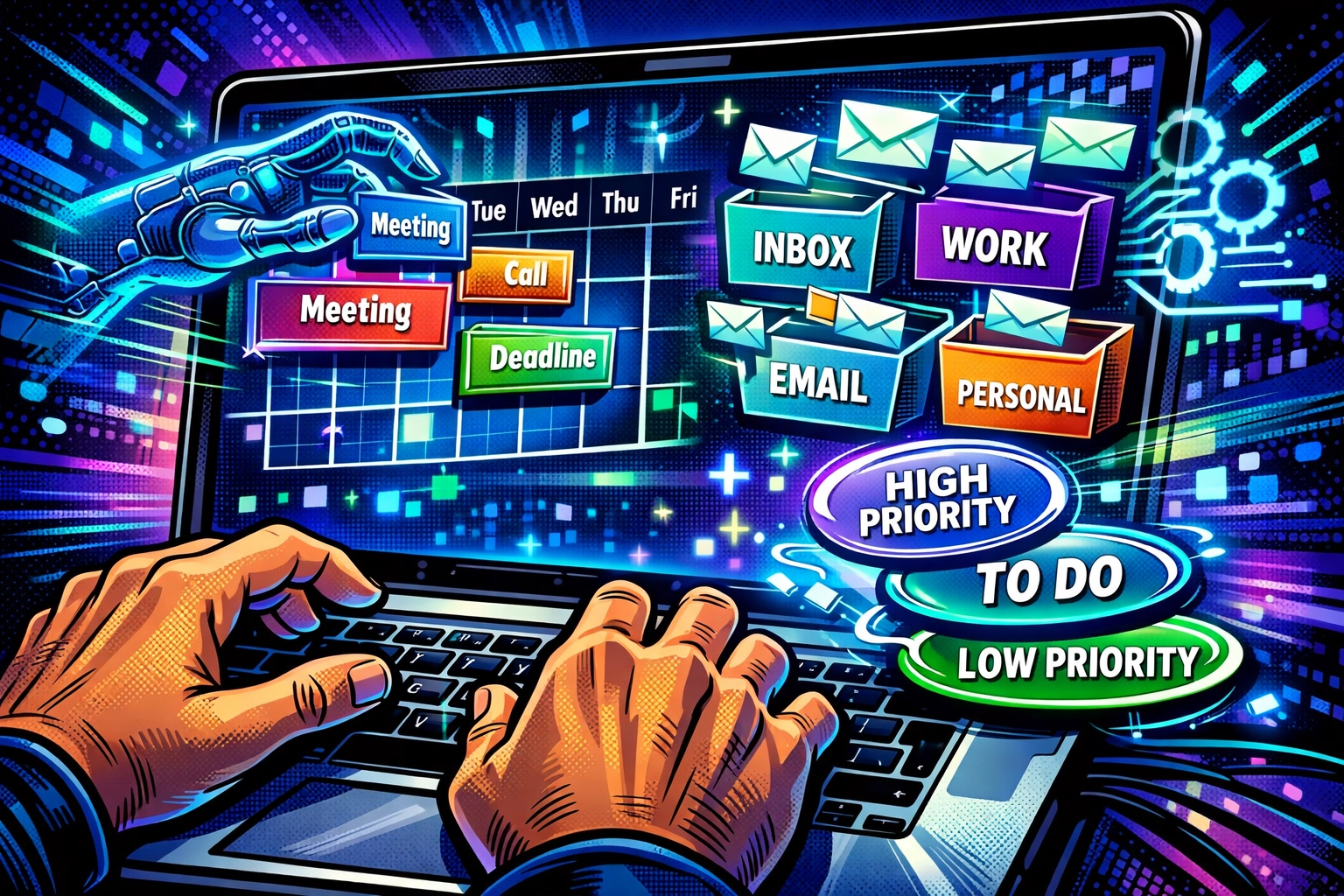
    AI business automation organizing tasks and emails while user works on laptop

    THE SETUP THAT ACTUALLY WORKS

    You want the honest truth? The fancy five-app automation setup you're picturing… you don't need it.

    You need one good task manager that understands natural language. One calendar tool that auto-schedules. And maybe one email sorter if you're drowning in messages.

    That's it.

    Everything else is optimization theater: it makes you feel productive while actually adding complexity.

    The companies killing it with ai business automation? They're not using 47 different tools. They're using three tools really well.

    Start there.

    If you want to see how this looks when it's properly integrated (without spending your weekend building Zapier workflows), check out what we've built at Marblism. It's the kind of setup that handles morning admin before you're even awake: without the complexity that makes most automation systems fall apart.

    Five-minute setup. Zero maintenance. Your mornings back.

    THE QUIET PART OUT LOUD

    Here's what nobody wants to admit…

    Most morning admin tasks exist because we haven't figured out a better system. We're still managing our businesses like it's 2010, manually moving information from one place to another.

    Email to calendar. Calendar to task list. Task list to notes. Notes back to email.

    It's digital busywork dressed up as productivity.

    The business automation tools that actually matter? They eliminate the busywork entirely. They don't help you manage tasks faster: they handle the tasks while you're doing something else.

    That's the difference between automation that saves time and automation that gives you your life back.

    YOUR MOVE

    Tomorrow morning, before your first coffee, try this:

    Open your task manager. Type one sentence in natural language about what you need to do. Let the AI schedule it.

    That's it.

    Don't overthink it. Don't build the perfect system. Just automate one morning task and see what happens.

    By next week, you might not recognize your mornings.

    In a really good way.


    The smart business owners aren't working harder. They're automating smarter. And their mornings look suspiciously relaxed.

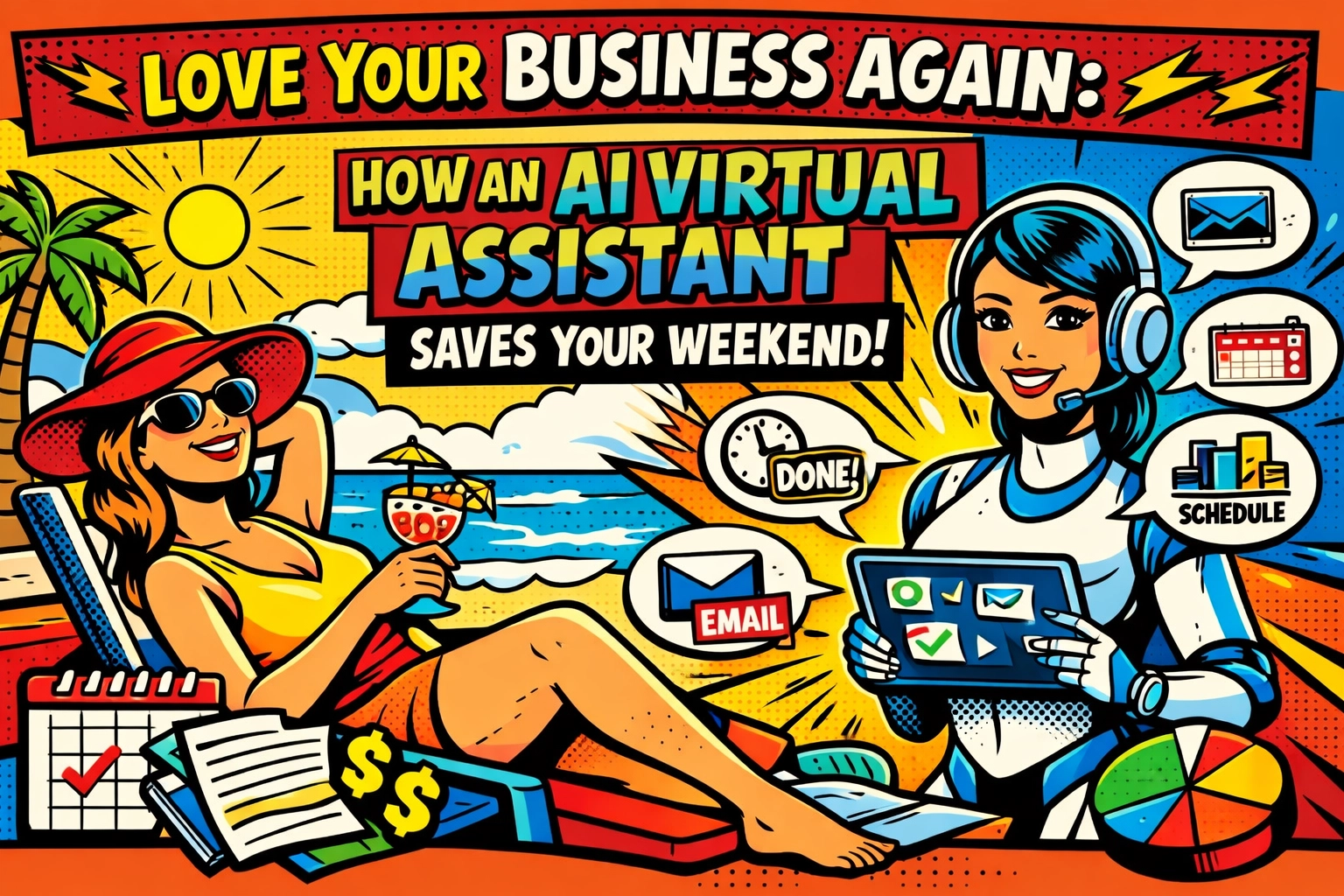
  • Love Your Business Again: How an AI Virtual Assistant Saves Your Weekend

    Love Your Business Again: How an AI Virtual Assistant Saves Your Weekend

    You know that feeling when Friday afternoon hits?

    That moment when everyone else is making weekend plans… and you're mentally listing all the customer emails you'll "just quickly check" on Saturday morning. The invoices that need sending. The calendar that needs organizing. The lead follow-ups that can't wait until Monday.

    Your business was supposed to give you freedom.

    Instead, it's stolen your weekends.

    Overwhelmed solopreneur at desk buried in paperwork, emails, and business tasks

    THE SATURDAY MORNING LIE

    It always starts the same way. "I'll just do an hour of admin," you tell yourself. "Get ahead of the week."

    Two hours later, you're still at your laptop. Your coffee's gone cold. Your partner's stopped asking if you want to go for that walk.

    Because solopreneurs don't get weekends. We get "working from home in sweatpants instead of the office."

    You're not lazy. You're not inefficient. You're just one human being trying to do the job of five people.

    The scheduling. The customer queries. The CRM updates that multiply like rabbits. The social media posts you promised yourself you'd stay consistent with. The proposals that need writing, the invoices that need chasing, the inbox that never… stops… growing.

    And here's the brutal truth: 60-70% of your time gets eaten by tasks that don't actually need your brain. They just need someone to do them.

    But you don't have someone. You have you. And your business needs you to be the strategist, the salesperson, the product expert, the customer service hero, and the administrator.

    All at once. All weekend.

    WHEN DID YOU LAST PROPERLY SWITCH OFF?

    Think about it. When was the last time you spent a Sunday without checking your business email? Without that little voice saying "I should just quickly…"

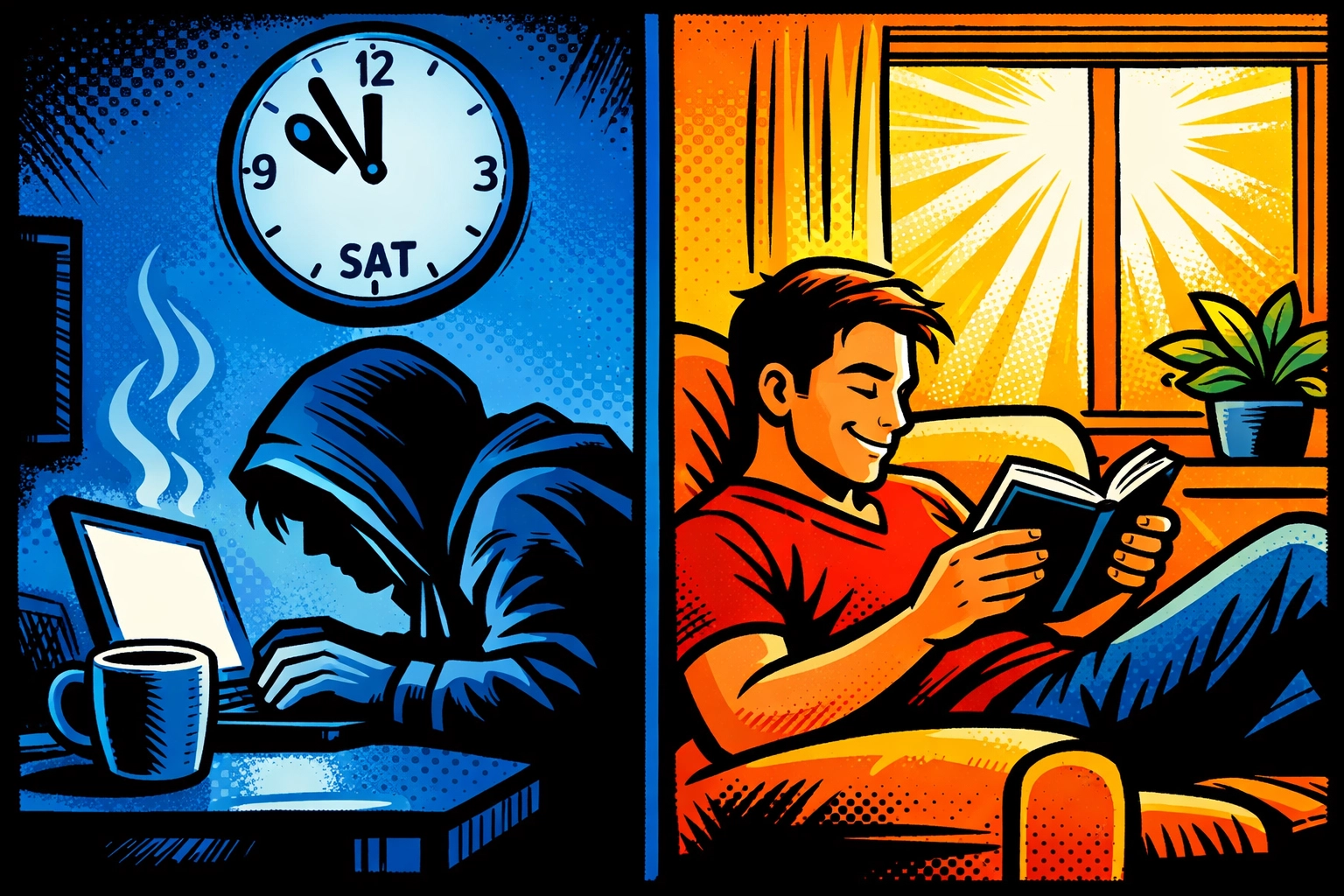
    Solopreneur working on Saturday versus relaxing with AI automation and work-life balance

    Your friends stopped inviting you to brunches. Your kids know that "working" is your default state. You've forgotten what it feels like to read a book without your phone buzzing every fifteen minutes.

    This isn't sustainable. You know it. I know it.

    But what's the alternative? Hire someone? With what budget, and what time to train them?

    ENTER: YOUR AI VIRTUAL ASSISTANT

    Here's what changes when you hand the repetitive stuff to an AI assistant designed for business automation.

    Saturday, 8:00 AM

    You wake up naturally. No alarm. Your phone sits on the bedside table, and for the first time in months, you don't reach for it immediately.

    Because while you slept, your AI assistant was already handling it:

    • Triaged the 47 customer emails that came in overnight
    • Responded to the basic queries with your pre-approved answers
    • Flagged the three that actually need your human touch (and scheduled them for Monday)
    • Updated your CRM with Friday's client interactions
    • Pulled together the meeting agenda for your Monday call

    The chaos is organized before you even open your eyes.

    🌤️ 10:30 AM

    You're at the farmer's market. Actually present. Not thinking about whether you remembered to send that proposal.

    You didn't need to remember. Your AI assistant sent it yesterday afternoon, along with a personalized follow-up sequence. It's tracking opens, logging everything in your system, and will notify you if there's a reply that needs your attention.

    But right now? There isn't. So you're buying fresh bread and enjoying your Saturday like a normal human being.

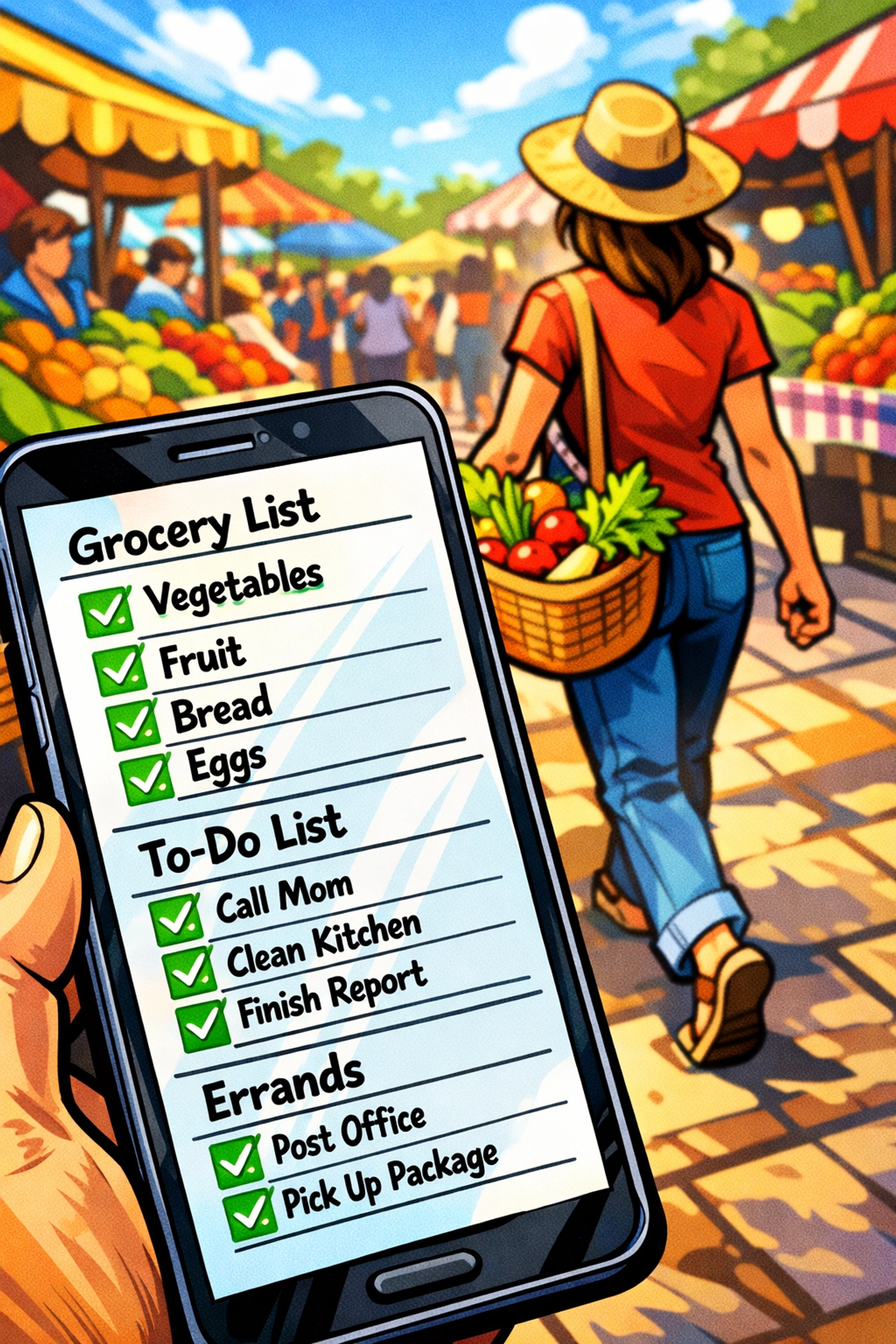
    AI virtual assistant organizing tasks on phone while business owner enjoys weekend shopping

    📱 2:00 PM

    Your phone buzzes. Not with a panicked customer. Not with an urgent request that'll derail your afternoon.

    It's a notification: "3 new qualified leads captured and added to your pipeline. Follow-up sequence initiated."

    Your AI assistant has been working your lead magnets, responding to inquiries, qualifying prospects based on your criteria, and nurturing them through your funnel. While you were buying fresh bread.

    You smile. Send a thumbs up. Keep walking.

    WHAT ACTUALLY GETS AUTOMATED

    Let's get specific. Because "automation" sounds nice… until you wonder what it actually means for your daily reality.

    An AI virtual assistant handles the time-vampires:

    The Admin Black Holes

    • Scheduling meetings across time zones (without the 47-email back-and-forth)
    • Managing your calendar and sending reminders
    • Organizing files and documents so you can actually find things
    • Processing expense reports and basic bookkeeping entries

    The Customer Service Treadmill

    • Answering FAQs instantly, 24/7
    • Routing complex issues to you with full context
    • Following up on support tickets
    • Collecting and organizing customer feedback

    The Marketing Grind

    • Posting to social media on schedule
    • Sending email sequences to leads
    • Updating your CRM after every interaction
    • Generating content ideas based on your industry trends

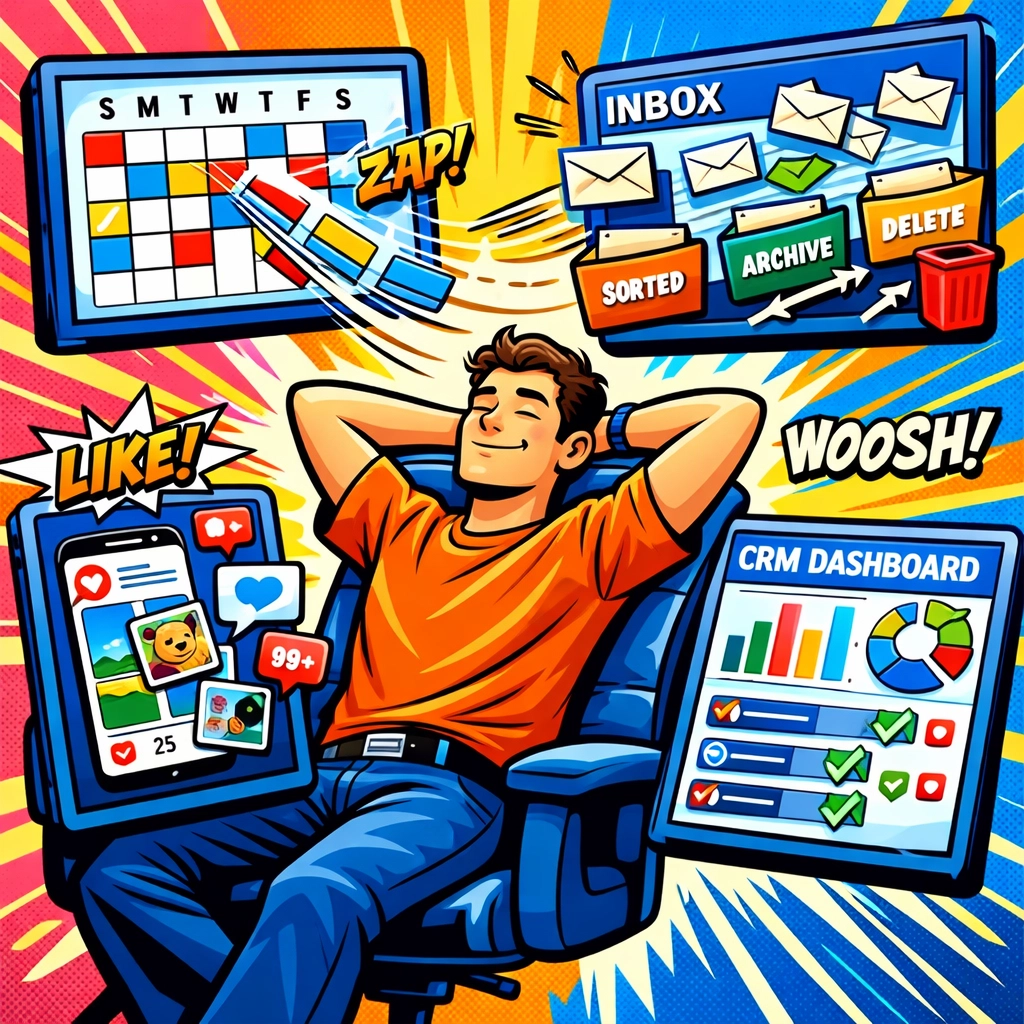
    AI business automation managing calendar, emails, social media, and CRM tasks effortlessly

    The Sales Follow-Up Game

    • Qualifying inbound leads
    • Sending personalized follow-ups at optimal times
    • Tracking engagement and updating deal stages
    • Scheduling demos with interested prospects

    Harvard Business Review found that AI-powered virtual assistants increase productivity by up to 25%. But for solopreneurs, it feels like more. Because that 25% was the exact percentage of your time that was bleeding into your weekends.

    YOUR NEW SUNDAY REALITY

    🌙 Sunday, 7:00 PM

    You're winding down. Genuinely winding down. Not "pretending to relax while mentally preparing for Monday."

    Your AI assistant has already:

    • Confirmed Monday's meetings and sent prep materials to attendees
    • Compiled your weekly performance report (sales, leads, outstanding tasks)
    • Drafted responses to any weekend inquiries
    • Lined up your content posts for the week ahead

    Tomorrow morning, you'll start fresh. Not playing catch-up. Not drowning in weekend backlog. Just… starting.

    With strategy. With focus. With energy.

    Because you actually rested.

    THE BREAKING POINT THAT LEADS TO BREAKTHROUGH

    Look, you started your business for a reason. Freedom. Impact. Building something meaningful on your own terms.

    Somewhere along the way, it became a prison. A very busy, very exhausting prison where you're both the inmate and the warden.

    AI business automation isn't about replacing you. It's about freeing you to do the work only you can do. The strategic thinking. The relationship building. The creative problem-solving that actually grows your business.

    Everything else? The scheduling, the data entry, the basic customer queries, the follow-up emails, the social media consistency, the CRM busywork…

    That's not where your genius lives. So why are you spending your weekends on it?

    Relaxed solopreneur enjoying Sunday evening with laptop closed after AI handles business

    WHAT IT ACTUALLY FEELS LIKE

    Here's what solopreneurs tell us after implementing AI virtual assistants:

    "I cried the first Saturday I didn't work. Not because something went wrong: because nothing did. Everything just… ran." : Jennifer

    "My partner asked if I'd sold the business. I was that present for an entire Sunday. Game-changer." : Marcus

    "I forgot I had an AI assistant for a few hours. Then I checked my CRM and realized it had processed 30+ tasks while I was at my kid's football match. Wild." : Sarah

    That's the goal. Not to make you think about automation constantly. But to make you forget about all the tasks that used to consume you.

    Because they're handled. Quietly. Competently. Without you.

    READY TO RECLAIM YOUR WEEKEND?

    You can't get back the Saturdays you've already lost to admin work. But you can decide that next weekend will be different.

    Marblism's AI virtual assistants are built specifically for solopreneurs and small business owners who are drowning in the day-to-day. They integrate with your existing tools, learn your processes, and start handling the repetitive work immediately.

    No six-month implementation. No massive learning curve. Just relief.

    See it in action: https://marblism.link/scott-bowen

    Because your business should fuel your life. Not consume it.

    And weekends? They're supposed to be yours.


    Your AI assistant is already working. The question is: are you?

  • How to Choose Coffee Suppliers for Your Coffee Shop: 7 Questions You Must Ask First

    Choosing the right coffee supplier isn't just about getting beans delivered on time. It's about finding a partner who'll support your business, understand your vision, and help you serve exceptional coffee day after day.

    We've seen too many café owners rush into supplier relationships without asking the right questions upfront. Six months later, they're stuck with mediocre coffee, zero support, and a contract they can't escape. So let's make sure that doesn't happen to you.

    Here are seven essential questions you need to ask any potential coffee supplier before you sign anything.

    Café owner and coffee supplier discussing bean samples during partnership meeting

    1. What's the Quality and Origin of Your Coffee Beans?

    This is where it all starts. You need to understand exactly what you're serving your customers.

    Ask about bean grades, roasting methods, and countries of origin. Are they offering 100% Arabica, or are you getting blends with Robusta? There's nothing inherently wrong with Robusta in certain contexts, but you should know what you're buying and why the roaster chose those particular beans.

    Request samples. Always. And don't just taste them yourself: get your team involved in blind taste tests. What impresses you might not resonate with your baristas who'll be pulling shots all day, every day.

    Check roast dates too. Fresh is best. If a supplier can't tell you when their coffee was roasted or seems vague about freshness guarantees, that's a red flag. At Limini Coffee, we're obsessed with freshness: our roasting schedule is built around getting coffee to you at peak flavour, not sitting in warehouses for weeks.

    2. What Range of Coffee Products Do You Offer?

    Your menu needs variety. Your customers want options. So does your supplier have them?

    A roaster offering just one or two standard blends is going to limit your creativity. Ask whether they have different origins, roast profiles, and seasonal offerings. Can they provide beans, pre-ground options, or even capsules if you're thinking about retail sales?

    Also, find out about limited edition or specialty releases. These can be brilliant for attracting customers who want something unique, and they give you the flexibility to rotate your menu and keep things interesting.

    If you're planning to develop signature drinks or experiment with single origins, you need a supplier who can support that ambition, not restrict it.

    Variety of coffee beans from different origins showing light to dark roasts

    3. What Support and Training Do You Provide?

    Here's the thing: wholesale coffee suppliers who just drop bags at your door and disappear are basically useless.

    The best suppliers become genuine partners in your business. They should offer barista training, equipment support, maintenance services, and technical assistance when things go wrong (because they will).

    Ask specifically about their training programs. Will they come to your shop and train your team? Do they offer ongoing support, or is it a one-time thing? What about when you hire new staff: can they help you get them up to speed?

    Equipment maintenance is huge too. Coffee machines are complex, temperamental beasts. Having a supplier who understands your setup and can help troubleshoot issues is worth its weight in gold.

    We take this seriously at Limini Coffee: our training programs are designed to turn your team into confident, skilled baristas who can consistently deliver excellent coffee. Because your success is our success.

    4. Can You Meet My Volume and Delivery Requirements?

    This is practical stuff, but it matters enormously.

    You need to know whether your supplier can handle your typical weekly or monthly demand without running out of stock. Nothing's worse than scrambling for emergency coffee when your regular supplier can't fulfil an order.

    Ask about minimum order quantities too. If you're a small operation with limited storage, a supplier demanding huge minimum orders is going to cause problems. Your storage capacity matters: there's no point ordering 50kg of coffee if you only have space for 20kg and it's going to go stale.

    Check delivery schedules. How often can they deliver? What's the turnaround time? Can they accommodate rush orders if you're busier than expected, or adjust orders if things are quiet?

    Flexibility here is crucial. Your business isn't static, and your supplier needs to roll with your peaks and troughs.

    Experienced barista training new staff member on espresso machine in coffee shop

    5. What Are Your Sustainability and Ethical Sourcing Practices?

    Your customers care about this. A lot. Around 70% of UK consumers say sustainability influences which venues they choose, so your supplier's ethics aren't just nice-to-have: they're business-critical.

    Ask about transparent sourcing. Where exactly do the beans come from? Are farmers paid fairly? What certifications do they hold: Fair Trade, Rainforest Alliance, B Corp status?

    We believe coffee should benefit everyone in the supply chain, not just roasters and retailers. That's why we're committed to ethical sourcing practices and building long-term relationships with growers who share our values.

    Also ask about packaging. Are they using recyclable materials? Do they offer refillable options? These details matter when you're trying to build a brand that stands for something beyond just caffeine delivery.

    6. What's Your Pricing, and How Does It Compare to Market Conditions?

    Let's talk money. You need transparent pricing that makes sense.

    Be cautious of prices that seem unusually low. Coffee is a commodity with fairly well-established market prices. If someone's claiming they can deliver specialty beans at prices significantly below market rates, something's off. Either the quality isn't what they're promising, or there's a catch in the contract terms.

    That said, you shouldn't be paying ridiculous premiums either. Ask for a detailed breakdown of costs and compare them against other suppliers. Understand what you're getting for your money: does the price include training, equipment support, delivery, or are those extras?

    Remember that the cheapest option rarely ends up being the best value. A slightly higher price that includes comprehensive support, training, and consistent quality will save you money in the long run by reducing waste, improving customer satisfaction, and keeping your team skilled.

    Coffee supplier delivering fresh wholesale coffee bags to independent café owner

    7. How Flexible and Responsive Is Your Customer Service?

    Finally, you need to know whether your supplier will actually be there when you need them.

    Ask about contract flexibility. Can you adjust orders seasonally when your business slows down or ramps up? What are the cancellation terms? Are you locked in for years, or can you reassess if things aren't working?

    Find out how they handle specific operational constraints. If you have limited storage and need more frequent, smaller deliveries, can they accommodate that? If you want to trial a new blend before committing, is that possible?

    Test their responsiveness before you commit. How quickly do they reply to emails? When you call, do you get a human or endless voicemail? Are they genuinely interested in understanding your business, or just trying to close a sale?

    The relationship between a coffee shop and its supplier needs to be built on communication and mutual understanding. If they're not responsive during the courting phase, they definitely won't be responsive once you've signed a contract.

    Making the Right Choice

    Choosing coffee suppliers for your coffee shop is one of the most important decisions you'll make. The right wholesale coffee roaster becomes a genuine partner who supports your growth, understands your challenges, and helps you serve exceptional coffee every single day.

    Don't rush this decision. Ask these questions, request samples, meet the team, and trust your instincts. The cheapest option or the biggest name isn't always the right fit: you need a supplier who aligns with your values, supports your vision, and delivers consistent quality.

    If you're looking for a roaster who ticks all these boxes, we'd love to chat. At Limini Coffee, we're passionate about supporting independent coffee shops with exceptional specialty coffee, comprehensive training, and genuine partnership. Our state-of-the-art roasting facility and commitment to ethical sourcing means you're getting coffee that's not just delicious, but traceable and responsibly sourced too.

    Check out our wholesale options and let's start a conversation about how we can support your coffee shop's success.

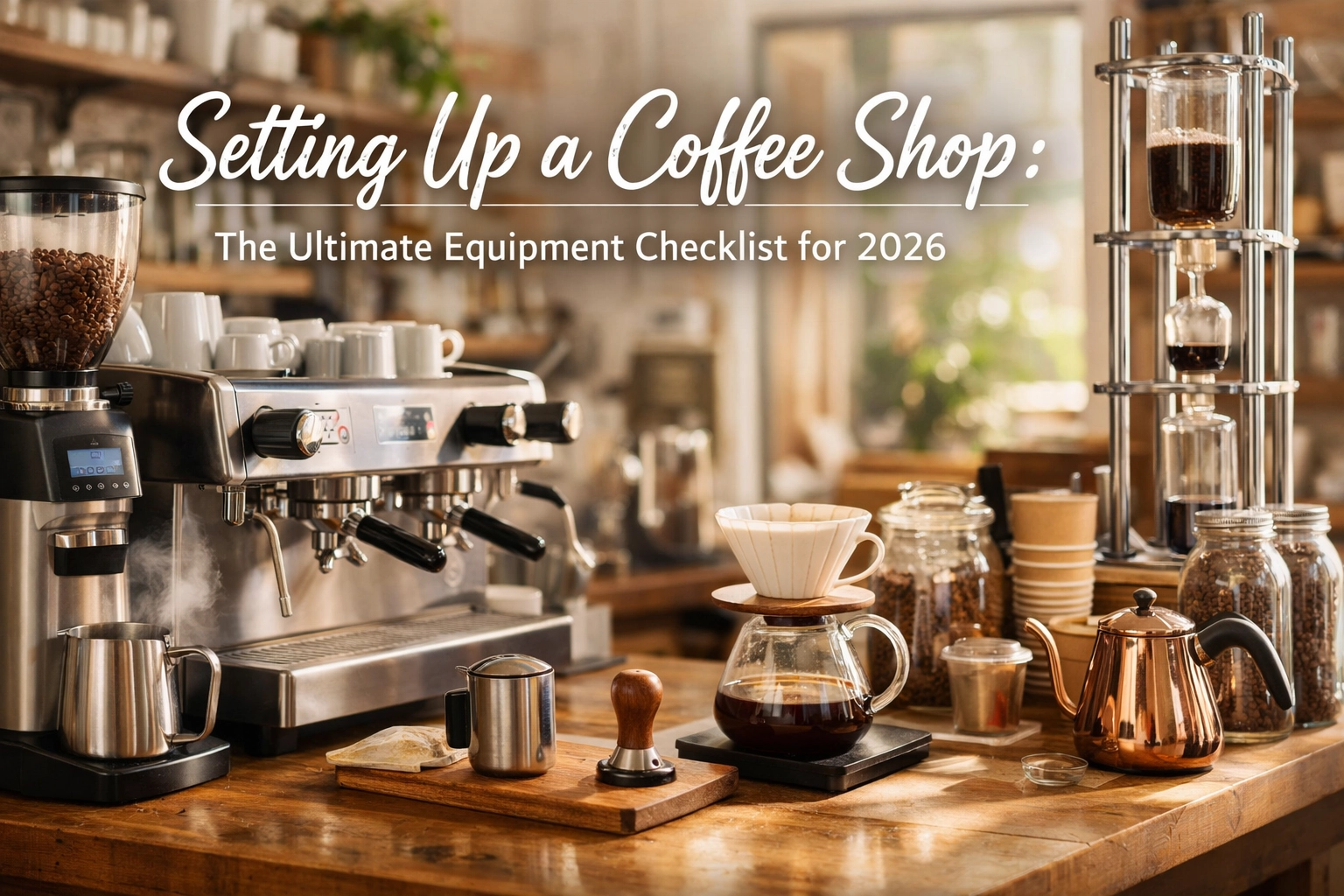
  • Setting Up a Coffee Shop: The Ultimate Equipment Checklist for 2026

    Setting Up a Coffee Shop: The Ultimate Equipment Checklist for 2026

    So you're setting up a coffee shop. Exciting times ahead.

    But let's be honest, walk into any equipment supplier's showroom and you'll be overwhelmed within minutes. Shiny espresso machines, grinders that cost more than a second-hand car, and a bewildering array of pitchers, tampers, and mysterious gadgets you've never seen before.

    We've helped countless cafés get their equipment right from day one, and we know exactly where new owners get stuck. This isn't about buying everything. It's about buying the right things, in the right order, within a budget that doesn't make your accountant weep.

    Let's break it down.

    The Espresso Machine: Your Centrepiece Investment

    This is your biggest single expense, and rightfully so. The espresso machine is the beating heart of your coffee shop, and skimping here is false economy.

    For most cafés starting out, a two-group espresso machine hits the sweet spot. It gives you the capacity to handle morning rushes without leaving customers queuing forever, but it won't bankrupt you or dominate your counter space like a three-group beast.

    What to look for:

    • Programmable dosing for consistency (your baristas will thank you)
    • Dual steam wands so you can steam milk for two drinks simultaneously
    • PID temperature control, this is basically cruise control for your brew temperature
    • A reliable brand with local service support (a broken machine on Saturday morning is your worst nightmare)

    Budget between £5,000 and £15,000 depending on whether you go new or refurbished. We've written a detailed guide on choosing espresso equipment if you want to dive deeper into the technical side.

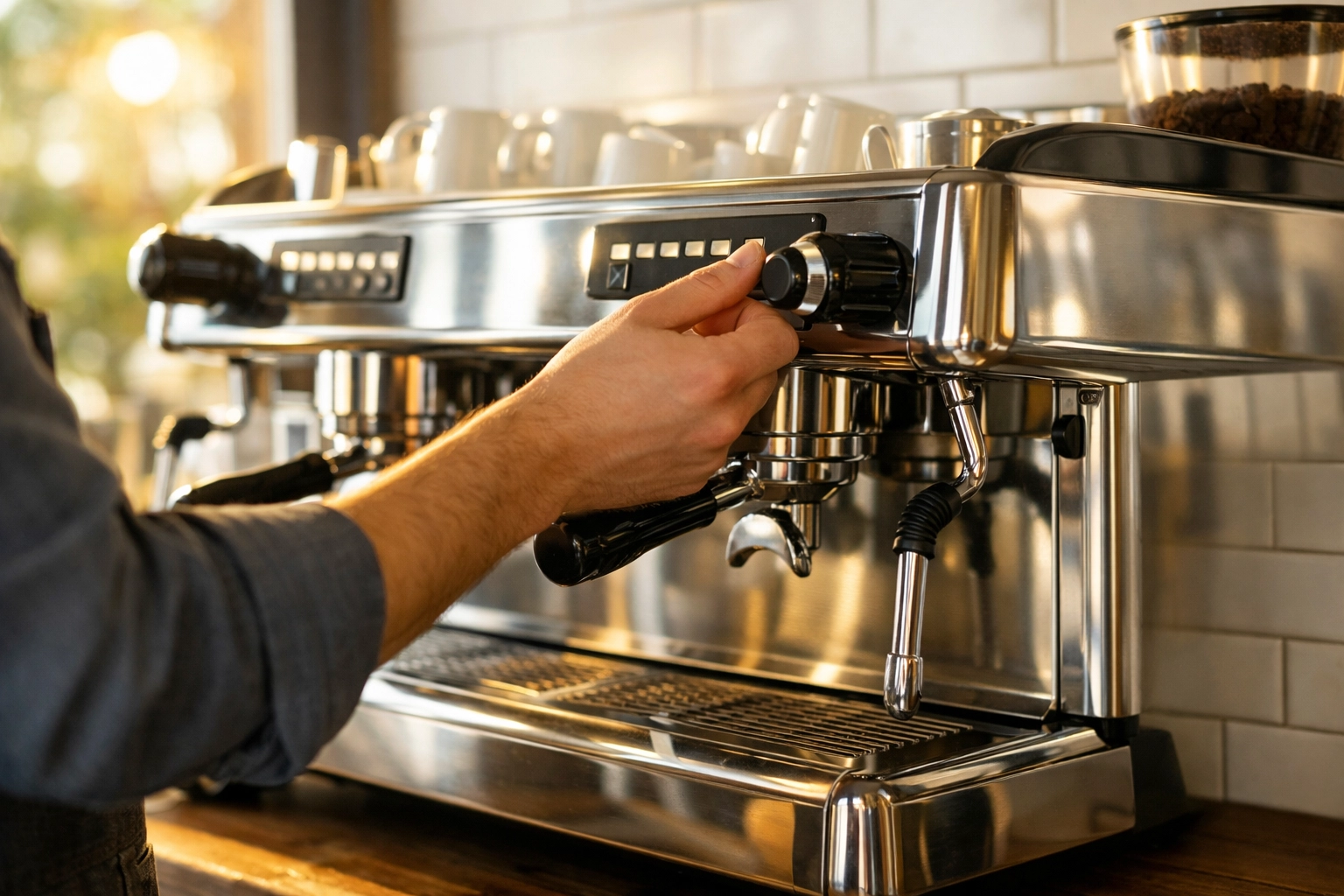
    Barista adjusting commercial espresso machine settings in specialty coffee shop

    Grinders: Never Compromise Here

    Here's something we tell every new café owner: your grinder matters more than your espresso machine.

    Controversial? Perhaps. But it's true.

    A brilliant machine with a rubbish grinder will produce mediocre coffee. A decent machine with an exceptional grinder will produce excellent coffee. The grind is where consistency happens, or doesn't.

    You'll need at least two commercial burr grinders:

    • Primary grinder for your main espresso blend
    • Secondary grinder for decaf (never mix them, the flavour contamination is real)

    If you're planning on offering single origins or guest roasts, budget for a third. Some cafés even run four grinders during peak specialty seasons.

    Look for:

    • Stepless grind adjustment for precision
    • Low retention (minimal coffee left in the grinder between doses)
    • Consistent particle distribution
    • Easy cleaning access

    Budget £800–£2,500 per grinder. And yes, that seems like a lot. But remember: these workhorses will grind thousands of shots. Quality here pays back quickly.

    Batch Brewing Equipment: Speed When You Need It

    Not every customer wants to wait for a pour-over at 8:15 AM on a Monday. Batch brewers are your secret weapon during rush periods.

    A commercial drip coffee maker or batch brewer lets you produce quality filter coffee at volume. During morning rushes, you can serve customers quickly while your baristas focus on the espresso bar.

    We recommend having both batch brewing and manual brewing options. The batch brewer handles speed and volume. Manual methods like V60, Chemex, or AeroPress showcase your specialty offerings and give your baristas room to shine when things slow down.

    Budget £600–£1,500 for a reliable batch brewer.

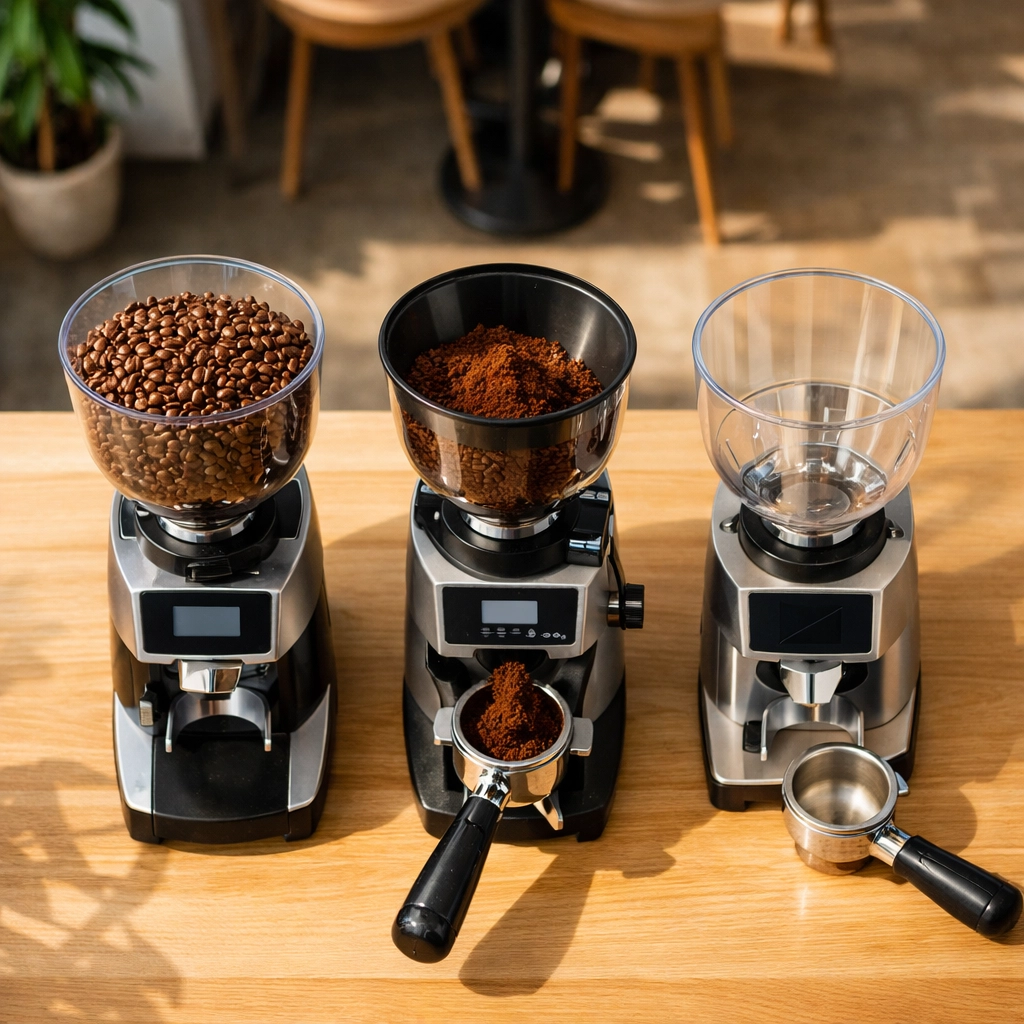
    Three commercial coffee grinders with fresh beans on café counter

    The Supporting Cast: Barista Tools That Matter

    These might seem like small items, but they're the difference between frustrated baristas and smooth service:

    Essential barista tools:

    • Stainless steel milk pitchers (at least three, in various sizes)
    • Proper tampers (sized correctly for your portafilter baskets)
    • Digital scales (accurate to 0.1g for dosing consistency)
    • Shot glasses for dialling in
    • Knockbox for spent pucks
    • Steaming thermometers
    • Distribution tools
    • Gooseneck kettles for manual brewing

    Don't buy the cheap versions. Your team uses these tools hundreds of times daily. Quality here means efficiency, consistency, and baristas who aren't constantly battling their equipment.

    Budget around £800–£1,200 for a complete set of professional-grade tools.

    Cold Equipment: Ice, Refrigeration, and Storage

    Iced drinks aren't a summer novelty anymore: they're year-round revenue generators. Which means your cold equipment needs serious thought.

    You'll need:

    A commercial ice machine that can actually keep pace with demand. Domestic ice makers won't cut it. During a summer afternoon rush, you'll blast through ice faster than you'd believe possible. Size it generously.

    A commercial refrigerator for milk, syrups, and perishables. Undercounter models save space but limit capacity. Walk-in fridges are brilliant if you have the room and budget.

    A commercial dishwasher (high-temperature sanitising) for health regulations and efficiency. Hand-washing during busy periods is neither practical nor hygienic at commercial volume.

    Budget £3,000–£6,000 for commercial-grade cold equipment.

    Water: The Ingredient Everyone Forgets

    Coffee is 98% water. Your water quality directly impacts every cup you serve.

    A proper water filtration system is non-negotiable. It protects your expensive espresso machine from scale buildup, and more importantly, it ensures your coffee tastes as the roaster intended.

    You'll need:

    • Professional filtration system
    • Regular replacement filters (budget for ongoing costs)
    • Water testing kit
    • Possibly a water softener depending on your local water hardness

    This isn't glamorous spending, but it's utterly essential. Budget £500–£1,500 for installation, and factor in ongoing filter costs.

    Batch brewer and manual pour-over coffee equipment in café kitchen

    Cleaning and Maintenance: The Unsexy Essential

    Equipment maintenance prevents disasters. A clogged group head or scaled-up boiler can shut you down during your busiest period.

    Daily cleaning requirements:

    • Espresso machine backflush disks and cleaning powder
    • Steam wand brushes
    • Grinder cleaning tablets
    • Microfibre cloths (lots of them)
    • Pitcher rinsers
    • Food-safe sanitiser

    Schedule professional machine servicing quarterly minimum. The cost of prevention is always less than the cost of emergency repairs and lost revenue.

    Budget £300–£500 for initial cleaning supplies, plus ongoing costs.

    The Coffee Itself: Your Most Important Ingredient

    Here's where everything comes together. You can have the finest equipment money can buy, but if you're serving stale, poorly roasted coffee, none of it matters.

    We're obviously biased, but we believe sourcing freshly roasted specialty coffee from a dedicated roaster makes all the difference. At Limini Coffee, we work with cafés to develop custom blends, provide staff training, and ensure you're always serving coffee at its peak.

    Wholesale partnerships mean consistent supply, technical support, and often better pricing than buying retail. It's worth having that conversation early in your planning. You can explore our wholesale offerings to see how we support café partners.

    Optional Equipment (Menu Dependent)

    Planning to serve food? You'll need:

    • Commercial oven or combi oven
    • Toaster and microwave
    • Baking equipment if you're making pastries in-house
    • Additional prep space and storage

    Planning cold brew? You'll need:

    • Cold brew brewing system
    • Adequate cold storage (this takes up serious fridge space)
    • Kegging equipment if you're serving on tap

    Only buy what your menu actually requires. You can always expand later once you've established what sells.

    Budget Reality Check

    For a complete café setup with quality equipment, expect £20,000–£50,000 for everything covered here. That's a wide range because your exact needs depend on:

    • Size of your operation
    • Whether you're serving food
    • New versus quality refurbished equipment
    • Your menu complexity
    • Local plumbing and electrical requirements

    Getting Started: What to Buy First

    If budget is tight, prioritize in this order:

    1. Espresso machine and primary grinder (these are your foundation)
    2. Water filtration (protects your investment)
    3. Batch brewer (handles volume efficiently)
    4. Ice machine and refrigeration (required for operations)
    5. Essential barista tools (for quality and consistency)
    6. Secondary grinder and specialty equipment (when cash flow allows)

    Starting lean is fine. Plenty of successful cafés began with the basics and expanded as revenue grew.

    Final Thoughts

    Setting up a coffee shop is equal parts exciting and terrifying. The equipment investment is significant, but it's also your toolkit for building something special.

    Focus on quality where it matters most: your coffee-making equipment. These are the tools that directly impact every cup. Everything else can be functional rather than fancy, at least to start.

    And remember: equipment is just equipment. What matters is the coffee you serve and the experience you create. Get the fundamentals right, source exceptional coffee, train your team properly, and the rest follows.

    If you'd like specific guidance on equipment selection for your café project, or if you're looking for a wholesale coffee partner who understands the realities of running a coffee shop, we're always happy to chat. That's what we're here for.

    Good luck with your new venture. The coffee world needs more cafés that care about getting it right.

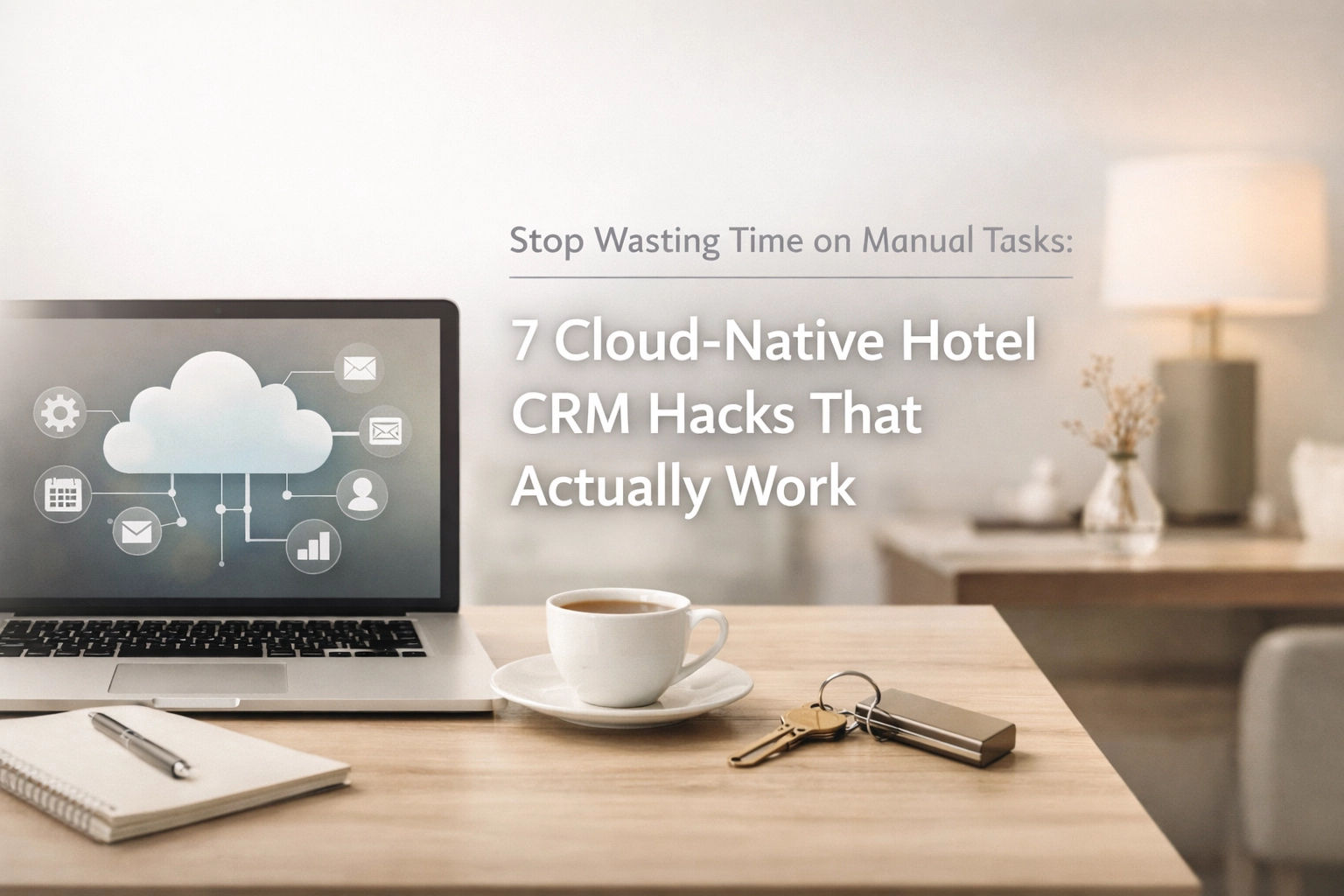
  • Stop Wasting Time on Manual Tasks: 7 Cloud-Native Hotel CRM Hacks That Actually Work

    Stop Wasting Time on Manual Tasks: 7 Cloud-Native Hotel CRM Hacks That Actually Work

    Your front desk team shouldn't spend three hours a day copying guest preferences into spreadsheets. Your revenue manager shouldn't manually update rates across seven OTAs every morning. And your marketing team definitely shouldn't be hunting for guest emails in five different systems.
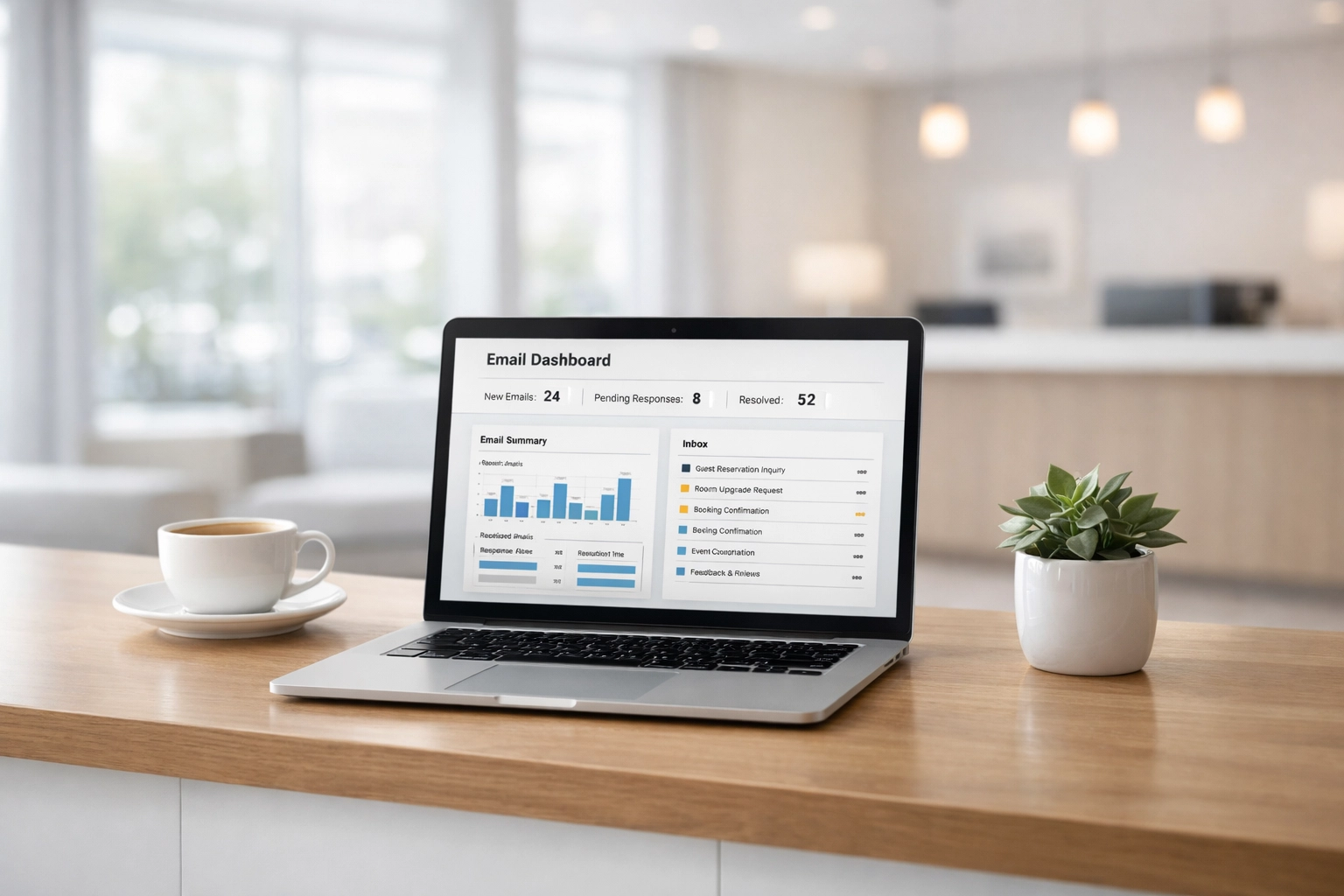
    Cloud-native hotel CRM platforms change this. They automate the repetitive work that's stealing time from what actually matters: creating experiences guests remember.

    Here are seven automation hacks that work right now.

    1. Let Your CRM Handle Guest Communication (All of It)

    Stop manually sending pre-arrival emails, payment reminders, and post-stay surveys.

    Modern cloud-native systems automate the entire guest communication workflow. Pre-arrival emails go out automatically. Payment reminders send themselves. Follow-ups happen without anyone clicking "send." Upsell campaigns run while you sleep.

    Hotel front desk with laptop displaying automated CRM email dashboard for guest communication

    The result? Your team reclaims hours every week. Guests get timely, personalized messages. And nothing falls through the cracks because someone was busy at check-in.

    Set up automated email sequences once. Let them run forever. Adjust them when you test new messaging. That's it.
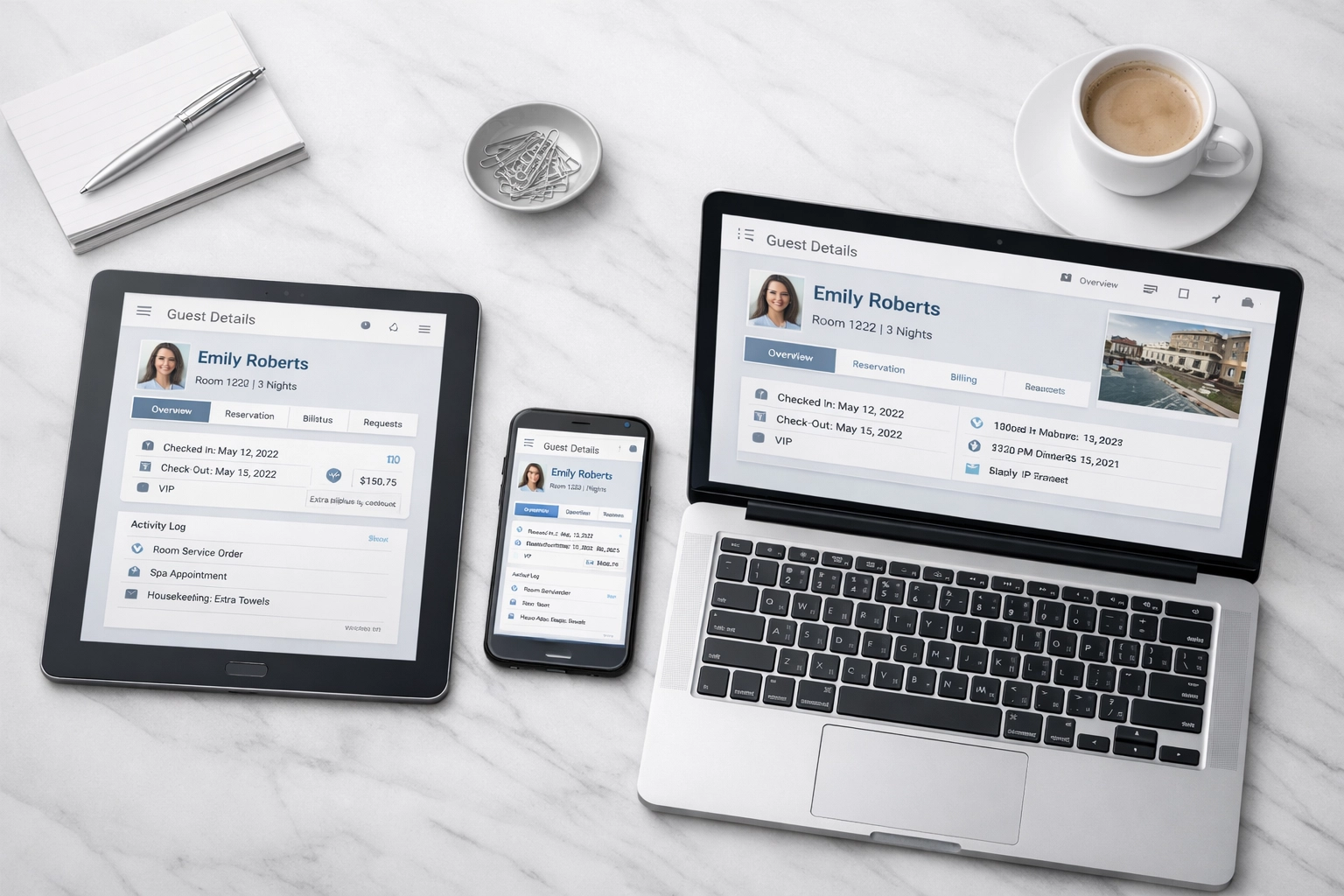
    2. Sync Guest Data in Real Time Across Your Entire Operation

    Here's a common scenario: A guest submits a gluten allergy through your pre-arrival portal. Your front desk sees it. But housekeeping doesn't. F&B doesn't. The restaurant serves bread anyway.

    Two-way PMS-CRM integration solves this. When guests update their preferences anywhere in your system, that information appears everywhere instantly. Your hotel PMS talks to your CRM. Your CRM talks to your POS. Everyone has the same guest data at the same time.

    No more manual updates. No more "did you see that note in the system?" conversations. No more disappointed guests explaining their dietary restrictions twice.

    3. Consolidate Your Guest Profiles (You Probably Have Duplicates)

    Enterprise hotels routinely discover they have millions of duplicate guest profiles. Same person, seven different entries. Different email addresses. Slightly different name spellings. Bookings that never got merged.

    This costs you. You're sending the same marketing email to the same person three times. You're losing insights because that guest's entire stay history is fragmented. You're treating loyal guests like first-timers because you can't see they've stayed with you twelve times.

    Cloud-native CRMs with AI-assisted deduplication clean this up automatically. One hotel chain reduced 7 million profiles to 2.5 million after implementing smart deduplication. That's not just cleaner data: it's saved marketing spend and better guest experiences.

    Multiple devices showing synchronized hotel PMS and CRM guest data integration

    Run a deduplication audit. Let AI handle the matching. Watch your guest insights get dramatically better.
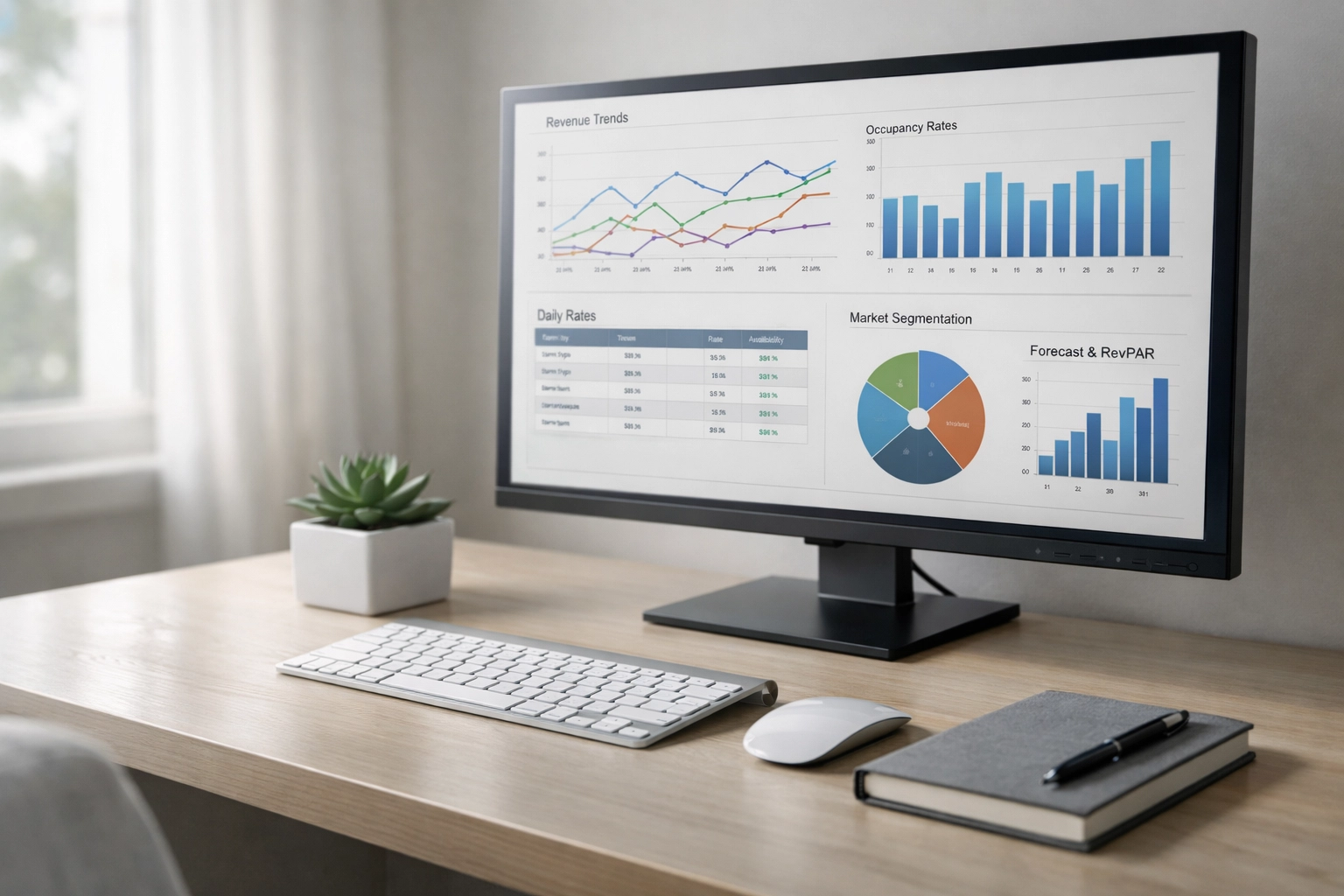
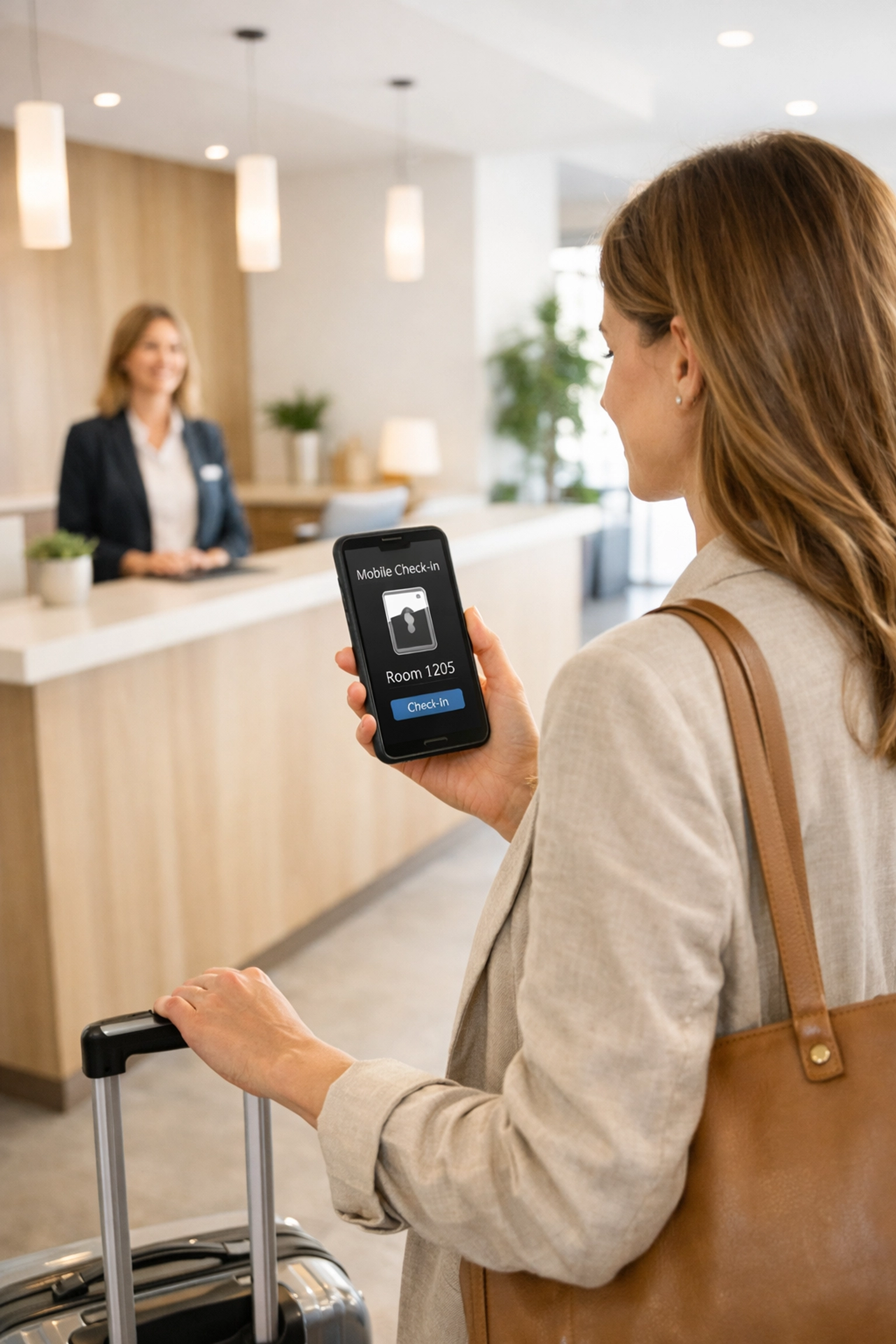
    4. Use Predictive Analytics to Know What Guests Want Before They Ask

    Traditional CRM systems tell you what happened. Cloud-native systems with AI tell you what's going to happen.

    Modern hotel CRM platforms analyze booking patterns, review sentiment, and guest behavior to predict:

    • Which guests are likely to book again (and when)
    • Who's at risk of churning
    • What upsells specific guest segments actually want
    • Which communication timing drives the best response rates

    This isn't guesswork. It's machine learning analyzing thousands of data points you'd never catch manually.

    One property manager put it simply: "We used to guess which guests to target for upgrades. Now the system tells us. Our upsell conversion rate doubled."

    5. Integrate Everything So You're Not Managing Ten Systems Separately

    Your booking engine. Your channel manager. Your payment processor. Your guest messaging platform. Your review management tool. Your revenue management system.

    Managing these separately is exhausting. Copying data between them is a waste of time. Missing integrations create data gaps that hurt your operation.

    Cloud-native platforms support hundreds (sometimes over 1,000) plug-and-play integrations. Connect your entire tech stack once. Let data flow automatically between systems.

    Hotel revenue manager workspace with analytics dashboard and pricing charts on monitor

    Your booking engine updates your hotel PMS. Your PMS updates your channel manager. Your channel manager updates your revenue management system. Your CRM pulls data from all of them. Everyone works from the same information.

    This is what cloud-native actually means: systems that talk to each other without manual intervention.

    Want to see how Mews handles this? Their platform connects seamlessly with everything from Google Hotel Ads to your favorite property management tools.

    6. Automate Revenue Management Across All Your Channels

    Manual rate management doesn't scale. By the time you've updated rates on Booking.com, Expedia's already out of sync. Your direct booking engine is showing yesterday's prices. Your channel manager needs another manual update.

    Cloud-native revenue management automates this entirely. Set your pricing rules once. Let machine learning adjust rates based on demand, competitor pricing, and historical data. Push updates to every channel simultaneously.

    The system monitors occupancy rates, seasonal trends, and market conditions. It adjusts pricing in real time. You review the results and refine your strategy: but you're not spending two hours every morning on manual rate updates.

    7. Enable Mobile Operations So Your Team Isn't Chained to the Front Desk

    Self check-in kiosks. Mobile keys. Contactless payments. Guest messaging through mobile apps.

    These aren't just pandemic-era conveniences. They're permanent efficiency gains that free your team to be where they're actually needed: on the floor with guests, not behind a desk processing paperwork.

    Cloud-native platforms make this possible because everything lives in the cloud. Your staff can check guests in from a tablet. Update room status from their phone. Answer guest questions from anywhere on property.

    One hotelier saved ten hours a week just by implementing mobile check-in. "My team used to be stuck at the desk during check-in rush. Now they're greeting guests in the lobby, helping with luggage, making recommendations. The actual hospitality part of hospitality."

    Hotel guest using smartphone for mobile check-in in modern lobby

    Stop Managing Your Systems. Start Running Your Hotel.

    These seven hacks share one thing: they eliminate manual work that doesn't need human judgment.

    Your team shouldn't copy data between systems. They shouldn't manually send routine emails. They shouldn't update rates across channels one by one. They shouldn't search for guest information in five different places.

    Cloud-native hotel CRM and PMS platforms automate all of this. Not someday. Right now.

    The hotels that embrace this automation don't just save time. They provide better guest experiences because their teams focus on guests instead of systems. They make smarter decisions because they have better data. They scale more easily because their operations aren't bottlenecked by manual processes.

    Want to see what modern hospitality technology actually looks like? Check out Mews: a cloud-native platform built specifically to automate everything we just talked about.

    Your manual processes aren't making you special. They're making you slow.

    Time to change that.

  • The 3 PM Productivity Hack: How an AI Assistant for Small Business Gets You Out of the Office on Time

    You know the feeling.

    It's 3:00 PM on a Thursday. You glance at your to-do list. Half the boxes are still unchecked. Your inbox has 47 unread messages. Three customers are waiting for responses. And you promised yourself, promised, you'd leave by 5:30 today.

    That promise is already broken.

    You're not leaving at 5:30. You'll be lucky if you're out by 7:00. Again.

    The worst part? Most of what's keeping you chained to your desk isn't even your work. It's admin. Emails. Scheduling. Customer questions you've answered 1,000 times. The repetitive stuff that eats your afternoons alive.

    But here's the thing…

    What if 3:00 PM could be your turning point instead of your breaking point?

    THE 3 PM WALL (AND WHY IT EXISTS)

    Overwhelmed small business owner at cluttered desk facing the 3 PM productivity wall

    Let's talk about what actually happens at 3:00 PM in most small businesses.

    You've survived the morning rush. Meetings are done. You've put out the urgent fires. Now you're supposed to tackle the real work, the strategic stuff, the growth projects, the things that actually move your business forward.

    Instead?

    You're drowning in busywork.

    Customer emails pour in. Someone needs an invoice. Another person wants to reschedule. Your social media needs attention. That report you started at 9 AM is still sitting at 30% complete.

    And every single interruption pushes your finish line further into the evening.

    This is the 3 PM wall. The moment when you realize your day isn't yours anymore. The moment when "leaving on time" becomes a fantasy.

    The brutal truth? You can't outwork this problem. You can't "time manage" your way out of it. You need a different approach entirely.

    You need help.

    But not the kind that requires hiring, training, or managing another person.

    MEET YOUR 3 PM SECRET WEAPON

    Here's what changes everything: an AI virtual assistant for business that actually handles the afternoon chaos for you.

    Not "helps you manage it better." Not "gives you tips to be more efficient."

    Handles it.

    While you're in that 3:00 PM meeting, your AI assistant is:

    • Responding to customer inquiries with accurate, helpful answers
    • Organizing your inbox and flagging what actually needs your attention
    • Scheduling appointments without the back-and-forth email tennis
    • Following up on leads who went quiet
    • Drafting social media posts for next week

    The work that normally eats your 3-7 PM window? It's getting done. In the background. Without you.

    And suddenly, leaving at 5:30 isn't a pipe dream. It's just… what you do.

    WHAT 3 PM ACTUALLY LOOKS LIKE NOW

    AI virtual assistant for business transforming chaos into calm productivity

    Let me show you how this plays out in real time.

    3:00 PM : The Meeting

    ☕ You're in a client call. It's running long, but it's important. Your phone is face-down on the desk.

    Behind the scenes, your AI assistant is triaging 23 new emails. Twelve are automated confirmations: archived. Six are customer questions: answered with your approved response templates. Three need your personal attention: flagged for 4:30. Two are spam: deleted.

    You finish the meeting at 3:45. You check your inbox.

    15 emails, down from 23. The important ones are clearly marked. The noise is gone.

    4:00 PM : The Customer Crisis (That Isn't)

    📱 A customer messages your support channel. They're confused about how to use a feature. Normally, this is a 20-minute back-and-forth that derails your afternoon.

    Your AI assistant sees the message. Recognizes the issue. Sends a clear, helpful response with screenshots and a video tutorial link.

    Problem solved in 90 seconds.

    The customer replies: "Perfect, thanks so much!"

    You didn't even know it happened.

    4:30 PM : The Real Work

    Now you're doing what you're actually good at. Strategy. Planning. The stuff that requires your brain, not your time.

    You're not context-switching between admin tasks. You're not interrupted every 8 minutes. You're in flow.

    You finish the project you started at 9 AM. The one that's been sitting at 30% for three days.

    Done.

    5:15 PM : The Wrap-Up

    🌙 You check your dashboard. Everything's handled. Tomorrow's calendar is organized. Your follow-up emails are drafted and ready to review.

    You close your laptop.

    At 5:25 PM.

    And you actually leave.

    THE MATH THAT CHANGES EVERYTHING

    AI assistant handling customer support and email management throughout the workday

    Let's get specific about what you're getting back.

    The average small business owner spends:

    • 2.5 hours per day on email management
    • 1.5 hours per day on scheduling and admin
    • 1 hour per day answering repetitive customer questions

    That's 5 hours. Every single day. Five hours that could be spent on growth, strategy, or: wild idea: having a life outside your business.

    When you automate customer support with AI and delegate admin tasks to a virtual assistant, you reclaim those hours.

    Not all at once. Not overnight. But quickly. Noticeably. Measurably.

    Within a week, you're leaving 30 minutes earlier. Within two weeks, you're leaving an hour earlier. Within a month, you've forgotten what it feels like to be the last one in the office.

    The 3 PM wall doesn't disappear. But you're not the one hitting it anymore. Your AI assistant is handling it while you do the work that actually matters.

    WHAT ABOUT THE "HUMAN TOUCH"?

    Here's the question everyone asks: "But won't my customers notice they're talking to AI?"

    Short answer: Only if you want them to.

    Modern AI assistants for small business aren't robotic chatbots spitting out canned responses. They're trained on your voice, your brand, your typical responses. They sound like you. Because they've learned from you.

    And for the 80% of customer questions that are repetitive? Your customers don't care if it's you or an AI. They care that they got a fast, accurate answer.

    For the 20% that need your personal touch? Those get flagged for you. The AI knows the difference.

    You stay human where it matters. You automate where it doesn't.

    THE ACTUAL 3 PM HACK (IN THREE STEPS)

    Small business owner reclaiming 5 hours daily with AI automation for work-life balance

    Ready for the tactical breakdown? Here's how to actually implement this.

    Step 1: Identify Your 3-7 PM Time Wasters

    Look at what you did between 3 PM and 7 PM yesterday. Write it down. Be honest.

    How much was:

    • Responding to routine emails?
    • Scheduling or rescheduling meetings?
    • Answering customer questions you've answered before?
    • Administrative follow-up tasks?

    That's your automation target list.

    Step 2: Deploy an AI Virtual Assistant for Business

    This isn't complicated. You don't need a tech degree or a massive budget.

    Modern AI assistants plug into your existing systems: your email, your CRM, your customer support channels. Setup takes hours, not weeks.

    You can see exactly how this works here.

    Step 3: Train It on Your 3 PM Patterns

    Your AI assistant learns from watching how you handle these tasks. You show it your response templates. Your scheduling preferences. Your brand voice.

    After a few days, it's handling them independently. After a week, you've forgotten they were ever on your plate.

    The 3 PM wall becomes the 3 PM handoff. You pass the baton. Your AI assistant runs the rest of the afternoon relay.

    WHAT YOU DO WITH THE EXTRA TIME IS UP TO YOU

    Here's the beautiful part.

    Once you're consistently leaving at 5:30 or 6:00 instead of 7:30 or 8:00, you have choices again.

    You can:

    • Actually have dinner with your family
    • Go to the gym before it closes
    • Work on that side project you've been putting off
    • Read a book that isn't about business
    • Simply… relax

    Or: and some of you will do this: you can use those reclaimed hours to grow faster. To take on one more client. To finally build that thing you've been planning.

    The point isn't what you do with the time.

    The point is that it's yours again.

    THE REAL PRODUCTIVITY HACK

    AI customer support providing personalized service vs robotic chatbot responses

    Here's what no productivity guru will tell you:

    The secret to getting out of the office on time isn't better time management. It's not waking up earlier. It's not the Pomodoro Technique or inbox zero or any other life hack.

    The secret is stopping the flood of low-value tasks that drown your afternoons.

    And the only way to stop the flood is to delegate it to someone: or something: that can handle it as well as you can, but without exhausting themselves.

    An AI assistant for small business doesn't get tired. Doesn't take breaks. Doesn't mind answering the same question for the 500th time.

    It just works.

    Which means you can stop working at a reasonable hour.

    YOUR NEXT STEP

    If you're reading this at 3 PM: or later: and you're still staring at an endless to-do list, here's what to do:

    Stop trying to outwork the problem. Start automating it.

    See how Marblism's AI assistants handle the afternoon chaos so you can actually leave when you planned to leave.

    Because here's the truth nobody tells you when you start a business:

    Working late doesn't make you dedicated. It makes you unavailable for everything else that matters.

    The most successful small business owners aren't the ones who work the longest hours.

    They're the ones who figured out how to reclaim their 3 PM.