Category: Category 1

Use this description to tell users what kind of blog posts they can find in this category.

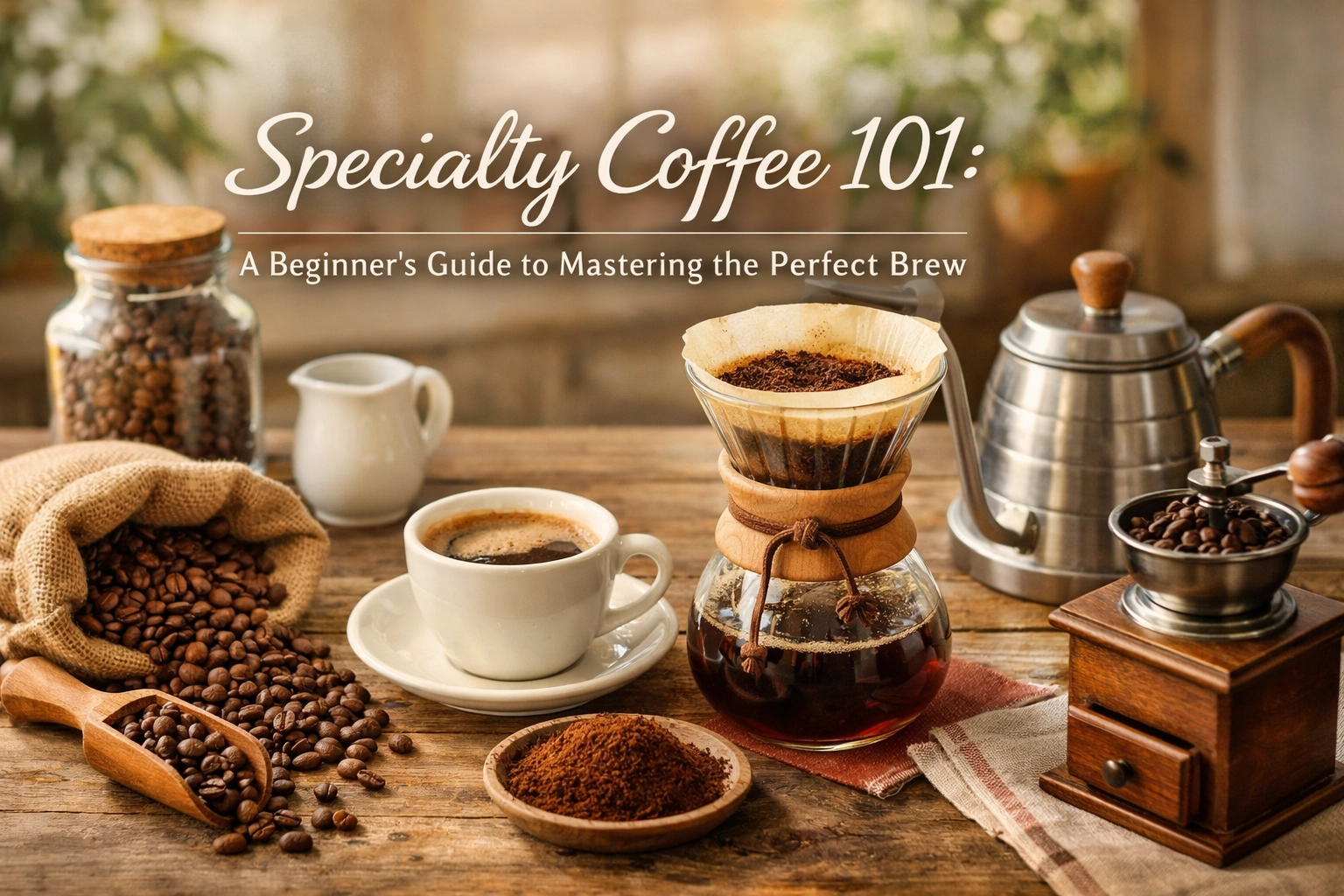
  • Specialty Coffee 101: A Beginner’s Guide to Mastering the Perfect Brew

    Specialty Coffee 101: A Beginner’s Guide to Mastering the Perfect Brew

    So, you’ve decided to step into the world of specialty coffee? Welcome to the rabbit hole. It’s a deep, aromatic, and sometimes slightly obsessive place to be, but we promise the view (and the taste) from here is significantly better than that jar of instant gathering dust in the back of your cupboard.

    For most of us, coffee starts as a caffeine delivery system: a bitter, hot liquid we drown in milk and sugar just to make it through a Tuesday morning. But specialty coffee? That’s an entirely different beast. It’s about clarity, terroir, and a level of craftsmanship that turns a simple morning ritual into a genuine experience.

    At Limini Coffee, we live and breathe this stuff. We spend our days roasting, tasting, and obsessing over variables so you don't have to: though, to be honest, once you start, you probably won't be able to stop.


    What Exactly is "Specialty" Coffee?

    You’ll see the word "specialty" thrown around a lot these days, often by big chains trying to look a bit more "boutique." But in our world, specialty has a very specific, technical meaning.

    The Specialty Coffee Association (SCA) uses a 100-point scale to grade coffee beans. To earn the title of "Specialty," a coffee must score 80 points or higher. Anything below that is considered "commodity" coffee: the kind of stuff that ends up in supermarket blends or those giant tins of pre-ground brown dust.

    So, why does the score matter? Because it represents quality at every single step of the journey. We’re talking about farmers who hand-pick only the ripest red cherries, careful processing to prevent defects, and meticulous sourcing to ensure we’re bringing you the best possible harvest. It’s the difference between a mass-produced table wine and a fine single-vineyard vintage.
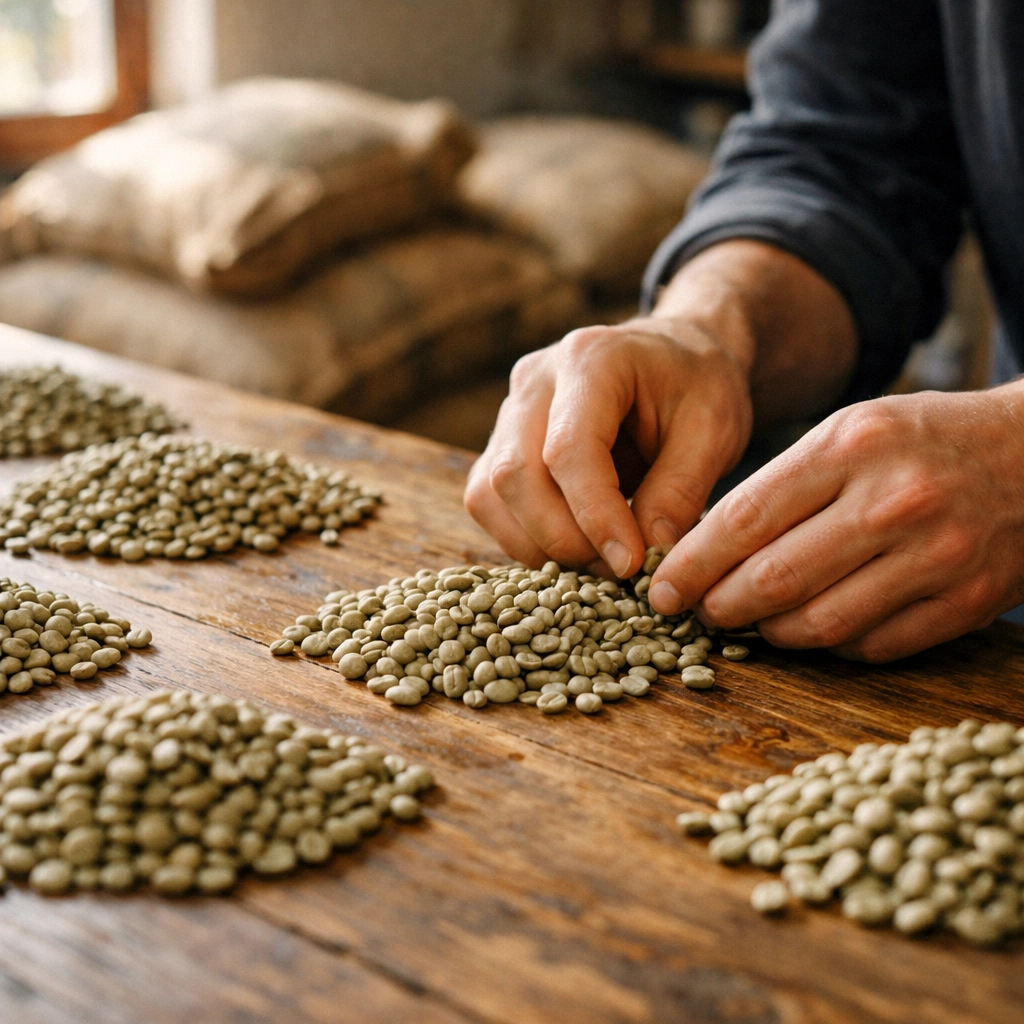
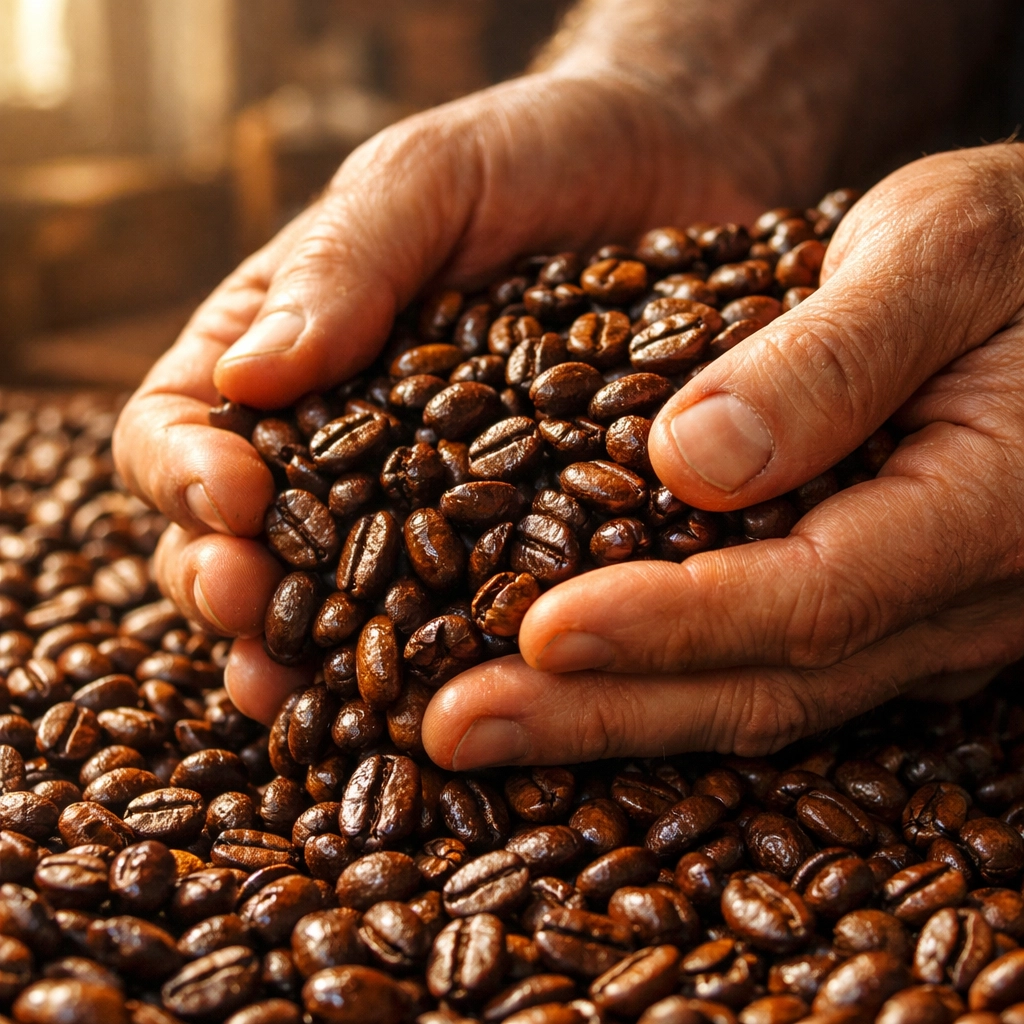
    Hands sorting green specialty coffee beans at a roastery to ensure high-quality sourcing.

    It Starts with the Bean (and the Roast)

    If you’ve spent any time looking at our shop, you’ve probably noticed two main categories: Blends and Single Origins.

    Single Origin coffees come from one specific place: a single farm, a specific region, or even a tiny "micro-lot" within a farm. These are for the explorers. When you drink a single origin from Ethiopia, you might taste blueberries and jasmine. A Brazilian single origin, on the other hand, might remind you of peanut butter and milk chocolate.

    Blends are where we get to be mad scientists. We take different beans and combine them to create a specific flavor profile that is consistent and balanced. These are usually the go-to for espresso because they play so well with milk.

    But the beans are only half the story. The roast is where the magic (and the science) happens.

    The Roast Profile Spectrum

    • Light Roasts: These are pulled out of the roaster just before or shortly after the "first crack." They preserve the most "origin character": the flavors inherent to the soil and climate where the coffee grew. Expect high acidity, tea-like bodies, and floral notes.
    • Medium Roasts: This is the sweet spot for many. It balances the natural acidity of the bean with a bit of "roastiness." You get more body and sweetness, like caramel or toasted nuts.
    • Dark Roasts: These are roasted longer, often until oils appear on the surface. While some commercial brands use dark roasting to hide low-quality beans, a specialty dark roast should still be sweet and bold, not burnt and ashy.

    The Golden Rules of Home Brewing

    You’ve got the bag of fresh Limini Coffee beans in your hand. Now what? You can have the most expensive beans in the world, but if your brewing technique is off, you’re going to end up with a disappointing cup.

    Here are the variables we think are most important for mastering the brew at home.

    1. Freshness is Everything

    Coffee is a fresh agricultural product. Once it’s roasted, it starts to lose its volatile aromatic compounds. This is why we always recommend buying whole beans and grinding them right before you brew. If you buy pre-ground coffee, the surface area is so high that it goes stale within hours. Trust us, a decent burr grinder is the best investment you’ll ever make.

    2. The Water Factor

    Coffee is roughly 98% water. If your tap water tastes like a swimming pool or is incredibly hard (full of minerals), your coffee will taste flat or metallic. We suggest using a simple water filter jug. It makes a massive difference to the clarity of flavor.

    Also, watch your temperature! Never use boiling water straight off the kettle (100 °C / 212 °F). It can "scorch" the coffee, leading to an unpleasant bitterness. We find the sweet spot is usually between 91 °C and 94 °C (195 °F to 202 °F).

    3. The Ratio

    Stop "eyeballing" your coffee scoops. To get a consistent brew, you need to use a scale. A standard starting point is the 1:16 ratio: 1 gram of coffee for every 16 grams of water. If you want to get technical (and we love technical), check out our coffee brewing calculator to dial in your recipe perfectly.
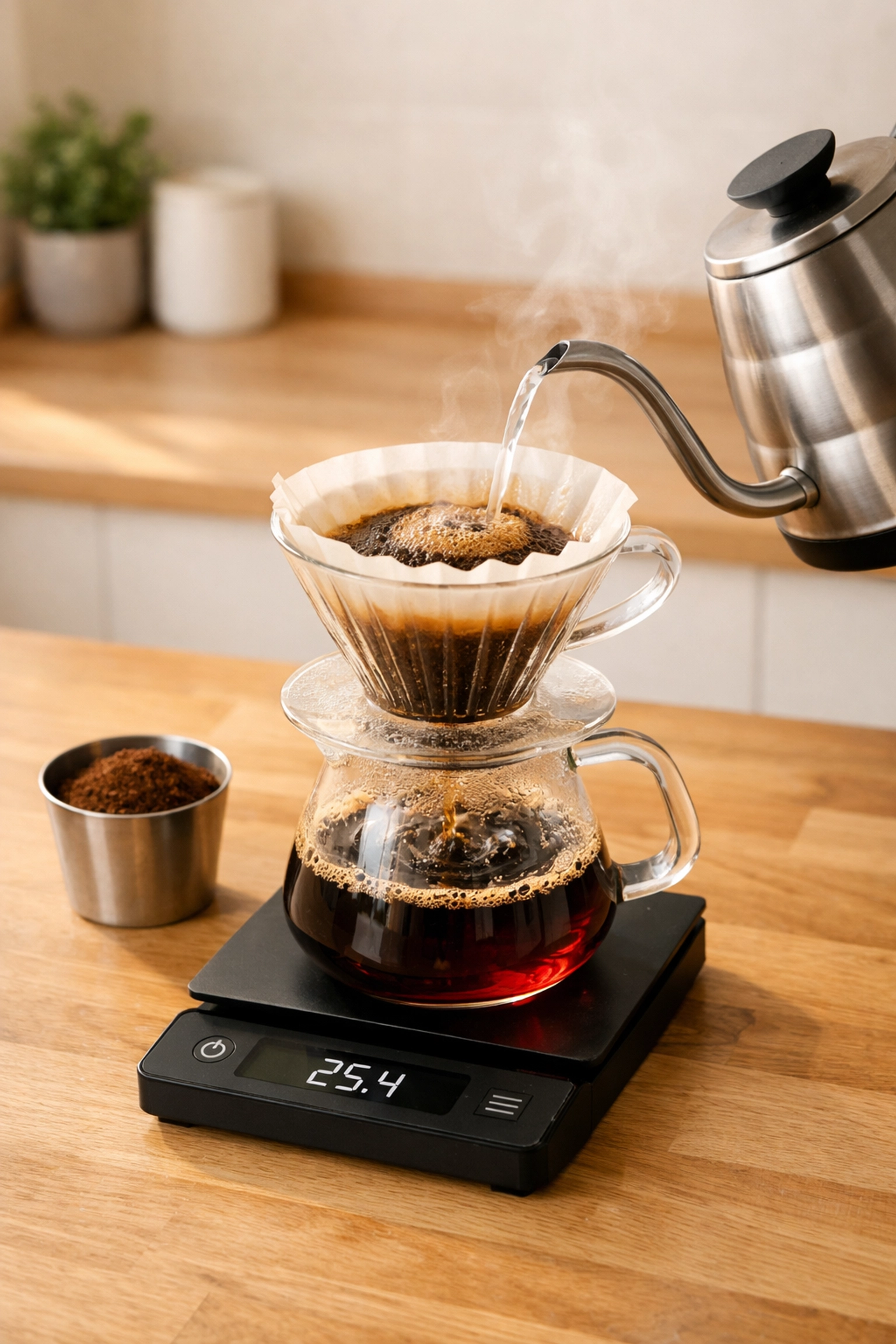
    A pour-over coffee brewing setup with a V60 dripper and digital scale on a kitchen counter.

    Choosing Your Method

    There is no "best" way to make coffee, only the way that suits your palate and your morning routine.

    The Pour Over (V60, Chemex)

    If you love clarity and want to taste those delicate floral or fruity notes in a single-origin coffee, this is for you. It uses a paper filter to remove most of the oils and fine particles, resulting in a clean, crisp cup. It requires a bit of technique (and a gooseneck kettle helps), but the results are incredibly rewarding.

    The French Press (Cafetière)

    The classic immersion brewer. It’s simple, reliable, and produces a heavy, textured body because the metal mesh filter lets all those delicious oils through. If you like your coffee "strong" and "bold," this is your best friend. Just make sure you use a coarse grind: if it’s too fine, it’ll be a muddy mess.

    Espresso

    The final boss of coffee brewing. Espresso requires pressure (usually 9 BAR) to force water through a very fine puck of coffee. It’s concentrated, intense, and forms that beautiful golden layer on top known as crema. If you're looking to dive into the world of home espresso, you’ll need to put some thought into choosing espresso equipment. It’s an investment, but having a cafe-quality flat white in your pyjamas? Priceless.


    Understanding the "Dial-In" Process

    When you start brewing specialty coffee, you’ll likely encounter two problems: your coffee is too sour, or it's too bitter. This is where "dialing in" comes in. It’s all about extraction: how much of the coffee flavor you’re pulling out of the grounds.

    • Under-extracted (Sour/Salty): The water didn't stay in contact with the coffee long enough, or the grind was too coarse. It tastes sharp and unpleasant.
    • Over-extracted (Bitter/Dry): The water took too much out of the coffee. This happens if the grind is too fine or the water is too hot. It leaves a drying sensation on your tongue.

    Basically, if it’s sour, grind finer. If it’s bitter, grind coarser. It’s a simple rule, but it’s the key to unlocking the "sweet spot" where the coffee tastes balanced and delicious.
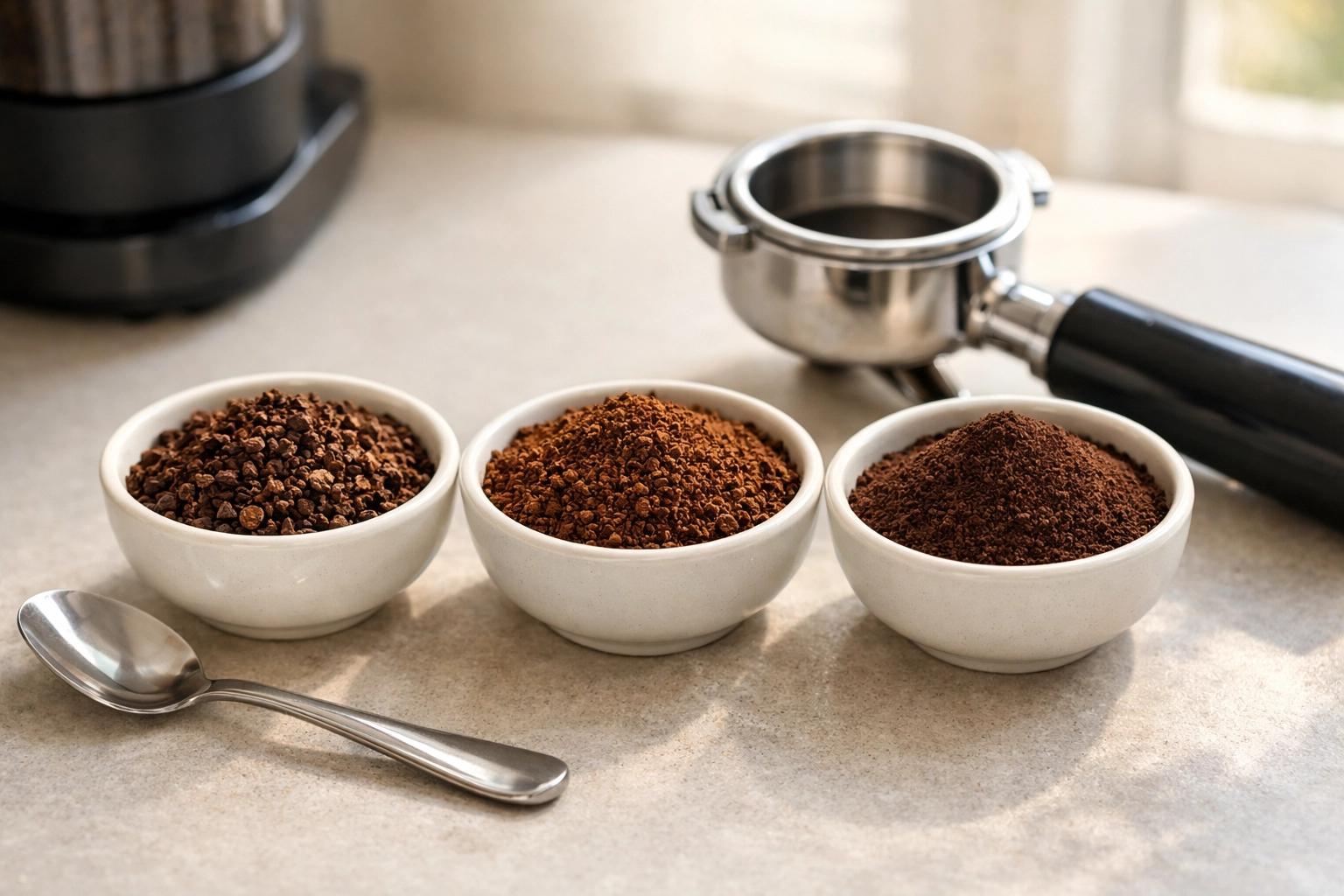
    Different coffee grind sizes from coarse to fine used for mastering specialty coffee extraction.

    The Joy of the Sensory Experience

    Once you’ve brewed your cup, don't just gulp it down! Take a second. Specialty coffee is meant to be tasted.

    Start with the Aroma. What do you smell? Is it nutty? Fruity? Like dark chocolate? Then, take a sip and think about the Acidity. In specialty coffee, acidity isn't a bad thing: it's brightness. Think of the difference between a dull red apple and a crisp green one.

    Next, consider the Body (or mouthfeel). Is it thin like tea, or creamy like whole milk? Finally, the Finish. Does the flavor disappear immediately, or does a pleasant sweetness linger on your palate?

    If you’re really serious about improving your palate, you might even consider some barista training. We love teaching people how to spot these nuances!


    Why We Do What We Do

    At the end of the day, coffee is about connection. It’s about the connection between the farmer in Colombia and the person sitting at their kitchen table in Yorkshire. Our job at Limini Coffee is to make sure that the hard work of the farmer isn't lost in the roasting process, and your job is to make sure it isn't lost in the brewing process.

    It might seem like a lot of information at first, but don't let it intimidate you. The "perfect" cup is whichever one you enjoy the most. Whether you’re looking for a high-end espresso machine or just a bag of fresh beans to kickstart your morning, we’re here to help.

    Ready to start your journey? Grab a bag of our latest roast at Limini Coffee and start experimenting. We promise your mornings will never be the same.

    Someone holding a warm mug of fresh roasted coffee next to whole beans and a manual grinder.

    Happy brewing! Whether you're chasing the perfect crema or trying to master the art of the latte, remember that the best part of coffee is the process itself. Take your time, enjoy the smells, and most importantly, enjoy the drink.

    If you ever find yourself stuck or wondering why your shots are pulling a bit weird, don't hesitate to reach out. We’ve spent years looking after espresso machines and training baristas, and we love nothing more than talking shop.

    Now, go put the kettle on. You’ve earned it.

  • Why ‘Local’ Isn’t Enough: The Case for Wholesale Specialty Coffee in Your Cafe

    Why ‘Local’ Isn’t Enough: The Case for Wholesale Specialty Coffee in Your Cafe

    We get it. The lure of the "local" label is incredibly strong. In the world of independent cafes, "local" feels like a warm hug. It suggests community, low carbon footprints, and a handshake deal with a guy named Dave who roasts in a garage three streets away. And honestly? We love that spirit. Supporting the neighborhood is part of the DNA of any great coffee shop.

    But here is the slightly uncomfortable truth we’ve learned over years in the industry: "Local" is a geographic descriptor, not a quality standard.

    When you are building a business, one that relies on repeat customers who can tell the difference between a flat white that tastes like blueberries and one that tastes like a burnt rubber tire, you need more than just proximity. You need a partner. Specifically, you need a wholesale specialty coffee partner.

    So, let’s talk about why your "local" roaster might be holding you back, and why making the switch to a dedicated coffee roaster wholesale specialist is the best long-term investment you can make for your cafe.


    Commercial vs. Specialty: The Great Divide

    Before we dive into the "why," we need to clear up the "what." In the wholesale world, there’s a massive chasm between "commercial" grade and "specialty" grade coffee.

    Commercial coffee is a commodity. It’s traded on global markets, focused on volume, and often roasted quite dark to mask the fact that the beans are… well, not great. It’s the stuff you find in most supermarkets and high-street chains. It’s consistent, sure, but it’s consistently mediocre.

    Specialty coffee, on the other hand, is a different beast entirely. To be labeled "specialty," coffee must score 80 points or higher on a 100-point scale by the Specialty Coffee Association (SCA). It’s about traceability, ethical sourcing, and roasting profiles that highlight the unique characteristics of the bean rather than hiding them.

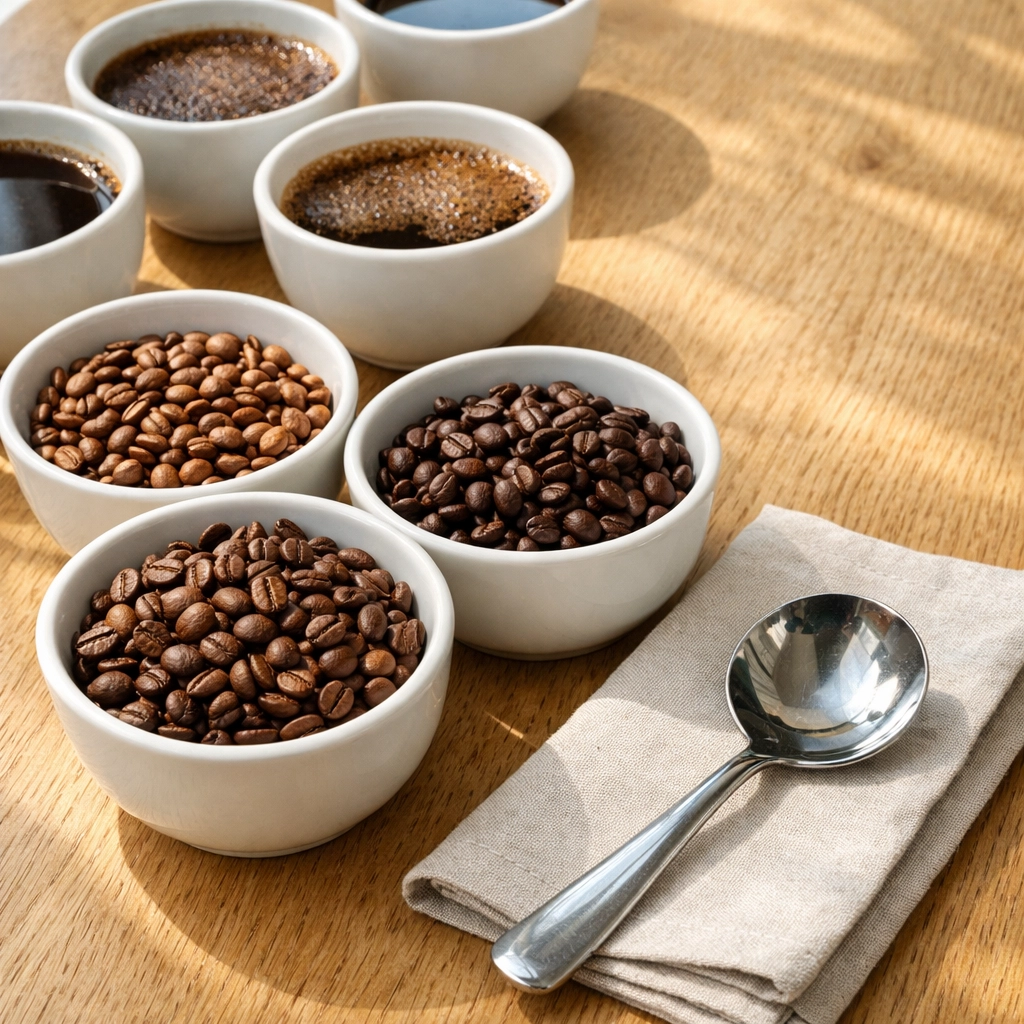
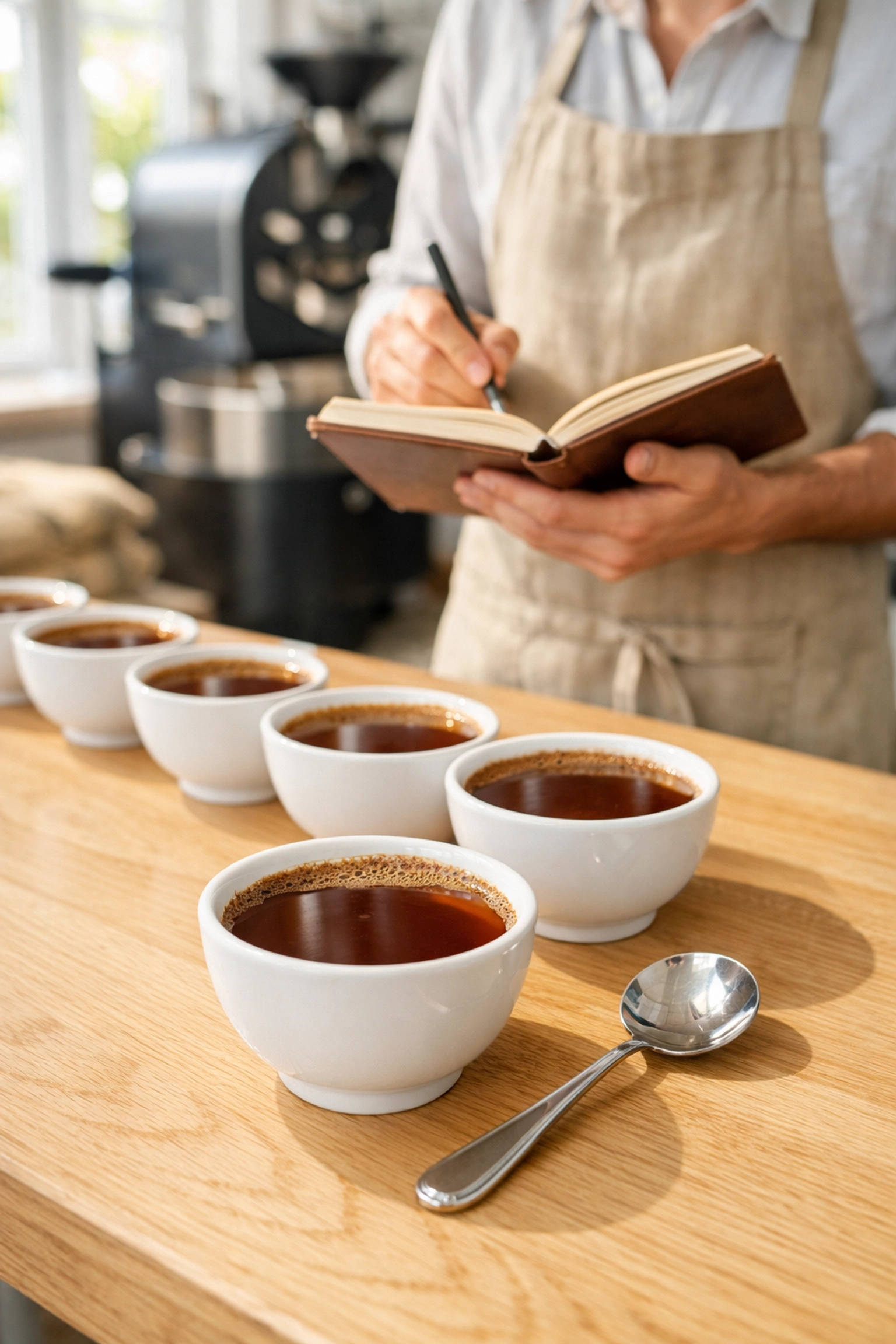
    Professional coffee cupping session evaluating wholesale specialty coffee for cafe quality.

    When you work with a coffee roaster wholesale partner like us, you aren't just buying beans; you’re buying into a supply chain that values quality at every single step, from the altitude of the farm to the precision of the roast. If you want to see how we handle our sourcing to ensure that quality, take a look at our process here.

    The Hidden Cost of "Cheap" Wholesale

    We’ve seen it a thousand times. A new cafe owner is looking at their margins and thinks, "If I buy this commercial-grade 'local' roast for £12 a kilo instead of a specialty roast for £18, I’ll save a fortune!"

    Math-wise, you aren't wrong in the short term. But business-wise? It’s a bit of a disaster.

    The problem is that commercial coffee often has a higher defect rate. This means more "off" shots, more wasted milk, and, most importantly, fewer customers coming back for a second cup. Specialty coffee has a much higher "sweet spot." It’s easier to dial in, and it stays delicious even as it cools.

    We believe that the extra 10p or 15p it costs you per cup to serve wholesale specialty coffee is the cheapest marketing budget you will ever have. It turns a casual visitor into a regular. And if you’re looking to really nail those margins while keeping quality high, Scott’s affiliate link is a great place to start exploring how we can help your bottom line without sacrificing the soul of your brew.


    Consistency: The Silent Killer of Cafes

    Imagine this: A customer comes in on Tuesday. The coffee is incredible. They come back on Friday, bringing a friend and raving about your espresso. But today, the "local" roaster had a bit of a temperamental day with their vintage Probat, or perhaps the green beans they sourced locally were from a different, slightly cheaper lot.

    Suddenly, that espresso is sour. Or bitter. Or just… flat.

    That customer won't tell you the coffee is bad. They’ll just never come back.

    A dedicated coffee roaster wholesale operation invests heavily in technology to prevent this. We’re talking about crop-to-cup consistency. We use sophisticated software to track roast curves, ensuring that the profile we developed for a specific Ethiopian Yirgacheffe is replicated perfectly, batch after batch, week after week.

    We also understand the technical side of the equipment. If your shots are tasting "off," it might not be the beans, it might be your tamping or your water temperature. We’re big fans of precision here; for example, understanding how tamping affects your extraction is vital. A good wholesale partner will help you troubleshoot these variables rather than just telling you to "adjust the grinder."

    Perfect espresso extraction with rich crema from a coffee roaster wholesale partner.

    More Than Just Beans: The Support System

    This is where the "Case for Specialty" really wins. A local hobbyist roaster can give you great beans, but can they give you a business strategy?

    When you partner with a professional wholesale specialty coffee provider, you’re gaining an entire support department. This includes:

    1. Staff Training: You can have the best beans in the world, but if your barista doesn't know the difference between a latte and a flat white (and yes, there is a huge difference), you're in trouble. We offer comprehensive barista training because we know our coffee only tastes as good as the person pulling the shot.
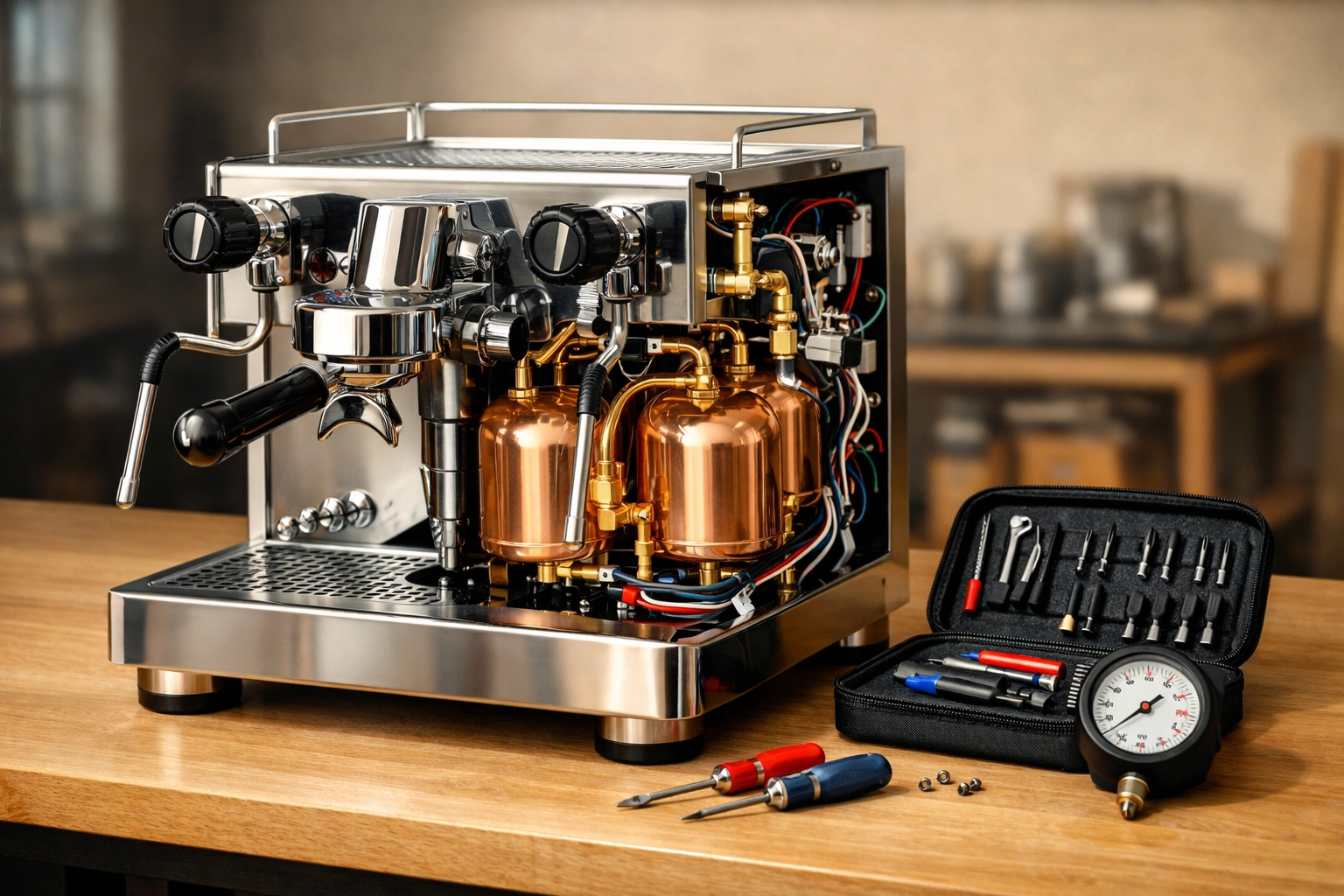
    2. Equipment Expertise: Should you go for a lever machine or an automatic? How do you look after your espresso machine so it doesn't die mid-Saturday rush? We’ve got guides on choosing the right equipment and maintaining your machine to keep your shop running smoothly.
    3. The "Theatre" of Coffee: In 2026, people don't just go to cafes for caffeine; they go for the experience. Specialty coffee allows you to lean into the theatre of coffee making, from the aroma of freshly ground beans to the intricate latte art.

    Branding and Identity

    Your cafe’s brand isn't just your logo; it’s the flavor profile people associate with your space. One of the best things about a coffee roaster wholesale partnership is the ability to create something unique.

    Many local roasters have one or two "house blends" and that’s it. A specialty wholesaler can help you source specific single-origin coffees that tell a story. You can tell your customers about the specific washing station in Rwanda or the altitude of the Colombian farm. This level of detail builds trust and authority.

    It also helps you stand out in a crowded market. If every cafe in town is using the "local guy," then every cafe in town tastes the same. By choosing a specialty partner who offers a diverse and rotating selection, you give people a reason to walk past three other shops to get to yours.

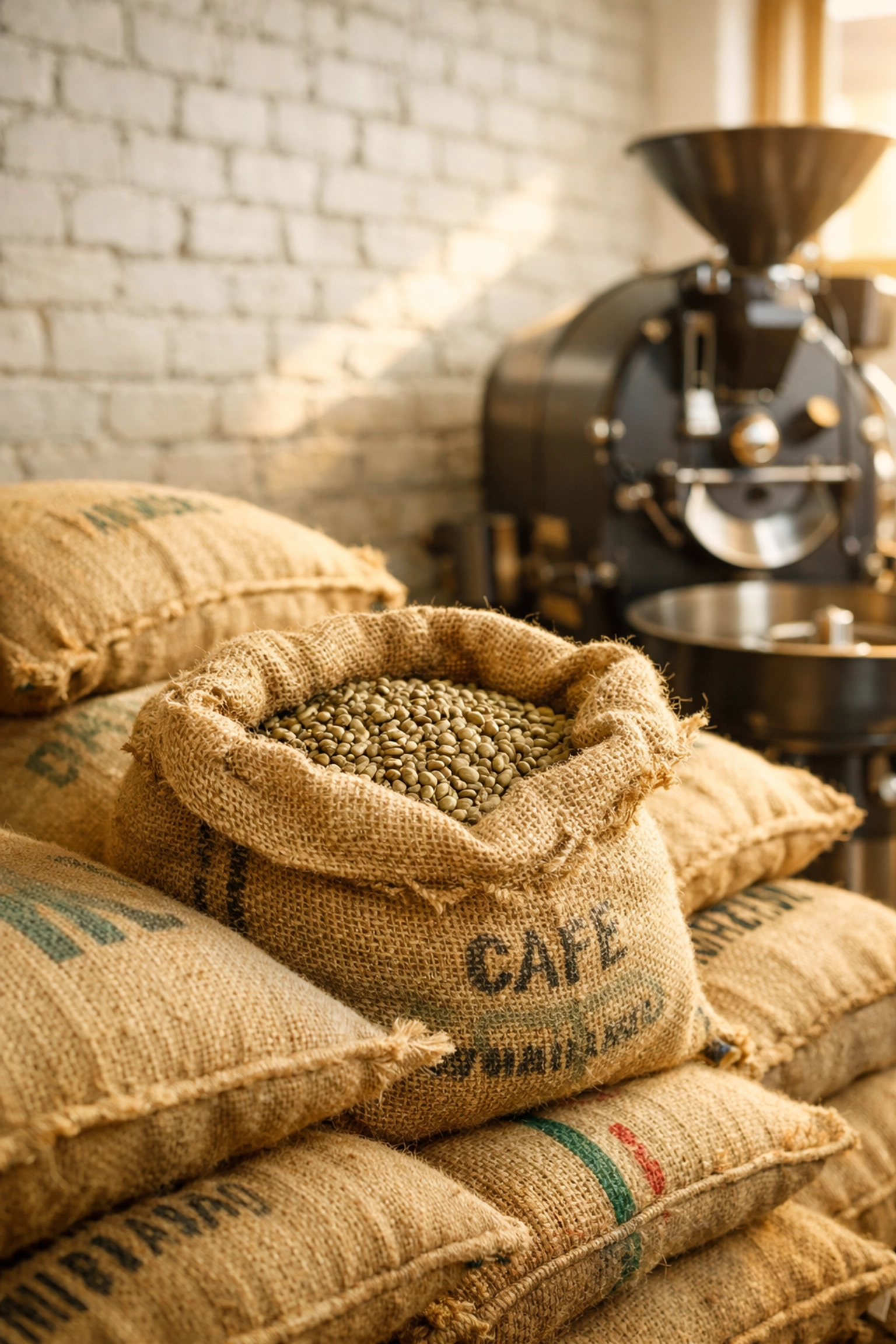
    Burlap sacks of green beans at a coffee roaster wholesale facility showing premium sourcing.

    The Technical Edge (For the Coffee Nerds)

    We promised some technicality, so here it is. Why does specialty coffee actually perform better in a commercial environment?

    It comes down to solubility and roast development. Commercial roasts are often "baked" or "flash roasted," which can lead to uneven extraction. You’ll find yourself constantly chasing the grind, adjusting for humidity, and still ending up with "channelling" (where water finds a path of least resistance through the puck).

    Specialty roasters focus on development. We ensure the heat has penetrated the center of the bean without scorching the outside. This results in a more uniform cell structure within the bean, which leads to a more predictable extraction. Whether you’re aiming for that perfect crema or trying to master the art of milk texturing, starting with a well-developed bean makes every other part of your job easier.


    Why Limini Coffee is Your Ideal Partner

    We don't just roast coffee; we live and breathe the cafe business. We know that opening a shop is a massive undertaking (which is why we wrote a guide on building a coffee shop and shop fitting). We know that you need more than a supplier, you need a consultant, a trainer, and a cheerleader.

    If you’re ready to move beyond "local" and start serving coffee that actually builds your brand, we’d love to chat. You can check out our wholesale options here, and if you want to see what other cafe owners think of our partnership, our reviews speak for themselves.

    And hey, if you’re just starting your journey and want some expert guidance on the best way to get set up with Limini, don't forget to use Scott’s link to see what we can do for you.

    Barista training session pouring latte art, part of a wholesale specialty coffee support system.

    Final Thoughts: The Long Game

    Opening a cafe is easy. Keeping a cafe open for five years is hard.

    The shops that survive are the ones that prioritize quality and consistency over the convenience of a local zip code. By investing in wholesale specialty coffee, you are telling your customers that you care about their experience. You’re telling your staff that you value their craft. And you’re telling yourself that your business deserves the best foundation possible.

    "Local" is a great place to start. But "Specialty" is how you win.

    So, next time you're looking at your coffee supply, ask yourself: Is this just the closest coffee, or is it the best coffee for my business? If the answer isn't a resounding "best," it might be time for a change. We're here when you're ready. ☕️

  • The Ultimate Guide to AI in Hospitality: Everything You Need to Succeed (The Easy Way)

    Automate the mundane. Elevate the human. Scale your success.

    The hospitality industry isn’t just changing; it’s being rewritten by lines of code that think, learn, and act. If you feel like you’re falling behind the curve, don't worry: you’re actually right on time. With 78% of hotel chains already integrating AI solutions, the technology has moved from "futuristic experiment" to "operational necessity" almost overnight.

    We believe that technology should serve people, not the other way around. AI in hospitality isn’t about replacing your front desk team with shiny metal robots; it’s about giving your staff the freedom to actually talk to guests while the software handles the heavy lifting. It’s about creating a guest experience so seamless it feels like magic.

    All from one innovative platform.

    Personalization at scale

    We believe the "standard" guest experience is a relic of the past. Today’s travelers don't want a room; they want their room. AI allows you to deliver that level of detail without needing a psychic on the payroll.

    Data shows that approximately 80% of hotels are already using or planning to use AI to present guests with personalized offers. This isn't just about putting their name on a TV screen. It’s about knowing they prefer a high floor, oat milk in their coffee, and a 6:00 AM yoga session before they even pull into the driveway.

    • Anticipate needs. AI analyzes past behavior to suggest amenities before the guest asks.
    • Real-time adjustments. Shift room temperatures or lighting based on saved preferences.
    • Smart recommendations. Offer local dining spots based on a guest’s actual interests, not just a generic brochure.

    Personalized hotel room service tray with coffee and fruit, reflecting AI-driven guest preferences.

    The 24/7 digital concierge

    The modern guest doesn’t want to wait in line at 11:00 PM to ask for an extra pillow. They want to send a quick text and see that pillow arrive in minutes. AI-powered chatbots and virtual assistants provide that instant gratification in multiple languages, 24 hours a day.

    These systems do more than just answer FAQs. They learn. If your AI notices a spike in guests asking about pet policies or EV charging, it flags that trend so you can proactively address it in your booking flow. It’s a virtuous cycle of communication that keeps your staff focused on complex human interactions rather than repeating the Wi-Fi password for the hundredth time.

    "Using AI for basic guest inquiries saved our front desk 10 hours a week," says one Mews partner. "Our team is happier, and our guests feel heard instantly."

    Revenue management that never sleeps

    Pricing a hotel room used to be a guessing game based on last year’s spreadsheets. Not anymore. AI-based reservation technology and dynamic pricing tools analyze the world in real-time.

    From local concerts and sporting events to sudden shifts in weather or flight cancellations, AI adjusts your rates across all distribution channels instantly. It ensures you aren't leaving money on the table during peak demand and stays competitive when the market cools down.

    • Dynamic pricing. Real-time rate adjustments based on global and local demand.
    • Inventory optimization. Manage room blocks and OTA distributions automatically.
    • RevPAR growth. Maximize revenue per available room through intelligent forecasting.

    Modern hotel lounge at night, illustrating data-driven revenue management and market demand forecasting.

    Operational excellence behind the scenes

    The most powerful AI is the kind your guests never see. It’s the "invisible engine" that keeps the building running smoothly. Predictive maintenance is a prime example. By analyzing data from smart room devices, AI can detect that an AC unit is working too hard before it actually breaks down.

    Instead of a guest complaining about a hot room at midnight, your maintenance team gets a proactive alert to swap a filter during the day. This reduces downtime, saves on emergency repair costs, and: most importantly: prevents a bad review before it happens.

    We think operational headaches should be a thing of the past. AI also optimizes housekeeping schedules, ensuring rooms are cleaned in the most efficient order based on check-out times and priority arrivals. It’s about working smarter, not harder.

    Data-driven decision making

    Stop guessing and start knowing. AI doesn’t just collect data; it interprets it. Sentiment analysis allows you to scan thousands of guest reviews and feedback forms to find the signal in the noise.

    If guests at your London property are raving about the breakfast but complaining about the check-in speed in Paris, you’ll know exactly where to allocate your resources.

    • Pattern recognition. Identify seasonal trends before they happen.
    • Sentiment analysis. Understand the "why" behind your guest satisfaction scores.
    • Cost management. Predict staffing needs to avoid over-scheduling during slow periods.

    Sunlit hotel corridor with fresh linens, representing operational excellence and automated efficiency.

    How to get started (The Easy Way)

    Implementing AI doesn't require a degree in computer science. It requires the right foundation. At Mews, we’ve built a platform that integrates the world’s most advanced AI tools directly into your daily workflow.

    1. Audit your pain points. Where is your team spending the most time on manual tasks?
    2. Choose a flexible PMS. Ensure your core software can talk to the latest AI integrations.
    3. Start small. Launch a chatbot or a dynamic pricing tool, then scale up as you see the ROI.

    If you’re ready to see how innovation can transform your property, check out how Mews is leading the charge.

    The future is human-centric

    Despite all the talk of algorithms and automation, the heart of hospitality remains human connection. AI is simply the tool that clears away the administrative clutter so those connections can happen.

    89% of hotel chains are planning to expand their AI implementations because it works. It increases RevPAR, boosts guest loyalty, and makes life easier for your staff. In an industry built on service, the most innovative thing you can do is give your team the time to actually serve.

    Schedule a 30-minute demo. Get your team on board. Start seeing results.

    The transition to an AI-powered property is easier than you think, and it will get you earning more revenue in no time.

    Friendly guest interaction in a modern hotel lobby, highlighting human-centric hospitality technology.

    Why wait for the future?

    The "Ultimate Guide" to AI isn't a thick manual: it's a mindset. It’s the realization that technology is here to support your vision of hospitality, not replace it. Whether you manage a boutique hotel or a global chain, the tools are ready for you.

    • 12,500 properties are already rethinking hospitality.
    • 78% of the industry is already on board.
    • 1 platform to manage it all.

    Don't let the technical jargon intimidate you. AI in hospitality is about one thing: making people happy. And when your guests are happy, your business thrives. It’s that simple.

    Ready to join the revolution? Discover the Mews ecosystem today and turn your property into a future-proof powerhouse.

  • Hotel PMS vs. The “Franken-stack”: A Horror Story with a Happy Ending

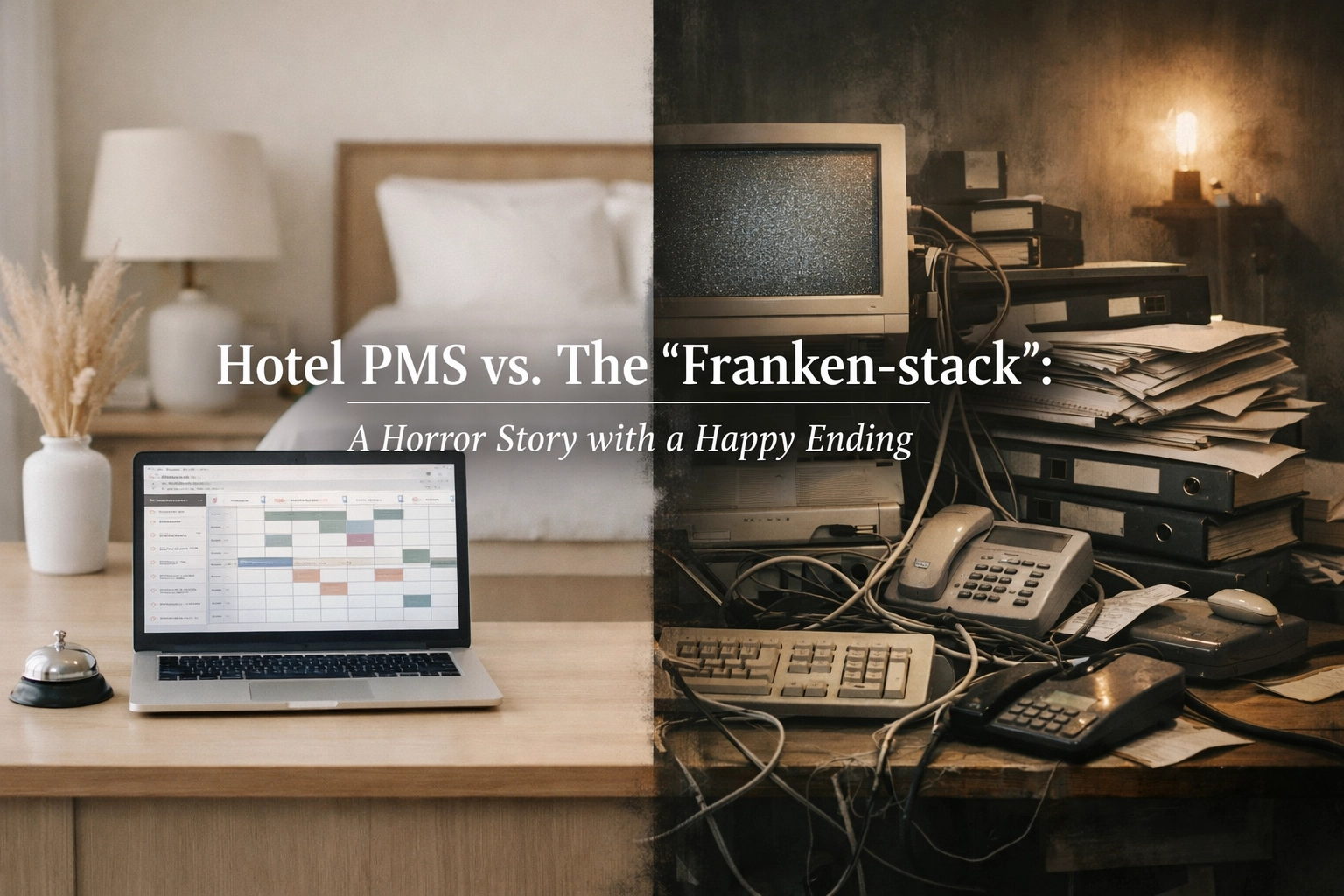
    Hotel PMS vs. The “Franken-stack”: A Horror Story with a Happy Ending

    It’s 8:02 AM on a Saturday. The lobby is filling up. A tour group just arrived three hours early, a guest is complaining that their digital key doesn’t work, and your breakfast server is shouting that the POS system isn't "talking" to the front desk.

    In the middle of it all sits your Night Manager, staring at a screen that looks like a control panel from a 1980s Soviet submarine. He has 14 tabs open. He’s trying to manually copy a credit card number from an OTA email into a separate payment gateway while cross-referencing a spreadsheet that, hopefully, contains the most recent room availability.

    This isn't just a busy morning. This is an encounter with the Franken-stack.

    We’ve all seen it. We’ve all lived it. It’s the result of years of "bolting on" new technology to a legacy Property Management System (PMS) that was never designed to handle the modern guest journey. It’s a monster made of mismatched parts, held together by digital duct tape and the sheer willpower of your exhausted staff.

    But there’s a better way. A way that doesn't involve screaming at a server rack in the basement.

    Meet the Monster: What is a Franken-stack?

    The Franken-stack isn't one single product. It’s a collection of 10 to 20 disconnected systems that were forced to play nice together. You have a legacy PMS from the 90s. You have a third-party channel manager. You have a standalone payment processor. You have a separate CRM.

    On paper, they’re "integrated." In reality, they communicate through carrier pigeons, or worse, manual data entry.

    The symptoms are easy to spot:

    • Staff spend more time looking at screens than at guests.
    • Data "sync errors" are a daily occurrence.
    • Onboarding a new employee takes three weeks of intensive training.
    • The "system is down" is a common phrase in your lobby.

    When your technology is fragmented, your guest experience is fragmented. You can't offer a seamless check-in if your PMS doesn't know the guest already paid through an external link. You can't offer a personalized stay if your CRM is three days behind your front desk.

    A cluttered hotel back-office desk with tangled cables and mismatched monitors representing a fragmented tech stack.

    The Horror: Why the Franken-stack is Killing Your Vibe

    The real cost of a Franken-stack isn't just the monthly subscription fees for twenty different vendors. It’s the human cost. It’s the invisible tax on your team’s mental health and your guest’s patience.

    1. The "Tab-Hopping" Fatigue
    Imagine being a receptionist. A guest wants to upgrade their room and pay the difference. To do this, the receptionist has to:

    • Update the room in the PMS.
    • Open the payment gateway to charge the card.
    • Manually type the transaction ID back into the PMS.
    • Refresh the Channel Manager to ensure the inventory is correct.
    • Hope the printer actually recognizes the command from the legacy driver.

    By the time the transaction is done, the guest has checked their watch four times and your staff member has a brewing migraine. This isn't hospitality. It's data entry under pressure.

    2. The Onboarding Nightmare
    In an industry with high turnover, speed to productivity is everything. With a modern, intuitive platform, a new hire should be ready to check in a guest within hours. With a Franken-stack? You’re looking at weeks of "If the screen freezes, press F12, but only if it’s a Tuesday."

    3. The Guest Who Feels Like a Number
    Guests today expect the "Netflix experience." They want you to know who they are, what they like, and how they want to pay. When your systems don't talk, you end up asking for their passport and credit card three different times. It feels clunky. It feels dated. It feels like a horror movie where the guest is the victim of bad tech.

    The Turning Point: Finding the Happy Ending

    Every good horror story needs a hero. In this case, the hero isn't a person, it's a philosophy. It’s the shift from "fragmented legacy" to "unified cloud-native."

    We believe technology should disappear into the background. It should enable hospitality, not hinder it. That’s where a platform like Mews comes in. Instead of a patchwork of parts, you get a cohesive ecosystem designed to work as one.

    See what a unified platform can do:

    • Automate the boring stuff: Stop manually entering credit card details.
    • Empower your guests: Let them check in on the train via their phone.
    • Free your staff: Move the "front desk" to a tablet so your team can roam the lobby.

    A stressed hotel receptionist working on multiple screens, showing the operational burden of legacy hotel systems.

    Why Cloud-Native Changes Everything

    A "cloud-native" PMS isn't just a legacy system that someone moved onto a remote server. It’s built from the ground up for the internet age. It uses open APIs, which means it actually likes talking to other software.

    When you move to a unified platform, the "Franken-stack" starts to dissolve. You don't need a separate payment gateway if payments are built into the core of the system. You don't need a clunky middleware for your door locks if the integration is native and bi-directional.

    The impact of consolidation:

    • 500+ hours saved: Modern systems save hotels more than 500 hours of labor annually through automation.
    • Real-time data: No more waiting for the "Night Audit" to see how you're performing.
    • One invoice: Stop chasing twenty different vendors for support.

    We think your tech stack should be a competitive advantage, not a source of stress. When your systems are unified, you stop "managing software" and start "managing a hotel."

    Case Study: From Chaos to Calm

    Consider a 100-room boutique hotel that made the switch. Before, they were losing three hours a day just reconciling payments. Their "Franken-stack" was causing overbookings because the channel manager would lag by ten minutes during peak times.

    After switching to a unified, cloud-native PMS, the results were almost immediate.

    • Check-in time dropped from 6 minutes to 90 seconds.
    • Overbookings vanished.
    • Staff turnover decreased because the team actually enjoyed using the software.

    "It felt like we finally turned the lights on," says one General Manager. "We realized we had been working in the dark for years, just trying not to trip over our own technology."

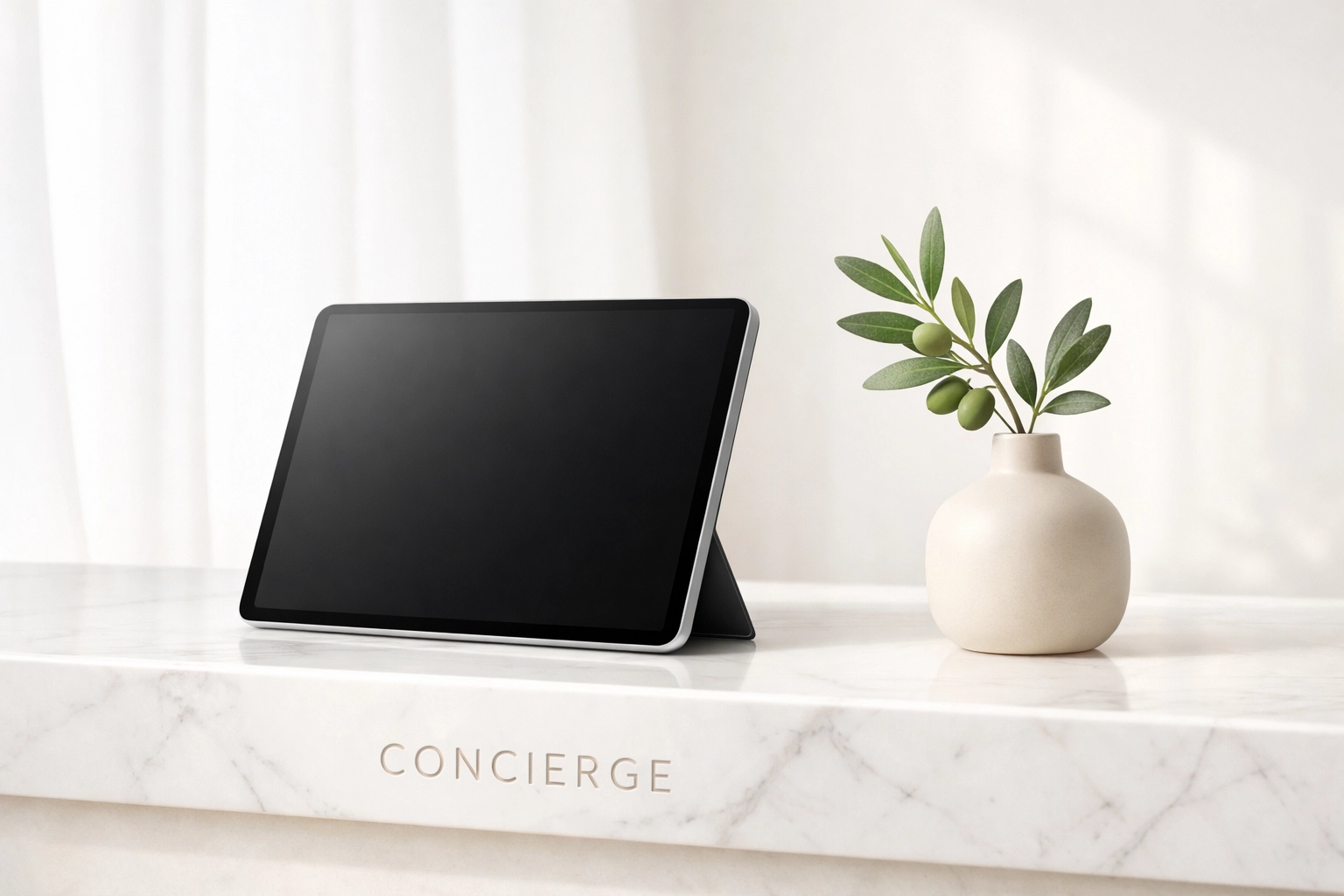
    A sleek tablet on a minimalist marble desk symbolizing a modern, unified cloud-native hotel management platform.

    The Happy Ending is Within Reach

    Transitioning away from a Franken-stack can feel scary. You’ve lived with the monster for so long that you’ve learned how to soothe it. You know which buttons not to press. You’ve grown attached to your spreadsheets.

    But the "Happy Ending" isn't just a dream. It’s a measurable improvement in your bottom line and your team’s happiness.

    Three steps to kill the monster:

    1. Audit your stack: List every piece of software you use. Ask: "Does this talk to my PMS automatically?" If the answer is no, it’s a limb of the Franken-stack.
    2. Focus on the Guest: Identify where tech friction is slowing down the guest journey. Is it check-in? Is it billing?
    3. Choose a Platform, Not a Tool: Look for a solution that handles the core of your business: reservations, payments, and guest journeys: all from one innovative platform.

    A hotel staff member using a mobile device to assist a guest, highlighting seamless hospitality and connection.

    Ready to ditch the horror story?

    You don't have to live in a digital haunted house. The transition to a modern, cloud-native PMS is easier than you think, and the rewards are waiting for you on the other side.

    Imagine a world where your morning shift starts with coffee and conversation, not a battle with a crashing server. Imagine a world where your guests feel recognized and valued from the moment they book.

    That world exists. And it doesn't involve any "Franken-stack" monsters.

    Get started today.
    Experience what it feels like to have a system that works for you, not against you.

    Explore the future of hospitality with Mews

    We believe in making life easier for hoteliers. We believe in the power of a unified platform. And most importantly, we believe your story deserves a happy ending.

    Let’s build a tech stack you actually love. All from one innovative platform. All designed to get you earning revenue and delighting guests in no time.

    A calm, modern hotel lobby with minimalist design illustrating an efficient and integrated hotel operation.

  • Why Your Choice of Wholesale Coffee Roasters Will Change the Way You Run Your Business

    Why Your Choice of Wholesale Coffee Roasters Will Change the Way You Run Your Business

    So, you’ve finally decided to take the plunge. You’re opening a café, or perhaps you’re looking to level up your current setup. You’ve got the perfect location, the décor is looking sharp, and you’ve spent hours agonizing over the font for your menu. But then comes the big one: choosing your coffee suppliers.

    It’s easy to think that coffee is just coffee. You find a bag with a nice label, check the price per kilo, and get on with it. But honestly? That is a recipe for a very stressful life. Your choice of wholesale coffee roasters is probably the most significant decision you’ll make for your business. It’s the difference between a café that runs like a well-oiled machine and one that’s constantly putting out fires (sometimes literally, if the grinder isn't set right).

    At Limini Coffee, we’ve seen it all. We’ve seen startups soar because they had the right support, and we’ve seen talented people struggle because their supplier treated them like just another number on a spreadsheet.

    It’s About More Than Just the Beans

    When you’re looking for wholesale coffee roasters, you aren't just buying beans; you’re buying into a partnership. A good roaster should be your silent partner, your technical support, and your chief cheerleader all rolled into one.

    The reality of the specialty coffee world is that the product is delicate. Unlike commodity coffee that’s roasted until it tastes like charcoal (which stays "consistent" only because it's burnt), specialty coffee is a living, breathing thing. It changes with the weather, the humidity, and the age of the roast. If your supplier just drops a pallet of bags at your door and disappears, you’re on your own when the shots start pulling at 15 seconds and tasting like vinegar.

    This is why we believe that the relationship is everything. You need someone who understands sourcing our coffee isn't just a marketing slogan, but a commitment to quality that translates directly to your bottom line.

    Quality-focused inspection of roasted specialty coffee beans from a wholesale coffee roaster.

    Quality and the "First Sip" Factor

    We all know that first-time customers are easy to get, but repeat customers are what keep the lights on. That "first sip" factor is dictated entirely by the consistency of your roaster.

    Large national distributors often treat coffee as a commodity. They roast in massive batches, and by the time that bag reaches your hopper, it could have been sitting in a warehouse for months. Specialty roasters, on the other hand, prioritize small-batch roasting. This means the coffee is fresh, the oils are intact, and the flavor profile is exactly what it was meant to be.

    Consistency is the holy grail of the coffee shop world. If a customer has a life-changing flat white on Tuesday, they expect that same experience on Friday. If your roaster fluctuates in quality from batch to batch, your reputation will take a hit. We take this extremely seriously here. We want your customers to know that every time they walk through your door, they’re getting the best version of that bean possible.

    The Burdens of Operation: Training is Your Secret Weapon

    You could have the most expensive espresso machine in the world and the highest-rated beans, but if your team doesn't know how to use them, it’s all for nothing. We like to say that putting an untrained barista behind a high-end machine is like giving a Ferrari to a learner driver. It’s probably not going to end well.

    A top-tier wholesale coffee roaster provides more than just product: they provide knowledge. One of the biggest shifts in how you run your business will come from the coffee barista training your supplier offers.

    Does your team understand how to tamp correctly? Do they understand the science of milk? Understanding the difference between a latte and a cappuccino is basic, but understanding milk at a molecular level: knowing how to stretch it to exactly 60°C (140°F) for that silky texture: is what sets you apart.

    When your roaster handles the training, it takes a massive weight off your shoulders. You don’t have to be the expert in everything. You can focus on the building of your coffee shop while we ensure your staff are pulling perfect shots with gorgeous crema every single time.

    Skillful barista pouring latte art, demonstrating the results of specialty coffee training.

    Technical Support: When Things Go Wrong (And They Will)

    Imagine it’s a Saturday morning. You have a queue out the door. Suddenly, your espresso machine starts acting up. The pressure is dropping, or maybe it’s leaking from the group head. If you bought your machine from a random website and your beans from another, who do you call?

    This is where your choice of wholesale coffee roaster changes your daily life. A supplier like Limini Coffee doesn't just sell you the coffee; we help you with choosing espresso equipment and, more importantly, looking after it.

    We often recommend equipment that we know inside out, like the La Spaziale range. Knowing the workings of a La Spaziale means we can often troubleshoot issues over the phone, saving you a costly call-out fee and, more importantly, saving your Saturday trade. If you’re curious about how these machines actually put a drink together, you can even check out the makings of a La Spaziale.

    Supply Chain Reliability: The Silent Killer

    There is nothing quite as terrifying for a café owner as realizing you’re down to your last two bags of espresso on a Thursday afternoon and your supplier isn't answering the phone.

    Reliability in your supply chain is the backbone of your operational efficiency. You need a roaster who has a proven track record of consistent production and delivery schedules. When you work with established coffee suppliers, you aren't just paying for the beans; you’re paying for the peace of mind that those beans will actually arrive when they're supposed to.

    Stock-outs disrupt your service, frustrate your staff, and drive your customers to the shop down the road. A reliable wholesale partner works with you to predict your needs, especially as you grow.

    Ordered bags of wholesale coffee on a shelf, ensuring supply chain reliability for café owners.

    The "Theatre" of Coffee

    Running a coffee business isn't just about the caffeine hit; it's about the experience. We call this theatre. From the sound of the grinder to the way the milk is poured, everything is a performance for the customer.

    Your roaster should help you curate this. This includes the small details, like choosing the right coffee cups for your brand. Does a heavy ceramic mug fit your vibe, or are you looking for something sleek and modern? These decisions affect the perceived value of your product.

    And let’s talk about the coffee brewing calculator. Using tools like this allows your baristas to be precise. Precision looks professional. It shows the customer that you care about the science behind the cup, which in turn justifies a specialty price point.

    Scaling Your Business

    If you’re planning on opening a second or third location, your roaster becomes even more vital. You need a partner who can scale with you. This involves discounted wholesale pricing for volume orders, but also the logistical capability to support multiple sites.

    A good roaster will help you maintain the same standards across all locations. They’ll ensure the training overview remains consistent so that a customer at Shop A gets the same experience as a customer at Shop B. This is the only way to build a brand that lasts.

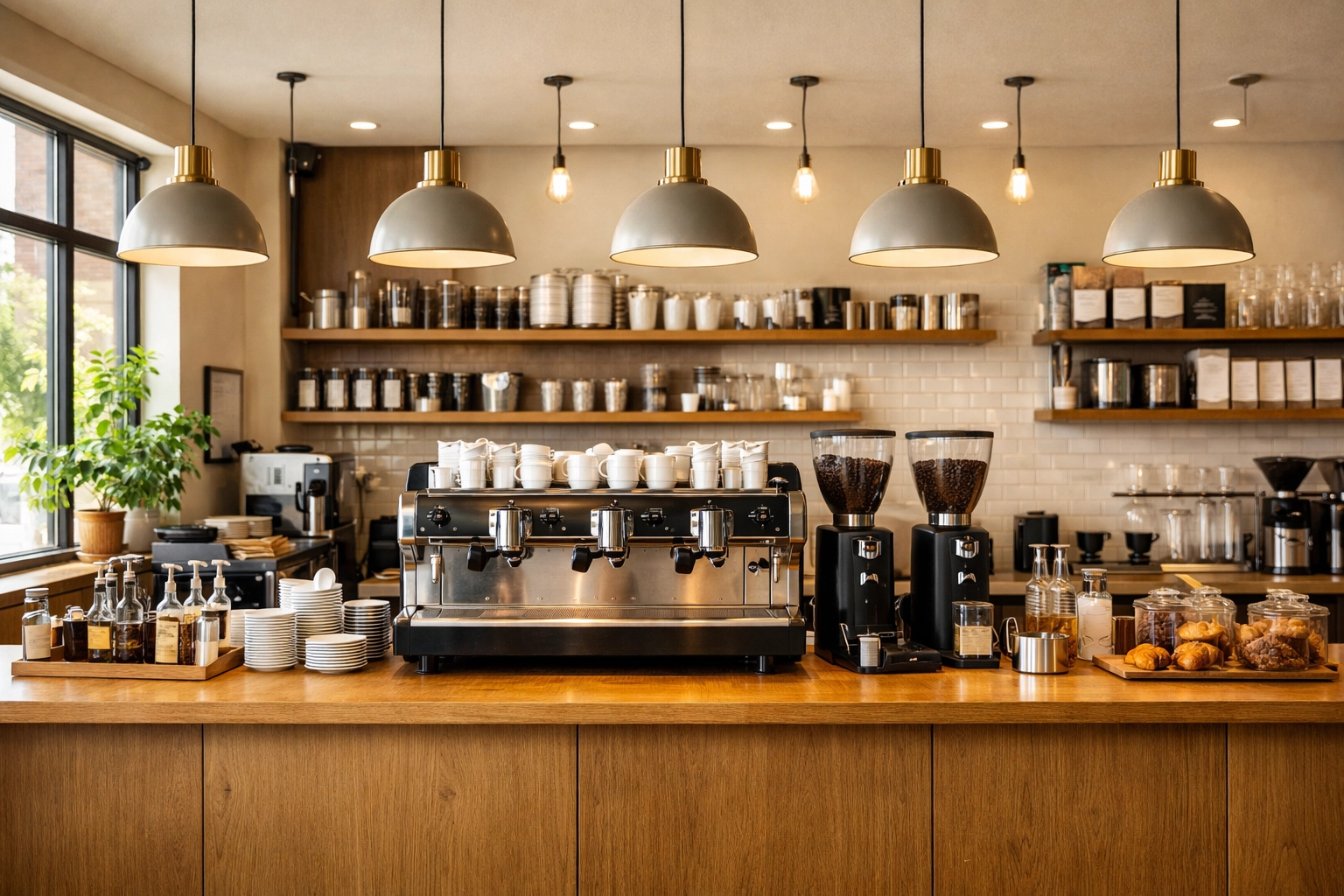
    Sun-drenched specialty coffee shop interior showcasing professional equipment and business growth.

    Why We Do What We Do

    At the end of the day, we’re coffee geeks who love seeing businesses succeed. We’ve spent years refining our processes, from the way we roast to the way we teach. We believe that the best coffee comes from a place of passion and precision.

    If you’re looking for a wholesale partner who will actually pick up the phone, who will come and train your staff until they’re experts, and who will provide you with beans that make people stop in their tracks, then we should talk. You can learn more about us and our philosophy, or better yet, see what our current partners have to say in our reviews.

    Choosing the right wholesale coffee roaster isn't just another task on your to-do list. It is the foundation of your business. It affects your quality, your stress levels, your staff retention, and ultimately, your profit.

    So, don’t just settle for a supplier. Choose a partner.

    If you're ready to take your coffee business to the next level with a roaster that truly cares, check out the wholesale options at Limini Coffee. We’d love to be part of your journey.

    Top-down view of a steaming flat white coffee, the result of a great wholesale coffee partnership.

    Running a café is hard work: there’s no denying that. But with the right people in your corner, it’s also one of the most rewarding things you can do. Let’s make some great coffee together. 🙂

  • Why AI Business Automation Will Change the Way You Scale Your Growing Business

    Why AI Business Automation Will Change the Way You Scale Your Growing Business

    You’re staring at your laptop screen. It’s 11:42 PM. Your eyes are bloodshot, your coffee is stone cold, and you’re currently manually copying data from a lead form into a spreadsheet.

    Is this what "scaling" was supposed to look like?

    You thought growth meant more freedom. Instead, it feels like you’ve just built yourself a bigger, more complicated cage. Every new customer brings a mountain of paperwork, three more threads in your inbox, and a nagging feeling that you're missing something important.

    But it doesn't have to be this way.

    The secret isn't hiring more people you can't afford yet. The secret is decoupling your growth from your heartbeat. It’s about building a system that works while you’re asleep, literally.

    AUTOMATE ADMIN TASKS: HOW TO SAVE 10+ HOURS EVERY WEEK

    ☕ 8:00 AM.
    You open your laptop. Usually, this is where the dread sets in. A hundred unread emails. Three invoices that need chasing. A calendar that looks like a game of Tetris gone wrong.

    But today is different…

    You don't touch the inbox. You don't look at the invoices. Why? Because the business automation tools you set up yesterday already handled the "boring stuff."

    THE INVISIBLE ASSISTANT

    While you were sleeping, an AI agent screened your emails. It archived the newsletters, flagged the high-priority client questions, and even drafted a response to that common FAQ about your pricing.

    It’s not just about "sorting." It’s about execution.

    Think about the time you spend on:

    • Data entry (The ultimate soul-crusher).
    • Scheduling meetings (The "Are you free at 2?" "No, how about 4?" dance).
    • Sending follow-up reminders to people who haven't paid you yet.

    When you automate these, you aren't just saving time. You're saving your sanity. You’re reclaiming 10+ hours a week that were previously flushed down the drain of "operational friction."

    Entrepreneur relaxing while automated robotic arms use business automation tools for admin tasks.

    THE MATH OF SCALING

    Let's be real. If it takes you 30 minutes to onboard a new client manually, you can only grow as fast as your schedule allows. If you want 100 clients, that's 50 hours of pure admin.

    With AI, that 30 minutes becomes 0 minutes.

    The system triggers the contract, sends the welcome deck, and sets up the project folder the moment the payment hits. You just get a notification. You smile. You keep drinking your coffee.

    If you're ready to stop being the bottleneck in your own business, check out how Marblism can turn your manual chaos into a streamlined machine.


    THE BEST AI ASSISTANT FOR SMALL BUSINESS IN 2026

    📱 1:00 PM.
    Your phone buzzes. It’s not a notification that you need to do something. It’s your AI assistant telling you that it already did something.

    "I’ve rescheduled your 2 PM because the client had a conflict. I’ve also updated the CRM with the notes from your morning call."

    In 2026, the ai assistant for small business isn't just a chatbot that tells jokes or gives you the weather. It’s a proactive member of your team. It understands context. It knows your business goals.

    BEYOND THE CHATBOX

    Old AI waited for you to ask a question. New AI anticipates your needs. It connects your tools: your Slack, your email, your CRM, your project management software: and acts as the glue.

    Imagine an assistant that:

    • Prepares a briefing note before every call so you never look unprepared.
    • Monitors your cash flow and warns you if a subscription cost spiked unexpectedly.
    • Researching your leads' LinkedIn profiles so you have a "hook" for your next pitch.

    It’s like having a Chief of Staff on a solo-preneur budget.

    WHY 2026 IS THE TURNING POINT

    We’ve moved past the "experimental" phase of AI. The tools are now reliable. They don't make up facts (mostly). They don't get tired. And they definitely don't ask for a raise after they’ve worked a 24-hour shift.

    The best part? You don't need a computer science degree to run them. The interface is human. You talk to it. It listens. It executes.

    A small business owner walking with a futuristic AI assistant managing their daily schedule.

    Stop thinking of AI as a "tool" and start thinking of it as your first: and most loyal: employee. If you want to see what the cutting edge looks like, Scott Bowen is showing businesses exactly how to integrate these assistants without the headache.


    AI CONTENT GENERATOR FOR SMALL BUSINESS: YOUR SECRET MARKETING WEAPON

    🔍 4:00 PM.
    The "Content Guilt" sets in. You know you should be posting on LinkedIn. You know you need a blog post to keep your SEO alive. You know your newsletter is three days late.

    But you have a business to run. You aren't a full-time writer.

    This is where the ai content generator for small business becomes your unfair advantage.

    CONTENT WITHOUT THE CRINGE

    We’ve all seen "AI content" that sounds like a robot trying to pass for human. It’s dry. It’s repetitive. It’s… boring.

    But the game has changed.

    Modern AI can be trained on your voice. It can learn your quirks, your favorite phrases, and your specific industry knowledge. You don't start with a blank page; you start with a 90% finished draft that sounds like you on your best day.

    THE MULTIPLIER EFFECT

    One great idea can now become:

    1. A long-form blog post.
    2. Five punchy LinkedIn updates.
    3. A script for a 60-second Reel.
    4. An email blast to your subscribers.

    You provide the spark: the "insider insight" only you have: and the AI handles the heavy lifting of formatting, SEO optimization, and distribution.

    A creative explosion showing an AI content generator for small business multiplying marketing ideas.

    STOP SHOUTING INTO THE VOID

    Marketing shouldn't feel like a chore. It should feel like a conversation. When you use AI to handle the volume, you can spend your energy on the strategy.

    • Who are we talking to?
    • What problem are we solving today?
    • How do we make them feel understood?

    Let the AI handle the word count. You handle the heart.

    If you’re tired of the content treadmill and want to start winning the attention game, it’s time to see what Marblism can do for your marketing workflow.


    THE QUIET CONFIDENCE OF A SCALED BUSINESS

    🌙 7:00 PM.
    The day is winding down. Usually, this is when you’d be starting your "second shift": the one where you do all the admin you missed during the day.

    But it’s quiet.

    The invoices are out. The leads are nurtured. The content is scheduled. The "chaos" that used to define your growth phase has been replaced by a system that just… works.

    Scaling doesn't have to mean working more hours. In fact, if you're doing it right, it should mean working fewer. It means building an engine that generates more output than the input you provide.

    AI isn't coming for your job. It's coming to give you your life back.

    You’ve spent years building your business. Don't let the "busy work" be the reason it stops growing. Take the leap. Automate the friction. Focus on the vision.

    The future of your business is waiting. And it’s a lot more relaxed than you think.

    Ready to make the shift? Connect with Scott Bowen and start building your AI-powered empire today.

    STAY LEAN. GROW FAST. BE HUMAN.

  • Stop Wasting Time on Admin: 7 Quick AI Business Automation Hacks for Busy CEOs

    ☕ 7:00 AM.

    The sun is barely up, but your brain is already spinning at 4,000 RPM. You reach for your phone before you even reach for your coffee. Big mistake.

    142 unread emails. Three "urgent" Slack messages from the marketing team. A calendar invite for a "quick sync" that you know will take forty-five minutes of your life you'll never get back.

    You’re the CEO. You should be dreaming up the next big pivot, closing five-figure deals, or at least enjoying a quiet breakfast. Instead, you’re drowning in the digital equivalent of paper cuts. Admin. It’s not just boring: it’s a silent killer of growth.

    But imagine a world where the chaos is gone before you even take your first sip of espresso.

    It’s not a dream. It’s just AI business automation. And it’s a lot easier to set up than you think.

    STOP JUGGLING. START SCALING.

    You didn’t start this company to spend four hours a day shuffling data between spreadsheets or chasing down meeting notes. You started it to make an impact.

    The problem is, admin work expands to fill every available second. If you don't automate it, it becomes your full-time job.

    Here are 7 quick AI business automation hacks that will give you your life back.


    1. THE END OF THE "QUICK SYNC" BRAIN DRAIN

    📱 9:30 AM.

    You’re in a meeting. Your Lead Dev is talking about API integrations, and honestly? You lost the thread ten minutes ago. You’re frantically taking notes, trying to remember what you promised to follow up on.

    Stop scribbling.

    Tools like Fireflies.ai or Otter.ai are your new best friends. These AI assistants join your Zoom or Google Meet calls, record everything, and: this is the magic part: generate a searchable transcript with key action items highlighted.

    No more "Wait, what did we decide on the budget?"

    You just glance at the summary after the call, hit "share" to the relevant team members, and move on. The AI does the listening. You do the leading.

    AI assistant transcribing a meeting while a relaxed CEO focuses on high-level strategy.

    2. LET AN AI PLAY CALENDAR TETRIS

    📅 11:00 AM.

    Your day looks like a game of Tetris played by someone who’s losing. You have a ten-minute gap here, a twenty-minute gap there. Not enough time to actually think, just enough time to check LinkedIn and get distracted.

    You need a scheduling agent like Motion or Reclaim.ai.

    Instead of you manually moving blocks around, these tools use AI to protect your "Deep Work" time. If a meeting gets rescheduled, the AI automatically reshuffles your tasks to ensure you still hit your deadlines.

    It’s like having a world-class Executive Assistant who works 24/7 and never forgets to block out time for your lunch.

    Scaling shouldn't be this hard. But here we are, letting the machines handle the calendar. Check out how we handle the heavy lifting over at https://marblism.link/scott-bowen.

    3. OUTSOURCE THE HUNT (SALES AUTOMATION)

    🔍 1:00 PM.

    Lunch is over. Now comes the part you hate: prospecting. Searching through LinkedIn, finding the right names, trying to guess their email addresses, and writing "personalized" cold reach-outs that sound like they were written by a robot.

    Irony alert: Let an actual robot do it better.

    AI business automation tools can now define your ideal customer profile (ICP), scrape databases, and draft hyper-personalized outreach based on the prospect's recent activity.

    You’re not "spamming." You’re using AI to find the people who actually need your help and starting a human conversation with them.

    The AI finds the door. You just walk through it.

    4. KILL THE BLINKING CURSOR

    ✍️ 3:00 PM.

    You need to write a LinkedIn post. Or a recommendation for a departing employee. Or a formal response to a partnership inquiry.

    You stare at the white screen. The cursor blinks. It’s mocking you.

    "Just use ChatGPT," people say. But the secret isn't just using it: it's training it.

    Set up a custom GPT with your brand voice, your company history, and your specific tone of voice (Casual? Witty? No-BS?). Feed it three of your best emails or posts. Now, whenever you need to write something, you give it the bullet points, and it produces a draft that actually sounds like you.

    You spend 60 seconds editing instead of 60 minutes agonizing.

    Powerful business automation tool organizing complex workflows and company data into a grid.

    5. THE DASHBOARD THAT BUILDS ITSELF

    📊 4:30 PM.

    You want to know your KPIs. You want to see the lead conversion rate, the churn, and the burn rate.

    Usually, this involves logging into four different platforms, exporting CSV files, and crying over a VLOOKUP in Excel.

    Stop.

    Use Zapier AI to connect your CRM, your payment processor (like Stripe), and your marketing tools to a single Slack channel or a Google Sheet. You can literally tell Zapier in plain English: "Every time we get a new sale over $500, send a summary to the #wins channel and update the master revenue sheet."

    It’s invisible. It’s automatic. It’s beautiful.

    6. HIRE A 24/7 DIGITAL SPY

    🕵️ 6:00 PM.

    While you’re heading home, your competitors are making moves. They’re launching new products, changing their pricing, and posting on social media.

    You could spend your evening stalking them… or you could let AI do it.

    Tools like Crayon or specialized AI agents can monitor competitor websites 24/7. They’ll alert you the second a competitor changes their homepage hero text or drops a new feature.

    You stay one step ahead without ever having to click "refresh" on their blog.

    7. PREDICT THE FUTURE (FINANCIAL FORECASTING)

    🌙 8:00 PM.

    The house is quiet. You’re thinking about next quarter. "Can we afford that new hire? What happens if that big contract doesn't renew?"

    Manual forecasting is a guessing game wrapped in a headache.

    AI-driven financial tools like Adaptive Insights take your historical data and run thousands of "what-if" scenarios in seconds. It gives you a range of outcomes based on real data, not just "gut feeling."

    You sleep better knowing the numbers actually add up.


    EMPLOYEE OF THE MONTH. EVERY MONTH.

    You might be thinking, "This sounds great, Scott, but I don't have time to set up seven new pieces of software."

    I get it. You’re busy. That’s the whole point.

    You don't have to do it all at once. Pick one. Just one.

    Start with the meetings. Or the calendar. Experience that first "click" of a task finishing itself while you're grabbing a sandwich. That’s the moment you realize you’re no longer a slave to your inbox.

    You’re the CEO again.

    WHY MARBLISM?

    At Marblism, we’re obsessed with this stuff. We don't just talk about AI business automation; we live it. We build tools that take the "boring" out of business so you can focus on the "big."

    If you're tired of the admin grind and ready to see what an automated business actually looks like, you need to see what we're doing.

    It’s fast. It’s efficient. And it’s exactly what you need to scale without burning out.

    Take the first step toward a cleaner calendar here: https://marblism.link/scott-bowen


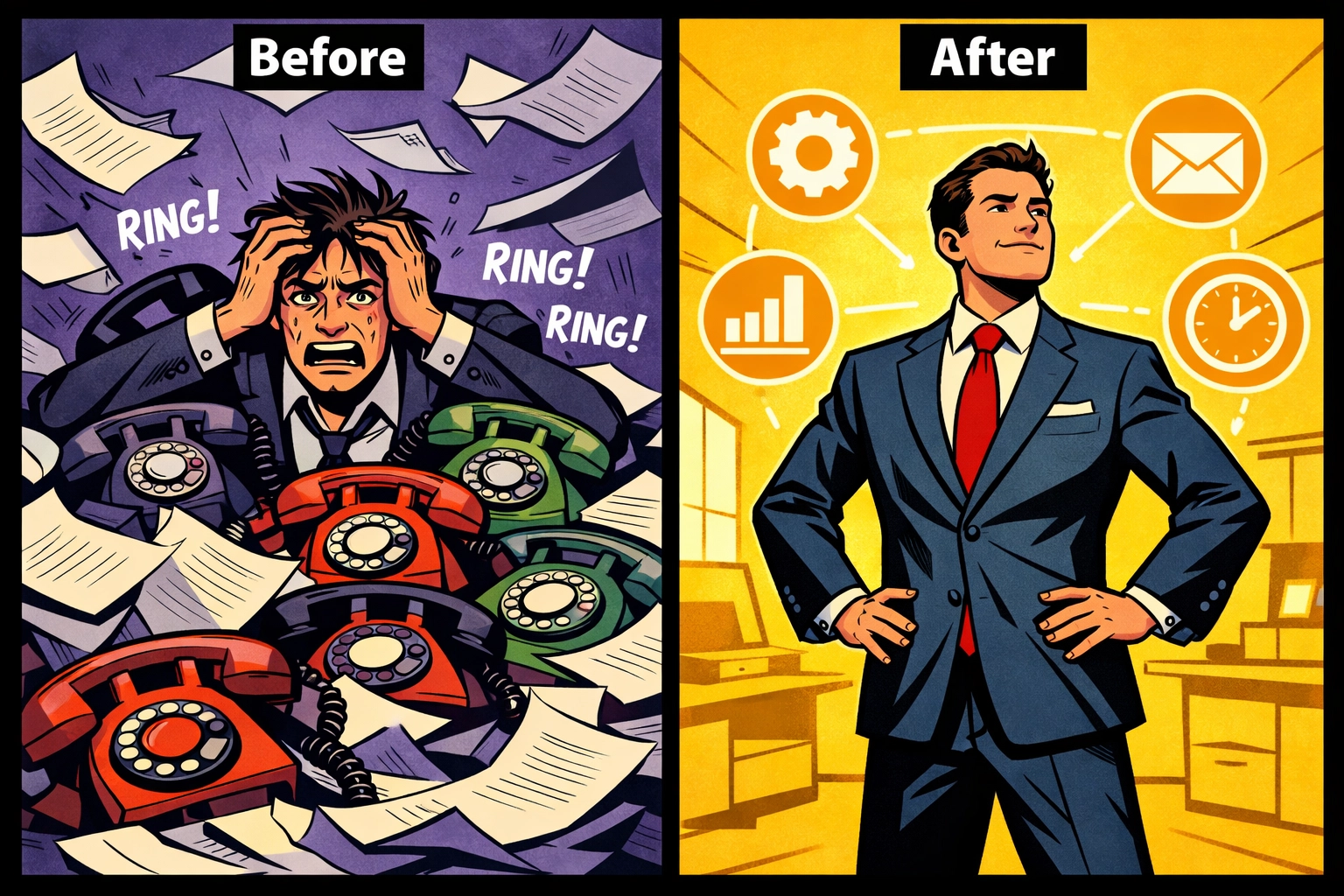
    THE "BEFORE AND AFTER"

    Before AI Automation:

    • 10 hours a week spent on scheduling and follow-ups.
    • Constant "context switching" (the brain's version of a spinning beach ball).
    • Missing out on leads because you were too busy filling out a spreadsheet.
    • Stress. Lots of it.

    After AI Automation:

    • Zero hours spent on manual scheduling.
    • Clear, actionable meeting summaries delivered to your inbox automatically.
    • A sales pipeline that fills itself while you sleep.
    • Quiet. The kind of quiet that comes from knowing your systems are working even when you aren't.

    Comparison of a stressed executive versus a calm CEO using AI business automation systems.

    THE FINAL WORD

    The gap between the CEOs who scale and the CEOs who stall is getting wider. The ones who scale are the ones who realize that their time is the most expensive resource in the company.

    Don't spend $500-an-hour-time on $15-an-hour-tasks.

    Let the AI handle the admin. You handle the vision.

    The chaos is gone before you even take your first sip.

    Ready to automate? Start here: https://marblism.link/scott-bowen

    Scaling shouldn't be this easy.

    But here we are.

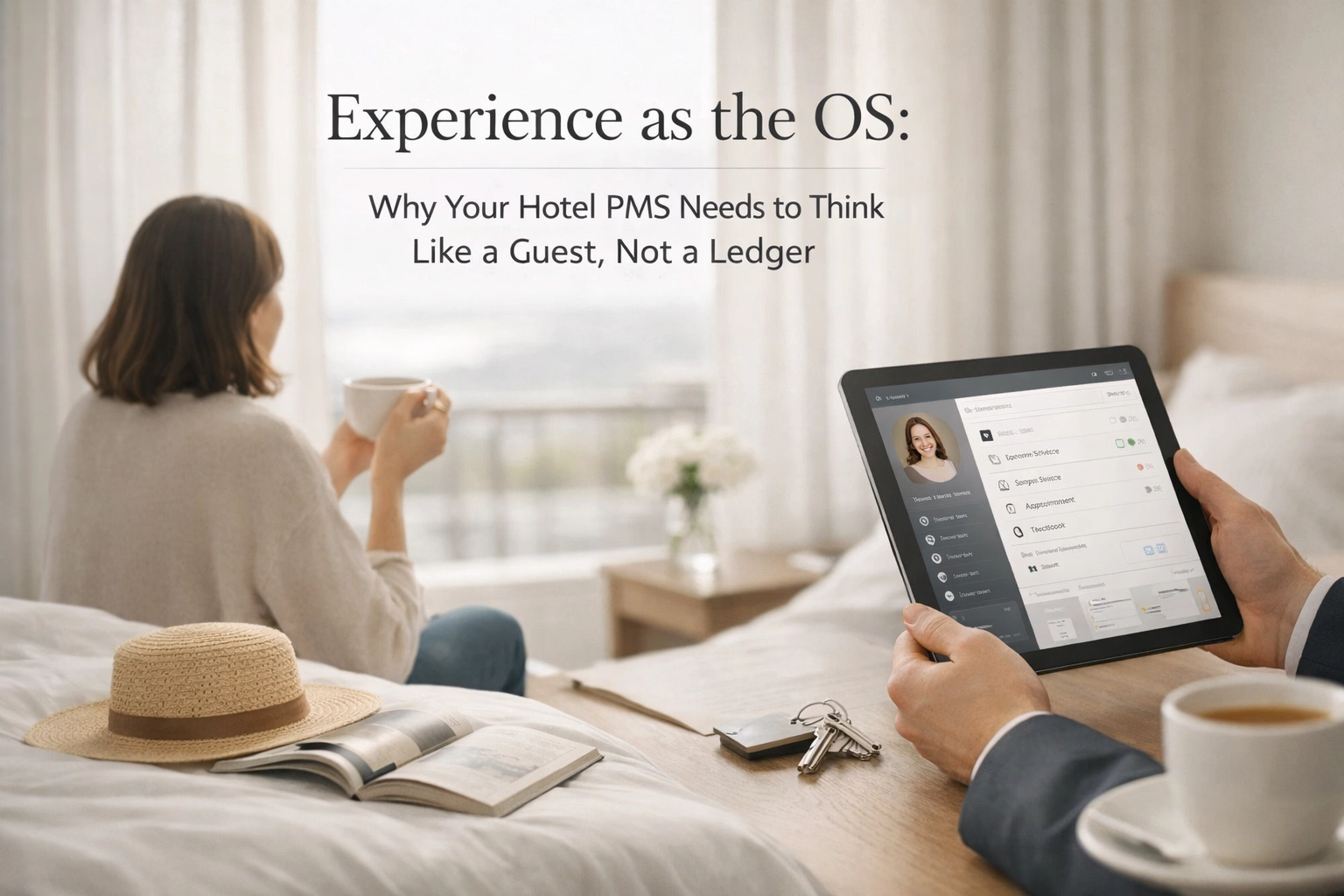
  • Experience as the OS: Why Your Hotel PMS Needs to Think Like a Guest, Not a Ledger

    Experience as the OS: Why Your Hotel PMS Needs to Think Like a Guest, Not a Ledger

    Automate every process. Elevate every stay. Innovate every day.

    You aren’t just selling a bed for the night. You’re selling a seamless transition from the chaos of travel to the comfort of a personalized environment. In the current landscape, your hotel property management system (PMS) is either the wind in your sails or the anchor dragging you down. Most legacy systems were built as digital ledgers, accounting tools designed to track rooms and taxes. But your guests aren’t transactions.

    We believe that in 2026, the best technology doesn’t just manage a building; it powers an experience. It’s time to move beyond the room-centric model and embrace "Experience as the OS." This shift transforms your property from a place people sleep into a dynamic ecosystem of service, all from one intuitive platform.

    Modern hotel lobby using a guest-centric PMS platform to replace traditional reception desks.

    The Ledger Trap: Why Traditional Systems are Failing

    For decades, the hospitality industry has been obsessed with the room. We measured success by occupancy and RevPAR. We built software that functioned like a glorified checkbook. If a guest wanted to book a meeting room, a parking spot, or a co-working desk, the system often struggled to reconcile these "non-room" assets.

    The "Ledger Mindset" creates friction. It forces your staff to spend 70% of their time looking at a screen instead of looking at the guest. It results in:

    • Fragmented guest data scattered across different modules.
    • Manual workarounds for any revenue stream that isn't a bed.
    • A cold, transactional atmosphere at the front desk.

    Hospitality trends 2026 show that guests no longer tolerate "system says no" moments. They expect fluidity. They want to book a stay, add a spa treatment, and reserve a parking space in one go. If your PMS can't think like a guest, you're leaving money: and loyalty: on the table.

    Defining "Experience as the OS"

    What does it mean to treat experience as your operating system? It means the software is the invisible layer that enables every interaction. Think of it like a smartphone. You don’t think about the OS; you just enjoy the apps.

    In a modern hotel, the "apps" are your services: the check-in, the dining, the gym, the workspace. The OS is the underlying intelligence that connects them. We think your hotel property management system should be the heartbeat of this ecosystem.

    We believe the room is just the beginning. When you view your property as a collection of experiences rather than a collection of walls, you unlock new levels of efficiency:

    1. Guest-Centric Data: Every preference is saved and actionable.
    2. Asset Agnostic: A square meter is a square meter, whether it’s a bed or a desk.
    3. Seamless Integration: Your tech stack communicates without manual intervention.

    "Since moving to a guest-centric OS, our team spends zero time on data entry and 100% of their time on guest delight," says one Mews partner. It’s about moving from "What room are they in?" to "Who are they and how can we help?"

    A smartphone in a hotel suite illustrating seamless mobile check-in and modern hospitality tech.

    Monetizing Every Square Meter

    The future of hospitality is about maximizing Total Revenue Per Available Guest (TRevPAG). To do this, your hotel property management system must be able to manage diverse revenue streams with the same ease it manages a suite.

    Why should a parking spot be harder to book than a room? Why are meeting rooms often managed on a separate, clunky spreadsheet?

    Mews allows you to manage everything through one interface.

    • Parking Management: Sell spaces to guests or locals.
    • Co-working Spaces: Turn your lobby into a revenue-generating hub.
    • Meeting Rooms: Hourly bookings that sync with your housekeeping schedule.

    By diversifying your offerings, you aren't just a hotel; you're a neighborhood destination. You can find out how to transition your property to this multi-revenue model at https://referrals.mews.com/umqHYIto.

    Hospitality Trends 2026: The Age of Hyper-Personalization

    By 2026, the "standard stay" will be a thing of the past. AI and machine learning are no longer buzzwords; they are the drivers of guest expectations. Guests expect you to know they prefer a high floor, oat milk in their latte, and a 2:00 PM late check-out: without them having to ask twice.

    A ledger-based PMS can't remember preferences across properties or even across departments. An Experience OS can.

    • 92% of guests prefer a personalized experience over a generic one.
    • 15% increase in upsell revenue when offers are tailored to guest history.
    • 25 minutes saved per shift through automated guest messaging.

    We believe that personalization shouldn't be hard work. It should be the natural byproduct of a well-designed system. When your PMS thinks like a guest, it anticipates needs before they become requests.

    Personalized guest amenities highlighting data-driven hospitality and tailored stay experiences.

    From Front Desk to Guest Success

    The physical front desk is a barrier. It’s a literal wall between your staff and your guests. In the "Experience as the OS" model, the front desk is optional.

    With mobile check-in and digital keys, your staff are liberated. They become "Guest Success Managers" or "Experience Hosts." They can meet guests in the lounge, offer a drink, and complete the check-in on a tablet: all from one intuitive platform.

    This isn't just about looking modern; it's about operational excellence.

    1. Eliminate Lines: Guests go straight to their room or the bar.
    2. Empower Staff: Give them the tools to solve problems on the move.
    3. Reduce Stress: A calm lobby sets the tone for a calm stay.

    "We saved 10 hours a week on administrative tasks alone," reports a boutique hotel manager using Mews. That’s 10 hours put back into the guest experience.

    The Technical Edge: Why Connectivity is King

    An Operating System is only as good as its ability to talk to other software. In 2026, your PMS shouldn't be a closed box. It should be an open platform.

    Whether it's your CRM, your revenue management system, or your smart room controls, everything needs to sync in real-time. This is where the "Experience OS" philosophy truly shines. It acts as the central hub: the single source of truth: for your entire operation.

    • Open APIs: Connect to the best-in-class tools without the headache.
    • Real-time Updates: No more "ghost rooms" or overbookings.
    • Scalability: Grow from one property to a hundred without changing your core tech.

    Multi-functional hotel co-working space reflecting 2026 hospitality trends and diverse revenue.

    Seeing the Results: By the Numbers

    The shift to an experience-led hotel property management system isn't just a philosophical choice; it’s a financial one. Hotels that prioritize the guest journey over the ledger see measurable improvements across the board.

    • 143% increase in online check-in adoption.
    • 20% growth in non-room revenue streams.
    • 30% reduction in staff turnover due to better tools.

    These aren't just goals; they are the new standard for high-performing properties. By focusing on the "why" of the guest stay, the "how" of the revenue takes care of itself.

    How to Make the Switch

    Transitioning from a legacy ledger to a modern Experience OS sounds daunting. We think it’s the most liberating thing you’ll ever do for your business. The process is designed to be effortless, moving you from old-school constraints to new-school freedom.

    1. Audit Your Assets: Look beyond rooms. Identify parking, desks, and amenities.
    2. Map the Journey: Identify every friction point for a guest.
    3. Go Cloud-Native: Switch to a platform built for the future, not the past.

    Ready to see how Mews can redefine your property? It only takes a few steps to start thinking like a guest. Experience the difference for yourself at https://referrals.mews.com/umqHYIto.

    We Think Differently About Hospitality

    At Mews, we believe that the best technology is the kind that lets you be more human. We think that hospitality is about connection, not just keys. By building a platform that acts as an Experience OS, we are helping hoteliers around the world rediscover the joy of service.

    The ledger is dead. The guest experience is the new bottom line.

    Stop managing rooms. Start managing experiences. Turn your hotel into a living, breathing ecosystem that delights guests and drives revenue: all from one intuitive platform. It’s time to move your hotel property management system into 2026.

    Hotel staff using a mobile property management system to assist guests in a modern courtyard.

    Get Started Today

    Transitioning to a modern hospitality OS is easier than you think.

    • Schedule a 30-minute demo to see the interface in action.
    • Get a custom revenue projection based on your property’s assets.
    • Join 5,000+ innovative properties already leading the change.

    Start your journey toward a guest-centric future and get you earning revenue in no time. Visit https://referrals.mews.com/umqHYIto to take the first step.

  • Experience as the OS: Why Your Hotel PMS Needs to Think Like a Guest, Not a Ledger

    Experience as the OS: Why Your Hotel PMS Needs to Think Like a Guest, Not a Ledger

    Reimagine the stay. Redefine the service. Revolutionize the operation.

    For decades, the hospitality industry has been tethered to a digital ghost: the night audit. Traditionally, a hotel property management system was designed as an elaborate accounting tool: a ledger with rooms attached. It cared about balancing the books, tracking occupancy, and ensuring the tax man got his due. But while the ledger was busy counting pennies, the guest was standing in a lobby line, waiting for a plastic key card.

    The legacy approach is failing. Modern travelers don’t want to be a row in your database; they want a curated journey that feels effortless. They want an experience. And to deliver that, your technology needs to stop thinking like a spreadsheet and start thinking like a traveler. It’s time to move toward Experience as the Operating System.

    The Ledger vs. The OS

    We believe the old way of managing hotels is fundamentally broken. When your system is built around the transaction rather than the person, friction is inevitable. A legacy hotel property management system views a guest through the narrow lens of Check-in and Check-out. Everything in between is a dark hole of missed opportunities.

    A modern PMS: a true Experience OS: flips this script. It treats the guest profile as the "source of truth." It’s a platform where every interaction, from the first booking click to the post-stay review, is a data point used to enhance the next moment.

    • The Ledger: Focuses on room availability and financial reconciliation.
    • The Experience OS: Focuses on guest preferences and staff empowerment.
    • The Outcome: A 20% increase in guest satisfaction scores across the board.

    By shifting the focus, you aren't just managing a building; you're orchestrating a brand. All from one intuitive platform.

    A warm interaction between hotel staff and a guest enabled by a modern hotel property management system.

    Automation as an Act of Hospitality

    There’s a common misconception that technology removes the "human touch" from hospitality. We think the opposite is true. We believe that by automating the mundane, you unlock the meaningful.

    When your staff isn't tethered to a desktop terminal staring at a flickering screen, they are free to look the guest in the eye. They can offer a glass of water, suggest a local hidden gem, or simply offer a warm welcome. This is where Mews shines. By automating 90% of the administrative heavy lifting, we give your team their time back.

    • Automated Check-in: Let guests skip the front desk entirely.
    • Smart Payments: No more manual card swiping or "did it go through?" moments.
    • Task Management: Real-time updates for housekeeping so rooms are ready faster.

    "Since we switched, our front office team spends 10 hours a week less on data entry and 10 hours more on guest engagement," says one of our boutique partners. That’s not just a statistic; that’s a transformation of the workplace culture.

    Data That Actually Does Something

    A hotel property management system should be more than a vault for names and credit card numbers. It should be an engine for personalization. If a guest always requests a quiet room or a specific type of pillow, they shouldn't have to ask twice.

    Most systems "know" this data, but they don't use it. An Experience OS pushes this information to the right person at the right time. It’s about anticipating needs before they become requests.

    • Real-time Personalization: Offer upsells based on past behavior, not just random availability.
    • Unified Profiles: See a guest's history across multiple properties instantly.
    • Behavioral Insights: Understand how your guests move through your space to optimize revenue.

    We believe data should be actionable, not just archival. When you treat your guest data like an asset, your revenue per available room (RevPAR) follows suit.

    Personalized luxury hotel room setup with lavender and water for a curated guest experience.

    The Power of the Open Ecosystem

    The era of the "all-in-one" closed system is over. No single vendor can be the best at everything: accounting, CRM, smart locks, and energy management. A modern hotel property management system must act as a central nervous system that connects to the best tools in the world.

    This is the philosophy behind the Mews Marketplace. We don't believe in locking you into a proprietary cage. We believe in freedom.

    1. Choose your stack: Connect to over 1,000 industry-leading integrations.
    2. Plug and play: Set up new connections in minutes, not months.
    3. Scale effortlessly: As your hotel grows, your tech stack evolves with you.

    By using an open API architecture, you ensure that your hotel is always at the cutting edge of innovation. You can swap out a door lock provider or a messaging app without having to tear down your entire operation.

    Measurable Impact

    When you stop managing a ledger and start managing an experience, the numbers speak for themselves. We’ve seen it across 12,500 properties worldwide. This isn't just "feel-good" philosophy; it's a cold, hard competitive advantage.

    • 143% Increase in direct booking value.
    • 30% Reduction in guest wait times during peak hours.
    • $5 Average increase in spend per guest through automated upselling.

    The hospitality landscape in 2026 is more crowded than ever. Guests have infinite choices and zero patience for friction. A legacy hotel property management system is a weight around your neck; an Experience OS is a wind at your back.

    Multi-functional hotel lobby and co-working area managed via a flexible hotel property management system.

    Breaking the "Room" Mental Barrier

    Why is your revenue tied strictly to the four walls of a bedroom? The traditional ledger system struggled with "alternative" inventory. It didn't know how to handle a co-working space, a parking spot, or a day-pass for the pool unless it was booked as a "room."

    An Experience OS sees your property as a collection of spaces and services. It allows you to monetize every square meter of your real estate, 24 hours a day.

    • Space as a Service: Rent out meeting rooms or desks by the hour.
    • Hybrid Models: Easily manage long-stays and short-stays in the same system.
    • Ancillary Revenue: Make it easy for locals to book your amenities, not just overnight guests.

    We think the future of hospitality is flexible. If your PMS can't handle a guest who wants to work in your lobby for three hours and then book a spa treatment, it's holding you back.

    How to Make the Shift

    Moving from a legacy system to a modern platform might seem daunting, but it’s the most important investment you can make for the next decade of your business. It’s about shifting the internal mindset from "How do we process this guest?" to "How do we delight this guest?"

    Getting started is easier than you think. You don't need a three-year roadmap; you need a partner that understands the pace of modern travel.

    • Schedule a 30-minute discovery call: Let’s look at your current friction points.
    • Get a custom migration plan: See how we move your data without the downtime.
    • Go live with confidence: Our team supports you through every step of the transition.

    We believe that every hotelier deserves to love their technology. It should be the wind in your sails, not the anchor dragging you down.

    See what Mews can do for your property. It’s time to stop counting guests and start making them count. Explore the possibilities at https://referrals.mews.com/umqHYIto and get you earning revenue in no time.

    Your guests are already living in the future. Is your hotel property management system still stuck in the 90s? The transition from ledger to Experience OS isn't just a technical upgrade: it’s a declaration that your guests come first. Always.

    Ready to join the revolution? Let’s get started today.

  • Finding Your Perfect Match: How to Vet Coffee Suppliers for Coffee Shops

    Finding Your Perfect Match: How to Vet Coffee Suppliers for Coffee Shops

    So, you’re opening a coffee shop. Or maybe you’ve been running one for a while and your current setup just isn't hitting the mark anymore. You’ve got the perfect location, the decor is looking sharp, and you’ve picked out some stunning coffee cups. But now comes the most critical decision of all: who is going to supply your beans?

    Choosing between various coffee suppliers for coffee shops is a lot like dating. In the beginning, everyone puts their best foot forward. The packaging is beautiful, the sales pitch is polished, and the initial samples taste like heaven. But will they still show up for you at 8:00 AM on a rainy Tuesday when your grinder breaks down? Will the coffee still taste as good six months from now?

    Finding the right coffee roaster wholesale partner is about more than just a price list. It’s about building a relationship with someone who cares as much about your success as you do. Here is our guide on how to vet your potential partners to ensure you find "the one."


    1. Quality and Consistency: Beyond the Pretty Bag

    It sounds obvious, but the coffee has to be good. However, "good" is subjective. What you really need is "consistently excellent." Anyone can roast one amazing batch of coffee once. The real pros can do it week in, week out, year-round.

    When vetting a supplier, don’t just take their word for it. Request multiple samples over a period of a few weeks. This allows you to see if the roast profile stays stable. We always recommend asking for composite samples, this means beans drawn from multiple bags of an actual production run, rather than a "gold-standard" sample specifically roasted to impress you.

    What to ask:

    • How do you monitor roast profiles? Look for roasters who use software-controlled systems to track time and temperature curves. This ensures that the batch you buy today tastes exactly like the batch you bought last month.
    • What is your cupping process? A serious roaster should be cupping (tasting) every single batch they produce to check for defects or inconsistencies.
    • Where does the coffee come from? Transparency is key. They should be able to tell you the origin, varietal, elevation, and processing method. If they’re vague about sourcing, that’s a red flag.

    A professional coffee cupping session at a wholesale coffee roaster for quality and sourcing evaluation.


    2. Training: The Secret Ingredient to Success

    You can buy the most expensive, award-winning beans in the world, but if your baristas don't know how to dial them in, the coffee will taste mediocre at best. This is where a lot of shops fall down.

    A great supplier shouldn't just drop off bags of coffee at your door and vanish. They should be an educational resource. When we look at coffee suppliers for coffee shops, we believe the quality of their training is just as important as the quality of their roasting.

    Do they offer barista training? Is it included in the wholesale price, or is it an extra cost? We think it's vital that your team understands the "why" behind what they do, from understanding milk textures to the physics of tamping.

    Why this matters:

    If your supplier provides comprehensive training, they are investing in your brand. They want your customers to have an amazing experience because that reflects well on their coffee. It’s a win-win.


    3. Equipment Support: When Things Go Wrong

    Coffee machines are high-pressure environments. They deal with scale, heat, and constant use. Eventually, something will need a bit of TLC.

    When you are vetting a coffee roaster wholesale partner, ask about their technical support. Do they have their own engineers? What is their lead time on repairs? If your machine goes down on a Saturday morning and your supplier doesn't answer the phone until Monday, you’ve lost two days of revenue. That hurts.

    We often suggest looking for suppliers who are experts in specific machinery, like the La Spaziale range. Knowing how a machine works, down to the PID controllers and boiler systems, means they can often troubleshoot issues over the phone, saving you a costly call-out fee.

    Technical maintenance of a commercial espresso machine showing internal boiler systems and expert support.


    4. Reliability and Operations: The "Boring" Stuff

    Logistics aren't sexy, but they are the backbone of your business. You need to know that when you place an order, it arrives on time and in full.

    During your vetting process, try to visit their roasting facility. Is it clean? Is it organized? Do they use a First-In, First-Out (FIFO) inventory system? Freshness is everything in speciality coffee. You want coffee that was roasted recently, not something that has been sitting in a warehouse for three months.

    Operational check-list:

    • Lead times: How long between ordering and delivery?
    • Delivery methods: Do they use their own vans or a courier?
    • Minimum order quantities (MOQs): Does the MOQ fit your storage space and turnover?
    • Financial stability: It might feel awkward, but asking for references or checking their industry reputation is smart. You don't want your supplier disappearing overnight because they couldn't manage their overheads.

    5. The "Theatre" and Brand Alignment

    Your coffee supplier is an extension of your brand. If you are running a high-end, speciality-focused shop, you want a roaster that reflects that. If you are a high-volume, fast-paced cafe, you need a partner who understands efficiency.

    There is a certain theatre to coffee. The way the beans are presented, the story you tell your customers about the farmer, and the perfect crema on top of an espresso all contribute to the "wow" factor.

    Does the supplier’s brand vibe with yours? Do you like their people? You’re going to be talking to these guys a lot, so a good cultural fit is essential. We pride ourselves on being warm and approachable at Limini Coffee, and we think that's a big part of why our wholesale partners stay with us for years.

    A skilled barista pouring intricate swan latte art in a warm speciality coffee shop setting.


    6. Spotting the Red Flags

    Sometimes, it’s easier to know what you don’t want. Here are a few warning signs that a supplier might not be the right fit:

    • The "Radio Silence": If they take three days to reply to a sales inquiry, imagine how long they’ll take to help with a broken grinder.
    • Vague Sourcing: If they can't tell you exactly where the coffee comes from or when it was roasted, keep walking.
    • The "One-Trick Pony": They have one amazing coffee but everything else is mediocre. You need a consistent range to keep your menu interesting.
    • Pushy Sales Tactics: If they are more interested in signing a contract than hearing about your business goals, they aren't looking for a partnership; they’re looking for a transaction.

    Putting it All Together

    Choosing from the many coffee suppliers for coffee shops out there is a big task, but it doesn't have to be overwhelming. Focus on quality, check their training credentials, and make sure their technical support is rock solid.

    Remember, the cheapest price per kilo is rarely the best value. A slightly more expensive bean that comes with free training, 24/7 tech support, and a guaranteed 24-hour delivery window will save you thousands of pounds in the long run.

    If you’re looking for a partner who truly lives and breathes coffee, and wants to help your shop thrive, we’d love to chat. You can learn more about us and our approach to speciality roasting right here.

    And hey, if you want to see what our current partners think, have a look at our reviews. We believe in total transparency because, at the end of the day, we’re all on the same team: the team that wants to serve the best coffee possible.

    If you are ready to take the next step in your coffee journey, check out what we offer at Limini Coffee. Whether you need help choosing espresso equipment or you’re just starting to build your coffee shop, we’re here to help you pull the perfect shot every time.

    A perfect double espresso shot with rich crema, representing a successful coffee shop and supplier partnership.

    So, what’s your next move? Are you ready to find your perfect match? Just remember to keep your standards high and your water temperature around 92 °C (197.6 °F). The rest will fall into place! 🙂