Category: Category 1

Use this description to tell users what kind of blog posts they can find in this category.

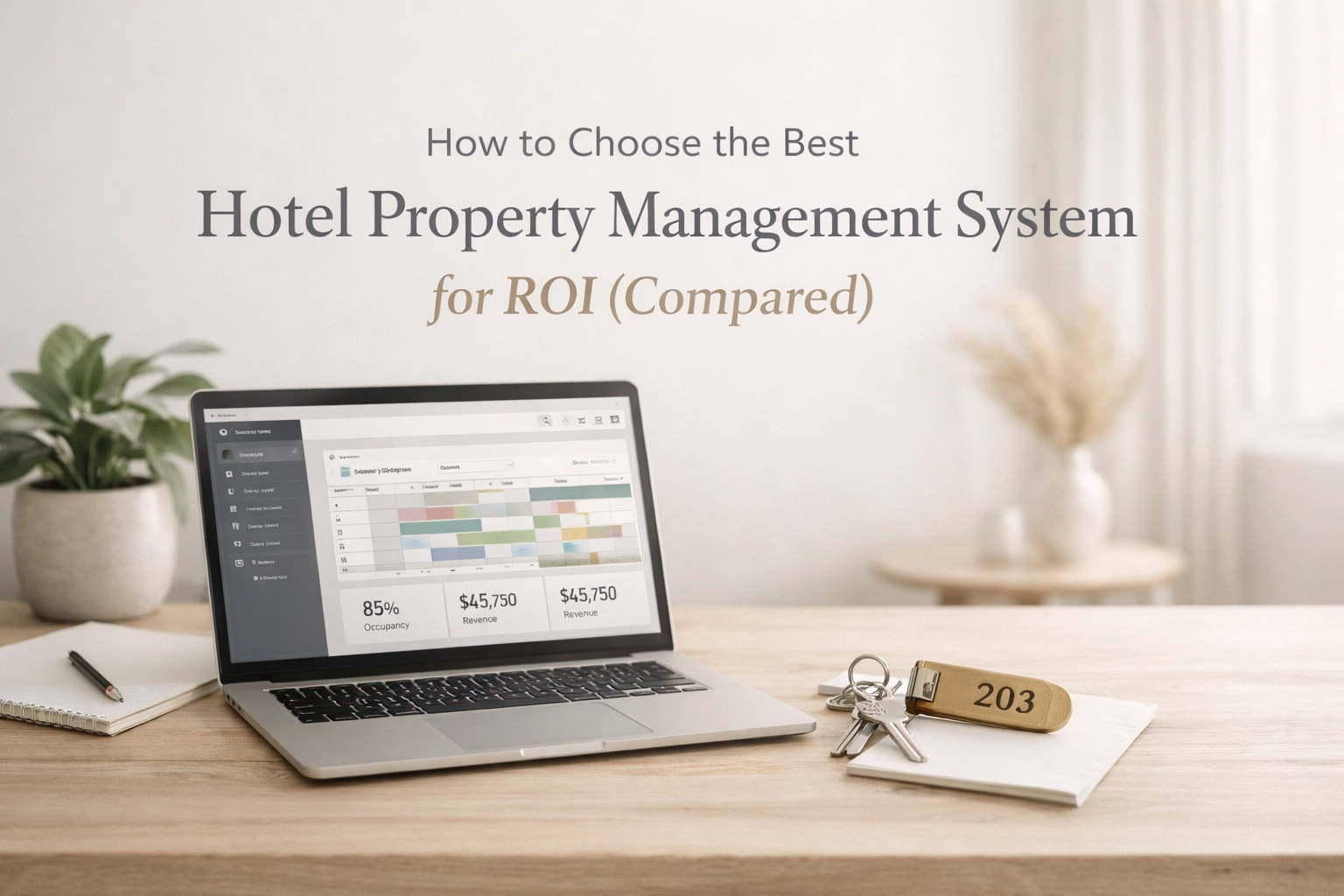
  • How to Choose the Best Hotel Property Management System for ROI (Compared)

    How to Choose the Best Hotel Property Management System for ROI (Compared)

    Maximize every room. Automate every task. Scale every property.

    Your Property Management System (PMS) is no longer just a digital ledger for check-ins and check-outs. In the modern hospitality landscape, it is the central nervous system of your business. A legacy system doesn't just slow you down: it costs you money. Properties switching to a modern, cloud-native platform typically see a 143% increase in direct booking value and a significant reduction in labor costs. You deserve a system that works as hard as your staff does. All from one innovative platform.

    Guest using a mobile phone in a modern hotel lobby, showcasing seamless guest experience technology.

    The ROI mindset in hospitality

    We believe technology should be a profit center, not a cost. The old way of managing hotels involved fragmented tools and manual data entry. That approach kills your margins. To truly maximize your Return on Investment (ROI), you need to look beyond the initial subscription fee and evaluate how the software impacts your entire operation.

    • Capture more direct revenue.
    • Reduce staff turnover through better UX.
    • Eliminate hidden integration fees.

    You can explore how these efficiencies work in practice by visiting Mews.

    Comparing the top contenders

    Choosing the right system depends on your specific needs, but the "best" for ROI is always the one that scales with you without adding friction.

    Mews: The Innovation Leader

    We think hospitality should be about people, not screens. Mews is designed for high-growth properties and forward-thinking brands that prioritize automation and guest freedom. With an open API and over 1,000 integrations, it allows you to build a tech stack that fits your exact vision.

    • Best for: Boutique hotels, multi-property groups, and hybrid spaces.
    • ROI Factor: High automation reduces front desk hours by up to 40%.
    • Highlight: Industry-leading mobile check-in and integrated payments.

    Cloudbeds: The All-in-One Alternative

    Cloudbeds offers a simplified approach by bundling the PMS, channel manager, and booking engine into a single interface. It’s a solid choice for independent properties that want to get up and running quickly without managing multiple vendors.

    • Best for: Small to mid-sized independent hotels.
    • ROI Factor: Lower upfront complexity and consolidated billing.
    • Highlight: Strong distribution reach for global OTAs.

    Oracle OPERA: The Enterprise Legacy

    The "old guard" of the industry. While powerful and feature-rich, OPERA often requires significant IT overhead and long implementation cycles. For massive enterprise chains, the standardization is valuable, but for agile brands, the rigidity can be a bottleneck.

    • Best for: Global enterprise hotel chains.
    • ROI Factor: Scalability across thousands of rooms.
    • Highlight: Comprehensive reporting for complex corporate structures.

    Hotel management software on a tablet at a high-end concierge desk for improved operational ROI.

    Focus on revenue-generating features

    We believe every feature should move the needle on your bottom line. If a tool doesn't help you sell more or save time, it’s just noise.

    Native Revenue Management

    Don't leave money on the table. Systems that include native rate management and dynamic pricing tools allow you to react to market changes in real-time. Instead of manual updates, the system adjusts your rates based on occupancy and demand spikes automatically.

    • Increase RevPAR without extra staff.
    • React instantly to local events.
    • Lower your total subscription costs by cutting third-party tools.

    Integrated Payments

    Chasing payments is a waste of your time. Integrated payment processing allows for "push-button" invoicing and instant reconciliation. When your PMS and your payments live in the same house, you eliminate human error and reduce accounting overhead significantly. "Since we automated our payments, we save about 10 hours a week on manual reconciliation," says one of our partners.

    Operational efficiency is the new profit

    Saving money is just as important as making it. Labor is the highest expense in hospitality, and a clunky PMS is a labor-thief.

    Mobile-first operations

    Your staff shouldn't be tethered to a desk. Modern systems offer mobile apps for housekeeping and maintenance. When a room is cleaned, it’s updated in the PMS instantly. This speeds up turn-around times and allows you to check guests in earlier, improving the overall guest experience and driving positive reviews.

    1. Housekeeping marks room clean on a tablet.
    2. Front desk receives an instant notification.
    3. Guest gets an automated SMS that their room is ready.

    Staff member using a mobile app for hotel operations in a perfectly prepared luxury guest room.

    The Power of the Open API

    Avoid the "walled garden" trap. An open API means your PMS can talk to any other software you use: from smart locks to guest messaging apps. This flexibility ensures that you are never stuck with outdated tech. You can swap out individual components of your tech stack as better solutions emerge.

    Calculating Total Cost of Ownership (TCO)

    The sticker price is rarely the real price. To find the true ROI, you must calculate the Total Cost of Ownership over the first 12 to 24 months.

    • Implementation Fees: How much does it cost to get started?
    • Training Costs: Is the UI intuitive, or will you spend weeks training staff?
    • Integration Costs: Does the PMS charge you a fee every time you want to connect a new tool?
    • Opportunity Cost: How much revenue are you losing by not having a direct booking engine or automated upselling?

    For a transparent look at how modern pricing translates to value, check out the Mews referral portal.

    Why the "Safe Choice" is often the most expensive

    Many hoteliers stick with legacy systems because it feels "safe." In reality, staying with an outdated system is a high-risk strategy. In an era of Agentic AI and hyper-personalization, guests expect a seamless digital journey. If your system can't handle a digital key or a self-service kiosk, your guests will find a hotel that can.

    "The transition was surprisingly easy. We were up and running in half the time we expected," says a manager of a 50-room boutique property.

    Moving toward a more profitable future

    Selecting a PMS is a long-term partnership. You aren't just buying software; you’re choosing the foundation for your business growth. Look for a partner that prioritizes innovation and stays ahead of industry trends.

    Your 3-step selection process

    1. Audit your current bottlenecks. Identify where your staff spends the most manual time.
    2. Prioritize integration. Ensure the system works with your existing (and future) tech stack.
    3. Run the numbers. Compare the TCO against the potential revenue gains from automation.

    Innovative hotel architectural design representing the future of scalable hospitality technology.

    The hospitality industry is changing faster than ever. To stay competitive, your technology needs to be faster than the industry. Choose a system that empowers your team, delights your guests, and: most importantly: maximizes your ROI.

    Ready to see what the future of hospitality looks like? Get started with Mews today. Reach your potential. Automate the mundane. Focus on what matters: the guest. All from one remarkable platform.
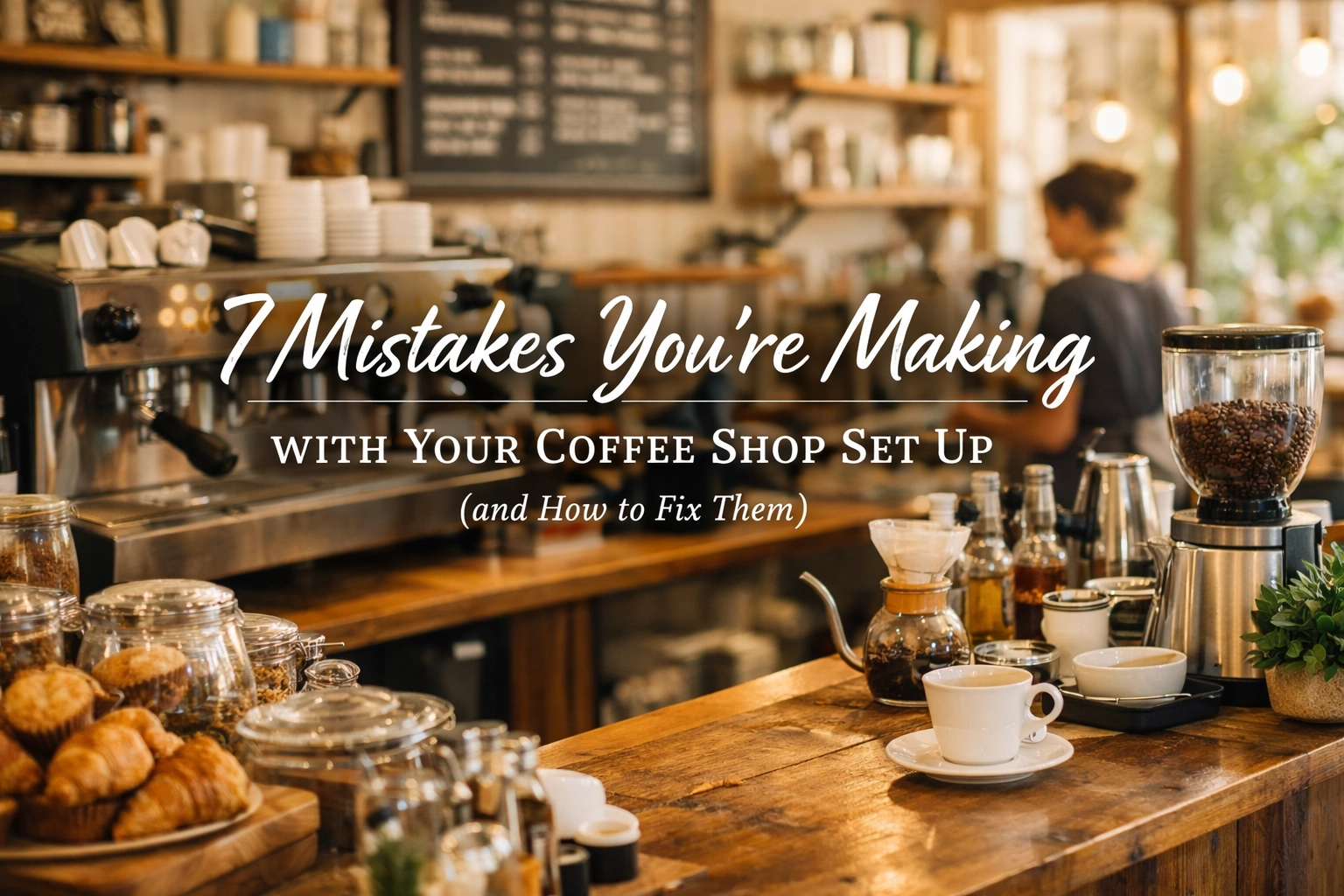

  • 7 Mistakes You’re Making with Your Coffee Shop Set Up (and How to Fix Them)

    7 Mistakes You’re Making with Your Coffee Shop Set Up (and How to Fix Them)

    So, you’ve decided to open a coffee shop. That’s brilliant. There is honestly nothing quite like the smell of a freshly opened bag of beans in your very own space, the hiss of the steam wand, and the first "wow" from a customer. It’s a dream many people have, but as we often see here at Limini Coffee, the transition from "coffee lover" to "coffee shop owner" is filled with some pretty sneaky traps.

    We’ve helped hundreds of businesses get off the ground through our wholesale partnerships, and we’ve noticed a pattern. People tend to make the same handful of mistakes during the setup phase. These aren’t just small hiccups; they are the kind of errors that can drain your bank account and leave you exhausted before you’ve even served your hundredth flat white.

    Let’s talk about those mistakes and, more importantly, how you can fix them (or avoid them entirely).


    1. Buying the "Wrong" Equipment

    We get it. When you’re looking at a spreadsheet of startup costs, that semi-professional espresso machine you found online for a fraction of the price of a commercial one looks very tempting. You might think, "It’s just for the first few months while we’re quiet."

    The problem is, domestic or semi-pro equipment isn't built for the "rush." Commercial machines are designed to maintain a consistent temperature (usually between 88 C to 95 C) and a steady 9 BAR of pressure while pulling shot after shot. A domestic machine will struggle to keep up, the temperature will fluctuate, and your coffee quality will dive off a cliff. Even worse, if it breaks down, most commercial technicians won't have the parts to fix it, and your insurance might not even cover a non-commercial unit.

    The Fix: Invest in NSF-approved, commercial-grade equipment from day one. It’s better to have a reliable, refurbished commercial machine than a shiny new domestic one. When choosing espresso equipment, think about your projected volume. Do you need a two-group or a three-group? And don't forget the grinder! A cheap grinder will clump your coffee and make consistent extraction impossible.

    Commercial espresso machine pulling a double shot into a ceramic cup in a specialty coffee shop.


    2. Skipping Due Diligence on the Building

    You’ve found the perfect "character" building. It’s got exposed brick and great light. But have you checked the power?

    Most specialty coffee shops require a significant amount of electricity. You’re looking at 200-400 amps of service to run your espresso machine (which can pull 3000 watts or more), grinders, refrigeration, dishwashers, and HVAC. We’ve seen many owners sign a lease only to realize they need to spend £10,000 just to upgrade the electrical board.

    Then there’s the plumbing and ventilation. Do you have a floor drain? Is there a "make-up air" system for your kitchen? If you don't check these things, you'll be hit with massive construction delays and costs you didn't see coming.

    The Fix: Bring an architect or a contractor to the site before you sign the lease. Have them verify the electrical capacity and the plumbing layout. It’s worth spending a few hundred pounds on a professional walkthrough now to save thousands later.


    3. The "Cheesecake Factory" Menu Syndrome

    We see this a lot. New owners want to cater to everyone, so they create a menu with 40 different drinks, five types of sandwiches, and three types of soup.

    The issue? Choice overload. When a customer walks in and sees a wall of text, they get stressed. From an operational standpoint, it’s a nightmare. It means more inventory to manage, more waste, and slower service times. If your barista has to remember how to make a "Caramel Marshmallow Dream" while also trying to pull a perfect shot of speciality coffee, something is going to suffer. Usually, it’s the coffee.

    The Fix: Keep it simple. Start with a focused menu of high-quality staples. Master the classics, latte, cappuccino, flat white. Once you’ve nailed those and your workflow is smooth, you can introduce a "signature drink" to add some theatre to the experience.


    4. Neglecting Staff Training

    This is a big one. You can buy the most expensive equipment in the world, but if your staff don't know how to use it, you're just making expensive, bad coffee.

    Inconsistency is the silent killer of coffee shops. If a customer gets a great latte on Tuesday but a burnt, bubbly mess on Thursday because a different person was on the machine, they won't come back. They need to know that every time they walk through your door, the quality will be exactly the same.

    The Fix: Establish standardized procedures. Everyone should tamp the same way, steam milk to the same temperature (ideally 140 °F / 60 ºC), and follow the same recipes. We strongly recommend barista training for every single member of your team. It’s not just about making coffee; it’s about understanding the science behind it.

    A professional barista pouring heart-shaped latte art to demonstrate skill and consistency.


    5. Poor Floor Plan and Workflow

    Have you ever been in a coffee shop where the line for the till blocks the pickup area? Or where the barista has to walk across the room to get milk? That’s a layout fail.

    A poorly designed space creates bottlenecks. It makes your staff work harder than they need to, which leads to fatigue and mistakes. In the coffee world, we talk about the "Barista Triangle", the distance between the grinder, the espresso machine, and the sink/milk fridge. Every extra step your barista takes is time wasted.

    The Fix: When building a coffee shop, map out the customer flow. Imagine a busy Saturday morning. Where do people stand to order? Where do they wait? Make sure your "handoff" area is separate from the ordering queue. And keep your baristas' tools within arm's reach.

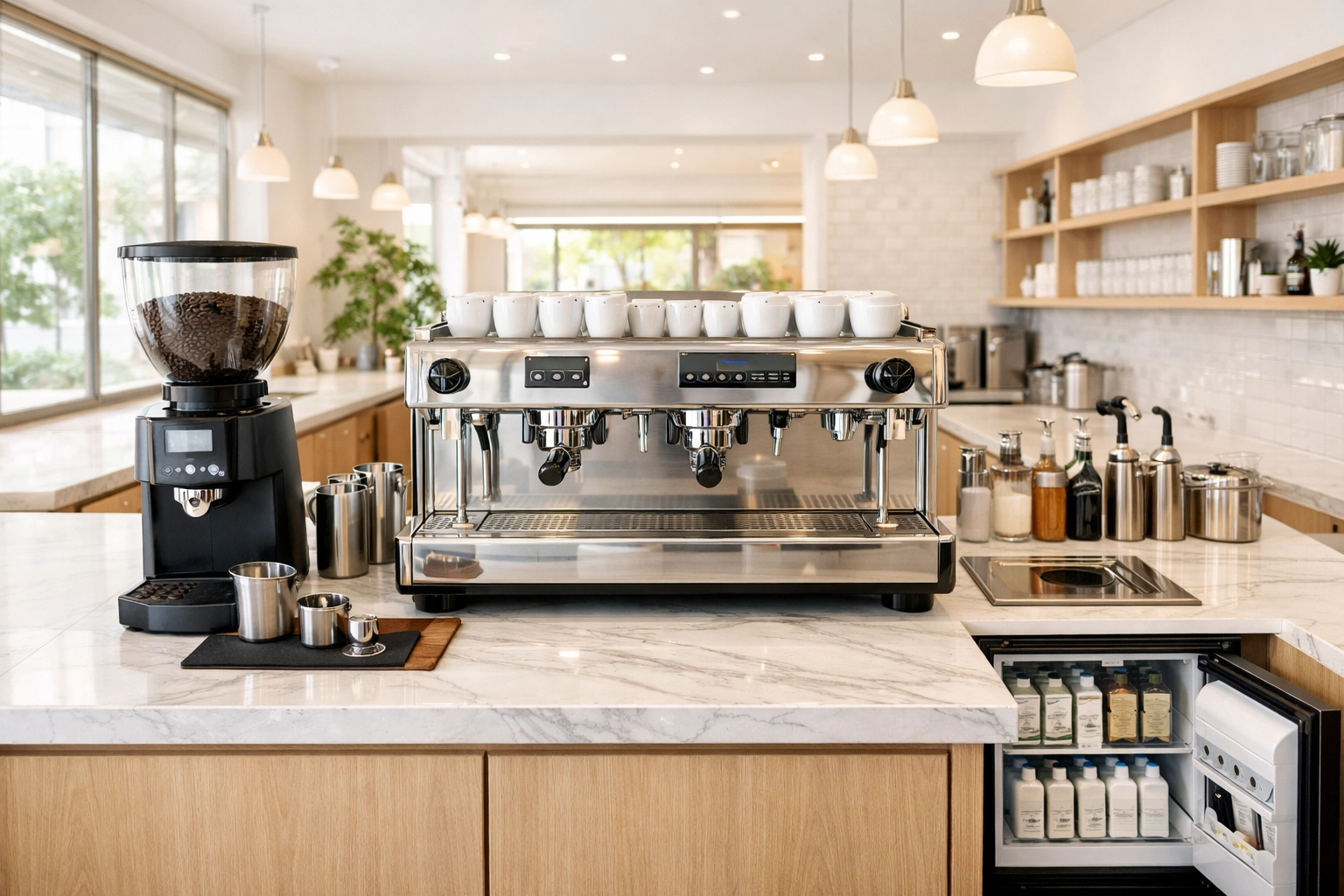
    Efficient coffee shop layout and barista workflow design with modern equipment and marble counters.


    6. Not Setting a Realistic Budget Early On

    "It’ll probably cost about £20,000 to get open."

    Unfortunately, that is rarely the case. Between legal fees, signage, initial stock, insurance, and the "unexpected" repairs we mentioned earlier, costs spiral quickly. Many shops fail not because the coffee was bad, but because they ran out of cash before they could reach profitability.

    The Fix: Create a detailed budget and then add a 20% contingency fund. Be honest about your costs. Don't forget the "invisible" expenses like POS system fees, music licenses, and waste collection. If you're looking for wholesale coffee that offers great value without sacrificing quality, we can help you balance those margins.


    7. Overlooking the "Modern" Customer Needs

    Ten years ago, you could get away with mediocre WiFi and hard wooden chairs. Today? Not so much. A huge portion of coffee shop customers are remote workers or students. If you don't have enough power outlets or reliable internet, they will find another place to spend their afternoon.

    Similarly, don't assume that just because you've opened your doors, people will find you. A "Now Open" sign in the window isn't a marketing plan.

    The Fix: Think about your "vibe." Is it a quick-turnover takeaway spot or a "stay and work" lounge? If it's the latter, invest in comfortable seating and diverse lighting. On the marketing side, get on social media before you open. Show the build-out process, introduce the team, and build a community before the first bean is even ground.

    Cozy coffee shop seating area with a latte, perfect for remote workers and modern customers.


    Summary

    Setting up a coffee shop is a massive undertaking, but it’s also incredibly rewarding when done right. Basically, it comes down to being prepared. Don't cut corners on your equipment, don't ignore your building's limitations, and for the love of coffee, please train your staff.

    If you focus on consistency, workflow, and a simple, high-quality menu, you’re already miles ahead of the competition.

    If you're feeling a bit overwhelmed by the technical details: whether it's understanding milk chemistry or figuring out the best la spaziale settings: we are here to help. At Limini Coffee, we don't just supply beans; we partner with you to make sure your business succeeds.

    Why not have a look at our wholesale options or reach out for a chat? We’d love to help you turn that dream into a reality. After all, that’ the beauty of coffee : )

  • The Ultimate Guide to Hotel Revenue Management Software: Everything You Need to Succeed

    The Ultimate Guide to Hotel Revenue Management Software: Everything You Need to Succeed

    Price smarter. Scale faster. Maximize every booking.

    In the modern hospitality landscape, leaving your room rates to guesswork is a recipe for empty beds and missed margins. Successful hoteliers have moved beyond the "set it and forget it" mentality, embracing a world where data dictates every dollar. By leveraging real-time market intelligence and automated pricing, you can transform your property from a place people stay into a high-performance revenue engine: all from one innovative platform.

    Beyond the spreadsheet

    We believe your pricing should be as dynamic as your guests. Gone are the days of manually updating Excel sheets or staring at competitor websites every Tuesday morning. Today’s market moves too fast for human fingers to keep up.

    A Revenue Management System (RMS) is the brain of your commercial operation. It doesn’t just change prices; it predicts the future. By analyzing thousands of data points: from local events and weather patterns to competitor inventory and historical booking curves: it ensures you never leave money on the table. It’s the difference between hoping for a good season and engineering one.

    Modern laptop on a marble desk representing automated hotel revenue management software.

    Why revenue tech matters

    The numbers don't lie. Properties that transition from manual pricing to automated revenue management software typically see a massive shift in their bottom line. We’re talking about more than just a few extra bucks per night.

    • 15% average increase in RevPAR through optimized demand capture.
    • 20+ hours saved per month by automating repetitive manual updates.
    • 100% data accuracy by removing the "oops" factor of human entry.

    When you stop reacting to the market and start anticipating it, your entire team wins. Your revenue manager moves from "data entry clerk" to "strategic visionary." Your owners see healthier returns. Your guests get prices that reflect the true value of the moment.

    The core components of success

    Not all software is created equal. If you’re looking to upgrade your tech stack, you need a system that does more than just move a slider up and down. We think a truly innovative RMS should focus on three pillars of excellence.

    1. Dynamic pricing and rate optimization

    Static rates are a relic of the past. Your software should automatically adjust prices based on real-time demand fluctuations.

    • Automated rate recommendations based on AI.
    • Granular control over room types and segments.
    • Independent pricing for different booking channels.

    2. Intelligent demand forecasting

    Predicting the future isn't magic; it's math. Advanced machine learning algorithms look at your historical data and combine it with current market trends to tell you exactly what’s coming.

    • Proactive planning for seasonal shifts.
    • Identification of "compression nights" before they happen.
    • Accurate budgeting based on data, not gut feelings.

    3. Real-time market intelligence

    You can’t win the game if you don't know the score. You need to know what the hotel across the street is doing, but you also need to know what the entire market is feeling.

    • Instant rate shopping across OTAs.
    • Competitor positioning analysis.
    • Parity monitoring to ensure you aren't being undercut.

    Smartphone on a desk with a city view, highlighting real-time market data for hotel revenue growth.

    Choosing your perfect match

    The "best" software is the one that fits your specific needs. A 500-room resort in Vegas has different requirements than a 15-room boutique hotel in the Cotswolds. Here is how the top players in the market currently stack up:

    Platform Best For Key Strengths
    Lighthouse Independent hotels High-tier market data and incredibly easy to use.
    Duetto Flexibility seekers Open pricing model that gives you total strategy control.
    IDeaS Large-scale operations Serious AI power for complex, multi-property portfolios.
    RoomPriceGenie Small to mid-sized hotels Plug-and-play simplicity that gets results in minutes.
    Atomize Busy lean teams Heavy focus on full automation with minimal manual input.

    Choosing the right partner is about more than just features; it’s about integration. Your RMS is only as good as the data it receives from your Property Management System (PMS). When these two talk to each other seamlessly, you unlock a level of operational excellence that your competitors simply can't match.

    Explore how the right tech stack can transform your business at Mews.

    The AI revolution in hospitality

    We are currently living through the most significant shift in travel tech history. AI isn't just a buzzword; it’s the new standard for efficiency. Modern revenue management software uses neural networks to understand guest behavior in ways we couldn't imagine five years ago.

    It understands that a "business traveler" isn't just a category: it's a behavior pattern that changes based on the day of the week, the lead time, and even the device they use to book. By feeding this level of detail into your pricing strategy, you aren't just selling a room; you're capturing the maximum willingness to pay for every single guest.

    "Switching to an automated RMS was like finally turning the lights on in a dark room. We realized we were underpricing our weekends by nearly 20% for years."
    : Sarah J., Boutique Hotel Owner

    Coffee on hotel linens symbolizing the precision and guest experience focus of AI in hospitality.

    Implementation: Three steps to start

    Don't let the "tech" part of technology scare you. Transitioning to a smarter way of working is simpler than you think.

    1. Define your goals. Are you chasing occupancy, ADR, or a balanced RevPAR growth?
    2. Audit your data. Ensure your current PMS is clean and ready to feed the RMS "brain."
    3. Trust the automation. Start with "semi-automated" mode to build confidence, then let the AI take the wheel.

    Most modern systems can be up and running in a matter of weeks, providing an almost immediate return on investment. The goal is to spend less time looking at screens and more time looking at guests.

    The Mews perspective

    At Mews, we believe that technology should serve people, not the other way around. Our ecosystem is built to play nice with the world's leading revenue management tools. We don't believe in closed gardens; we believe in open horizons.

    When your PMS and RMS work in perfect harmony, the "manual" part of your job disappears. You get real-time synchronization, zero-latency rate updates, and a guest experience that feels personal because your team actually has the time to make it so.

    Hotel staff member with a tablet in a modern hallway illustrating seamless operational efficiency.

    Frequently Asked Questions

    Does a small hotel really need revenue software?
    Absolutely. In many ways, small hotels need it more. With fewer rooms, every vacancy hurts twice as much. Automation allows you to compete with the big brands without needing a 10-person corporate revenue team.

    Will I lose control of my pricing?
    Never. You set the guardrails. You decide the minimums, the maximums, and the "never-exceed" rules. The software simply works within the boundaries you define to find the most profitable path forward.

    How long does it take to see results?
    Most properties see an uptick in ADR or occupancy within the first 30 days of implementation. As the AI learns your specific market patterns, the results typically compound over the first six months.

    Ready to earn more?

    The gap between the tech-forward hotels and the traditionalists is widening every day. While one manager is still manually typing rates into a channel manager, another is watching their AI optimize their portfolio while they focus on guest satisfaction.

    It’s time to stop leaving your revenue to chance. Embrace the data, trust the tech, and start seeing what your property is truly capable of achieving.

    Get started on your journey toward total operational excellence and see how Mews can elevate your strategy at https://referrals.mews.com/umqHYIto.

    Modern boutique hotel staircase representing the elevated journey to operational excellence.

  • 15 Boutique Hotel Management Tips to Crush Your Revenue Goals

    15 Boutique Hotel Management Tips to Crush Your Revenue Goals

    Boost occupancy. Drive revenue. Delight guests.

    Running a boutique hotel is a balancing act. You aren’t just selling a bed; you’re selling a vibe, a story, and a localized experience that big chains can’t touch. But "vibe" doesn't pay the bills: revenue does. To dominate in 2026, you need to marry that unique personality with cold, hard data and cutting-edge tech.

    We believe that great hospitality starts when you step away from the front desk. It happens when your systems work as hard as you do. In fact, properties using modern hospitality clouds see a 15% increase in RevPAR within the first year.

    It’s about moving faster, thinking smarter, and automating the boring stuff. All from one innovative platform.

    Master the math of pricing

    1. Shift to real-time dynamic pricing

    Static rates are a relic of the past. If you’re still charging the same price for a Tuesday in November as a Saturday in July, you’re leaving money on the table. Dynamic pricing allows you to react to the market as it happens. When a local festival is announced or a competitor sells out, your rates should climb automatically.

    2. Trust the forecast

    Advanced demand forecasting isn't just for the big guys. Use your historical data, current booking pace, and market trends to predict the future. We think the best decisions are data-driven.

    • Analyze booking windows to catch early birds.
    • Identify high-demand dates months in advance.
    • Adjust inventory before the rush starts.

    3. Smart segmentation for the win

    Not all guests are created equal. A corporate traveler has different needs: and a different budget: than a weekend romantic couple. Offer the same room at different price points through targeted segments.

    • Create "hidden" rates for loyalty members.
    • Offer corporate packages with high-speed Wi-Fi and breakfast.
    • Design "last-minute" local staycation deals.

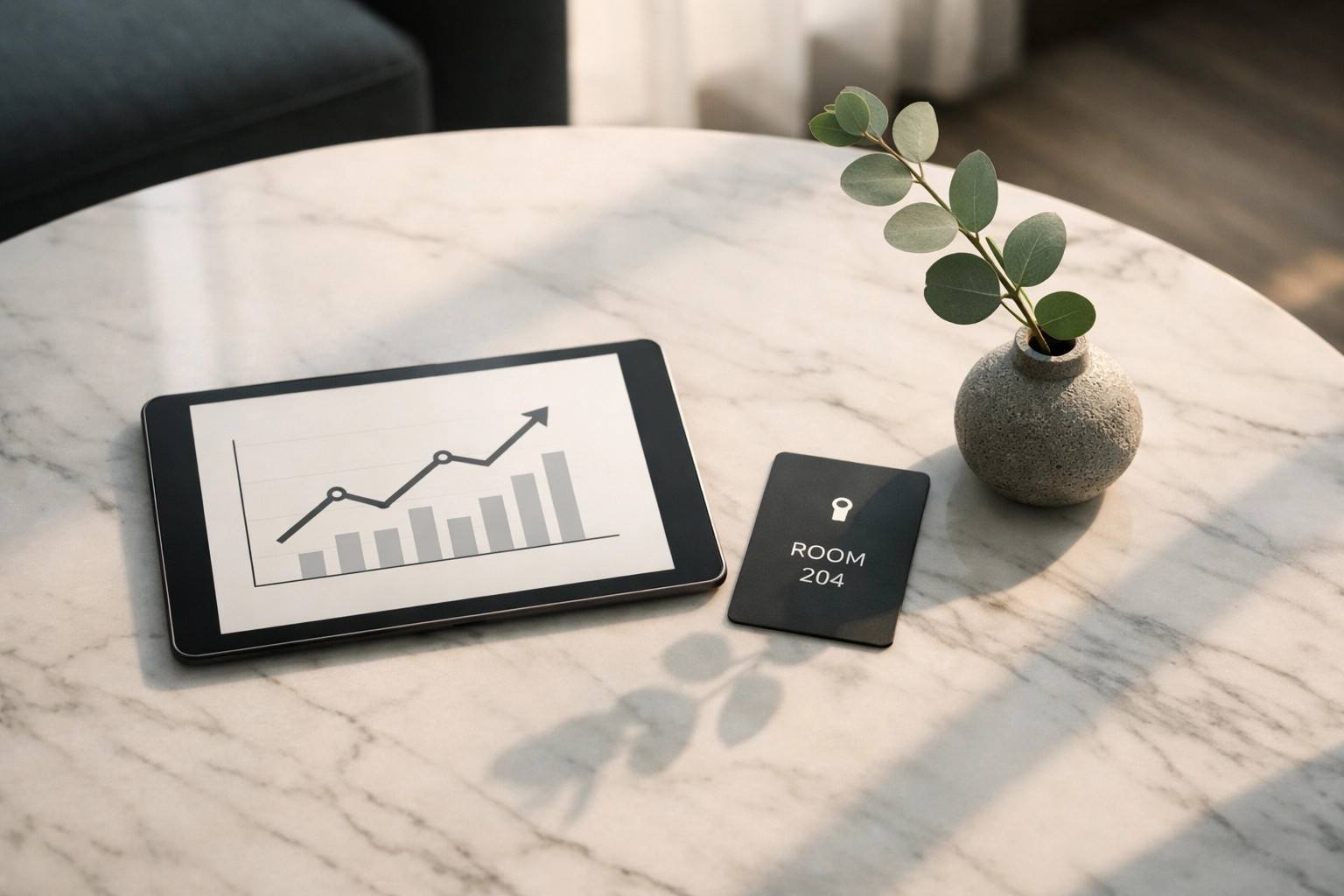
    Boutique hotel revenue strategy data displayed on a tablet with a modern room key.

    Own your distribution

    4. Make direct bookings the default

    Online Travel Agencies (OTAs) are a necessary evil, but their 20% commission isn't. Your website should be your best salesperson. Use a mobile-friendly booking engine that makes it easier to book a room than to order a pizza. If you want to see how the pros do it, check out the Mews approach to guest journeys.

    5. Kill the gap nights

    A one-night stay on a Tuesday and another on a Thursday leaves a "gap night" on Wednesday that’s notoriously hard to fill. Use stay-length restrictions during peak periods. If someone wants that Saturday night, make it a two-night minimum. It protects your inventory and maximizes your cleaning schedule.

    6. Lean into mobile-first commerce

    By 2026, over 70% of travel bookings happen on a smartphone. If your checkout process requires a desktop, you’re losing the Gen Z and Millennial market. Shorten the path to purchase. Three clicks and a "Book Now" button. That’s the goal.

    7. Strategic stop-sells

    When you know you’re going to sell out (think Graduation weekend or New Year’s Eve), stop selling on OTAs. Pull your inventory from Expedia and Booking.com and keep those high-value rooms for your direct site. Why pay a commission on a room that would have sold itself?

    "We saved 10 hours a week on manual rate updates, which let our team focus back on the guests." : Boutique Owner in London

    Elevate the guest experience

    8. Upsell before they arrive

    The "hard sell" at the front desk is awkward. The "convenient upgrade" in a pre-arrival email is service. Offer room upgrades, early check-ins, or a bottle of chilled prosecco waiting in the room. It’s low effort and high margin.

    9. Diversify your revenue streams

    Your lobby is more than a waiting area. It’s a coworking space. Your roof is more than a ceiling. It’s a yoga studio or a cocktail bar.

    • Sell "Day Passes" for digital nomads.
    • Partner with local artisans for a curated lobby shop.
    • Host ticketed events for locals and guests alike.

    10. Create hyper-detailed guest personas

    Generic service is forgettable. When you know your "Digital Nomad Dave" needs a quiet corner and strong coffee, or "Leisure Laura" wants the best brunch spots, you can personalize the experience. Personalization leads to reviews, and reviews lead to higher rates.

    Modern boutique hotel guest persona relaxing in a lounge with curated local travel amenities.

    Operational excellence through tech

    11. Automate the "busy work"

    If your staff is spending four hours a day on data entry, they aren’t spending four hours a day helping guests. Automate your night audit, your billing, and your reporting. We believe technology should be invisible: it should just work.

    12. Integrate everything

    A PMS that doesn't talk to your POS, which doesn't talk to your CRM, is a recipe for disaster. You need a tech stack that communicates in real-time. When a guest buys a drink at the bar, it should hit their folio instantly. No paper slips. No manual mistakes.

    13. Embrace the AI revolution

    AI isn't here to replace your concierge; it’s here to make them a superhero. Use AI chatbots to handle repetitive questions ("What's the Wi-Fi password?") so your human staff can handle the complex stuff. It keeps your overhead low and your response time instant.

    14. Value-added pricing over discounting

    Instead of dropping your price by $20 to compete with the hotel down the street, add $20 worth of value. Throw in breakfast, a local walking tour, or a late checkout. You maintain your price integrity while looking like the better deal.

    15. The power of a 30-minute check-in

    Actually, make it a 30-second check-in. Better yet, let them do it on their phone before they even reach the door. Online check-in is no longer a luxury; it’s an expectation. It removes the friction of travel and starts the guest experience on a high note.

    The bottom line

    Boutique hotel management in 2026 is about being agile. It’s about recognizing that your property is a living, breathing business that requires constant optimization. By focusing on direct bookings, automated operations, and diversified revenue, you don't just hit your goals: you crush them.

    See what a modern PMS can do for your property. It’s easy to get started and even easier to see the results.

    Get a demo and see how Mews can transform your revenue

    We think you deserve a platform that dreams as big as you do. One that handles the complexity so you can handle the hospitality. It’s all about creating remarkable guest experiences, all from one innovative platform.

    Quick Stats to Remember:

    • 20%: The average commission saved by moving to direct bookings.
    • 15%: The RevPAR growth seen by tech-forward boutique hotels.
    • 0: The amount of paper guest folios you should be printing in 2026.

    Ready to take the next step? The future of hospitality is already here. Let’s get you earning more revenue in no time.

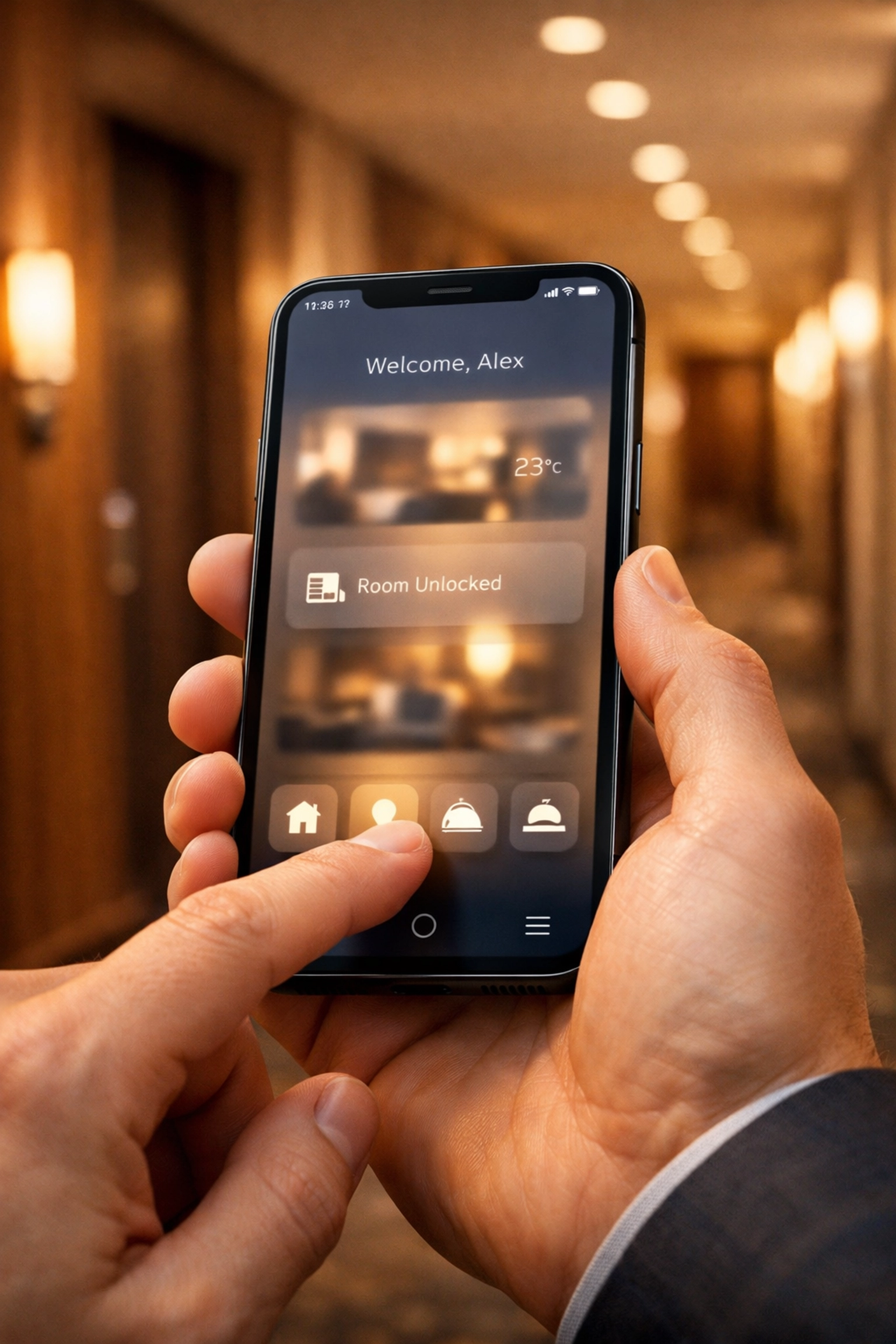
    Efficient hotel technology showing a guest using a mobile phone to unlock a suite door wirelessly.

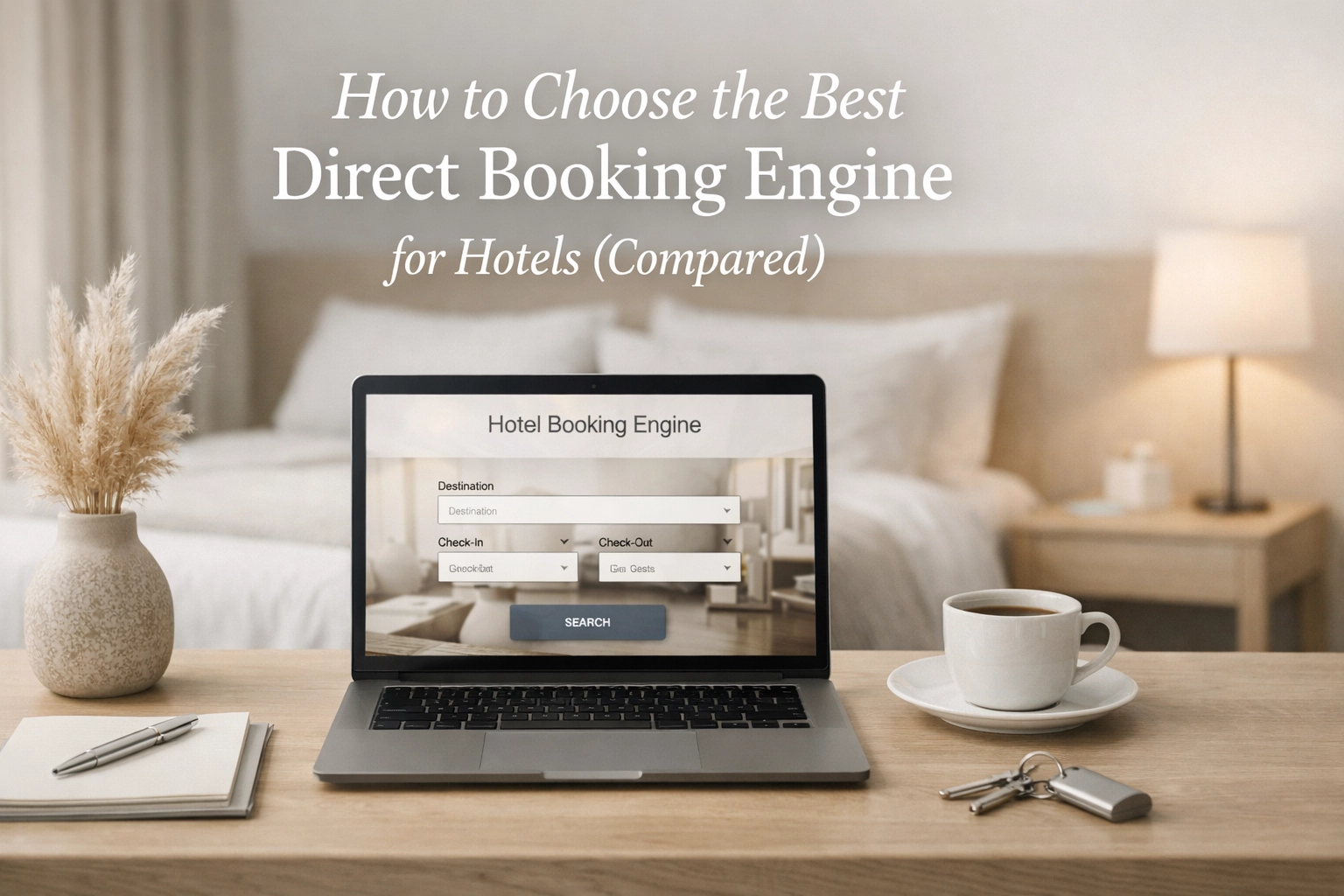
  • How to Choose the Best Direct Booking Engine for Hotels (Compared)

    How to Choose the Best Direct Booking Engine for Hotels (Compared)

    Own your traffic. Grow your margins. Build your brand.

    Choosing a booking engine isn’t just about adding a "Book Now" button to your website. It’s about designing a digital front door that welcomes guests and convinces them to stay. In an era where OTAs can take a 20% bite out of your revenue, your direct booking engine is your most profitable employee. It works 24/7, speaks every language, and keeps the commissions in your pocket. All from one intuitive guest experience platform.

    Why direct bookings are the ultimate flex

    We believe that every guest who books directly is a victory for your brand. It’s not just about the money (though the money is great). It’s about the data, the relationship, and the freedom to curate the entire stay from the first click.

    Industry data shows that top-tier booking engines can deliver an average 63x return on investment. That’s not a typo. When you move a guest from a third-party site to your own, you aren't just saving on commission; you’re increasing the lifetime value of that customer. You get their email. You get their preferences. You get the chance to upsell them that rooftop yoga session before they even pack their bags.

    Hotel guest using a smartphone for a seamless direct booking experience in a minimalist room.

    The non-negotiables: What to look for

    Don't settle for "good enough." The modern traveler has zero patience for clunky interfaces or hidden fees. If your booking flow feels like a tax audit, they’re heading back to Expedia.

    Here is what actually matters.

    Mobile-first or bust.

    Over 60% of travel searches happen on a phone. If your booking engine requires pinching and zooming, you’re losing money every single minute. A modern engine should feel like an app, fast, thumb-friendly, and sleek.

    Frictionless payment flows.

    Nobody wants to dig for their credit card while sitting on a train. Your engine needs to support Apple Pay, Google Pay, and localized payment methods. Speed is the ultimate currency.

    Real-time synchronization.

    There is nothing more stressful than a double booking. Your engine must talk to your PMS and channel manager in real-time. Speed. Accuracy. Reliability.

    "We saw a 15% jump in direct revenue within the first month of switching. The guest just finds it easier to say yes."

    Comparing the heavy hitters

    The market is crowded, but a few names consistently rise to the top. Depending on your property size and your appetite for innovation, your "perfect match" might vary.

    Mews: The Innovation Leader

    We don't just process bookings; we design experiences. Mews is built for the modern court of hospitality: those who want to move fast and stay ahead of the curve. It’s highly customizable, deeply integrated with AI, and focuses on the entire guest journey rather than just the transaction.

    • Best for: Boutique hotels, multi-property groups, and forward-thinking brands.
    • Key strength: Ecosystem connectivity and smart upselling.
    • Why it wins: It turns your booking engine into a revenue-generating machine.

    Check out how Mews can transform your tech stack here: https://referrals.mews.com/umqHYIto

    SiteMinder: The Distribution King

    SiteMinder is a powerhouse when it comes to reach. They connect to over 450 OTAs, making them a solid choice if your primary goal is massive international visibility.

    • Best for: Medium to large hotels with high volume.
    • Key strength: Global distribution and channel management.
    • Why it wins: It’s a reliable workhorse for global visibility.

    Cloudbeds: The All-in-One

    For smaller, independent properties that don't want to manage five different logins, Cloudbeds offers a simplified approach.

    • Best for: Small inns, B&Bs, and hostels.
    • Key strength: Simplicity and integrated PMS functionality.
    • Why it wins: It’s an easy, commission-free entry point for smaller teams.

    Minimalist hotel reception desk with integrated tablet for simple booking engine management.

    Features that actually move the needle

    We think most booking engines focus on the wrong things. It’s not about how many fields you can add to a form; it’s about how many you can take away.

    1. Smart Upselling.
    Don't just sell a room. Sell an experience. Whether it's a late checkout, a bottle of champagne on arrival, or a breakfast add-on, your booking engine should prompt these naturally during the checkout process. This is how you drive incremental revenue without lifting a finger.

    2. Multi-Currency and Multi-Language.
    If you want international guests, you have to speak their language, literally and financially. A booking engine that automatically adjusts based on the user's location builds immediate trust.

    3. Advanced Analytics.
    If you can't measure it, you can't improve it. You need to know exactly where your guests are dropping off. Is it the room selection page? The payment screen? Data tells the story that your gut feeling can’t.

    The role of AI in your booking flow

    The future of hospitality isn't just digital; it's intelligent. We are moving toward a world where your booking engine knows what a guest wants before they do.

    Imagine a booking engine that recognizes a returning guest and automatically suggests their favorite room type or a specific dietary package. AI can help optimize pricing in real-time based on demand, weather, or even local events. It’s about moving from a reactive "take an order" mindset to a proactive "concierge" mindset. All from one intelligent platform.

    Close-up of a mobile hotel booking engine interface showing an intelligent guest experience.

    Pricing models: What’s the catch?

    Pricing in the hospitality tech world can be a bit of a maze. Usually, you’ll encounter three main models:

    • Flat Monthly Fee: You pay a set price regardless of how many bookings you take. This is great for high-volume hotels because it makes costs predictable.
    • Commission-Based: You pay a small percentage (usually 2-5%) of each direct booking. This is low-risk for smaller properties but can get expensive as you grow.
    • Per-Booking Fee: A flat dollar amount per transaction.

    Be wary of hidden costs. Some "free" booking engines make their money by charging for essential integrations or basic support. Always look at the total cost of ownership over a 12-month period.

    Implementation: Get it right the first time

    Switching your booking engine shouldn't feel like open-heart surgery. It should be a 30-minute exercise in setting yourself up for success.

    1. Audit your current flow. Go through the booking process on your own phone. If you get frustrated, your guests definitely will.
    2. Request a tailored demo. Don't just watch a video. Ask the provider to show you how the engine handles your specific room types and packages.
    3. Check the integrations. Make sure the engine plays nice with your current PMS, CRM, and payment gateway.
    4. Go live and iterate. Your booking engine is a living thing. Use analytics to tweak your photos, descriptions, and offers every month.

    Hotel professional analyzing direct booking engine ROI and performance on a modern laptop.

    The bottom line

    The best direct booking engine is the one that disappears. It should be so seamless, so fast, and so intuitive that the guest doesn't even realize they’ve left your "marketing" site and entered a "transaction" site.

    We believe hospitality is about removing barriers. Whether you’re running a 10-room boutique in London or a 500-room resort in the Maldives, your technology should empower you to spend less time behind a screen and more time with your guests.

    Ready to see how the right tech can change your business? Explore the Mews ecosystem and start reclaiming your revenue: https://referrals.mews.com/umqHYIto

    Stop letting OTAs tell your story. Start owning the journey. All from one remarkable platform.

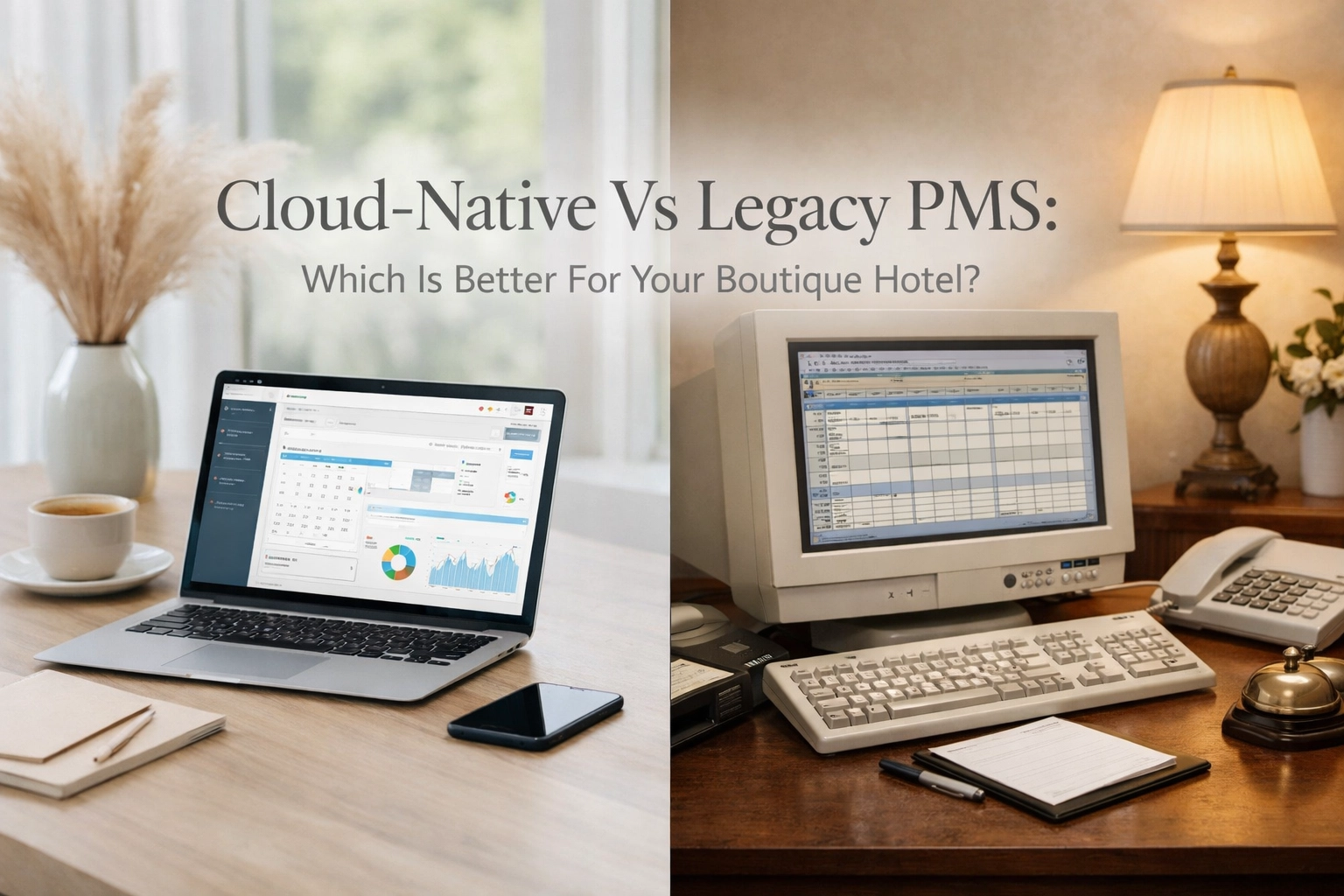
  • Cloud-Native Vs Legacy PMS: Which Is Better For Your Boutique Hotel?

    Cloud-Native Vs Legacy PMS: Which Is Better For Your Boutique Hotel?

    Automate your operations. Elevate your guest experience. Reclaim your time.

    For boutique hoteliers, the choice between a cloud-native platform and a legacy Property Management System (PMS) isn't just a technical decision. It’s a business strategy. In an era where travelers expect instant gratification and hyper-personalized service, your choice of hotel PMS dictates how fast you can innovate.

    We believe that boutique hotels shouldn't be held back by clunky hardware or outdated software. The numbers tell a clear story: hotels switching to cloud-native systems see a 60% reduction in total IT spend and a 24% boost in front-desk efficiency.

    It’s time to move beyond managing reservations and start managing experiences, all from one innovative platform.

    The high price of staying "Traditional"

    Legacy systems are the heavy anchors of the hospitality world. They require on-site servers, dedicated IT staff to keep the lights on, and manual updates that often result in hours of downtime. For a boutique hotel, where every room and every guest interaction counts, this friction is more than an inconvenience, it’s a revenue killer.

    When you use a legacy PMS, you aren't just paying for the software. You’re paying for the cooling systems for the server room, the security patches you have to install manually, and the missed opportunities because your system doesn't "talk" to your other tools.

    Minimalist boutique hotel reception desk with a tablet, showcasing cloud-native PMS efficiency.

    We think the "old way" of doing things is fundamentally broken.

    • Legacy systems demand massive upfront capital.
    • They create data silos that prevent a 360-degree guest view.
    • They rely on hardware that inevitably fails.

    Efficiency by the numbers

    Switching to a cloud-native hotel PMS like Mews isn't just about moving your data to the internet; it’s about redesigning how your hotel breathes. When your staff isn't tethered to a desktop at the front desk, the entire vibe of your lobby changes.

    Efficiency isn't just a buzzword. It’s a measurable outcome.

    • 30% faster training: Cloud interfaces are designed to be as intuitive as the apps on your smartphone.
    • 31% reduction in human error: Automation handles the repetitive data entry, leaving less room for mistakes.
    • 24% more efficient staff: Your team spends less time clicking and more time talking to guests.

    Imagine a world where your new hire is fully operational within their first two hours, not their first two weeks. That’s the power of an easy-to-use, cloud-native interface.

    Seamless guest journeys: Booking engine to self-check-in

    Your guest's journey starts long before they walk through your front door. It starts the moment they land on your website. If your booking engine feels like a relic from 2005, you’ve already lost their trust.

    Modern boutique hotels thrive on the "hidden" guest experience, the things that work so well, the guest doesn't even notice them. A cloud-native PMS integrates directly with your booking engine to provide real-time availability and dynamic pricing without a second's delay.

    Once the guest arrives, why force them to stand in line?

    • Self-check-in kiosks: Let guests skip the queue and get straight to their room.
    • Mobile check-in: Empower guests to use their own devices.
    • Automated payments: Secure, instant, and completely hands-off for your team.

    "We saved 10 hours a week just by automating our check-in process, and our guests love the autonomy."

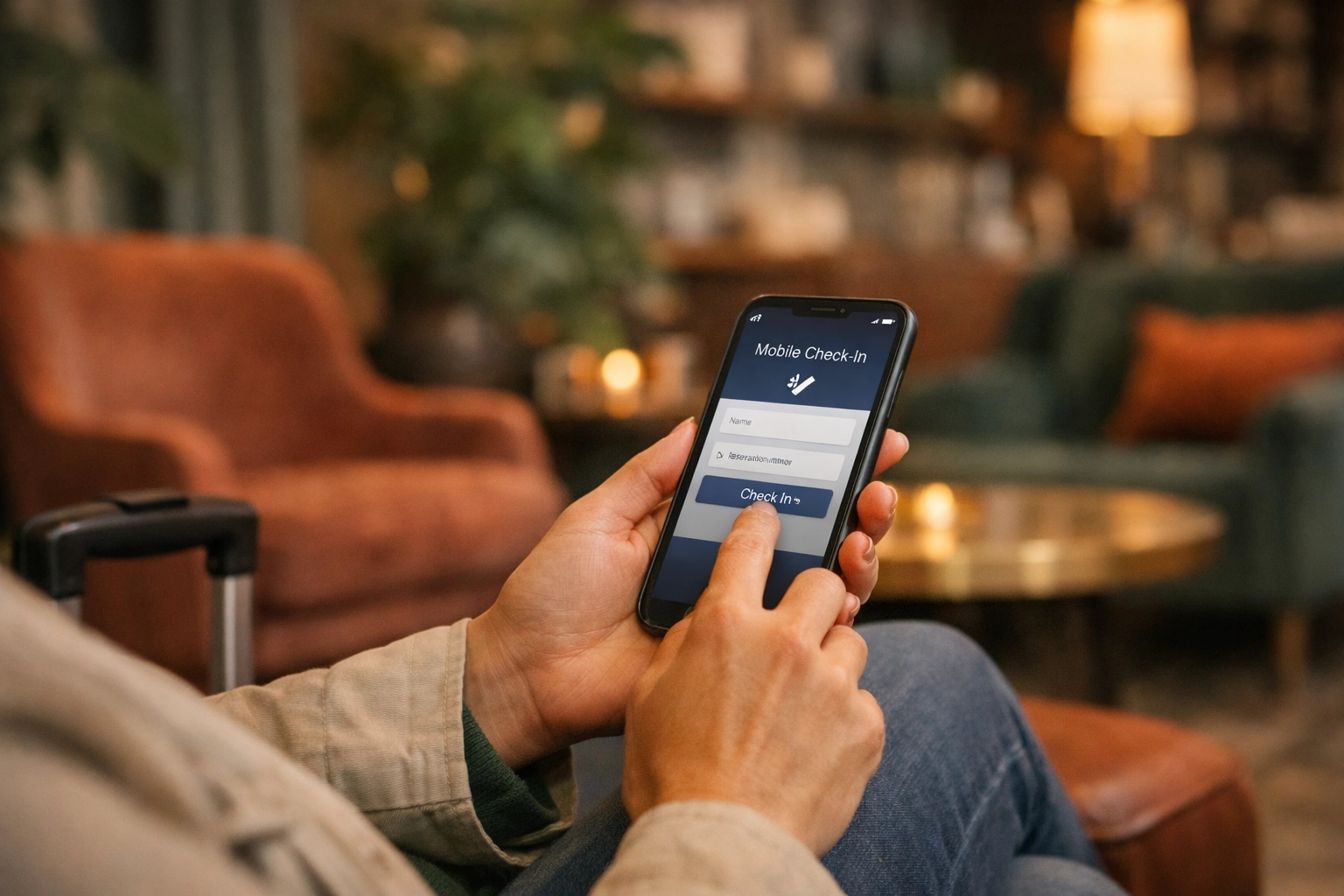
    Hotel guest using a smartphone for mobile check-in in a modern boutique hotel lounge.

    The power of the marketplace: CRM and Channel Manager

    One of the biggest pitfalls of legacy systems is their "walled garden" approach. They make it intentionally difficult to connect with third-party apps. In contrast, cloud-native systems are built on open APIs.

    This means your hotel PMS can act as the central nervous system for your entire tech stack. Need a high-performing channel manager to sync your rates across 200+ booking sites? Done. Want to connect a robust CRM to send personalized welcome emails? It’s just a few clicks away.

    We believe you should have the freedom to choose the best tools for your specific needs.

    • Integrate with over 1,000 marketplace apps.
    • Scale your tech stack as your boutique property grows.
    • Sync data instantly between your CRM and front desk.

    Check out how easy it is to build your own ecosystem at https://referrals.mews.com/umqHYIto.

    Why cloud-native means future-proof

    Innovation waits for no one. With a legacy system, you might wait years for a significant feature update, and then you’ll likely have to pay for it. With a cloud-native platform, updates happen in the background. You wake up, and your system is better than it was the night before.

    This constant evolution is essential for boutique hotels that want to stay ahead of the curve. Whether it's integrating the latest AI guest messaging tool or adopting a new payment method, a cloud-native PMS ensures you’re never the last to the party.

    Laptop and phone used for remote hotel management via a cloud-native PMS platform.
    We think about it like this: your PMS should be an engine for growth, not a box under your desk.

    • Zero downtime: Updates happen while you sleep.
    • Infinite scale: Add rooms or even new properties in minutes.
    • Global accessibility: Manage your hotel from a laptop in London or a phone in Bali.

    The 48-hour transformation

    Many hoteliers fear the "big switch." They worry about lost data, angry guests, and weeks of chaos. But the reality of modern migration is far different. Because cloud-native systems don't require physical hardware installation, the deployment is lightning fast.

    We’ve seen hotels go from a dusty legacy system to a fully automated Mews environment in as little as 48 hours. The transition is seamless, often scheduled during off-peak hours to ensure your guests never feel the ripple.

    Schedule a transition. Get trained. Go live.

    It really is that simple.

    Bright, modern boutique hotel lobby representing a seamless transition to a new PMS.

    Boutique excellence with Mews

    Mews isn't just another hotel management software; it’s a platform designed specifically for the modern era of hospitality. We focus on three core pillars: being cloud-native, being remarkably easy to use, and being obsessed with automation.

    For boutique hotels, these USPs are game-changers. You don't have the massive IT budgets of global chains, and you don't have time to waste on complex manual processes. You need a partner that understands the importance of brand identity and guest intimacy.

    Why boutique hotels choose Mews:

    1. Automation-focused: We eliminate the admin so you can focus on the art of hosting.
    2. Design-forward: An interface your team will actually enjoy using (no, seriously).
    3. Guest-centric: Tools that put the guest in control of their own stay.

    See what Mews can do for your property and get you earning more revenue in no time: https://referrals.mews.com/umqHYIto.

    The Verdict: Cloud-Native or Legacy?

    The world has changed, and the way we manage hotels has to change with it. While legacy systems might offer a sense of physical "control," they lack the agility, cost-efficiency, and guest-facing features required to compete in 2026.

    Cloud-native systems aren't just the "better" choice: they are the only choice for boutique hotels that want to thrive. You get lower costs, happier staff, and guests who keep coming back because their stay was effortless.

    Stop managing servers. Start managing your legacy.

    Ready to make the switch? It only takes a 30-minute demo to see the future of your hotel.

    Explore Mews today.

  • Self-Service is the New White Glove Service: Why Kiosks are a Win-Win

    White glove service used to mean someone doing everything for you. Now? It means getting out of your way.

    That's the beautiful irony of hospitality in 2026. The same guests who expect premium experiences also want speed, control, and zero hassle. And self-service kiosks deliver all three, while simultaneously freeing your staff to do what they actually trained for: creating memorable guest moments, not typing into a screen.

    Let's talk about why kiosks aren't the end of hospitality. They're the beginning of better hospitality.

    The Old Model Was Broken (We Just Didn't Notice)

    Picture traditional check-in. Your guest walks up to the desk after a long journey. They're tired. They just want their key.

    But first: they wait in line behind someone changing a reservation. Then they wait while your front desk agent battles the PMS. Then they spell their name. Twice. Then they hand over their ID and credit card. Then they listen to information they already read online. Then, finally, they get their key.

    Your front desk agent? They spent that entire interaction staring at a screen, typing, clicking, and probably apologizing for the wait.

    Nobody won. The guest didn't feel attended to. Your staff didn't feel like hosts. They felt like data entry clerks.

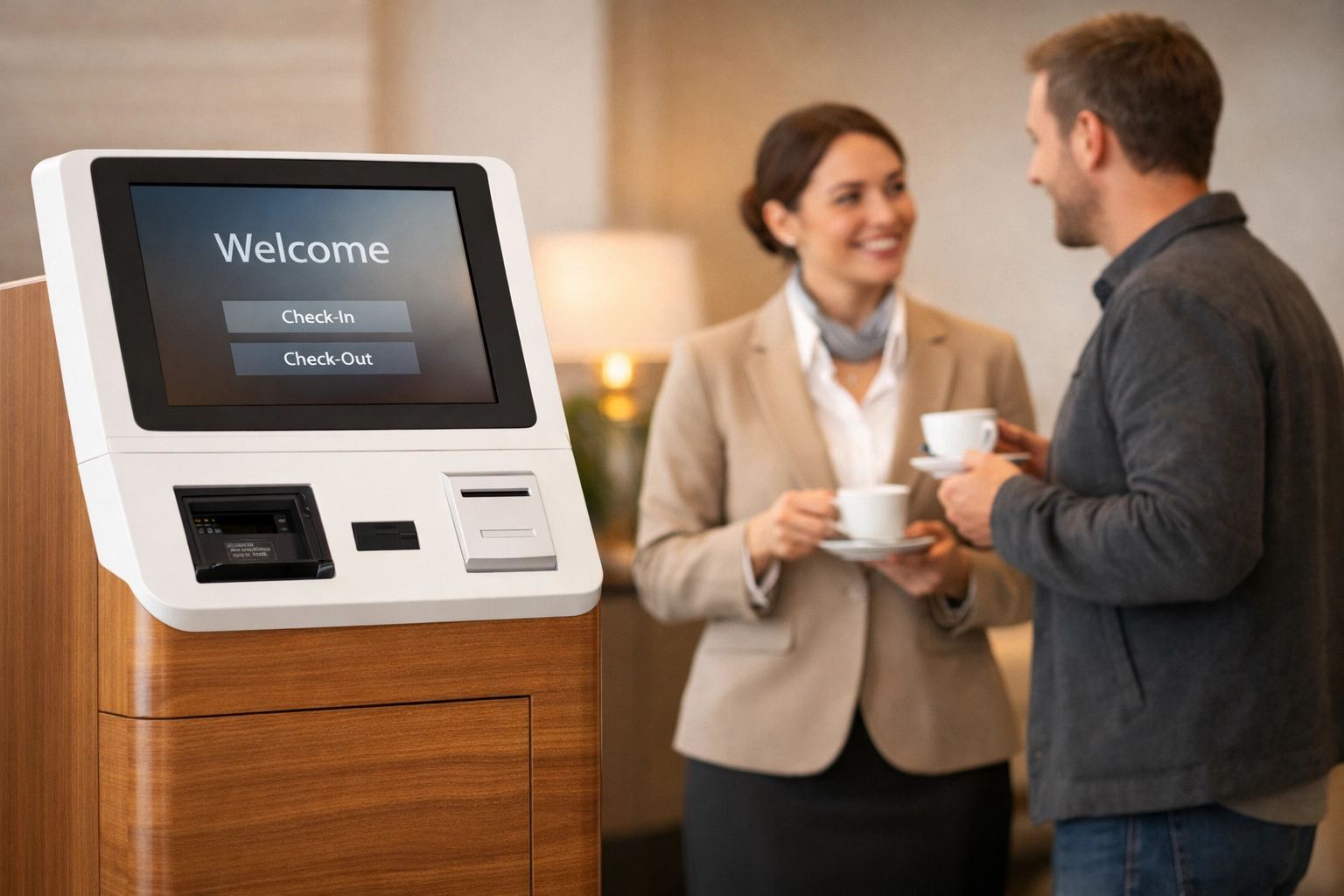
    Modern hotel lobby with self-service check-in kiosk while staff engages with guest

    Enter the Kiosk: Your Silent Service Hero

    Here's what actually happens with a well-implemented kiosk system:

    Guest walks in. Taps the screen. Scans their ID or confirmation. Reviews their reservation. Selects room preferences. Gets their key. Done in under two minutes.

    Your front desk agent? They're notified the guest has arrived. They walk over with a welcome drink and a genuine smile. They ask about the journey. They recommend the new restaurant. They handle the upgrade request. They build a relationship.

    That's white glove service. Not typing faster.

    According to recent data, 90% of guests now actively want self-service options. They're not settling for kiosks, they're seeking them out. Why? Because autonomy feels premium when it's executed well.

    The Win for Guests: Control Without Compromise

    Let's break down what guests actually gain:

    Speed. Multiple guests can check in simultaneously instead of queuing at a single desk. No bottlenecks during group arrivals. No missed dinner reservations because check-in took 20 minutes.

    Accuracy. When guests input their own information, miscommunications disappear. They see exactly what they're selecting. They verify their own details. Order accuracy, whether it's room preferences or F&B selections, improves dramatically.

    Privacy. Not everyone wants to discuss room charges or special requests with an audience behind them in line. Kiosks offer discretion.

    Pace. Some guests move quickly. Others like to review everything twice. Kiosks let both travel at their own speed without feeling rushed or judged.

    Language barriers? Gone. Kiosks offer multiple language options instantly. Dietary restrictions? Guests can browse and customize without explaining themselves repeatedly.

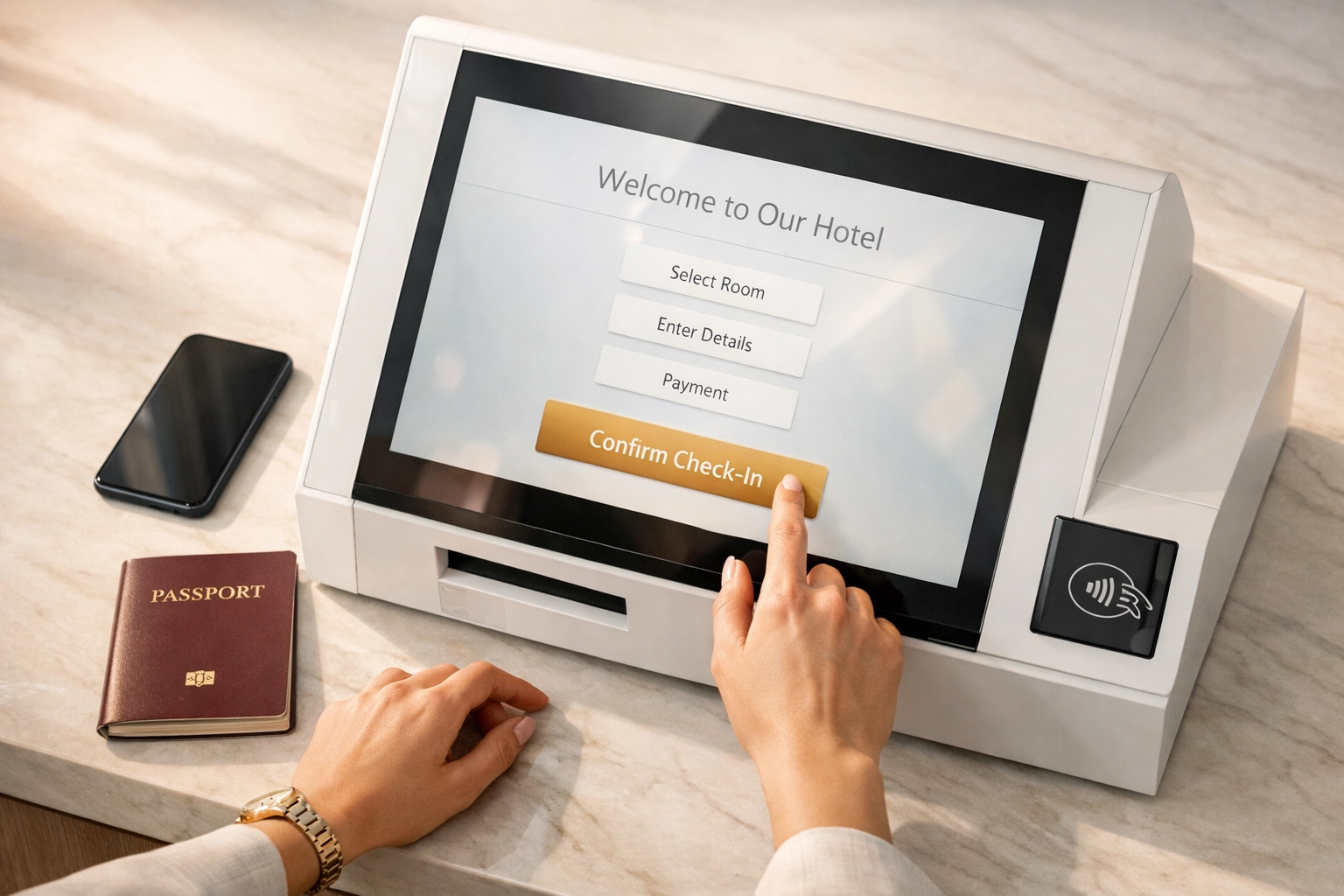
    Guest using hotel self-service kiosk touchscreen for quick check-in with passport

    The Win for Staff: Liberation from the Screen

    Here's what nobody talks about enough: your team didn't get into hospitality to become typists.

    They wanted to host. To connect. To solve problems and create experiences. Kiosks give them that time back.

    When routine transactions move to self-service, your staff can focus on:

    • Greeting VIP arrivals personally
    • Handling complex requests that actually need human judgment
    • Upselling experiences (not just room types) through conversation
    • Managing guest issues before they become complaints
    • Building relationships that drive loyalty and repeat bookings

    One hotel manager put it perfectly: "Our front desk team used to spend 70% of their time on check-ins and check-outs. Now they spend 70% of their time making guests feel welcome. It's like we hired more people, but we just gave them their jobs back."

    Think about your peak times. Sunday afternoon when three groups arrive simultaneously. Conference check-in day. Holiday weekends. Previously, these were stress tests. Now? Your kiosks handle the volume while your team handles the VIPs and complex situations.

    That's not replacing hospitality. That's upgrading it.

    The Win for Operations: Efficiency Without Sacrificing Experience

    Let's talk business benefits, because kiosks deliver here too.

    Labor optimization. You're not reducing staff, you're redeploying them to higher-value interactions. One person can oversee multiple kiosks while being available for guest questions. Your labor costs stabilize even as volume increases.

    Consistency across properties. Every guest gets the same streamlined experience whether they're at your flagship or your newest location. Your brand promise becomes standardized and reliable.

    Data capture. Kiosks collect clean, accurate guest data automatically. Preferences. Patterns. Behaviors. All of it flows directly into your PMS without manual entry errors. That data drives smarter marketing, better personalization, and more targeted upsells.

    Upsell opportunities. Here's a surprising stat: kiosks often outperform staff at certain upsells. Why? Because guests don't feel pressured. They can browse room upgrades, late checkout options, or F&B credits at their own pace. The conversion rates speak for themselves.

    Hotel staff member providing personalized guest service in contemporary lobby

    How Mews Kiosks Actually Work

    Theory is great. Execution is everything.

    Mews Kiosks integrate seamlessly with the entire Mews platform, your PMS, payments, housekeeping, everything. It's not bolted-on technology. It's part of the ecosystem.

    Guests arrive. They use the kiosk to check in. The system automatically:

    • Verifies their reservation
    • Processes payment authorization
    • Assigns the optimal available room based on their preferences
    • Issues digital or physical keys
    • Updates housekeeping and all relevant departments
    • Captures guest data for your CRM

    Your staff gets a notification. They can intercept for a personal welcome or let the guest proceed independently, whatever matches your service style and that specific guest's vibe.

    For check-out? Even simpler. Tap, confirm charges, done. The room automatically updates to dirty status for housekeeping.

    No duplicate systems. No manual syncing. No wondering if the kiosk data matches the PMS data. It's all one platform.

    The Cultural Shift: Premium Means Seamless

    We need to retire the idea that high-touch always means high-staff-involvement.

    Modern luxury is about removing friction. It's about anticipating needs. It's about giving guests options and respecting their preferences.

    Some guests want face-to-face interaction. Great, your freed-up staff can deliver that beautifully. Other guests want to grab their key and disappear into their room after a long flight. Also great, kiosks make that possible without making them feel like second-class guests.

    Both experiences can coexist. Both can feel premium.
    The properties that get this, that understand self-service isn't about cutting corners but about offering choice, are the ones seeing satisfaction scores rise alongside operational efficiency.

    Contemporary hotel lobby featuring self-service kiosk station with natural lighting

    Implementation Reality Check

    Yes, there's a transition period. Yes, some guests will need guidance initially. Yes, your team needs training: not just on the technology, but on how to position it positively.

    But here's the thing: guests adapt faster than you expect. Especially when the alternative is waiting in line.

    Start with check-in. Add check-out. Layer in additional services (restaurant reservations, spa bookings, local recommendations) once the basics are smooth. Give yourself permission to iterate.

    The properties seeing the biggest wins treat kiosks as part of the service offering, not a replacement for it. They position staff nearby during the first few weeks. They celebrate the time savings with guests. They train the team on how to engage guests post-kiosk check-in.

    It's a cultural shift as much as a technological one. But the results: faster service, happier guests, more engaged staff: make it worthwhile.

    The Bottom Line

    Self-service kiosks are a win-win because they solve the fundamental tension in modern hospitality: guests want both speed and personalization, efficiency and warmth.

    Traditional models forced you to choose. Kiosks let you deliver both.

    Your guests get control, speed, and accuracy. Your staff get their time back to actually host. Your business gets consistency, data, and scalability.

    That's not sacrificing white glove service. That's redefining it for an era where choice, autonomy, and seamlessness are the new luxury.

    Ready to see how Mews Kiosks can transform your operation? Book a demo and discover how self-service and exceptional service can coexist beautifully.

  • 7 Mistakes You’re Making with AI Business Automation (and How to Stop Doing the Robot’s Job)

    7 Mistakes You’re Making with AI Business Automation (and How to Stop Doing the Robot’s Job)

    ☕ 8:15 AM. You sit down with a lukewarm coffee and open your laptop. Your inbox is a graveyard of "automated" replies that somehow created more work than they saved. Your customer support bot just tried to sell a refund-seeker a premium upgrade. Your "automated" CRM somehow deleted three of your biggest leads.

    You were promised a beach in Bali. Instead, you're stuck in a basement, fixing the mistakes of a software program that was supposed to be your "employee of the month."

    Automation is the dream. But right now? It’s a bit of a nightmare.

    If you feel like you’re working for your AI instead of the other way around, you’re likely falling into one of the classic traps. Let’s talk about the 7 mistakes you’re making with AI business automation, and how to finally get that robot to do its job so you can do yours.

    1. THE "SET IT AND FORGET IT" DELUSION

    📱 9:30 AM. You get a notification. A customer is screaming in all caps because your automated support loop is trapped in a 2004-style logic puzzle.

    The biggest mistake? Thinking that because it's "AI," it doesn't need a manager. You wouldn't hire a human intern and never check their work, right? So why are you letting a bunch of code run your customer relationships without an adult in the room?

    When you automate customer support with ai, you aren't just flipping a switch. You're building a system. If you don't set up checkpoints, you’ll end up with "technically correct" responses that are socially disastrous. Like congratulating someone on canceling their subscription because they're going through a family crisis. Yikes.

    STOP THE MADNESS: Use AI to gather data and handle the "Where is my order?" stuff. But the second things get emotional? Escalate to a human. Immediately.

    A panicked robot tangled in wires, showing why AI business automation needs human oversight.

    2. FEEDING THE BEAST GARBAGE DATA

    🔍 10:45 AM. You're looking at a projection report that says you’re going to sell 5 million units of… artisanal birdhouses… next Tuesday.

    AI isn't a psychic; it’s a mirror. If your spreadsheets are a mess, full of duplicates, outdated info, and weird naming conventions, your AI’s predictions will be a mess, too. This is the "Garbage In, Garbage Out" rule of the digital age.

    If you haven't audited your data, your ai virtual assistant for business is basically trying to bake a cake with salt instead of sugar. It looks like a cake, but the first bite is going to be a disaster for your bottom line.

    STOP THE MADNESS: Before you sync your AI tools to your database, clean house. Delete the duplicates. Fix the labels. Give your AI a fighting chance to actually be smart.

    3. TREATING FREE TOOLS LIKE SECURE VAULTS

    🤝 12:15 PM. You’re pasting a confidential client contract into a free web-based AI to "summarize the main points."

    Stop. Right. There.

    Most free AI tools are like a gossipy neighbor. Whatever you tell them, they remember. And they might just repeat it to someone else (or use it to "train" their model). Putting sensitive data, payroll info, or tax IDs into an unsecured, free AI is a security breach waiting to happen.

    STOP THE MADNESS: Use enterprise-grade, secure solutions like those found at https://marblism.link/scott-bowen. If you aren't paying for the product, your data is the product. Protect your secrets.

    A detective whispering to a robot with an unlocked chest, illustrating AI security and data privacy risks.

    4. THE "HALLUCINATION" HANDS-OFF APPROACH

    ☎️ 2:00 PM. Your bot just told a prospect that your company offers free lifetime support, a pony, and a trip to Mars.

    AI is confident. Even when it’s 100% wrong. It doesn't "know" things; it predicts the next most likely word in a sentence. Sometimes, that prediction is a total hallucination. It will cite laws that don't exist and quote policies you never wrote.

    If you aren't reviewing the output, you’re basically letting a very fast, very confident liar run your marketing and compliance.

    STOP THE MADNESS: Treat AI output as a first draft. Always. Never let it hit "send" on a contract or a high-stakes customer email without a quick human eye (or a very well-tuned verification layer) checking the facts.

    5. SCALING WITHOUT A STRATEGY

    🌙 3:30 PM. You have 14 different AI subscriptions, and your team is still spending three hours a day on "admin stuff."

    A lot of business owners buy AI tools because they’re shiny. It’s called "Shiny Object Syndrome," and it’s expensive. You end up with overlapping tools that don't talk to each other, creating more friction than they solve.

    Implementing an ai virtual assistant for business should solve a specific problem, not just look cool in your browser bar. Are you trying to save time? Reduce headcount? Increase lead conversion? If you don't know the goal, you won't know if it's working.

    STOP THE MADNESS: Pick one bottleneck. Just one. Automate that. Measure it. If it works, move to the next.

    A stressed business owner overwhelmed by gadgets, highlighting the need for a clear AI automation strategy.

    6. IGNORING THE "HUMAN" IN HUMAN RESOURCES

    🤝 4:45 PM. You’ve automated your hiring filter, and now you’re wondering why every candidate looks exactly the same (and none of them are quite right).

    AI inherits the biases of its training data. If your historical data is biased, your AI will be, too. It doesn't understand "culture fit" or "potential." It understands patterns. If you rely too heavily on automation for people-centric decisions, you’ll lose the very thing that makes your business unique: the people.

    STOP THE MADNESS: Use AI to sift through the noise, but keep the final decision, and the "vibe check", strictly human.

    7. DOING THE ROBOT'S JOB MANUALLY

    ☕ 6:00 PM. The day is ending, and you’re manually copying data from your AI tool into your email software.

    This is the ultimate irony. You’ve "automated" your business, but you’ve actually just created a new job for yourself: Data Courier. If your tools aren't integrated, you aren't automating, you're just using a fancy calculator.

    True efficiency happens when your ai virtual assistant for business talks directly to your CRM, which talks to your email, which talks to your calendar.

    STOP THE MADNESS: Focus on end-to-end workflows. If you have to click "copy" and "paste" more than twice, you haven't finished the automation yet.

    A person carrying heavy data folders while a robot rests, showing inefficient AI virtual assistant setups.

    THE SOLUTION: STOP FIGHTING THE FUTURE

    You didn't start a business to become a full-time AI debugger. You started it to build something, to help people, and (let's be real) to make some money without working 80 hours a week.

    The "mistakes" above aren't because AI is bad. It’s because the implementation is messy. You need a partner that understands the balance between "robot speed" and "human touch."

    At Marblism, we’ve seen every mistake in the book. We’ve also seen what happens when it’s done right. Imagine a world where your customer support is actually helpful, your data is actually clean, and your admin tasks actually… disappear.

    Scaling shouldn't be this hard. But here we are.

    Stop juggling 50 different tools and start building a real system. You can see how a professional setup actually looks (and works) by checking out our latest strategies here: https://marblism.link/scott-bowen.

    The chaos is gone before you even take your first sip of coffee.

    You just send a thumbs-up.

    Because the robot is finally doing its job.

    A human and robot high-fiving to show how to successfully automate customer support with AI.

    FAQ: Is It Too Late to Start?

    Is AI only for big corporations?
    No. Small businesses actually benefit more because they have fewer hands on deck. A good ai virtual assistant for business is like adding three employees for the price of a software subscription.

    How do I know which tool to trust?
    Look for "enterprise-grade" security. If they don't have a clear privacy policy about how they use your data to train their models, run.

    Can AI really automate customer support with ai?
    Yes, but it needs a "human-in-the-loop" system. It handles the 80% of boring questions so you can focus on the 20% that actually matter.

    Will I lose my brand voice?
    Only if you use "out of the box" settings. The best AI systems are trained on your past emails and your brand guidelines to sound exactly like you: just faster.

    Ready to stop doing the robot's job? Check out https://marblism.link/scott-bowen and let's get your time back.

    YOU BUILT THE BUSINESS. LET THE AI RUN THE ENGINE.

  • The Ultimate Guide to Specialty Coffee at Home: Everything You Need to Succeed

    The Ultimate Guide to Specialty Coffee at Home: Everything You Need to Succeed

    So, you’ve decided to take the plunge into the world of specialty coffee. Perhaps you’ve had that "eureka" moment in a local café, a cup of Ethiopian Yirgacheffe that tasted more like blueberry juice than the bitter "coffee-flavoured" drink you grew up with. Now, you want to recreate that magic in your own kitchen.

    We’ve got some good news and some bad news. The bad news? Your trusty old blade grinder and that dusty tin of pre-ground supermarket coffee aren't going to cut it. The good news? Setting up a world-class home coffee bar is easier (and more fun) than you might think. We believe that anyone can brew cafe-quality coffee at home if they have the right tools and a bit of patience.

    In this guide, we’re going to walk you through everything you need to succeed. From the essential gear to the science of extraction, we’ve got you covered. And if you’re looking to grab the best beans or gear to get started, you can find everything we recommend right here at Limini Coffee.


    It All Starts with the Bean

    We cannot stress this enough: you can have the most expensive espresso machine in the world, but if your beans are stale or poorly roasted, your coffee will taste like disappointment. Specialty coffee is defined by quality, and at Limini Coffee, we take sourcing our coffee very seriously.

    When you’re looking for beans, ignore the "best before" date. You want a "roasted on" date. Ideally, you should be using beans that were roasted within the last two to four weeks. Freshness is the foundation of flavour.

    Single Origin vs. Blends

    Are you looking for a wild, fruity adventure or a comforting, chocolatey hug?

    • Single Origin: These beans come from one specific place (a single farm or region). They showcase the unique "terroir" of that area. Think of them like fine wine.
    • Blends: These are a mix of beans from different regions, designed to create a consistent, balanced flavour profile. Perfect for your morning latte.

    Freshly roasted specialty coffee beans spilling from a burlap sack onto a wooden tabletop.


    The Foundation: Your Grinder

    If you ask any barista what the most important piece of equipment is, they won't say the brewer. They’ll say the grinder.

    Why? Because consistency is king. When you brew coffee, you are extracting flavours from the ground beans using water. If your coffee grounds are all different sizes, some like boulders and some like dust, the water will extract them at different rates. The dust will over-extract (bitter), and the boulders will under-extract (sour). The result? A muddy, confusing mess.

    Burr Grinders vs. Blade Grinders

    Please, for the love of all things holy, stay away from blade grinders. They don't grind; they chop. It’s like trying to cut a steak with a blender.

    We recommend investing in a burr grinder. These use two abrasive surfaces to crush the beans into a uniform size.

    • Conical Burrs: Great for home use, usually quieter and more affordable.
    • Flat Burrs: Offer incredible precision and are often found in high-end commercial setups.

    If you’re just starting out, something like the Baratza Encore is a fantastic entry point. To see what others are saying about the best gear, check out our equipment reviews.


    Choosing Your Brewing Method

    This is where the fun begins. There isn't a single "best" way to brew coffee; it all depends on what you enjoy drinking.

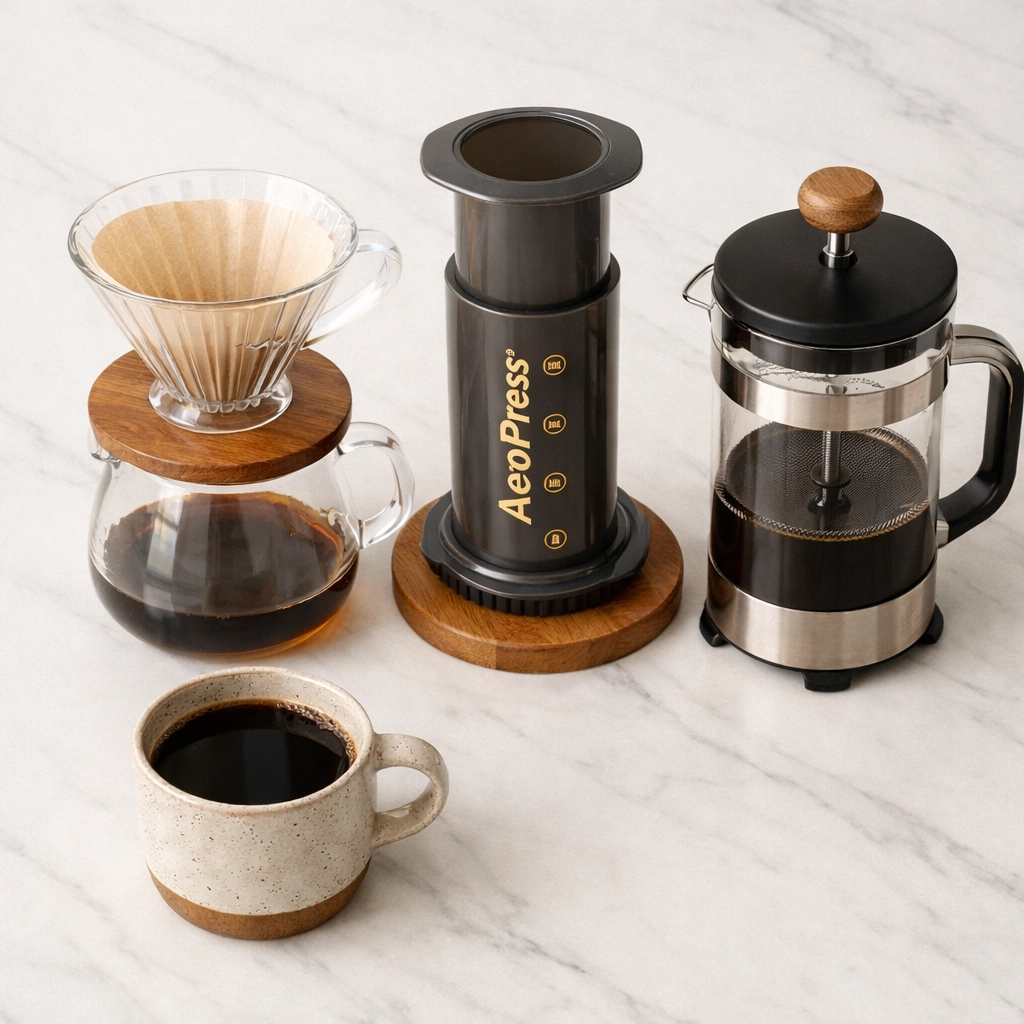
    Brewing Method Flavor Profile Best For Effort Level
    V60 / Pour Over Clean, tea-like, complex Highlighting delicate notes Medium (Requires technique)
    AeroPress Versatile, rich, clean Travelers and tinkerers Easy (Very forgiving)
    French Press Heavy body, bold, textured A classic, rich morning cup Easy (Set and forget)
    Espresso Intense, concentrated, syrupy Milk drinks or quick shots Hard (High learning curve)

    The Pour Over (V60)

    We love the V60 for its ability to produce a clean cup that lets the coffee's natural acidity shine. However, it does require a steady hand and a bit of gear. If you’re going this route, you’ll definitely want to check out our choosing espresso equipment guide, as many of the principles of precision apply here too.

    The AeroPress

    The AeroPress is a bit of a cult favourite in the specialty world. It’s virtually indestructible and incredibly versatile. You can make anything from a concentrated, espresso-style shot to a clean filter-style coffee. Plus, cleaning it takes about five seconds.

    Collection of home brewing gear including a V60, AeroPress, and French press on a kitchen counter.


    The Precision Tools: Scales and Kettles

    You might think using a digital scale for coffee is "over the top." We promise it’s not. In fact, it’s the easiest way to immediately improve your coffee.

    Measuring by "scoops" is notoriously inaccurate. Different beans have different densities. A scoop of a dark roast will weigh significantly less than a scoop of a light roast. By weighing both your coffee and your water, you can find a ratio you love and replicate it every single morning.

    The Golden Ratio

    A great starting point is a 1:16 ratio. This means 1 gram of coffee for every 16 grams of water.

    • For a single cup: 15g coffee to 240g water.
    • For a larger carafe: 30g coffee to 480g water.

    If you’re feeling a bit lazy with the math (we’ve all been there), use our coffee brewing calculator to get it perfect every time.

    The Gooseneck Kettle

    If you are brewing pour-over coffee, a gooseneck kettle isn't just a "nice to have": it’s essential. The thin, curved spout gives you total control over where the water goes and how fast it flows. This prevents "channeling," where water finds a path of least resistance through the coffee bed, leading to uneven extraction.

    A matte black gooseneck kettle pouring water into a dripper for precise specialty coffee extraction.


    Water: The Invisible Ingredient

    Coffee is roughly 98% water. If your tap water tastes like a swimming pool, your coffee will too. We aren't saying you need to start mixing your own minerals (though some people do!), but using a simple charcoal filter pitcher will make a world of difference.

    Temperature is also key. We generally recommend brewing between 92 °C and 96 °C (198 °F to 205 °F). If your water is boiling (100 °C), it can scorch the grounds, leading to a bitter taste. If it's too cool, you won't extract enough flavour, and the coffee will taste thin and sour.


    Understanding Extraction

    This is the "science" part, but don't worry, we'll keep it simple. Extraction is the process of water dissolving the flavours from the coffee grounds. It happens in stages:

    1. Acids and Fats: These come out first (sour/salty).
    2. Sugars: These come out next (sweet/balanced).
    3. Plant Fibers: These come out last (bitter/astringent).

    Your goal is to stop brewing right after the sugars have been extracted but before the bitterness takes over. This is the "sweet spot." If your coffee tastes sour, you need to extract more (grind finer or use hotter water). If it tastes bitter, you need to extract less (grind coarser or use slightly cooler water).


    The "Theatre" of Coffee

    Brewing specialty coffee at home is about more than just caffeine; it’s a ritual. There is something incredibly satisfying about the "bloom" (when you first wet the grounds and they bubble up, releasing CO2) and the aroma that fills the kitchen. We call this the theatre of coffee, and it’s a big part of why we love what we do.

    Taking those few minutes in the morning to focus on the pour, the weight, and the smell can be quite meditative. It’s a chance to slow down before the chaos of the day begins.

    Macro shot of fresh coffee grounds blooming in a filter, releasing carbon dioxide during brewing.


    Ready to Start?

    Transitioning to specialty coffee at home is a journey. You’ll probably have a few "bad" cups along the way while you’re dialling in your technique, and that’s perfectly okay. Even the pros have off days. The key is to experiment and find what tastes good to you.

    Whether you need a new bag of fresh-roasted beans or a reliable burr grinder, we’re here to help. You can browse our full range of speciality beans and brewing gear over at the Limini Coffee shop.

    If you find yourself getting really serious about your home setup: maybe even considering a pro-level espresso machine: it’s worth looking into things like tamping techniques and understanding crema to truly master the art.

    So, what are you waiting for? Grab a scale, some fresh beans, and let’s start brewing. Your taste buds will thank you.

    Happy brewing!
    The Team at Limini Coffee 🙂

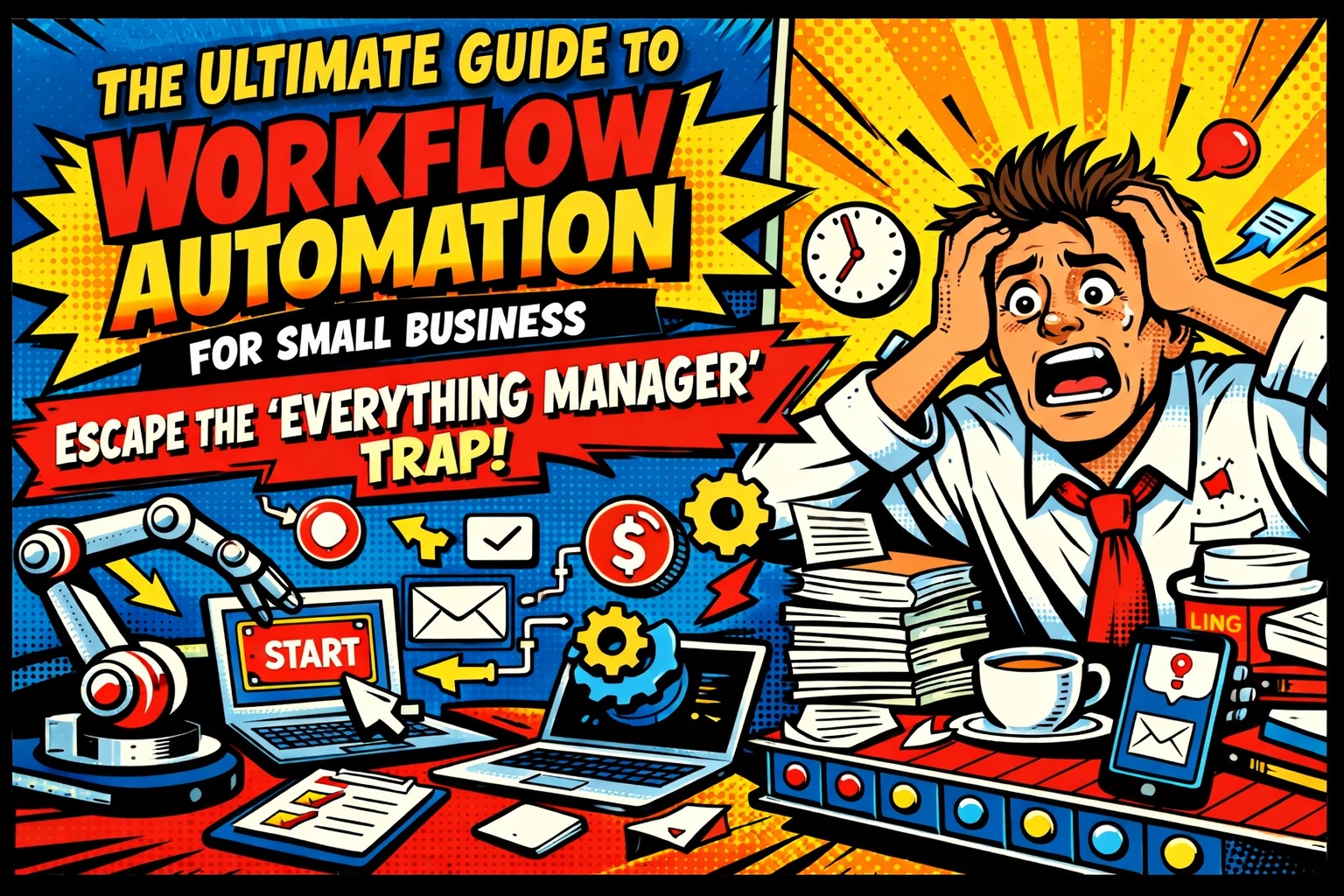
  • The Ultimate Guide to Workflow Automation for Small Business: Escape the “Everything Manager” Trap

    The Ultimate Guide to Workflow Automation for Small Business: Escape the “Everything Manager” Trap

    Workflow Automation for Small Business: Stop Doing the Busy Work

    ☕ 7:00 AM.

    The sun is barely up, but your brain is already running a marathon. You’re scanning emails, checking if that invoice was sent, and wondering why on earth you’re the one manually updating a spreadsheet at this hour.

    You’re the founder. The visionary. The "Everything Manager."

    But let’s be real… if you’re spending four hours a week moving data from one app to another, you’re not a CEO. You’re a very expensive data entry clerk.

    Workflow automation for small business isn't just a tech trend. It’s your ticket out of the "Busy Work" trap.

    The $15/Hour Trap

    You’ve got big goals. You want to scale, innovate, and maybe, just maybe, take a weekend off without checking Slack. But you’re stuck in the weeds.

    You’re handling:

    • Responding to the same "How much do you charge?" emails.
    • Chasing down late payments.
    • Manually posting the same quote to three different social platforms.

    It’s exhausting. It’s prone to human error (did you really just CC the wrong client?). And most importantly… it’s holding you back.

    Stressed small business owner overwhelmed by paperwork and manual tasks before workflow automation.

    Your 30-Day Escape Plan

    You don’t need a degree in computer science to fix this. You just need a roadmap. Here is how you reclaim your time in four weeks.

    Week 1: The Audit (Look at the Mess)
    Stop working for a second and watch yourself. Every time you do something repetitive, write it down. List the apps involved. If it takes more than three steps and you do it more than five times a week, it’s a candidate for execution.

    Week 2: Pick Your Battles
    Don’t try to automate your entire life in one go. Pick three "Quick Wins." High impact, low complexity.

    • The "New Lead" Flow: Lead fills out a form → They get a PDF guide → They’re added to your CRM.
    • The "Paid" Flow: Client pays → Invoice is marked "Closed" → A "Thank You" email goes out automatically.

    Week 3: The Build
    Use tools that play nice together. You want visual flow builders. Drag and drop. No code. No headaches. You connect the trigger (The Lead) to the action (The Email).

    Week 4: Optimization
    Watch the machines work. Gather feedback. Does the automated email sound too robotic? Tweak it. Does the CRM update correctly? Perfect.

    The Result? Peace of Mind.

    Imagine a world where you wake up and the "busy work" is already done. Your invoices are sent. Your leads are nurtured. Your team knows exactly what to do because the system told them, not you.

    Scaling shouldn’t be this hard. But here we are.

    If you're ready to stop being the bottleneck, you need to see how the pros do it. Start your journey here with Scott at Marblism.


    Why Your Business Needs an AI Virtual Assistant (Before Your Competitors Get One)

    📱 11:00 PM.

    The lights are off. You’re in bed, trying to sleep. Your phone buzzes. A potential client just asked a question on your website.

    If you answer now, you’re "on" 24/7 and headed for burnout. If you wait until morning, they’ve already moved on to your competitor who replied in three seconds.

    This is where the AI virtual assistant for business changes the game.

    Meet Your New Employee (Who Never Sleeps)

    An AI virtual assistant isn’t just a chatbot that says "Sorry, I don't understand." It’s a sophisticated layer of intelligence that lives inside your workflow. It learns your voice, understands your services, and handles the "first touch" so you don’t have to.

    A professional AI virtual assistant for business multitasking and managing daily workflows efficiently.

    A Day in the Life of a Business with AI

    9:00 AM: The Morning Filter
    While you’re having your first coffee, your AI assistant, let's call her Eva, has already cleared the junk. She’s categorized your inbox, flagged three urgent client issues, and scheduled two discovery calls based on your actual availability.
    You just send a thumbs-up.

    2:00 PM: The Content Machine
    You need to get a blog post out and three LinkedIn updates. Instead of staring at a blinking cursor, you give Eva a few bullet points. Ten seconds later, you have a draft that sounds like you, but better.
    You click "Publish."

    6:00 PM: The After-Hours Guard
    You’ve closed your laptop. You’re at dinner. A lead asks about your pricing on Instagram. Eva handles it. She qualifies them, asks about their budget, and sends them a link to book a call for tomorrow.
    The chaos is gone before you even take your first sip of wine.

    Why Now? (Because Your Competition is Watching)

    The gap between businesses using AI and those "waiting to see" is widening.

    • Speed: AI responds instantly. Humans don't.
    • Cost: An AI assistant doesn't need health insurance, a desk, or a pep talk.
    • Consistency: AI doesn't have "off days" or bad moods.

    Automated business rocket outperforming manual processes to show the speed of workflow automation.

    If you wait another six months, you aren't just behind on tech, you’re losing market share to the guy down the street who decided to automate his customer service and lead gen while you were still manually typing "Checking in on this!" for the 40th time today.

    The Transition to "Strategic Leader"

    The "Everything Manager" trap is a choice. You can keep spinning the plates until they all drop, or you can build a system that spins them for you.

    When you implement an AI virtual assistant, you stop managing tasks and start managing outcomes. You move from the engine room to the captain’s chair.

    It’s quiet. It’s organized. It’s actually fun again.

    Ready to see how an AI assistant can transform your specific workflow? Connect with us and Scott Bowen here.

    Frequently Asked Questions

    Is it hard to set up?
    No. Most modern AI tools are "plug and play." If you can use Facebook, you can set up a basic AI assistant.

    Will it sound like a robot?
    Only if you want it to. Modern AI can be trained on your previous emails and writing style to mimic your tone perfectly.

    What if it makes a mistake?
    You set the guardrails. You decide what the AI can handle and what needs a human touch. It’s a collaborator, not a replacement.

    Relaxed small business owner scaling their company using efficient workflow automation systems.

    Stop Juggling. Start Scaling.

    The most successful small businesses in 2026 aren't the ones with the most employees. They’re the ones with the best systems.

    Workflow automation for small business is no longer a luxury: it’s survival. Whether it's automating your invoicing or deploying a 24/7 AI virtual assistant for business, the goal is the same:

    Get your time back.

    Don't let your "Everything Manager" title become a life sentence. The tools are here. The roadmap is clear. The only thing missing is your decision to start.

    Escape the trap today.