Category: Category 1

Use this description to tell users what kind of blog posts they can find in this category.

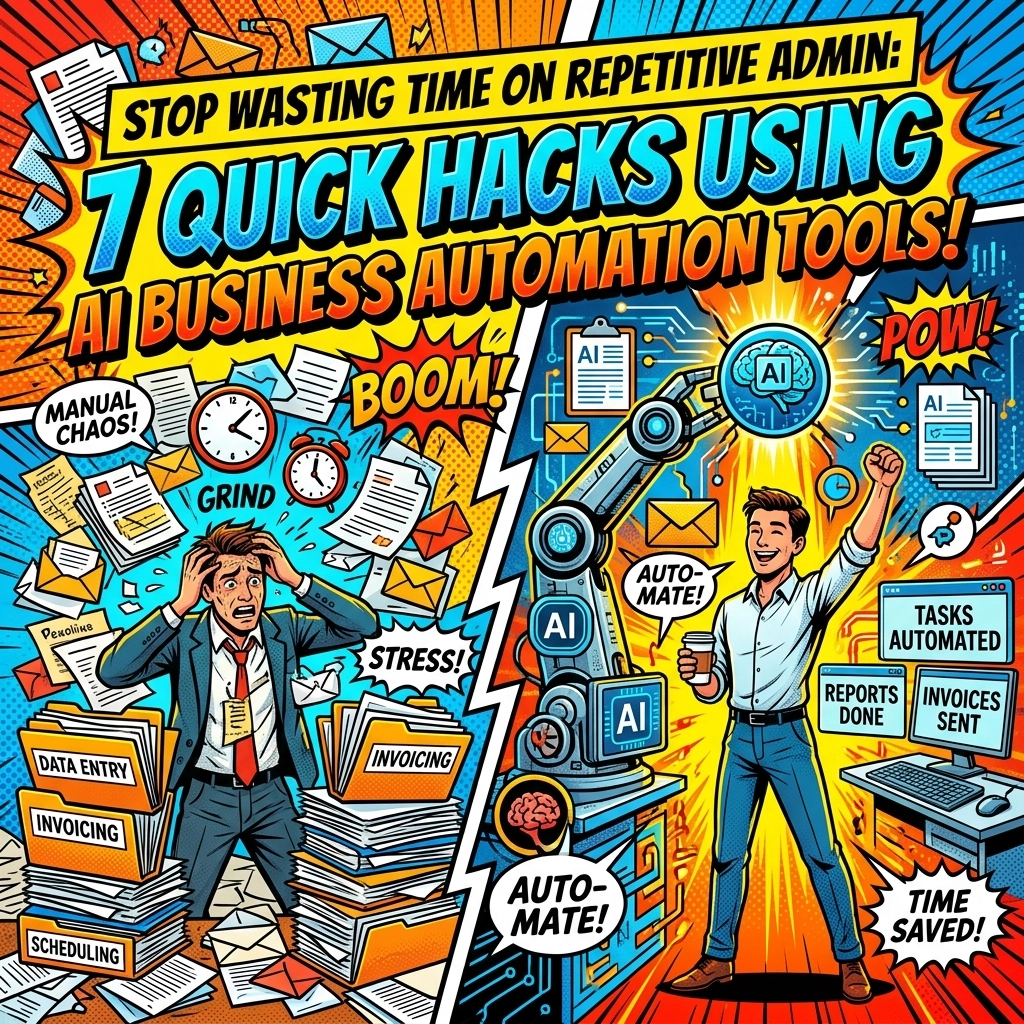
  • Stop Wasting Time on Repetitive Admin: 7 Quick Hacks Using AI Business Automation Tools

    Stop Wasting Time on Repetitive Admin: 7 Quick Hacks Using AI Business Automation Tools

    You wake up. You reach for your phone. Before your feet even hit the floor, you’re already behind…

    There’s that familiar tightness in your chest. A notification from a client. Three emails from "urgent" leads. A calendar that looks like a game of Tetris played by someone who hates you. This is the "admin tax": the invisible fee you pay just for the privilege of running a business.

    But here’s the thing. You didn't start this company to spend four hours a day shuffling data between spreadsheets or playing email tag to find a 15-minute window for a Zoom call. You started it to create, to lead, and: dare we say: to actually enjoy your life.

    The secret isn’t working harder. It’s letting the robots take the wheel. AI business automation isn't some futuristic sci-fi concept anymore; it's the difference between scaling your business and burning out by Tuesday.

    Let’s walk through a typical day. A day where you aren't the janitor of your own digital office.


    THE MORNING TRANSFORMATION

    8:00 AM: The Silence of a Managed Calendar

    You’re in the kitchen. The coffee is brewing. Usually, this is when you’d be frantically typing, "Does 2:00 PM work? No? How about Thursday at 10:00?"

    But today… it’s quiet.

    Hack #1: Automate Calendar Management
    Instead of the back-and-forth dance, you’ve deployed AI calendar managers like Motion or Calendly. When someone wants your time, they don't get an email; they get a link. The AI looks at your real-world priorities, blocks out deep-work time, and only shows them what’s left.

    Even better? If a task doesn't get finished, the AI automatically reschedules it for tomorrow. No manual dragging and dropping. No guilt. You just sip your coffee and let the algorithm handle the logistics.

    Entrepreneur relaxing with coffee while an AI calendar tool automatically manages meeting schedules.

    📱 9:30 AM: The Inbox Ninja

    You sit at your desk. Normally, the sight of 142 unread emails would trigger a mild panic attack. But your inbox looks… different. It’s organized.

    Hack #2: Prioritize and Filter Your Email
    You’re using tools like Superhuman AI or SaneBox. These aren't just spam filters: they’re digital bodyguards. They’ve already sorted the "must-reads" from the "probably-noise." The AI has flagged a high-value lead and even drafted a suggested response based on your previous emails.

    You read the draft. It sounds like you. You hit send. Three seconds of work for a task that used to take ten minutes of agonizing over the perfect "Hey there!"


    THE MID-DAY MOMENTUM

    🤝 11:00 AM: The Ghostwriter in the Meeting

    You’re in a strategy session. In the past, you’d be scribbling notes like a madman, trying to catch every action item while simultaneously trying to actually listen to what the client is saying.

    Hack #3: Generate Meeting Summaries Automatically
    While you talk, an AI assistant: something like Otter.ai or Jamy: is sitting in the call with you. It’s not just transcribing; it’s thinking.

    As soon as the call ends, you don't spend the next hour typing up a summary. Instead, a perfectly formatted recap lands in your inbox and the client’s inbox. It lists the decisions made, the deadlines set, and who is responsible for what.

    You didn't take a single note. You just focused on the human connection. Scaling shouldn't be this easy. But here we are.

    AI meeting assistant taking automated notes during a professional business strategy session.

    🔍 1:00 PM: The Data Janitor (Who Isn't You)

    Lunch is over. Now comes the part everyone hates: updating the CRM. Copying names from an email. Pasting them into a spreadsheet. Realizing you misspelled "Smythe."

    Hack #4: Automate Data Entry and Record Keeping
    Stop it. Stop being a highly-paid data entry clerk. By using AI-powered business automation tools like Zapier, you’ve built a bridge between your world and your database.

    When a new lead fills out a form, the AI extracts their info, checks if they’re already in your Salesforce, creates a new entry if they aren't, and pings your Slack channel. All while you were eating a sandwich. Zero copy-pasting. Zero errors.

    If you’re wondering how to set this up without a computer science degree, check out how we handle the heavy lifting at https://marblism.link/scott-bowen.


    THE AFTERNOON ASCENSION

    ☎️ 3:00 PM: The Project Prophet

    The afternoon slump is real. You’re looking at a project board and wondering, "Wait, what is actually overdue?"

    Hack #5: Create Task Lists and Summaries with AI
    You open your project management tool: maybe it’s ClickUp or Notion. Instead of scrolling through 50 sub-tasks, you just ask the AI: "What’s the status of the Henderson account?"

    The AI scans the documents, the chat logs, and the deadlines. "The Henderson account is 80% done, but we're waiting on a logo file from their designer. I’ve already sent them a reminder."

    You smile. You’re not managing tasks; you’re managing outcomes.

    A business leader viewing an AI-powered project dashboard to track tasks and automate workflows.

    4:30 PM: The Master of Follow-Up

    A client meeting is coming up tomorrow. Usually, this means spending 20 minutes digging through old threads to remember what you talked about last month.

    Hack #6: Automate Pre- and Post-Meeting Comms
    Your AI assistant is ahead of you. It pulls the relevant documents, summarizes the last interaction, and sends a "Looking forward to our chat" email to the client with a brief agenda.

    It looks like you have a world-class executive assistant working 24/7. In reality, you just have a few smart business automation tools running in the background while you focus on the big picture.


    THE EVENING EASE

    🌙 5:30 PM: The Filing Fairy

    The day is winding down. The sun is lower. The old you would be staring at a pile of PDFs and receipts, trying to remember which folder "Invoice_Final_FINAL_2.pdf" belongs in.

    Hack #7: Streamline Document Management
    Your AI document tools have been working in the shadows. Using Optical Character Recognition (OCR), the system reads your incoming documents, names them according to your filing convention, and drops them into the correct folder.

    It even pulls the totals and dates into your accounting software. The "paper trail" is now a digital highway that builds itself.

    AI document automation software organizing digital files and paperwork in a modern office setting.

    STOP JUGGLING. START LEADING.

    Look at your watch. It’s 6:00 PM.

    The office is quiet. Your phone isn't buzzing with forgotten tasks. Your inbox isn't a dumpster fire. You actually know what you’re doing tomorrow.

    This isn't just about saving five minutes here and ten minutes there. It’s about reclaimed mental bandwidth. When you stop wasting time on repetitive admin, you find the space to be creative again. You find the energy to grow your business instead of just maintaining it.

    The "hustle" is a lie if it’s built on manual labor that a 10-dollar-a-month AI could do better.

    Is your business still running on manual?

    It doesn't have to be. Whether you're a solopreneur or leading a growing team, the tools are ready for you. You just have to decide that your time is worth more than a spreadsheet.

    If you want to see how these pieces actually fit together for your specific business, stop guessing. Take the first step toward a business that runs itself.

    Ready to automate the boring stuff?
    See how Marblism can transform your workflow right here.

    FAQ: THE REAL TALK ON AI AUTOMATION

    Q: Is this going to take months to set up?
    No. Most of these hacks can be implemented in under 15 minutes. Start with one (we recommend the calendar) and feel the relief instantly.

    Q: Does AI make my business feel "robotic"?
    Only if you let it. The goal isn't to replace your voice; it's to handle the silence between the conversations. AI drafts the email: you give it the final human touch.

    Q: Is my data safe?
    Yes. Modern AI business automation tools use enterprise-grade encryption. They are designed to assist you, not expose you.

    Q: Do I need to know how to code?
    Absolutely not. If you can use a smartphone, you can use these tools. Most are "no-code," meaning you just click and connect.

    Scaling shouldn't be a struggle. It should be a system.

    The lights are off. The day is done. And for the first time in a long time… you're actually finished.

    Go home. The robots have it from here.

  • 10 Reasons Your Direct Booking Engine Isn’t Working (And How to Fix It)

    10 Reasons Your Direct Booking Engine Isn’t Working (And How to Fix It)

    Capture more guests. Drive higher margins. Build lasting loyalty.

    Your direct booking engine is the digital front door to your hotel. If that door is stuck, heavy, or hidden behind a bush, guests will simply walk next door to an OTA. We believe that direct bookings shouldn't just be a transaction; they should be the start of a seamless guest journey.

    In a world where 76% of travelers prefer to book through a frictionless mobile experience, your technology needs to do more than just exist: it needs to perform. If your direct numbers are dipping while your commission checks to third parties are growing, it’s time to look under the hood.

    Here is how to transform your booking engine from a static form into a high-conversion engine, all from one innovative platform.

    1. Speed is the silent killer

    The barrier: Slow loading times and laggy performance.
    The fix: Optimize your infrastructure for instant response.

    A slow website is a professional ghost town. If a guest clicks your "Book Now" button and has time to go make a coffee before the room list populates, you’ve already lost them. Every second of delay results in a measurable drop in conversion. Search engines also penalize sluggish sites, meaning you’re paying twice: once in lost SEO and once in lost revenue.

    We think the booking experience should feel instantaneous. By minimizing heavy scripts and optimizing image delivery, you create a sense of modern efficiency that reflects the quality of your physical property.

    2. The mobile-first mismatch

    The barrier: A desktop-first design that breaks on smartphones.
    The fix: Implement a mobile-first booking journey.

    Most of your guests are finding you while scrolling on a train or waiting for a flight. If your booking engine requires pinching, zooming, or squinting, they will abandon the process. A truly modern booking engine doesn’t just "work" on mobile; it is designed for it.

    • Big, thumb-friendly buttons.
    • Vertical layouts that flow naturally.
    • Simplified calendars for easy date selection.

    Guest using a mobile-first hotel booking engine on a smartphone in a modern, minimalist hotel lobby.

    3. Data silos and "Ghost" inventory

    The barrier: Poor integration between your PMS and booking engine.
    The fix: Use a unified platform for real-time synchronization.

    There is nothing more damaging to your brand than a guest booking a "last available" suite only to receive a phone call ten minutes later saying it was a mistake. This usually happens when your booking engine and your Property Management System (PMS) aren't talking to each other in real-time.

    Manual updates are a relic of the past. By integrating your engine directly with a modern PMS like Mews, you ensure that rates, availability, and guest data flow seamlessly. It reduces operational stress and eliminates the risk of overbooking.

    4. Friction is the enemy of conversion

    The barrier: Asking for too much information too early.
    The fix: Streamline the path to purchase.

    We’ve all seen them: booking forms that look like a tax audit. Why do you need a guest’s home address and their favorite color before they’ve even seen the price? High abandonment rates are often tied to excessive form fields.

    We believe in the power of simplicity.

    • Start with dates and guest count only.
    • Request payment details last.
    • Allow for "one-click" style returning guest logins.

    "Switching to a streamlined flow saved our team 10 hours a week in manual data entry and boosted our conversion by 15% almost overnight," says one of our partners.

    5. The hidden "Book Now" button

    The barrier: Poor UI and unclear navigation.
    The fix: Make your call-to-action (CTA) prominent and persistent.

    If your guest has to hunt for the booking button, you’re making them work too hard. The "Book Now" button should be the North Star of your website. It needs to be visible on every page, ideally in a contrasting color that pops against your brand palette.

    A laptop displaying a hotel direct booking engine on a clean desk in a sunlit luxury suite.

    6. Lacking the personal touch (and the upsell)

    The barrier: A generic, "one-size-fits-all" booking experience.
    The fix: Use AI-driven customization and targeted add-ons.

    OTAs are great at selling rooms, but they are terrible at selling your experience. If your booking engine doesn't offer the ability to add a bottle of champagne, a late checkout, or a breakfast upgrade, you are leaving money on the table.

    Modern travelers want personalization. By using a platform that understands guest preferences, you can offer relevant upsells at the exact moment the guest is most likely to buy. It’s not just about higher RevPAR; it’s about a better stay.

    7. Inaccurate or outdated content

    The barrier: Using old photos or vague room descriptions.
    The fix: Keep your digital storefront as fresh as your linens.

    If your booking engine shows a grainy photo of a room from 2018, the guest will assume the hotel looks like that today. Accuracy builds trust. If the price on the landing page doesn't match the price in the final checkout, that guest is gone forever (and they might leave a nasty review about "hidden fees").

    Sync your content across all channels and ensure your direct engine has the highest quality imagery. It’s the visual proof that your property is worth the price.

    8. No direct path to specific offers

    The barrier: Redirecting specific ad clicks to a generic home page.
    The fix: Use deep linking for specific rooms and packages.

    If you run a social media ad for a "Romantic Spa Weekend," and the link takes the guest to your general home page where they have to search for that offer manually, the friction will kill the sale.

    You need the ability to create direct links to specific room types or promo codes. This shortens the guest's journey and ensures that the promise of your marketing matches the reality of your booking engine.

    Detailed view of a luxury hotel bed highlighting specific room type offers for direct bookings.

    9. The "Support Gap"

    The barrier: No way to ask a quick question during the booking process.
    The fix: Integrate instant messaging or AI chatbots.

    Sometimes a guest just needs to know if the parking fits a large SUV or if the pool is heated in March. If they have to pick up the phone, they might just close the tab instead.

    Integrating a quick contact option: like a WhatsApp link or an AI-powered chat: allows you to resolve doubts in real-time. It’s the digital equivalent of a front desk clerk standing ready to help.

    10. Forgetting why "Direct is Best"

    The barrier: Failing to communicate the value of booking direct.
    The fix: Highlight direct-only perks clearly.

    Why should a guest book with you instead of a site where they have points or a "Genius" discount? If you don't tell them, they won't know.

    Use your booking engine to highlight the "Direct Booking Advantage."

    • Best price guarantee.
    • Complimentary welcome drink.
    • Priority for room upgrades.

    Make these benefits clear, bold, and impossible to miss.

    Ready to take back control?

    Direct bookings are the lifeblood of a profitable hotel. When you remove the friction, sync your data, and prioritize the mobile experience, you aren't just selling a room: you're starting a relationship.

    We think you deserve a platform that works as hard as you do. Whether it's through AI-driven insights or seamless PMS integration, the goal is always the same: a better experience for the guest and more freedom for you.

    See how the right technology can transform your property. Explore what Mews can do for your direct bookings here.

    It's time to stop losing guests to the "big guys" and start owning your journey. Get started with a demo today and get your revenue moving in the right direction. All from one innovative platform.

  • Stop Wasting Time on Manual Admin: 7 Automation Hacks for Busy Hoteliers

    Free your team. Scale your service. Focus on your guests.

    Running a hotel shouldn't feel like a constant battle against spreadsheets and sticky notes. Yet, many hoteliers spend up to 40% of their shift on manual data entry and repetitive admin. We think that’s a waste of human potential. Your team was hired to provide hospitality, not to act as human bridges between disconnected software systems.

    Modern hospitality is shifting toward a model where technology handles the heavy lifting, allowing humans to do what they do best: create memorable experiences. By embracing a cloud-native platform like Mews, you move from "staying afloat" to "thriving."

    Here are 7 automation hacks to reclaim your time and transform your operations.

    1. Deploy AI Reservation Agents

    We believe the first line of defense against burnout is a smart inbox. Roughly 75% of traveler interactions happen via chat, and nearly half of those are just people asking for a price quote or asking if they can bring their cat.

    An AI reservation agent doesn't get tired of answering "What time is check-in?" for the hundredth time. It handles:

    • Instant booking quotes and availability.
    • Common FAQs about amenities and pet policies.
    • Neighborhood recommendations and directions.

    By automating these micro-interactions, your front desk can actually look up and smile when a guest walks through the door. It’s about being present, not just being there.

    Hotel staff focusing on guest experience in a lobby while AI automation handles reservations.

    2. Unify Your Tech with a Cloud-Native PMS

    The heart of your hotel is your hotel PMS. If that heart is old, slow, and doesn't talk to your other organs, the whole body suffers. We think your tech stack should work as one unified organism.

    A modern, cloud-native PMS like Mews acts as your operational backbone. It shouldn't just store data; it should move it.

    • Automate room assignments based on guest history.
    • Sync your booking engine and channel manager in real-time.
    • Predict booking patterns to help you staff smarter.

    Instead of juggling five different logins, you get one source of truth. Everything from billing to guest preferences lives in one intuitive dashboard. It’s not just software: it’s peace of mind.

    3. Set Guest Communications to Autopilot

    The right message. The right time. The right channel. You shouldn't have to manually email every guest three days before they arrive. Automation allows you to create a "set it and forget it" guest journey that feels incredibly personal.

    Effective communication automation includes:

    1. Abandoned Quote Follow-ups: Automatically nudge potential guests who started a booking but didn't finish.
    2. Pre-arrival SMS: Send check-in instructions or parking tips automatically.
    3. Post-stay Vouchers: Send a "we miss you" discount on a guest's birthday or anniversary.

    When you use a CRM integrated with your PMS, these messages aren't just generic templates: they are data-driven touchpoints that drive loyalty without you lifting a finger.

    4. Ditch the Clipboards for Digital Housekeeping

    If your housekeeping team is still walking around with printed sheets of paper, you’re losing hours every week. Housekeeping automation is one of the fastest ways to see a ROI in hospitality technology.

    Imagine a world where:

    • Task lists are generated and assigned automatically based on occupancy.
    • Room status updates instantly on the front desk's screen the second a cleaner taps "complete" on their phone.
    • Maintenance tickets are triggered automatically when a guest reports a broken lamp.

    This eliminates the "chase." No more radioing back and forth to see if room 302 is ready. No more manual data entry at the end of the day. Just a smooth, digital flow.

    Using a mobile app for digital housekeeping and real-time room status in a modern hotel.

    5. Embrace Self-Check-In Kiosks

    The traditional check-in desk is a bottleneck. We believe guests should have the choice to skip the line. Self-check-in kiosks and mobile check-in aren't just about efficiency: they're about guest empowerment.

    By automating the check-in process:

    • Guests can verify their ID and cut their own keys in under 60 seconds.
    • You reduce lobby congestion during peak hours.
    • Your staff can move from behind the desk to the lobby floor to act as concierges.

    It’s about removing friction. When the boring stuff is automated, the meaningful stuff: like a warm welcome or a local dinner tip: becomes the focus.

    6. Let Dynamic Pricing Do the Math

    Setting room rates manually is a losing game. The market moves too fast. To maximize revenue, you need to be reacting to local demand, competitor shifts, and even the weather in real-time.

    Dynamic pricing tools integrated with your PMS can:

    • Automatically adjust rates based on occupancy levels.
    • Monitor local events and surge pricing.
    • Ensure you never leave money on the table during high-demand periods.

    You don't need to be a data scientist to get this right. You just need the right tools to monitor the patterns while you focus on the big picture.

    A hotelier monitoring dynamic pricing and hotel pms data for strategic revenue management.

    7. Centralize Your Financial Operations

    For hoteliers managing multiple locations, the paperwork can be a nightmare. Centralizing your invoices and vendor payments is the final piece of the automation puzzle.

    Modern AP (Accounts Payable) automation can:

    • Capture and match invoices to purchase orders automatically.
    • Handle vendor payments using virtual cards to reduce fraud.
    • Provide real-time visibility into costs across your entire portfolio.

    When your finance is automated, you stop looking at what happened last month and start looking at what’s possible next month.

    Ready to see what Mews can do?

    We believe technology should make your life easier, not more complicated. That’s why Mews is built to be cloud-native, easy to use, and focused entirely on automation. It’s designed for the modern hotelier who wants to spend less time on admin and more time on people.

    See how much time you can save with a platform that works for you. Get started with Mews today.


    Why Mews?

    At Mews, we’re not just building software; we’re building the future of hospitality. With over 12,500 properties worldwide, we’ve seen firsthand how automation can transform a business. Whether you’re a boutique hotel or a large-scale enterprise, our platform scales with you.

    • Cloud-native: Access your data from anywhere, on any device.
    • Easy to use: A clean interface that your staff will actually enjoy using.
    • Automation-focused: Reduce manual tasks by up to 80%.

    Ready to join the revolution? Check out our affiliate program and start earning while you innovate: Join the Mews Affiliate Program.

    The Bottom Line

    The busiest hoteliers aren't the ones who work the hardest; they’re the ones who work the smartest. By implementing these seven automation hacks, you’re not just saving time: you’re creating a better environment for your staff and a more seamless experience for your guests.

    Innovation isn't about the gadgets; it's about the freedom those gadgets give you. It's time to step away from the keyboard and back into the lobby. Your guests are waiting.

  • AI Business Automation 101: How to Stop Being the Bottleneck in Your Own Business

    AI Business Automation 101: How to Stop Being the Bottleneck in Your Own Business

    It’s 2:14 AM.

    Your phone vibrates on the nightstand. Another "Where is my tracking number?" email. Another support ticket from a customer who can’t find the "reset password" button. Another tiny, microscopic task that requires exactly 30 seconds of your brainpower… but 100% of your attention.

    You roll over, squinting at the blue light, and handle it. Because if you don’t, who will?

    That’s the problem. You’re the CEO. You’re the visionary. But right now? You’re also the help desk, the data entry clerk, and the human shield between your business and its own growth.

    You aren't just running the business. You are the bottleneck.

    If you disappeared for a week, would your business keep moving? Or would it grind to a halt because you weren’t there to move a lead from "Inquiry" to "Booked"?

    It’s time to stop being the "everything" guy. It’s time to automate your business before you burn out entirely.


    STOP JUGGLING. START SCALING.

    Business automation isn't about replacing people with cold, heartless machines. It’s about replacing the soul-crushing, repetitive tasks that make you want to scream into a pillow at 3 PM.

    Think about your daily "To-Do" list. How much of it actually requires your specific genius?

    • Sorting through junk emails? No.
    • Scheduling social media posts? No.
    • Answering the same 15 support questions every day? Definitely no.

    AI business automation is like hiring a team of experts who never sleep, never ask for a raise, and never forget to follow up with a lead. When you automate customer support with ai, you aren't just saving time. You're giving your customers a better experience while you’re off doing things that actually move the needle.

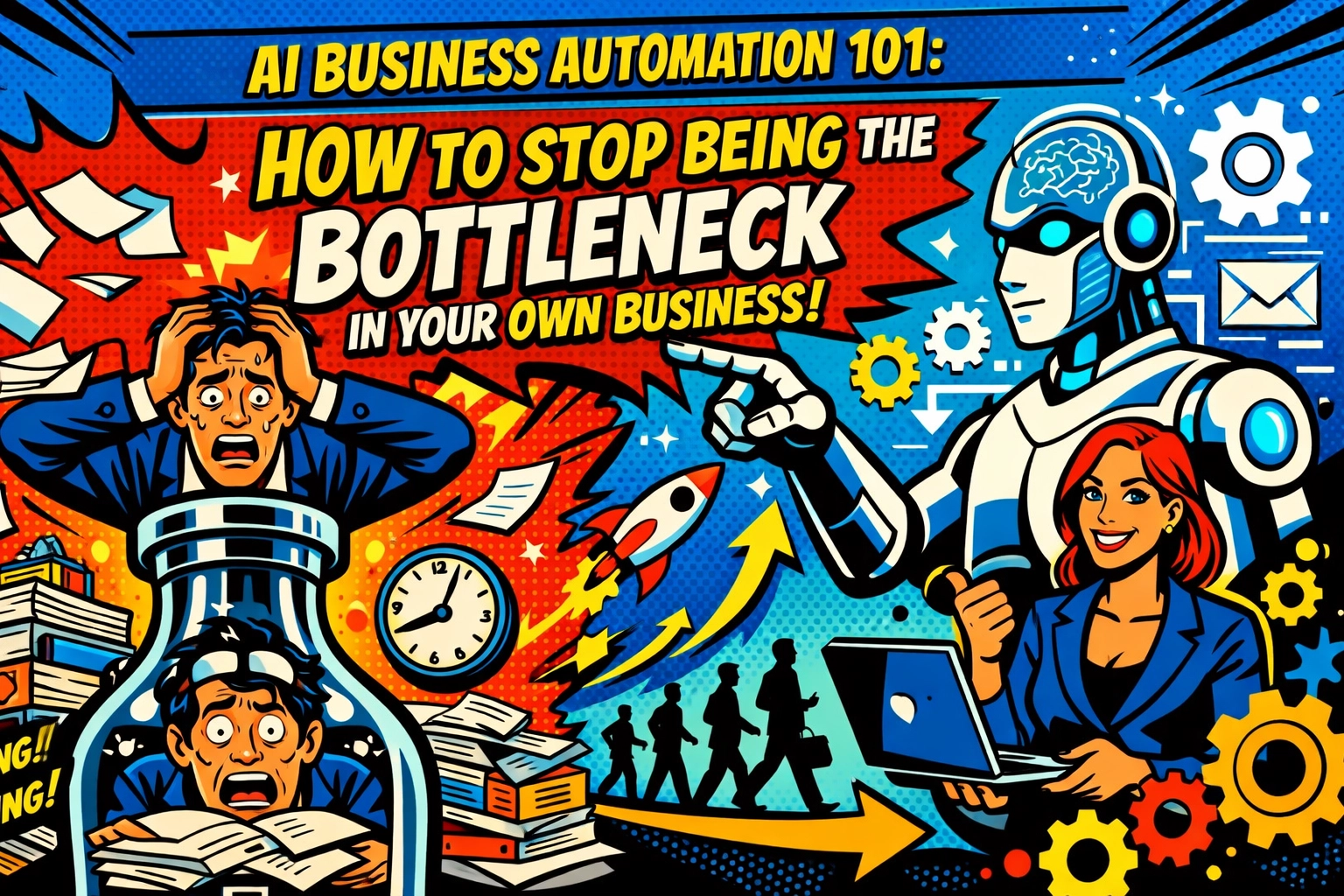
    A stressed business owner juggling manual tasks before using an AI virtual assistant for business.

    THE AI VIRTUAL ASSISTANT: YOUR NEW SILENT PARTNER

    You’ve probably heard of virtual assistants (VAs). Maybe you’ve even hired one. But a human VA still needs managing. They need sleep. They have "off" days.

    An ai virtual assistant for business is different.

    Imagine an assistant that lives inside your inbox, your CRM, and your calendar. It doesn't just "remind" you to do things; it does them for you. It reads an incoming email, realizes it's an invoice, extracts the data, puts it into your accounting software, and sends a "Thank You" note to the sender.

    All while you’re having your first cup of coffee. ☕

    This isn't sci-fi. This is what we do at Marblism. We build the bridges between your manual chaos and automated peace of mind. Check out how it works here: https://marblism.link/scott-bowen.


    A DAY IN THE LIFE: FROM CHAOS TO CALM

    Let’s look at how your day changes when you stop being the bottleneck.

    ☕ 7:00 AM: The Morning Filter

    Normally, you’d wake up to 45 unread notifications. Your stomach would do that little "stress flip."
    But today? Your ai virtual assistant for business has already triaged the mess. The "spam" is gone. The "thank you" notes are archived. The only thing waiting for you is a single notification: “Three high-value leads are ready for your signature.”
    You just send a thumbs-up.

    📱 10:00 AM: The Support Surge

    Your latest product launch just went live. Usually, this means your phone would be blowing up with basic questions.
    Instead, you watch your dashboard. You see your AI agent automate customer support with ai in real-time. It’s answering questions about shipping, sizing, and pricing.
    The customers are happy. They got answers in 3 seconds.
    You stay focused on your partnership meeting.

    🤝 1:00 PM: The Lead Nurture

    A potential client visits your site. They’re curious. They ask a complex question about your services.
    Instead of waiting 4 hours for you to finish lunch and reply, the AI engages. It qualifies the lead, checks your calendar, and books a call for Thursday.
    By the time you finish your sandwich, the deal is halfway closed.

    🔍 4:00 PM: The Data Deep Dive

    You need to know your profit margins for the month. Instead of spending two hours in a spreadsheet, you ask your AI assistant to generate a report.
    It pulls data from Shopify, Stripe, and your ad spend.
    The report is ready in 45 seconds.
    You smile.

    Business owner relaxed as an AI virtual assistant manages automated workflows and daily tasks.

    WHY YOU’RE AFRAID TO LET GO (AND WHY YOU SHOULD)

    "But Penny," you say, "AI doesn't sound like me. My customers want a personal touch."

    I get it. You’ve spent years building your brand’s voice. You don't want a "robot" ruining it.

    But here’s the cold, hard truth: A slow, stressed-out human response is always worse than a fast, helpful AI response.

    When you automate customer support with ai, the AI is trained on your past emails. It uses your tone. It knows your policies. Most customers won't even realize they aren't talking to you, they'll just be thrilled they didn't have to wait 24 hours for a reply.

    And let's be honest… when you’re responding to emails at 11:30 PM, you probably don't sound that "personable" anyway. You sound tired.


    REMOVING THE BOTTLENECK: WHERE TO START

    You don’t have to automate your entire life in one afternoon. That’s how people get overwhelmed and quit. Start with the "Low-Hanging Fruit."

    1. The FAQ Filter: Look at your last 100 support tickets. How many of them are the same 5 questions? Automate those first.
    2. The Calendar Gatekeeper: Stop the "When are you free?" / "I'm free Tuesday at 2" / "Oh, wait, I can't do Tuesday" dance. Use an AI scheduler.
    3. The Data Bridge: If you are manually copying data from one app to another, stop. Right now. Seriously.

    Scaling shouldn't be this hard. If you're ready to see how Marblism can take the weight off your shoulders, click here to see the magic in action.


    EMPLOYEE OF THE MONTH. EVERY MONTH.

    Imagine an employee who:

    • Never takes a sick day.
    • Works 168 hours a week.
    • Remembers every single customer’s name.
    • Processes 1,000 tasks at the same time.

    That’s not a person. That’s a system.

    When you implement an ai virtual assistant for business, you aren't just "buying software." You're buying your freedom back. You're buying the ability to go to your kid's soccer game without checking your phone every 5 minutes. You're buying the headspace to actually lead your company instead of just managing its friction.

    Heroic robot depicting efficient AI business automation as the perfect virtual assistant for scale.


    YOU ASKED, WE ANSWERED (FAQ)

    Q: Is AI automation expensive for small businesses?
    A: Not compared to the cost of your time. If you value your time at $100/hour and automation saves you 10 hours a week… well, you do the math. It pays for itself by Tuesday.

    Q: Will it mess up my data?
    A: Actually, AI is usually more accurate than humans. It doesn't get tired, it doesn't have "fat finger" typos, and it doesn't forget to hit "save."

    Q: Do I need to be a coder?
    A: Nope. That’s why we’re here. We build the systems so you can just reap the rewards.


    SCALING SHOULDN'T BE THIS EASY. BUT HERE WE ARE.

    You've spent enough time being the cog in the machine. It’s time to be the operator.

    The transition from "Overwhelmed Owner" to "Efficient Executive" starts with a single step. You can keep manually replying to those 2 AM emails, or you can let us build a system that handles them for you.

    The choice is yours. But the couch is calling, and your business could be running itself while you’re on it.

    Stop being the bottleneck. Start being the boss.

    The lights are off. The office is quiet.

    But your business? It’s just getting started.

    🌙


    Ready to see how Marblism can transform your workflow? Explore our AI solutions here and stop being the bottleneck today.

  • The Ultimate Guide to Brewing Better Coffee at Home: Everything You Need to Succeed

    The Ultimate Guide to Brewing Better Coffee at Home: Everything You Need to Succeed

    So, you’ve decided to take the plunge into the world of home brewing. Perhaps you’re tired of the "meh" coffee from your old pod machine, or maybe you’ve visited a specialty cafe and thought, "I wish I could make this in my kitchen."

    We’ve got good news for you: you absolutely can.

    At Limini Coffee, we live and breathe the bean. We spend our days roasting, tasting, and obsessing over the tiny details that turn a decent cup into a life-changing experience. But you don't need a commercial roastery or a five-figure espresso machine to enjoy incredible coffee. You just need the right foundation. This guide is designed to take you from "confused by the terminology" to "confidently brewing like a pro."

    And if you’re looking to stock up on the good stuff, you can find our full range of freshly roasted beans and gear right here: Limini Coffee Shop.


    It All Starts with the Bean (No, Really)

    We often say that a barista is only as good as the beans they’re using. You can have the most expensive gooseneck kettle in the world, but if your beans are stale or poor quality, your coffee will be too.

    Freshness is Everything

    Coffee is a fresh agricultural product. Once it’s roasted, it begins to lose its aromatic compounds through a process called oxidation. Imagine an apple: once you slice it, it starts to turn brown and lose its crispness. Coffee does the same thing, just a bit slower.

    We recommend using beans within 4 to 30 days of their roast date. This is why buying from a local Speciality Coffee Roaster like us is so important. Supermarket coffee has often been sitting on a shelf for months. By the time it reaches your cup, the "sparkle" is gone.

    Understanding Roast Profiles

    • Light Roasts: These are often bright, acidic, and tea-like. They preserve the unique characteristics of the origin (the "terroir"). If you love floral or citrus notes, this is for you.
    • Medium Roasts: The sweet spot for many. You get a balance of acidity and body, often with notes of chocolate and nuts.
    • Dark Roasts: These are bold, smoky, and heavy-bodied. Great for those who love a traditional "coffee" taste or add lots of milk.

    Three piles of coffee beans showing light, medium, and dark roast profiles on a wooden surface.


    The Essential Gear List

    You don't need a kitchen full of gadgets, but a few key pieces of equipment will make your life much easier (and your coffee much better).

    1. The Grinder (The Most Important Tool)

    If you only buy one piece of gear, make it a burr grinder. Why? Because coffee starts losing flavor almost immediately after it's ground. A burr grinder ensures uniform particle size, which leads to even extraction. Blade grinders (the ones that look like mini blenders) produce a mix of "boulders" and "dust," resulting in coffee that is simultaneously bitter and sour. Not something we would recommend.

    2. A Digital Scale

    Coffee is a game of ratios. We usually talk about a 1:15 or 1:17 ratio (1 gram of coffee for every 15-17 grams of water). Trying to measure this with a spoon is like trying to bake a soufflé by eye: it might work once, but you’ll never be able to repeat it. If you’re feeling scientific, check out our coffee brewing calculator to get your numbers perfect.

    3. A Gooseneck Kettle

    If you’re into pour-over coffee, a gooseneck kettle gives you the precision needed to saturate the grounds evenly. If you just dump water in from a standard kettle, you’ll create "channels" where water bypasses the coffee, leading to a weak brew.


    Choosing Your Brewing Method

    There is no "best" way to brew coffee: only the way that fits your lifestyle and taste buds.

    The Pour Over (The Purist’s Choice)

    Methods like the Hario V60 or Chemex are beloved for their clarity. Because they use paper filters, they remove most of the coffee oils and sediment, leaving you with a clean, vibrant cup.

    Best for: Single-origin beans with delicate flavor profiles.
    Pro Tip: Wet your paper filter first to wash away any "papery" taste before you add the coffee.

    The French Press (The Full-Bodied Classic)

    This is an immersion method, meaning the coffee grounds sit in the water for the entire brew time (usually 4 minutes). It uses a metal mesh filter, which allows those delicious oils to pass through into your cup.

    Best for: Darker roasts and people who love a heavy, velvety mouthfeel.
    The Secret: After the 4 minutes are up, give the top a gentle stir, let the grounds sink for another few minutes, and then press. It makes for a much cleaner cup.

    The Aeropress (The Versatile Traveler)

    The Aeropress is virtually indestructible and incredibly forgiving. You can make anything from a concentrated espresso-style shot to a light filter coffee. It’s the Swiss Army knife of brewing.

    A minimalist home coffee brewing setup featuring a glass pour-over dripper and a gooseneck kettle.


    The Science of Extraction: Why Does My Coffee Taste Weird?

    Have you ever brewed a cup that tasted like lemon juice? Or maybe one that was so bitter it felt like it was drying out your tongue? That’s the result of improper extraction.

    Under-extraction (The Sour Side): This happens when you haven't taken enough flavor out of the beans. It usually happens if your grind is too coarse, your water is too cold, or your brew time was too short.
    Over-extraction (The Bitter Side): This is when you've taken too much out. Usually caused by a grind that's too fine, water that's too hot, or letting it brew for too long.

    The Water Variable

    Since coffee is about 98% water, the quality of your tap water matters. If your water is very hard (lots of minerals), it can make coffee taste dull. We recommend using a simple water filter jug to give the coffee a clean canvas to shine on.

    And let’s talk temperature. We believe the sweet spot is between 195°F and 205°F (90.5°C to 96°C). If you don't have a temperature-controlled kettle, just let your boiled water sit for about 30-60 seconds before pouring. Boiling water can actually "scorch" the coffee, leading to a harsh, ashy taste.


    Dialing in Your Espresso at Home

    For those of you brave enough to venture into home espresso, welcome to the big leagues. Espresso is a temperamental beast. It requires a fine grind and about 9 BAR of pressure to force water through a compacted "puck" of coffee.

    If you're just starting out, choosing espresso equipment can be overwhelming. We often recommend starting with a machine that offers some stability, like a La Spaziale. Understanding how the lever automatic systems work or how tamping affects your shot can save you a lot of wasted beans.

    One thing people often overlook is the crema. While it looks beautiful, it’s actually quite bitter on its own. Give your espresso a quick stir before drinking to incorporate all those layers: your taste buds will thank you.

    Close-up of a rich espresso shot with thick golden crema being extracted into a ceramic cup.


    Mastering the Milk

    If you prefer a latte or a flat white, the milk is just as important as the coffee. The goal is "microfoam": milk that looks like wet paint, with no visible bubbles.

    When you steam milk, you’re doing two things: heating it and aerating it (introducing air). For a latte, you want just a little bit of air. For a cappuccino, you want more. If you want to dive deep into the chemistry, we have a whole article on understanding milk that explains why some milks froth better than others.

    (Hint: It's all about the proteins and fats!)


    The "Golden Rules" for Success

    To wrap things up, here are our non-negotiable rules for brewing better coffee at home:

    1. Buy Fresh: Get your beans from a reputable roaster. You can check out our latest seasonal harvests here: Limini Coffee Beans.
    2. Grind On-Demand: Only grind what you need, right before you brew.
    3. Use a Scale: Stop guessing. Consistency is the key to improvement.
    4. Clean Your Gear: Old coffee oils turn rancid and will ruin your next brew. Keep your equipment sparkling. For espresso lovers, looking after your machine is vital for its lifespan.
    5. Experiment: Don't be afraid to change one variable at a time. Try a slightly finer grind tomorrow and see how it changes the flavor.

    Barista pouring silky milk microfoam into a cup to create a heart-shaped latte art design.

    Final Thoughts

    Brewing coffee at home is a journey. Some days you’ll nail it, and some days you’ll wonder what went wrong. That’s the beauty of coffee: there’s always something new to learn, a new origin to try, or a new technique to master.

    We’re here to help you every step of the way. Whether you're looking for barista training to level up your skills or you're a business looking for wholesale support, we’ve got you covered.

    So, go ahead: put the kettle on, grab your favorite mug, and start brewing. Your perfect cup is closer than you think.

    Happy brewing!

    ( The Limini Coffee Team)

  • 7 Mistakes You’re Making with Workflow Automation for Small Business (and How to Fix Them)

    7 Mistakes You’re Making with Workflow Automation for Small Business (and How to Fix Them)

    ☕ 8:14 AM.

    You’re sitting at your desk with a lukewarm latte, staring at a spreadsheet that seems to have developed its own personality, and it’s not a friendly one. You spent three hours yesterday "automating" your lead intake, and yet, here you are, manually fixing a data mismatch for the fourth time this morning.

    You were promised a beach. You were promised "passive systems." Instead, you’ve just built yourself a faster, digital version of the chaos you already had.

    Workflow automation for small business isn’t just about buying a tool and flipping a switch. It’s about not tripping over these seven very common, very annoying landmines.


    1. AUTOMATING A HOT MESS

    You take a broken, manual process, say, a messy approval chain, and you digitize it.

    The result? You now have a broken, automated process that fails at the speed of light. If your workflow has unnecessary steps or "that’s just how we’ve always done it" bottlenecks, automation won't fix it. It just hides the rot.

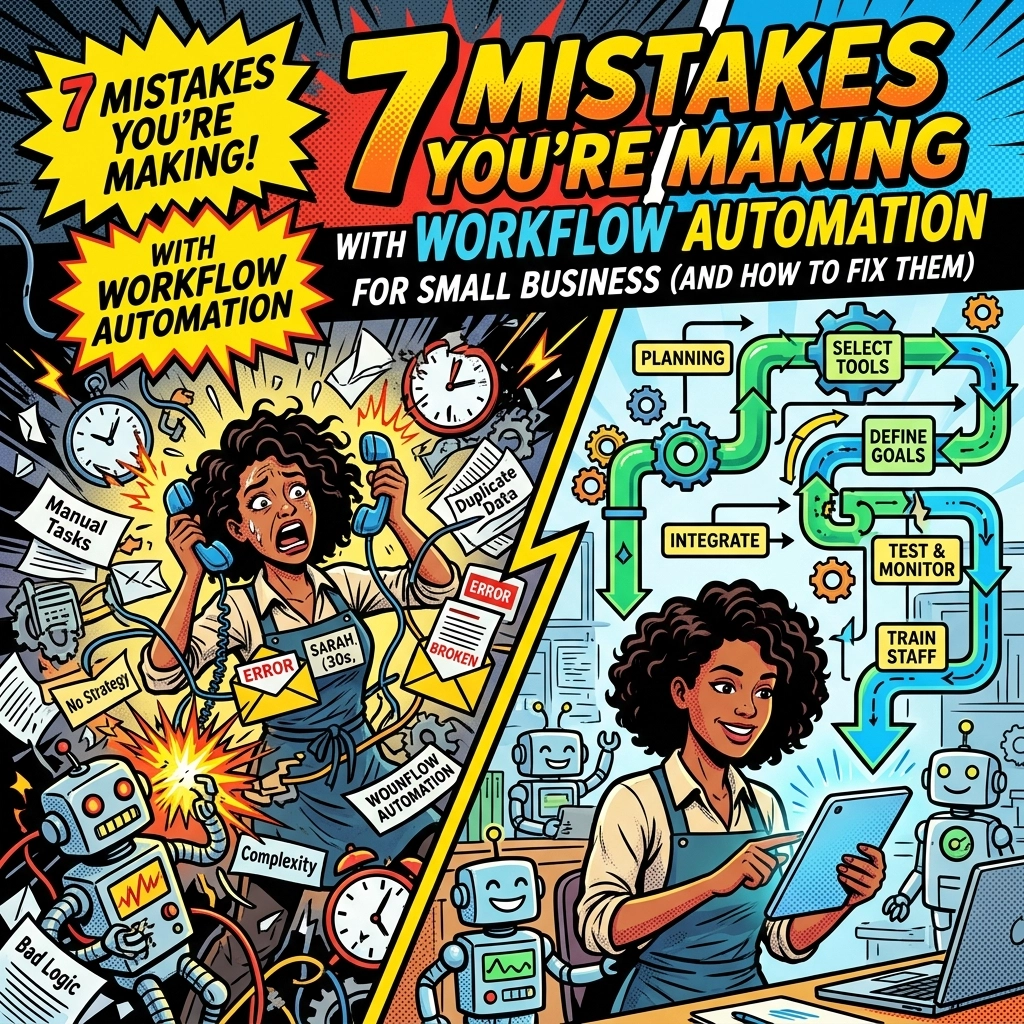
    The Fix: Map it out on paper first. If a step doesn't add value, kill it. Simplify the workflow until it’s lean. Only then do you let the robots take over. Pop art illustration of a business owner struggling with a broken computer and messy workflow automation.

    2. THE "WINGING IT" STRATEGY

    You saw a cool ad. You clicked "Start Free Trial." You started connecting apps like a mad scientist. Three days later, you have no idea why your CRM is sending "Welcome" emails to your unsubscribed list.

    Most automation projects fail because they lack a blueprint. You’re building a house without a foundation.

    The Fix: Set clear goals. What are you trying to save? Time? Sanity? Errors? Before you click a single button, decide exactly what the "Success" state looks like.

    3. GOING FROM 0 TO 100 TOO FAST

    You want to automate everything. Onboarding, billing, marketing, customer support, all by Tuesday.

    This is a recipe for a total system meltdown. When you try to automate independent tasks all at once, you create silos that don't talk to each other.

    The Fix: Start small. Pick one tiny, annoying task. Automate it. Watch it work for a week. Then move to the next. Build your empire one brick at a time.

    4. CHASING THE SHINY OBJECTS

    There’s a new AI tool every six minutes. It’s tempting to grab the latest "AI-powered-hyper-optimizer" because it looks cool in a demo.

    But does it actually solve your problem?

    The Fix: Focus on business needs, not hype. If a simple tool works, use the simple tool. You don't need a chainsaw to cut a piece of string.

    5. THE APP JUNGLE

    One tool for data, one for Slack notifications, one for Trello cards, and another just to keep the others connected.

    Every new tool is another point of failure. Over 80% of business leaders struggle with unintegrated systems. It’s a mess.

    The Fix: Aim for an all-in-one platform or a very tight, native integration. The fewer moving parts, the less likely the engine is to blow up. Check out how we do it at Marblism to keep things under one roof.

    6. THE "GHOST" IN THE MACHINE

    You set up the automation and walk away. You assume the robot is doing its job perfectly. Then, a month later, you realize 50 leads fell through the cracks because a password expired and no one was "watching" the system.

    The Fix: Assign an owner. Even automated tasks need a human "manager" to check the pulse once a week. Someone has to be responsible for the "Update" button.

    7. FORGETTING TO DO THE MATH

    Is it actually worth it? If you spend $500 a month on software to save two hours of work, your math is broken.

    The Fix: Calculate your ROI. Factor in the tool cost, the setup time, and the maintenance. If the robot isn't paying for itself in time or money, it’s just a hobby.

    Stop juggling the busy work and start scaling. See how easy it should be here: https://marblism.link/scott-bowen


    Why Your Business Needs an AI Virtual Assistant (Before Your Competitors Get One)

    🌙 11:42 PM.

    You are finally closing your laptop. Your eyes are heavy. You’re thinking about that one lead that emailed at 9:00 PM, you’ll get to it tomorrow, right?

    Meanwhile, your competitor is also asleep. But their business isn’t.

    Their AI virtual assistant for business just answered that lead, qualified them, scheduled a demo for 10:00 AM tomorrow, and sent over a personalized case study.

    By the time you wake up and reach for your phone, the lead is already gone. They’ve moved on to the person who replied in three minutes, not twelve hours.

    Heroic robot representing an AI virtual assistant for business providing 24/7 workflow automation.

    THE "ALWAYS ON" ADVANTAGE

    In the old days (like, three years ago), you had two choices:

    1. Work 24/7 and lose your mind.
    2. Hire a massive team and lose your profit.

    Now? You have a third option. An AI virtual assistant doesn't take lunch breaks. It doesn't get "Monday blues." It doesn't forget to follow up because it got distracted by a cat video.

    IT’S NOT JUST A CHATBOT

    Forget those annoying pop-ups from 2018 that just said "I don't understand." Modern AI virtual assistants are smart. They can:

    • Organize your life: "Penny, find a time for a meeting with Stan next Tuesday that isn't during my gym hour." Done.
    • Sift through the noise: They can scan 500 emails and tell you the 3 that actually matter.
    • Handle the 'Boring' stuff: Data entry, invoice matching, and reporting.

    THE COMPETITION IS ALREADY DOING IT

    The gap between "traditional" small businesses and "AI-powered" small businesses is widening every day.

    "I used to spend my Sundays catching up on admin," says Mark, a boutique agency owner. "Now, my AI assistant handles the intake and scheduling while I'm actually at the park with my kids. I’m not just faster; I’m more human because I’m not stressed."

    SCALING SHOULDN'T BE THIS EASY. BUT HERE WE ARE.

    The beauty of an AI virtual assistant for business is that it scales with you. If you get 10 leads today or 1,000, the AI doesn't care. It doesn't need a raise. It doesn't need more desk space.

    You get to stay lean while looking like a Fortune 500 company.

    📱 9:00 AM.
    The day begins.

    You open your dashboard. No fires to put out. Your calendar is full of qualified appointments. Your inbox is organized. You take a sip of coffee: actual hot coffee this time: and smile.

    The chaos is gone before you even took your first sip.

    Stop playing catch-up. Your competitors aren't waiting, and neither should you.

    Ready to meet your new AI team?
    Check out Marblism and stop the grind today.


    FAQ: Is this going to replace my team?

    No. It replaces the stuff your team hates doing. It frees them up to do the creative, high-value work that actually grows your revenue.

    How long does it take to set up?

    Faster than you think. Most of our users are up and running in a few hours, not weeks.

    What if I’m not "techy"?

    That’s the whole point. We built this so you don't have to be a coder. If you can send a text, you can use Marblism.

    Scaling doesn't have to be a headache. It just takes the right partner.

    Join the club: https://marblism.link/scott-bowen

  • Looking For Coffee Suppliers for Coffee Shops? Here Are 10 Things You Should Know About Support

    So, you’re thinking about opening a coffee shop? Or maybe you’ve already got the keys in hand and you're staring at an empty space, wondering how on earth you're going to turn it into the neighborhood's favorite haunt. It’s an exciting time, but let’s be honest: it’s also a bit terrifying.

    When you start hunting for coffee suppliers, it’s easy to get tunnel vision. You focus entirely on the beans. You want that perfect, ethically sourced, medium-roast specialty coffee that tastes like blueberries and sunshine. And don’t get us wrong, the beans are vital. But here is the secret most people only learn after six months of trading: your relationship with your supplier isn't just about the coffee. It’s about the support.

    In the world of wholesale specialty coffee, support is the difference between a thriving business and a stressful "hobby" that eats your savings. Here are 10 things you absolutely must know about the support you should expect from your wholesale coffee roasters.


    1. Training is Not a One-Time Event

    Most coffee suppliers will offer you a "training day" when you first sign up. That’s great, but honestly? It’s not enough. Learning to dial in an espresso at 9 BAR pressure or steaming milk to a silky 140 °F / 60 ºC is a skill that takes time to master.

    We believe that training should be ongoing. Staff turnover in the hospitality industry is a real thing (unfortunately), and you need a supplier who is ready to train your new recruits so the quality of your flat whites doesn't tank when your head barista leaves. Look for a partner who offers comprehensive barista training as a core part of their wholesale package.

    Hands-on barista training session teaching a trainee how to pour latte art into a specialty coffee cup.

    2. Equipment Wisdom (Before You Buy)

    It is so tempting to hop online and buy the sparkliest espresso machine you can find. But does it suit your volume? Does it have a PID for temperature stability? Will it actually fit on your counter?

    A good supplier acts as a consultant before you spend a single penny. We’ve seen too many startups over-invest in massive three-group machines when a two-group would have been plenty. This is why choosing espresso equipment is a conversation you should have with your roaster. They know which machines are workhorses and which ones are "just a real shame" to maintain.

    3. The "Sunday Morning Panic" Support

    Imagine this: it's 10:00 AM on a sunny Sunday. You have a queue out the door. Suddenly, your grinder starts making a sound like a bag of marbles in a blender. Who do you call?

    When vetting wholesale coffee roasters, ask them about their emergency maintenance. Do they have engineers? Do they have a "troubleshooting" guide you can access? You need a partner who understands that if your machine is down, your business is down. We spend a lot of time teaching our partners about looking after their espresso machines to prevent these disasters, but when they happen, support is everything.

    Specialist espresso machine maintenance and technical support for wholesale coffee shop partners.

    4. Layout and Shop Fitting Advice

    Designing a coffee shop is about more than just aesthetics. It’s about workflow. If your barista has to walk five steps to get to the fridge every time they make a latte, you’re losing money.

    The best coffee suppliers have seen hundreds of cafes. They know where the knock-box should go and why the height of your counter matters for customer engagement. If you are in the early stages, lean on your supplier for building and shop-fitting advice. It’s the kind of support that saves you from expensive mistakes later on.

    5. The Science of the "Why"

    We don't like to gatekeep knowledge. To be honest, we think the more you know about the science of coffee, the better our beans will taste in your shop.

    Does your supplier explain the "why"? Why does water temperature (usually between 88 °C to 95 °C) change the extraction? Why is the milk's protein structure so important for that glossy foam? A supplier that provides educational resources: like understanding milk: is helping you build a culture of expertise in your shop.

    Perfectly steamed microfoam in a stainless steel pitcher, highlighting specialty coffee milk science.

    6. Business and Menu Consultancy

    So, you’ve got the coffee. What about the tea? The hot chocolate? The seasonal specials?

    A wholesale partner should help you curate a menu that makes sense for your target demographic. This includes practical things like a coffee brewing calculator to help you manage your margins. If your supplier is just a "logistics company" that drops off bags of beans, you're missing out on a wealth of business experience.


    7. Consistency and Quality Control

    Fresh is best. Not something we would recommend is buying three months' worth of coffee just to get a bulk discount. Coffee is a fresh agricultural product, and it changes.

    A supportive supplier will keep in touch to ensure your extractions are still on point. They might ask you, "How is the crema looking today?" (Because, as we know, understanding crema is key to diagnosing your shots). This level of care ensures that the cup you serve today tastes just as good as the one you served during your opening week.

    8. Marketing and Branding Help

    Let’s say you’ve opened your doors, but the footfall is a bit thin. A great supplier will help you shout about your shop. This might be through social media shout-outs, providing attractive coffee cups, or even helping you tell the story of where the coffee comes from.

    People love a story. They want to know about sourcing. When you work with Limini Coffee, you aren't just buying beans; you're buying into a transparent supply chain that your customers will appreciate.

    Specialty coffee beans and latte art on a wooden table, representing a transparent coffee supply chain.

    9. Technical Knowledge on Tap

    There are a lot of moving parts in a cafe. Literally. From the internal workings of a La Spaziale machine to the intricacies of water filtration.

    You shouldn't have to be a mechanical engineer to run a coffee shop, but you do need access to someone who is. A supportive supplier should be able to explain technical concepts simply. "This means your pump pressure is too high," or "Basically, your water softener is exhausted." That’s the kind of plain-language help that keeps your stress levels low.

    10. A Partnership, Not a Transaction

    Finally, and perhaps most importantly, you need to feel like your supplier actually cares about your success. At Limini Coffee, we lovingly call ourselves partners with our wholesale customers.

    When you win, we win. That’s the beauty of coffee :). If you feel like just another invoice number, it’s probably time to look elsewhere. You want a team that is excited to hear about your record-breaking Saturday or your new latte art skills.


    So, What’s Next?

    Choosing between various coffee suppliers is one of the biggest decisions you’ll make for your business. Don't just look at the price per kilo. Look at the person on the other end of the phone. Look at the training facility. Look at the reviews.

    Are they going to help you understand the difference between a latte and a cappuccino? Will they be there when you’re struggling with your tamping technique?

    Opening a shop is a journey. We’ve been on it many times, and we’d love to go on it with you. If you’re looking for a wholesale partner that offers all of the above (and some pretty spectacular beans, if we do say so ourselves), we should talk.

    Running a coffee shop is hard work, but with the right support, it’s also the best job in the world. Imagine the first time a regular walks in and you already have their "usual" underway. That’s the goal. Let’s get you there.

    A warm, busy coffee shop interior where a barista serves a fresh cup of coffee to a happy customer.

    If you would like to learn more about how we support our partners, or if you just want to geek out about coffee for a bit, head over to our About Us page or check out our wholesale section. We’re here to help you build something brilliant.

  • 7 Mistakes You’re Making with AI Business Automation (and How to Fix Them)

    7 Mistakes You’re Making with AI Business Automation (and How to Fix Them)

    8:14 AM.

    You’re staring at a customer support ticket. Your new, expensive AI chatbot just promised a customer a free lifetime subscription because they asked "pretty please."

    ☕ The coffee in your hand is getting cold.

    You thought ai business automation was supposed to be your ticket to a four-hour work week. Instead, it feels like you’ve just hired a very fast, very confident toddler to run your operations.

    We’ve all been there. You see the headlines. You hear the buzzwords. You jump in headfirst because you don't want to be the "Kodak" of your niche. But here’s the cold, hard truth: AI doesn’t fix a messy business. It just makes the mess happen at the speed of light.

    If you’re feeling more stressed than streamlined, you’re probably making one of these seven common mistakes. Let’s fix that before your bot promises someone your car.


    1. YOU’RE AUTOMATING A TRAIN WRECK

    Here is the golden rule of business automation tools: If your process is broken, automating it just makes it broken faster.

    Think about your lead follow-up. If your current manual process is "I’ll email them when I remember," and you automate that, you’re just consistently forgetting people at scale. Or worse, you’re sending "Hey [Name]" emails to people whose name is actually "RE: Invoice #402."

    AI is a multiplier. 0 x 100 is still zero.

    THE FIX:
    Before you touch a single line of code or sign up for a new SaaS, map it out. Draw your workflow on a napkin. If it doesn’t make sense on paper, it won’t work in the cloud. Audit your steps. Remove the fluff. Fix the leaks. Then, and only then, let the AI take the wheel.


    2. THE "SET IT AND FORGET IT" DELUSION

    You saw the demo. It looked like magic. You hit "deploy" and went to lunch.

    Six months later, you realize your AI-powered pricing tool has been slowly lowering your margins to zero because it "learned" that lower prices get more clicks. This is what the pros call "Model Drift," and it’s how companies like Zillow lost $500 million in half a year.

    AI isn't a slow cooker. You can't just set it and walk away.

    THE FIX:
    Build a "Check-In" ritual. Once a week, look at the outputs. Is the AI still doing what you intended? Is it hallucinating? Is it still aligned with your brand voice? You need a dashboard, not a blindfold. If you want to see how to actually build a system that stays on track, check out Marblism.

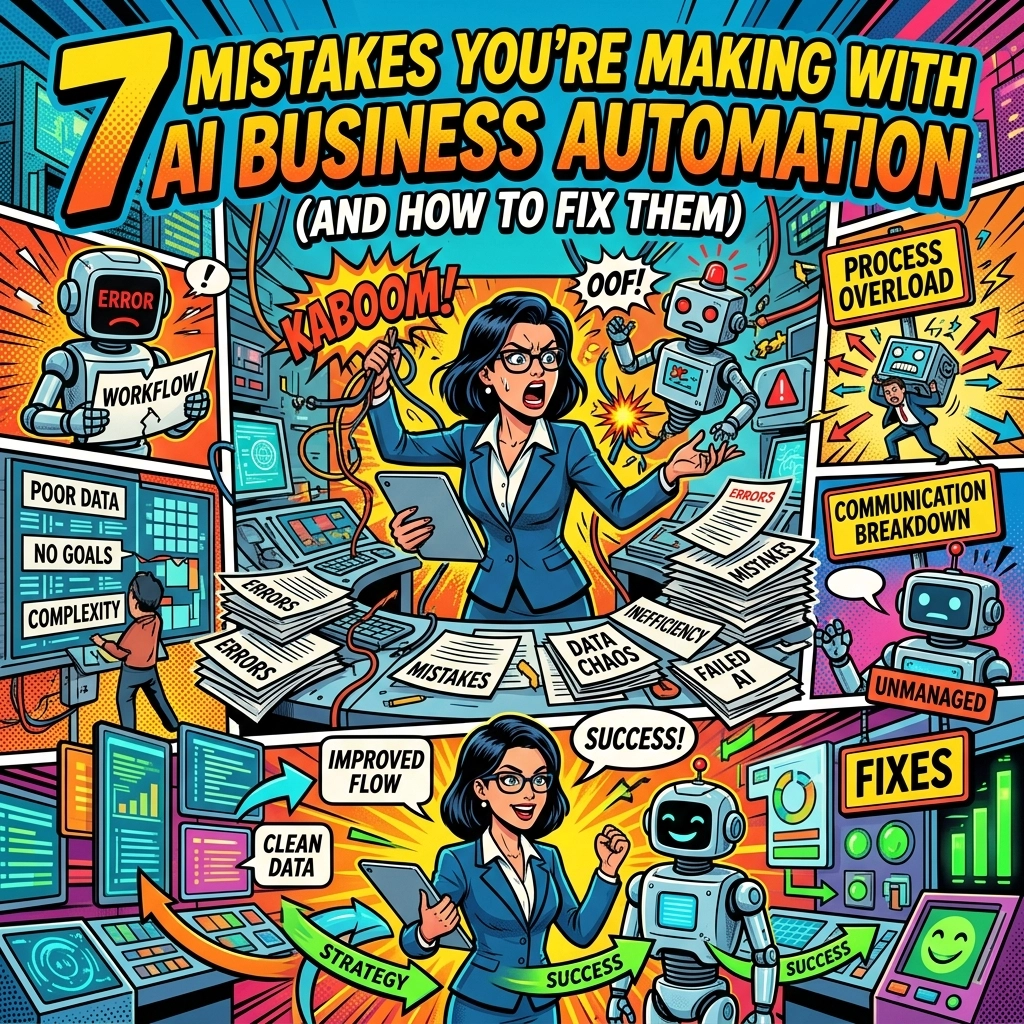
    A blindfolded business owner ignoring warning lights, illustrating risks of unmonitored AI business automation.


    3. IGNORING THE "GARBAGE IN, GARBAGE OUT" PRINCIPLE

    85% of AI projects fail. Why? Because the data they’re fed is hot garbage.

    If your CRM is filled with duplicate entries, outdated emails, and notes that say "Talked to this guy at the thing," your AI is going to be confused. It’s like trying to bake a Michelin-star cake with expired milk and salt instead of sugar.

    Roughly 60% of small businesses struggle with AI because their data is a junk drawer.

    THE FIX:
    Clean your room. Before you launch your next ai business automation project, do a data scrub. Delete the duplicates. Standardize your formatting. If your data is clean, your AI will be a genius. If it’s dirty, your AI will be a liability.


    4. THE INTEGRATION MAZE

    AI doesn't live on an island. It needs to talk to your CRM, your help desk, your Slack, and your calendar.

    Remember that story about the Chevy dealership chatbot that sold a $70,000 SUV for $1? That happened because the bot wasn't properly integrated with the actual inventory and pricing guardrails. It was just a fancy text generator with no connection to reality.

    If your tools aren't talking to each other, you’re just creating more work for yourself manually moving data between them.

    THE FIX:
    Focus on your tech stack connectivity. Use business automation tools that play well with others. If a tool doesn’t have a robust API or a Zapier integration, it’s probably not worth your time. Plan your connections before you build your features.


    5. OVER-AUTOMATING THE HUMAN TOUCH

    11:45 AM.

    Your phone buzzes. It’s a high-value client who is upset. Your AI bot responds with: "I understand you are frustrated. Please select from the following three options."

    …You just lost that client.

    There is a "Uncanny Valley" in business. If a customer feels like they’re being handled by a script when they need a human, they’ll bounce. AI should be your assistant, not your replacement.

    THE FIX:
    Keep a "Human in the Loop." Use AI to draft the response, but have a human hit "send." Use AI to summarize the meeting, but have a human verify the action items. Start with supervised modes for at least 30-60 days before you even think about full autonomy.

    An awkward robot hugging a crying customer, showing the danger of over-automating human business interactions.


    6. SHOOTING WITHOUT A TARGET

    "We need AI because everyone else has AI."

    That’s not a strategy. That’s FOMO.

    When you deploy AI without clear, measurable goals, you end up with "shiny object syndrome." You spend thousands on tools that look cool in a demo but don't actually move the needle on your ROI or save you any real time.

    THE FIX:
    Pick one metric. Just one. "I want to reduce lead response time by 50%." Or "I want to automate 30% of my basic support tickets." When you have a target, you can actually tell if the AI is working or just taking up space.

    Scaling shouldn't be a guessing game. Get a clear roadmap at Marblism.


    7. FORGETTING THE "CONTEXT"

    AI is great at patterns. It is terrible at context.

    A pattern says: "You sold 500 umbrellas last July."
    Context says: "There was a record-breaking hurricane last July, and this year is a drought."

    If you follow the AI’s pattern without checking the context, you’re going to end up with a warehouse full of umbrellas and no one to buy them. AI doesn’t know your industry trends, your local news, or your gut feeling.

    THE FIX:
    Treat AI outputs as "Strong Suggestions," not "Absolute Truths." Review the data. Cross-check recommendations against what you actually know about your business. You’re the captain; the AI is just the GPS.


    STOP JUGGLING. START SCALING.

    3:30 PM.

    The sun is starting to dip. Usually, this is when the "afternoon slump" hits and you realize you still have four hours of admin work left.

    But imagine this instead…

    You open your laptop. The AI has already sorted your leads. It’s flagged the high-priority ones. It’s drafted the follow-ups based on clean data. It’s updated your CRM.

    And because you didn't automate a broken process, it all actually works.

    The chaos is gone before you even take your last sip of coffee.

    Scaling a business is hard. But it’s a lot harder when you’re making these seven mistakes. Stop treating AI like a magic wand and start treating it like the powerful business tool it is.

    You don't need more tools. You need a better system.

    Ready to stop making mistakes and start seeing results? See how the pros handle ai business automation without the headache.

    👉 Build your dream AI business right here.

    Scaling shouldn't be this hard. But here we are.

    Let’s get to work.


    FAQ: YOUR QUESTIONS, UNFILTERED

    Is AI going to replace my small team?
    No. It’s going to make your small team act like a massive corporation. It replaces the "boring stuff" so your people can do the "human stuff."

    How much does it cost to fix these mistakes?
    Usually, it’s cheaper to fix them than to ignore them. A $500/month tool that fails is a waste. A $1,000 setup that works is an investment.

    Can I really automate my lead gen?
    Yes. But only if you have a clear funnel first. AI can find the leads, but you have to know what a "good lead" looks like.

    Do I need to know how to code?
    Not anymore. Most modern business automation tools are no-code or low-code. You just need to know how your business works.

    Where do I start?
    Start with the biggest bottleneck in your day. Whatever makes you sigh the loudest when you open your laptop: automate that first.

    A successful business owner relaxing while helpful robots manage efficient business automation tasks.

    🌙 The day ends. The lights are off. But your business is still moving.

    That's the power of doing it right.

  • Stop Wasting Time on Admin: How to Save 10+ Hours Every Week with Business Automation Tools

    You wake up. It’s 6:45 AM.

    Before you’ve even had a sip of coffee, your brain is already running through a mental checklist that feels more like a death warrant.

    The three "pending" invoices you forgot to send. The back-and-forth email thread with a client who can’t decide if Tuesday at 2:00 PM works for them. The social media post you promised yourself you’d write last night but didn’t because you were too busy staring at a spreadsheet…

    You’re not running a business. You’re running a marathon through a swamp.

    But it doesn't have to be this way. Imagine a world where the "admin tax" simply doesn't exist. Where your business breathes, moves, and grows while you’re actually getting some sleep.

    It’s 2026. Stop working like it’s 2012.


    AUTOMATE ADMIN TASKS: HOW TO SAVE 10+ HOURS EVERY WEEK

    7:00 AM: The silence is the first thing you notice.

    Usually, your phone is screaming with notifications. Today? Nothing.

    While you were sleeping, your business automation tools were busy. An invoice was automatically generated from your CRM data and sent to that client in Chicago. A reminder was pinged to the guy who’s three days late on a payment.

    You didn't lift a finger.

    The Scheduling Trap

    You know the dance. "How about Wednesday?" "No, I have a thing." "Thursday at 4:00?" "I’m in a different timezone."

    Stop it. You’re losing 1-2 hours every single day just playing calendar tag. By integrating real-time availability tools, you don't just save time, you reduce no-show rates by up to 60%.

    When someone wants your time, they click a link. They pick a slot. Your calendar updates. The Zoom link is created. The reminder is set.

    You just show up and look like a pro.

    The Paperwork Ghost

    Manual data entry is where dreams go to die. Moving a lead from a contact form to a spreadsheet, then to a mailing list, then to an invoice… it’s soul-crushing.

    Using tools like Zapier or Autonoly, you can build "zaps" that act like invisible hands. A new lead signs up? They’re instantly added to your CRM, tagged for follow-up, and sent a "Welcome" email.

    Total time spent by you: Zero seconds.

    Robotic arm clearing paperwork for a small business owner using business automation tools.

    Reporting Without the Headaches

    Most small business owners spend 3-4 hours a week just trying to figure out if they made money. They’re pulling data from Stripe, then Shopify, then their bank account.

    Automated dashboards aggregate this in real-time. You don’t "do" the reporting anymore. You just look at the screen and see the truth.

    Ready to reclaim your Sunday afternoons? Check out how it works here: https://marblism.link/scott-bowen


    THE BEST AI ASSISTANT FOR SMALL BUSINESS IN 2026

    🤝 11:00 AM: You’re in a deep-work zone.

    In the past, this is when a "quick question" from a customer would derail your entire morning. You’d drop everything to answer a FAQ that's already on your website.

    Not today.

    The ai assistant for small business isn't just a chatbot that says "Sorry, I don't understand." In 2026, it’s a virtual employee. It knows your products. It knows your tone. It knows when to handle a refund and when to pass a high-value lead directly to your phone.

    Meet Your New Most Reliable Employee

    Your AI assistant doesn't take lunch breaks. It doesn't get "the Mondays." It sits on your website or your WhatsApp line and handles the 80% of repetitive junk that clogs your brain.

    Imagine a lead asks: "Do you offer bulk discounts for the Q3 package?"
    Instead of you typing out the same response for the 500th time, the AI checks your price list, applies the logic, and drafts the quote.

    You see the notification: “Sale closed. $1,200 deposited.”

    Proactive, Not Just Reactive

    The best AI tools don't just wait for questions. They monitor your workflows. They see that a project is nearing its deadline and ping the team member responsible. They notice a client hasn't engaged in 30 days and suggest a personalized re-engagement email.

    It’s like having a Chief of Staff who costs less than your monthly coffee budget.

    A helpful robot managing digital tasks acting as an efficient ai assistant for small business growth.

    Why Now?

    The technology has shifted. We've moved past "auto-responders" into "autonomous agents." These tools learn from your previous emails and your specific business style. They start to sound like you, only faster and more organized.

    Scaling shouldn't be this hard. But here we are, making it easy.

    See the future of your team: https://marblism.link/scott-bowen


    AI CONTENT GENERATOR FOR SMALL BUSINESS: YOUR SECRET MARKETING WEAPON

    🔍 2:00 PM: The "Content Dread" sets in.

    You know you need to post. You know the "algorithm" demands blood. But the blinking cursor on a blank Google Doc is mocking you.

    This is where your ai content generator for small business steps in.

    From One Idea to Ten Posts

    You had a great conversation with a client this morning. You have one solid insight. In the old days, turning that into a blog post, five LinkedIn updates, three Instagram captions, and a newsletter would take you all afternoon.

    Now? You feed that one insight into your AI generator.

    Three minutes later, your entire week of marketing is drafted. It’s not generic fluff, either. It’s tailored to your brand voice. It’s punchy. It’s ready to convert.

    The Repurposing Machine

    Research shows that using AI for content repurposing can cut your production time by 70%.

    Take that 10-minute video you recorded. The AI transcribes it, pulls out the three best "hooks," turns them into short-form video scripts, and writes a long-form article based on the transcript.

    You aren't a content creator. You’re a business owner. Stop spending 20 hours a week pretending to be an influencer.

    A content factory machine turning a single idea into social posts with an ai content generator for small business.

    The SEO Advantage

    Search engines in 2026 are smart, but they still love consistency. An AI content generator ensures you never miss a day. It handles the meta tags, the keyword density, and the internal linking that usually makes your eyes bleed.

    You get the traffic. The AI does the typing.


    EMPLOYEE OF THE MONTH. EVERY MONTH.

    🌙 5:00 PM: The lights are off.

    Usually, you’d be bracing for "the second shift", that block of time after dinner where you finally "catch up" on admin.

    But tonight? The admin is already done.

    The invoices are out. The leads are nurtured. The content is scheduled for tomorrow.

    You step away from your desk and you don't feel that nagging pull of "I forgot something." You’re not just saving 10 hours a week; you’re saving your sanity.

    Stop Juggling. Start Scaling.

    The difference between a business that survives and a business that thrives is systems.

    You can keep trying to do it all yourself. You can keep "grinding" until you burn out. Or, you can lean into the tools that were built to give you your life back.

    The chaos is gone before you even take your first sip of coffee.

    It’s quiet. Organized.

    That’s the power of Marblism.

    Stop wasting time on the "how" and start focusing on the "why." You didn't start a business to become a professional email-replier. You started it to make an impact.

    Let the AI handle the rest.

    Business owner relaxing at a clean desk after automating tasks with business automation tools.

    Ready to see those 10 hours appear back on your calendar?

    Check out the interactive demo and see exactly how we can automate your specific chaos: https://marblism.link/scott-bowen

    FAQ: THE STUFF YOU’RE WONDERING ABOUT

    Is this hard to set up?
    No. Most people have their first automation running in under 15 minutes. No coding required. Just point and click.

    Will I lose the "human touch"?
    Only the parts of the human touch that involve repetitive, boring tasks. Your clients will actually appreciate the faster response times and more organized service.

    Is it expensive?
    Compared to the cost of 10 hours of your time? It’s basically free. Think of it as hiring a full-time assistant for the price of a Netflix subscription.

    Do I need to be a "tech person"?
    If you can send an email, you can use these tools. We built them for business owners, not developers.

    ONE FINAL THOUGHT.

    The best time to automate was last year. The second best time is right now.

    Don't let another 10 hours slip through your fingers this week.

    Your future self is already thanking you.

    https://marblism.link/scott-bowen

  • Data-Driven Decisions: Why Your PMS is Your Most Valuable Asset

    Data-Driven Decisions: Why Your PMS is Your Most Valuable Asset

    Capture every growth opportunity. Optimize your entire operation. Command your market with certainty.

    You’re sitting on a gold mine. Every single day, your property generates thousands of data points: from the exact moment a guest searches for a room to the specific beverage they order at the bar three nights later. But data without direction is just noise. To win in 2026, you need to stop viewing your Property Management System (PMS) as a digital filing cabinet. It’s actually your most powerful engine for revenue and guest loyalty.

    We’ve seen properties increase their RevPAR by 15% in just six months by simply listening to what their data was already trying to tell them. The difference between a struggling hotel and a market leader isn't just the location; it’s the ability to turn raw information into actionable insights. All from one cloud-native platform.

    Beyond the check-in desk

    We believe your PMS should be the heartbeat of your business. For too long, hospitality tech was designed to just "handle" guests. It was reactive. You waited for the guest to arrive, you checked them in, and you hoped they’d come back. That era is over. Today, a modern system like Mews acts as a central intelligence hub that connects every department: front office, housekeeping, F&B, and finance: into a single, unified stream of truth.

    When your data is siloed, you’re flying blind. When it’s integrated, you can see the patterns that matter. You can identify which marketing channels are actually driving high-value guests and which are just costing you commission. You can see which room types are over-performing and adjust your inventory in real-time.

    A hotel manager using a tablet in a modern lobby to access real-time property management data.

    Revenue management reimagined

    Stop guessing and start knowing. The days of manual pricing adjustments based on what the hotel down the street is doing are gone. Modern revenue management is about predictive power. By leveraging historical data and real-time market signals, your PMS helps you price for maximum profit, not just maximum occupancy.

    We think revenue management should be effortless.

    • Automate dynamic pricing based on real-time demand.
    • Analyze TRevPAR (Total Revenue Per Available Room) to understand true guest value.
    • Identify booking windows to optimize your early-bird and last-minute offers.

    It’s about more than just the nightly rate. With the right data, you can see that a guest who pays a lower room rate but spends $200 at the spa is actually more valuable than a high-rate guest who never leaves their room. A cloud-native PMS allows you to track these behaviors and tailor your offers accordingly. It turns your "gut feeling" into a data-backed strategy that yields results you can actually see in your bank account.

    Operations without the friction

    Data isn't just for the suits in the back office; it’s for the team on the floor. Operational excellence in 2026 is defined by how well you can predict your needs before they become problems. If your PMS can tell you that 40% of your arrivals today are requesting early check-in, your housekeeping team can prioritize those rooms before the first guest even walks through the door.

    We believe in making the hard work feel easy.

    1. Forecast staffing needs based on precise occupancy data.
    2. Reduce energy costs by syncing HVAC systems with check-in/out times.
    3. Automate repetitive tasks to give your team more time with guests.

    Efficiency is the byproduct of visibility. When you can see the live status of every room and every staff member, bottlenecks disappear. You aren't just running a hotel; you're orchestrating a seamless experience. This level of precision is only possible when your data is accessible, real-time, and mobile.

    Laptop displaying hotel revenue management analytics and data visualizations in a luxury suite.

    The 2026 guest experience

    Hyper-personalization is the new standard. In a world where every other industry knows exactly what you want before you ask for it, hospitality can't afford to be generic. Your PMS holds the key to this personalization. Every past stay, every preference, and every interaction is a building block for a better future experience.

    "We saved over 10 hours a week on admin, which meant we could finally focus on talking to our guests again," says one of our partners. That’s the real power of data: it buys you time.

    When a guest returns, they shouldn't have to tell you they like a quiet room or an extra pillow. Your system should already know. By using Agentic AI integrated with your PMS, you can send personalized upsell offers that actually convert because they’re based on real preferences, not a generic template. This doesn't just increase your bottom line; it makes your guests feel seen and valued.

    Why cloud-native wins every time

    If your data is trapped in an on-site server, it’s effectively dead. Legacy systems are the biggest hurdle to innovation. They’re slow, they’re hard to integrate, and they make data extraction a nightmare. A cloud-native PMS like Mews changes the game by making your data liquid. It flows where it needs to go, instantly.

    We believe your tech stack should be an ecosystem, not a prison.

    • Connect to over 1,000 industry-leading apps in minutes.
    • Access your dashboard from any device, anywhere in the world.
    • Scale your operations without needing a dedicated IT team.

    The agility of the cloud means you can experiment. Want to try a new keyless entry system? Or a third-party AI concierge? With an open API, you can plug these tools directly into your data stream. You aren't limited by what your software provider can build; you're only limited by your own ambition.

    A perfectly prepared minimalist hotel guest room illustrating operational excellence and efficiency.

    Turning insights into action

    It’s easy to get overwhelmed by the sheer volume of numbers. The goal isn't to look at more data; it's to look at the right data. Start by identifying the three biggest levers in your business. Is it your ADR? Your labor costs? Your direct booking ratio? Once you know what matters, use your PMS to track those metrics relentlessly.

    Modern hospitality is a game of margins. When you use data to shave 2% off your food waste and add 3% to your upsell conversion, you aren't just making small tweaks: you’re transforming your profitability. This is why over 12,500 properties trust Mews to handle their most valuable asset. We provide the clarity you need to make bold moves.

    We believe the future of hospitality is human-centric and data-driven. The tech shouldn't get in the way; it should pave the road. It should give you the freedom to be creative, the confidence to be aggressive with your pricing, and the tools to provide a level of service that was previously impossible.

    Close-up of personalized hotel guest amenities on a stone counter, representing high-touch service.

    Start your data journey

    Your PMS is either a cost center or a revenue generator. If you’re still using it just to assign rooms, you’re leaving money on the table every single day. The transition to a data-driven model doesn't have to be a mountain to climb. It starts with choosing a partner that prioritizes innovation and understands the unique challenges of modern hoteliers.

    Ready to see what a truly innovative PMS can do for your property? It’s time to move beyond the basics and start making decisions that are backed by the most comprehensive data in the industry.

    Get started with Mews today and see how we can get you earning more revenue in no time. Our 30-minute demo will show you exactly how to turn your data into your biggest competitive advantage. No fluff, just results.

    The future of your property is hidden in your data. It’s time to go find it.