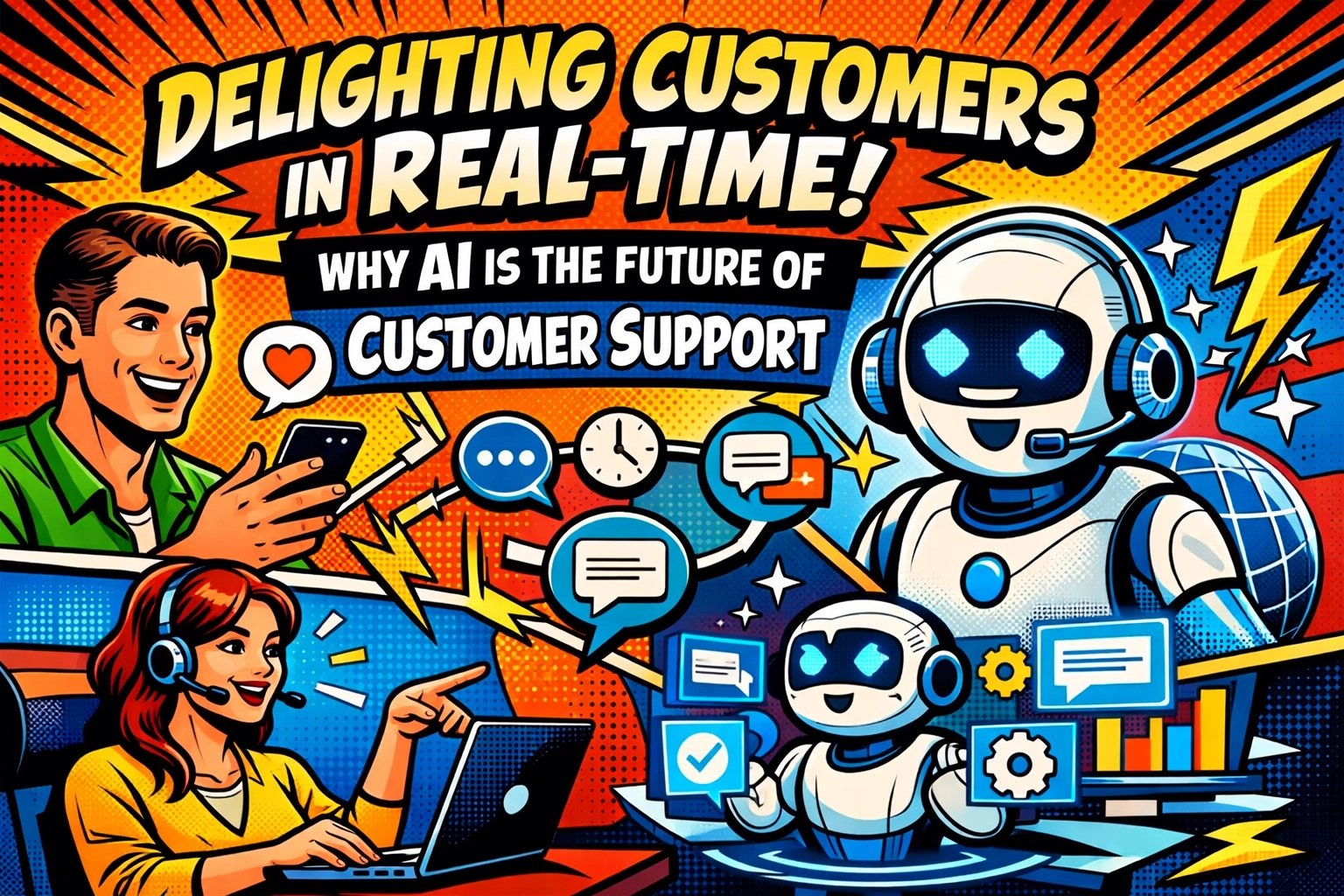
It's 2:00 AM.
Your customer in Tokyo has a question. Your support team in Denver is asleep. The ticket sits there… waiting. By morning, that customer's frustration has already turned into a negative review.
You've been there. The inbox that never empties. The phone that won't stop ringing. The chat widget lighting up while you're trying to close a deal. Every "quick question" pulls you away from actually growing your business.
And here's the thing : your customers don't care that you're a team of three. They expect Amazon-level support on a solopreneur budget.
The old answer was "hire more people." But that's expensive, complicated, and honestly… still doesn't solve the 2:00 AM problem.
The new answer? Let AI do what it does best while you focus on what only you can do.
THE SUPPORT BOTTLENECK YOU KNOW TOO WELL
📞 Picture your typical Tuesday.
You're deep in work. Creating. Building. Strategizing. Then the first support request comes in. Then another. Then five more. Before you know it, three hours have vanished answering the same questions you answered yesterday.
"Where's my order?"
"How do I reset my password?"
"Can you walk me through this feature?"
Each one matters. Each deserves a real answer. But each one also steals time from the work that actually moves your business forward.
Your options used to be pretty grim. Ignore customers and watch your reputation crumble. Or answer everything and watch your productivity die. Some choice, right?

WHAT HAPPENS WHEN SUPPORT RUNS 24/7
Here's where it gets interesting.
Companies using AI for customer support are seeing 87% faster resolution times. Not 8%. Not 17%. Eighty-seven percent faster. That's the difference between a customer waiting three hours and getting an answer in minutes.
And it's not just speed. It's accuracy. An AI virtual assistant for business doesn't get tired at 4:00 PM. Doesn't misread a ticket because it's handling twelve conversations at once. Doesn't forget what Customer A asked three days ago.
It remembers everything. Cross-references instantly. Delivers consistent answers whether it's the first inquiry of the day or the hundredth.
Your customers notice. Response times drop. Satisfaction scores climb. And suddenly, people are telling their friends about your "amazing support team" when really… it's just you and some very smart software.
THE MIDNIGHT ADVANTAGE
🌙 Let's talk about what happens while you sleep.
Your competitor's customer sends a question at 11:00 PM. Gets an auto-reply: "We'll get back to you during business hours." That customer goes to bed frustrated, wakes up still waiting, and by lunch has already started looking at alternatives.
Your customer sends a question at 11:00 PM. Gets an immediate, helpful response. Problem solved before they close their laptop. They wake up impressed, not irritated.
That's the retention game-changer nobody talks about enough. It's not about replacing human connection : it's about being there when your customers need you, even when you physically can't be.
When you automate customer support with AI, you're not choosing robots over people. You're choosing to show up for every customer, every time, regardless of time zones or working hours.
FREEDOM FOR THE COMPLEX STUFF
Here's what happened when one business implemented AI support:
Their team stopped drowning in "How do I…?" questions. Those got handled instantly by AI. Their actual support agents suddenly had time for the complicated stuff : the edge cases, the frustrated customers who needed empathy, the feedback that turns into product improvements.
Burnout dropped. Turnover stopped. Agent satisfaction went up because they were finally doing meaningful work instead of copy-pasting answers from a knowledge base all day.
And the business saved 35% on support costs while improving response times.
That math doesn't just work. It works beautifully.
REAL-TIME INTELLIGENCE THAT LEARNS
The smartest part? Modern AI doesn't just answer questions. It pays attention.
It notices when a customer's getting frustrated and alerts you before they churn. It spots patterns : "Ten people asked about this feature this week, maybe we need better documentation." It learns from every interaction, getting better at understanding what customers actually mean, not just what they type.
One customer writes: "This thing won't work."
Old support system: ¯_(ツ)_/¯
AI support: Checks their account, sees they're using Safari, knows there's a known Safari bug, provides the workaround immediately, and flags the issue for your dev team.
That's not just automation. That's intelligence.

THE PROACTIVE SHIFT
But here's where it gets really interesting.
AI doesn't just respond. It predicts. It sees a customer struggling with setup and proactively offers help before they even ask. It notices someone's been inactive for two weeks and sends a personalized check-in. It identifies customers who might be great fits for your premium tier and flags them for your sales team.
You move from reactive support (putting out fires) to proactive support (preventing fires from starting). That shift changes everything about how customers experience your business.
They stop thinking "I hope I can figure this out" and start thinking "These people really get it."
WHAT THIS LOOKS LIKE IN PRACTICE
☕ 9:00 AM: You check your dashboard. AI handled 47 inquiries overnight. Customers in Australia, Japan, and Europe all got immediate help. Zero tickets waiting for you.
📱 2:00 PM: A customer asks a complex question. AI provides the basics instantly, then routes the conversation to you with full context. You jump in with the human touch where it matters most.
🤝 5:00 PM: Your AI flags three customers showing signs of frustration. You reach out personally before they become problems. Two become testimonials instead.
This isn't science fiction. It's Tuesday for businesses using Marblism.
THE RETENTION MULTIPLIER
Here's the thing about customer support that nobody wants to admit: most businesses lose customers not because their product fails, but because their support does.
A customer has a question. Can't get an answer. Gets frustrated. Cancels. Posts a review. Tells five friends.
Or.
A customer has a question. Gets an instant, accurate response. Problem solved. Stays subscribed. Becomes an advocate.
The difference between those two scenarios isn't the quality of your product. It's the quality of your support. And increasingly, the quality of your support depends on your ability to be everywhere, instantly, accurately.
That's not humanly possible.
But it's exactly what AI does.
STARTING IS SIMPLER THAN YOU THINK
You might be thinking this sounds expensive. Complicated. Like something enterprise companies do.
It's not.
Setting up an AI virtual assistant for business used to require developers, custom code, and a five-figure budget. Now? It's plug-and-play. Connect your knowledge base, set your brand voice, and you're handling support inquiries while you're literally doing anything else.
The businesses winning at support in 2026 aren't the ones with the biggest teams. They're the ones smart enough to let AI handle what AI does best : instant, accurate, 24/7 responses : while humans focus on what humans do best: empathy, creativity, and building relationships.
YOUR SUPPORT TEAM IS SLEEPING
Right now, somewhere in the world, a potential customer is evaluating you against a competitor.
They both have a question. It's 3:00 AM your time.
Your competitor's customer is still waiting.
Yours just got an answer.
Guess who's making the purchase?
That's the game. And it's not about working harder. It's about working smarter.
Ready to see what real-time support looks like in action? Check out how Marblism helps businesses automate customer support without losing the human touch.
Because your customers don't sleep. Your support shouldn't either.
Leave a Reply