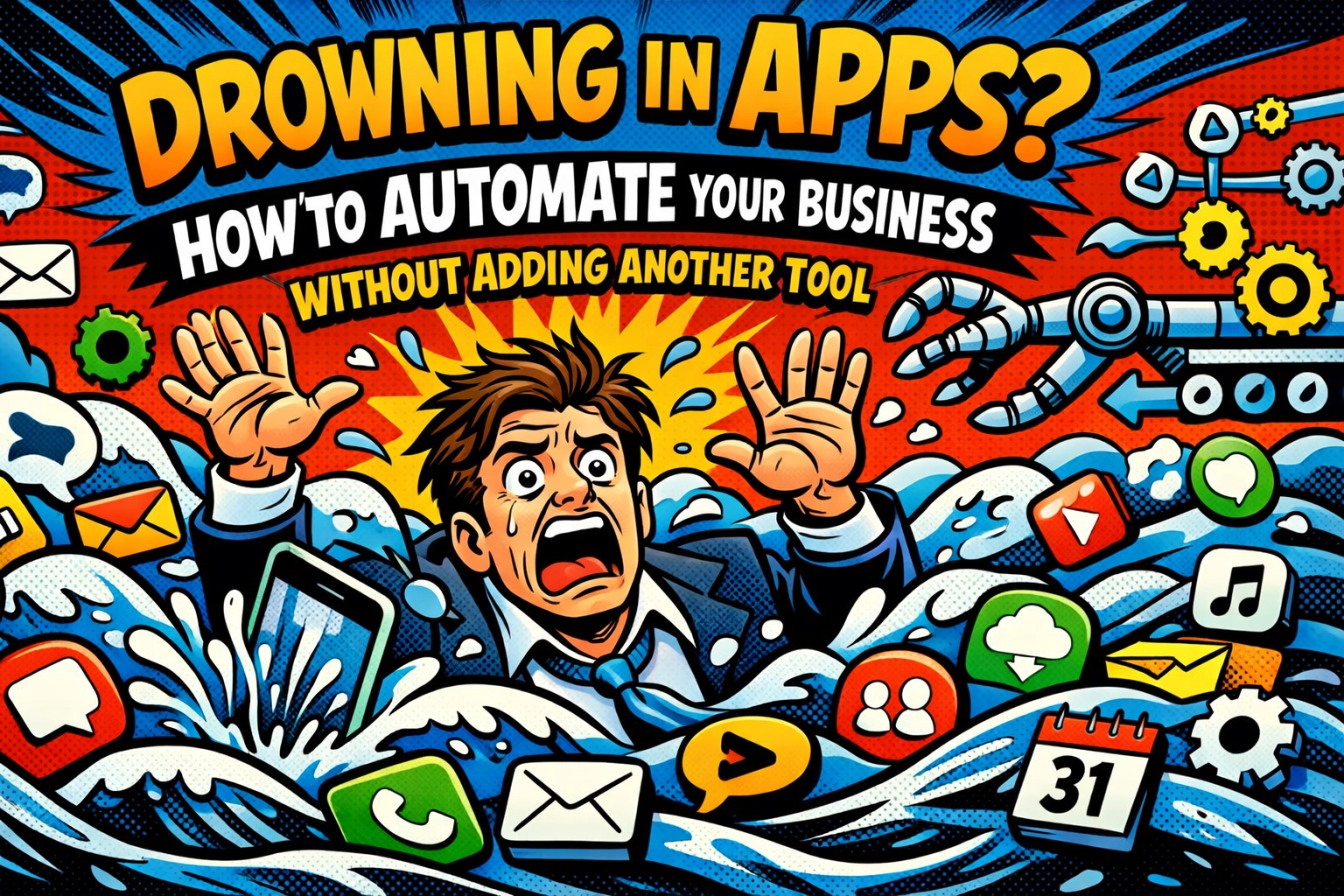
You open your laptop. Thirteen tabs. Again.
Slack for team chat. Asana for projects. HubSpot for leads. Mailchimp for emails. QuickBooks for invoices. Calendly for scheduling. Notion for documentation. Zapier to connect three of them. Google Drive for files. Stripe for payments. A spreadsheet for the stuff that doesn't fit anywhere else.
And somehow… nothing talks to each other.
Your assistant asks where to find the latest client brief. You're not sure if it's in Notion, Drive, or buried in Slack. A customer complains they never got their invoice. It's sitting in QuickBooks, but nobody remembered to actually send it. Your marketing campaign launched yesterday, but the sales team doesn't know about the new leads because HubSpot and Slack don't sync automatically.
Welcome to app fatigue. You thought these tools were supposed to make life easier.
THE APP ADDICTION NOBODY WARNED YOU ABOUT
Here's what happened.
You started with one app. Then a problem came up that app couldn't solve, so you added another. Then another. Each one promised to be "the solution." Each one cost money. Each one required training. Each one created its own login, its own dashboard, its own way of doing things.
Now you're paying for twelve different subscriptions. Your team spends the first hour of every day just catching up across platforms. And you… you're the person who has to remember where everything lives.

The average small business owner uses between 10-15 different business automation tools. Less than 30% of them are properly integrated. That means data lives in silos. Tasks fall through cracks. And you waste hours every week playing telephone between your own apps.
This isn't scaling. This is treading water.
THE PROBLEM WITH "JUST ONE MORE TOOL"
Someone always suggests another integration platform. "Just use Zapier!" "Try Make!" "Have you looked at Integromat?"
But here's the thing… those are more tools. More subscriptions. More dashboards. More places where something can break.
You set up a zap. It works for three weeks. Then an app updates its API and the connection breaks. You don't notice until a customer complains. Now you're troubleshooting at 11 PM, trying to figure out which piece of the Rube Goldberg machine failed.
Integration tools help. But they're still band-aids on a bigger problem.
Your business doesn't need more apps. It needs fewer apps that do more.
WHAT IF AUTOMATION DIDN'T MEAN MORE COMPLEXITY?
Let's reframe this.
True business automation isn't about connecting ten tools together. It's about having intelligence that works across everything you do , without needing thirteen browser tabs open.
Think about it differently. Instead of:
- An app for emails
- An app for scheduling
- An app for customer data
- An app for follow-ups
- An app for analytics
- Integration tools to connect them all
What if you had AI business automation that just… handled it?

Someone sends an email. The system reads it, understands the context, knows your business, checks your calendar, drafts a response that sounds like you, and either sends it or queues it for your approval. Without you teaching it which app does what. Without you building workflows. Without you maintaining integrations.
That's not more tools. That's intelligence replacing the need for tools.
HOW SMART BUSINESSES ARE ACTUALLY AUTOMATING IN 2026
The companies getting ahead right now aren't adding more apps to their stack. They're consolidating around AI that thinks.
Here's what that looks like:
7:00 AM ☕
Three customer inquiries came in overnight. Your AI assistant has already drafted responses based on your previous conversations, checked inventory, and scheduled follow-up calls. You review them over coffee. Two look perfect , you approve them with a tap. One needs a personal touch , you tweak it in 30 seconds.
Total time: Three minutes. Not three different apps.
10:00 AM 📊
You're preparing for a meeting. Instead of opening HubSpot, then Slack, then your CRM, then Google Analytics, you ask: "What happened with the Johnson account this week?"
Your AI pulls everything. Emails exchanged. Calls made. Revenue impact. Project status. One answer. One place.
2:00 PM 📱
A team member asks about the Q1 marketing budget. You don't remember if that's in the shared spreadsheet, the budget doc in Notion, or the email thread from January.
You just ask. The AI finds it, summarizes it, and sends it directly to them in Slack. You never opened a single app.
5:00 PM 📝
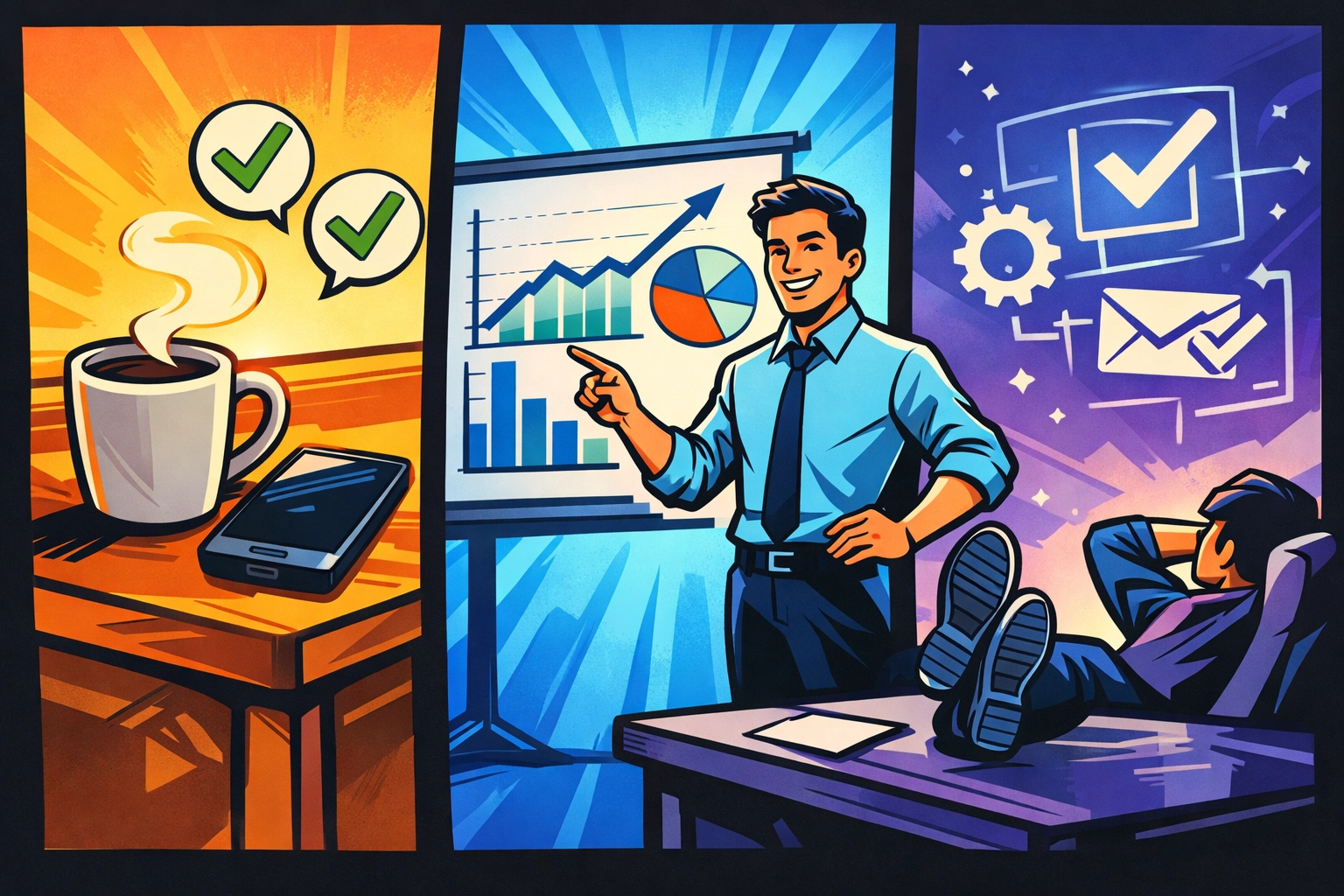
While you're wrapping up, your AI assistant has been working in the background. Blog post drafted for next week. Social media scheduled. Three client proposals generated from your templates and sent for review. Follow-up emails queued for tomorrow.
You didn't trigger any of these. It knew they needed to happen. It just… did them.
This is what ai business automation actually means. Not more tools. Fewer tools. Less complexity. More done.
THE CONSOLIDATION NOBODY'S TALKING ABOUT
The dirty secret of the SaaS industry is that you don't need most of what you're paying for.
You need:
- Communication that's organized
- Tasks that get done on time
- Information that's accessible
- Follow-ups that don't fall through cracks
- Content that gets created
- Data that makes sense
You don't need seventeen apps to do those things. You need intelligence that understands your business and executes across all of them.
Marblism isn't another tool in your stack. It's the thing that makes half your stack unnecessary.
Instead of:
- Hiring a VA to manage your calendar → AI handles scheduling
- Using Zapier to connect apps → AI understands context across everything
- Manually following up with leads → AI tracks conversations and nudges at the right time
- Switching between dashboards → AI surfaces what matters when you need it
You keep using the tools you love. Email. Slack. Your CRM. But now there's intelligence running underneath that makes them all work together.
Without you building it. Without you maintaining it. Without adding another login to remember.
WHAT THIS ACTUALLY LOOKS LIKE
Email: Instead of rules and filters you set up two years ago that don't work anymore, your AI learns what matters to you. Important messages get flagged. Spam gets ignored. Responses get drafted in your voice.
Scheduling: No more back-and-forth. Someone asks for a meeting, your AI checks your calendar, suggests times, handles rescheduling, sends reminders. Done.
Customer Management: Every interaction is tracked. Every follow-up is timely. Every question gets answered. Not because you built a workflow : because the AI understands relationships.
Content Creation: Blog posts. Social media. Email newsletters. Your AI knows your brand voice, your audience, your goals. It creates. You approve and refine.
Research & Analysis: Need competitor analysis? Market research? Customer insights? Ask. Get answers. Not links to read : actual analysis.
This isn't theoretical. This is happening right now for businesses that got tired of juggling apps.
THE SHIFT YOU NEED TO MAKE
Stop thinking in tools. Start thinking in outcomes.
You don't need a "project management tool." You need projects that actually get managed.
You don't need a "marketing automation platform." You need marketing that runs while you focus on your business.
You don't need "better integrations." You need information that flows naturally to where it's needed.
The question isn't "What app can solve this?" The question is "What outcome do I actually need?"
That's where AI business automation starts making sense. Not as another tool. As the thing that orchestrates everything else.
READY TO SIMPLIFY?
Imagine your business running smoothly with half the apps, a quarter of the logins, and ten times the clarity.
No more wondering where that file is. No more checking five places for one answer. No more paying for tools you barely use because "they might integrate with something someday."
Just your business. Running. While you focus on the parts that actually need you.
See how Marblism consolidates your chaos into clarity →
The companies winning in 2026 aren't the ones with the biggest tech stacks. They're the ones who figured out they didn't need one.
Leave a Reply