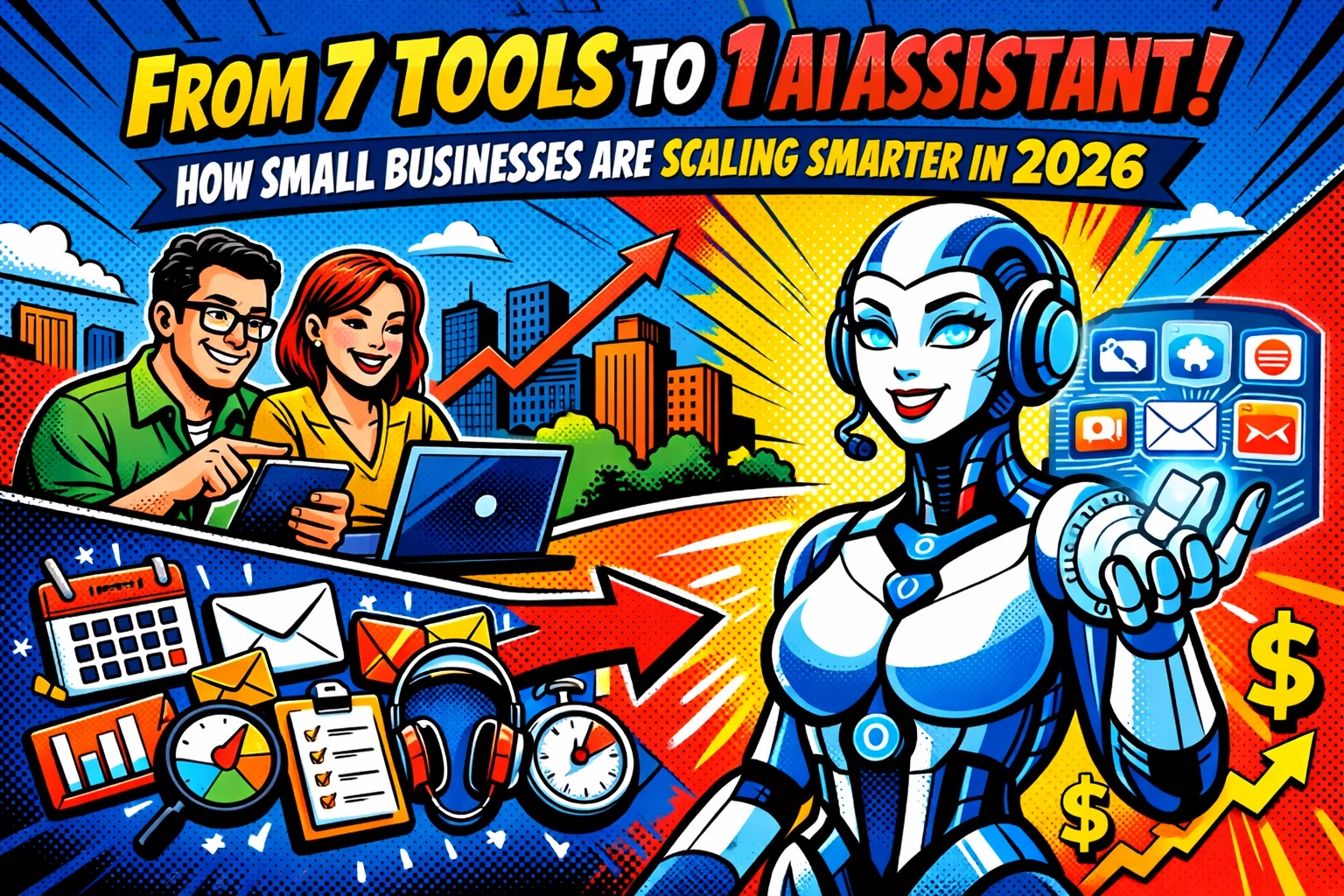
You know that feeling when you open your laptop in the morning?
Twelve browser tabs. Seven different logins. One tool for email. Another for social media. A third for content writing. A fourth for analytics. A fifth for project management. A sixth for customer support. A seventh for… what was that one even for?
Your monthly subscriptions look like a CVS receipt.
And somehow, despite having a tool for everything, nothing talks to each other. You're copy-pasting between apps like it's 2015. Your brand voice sounds different across every platform because each tool has its own AI that knows nothing about the others.
Welcome to SaaS sprawl. Population: you.
THE FRANKENSTACK IS KILLING YOUR FOCUS
Here's what nobody tells you about building a business in 2026.
The problem isn't that you don't have the right tools. It's that you have too many of them.
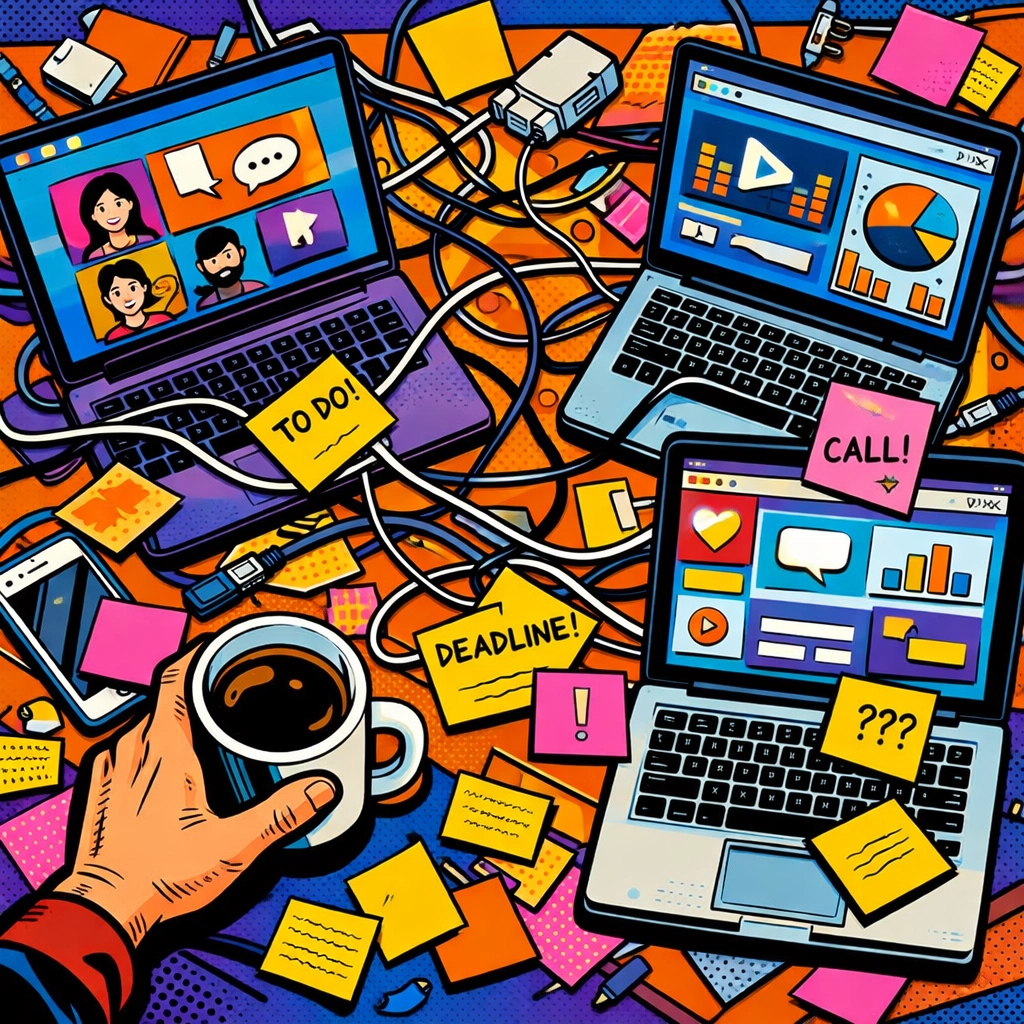
Small businesses used to think the answer was finding the "best" tool for each job. Best email tool. Best social scheduler. Best SEO analyzer. Best customer support platform. Stack them all together and you'd have the perfect setup, right?
Wrong.
What you actually created was a Frankenstack , a monster cobbled together from pieces that were never meant to work together. And now you're the one keeping it alive, manually stitching context between platforms, remembering which tool does what, and wondering why "streamlining your workflow" feels like a part-time job.
The cognitive load is the real killer here.
Every time you switch between tools, your brain has to reload context. What were you working on? Where did you save that file? Which brand guidelines live in this platform? Did you already post that content or just draft it?
It's not just time. It's mental energy you can't get back.
WHAT CONSOLIDATION ACTUALLY MEANS
Smart businesses in 2026 aren't playing the "best individual tool" game anymore.
They're asking a different question: What if one AI assistant could handle all of it?
Not seven subscriptions. Not twelve browser tabs. Not constant context-switching that turns your brain into mush by 2 PM.
One platform. Multiple AI assistants working inside it. All pulling from the same knowledge base, understanding your brand, talking to each other behind the scenes.
This is workflow automation for small business that actually makes sense.
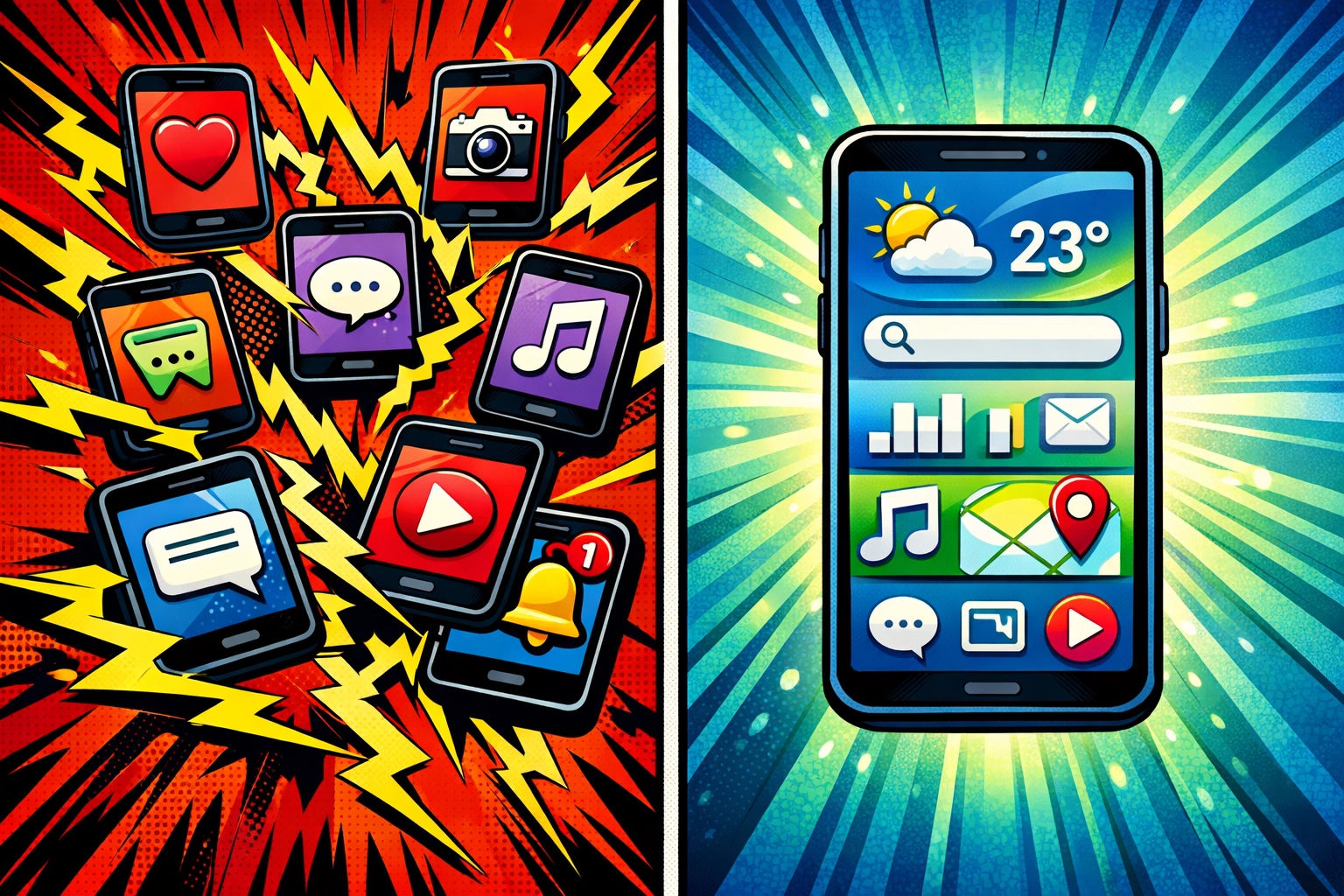
Here's what changes when you consolidate:
Your AI actually knows your brand. Upload your guidelines once. Store your documents, tone of voice, past campaigns, customer insights, all in one place. Now when you ask for a social post, email sequence, or blog outline, the AI isn't starting from scratch. It knows who you are.
You stop paying for redundancy. Five to seven subscriptions replaced with one integrated platform. The math is simple. The savings are real.
Work happens while you sleep. Instead of logging into seven tools to check seven things, your AI assistant for business runs proactive suggestions overnight. You wake up to drafted content, organized tasks, and prioritized leads.
Scaling doesn't require headcount. When everything's connected, automation compounds. The AI that writes your email can also schedule your social post, update your CRM, and prep your analytics report, because it's all in one place.
HOW THIS ACTUALLY WORKS (NOT THEORY , REALITY)
Let me paint you a picture.
☕ 8:00 AM. You open one workspace. Not seven tabs, one.
Your AI marketing assistant has already drafted three LinkedIn posts based on your recent blog. Your sales assistant pulled overnight leads and ranked them by priority. Your content assistant noticed a trending topic in your industry and outlined a response article.
All pulling from your shared knowledge base. All on-brand. All waiting for your thumbs-up.
You review everything in 15 minutes. Send a few edits. Hit publish.
11:00 AM. A customer question comes in. Your support assistant has already checked past conversations, pulled relevant documentation, and drafted a personalized reply. You glance at it. It's perfect. You click send.
No switching to your support tool. No searching through old tickets in another platform. No wondering if the response matches your brand tone.
It does. Because the AI knows.

2:00 PM. You need to write a proposal. Your business assistant has already gathered your past successful proposals, identified patterns in what works, and created a template with your client's specific needs filled in.
You just personalize the details. The heavy lifting is done.
5:00 PM. Your analytics assistant drops a report in your workspace. Not raw data, insights. What's working. What's not. What to double down on tomorrow.
No logging into Google Analytics. No exporting CSV files. No building dashboards.
Just answers.
This isn't science fiction. This is how small businesses are operating right now.
THE MONEY MATH THAT MAKES SENSE
Let's be honest about costs.
Your current setup probably looks something like this:
- Writing AI: $29/month
- Social media scheduler: $39/month
- Email marketing: $49/month
- CRM: $45/month
- Analytics platform: $35/month
- Project management: $25/month
- Customer support tool: $59/month
Total: $281/month. Or $3,372/year.
And that's if you're being conservative. Many small businesses are pushing $500+/month across their entire stack.
An all-in-one AI assistant platform? You're looking at a fraction of that. Often $99-199/month for everything.
But the real savings isn't in subscription costs.
It's in your time. The hours you're not spending switching contexts, copying data between tools, remembering passwords, reconciling inconsistencies, and generally playing IT manager for your own business.
Time you could spend actually building your business.
WHAT YOU SHOULD LOOK FOR
Not all consolidation is created equal.
Here's what actually matters when you're evaluating an AI assistant for business:
Shared knowledge. Can all the AI assistants access the same information about your business? If not, you're just recreating the Frankenstack inside one tool.
Proactive assistance. Does it suggest actions, or do you have to prompt everything manually? The best systems work while you're offline.
Real workflow integration. Can tasks actually flow between different AI assistants, or is it just a bunch of chatbots in the same interface?
Brand consistency. When you update your brand guidelines, does it cascade everywhere instantly?
If the answer to these is no, you're just rearranging deck chairs.

THE HIDDEN BENEFIT NOBODY TALKS ABOUT
There's something that happens when you consolidate that the feature lists don't capture.
You get your brain back.
That low-level anxiety of "what am I forgetting?" starts to fade. The mental tab management of which tool does what: gone. The decision fatigue of "should I check this platform or that platform first?": over.
You're not managing tools anymore. You're running a business.
And that shift is worth more than any subscription savings.
Your focus returns. Your creativity comes back. You stop feeling like an administrator of your own operation and start feeling like the founder again.
MAKING THE SWITCH
I know what you're thinking.
"This sounds great, but migrating from seven tools to one sounds like a nightmare."
Fair.
But here's the thing: you don't have to rip everything out on day one.
Start with your biggest pain point. The tool you hate logging into. The workflow that makes you want to throw your laptop out a window.
Consolidate that first.
See how it feels to have one less tab open. One less subscription to manage. One less login to remember.
Then expand from there.
Most businesses find that once they experience the relief of consolidation in one area, they can't go back. The Frankenstack suddenly feels absurd.

THE FUTURE IS ALREADY HERE
Small businesses in 2026 aren't trying to compete with enterprise budgets anymore.
They're using AI to do what big companies do: with a fraction of the headcount and a fraction of the complexity.
The companies winning aren't the ones with the most tools. They're the ones with the smartest systems.
One workspace. Multiple specialized AI assistants. Shared intelligence. Proactive automation.
That's workflow automation for small business that actually scales.
And it's available right now. Not coming soon. Not in beta. Now.
If you're tired of tool sprawl and ready to see what consolidation actually looks like, check out what's possible here. The difference between juggling seven tools and working with one intelligent system? You'll feel it immediately.
The businesses scaling smartest in 2026 aren't working harder.
They're working with better systems.
Your move.
Leave a Reply