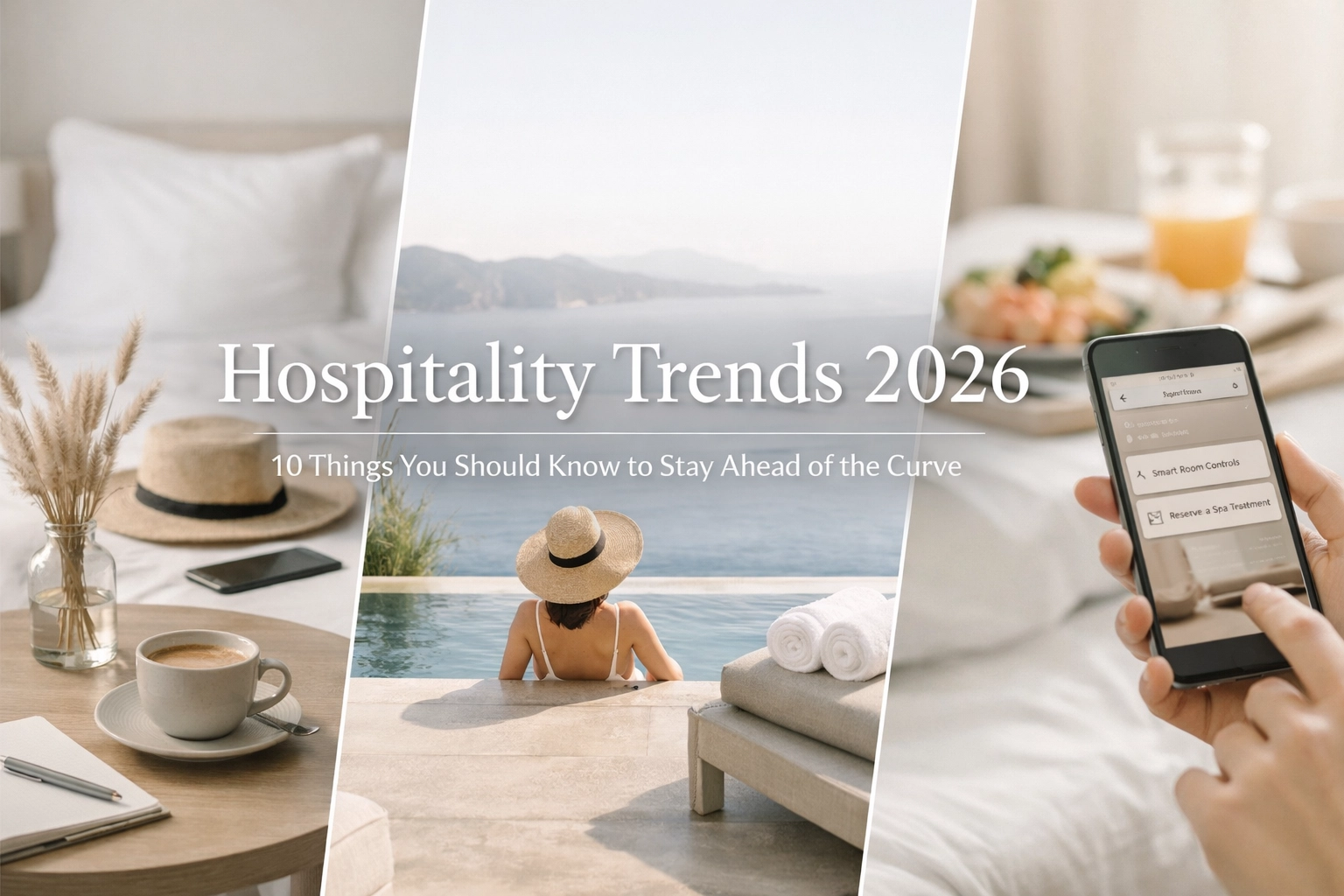
Adapt. Automate. Accelerate.
The hospitality landscape in 2026 isn't just evolving; it’s being rewritten by autonomous intelligence and a radical shift in how humans choose to spend their time. We’ve moved past the "digital transformation" buzzwords of the early 2020s and landed in an era of pure operational fluidity.
At Mews, we see this transformation daily across 12,500+ properties. Managing a hotel today means balancing high-tech autonomy with high-touch empathy, all from one innovative platform.
1. Agentic AI: The Invisible Operations Manager
We believe the era of the simple "chatbot" is officially over. 2026 is the year of Agentic AI: autonomous systems that don’t just answer questions but execute complex workflows without human intervention. These agents are the new backbone of revenue management and back-office efficiency.
- Autonomous dynamic pricing based on real-time weather, local events, and flight delays.
- Self-managing inventory systems that predict maintenance needs before a pipe even leaks.
- Housekeeping rosters that update instantly based on guest flight status and check-out patterns.
By delegating the "thinking" to AI agents, your staff can return to the "feeling": providing the genuine hospitality that machines can’t replicate.
2. Hyper-Personalization as the Minimum Standard
Data is no longer a luxury; it’s the guest's expectation. Guests aren't looking for a "standard king room" anymore. They are looking for their room. In 2026, attribute-based selling has moved from a niche concept to a revenue-driving powerhouse.
We think personalization should be effortless:
- Unbundle room features to let guests pay for specific views, high floors, or specialized coffee machines.
- Automated loyalty triggers that remember a guest’s preference for extra pillows or a specific room temperature.
- Marketing campaigns that reach guests with the right offer at the exact moment they’re planning their next trip.

3. The Rise of Agentic Commerce
Your next guest might not be a human. They might be an AI agent. Travelers are increasingly using LLMs (Large Language Models) like ChatGPT and Copilot to plan and book their entire itineraries. If your hotel isn't optimized for AI discovery, you’re essentially invisible.
- Optimize your digital footprint for AI crawlers, not just search engines.
- Ensure your availability and pricing are accessible to direct AI-to-hotel booking APIs.
- Focus on structured data that helps AI agents understand your unique value propositions.
"Since we integrated our inventory with AI-first booking channels, our direct bookings have increased by 15% without a single extra click from our marketing team," says one forward-thinking GM.
4. Human-Centric Leadership in a Tech-First World
Labor costs are rising, and the talent pool is picky. We believe the best way to keep your staff is to make their jobs easier. 2026 is about "people-first" leadership where technology is viewed as an employee benefit, not a replacement.
- Eliminate repetitive admin tasks to reduce employee burnout.
- Provide mobile-first tools that allow staff to manage the property from the floor, not the back office.
- Focus on fulfillment by letting teams spend more time in guest-facing roles.
A happy team leads to happy guests. It’s that simple.
5. The Death of Traditional Seasonality
Remote work has matured into a lifestyle, effectively killing the "traditional weekend." We’re seeing a massive rise in blended travel: the "workation" or "bleisure" trip where business and leisure are indistinguishable.
- Weekdays are the new weekends for many high-spending digital nomads.
- Shoulder months are seeing record occupancy as travelers avoid "over-tourism" peaks.
- Flexible pricing strategies are now a year-round requirement, not a seasonal adjustment.
Schedule a demo with Mews to see how we handle these shifting curves: https://referrals.mews.com/umqhyito
6. Combatting Labor Costs Through Extreme Efficiency
Operational excellence is no longer about cutting corners; it’s about maximizing every minute. With labor costs continuing to climb globally, hotels are turning to full-stack automation to protect their margins.
We believe in making the complex feel easy:
- One-click check-ins that take 30 seconds or less.
- Automated payment processing that eliminates manual reconciliation errors.
- Integrated smart-room tech that reduces energy waste in unoccupied rooms.
7. The Luxury Segment’s Focus on Privacy and "The Club"
The luxury market is bifurcating. While some travelers want the buzz of a lobby, the ultra-high-net-worth segment is moving toward "Hushpitality." This involves private access, exclusive club floors, and villa-style privacy within a hotel ecosystem.
- Growth in private residences and long-stay luxury suites.
- Emphasis on "embedded" local experiences that can't be found in a guidebook.
- High-touch concierge services that act as lifestyle managers.
8. Tech Assets Driving M&A Activity
In 2026, a hotel's value is determined as much by its tech stack and loyalty data as by its real estate. We’ve seen a 40% increase in deal activity focused on properties with "connected experiences."
- Loyalty programs are now core strategic assets in mergers and acquisitions.
- Unified data platforms allow groups to scale rapidly across different geographies.
- Modern PMS platforms like Mews make transitioning newly acquired properties effortless.
9. Beyond Sustainability: Regenerative Hospitality
"Eco-friendly" is so 2022. Today, guests want regenerative hospitality. They want to know that their stay actively improved the local community or restored the local environment.
- Food production is moving on-site with vertical gardens and hyper-local sourcing.
- Technology tracks carbon footprints in real-time, offering guests the chance to offset their stay.
- Hotels are becoming community hubs that support local artisans and social enterprises.
We think travel should leave the world better than we found it.
10. The Whycation and the Immersive Experience
Why are people traveling? In 2026, the "Why" is more important than the "Where." Whether it’s a restorative "Road Trip Revival" or a purpose-driven "Whycation," guests are seeking deep connection and control over their environment.
- Immersive room designs that adapt to the guest’s mood and purpose.
- Curated experiences that prioritize restoration and mental well-being.
- Road trip packages that leverage multi-property stays under a single booking.
Future-proof your property
The future of hospitality isn't a distant dream: it's happening right now in your lobby. To stay ahead of the curve, you need a platform that moves as fast as the market. Mews is designed to give you the freedom to innovate, the power to automate, and the data to personalize every single stay.
See what the world’s most innovative PMS can do for your RevPAR and guest satisfaction scores.
Ready to lead the pack in 2026?
Get started with Mews today: https://referrals.mews.com/umqhyito
Leave a Reply