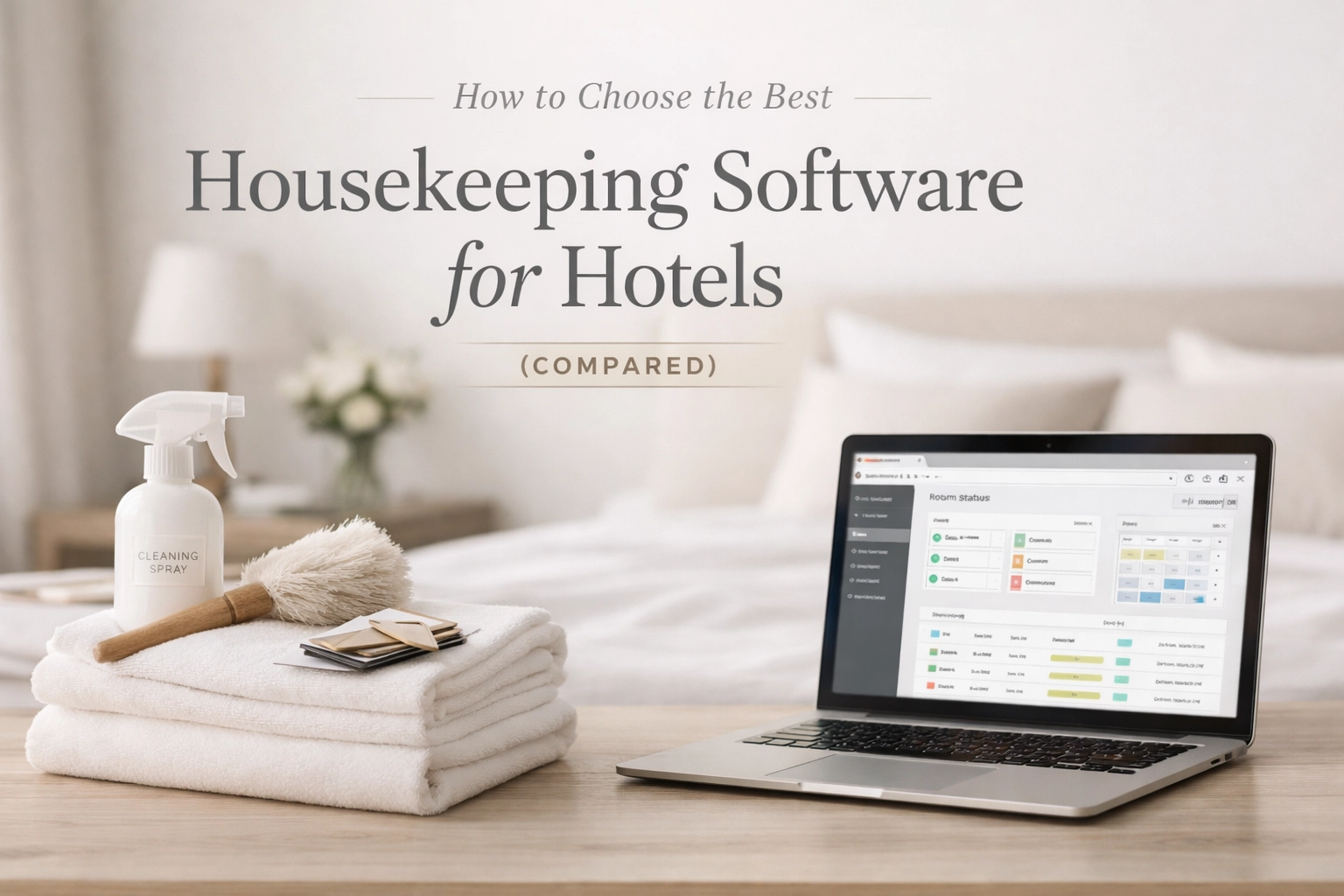
Clean rooms. Happy guests. Faster turnovers.
It’s the holy trinity of hotel operations. But if you’re still relying on walkie-talkies, printed clipboards, and neon highlighters to manage your housekeeping team, you’re essentially trying to run a Formula 1 race in a minivan. It’s slow, it’s noisy, and someone is definitely going to get lost.
In 2026, the gap between "fine" and "fantastic" is defined by your tech stack. Specifically, how your housekeeping software talks to your Property Management System (PMS). We believe that your cleaning crew shouldn't be the last to know when a guest checks out. They should be the first.
Modern housekeeping software isn't just a digital to-do list; it’s the heartbeat of your property. It’s about real-time visibility, reducing the physical toll on your staff, and ensuring that "Room Ready" isn't a guessing game.
Why Real-Time Sync is a Non-Negotiable
We’ve all seen the front desk "dance." A guest arrives early, the agent frantically calls the housekeeping supervisor, the supervisor radios the floor lead, and the floor lead wanders down the hall to see if Room 402 is actually scrubbed or just "in progress."
It’s a waste of time. It’s a waste of energy. It’s a waste of money.
When you use a platform like Mews, that data flow is instantaneous. The moment a guest taps "Check Out" on their phone, your housekeeping app pings the nearest team member. No phone calls. No radio static. Just pure, operational efficiency.
The benefits of instant synchronization:
- Reduced "Dead Time": Staff move directly from one dirty room to the next without returning to a central office.
- Faster Check-ins: Front desk agents see room status updates the second a housekeeper hits "Complete."
- Accurate Data: No more human error in transcribing room numbers or status codes.
Features That Actually Matter (And Those That Don't)
When you're shopping for software, it’s easy to get blinded by shiny dashboards and "AI-powered" buzzwords. But at 8:00 AM on a Tuesday, your team doesn't need a futuristic dashboard: they need a tool that works.
We think the best software stays out of the way. It should be an invisible hand that guides the day. Here are the three pillars of a functional housekeeping system.
1. Mobile-First Design
Housekeepers don't work at desks. If your software requires a laptop or a clunky terminal in the linen closet, it’s already failed. Your team needs a lightweight, native mobile app that works on the devices they already have in their pockets. It should be intuitive enough to learn in five minutes, regardless of the user's tech-savviness.
2. Visual Checklists and Photo Proof
Language barriers can be a real challenge in diverse teams. High-quality software uses icons and photos instead of dense blocks of text. Even better? Requiring a "photo of the finished room" before a task can be closed out. This ensures brand standards are met every single time, whether it's the placement of the hand towels or the way the duvet is tucked.
3. Automated Task Prioritization
Not all rooms are created equal. A "Stayover" cleaning is different from a "Deep Clean" or a "Departure." Your software should automatically prioritize VIP arrivals and early check-ins without a manager having to manually shuffle the deck every hour.
If you're ready to see how automated workflows can change your life, check out this setup.
How to Compare the Top Contenders
The market is crowded. To find the right fit, you have to look at your property type. A 500-room resort in Vegas has very different needs than a 20-room boutique hotel in the Cotswolds.
For the Large-Scale Powerhouse
If you’re managing hundreds of rooms across multiple wings, you need a heavy hitter like roommaster or Hotelogix. These systems excel at multi-property management and high-level reporting. They’re built for volume. The downside? They can sometimes feel a bit "corporate" and take longer to implement.
For the Agile Boutique
Boutique hotels live and die by the guest experience. You need something fast and flexible. RoomRaccoon or Xenia are great options here. They focus heavily on the user interface and getting tasks done quickly. They’re designed for teams that need to pivot on a dime when a guest makes a special request.
For the Innovation-Led Hotel
If you want a system that treats housekeeping as part of a holistic guest journey, you’re looking for a cloud-native solution like Mews. By integrating housekeeping directly into the PMS ecosystem, you eliminate the "middleman" software entirely. One login, one source of truth, zero headaches.
Putting Your Staff First
We talk a lot about "Guest Satisfaction," but what about "Staff Satisfaction"?
The hospitality industry is facing a massive labor shortage. Housekeeping is arguably the hardest job in the building. If you give your team tools that are frustrating, slow, or broken, they’re going to leave.
Good software reduces the mental load. It tells them exactly where to go, exactly what to do, and gives them a way to communicate issues (like a broken lightbulb) instantly without feeling like they’re shouting into the void.
"Since we switched to a mobile-synced system, our team saves about 90 minutes of walking time per shift. They aren't running back to the office for updates anymore: they’re just cleaning." : Regional Operations Manager
The "Total Guest Value" Connection
In the old days, we looked at ADR (Average Daily Rate). Today, we look at Total Guest Value.
If a guest can check into their room at 1:00 PM instead of 3:00 PM because your housekeeping was so efficient, they’re more likely to spend money at the bar, book a spa treatment, or return next year. Housekeeping software isn't a cost center; it’s a revenue generator.
By speeding up the "turn," you’re opening up more opportunities for early arrivals and late departures: both of which are high-margin upsell opportunities.
Making the Switch: A 3-Step Plan
Change is scary, but staying the same is scarier. If you're worried about the transition, follow this simple path:
- Audit Your Current Lag: For one week, track how long it takes from a guest checking out to a housekeeper entering the room. The "gap" is your lost revenue.
- Run a Pilot: Don't roll it out to the whole hotel on Day 1. Pick one floor and one team. Let them break the software and tell you what they hate about it.
- Integrate Everything: Don't let your housekeeping software live on an island. Connect it to your maintenance, your front desk, and your guest messaging app.
Final Thoughts
The "best" housekeeping software is the one your team actually uses. It’s the one that stops the frantic radio calls and replaces them with a quiet, efficient hum of productivity.
You deserve a property that runs itself. Your guests deserve a room that’s ready when they are. And your staff deserves a tool that makes their hard work a little bit easier.
Ready to see the future of hotel management? Explore the Mews platform and discover how a truly integrated system can transform your operations from the laundry room to the penthouse.
Let’s get those rooms ready. Faster. Better. Smarter.
<BLOG_POST:07e30aad-cfa9-4e8a-9244-722e02ada9dd>
Leave a Reply