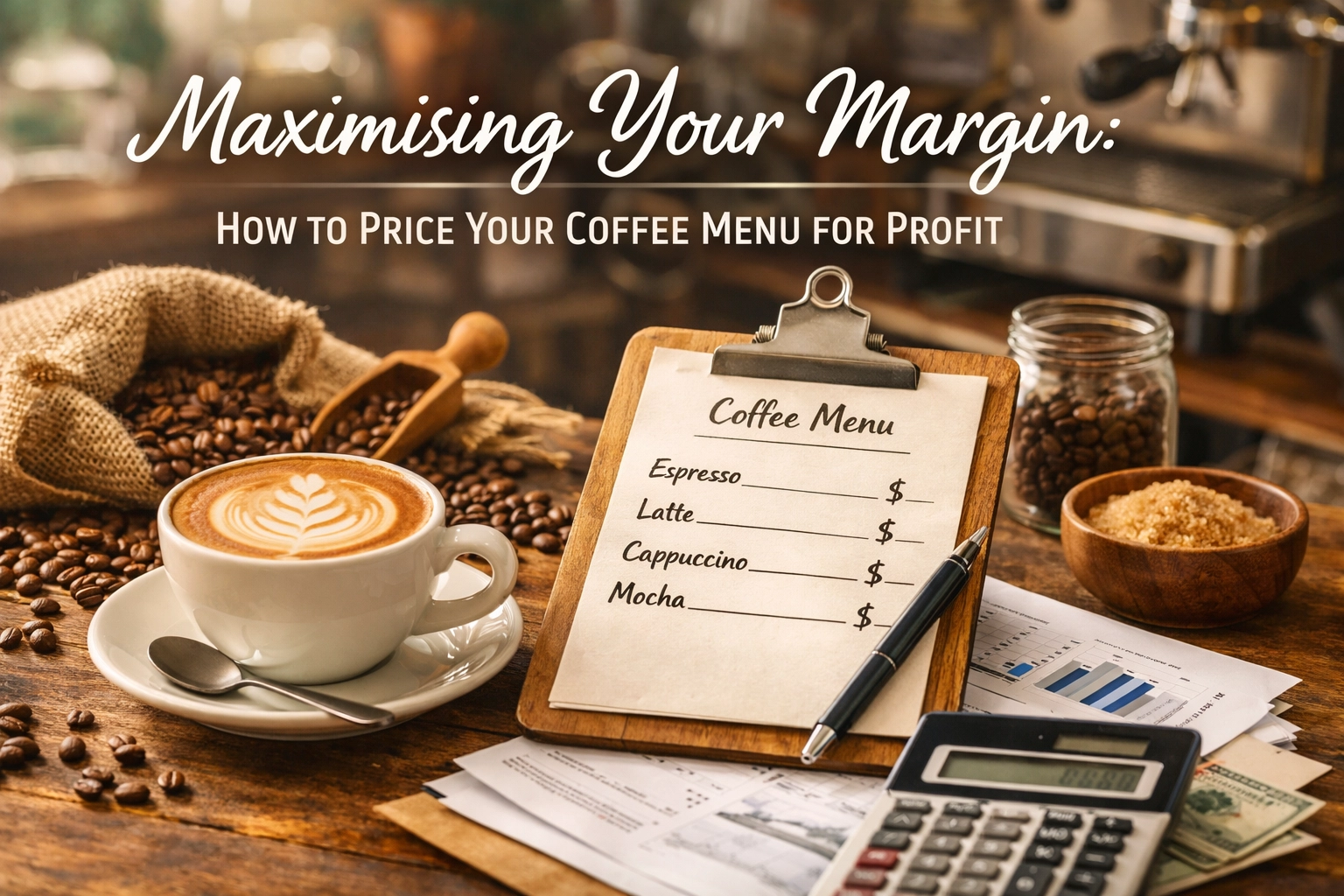
Let's talk about something every cafe owner thinks about but few get completely right: pricing your coffee menu for actual profit.
You've invested in a quality espresso machine, trained your baristas, and created the perfect atmosphere. But if your pricing strategy isn't dialled in, you're leaving money on the table, or worse, operating at margins that make long-term sustainability a struggle.
The good news? Pricing isn't some dark art. It's a strategic process you can master with the right approach and understanding of your costs. And yes, the quality of your beans plays a bigger role in your pricing power than you might think.
Understanding Your Baseline: Know Your Numbers
Before you can price effectively, you need to understand exactly what each drink costs you to produce. And we mean exactly.
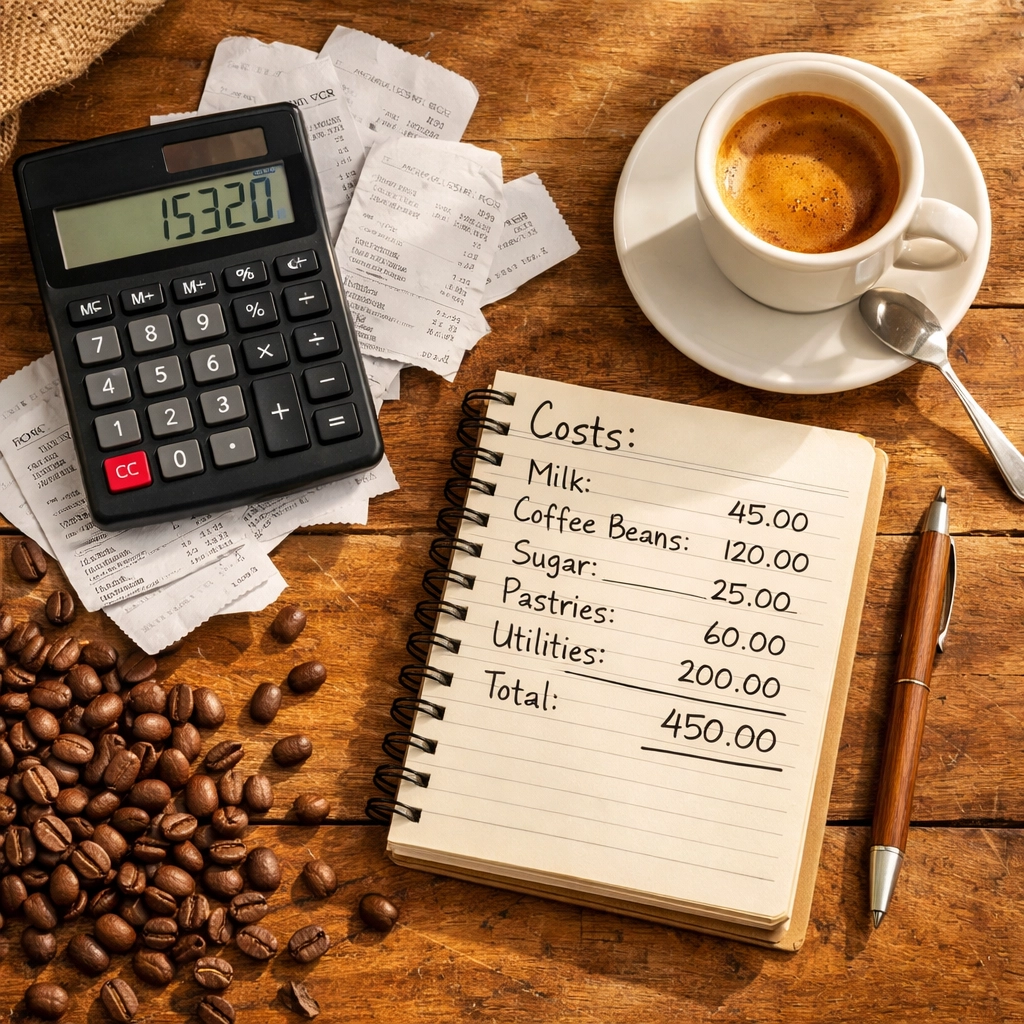
Your cost per drink includes:
- Coffee beans (the most variable and crucial element)
- Milk or alternative milks
- Syrups, flavourings, and extras
- Cups, lids, and packaging
- Labour time per drink
- A portion of your overhead (rent, utilities, equipment maintenance)
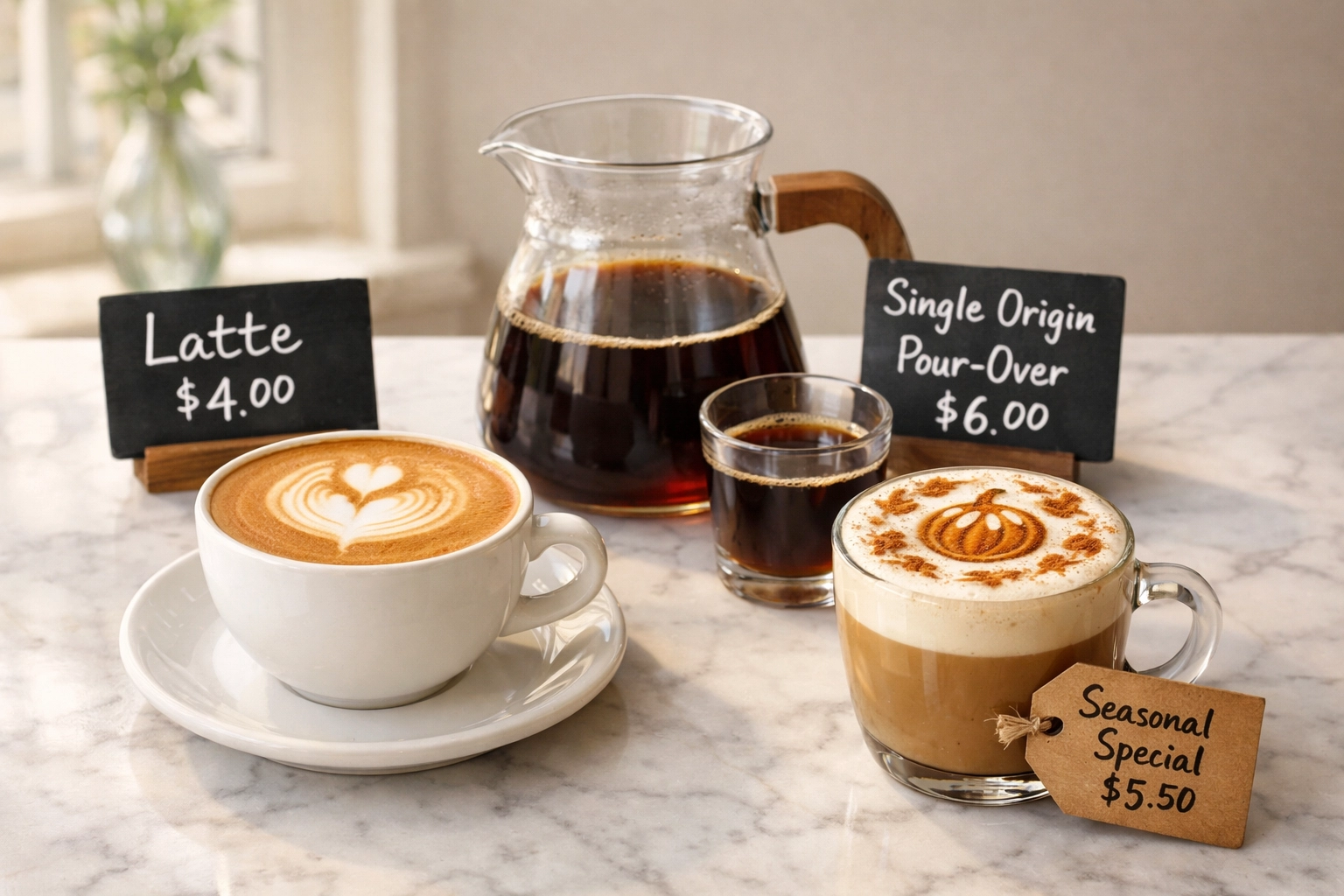
Most successful coffee shops target a 60-70% gross margin on standard drinks like lattes and cappuccinos. Premium specialty drinks: your seasonal specials, single-origin pour-overs, or signature creations: can justify margins of 70-80% because customers perceive higher value.
Let's say your flat white costs £2.40 to produce (including all factors above). With a 65% target margin, you'd price it at around £6.85. Round that to £6.90 for psychological pricing (more on that later), and you've got your baseline.
The critical insight here? Your ingredient quality directly impacts both your cost and your pricing power. Using cheap, commodity-grade coffee means you're competing purely on price. Using specialty-grade beans from a roaster like Limini means you can justify premium pricing based on genuine quality.
Three Core Pricing Strategies That Actually Work
Cost-Plus Pricing: The Foundation
This is your starting point. Calculate your production cost and add your target profit margin percentage. It's straightforward, reliable, and ensures you're covering costs.
The formula is simple: Cost ÷ (1 – Target Margin) = Price
So if your latte costs £2.80 to make and you want a 65% margin, that's £2.80 ÷ 0.35 = £8.00.
Cost-plus pricing keeps you profitable, but it doesn't account for what customers are willing to pay or what competitors are charging. That's where the next two strategies come in.
Competitor-Based Pricing: Know Your Market
You're not operating in a vacuum. Research what other cafes in your area charge for comparable drinks. This doesn't mean you should match their prices: it means you should understand where you sit in the market.
Are you positioning as the premium option with superior beans and expert baristas? Price above market rates. Are you the neighbourhood favourite competing on value and atmosphere? Price at or slightly below market rates. Just make sure your margins still work.
The key is differentiation. If you're charging £5.20 for a cappuccino when everywhere else charges £4.50, customers need to understand why. Which brings us to…
Value-Based Pricing: The Premium Play
This is where specialty coffee really shines. Value-based pricing means charging based on perceived quality and customer experience rather than pure cost calculation.
When you serve coffee from ethically sourced, specialty-grade beans, you're not just selling caffeine. You're selling traceability, flavour complexity, and the story behind the cup. Customers increasingly appreciate: and will pay for: this level of quality.
Your value proposition might include:
- Single-origin beans with traceable farms
- Expert roasting that highlights unique flavour profiles
- Skilled baristas who can discuss tasting notes
- Sustainable sourcing practices
- Consistency and quality standards
These elements justify higher prices because customers recognise tangible value. The cafe down the street might charge £3.80 for a cappuccino made with generic beans. You can charge £5.20 for one made with carefully sourced Ethiopian Yirgacheffe from a reputable specialty roaster: and customers will queue for it.
Why Your Bean Choice Matters More Than You Think
Here's something that doesn't get discussed enough: your coffee supplier is one of your most important pricing decisions.
Commodity coffee limits your pricing power. You're competing with every other cafe using similar beans, which means competing primarily on price or convenience. Your margins stay squeezed because customers don't perceive differentiation.
Specialty coffee from a quality roaster expands your pricing power. When you can tell customers their flat white is made with beans scored 85+ by Q Graders, roasted just days ago, and sourced directly from specific farms: that's a different conversation. That's a story worth paying for.
This is why partnering with a roaster like Limini makes strategic sense. Their range of specialty coffees gives you the quality and traceability that justifies premium pricing. More importantly, their consistency means your customers get the same exceptional cup every time, which builds loyalty and allows you to maintain those prices.
Practical Tactics to Maximise Revenue
Once your baseline pricing is solid, these tactics can increase average transaction values without alienating customers:
Bundling: Offer a pastry and coffee combo for £7.50 when they'd cost £8.50 separately. Customers feel they're getting value, and you're increasing basket size while maintaining healthy margins on both items.
Tiered Pricing: Create natural upsell opportunities. Your standard latte is £4.20, but an extra shot is £0.50, oat milk is £0.40, and a large size is £0.60 more. These small additions have minimal cost but significant margin impact.
Seasonal Specials: Add £0.80-£1.20 to your base drink price for seasonal offerings. The additional ingredients (pumpkin spice, peppermint, etc.) might only cost you £0.40, but customers expect and accept premium pricing for limited-time drinks.
Size Strategy: Many cafes make their biggest margins on large sizes. If a regular latte uses 30ml of espresso and 180ml of milk, a large might use 30ml of espresso and 240ml of milk. Your cost increases by perhaps £0.25, but you charge £0.80 more.
The Psychology of Pricing
How you present prices matters as much as the prices themselves.
Use £4.90 instead of £5.00. That lower leftmost digit genuinely feels more approachable to customers, even though the difference is minimal. This works for mid-range items where customers are price-conscious.
Use round numbers for premium items. A £10.00 single-origin pour-over feels more premium and intentional than £9.90. It signals quality and confidence in your offering.
Anchor with your premium items. When your menu shows a £12.00 specialty coffee flight, your £5.20 flat white suddenly feels quite reasonable. This isn't manipulation: it's helping customers understand your range and positioning.
Remove currency symbols from your menu board. Studies show that seeing "5.20" rather than "£5.20" reduces price sensitivity slightly. Every little bit helps.
Implementation: Making Changes Without Losing Customers
Here's what not to do: suddenly increase all your prices by 15% overnight. Here's what works:
Make gradual adjustments. Increase prices by £0.20-£0.30 annually rather than £0.80 every few years. Customers barely notice small, regular adjustments but definitely notice big jumps.
Communicate your value. When you do increase prices, explain why. "We've switched to specialty-grade single-origin beans to give you the best possible coffee" is a message customers respect. Quality-focused customers actually appreciate this transparency.
Start with new items. Launch new seasonal drinks or specialty options at your target margins. This establishes price expectations without changing existing favourites.
Monitor and adjust. Track your sales data religiously. If a price increase on flat whites drops volume by 20%, your margin improvement might not offset the lost sales. If volume only drops 5%, you've successfully optimised.
The Quality-Price Connection
Let's bring this full circle. Your pricing strategy is intimately connected to your product quality, and your product quality starts with your beans.
When you source from a specialty roaster with a proven track record, you're not just buying coffee: you're buying the credibility and quality that justifies your pricing. Your customers taste the difference between a carefully sourced Ethiopian natural process coffee and generic "house blend." They notice the complexity, the sweetness, the clean finish.
That quality difference is your pricing power. It's what separates a £3.80 commodity cappuccino from a £5.20 specialty cappuccino that customers rave about.
Ongoing Optimisation: This Isn't Set-and-Forget
Your pricing strategy should evolve continuously:
- Review your costs quarterly. Coffee prices fluctuate. Milk prices change. Don't wait until your margins are underwater to adjust.
- Analyse your menu performance monthly. Which drinks sell best? Which have the highest margins? Promote your profitable items and reconsider underperformers.
- Test and learn. Try a new specialty drink at a premium price point. If it sells well, you've found a new high-margin offering. If it doesn't, you've learned something about your market.
- Stay connected to your supplier. A good wholesale partner will alert you to price changes, help you understand market dynamics, and work with you to maintain your margins while delivering quality.
The Bottom Line
Pricing your coffee menu for profit isn't about charging the maximum possible price. It's about understanding your costs, positioning your quality appropriately, and creating a pricing structure that keeps your business sustainable while delivering genuine value to customers.
The cafes that thrive aren't necessarily the cheapest or the most expensive: they're the ones that align their quality with their pricing and communicate that value effectively.
Your beans matter. Your pricing strategy matters. And the connection between the two matters most of all. When you're ready to refine your pricing strategy with beans that justify premium positioning, explore what specialty-grade coffee can do for your margins.
Because at the end of the day, sustainable profitability and exceptional quality aren't mutually exclusive; they're two sides of the same perfectly pulled espresso shot.
Leave a Reply