Blog

  • Why Everyone Is Talking About AI Business Automation (And Why Your Competitors are Winning)

    Why Everyone Is Talking About AI Business Automation (And Why Your Competitors are Winning)

    Workflow Automation for Small Business: Stop Doing the Busy Work

    ☕ 7:00 AM. Your eyes aren't even fully open, but your thumb is already scrolling.

    You’re looking at a mountain of unread emails, half-finished invoices, and a LinkedIn notification from a lead you forgot to reply to three days ago. Your coffee is getting cold, and you haven’t even started "real" work yet.

    You’re stuck in the "busy work" trap.

    It’s that soul-crushing cycle of copy-pasting data from one spreadsheet to another, chasing down clients for payments, and manually scheduling social media posts. It feels like you’re running a marathon in a swimming pool. You’re working hard… but you’re not getting anywhere.

    This is where workflow automation for small business steps in to save your sanity.

    THE HIDDEN COST OF "DOING IT MANUALLY"

    Most small business owners think they’re saving money by doing everything themselves. "I’ll just handle the billing manually this weekend," you tell yourself.

    But you’re wrong.

    When you spend four hours a week on manual data entry, you aren't saving money. You’re losing four hours of high-level strategy. You’re losing four hours of sales calls. You’re losing four hours of sleep.

    Research shows that mid-sized companies can reduce operational costs by 20% to 30% just by automating these repetitive tasks. For a small business, that’s the difference between "just getting by" and actually scaling.

    And the best part? It doesn’t have to be complicated.
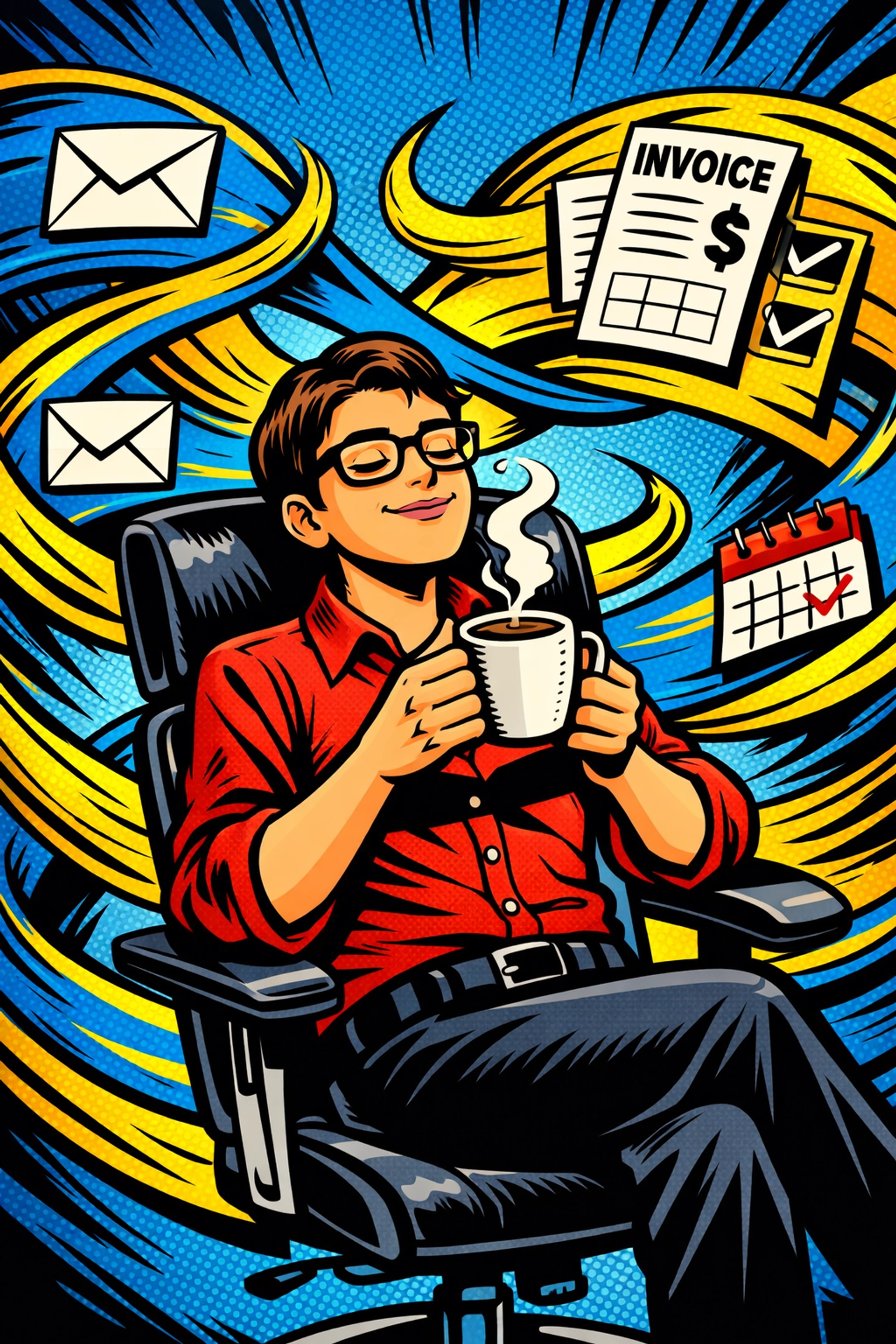
    Entrepreneur relaxing with coffee as workflow automation for small business manages digital tasks and emails.

    STOP JUGGLING. START FLOWING.

    Imagine a different morning.

    ☕ 7:15 AM. You take your first sip of coffee.

    Instead of an inbox explosion, your phone shows a single summary. Your automated system already captured three new leads from your website, sent them a personalized "Welcome" email, and booked a discovery call on your calendar for Thursday.

    Your invoices? Sent.
    Your social media? Posted.
    Your data? Synced across every platform you use.

    You didn’t lift a finger. You just watched it happen.

    This isn't a futuristic dream, it’s what happens when you implement workflow automation for small business. It’s about creating a "synchronized intelligence" across your company where data moves itself, so you don't have to move it.

    THREE TASKS YOU NEED TO AUTOMATE YESTERDAY

    1. Lead Management: Stop letting leads die in your inbox. Automation can instantly tag, sort, and follow up with potential customers the second they show interest.
    2. Invoicing & Collections: Don't be a debt collector. Set up systems that automatically send reminders and process payments while you sleep.
    3. Customer Support: Use automated workflows to answer common questions. If a customer asks "Where is my order?", they shouldn't have to wait 24 hours for you to find a tracking number.

    Scaling shouldn't be this hard. And honestly, it isn't, if you have the right tools in place. If you're ready to stop the grind and start the growth, you need to see what's possible at https://marblism.link/scott-bowen.


    Why Your Business Needs an AI Virtual Assistant (Before Your Competitors Get One)

    🔍 Let’s be honest: your competitors are already looking for ways to replace you.

    Okay, maybe not replace you personally, but they are definitely looking for ways to outpace you. While you’re still manually sorting through customer feedback or trying to figure out which marketing campaign actually worked, they’ve already moved on to the next big thing.

    The secret weapon they’re using? An ai virtual assistant for business.

    If you think an AI assistant is just a fancy chatbot that says "Hello, how can I help you?", you’re missing the point. We're talking about a digital team member that thinks, learns, and acts, without ever needing a lunch break.

    THE UNFAIR ADVANTAGE

    Why is everyone talking about AI automation? Because it creates a widening gap between the leaders and the laggards.

    Early adopters are building "self-improving enterprise models." Their systems learn from every interaction. If a customer asks a question, the AI learns the best answer. If a sale is made, the AI analyzes why it happened and optimizes the next pitch.

    📱 Real-Time Decision-Making.
    Traditional businesses rely on historical reports. They look at what happened last month. AI-enabled businesses look at what is happening right now. They use predictive analytics to adjust prices, move inventory, and pivot strategies in real-time.

    While you’re still reading the map, your competitor is using GPS with live traffic updates.

    Business owner standing with an AI virtual assistant for business managing digital tasks and data streams.

    EMPLOYEE OF THE MONTH. EVERY MONTH.

    Think about the cost of a human hire. Salary, benefits, office space, coffee, and the occasional "bad day."

    Now, consider this: an AI virtual assistant can operate at a fraction of that cost. We’re talking about scaling your output without scaling your headcount. It’s about revenue acceleration.

    An ai virtual assistant for business can:

    • Identify high-probability sales opportunities before you even see them.
    • Improve customer response times by 40%.
    • Handle data-heavy tasks with zero marginal cost.

    It’s not about replacing humans; it’s about freeing humans to do the things only humans can do, like building relationships and being creative. Let the AI handle the spreadsheets.

    THE CLOCK IS TICKING

    The gap isn't just growing; it's compounding.

    Every day you wait to integrate AI into your business, your competitors' systems are getting smarter. They are gathering more data, refining their processes, and lowering their costs.

    Wait too long, and you won’t just be behind, you’ll be obsolete.

    But it’s not too late. You can start building your AI-driven future today. Whether it’s streamlining your workflows or deploying a sophisticated virtual assistant, the tools are ready for you.

    Stop being the bottleneck in your own company.

    Check out how we're changing the game at https://marblism.link/scott-bowen.

    🤝 Your competitors are already there. Are you?

    FAQ: THE "NO-BS" ANSWERS

    Is this going to be hard to set up?
    No. Most modern automation tools are designed to be "plug and play." You don't need a PhD in computer science.

    Will I lose the "human touch" in my business?
    Actually, the opposite. By automating the boring stuff, you have more time to actually talk to your customers and solve their real problems.

    Is it expensive?
    What's more expensive? A software subscription or losing 30% of your operational efficiency every single day? You do the math.

    Where do I start?
    Start small. Pick one repetitive task that you hate doing and automate it. Then move to the next. Or better yet, talk to Scott and let him show you the shortcut.

    The chaos is gone before you even take your first sip of coffee.
    You just send a thumbs-up.
    The day belongs to you.

    Scaling shouldn't be this easy. But here we are.

    See what's next: https://marblism.link/scott-bowen
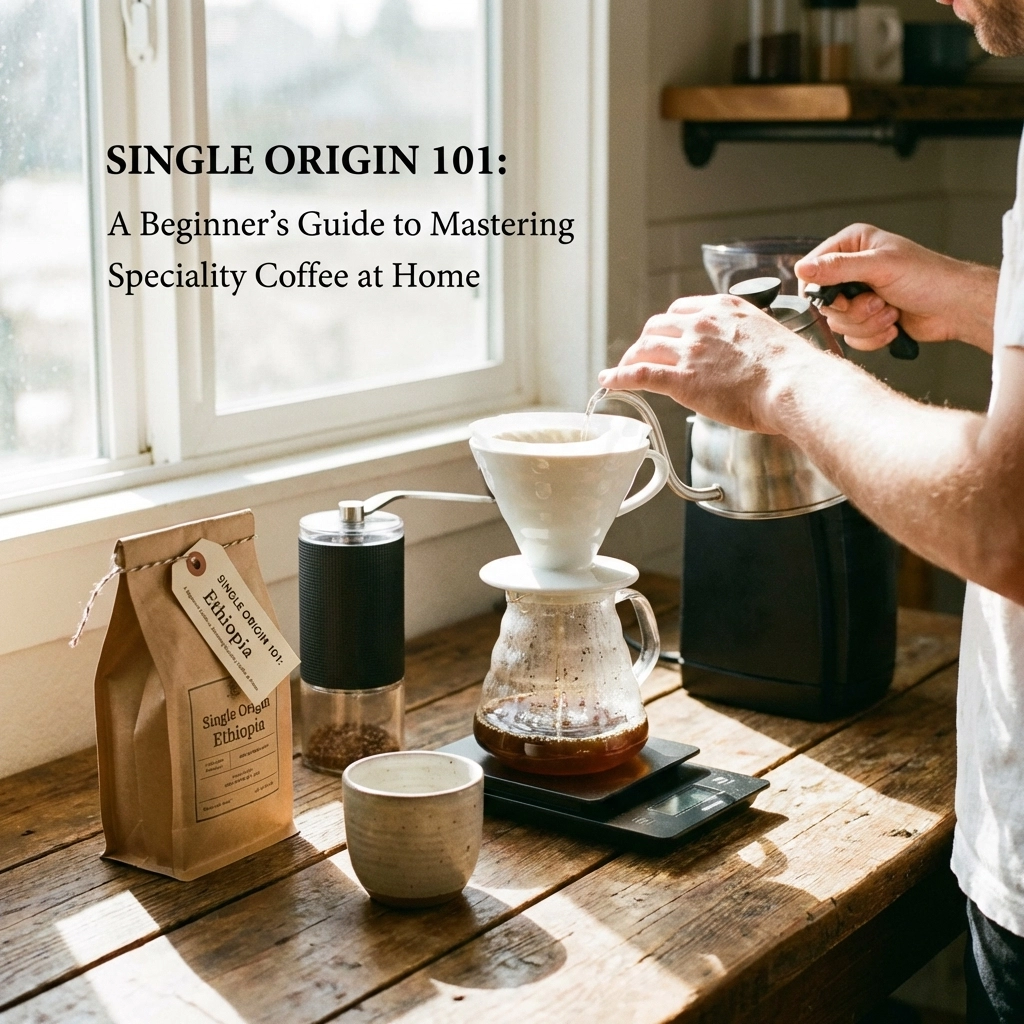
  • Single Origin 101: A Beginner’s Guide to Mastering Speciality Coffee at Home

    Single Origin 101: A Beginner’s Guide to Mastering Speciality Coffee at Home

    So, you’ve decided to step away from the supermarket shelves and dive headfirst into the world of speciality coffee. We think that’s a brilliant decision. There is something truly magical about the moment you open a bag of fresh roasted coffee beans and that first aroma hits you. It’s not just "coffee smell": it’s blueberries, or toasted hazelnuts, or maybe even a hint of jasmine.

    But then you see the label: "Single Origin." It sounds fancy, right? Maybe a bit intimidating? Don't worry, we are here to break it all down for you. Understanding single origin coffee is basically like moving from drinking "red wine" to appreciating a specific Malbec from a high-altitude vineyard in Mendoza. It’s about the story, the place, and, most importantly, the incredible flavour.

    If you’re ready to start your journey, you can find our latest seasonal picks at Limini Coffee, where we obsess over these details so you don’t have to.


    What exactly is Single Origin?

    In the simplest terms, single origin means your coffee beans come from one specific place. But "place" can be a bit of a sliding scale.

    Sometimes it means a whole country, like "100% Colombian." Other times, it’s a specific region, like the famous Yirgacheffe in Ethiopia. However, in the world of true speciality coffee, we usually like to get even more specific. We’re talking about a single farm (often called an "estate") or even a "micro-lot": which is coffee from one particular hillside on a farm, harvested on a specific day.

    Why does this matter? Because coffee is a fruit. And like any fruit, its flavour is dictated by the environment it grows in. When you buy a blend, the roaster is mixing beans from different places to create a consistent, reliable taste. But when you buy single origin, you are tasting the "terroir": the unique combination of soil, climate, and altitude.

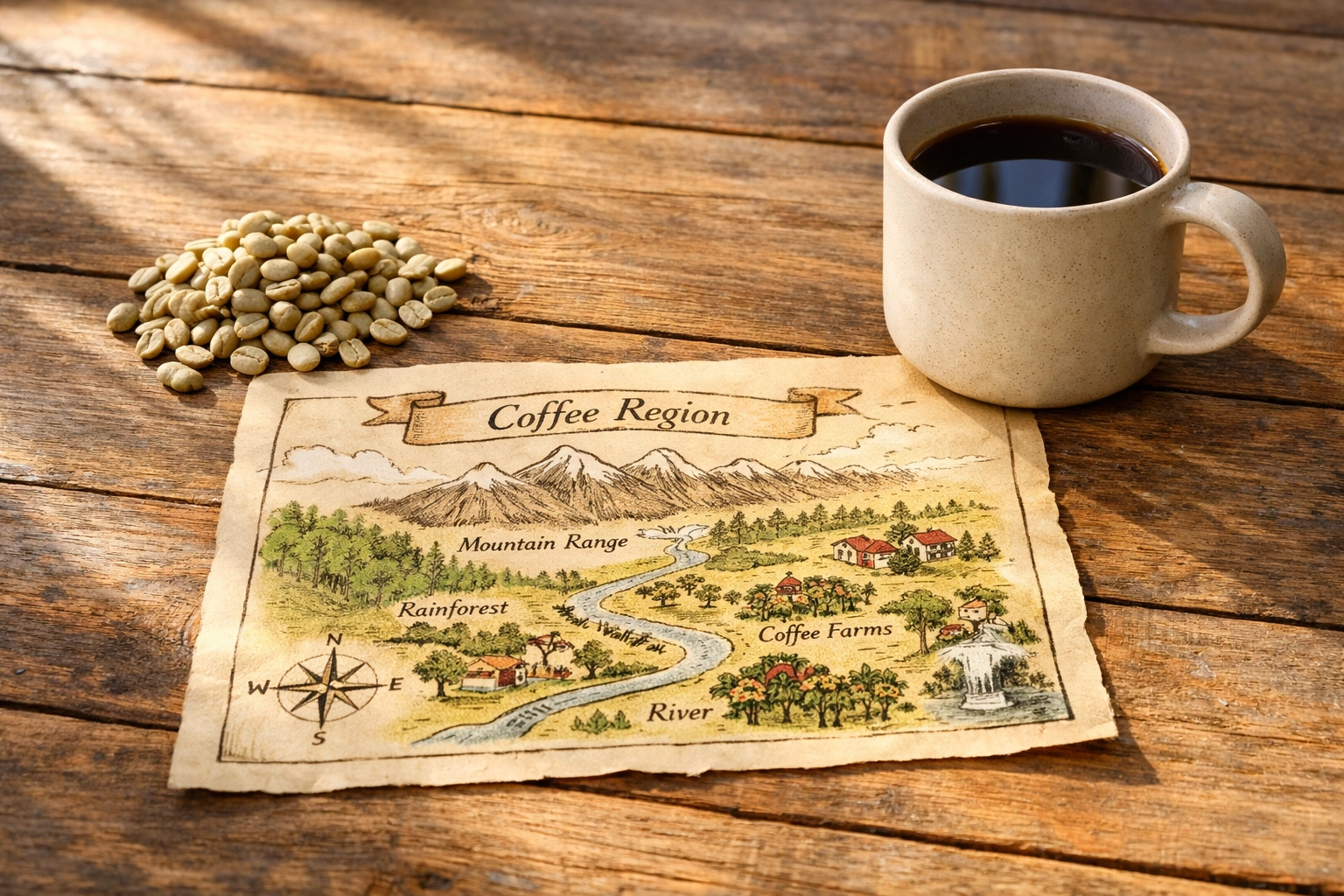
    Single origin coffee beans and a black coffee mug on a rustic table with a regional coffee map.


    Single Origin vs. Blends: Which should you choose?

    This is a question we get asked a lot. Neither is "better," but they serve different purposes.

    We believe blends are fantastic for your morning latte or if you use a lever automatic espresso machine. They are designed to be balanced, punchy, and cut through milk perfectly. Blends are the reliable friends of the coffee world.

    Single origins, on the other hand, are the adventurous explorers. They are often more delicate, more acidic (the good kind!), and have much more distinct flavour profiles. If you want to taste the difference between a coffee that tastes like milk chocolate and one that tastes like Earl Grey tea, single origin is the way to go.

    Feature Single Origin Coffee Blend
    Flavour Profile Distinct, unique, often fruity or floral Balanced, consistent, chocolatey
    Traceability High (often down to the specific farm) Moderate (mixed origins)
    Best Brew Method Pour-over, Aeropress, Black Espresso Espresso, Latte, Cappuccino
    Consistency Varies by season and harvest Highly consistent year-round
    Complexity High acidity and nuanced notes Smooth mouthfeel and reliable sweetness

    If you are just starting out, we recommend trying a few different single origins from Limini Coffee to see which regions sit best with your palate.


    Reading the Label like a Pro

    When you look at a bag of speciality coffee, it can sometimes feel like you’re reading a science report. Let’s decode the jargon so you know exactly what you’re getting into.

    1. The Process (Washed vs. Natural)

    This is extremely important. The "process" is how the coffee cherry is removed from the bean.

    • Washed: The fruit is stripped off before the beans are dried. This usually results in a very "clean" cup with bright acidity and floral notes.
    • Natural: The beans are dried inside the fruit. This leads to heavy bodies and intense, funky, fruit-forward flavours (think strawberry or tropical fruit).
    • Honey Process: A middle ground where some of the sticky fruit (mucilage) is left on during drying. It’s sweet, creamy, and delicious.

    2. Altitude

    You’ll see numbers like "1,800 masl" (metres above sea level). Higher altitude usually means slower growth for the coffee cherry, which leads to more density and more complex sugars. Basically, higher usually equals "fancier" flavours.

    3. Varietal

    This is the "breed" of the coffee plant. Bourbon, Typica, Caturra, Geisha… there are hundreds. Each has its own personality. For example, Bourbon is known for its sweetness, while Geisha is the "superstar" varietal known for intense floral aromatics.

    Ripe red coffee cherries and dried speciality beans showing the journey from farm to home brew.


    Mastering the Brew at Home

    Now, let's talk about getting that incredible flavour out of the bean and into your mug. If you’ve spent money on high-quality single origin beans, you don't want to ruin them with bad technique.

    Gear Matters (But not as much as you think)

    You don't need a £5,000 setup to enjoy speciality coffee. However, we do think a decent burr grinder is the single best investment you can make. Freshness is everything. Grinding your beans seconds before brewing preserves those delicate aromatics that make single origin so special.

    If you're looking for advice on a more serious setup, check out our guide on choosing espresso equipment.

    The Golden Rules of Brewing

    • Water Temperature: Don't use boiling water! It can scorch the delicate oils. We prefer a range between 88 C to 95 C (190 °F / 203 °F). If you don't have a temperature-controlled kettle, just let the boil settle for about two minutes.
    • The Ratio: This is the secret to consistency. Use a scale! We usually recommend a ratio of 60g of coffee per 1 litre of water. You can use our coffee brewing calculator to get the math perfect.
    • The Bloom: When you first pour water over the grounds, you’ll see them bubble and expand. This is the coffee releasing CO2 (degassing). Give it 30 seconds to "bloom" before adding the rest of your water. It makes a huge difference to the final taste.

    Why Single Origin is Better for Black Coffee

    To be honest, if you are planning on adding three sugars and a huge splash of milk to your coffee, a single origin might be a bit of a waste. The subtle notes of jasmine or lime are going to get lost in the dairy.

    Single origins truly shine when drunk black, particularly through filter methods like a V60 or Chemex. These methods allow the nuanced acidity and clarity of the bean to take centre stage. If you’re an espresso lover, drinking a single origin shot can be an intense, eye-opening experience: just be prepared for a bit more "zing" than you might find in a traditional Italian roast.

    If you are interested in how milk interacts with coffee though, we’ve got a whole article on understanding milk that might change how you view your flat white.

    Water pouring into a pour-over dripper to bloom fresh roasted speciality coffee beans at home.


    Sourcing and Ethics: The "Why" Behind the Price

    You might notice that single origin beans from a roaster like Limini Coffee cost a bit more than the stuff in the supermarket. Why is this?

    It comes down to sourcing our coffee. When you buy single origin, the supply chain is much shorter. Instead of a massive corporation buying "commodity grade" coffee at the lowest possible price, speciality roasters pay a premium for quality. This premium often goes directly back to the farmers, allowing them to invest in better equipment, sustainable farming practices, and better wages for their workers.

    It’s a win-win. You get a much better cup of coffee, and the farmer gets a fair price for their hard work. It's about respect for the craft.


    How to Start Your Journey

    If you’re feeling overwhelmed, don’t be! The best way to learn is to taste.

    We recommend starting with two very different origins. Maybe grab a bag of something from Ethiopia (expect tea-like, floral, and citrus notes) and compare it to something from Brazil (expect chocolate, nuts, and a creamy mouthfeel). Tasting them side-by-side is the quickest way to train your palate.

    And remember, coffee is subjective. There is no "right" way to enjoy it. Some people love the bright, acidic punch of a Kenyan coffee; others find it too sour and prefer the earthy, spicy notes of a Sumatran. That is the beauty of coffee 🙂

    If you want to dive even deeper, we offer coffee barista training where we go into the nitty-gritty of extraction and flavour profiles. It’s a great way to skip the trial-and-error phase and start brewing like a pro.


    Final Thoughts

    Mastering speciality coffee at home is a journey, not a destination. You’ll have days where you brew the perfect cup and days where it’s… well, a bit of a disaster. But that’s all part of the fun.

    By choosing single origin beans, you are opening yourself up to a world of flavour that most people never get to experience. You’re supporting small farmers, and you’re treating yourself to something truly special every morning.

    So, go ahead. Grab some fresh roasted beans from Limini Coffee, dust off that pour-over kit, and start exploring. We think you’re going to love what you find.

    Happy brewing!

  • Stop Wasting Time on Mind-Numbing Admin: Try These 7 Quick AI Business Automation Hacks

    ☕ 7:00 AM.

    The sun isn’t even fully up, but your phone is already screaming at you. Notifications from Slack. Three missed calls from a "Potential Lead" who definitely didn't leave a voicemail. And an inbox that looks like a digital landfill.

    You haven't even had a sip of coffee yet, and you’re already behind.

    You didn’t start your business to spend four hours a day copy-pasting data from a spreadsheet into an email. You didn't sign up for "Data Entry Specialist" or "Professional Meeting Scheduler." You’re the visionary. The founder. The one who actually makes the thing that people want to buy.

    But right now? You’re just a glorified admin assistant for your own company… and you’re doing a terrible job at it because you’re exhausted.

    There has to be a better way. And there is.

    It’s called AI business automation, and no, you don't need a computer science degree to make it work. You just need about 60 minutes and a little bit of curiosity.

    Let’s fix your life.

    1. TALK YOUR WAY OUT OF WORK

    Build automations with natural language prompts

    Remember when "automating" meant writing lines of code that looked like an alien language? Or staring at a logic tree for three hours trying to figure out if "If This Then That" applied to your specific brand of chaos?

    Those days are dead.

    Now, you can literally just talk to your software. Tools like Zapier’s Copilot allow you to describe your problem in plain English.

    Imagine typing: "Hey, every time a new lead fills out my website form, summarize their info and post it in the #new-leads Slack channel, then send them a 'Thanks' email."

    The AI builds the workflow. It connects the accounts. It maps the data. It tests the steps. You just sit there, nodding along like a boss while the machine does the heavy lifting.

    A business owner relaxes as an AI virtual assistant for business handles administrative tasks and workflows.

    2. THE 60-MINUTE FREEDOM SPRINT

    Launch within an hour using no-code platforms

    You think you don't have time to automate because you're too busy doing the work. It's a classic trap. It’s like saying you’re too busy pushing your car to stop and put gas in it.

    Stop pushing the car.

    Platforms like Lindy or the tools we recommend at Marblism allow you to deploy your first AI virtual assistant for business in under an hour. These aren't complex puzzles; they’re drag-and-drop interfaces with prebuilt templates.

    If you can use a Facebook account, you can automate your customer support.

    Imagine 400 tasks a month, scheduling, emailing, data sorting, done for you while you're at lunch. That’s not a dream. That’s just Tuesday.

    3. HIRE A BOT FOR THE "WHERE IS…?" QUESTIONS

    Automate HR and employee requests 24/7

    🤝 10:30 AM.

    Your newest hire, let’s call him Stan, just messaged you for the fourth time today.

    "Hey, where do I find the PTO form?"
    "What's the Wi-Fi password for the guest network again?"
    "Who do I talk to about the broken coffee machine?"

    You love Stan. But Stan is eating your brain.

    Enter the internal AI bot. By using tools like Agentforce or custom Slackbots, you can feed all your company docs into one searchable brain. Now, when Stan has a question, he asks the bot. The bot searches your actual company handbook and gives him the answer in seconds.

    The result? Stan gets his answer. You get your sanity back. The coffee machine stays broken (okay, AI can’t fix everything yet), but at least you aren't the one talking about it.

    4. THE MASTER ORCHESTRATOR

    Connect 2,500+ apps to run your life

    Your business isn't just one app. It’s a messy web of Gmail, Slack, Shopify, Trello, and that one weird app you downloaded three years ago and forgot to cancel.

    The magic happens when these apps talk to each other without you being the middleman.

    Think about your last marketing event.

    1. You collect survey feedback.
    2. You manually read 50 responses.
    3. You summarize the common complaints.
    4. You email the team.

    That’s old school.

    The new school way? The survey hits your inbox. AI automatically reads every response, identifies the top three themes, summarizes them into a bulleted list, and posts it in your "Team Strategy" channel.

    It takes zero seconds of your time.

    A conductor managing a vortex of digital icons, illustrating how to automate business processes and apps.

    5. STOP THE "FILE SCAVENGER HUNT"

    Automate your knowledge management

    🔍 1:00 PM.

    You know that PDF. You remember writing it. It had the exact pricing strategy you need for this afternoon's pitch. But where is it? Is it in Google Drive? Dropbox? An old email thread from 2022?

    You spend 20 minutes digging. You find three versions. None of them are the right one.

    Stop doing this.

    Using ClickUp Brain or integrated search tools allows you to surface information hidden in scattered documents instantly. Pair this with a tool like Perplexity, and you can even have the AI research industry news and generate an executive summary while you’re busy actually winning the client.

    To see how this kind of efficiency can transform your workflow, check out the options at https://marblism.link/scott-bowen.

    6. BROWSER BOTS ARE THE NEW INTERNS

    Deploy browser-based automation for data tasks

    Some work happens inside a specific app. But some work is just… "The Internet."

    Scraping LinkedIn for leads. Checking competitor prices. Updating a database from a website. This is the stuff that makes your eyes bleed.

    Tools like Bardeen are Chrome-native AI playbooks. They live in your browser and watch what you do. Once they see a pattern, like "I take this name and put it in this CRM", they offer to do it for you.

    It’s like having a tiny, very fast intern living inside your Chrome tabs. They don't take lunch breaks. They don't complain. They just move data.

    AI automation bots on a monitor moving data, showing how to automate customer support and admin tasks.

    7. DON'T REINVENT THE WHEEL

    Use templates for common business flows

    The biggest mistake small business owners make? Thinking their problems are unique.

    They aren't.

    Every business needs to automate customer support with AI. Every business needs to follow up with leads. Every business has a messy inbox.

    Instead of building a system from scratch, use prebuilt templates. Whether it’s for marketing, sales, or HR, there is already a "recipe" for your success.

    Grab a template. Tweak three settings. Hit "Go."

    Congratulations. You just saved five hours a week.


    WHAT DOES "AFTER" LOOK LIKE?

    📱 5:00 PM.

    The lights in the office are dimming. Usually, this is when you start your "second shift", the mountain of admin you ignored all day while fighting fires.

    But it’s quiet.

    Your inbox is organized. The leads from this morning have already received personalized follow-ups. Your new hires found their forms without calling you. The data from your browser is already sitting in your CRM, neat and tidy.

    You pick up your keys. You aren't "finishing up." You’re just leaving.

    You smile. You step back into your real life.

    Scaling shouldn’t be this hard. And with the right AI virtual assistant for business, it isn't.

    FAQ: THE STUFF YOU'RE WORRIED ABOUT

    Is it expensive?
    No. Most of these tools have free tiers that cover hundreds of tasks. It’s cheaper than your daily coffee habit.

    Do I need to be a "tech person"?
    Can you send a text message? If yes, you can use natural language AI.

    Will it replace my staff?
    No. It will replace the parts of their job they hate. It lets them do the "human" work they were actually hired for.

    How do I start?
    Start small. Pick ONE task: like "sorting emails" or "scheduling meetings": and automate it today.

    Ready to stop the grind? See how simple it can be at Marblism.

    The chaos is gone before you even take your first sip.

    Scaling Shouldn't Be This Easy. But Here We Are.

    🌙 The lights are off. The work is done. You're finally home.

  • Stop Wasting Time on Admin: 5 Business Automation Tools You Actually Need

    Stop Wasting Time on Admin: 5 Business Automation Tools You Actually Need

    7:00 AM.

    The sun isn’t even fully up, but your brain is already redlining. You open your laptop, and the blue light hits you like a physical weight. 47 unread emails. Three "gentle reminders" about invoices you forgot to send. A spreadsheet that needs manual updating because "System A" doesn't talk to "System B."

    You didn't start this business to spend four hours a day acting like a highly-stressed human bridge between different software apps. You started it to build something. To sell. To create.

    But here you are… copying and pasting data. Again.

    The truth? You’re not a business owner right now. You’re an unpaid admin clerk for your own company. And it’s killing your growth.

    Every minute you spend moving a lead from an email to a CRM is a minute you aren't closing a deal. Every hour you spend chasing signatures is an hour you aren't innovating.

    It’s time to stop the bleeding. AI business automation isn't some futuristic "nice-to-have" anymore, it’s the only way to stay sane.

    Here are the 5 business automation tools you actually need to claw back your life.


    1. ZAPIER: THE GLUE THAT HOLDS YOUR CHAOS TOGETHER

    📱 9:30 AM.

    You just got a new lead from a Facebook ad. Usually, you’d have to manually download that lead, upload it to your email list, and then send a "welcome" email. By the time you get around to it, the lead is cold. They’ve already moved on to your competitor who actually answers their phone.

    This is where Zapier comes in.

    Think of Zapier as the ultimate middleman. It connects over 5,000 different web apps. When something happens in App A (the "Trigger"), Zapier automatically makes something happen in App B (the "Action").

    Why you need it:
    It requires zero coding. None. If you can click a mouse, you can automate your admin tasks. You can set it up so that every time you get a new PayPal sale, it automatically creates an invoice in QuickBooks and sends a Slack message to your team.

    Stop being the middleman. Let the software do the heavy lifting while you focus on the big picture.

    Entrepreneur connecting puzzle pieces representing business automation tools for small business efficiency.

    2. MICROSOFT POWER AUTOMATE: THE OFFICE WORKHORSE

    🔍 11:15 AM.

    If your business lives and breathes in the Microsoft ecosystem, Outlook, Excel, Teams, SharePoint, then Power Automate is your new best friend.

    You know those repetitive approval processes? The ones where you have to wait for three different people to say "looks good" before a project can move forward? Power Automate eats those for breakfast.

    The No-BS Take:
    It’s a bit more "corporate" than Zapier, but if you’re already paying for Microsoft 365, you probably already have access to this. It uses low-code drag-and-drop features to automate routine approvals and data entry. It even has AI-powered features that can look at a PDF invoice, "read" the numbers, and put them directly into your database.

    No more squinting at blurry scans. No more manual entry errors. Just clean, automated workflows for your small business.

    3. ACTIVEPIECES: THE FLEXIBLE AI UPSTART

    🤝 2:00 PM.

    The world changed when AI went mainstream. Now, it’s not just about moving data; it’s about processing it.

    Activepieces is the tool for the business owner who wants to bake AI directly into their workflow without needing a computer science degree. It’s an open-source alternative to Zapier that leans heavily into the ai business automation trend.

    What makes it different:
    It’s incredibly intuitive. You can build a workflow that takes a customer inquiry, sends it to ChatGPT to draft a response based on your previous emails, and saves that draft in your "Outbox" for you to review.

    It’s like having a junior assistant who never sleeps and doesn’t need coffee breaks. You maintain the control, but the AI handles the first 80% of the work.

    AI assistant robot helping a small business owner with workflow automation to save time on admin tasks.

    4. N8N: FOR THE CONTROL FREAKS (IN A GOOD WAY)

    ☎️ 4:45 PM.

    You’re worried about privacy. Or maybe you have complex data transformations that simple "if-this-then-that" tools can’t handle.

    Enter n8n.

    Unlike most tools that live entirely in the cloud, n8n gives you the option to host it yourself. This means your data stays on your servers. It’s built for "fair-code," meaning it's highly flexible and powerful enough to handle massive, multi-step logic.

    Why it matters for you:
    If you find yourself saying, "I want to automate this, but the logic is too complicated for basic tools," n8n is the answer. It handles the "weird" stuff, the complex data loops and the niche transformations that keep other platforms up at night. It’s the tool you graduate to when you’re ready to take workflow automation for small business seriously.

    5. UIPATH: THE LEGACY LEAP

    🌙 6:30 PM.

    We all have that one piece of software. You know the one. It looks like it was designed in 1998, it doesn't have an "API," and it refuses to talk to anything else.

    Usually, this is where automation dies. But UiPath is different.

    UiPath uses Robotic Process Automation (RPA). It essentially "watches" what you do on your screen and mimics it. It clicks the buttons, types the text, and moves the mouse just like a human would.

    The bottom line:
    If you are stuck using legacy systems or government portals that feel like a time capsule, UiPath is how you automate the un-automatable. It’s the "brute force" of the automation world, and it is incredibly effective at saving time on the most annoying, outdated tasks on your plate.


    WHY SETTLING FOR "MANUAL" IS COSTING YOU A FORTUNE

    You might be thinking, "I don't have time to learn a new tool."

    Read that again.

    You don't have time to learn a tool that will give you back 10 hours a week? That's like saying you're too busy bailing water out of a sinking boat to stop and plug the hole.

    Every hour you spend on admin is an hour you aren't generating revenue. If your time is worth $100/hour, and you spend 5 hours a week on manual data entry, you are literally throwing $26,000 a year into the trash.

    Stop throwing money away.

    THE MARBLISM EDGE: CUSTOM AUTOMATION WITHOUT THE HEADACHE

    Building these workflows can still feel daunting. You’re a business owner, not a developer.

    That’s why we built Marblism. We believe that business automation tools shouldn't require a six-month training course. If you’re looking to scale fast and want an AI-driven approach that actually fits your specific business needs, you need to see what we’re doing.

    We help you skip the "how-to" and get straight to the "done."

    Whether it's streamlining your lead gen or automating your entire back-office operation, we specialize in the kind of high-impact automation that turns a struggling small business into a streamlined machine.

    Check out how we can help you stop wasting time here: https://marblism.link/scott-bowen

    Successful business owner standing on gears representing a streamlined machine powered by business automation.

    YOU DESERVE YOUR TIME BACK

    Look, the "hustle culture" lies to you. It tells you that working 14-hour days is a badge of honor.

    It’s not. It’s a sign of a broken system.

    The most successful entrepreneurs aren't the ones who work the hardest; they’re the ones who build the best systems. They use ai business automation to handle the boring stuff so they can focus on the "human" stuff, strategy, relationships, and vision.

    STOP JUGGLING.
    START AUTOMATING.

    Imagine your day tomorrow.
    7:00 AM. ☕ The day begins.
    But it’s quiet.
    Your leads are already in your CRM. Your invoices are already drafted. Your data is synced.

    You take a sip of coffee. You smile.
    The chaos is gone before you even take your first sip.

    You just send a thumbs-up and get to work on the things that actually matter.

    Scaling shouldn't be this hard. But here we are, making it easy.

    READY TO SEE IT IN ACTION?
    Don't take my word for it. See how Scott Bowen and the Marblism team are revolutionizing how small businesses operate.

    Click through to see a better way to work: https://www.marblism.com/scott-bowen


    FAQ: THE "NO-BS" ANSWERS

    Q: Is automation expensive?
    A: No. Most of these tools have free tiers. The "cost" is your time, but as we discussed, the cost of not automating is much higher.

    Q: Do I need to know how to code?
    A: For Zapier, Power Automate, and Activepieces? Absolutely not. For n8n and UiPath? A little technical curiosity helps, but you don't need to be a software engineer.

    Q: Will AI replace my employees?
    A: No. It will replace the tasks your employees hate doing. It frees them up to do the high-value work you actually hired them for.

    Q: How long does it take to set up?
    A: You can set up your first "Zap" in under 10 minutes. Complex workflows take longer, but the ROI starts the second you hit "Live."

    Q: Where do I start?
    A: Pick the one task you hate doing the most. The one that makes you sigh when you open your laptop. Automate that first. Then move to the next. Or better yet, let us show you how to do it right the first time.

    SCALING SHOULDN'T BE THIS EASY. BUT HERE WE ARE.

    https://marblism.link/scott-bowen

  • Why Your Water Quality is Ruining Your Morning Coffee

    Why Your Water Quality is Ruining Your Morning Coffee

    So, you’ve done everything right. You’ve spent a decent chunk of change on a high-quality burr grinder. You’ve mastered the art of the pour-over technique. You’ve even gone ahead and ordered a fresh bag of speciality beans from us here at Limini Coffee. You brew your cup, take that first expectant sip, and… it’s just fine. Not amazing. Not "singing" with notes of jasmine or chocolate like the bag promised. Just okay.

    What gives?

    Well, we hate to be the bearers of bad news, but the culprit is likely the very thing you use to fill your kettle: your tap water. We often treat water as a blank canvas, a neutral liquid that just carries the coffee flavour. But in reality, water is the most important "ingredient" in your brew, making up roughly 98% of your filter coffee and about 90% of your espresso.

    If your water is working against you, it doesn't matter how good our roasting is or how precise your brewing gear might be. Your coffee is going to taste flat, bitter, or just plain weird.


    It’s Not Just "Wet Stuff"

    When we talk about water quality, we aren’t just talking about whether it’s safe to drink. Your tap water is a complex chemical soup. It contains minerals, gases, and chemicals that interact with the ground coffee beans during the extraction process.

    Extraction is basically a chemistry experiment you run in your kitchen every morning. Water acts as a solvent. It’s essentially a magnet that pulls out the delicious oils, acids, and sugars from the coffee grounds. But here is the kicker: different minerals in the water pull out different things.

    If your "magnet" is already covered in other stuff (too many minerals), it can’t pick up the coffee flavours. If it’s too weak (not enough minerals), it might only pick up the harsh stuff. It’s all about balance.

    Close-up of water pouring into a glass pour-over dripper for optimal coffee extraction and flavour.

    The Mineral Tug-of-War: Magnesium vs. Calcium

    You’ve probably heard of "hard" and "soft" water. This refers to the concentration of minerals, specifically calcium and magnesium.

    Magnesium is the MVP of coffee extraction. It’s a small, highly charged ion that is incredibly good at sticking to the flavour compounds in coffee, especially those bright, fruity, and acidic notes we love in speciality coffee. If your water has a decent amount of magnesium, your coffee will likely taste vibrant and complex.

    Calcium, on the other hand, is a bit more of a heavy-handed character. It’s good at extracting the heavier, creamy, and bitter notes. In the right amount, it provides body. In the wrong amount, it makes everything taste chalky and dull.

    And then there’s bicarbonate (alkalinity). This is the "buffer." It’s basically the referee that decides how much acidity shows up in your cup. If you have too much bicarbonate, it will neutralise all the delicious acids in the coffee, leaving you with a cup that tastes like cardboard. Boring.


    Hard Water: The Heavy Hitter

    If you live in a hard water area (looking at you, London and the South East), your water is packed with calcium and magnesium. While you might think "great, more magnets!", the problem is that hard water is often too efficient.

    When water is very hard, it extracts everything. It pulls out the good stuff, the bad stuff, and the "I-wish-I-didn't-taste-that" stuff. This usually results in a cup that is overwhelmingly bitter and lacks any clarity. You won't be able to taste the delicate floral notes of a high-altitude Ethiopian bean; it will all just taste like "strong coffee."

    The other massive downside to hard water? Limescale. It’s the silent killer of espresso machines. It builds up on heating elements and inside pipes, eventually leading to a very expensive repair bill. If you're using a home machine, we always recommend keeping an eye on your maintenance routine.


    Soft Water: The Silent Killer of Flavour

    Now, you might think the solution is to use "soft" water. Maybe you’ve got a water softener installed in your house. Unfortunately, that’s often just as bad for coffee.

    Most domestic water softeners work by swapping calcium and magnesium for sodium (salt). This makes the water "soft" for your skin and your pipes, but it’s terrible for extraction. Remember our magnesium magnet? Well, sodium isn't very good at pulling flavour out of coffee.

    Coffee brewed with softened water often tastes "flat," "muted," or strangely "salty." It lacks body and that satisfying "zing" on the tongue. It’s like watching a movie with the brightness turned all the way down. You can see what’s happening, but you're missing all the detail.

    A glass carafe of pure water and steaming mugs of coffee on a rustic wooden table in soft morning light.

    The Chemical Cocktails: Chlorine and Beyond

    Even if your mineral balance is perfect, you might still be dealing with the "swimming pool" effect. Most municipal water supplies use chlorine to keep the water safe from bacteria. While this is great for public health, it’s a disaster for your morning brew.

    Chlorine has a very distinct, sharp, chemical taste. Even in tiny amounts, it can react with the phenols (aromatic compounds) in coffee to create something called chlorophenols. These taste medicinal, kind of like a hospital hallway or a plastic bandage. Not exactly what you want with your morning croissant.

    Then there are "off" flavours from old pipes, metallic notes from copper or lead, or "earthy" tastes from organic matter. If your water doesn't taste good straight from the tap, there is zero chance it will make a good cup of coffee.


    pH Levels: Finding the Sweet Spot

    Water pH measures how acidic or alkaline your water is. Ideally, for coffee, we want water that is as close to neutral as possible (pH 7.0), though a range of 6.5 to 7.5 is generally acceptable.

    If your water is too acidic (below 6.5), it can make the coffee taste sour and sharp. If it’s too alkaline (above 7.5), it will flatten out the coffee’s natural acidity, making it taste dull and lifeless.

    It’s worth noting that the pH of your water can actually change as you heat it, making this a tricky variable to control at home without serious lab equipment. But generally, if you get the mineral content right, the pH usually falls into line.


    Saving Your Gear (And Your Tastebuds)

    We can't talk about water without talking about machine health. If you've invested in a proper espresso setup, the last thing you want is a boiler full of white, crusty scale.

    Scale acts as an insulator. It means your machine has to work twice as hard to heat the water to the correct temperature (usually around 88 C to 95 C). Eventually, it will clog the tiny pathways in your group head or damage your sensors.

    If you're brewing at home, treat your water as a form of insurance for your machine. It’s much cheaper to buy a filter than it is to replace a heating element.

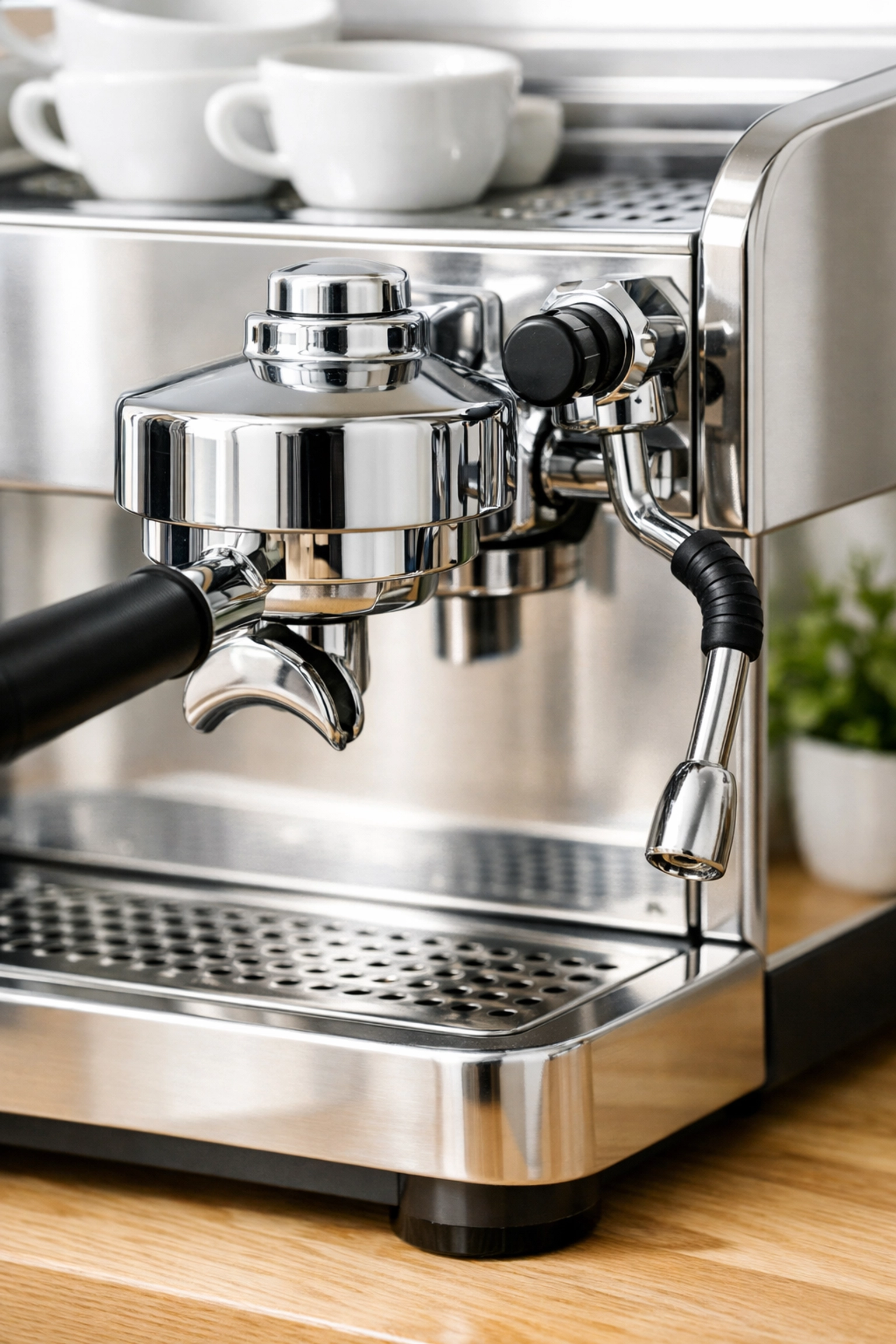
    Professional stainless steel espresso machine protected from limescale damage through quality water.

    What Can You Actually Do?

    Okay, so tap water is the enemy. What are your options? You don't need a PhD in chemistry to fix this, but you do need a plan.

    1. The Filter Jug

    A basic Brita-style filter jug is a good start. It will remove chlorine and some heavy metals, which will immediately improve the taste. However, most standard jugs don't do a great job of balancing minerals for coffee specifically. They are better than nothing, but not the ultimate solution.

    2. Specialist Coffee Filters

    There are now filter jugs designed specifically for coffee, like the Peak Water jug. These allow you to adjust the "strength" of the filtration based on how hard your tap water is. They are a fantastic middle ground for the serious home brewer.

    3. Bottled Water

    This is a bit of a minefield because not all bottled water is created equal. Some (like Volvic) are legendary in the coffee world for having a mineral profile that is "just right" for extraction. Others are too hard or too soft. If you go this route, check the label for "Total Dissolved Solids" (TDS). You’re looking for something in the 75-150mg/L range.

    4. Remineralized Water (The "Geek" Option)

    This involves taking pure, distilled water (which has zero minerals) and adding back a specific blend of minerals. Products like "Third Wave Water" come in little sachets that you drop into a gallon of distilled water. This gives you "perfect" coffee water every single time. It’s consistent, it’s easy, and it will make your Limini Coffee beans taste incredible.


    The Verdict

    Is it a bit obsessive to worry about the chemistry of your water? Maybe. But if you’re already buying high-quality, ethically sourced speciality coffee, why would you want to mask its flavour with chlorine and limescale?

    Next time you brew, try a little experiment. Brew one cup with your standard tap water and another with a bottle of Volvic or filtered water. We bet you’ll be able to tell the difference immediately. The acidity will be brighter, the sweetness more pronounced, and the finish much cleaner.

    Once you fix your water, you’ll realize that your brewing skills were actually better than you thought: it was just the "secret ingredient" holding you back.

    If you're looking to dive deeper into the world of coffee (and perhaps learn how to handle that water like a pro), why not check out our Barista Training courses? We cover everything from the chemistry of the bean to the science of the pour.

    Until then, keep your kettles clean and your water filtered!

  • The Ultimate Guide to Travel Tech Innovation: Everything You Need to Succeed in 2026

    The Ultimate Guide to Travel Tech Innovation: Everything You Need to Succeed in 2026

    Automate the boring. Personalize the unique. Scale the impossible.

    The travel landscape in 2026 isn't about flashy gadgets or "metaverse" gimmicks that never quite landed. It’s about invisible technology. It’s about systems that work so well you forget they’re even there. In 12 months, the industry has shifted from talking about AI to living it: and if your property isn't riding the wave, you’re likely drowning in manual spreadsheets.

    We’ve seen a fundamental shift toward intelligent systems that anticipate needs, reduce friction, and deliver measurable outcomes. All from one innovative platform.

    AI is the New Front Desk

    Planning a trip used to take hours of scrolling through reviews and maps. Not anymore.

    Generative AI has officially hit the mainstream. Recent data shows that nearly a quarter of all travelers now use gen AI tools for their entire trip planning process. In the EMEA region, that number jumps to 50%. Travelers aren't just "searching" anymore; they're conversing with algorithms to build itineraries, choose hotels, and find hidden local gems.

    We believe the best guest experience starts before the guest even arrives.

    • Real-time personalization: AI now crafts tailored offers based on real-time behavior.
    • Dynamic pricing: Revenue management that reacts to sentiment, not just occupancy.
    • Context-aware merchandising: Selling the right add-on at the exact moment the guest needs it.

    A traveler uses a smartphone for personalized guest experiences in a minimalist hotel lounge.

    When your tech stack understands the traveler better than they understand themselves, the "Trust Flywheel" kicks in. Guests stop looking for alternatives because your platform provides exactly what they need, every single time. It’s high-tech, but it feels like high-touch hospitality.

    Ready to see how the pros do it? Check out how Mews is leading the charge.

    The Rise of Invisible Automation

    The goal of travel tech in 2026 is simple: make the technology disappear.

    We’re moving toward "zero-touch" operations. In the corporate world, this is already the standard. Booking processes are automated, policies are handled by AI auditors, and the friction of expense reports has virtually vanished. For hotel operators, this means shifting your staff from "data entry clerks" to "experience curators."

    Think about your current check-in process. If it involves a desk, a physical credit card, and a printed registration card, you’re living in 2016, not 2026.

    • Zero-touch arrivals: Biometric palm-scans and facial recognition handle security.
    • Automated operations: Systems that process data from bookings and preferences without human intervention.
    • AI Auditors: Algorithms that train themselves to spot operational inefficiencies before they cost you money.

    "We used to spend 15 hours a week on manual reporting. Now, the system just tells us what to do next," says one of our partners. That’s the power of a platform designed for the modern age.

    Geolocation and the "In-the-Moment" Guest

    Travel companies are moving away from broad demographics. We don’t care if someone is a "Millennial" or a "Gen Z." We care about where they are and what they’re doing right now.

    Geolocation (GEO) technology has linked digital experiences to physical locations. Imagine a guest walking past your hotel bar and receiving a notification for a personalized cocktail based on their previous stays. Or a destination management system that realizes a museum is getting too crowded and automatically sends discount vouchers for a nearby park to visitors currently in the area.

    Modern smart hotel atrium featuring digital information systems for real-time geolocation.

    Smart destinations are now using digital twins: virtual copies of cities and attractions: to simulate visitor flow in real-time.

    1. Predict crowd sizes before they happen.
    2. Manage energy and water use based on real-time occupancy.
    3. Direct visitor flow to less busy, more sustainable areas.

    This isn’t just about efficiency; it’s about sustainability. Systems like Expedia’s "Smart Travel Health Checks" are now rewarding properties and destinations that manage tourism responsibly. In 2026, being "green" isn't a marketing slogan: it's a data-driven operational requirement.

    Innovation Tourism: The New Frontier

    We’re seeing a fascinating trend: people are traveling specifically to experience technology.

    Destinations like Shenzhen are seeing a massive spike in flight searches (up 48% year-on-year) from travelers who want to see the future. They want robots carrying their luggage. They want autonomous vehicle transfers. They want next-gen wellness spas that perform biometric health scans before suggesting a treatment.

    • Palm-scan ticketing: No more fumbling for QR codes.
    • Live translation glasses: Breaking down language barriers in real-time.
    • Robot assistants: Handling the heavy lifting so humans can handle the hospitality.

    If your property feels like a time capsule, you’re missing out on the "Innovation Tourist." You don't need a fleet of robots, but you do need an interface that feels like it belongs in the current decade.

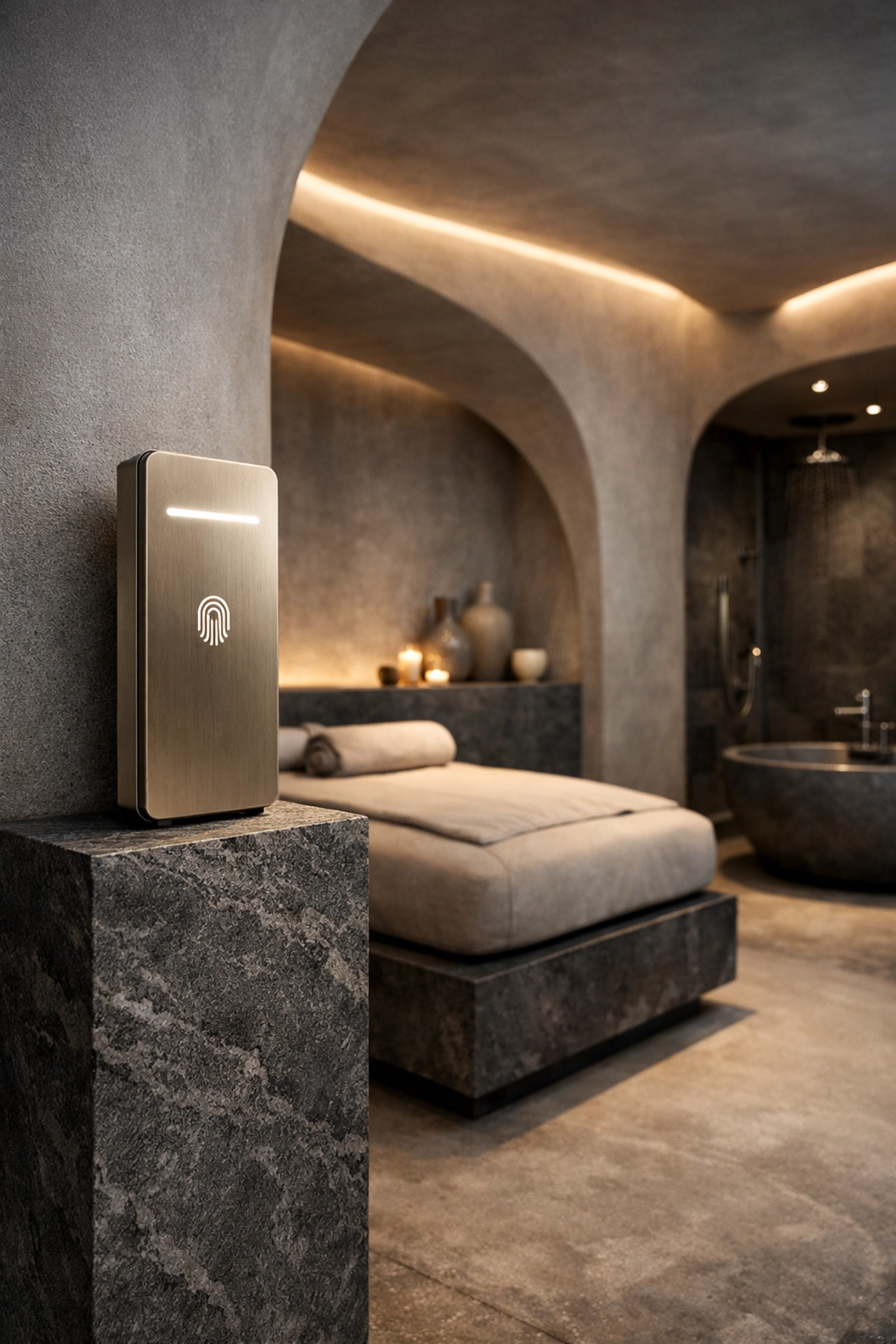
    High-tech wellness spa interior with a biometric scanner representing innovation tourism.

    Data Accuracy: The Foundation of Everything

    You can have the fanciest AI in the world, but if your data is garbage, your results will be too.

    To succeed in 2026, you must prioritize data accuracy. This enables the personalization and sustainability initiatives that guests now demand. We think the move from "volume" to "intelligence" is the most important shift a hotelier can make. Stop trying to get more bookings and start trying to get smarter ones.

    Succeeding today requires a shift in mindset:

    • Embrace AI integration as a core function, not an add-on.
    • Invest in automation to allow for scalability without increasing headcount.
    • Build trust through reliability so guests lean into your automated recommendations.

    The Mews Advantage

    At Mews, we’ve always believed that technology should empower people, not replace the human touch. Our platform is built to be the "invisible backbone" of your property. We handle the complexity of payments, bookings, and data management so you can focus on what actually matters: your guests.

    With over 12,500 properties worldwide, we’ve seen firsthand how the right tech stack can transform a business. It’s about more than just a PMS; it’s about an ecosystem that connects you to the future of travel.

    See how our innovative hospitality tech can get you ahead of the curve.

    Hotel staff using a mobile PMS tablet to provide personalized guest service on a terrace.

    Making the Leap

    The transition to a tech-forward model doesn't have to be a headache. It’s about taking small, deliberate steps toward automation and intelligence.

    • Schedule a demo: See how a modern PMS handles the heavy lifting.
    • Audit your tech: Identify where "friction" is slowing down your guests.
    • Go cloud-native: Ensure your data is accessible and actionable from anywhere.

    The most effective travel technology in 2026 works seamlessly behind the scenes. It delivers tangible benefits without requiring the traveler: or the hotelier: to think about the technology itself.

    It’s time to stop managing software and start managing experiences.

    Ready to transform your property? Join the Mews community today and let’s get you earning more revenue with less effort.

  • Beyond the Hotel Room: Monetizing Every Inch of Your Property

    Beyond the Hotel Room: Monetizing Every Inch of Your Property

    Your hotel is sitting on untapped revenue. Every day.

    That lobby space empty at 2 PM? Revenue opportunity. The parking lot half-full on weekdays? Revenue opportunity. The meeting room dark between events? You guessed it: revenue opportunity.

    Here's the thing: hotels that only think about room revenue are leaving serious money on the table. The most innovative properties are monetizing everything: parking spots, desk spaces, restaurant seats for locals, even rooftop access. And they're doing it without adding complexity, thanks to modern technology.

    The Revenue Reality Check

    Traditional hotels focus on one metric: occupancy. But the math doesn't add up anymore.

    A room sits empty for 8-10 hours while guests are out exploring. Meeting spaces go dark after 5 PM. Restaurants serve only hotel guests. Meanwhile, your neighborhood is full of people looking for exactly what you have: just not necessarily a place to sleep.

    Modern hotel lobby with co-working spaces and café serving multiple purposes

    Smart hoteliers are rethinking every square foot. Not as "hotel space," but as revenue-generating real estate that serves multiple purposes throughout the day.

    The best part? A robust hotel property management system makes managing these diverse revenue streams easier than you think.

    Turning Empty Space Into Income

    Parking: The Overlooked Gold Mine

    Your parking lot doesn't care if the car belongs to an overnight guest or someone attending a meeting downtown. Yet most hotels only monetize parking through room bookings.

    Progressive properties are listing parking spots separately: by the hour, by the day, or by the month. Commuters, event attendees, and locals all need parking. You have it. The margins on parking often exceed traditional amenities.

    Co-Working Spaces: The New Lobby

    That lobby redesign you did? It's not just for aesthetics. It's a workplace.

    Remote workers and freelancers need professional spaces outside their homes. Your lobby, lounge areas, and even converted meeting rooms can serve as flexible workspaces during off-peak hours. MAH Hotel in Belgium saw their booking engine conversion rate jump 8.3% after launching day-use and co-working options.

    Daily desk passes. Weekly memberships. Private office hours. All bookable, all trackable, all revenue.

    Meeting Spaces That Work Around the Clock

    Meeting rooms sit empty nights and weekends. But small businesses, local groups, and professionals need these spaces exactly when you're not using them.

    Offer hourly bookings for client meetings, workshops, or recording studios. Package them with catering from your restaurant. Add AV equipment for an upcharge. Suddenly, that Tuesday afternoon gap becomes billable.

    Hotel parking lot generating additional revenue beyond room bookings

    Food, Beverage, and Experiences

    Open Your Restaurant to the Neighborhood

    Hotel restaurants have a reputation problem: and it's costing you. Locals assume they're overpriced or exclusive. Change that narrative.

    Market your restaurant as a neighborhood destination. Host wine tastings on slow nights. Launch a Sunday brunch that becomes the place to be. Partner with local chefs for pop-up dinners. Your kitchen is already staffed: might as well fill more seats.

    Memberships: The Recurring Revenue Dream

    Memberships turn one-time visitors into regulars. And regulars spend more.

    Offer locals access to your pool, fitness center, or co-working lounge for a monthly fee. Throw in restaurant discounts and spa perks. You're building a community while generating steady off-season income.

    The psychology works: people use what they pay for. Those members will book your restaurant, use your spa, and recommend your rooms to visiting friends.

    Day-Use Bookings: The Obvious Play

    Business travelers between flights. Couples celebrating anniversaries without an overnight stay. Remote workers needing a day retreat. They all want hotel amenities: just not for the whole night.

    Day-use bookings monetize rooms during traditional downtime. Check-in at 10 AM, check-out at 6 PM. You turn the room twice in 24 hours, maximizing revenue per available room.

    Hotel meeting room transformed into flexible co-working space for teams

    The Technology That Makes It Possible

    Here's where it gets interesting. Managing all these revenue streams sounds complicated. Multiple booking systems, different pricing models, inventory conflicts: it could be a nightmare.

    Or it could be seamless.

    A modern hotel property management system handles everything from a single platform. Room bookings, parking reservations, co-working desk rentals, restaurant tables, spa appointments, and meeting room schedules: all connected, all automated, all revenue-optimized.

    Why This Matters

    Without integrated technology, you're juggling separate systems. Double bookings happen. Data sits in silos. Staff wastes time on manual coordination. Revenue leaks through the cracks.

    With the right PMS, you're orchestrating. One dashboard shows all inventory: rooms, spaces, and services. Dynamic pricing adjusts automatically based on demand. Guests book everything in one transaction. Your team manages it all without the chaos.

    Mews takes this approach. Their platform treats every bookable asset the same way: whether it's a penthouse suite or a parking spot. You set it up once, and it runs.

    Real Revenue, Real Results

    The numbers tell the story.

    Hotels monetizing beyond rooms see revenue per available square foot increase by double digits. Parking alone can add 5-10% to bottom-line revenue. Co-working memberships generate predictable monthly income that smooths out seasonality.

    One property added day-use bookings and saw their RevPAR climb 12% without adding a single room. Another opened their restaurant to locals and tripled F&B revenue in six months.

    Hotel restaurant serving gourmet cuisine to local guests and visitors

    The key isn't just having these offerings: it's making them easy to discover and book. Your website, booking engine, and property management system need to work together seamlessly. Guests (or locals) should be able to book a workspace, parking, and a restaurant reservation in the same flow.

    Making It Happen

    Start with what you have.

    Walk your property and identify underutilized spaces. That corner of the lobby? Desk space. The roof access? Event venue. The half-empty parking lot? Revenue center.

    Then ask: who in my community needs this space, and when? Early morning gym access for neighborhood professionals. Afternoon co-working for freelancers. Evening meeting rooms for small businesses.

    Price it right. Don't give it away, but don't charge room-rate premiums either. You're competing with coffee shops, co-working chains, and parking garages: price accordingly.

    Finally, get the technology right. Choose a hotel property management system that can handle diverse inventory types without forcing you into workarounds. You want one platform, one interface, one source of truth.

    The Bigger Picture

    This isn't just about squeezing more revenue from your property. It's about becoming a community hub.

    When locals use your co-working space, they bring guests to your restaurant. When they attend events in your meeting rooms, they recommend your hotel to visiting colleagues. When they're familiar with your property, they think of you first for staycations and celebrations.

    You're building brand loyalty that extends far beyond overnight guests.

    The hotel room will always be your core product. But it doesn't have to be your only product. Every space has potential. Every amenity can generate revenue. Every hour of every day is an opportunity.

    You just need the right tools to capture it.

    Hotel rooftop terrace set up as flexible event space with city views

    Modern hotel property management systems like Mews make it possible to think bigger about your property. They handle the complexity so you can focus on the creativity: finding new ways to serve your community while building a more resilient, diversified revenue model.

    Your property has more to offer than you're currently selling. Time to monetize every inch.

  • The Ultimate Guide to the Best AI Assistant for Small Business in 2026: Everything You Need to Succeed

    The Ultimate Guide to the Best AI Assistant for Small Business in 2026: Everything You Need to Succeed

    You wake up. It’s 6:45 AM.

    Before you’ve even reached for your coffee, your thumb is already scrolling. You’ve got 42 unread emails, three Slack pings about a missing invoice, and a calendar that looks like a game of Tetris played by someone who hates you.

    Your "small" business doesn't feel very small anymore. It feels heavy.

    The dream was freedom, right? But somehow, you’ve become the world’s most expensive data-entry clerk. You're juggling. You're dropping balls. And frankly, you’re tired of the noise.

    But it’s 2026. The world has changed… and your business should too.

    If you aren't using an AI assistant, you isn't just "old school." You're losing. You're losing time, you're losing focus, and most importantly, you're losing your sanity.

    It’s time to stop the bleeding.


    AUTOMATE ADMIN TASKS: HOW TO SAVE 10+ HOURS EVERY WEEK

    7:30 AM , The Morning Fog Clears

    You used to spend the first two hours of your day triaging. Sorting. Deleting. Responding to the same five questions about your pricing.

    Not today.

    While you were sleeping, your automation stack was working. Your business automation tools didn't just "organize" your inbox; they solved the problems before you even saw them.

    • The Invoice Chase: Your AI detected a late payment, sent a polite (but firm) reminder, and updated your spreadsheet.
    • The Meeting Minefield: Someone asked for a "quick chat." Your assistant checked your deep-work blocks, offered three slots, and sent the Zoom link.
    • The Data Entry Death-Trap: Leads from your website were automatically scrubbed, categorized, and dropped into your CRM with a personalized "nice to meet you" draft waiting in your outbox.

    Business automation tools juggling invoices and admin tasks while a business owner relaxes at their desk.

    Stop juggling.

    You aren't a robot, so why are you doing a robot’s job? When you lean into tools like those found at https://marblism.link/scott-bowen, those 10 hours of "grunt work" simply vanish.

    Imagine what you could do with an extra 40 hours a month. You could scale. You could innovate. Or, heaven forbid, you could actually take a lunch break.

    The administrative grind is a choice. In 2026, it’s a bad one.


    THE BEST AI ASSISTANT FOR SMALL BUSINESS IN 2026

    📱 10:15 AM , The Command Center

    You’re in the thick of it now. You need answers, and you need them three minutes ago.

    In the old days (we're talking 2024), you’d have to toggle between fourteen different tabs. Now? You have a central brain.

    Choosing the best AI assistant for small business isn't about finding a shiny toy. It’s about finding a partner that lives where you work.

    THE TOP CONTENDERS

    1. ChatGPT (The Generalist): Still the king of brainstorming. It's your logic-check. It handles the "How do I explain this to a frustrated client?" moments with grace.
    2. Microsoft Copilot & Gemini (The Ecosystems): If you live in Excel or Google Sheets, these aren't optional. They turn your messy data into a story with a single prompt.
    3. Slack AI (The Communicator): No more scrolling through 400 messages to find what "Scott" said about the project. It summarizes the chaos into three bullet points.
    4. Marblism (The Connector): This is where the magic happens. It’s the glue. It takes the power of AI and applies it specifically to your unique workflow. Check out how it works here: https://marblism.link/scott-bowen.

    You don't need all of them. You just need the right one.

    A person managing a digital command hub using an AI assistant for small business to organize work.

    A great AI assistant should feel like a second brain, only faster, more organized, and significantly less prone to distractions. It’s the "Employee of the Month" that never asks for a raise and doesn't steal your yogurt from the office fridge.


    AI CONTENT GENERATOR: YOUR SECRET MARKETING WEAPON

    🤝 1:45 PM , The Growth Spurt

    You know you need to be "active" on social media. You know you should be blogging. You know you need an email newsletter.

    But writing feels like pulling teeth.

    You stare at the blinking cursor. The cursor wins. Every. Single. Time.

    Enter the AI content generator for small business.

    In 2026, content isn't about "outputting more garbage." It’s about precision. You can now take one single idea, a transcript from a client call or a voice note you recorded while driving, and turn it into a multi-channel campaign.

    • The Blog Post: Professional, SEO-optimized, and actually readable.
    • The LinkedIn Snippets: Punchy thoughts that position you as an expert.
    • The Instagram Reels Script: Concise and high-energy.

    All of this happens in minutes, not days.

    An AI content generator for small business used as a megaphone for creative marketing and social posts.

    You aren't cheating; you're amplifying. Your voice is still the core, but the AI is the megaphone. It’s how a team of one looks like a team of twenty.

    If you're still staring at a blank page, you're working too hard. The tools at https://marblism.link/scott-bowen are designed to turn that "empty page" anxiety into a "published" notification.


    EMPLOYEE OF THE MONTH. EVERY MONTH.

    🔍 4:00 PM , The Reflection

    You look at your to-do list.

    Everything is checked off.

    The invoices are out. The leads are nurtured. The content is scheduled for the next two weeks.

    You didn't do it all yourself. You had help.

    The beauty of 2026 is that the barrier to entry for "big business" efficiency has collapsed. You don't need a $100k salary budget to have a world-class assistant. You just need the right software.

    WHY MARBLISM MATTERS RIGHT NOW

    Most business owners treat AI like a search engine. They ask it a question, get an answer, and move on.

    But the winners? The ones who are actually succeeding in 2026? They treat AI like a system.

    They use Marblism to build workflows that don't just "answer questions", they perform actions. It’s the difference between reading a recipe and having a private chef.

    "I was skeptical," says Sarah, a boutique agency owner. "I thought AI was just for tech bros. But once I integrated it into my admin, I realized I hadn't seen the bottom of my desk in three years. Now? I’m home by 5 PM. Every day."

    Scaling shouldn't be this easy. But here we are.

    A small business owner finishing work at sunset thanks to an AI assistant for small business.


    FREQUENTLY ASKED QUESTIONS

    Is AI going to replace my small team?
    No. It’s going to make them superhuman. Instead of your assistant spending 4 hours on data entry, they’ll spend 4 hours on high-level strategy.

    Is this expensive?
    Actually, it’s the opposite. Most of these tools cost less than your monthly coffee budget. The real "cost" is the time you’re currently wasting doing things manually.

    What if I’m not a "tech person"?
    If you can send an email, you can use these tools. The UI in 2026 is conversational. You just talk to it. It does the rest.

    Where do I even start?
    Start small. Pick one pain point: maybe it’s your inbox, maybe it’s your social media: and automate it. You can see how it all fits together at https://marblism.link/scott-bowen.


    🌙 6:00 PM : The Sunset

    The sun is going down.

    Your laptop is closed.

    The house is quiet.

    You aren't thinking about spreadsheets. You isn't worried about "what you forgot." You’re present. You’re with your family. You’re actually living the life your business was supposed to provide.

    The chaos is gone before you even take your first sip of evening tea.

    The best AI assistant for small business in 2026 isn't just a piece of code.

    It’s the key to your front door.

    See for yourself at https://marblism.link/scott-bowen.

    The Future Is Automated. And It’s Quiet.

  • Stop Wasting Time on Admin: Try These 7 AI Quick Hacks to Reclaim 2 Hours Today

    Stop Wasting Time on Admin: Try These 7 AI Quick Hacks to Reclaim 2 Hours Today

    You wake up.

    Before you’ve even had a chance to contemplate the structural integrity of your morning toast, it starts. The "ping" of a Slack message. The "buzz" of an email notification. The realization that your to-do list for today is already three pages long… and most of it is just "stuff."

    The "stuff" is what kills your momentum. It’s the meeting notes you have to clean up. It’s the invoices you need to file. It’s the back-and-forth "does Tuesday at 2 PM work for you?" dance that makes you want to hurl your laptop into the nearest body of water.

    You’re a business owner, not a professional data entry clerk. Yet, here you are, spending 60% of your day on administrative tasks that contribute exactly zero to your bottom line.

    It’s time to stop the leak.

    Business automation tools aren't just for Silicon Valley giants anymore. They are for you. Right now. Today. If you’re ready to reclaim those two hours lost to the "admin void," these 7 AI hacks are your roadmap.

    Let’s look at a day in the life of someone who actually has their time back.

    ☕ 9:00 AM: THE MEETING THAT DIDN’T STICK

    You’re sitting in your first meeting of the day. Normally, this is where the stress starts. You’re trying to listen, participate, and scribble down every "action item" like a court stenographer on caffeine.

    But today… it’s different.

    You aren’t typing. You aren’t even holding a pen. You’re just… talking.

    Behind the scenes, your AI meeting assistant is doing the heavy lifting. It’s transcribing every word, identifying who said what, and, this is the magic part, distilling a 45-minute rambling conversation into five bulleted action items.

    By the time you hit "Leave Meeting," a summary is already in your inbox. No more "Wait, what did we decide on the pricing?" No more thirty minutes spent "tidying up" notes.

    The Hack: Use tools like Otter.ai or Fireflies to automate your meeting notes.
    Time Reclaimed: 45 minutes per meeting.

    AI meeting assistant robot taking notes for a relaxed professional to save time on business admin.

    📥 10:30 AM: THE INBOX GRAVEYARD

    Your inbox is where productivity goes to die. You open it, and it's a wall of noise. Customer questions, bug reports, newsletters you don't remember signing up for, and "quick questions" that are never quick.

    Usually, you’d spend the next hour manually sorting these. Moving this to "Tasks," that to "Urgent," and the rest to "Maybe Saturday."

    Instead, your AI task assistant is already on it.

    It reads the incoming mail. It recognizes that a client is asking for a revision on a project. Automatically, it extracts the details, checks the urgency, and creates a formatted ticket in your project management tool. It even assigns a priority level based on the customer’s history.

    You don’t "check" your email. You glance at your prioritized task list.

    The Hack: Connect your email to an AI-powered automation tool (like Zapier with OpenAI integration) to convert emails into tasks instantly.
    Time Reclaimed: 15 minutes per actionable email.

    📱 11:15 AM: THE SMART SORT

    Even the emails that aren't "tasks" still need eyes, right? Wrong.

    Most of what you read is repetitive. You’ve written the phrase "I’ll get back to you on that by end of day" approximately four thousand times this year.

    AI email management tools are now smart enough to prioritize your high-priority messages and suggest "Smart Replies" that actually sound like you. They organize folders based on your behavior, not just keywords.

    You find yourself archived-heavy and stress-light. The noise is gone.

    The Hack: Leverage AI prioritization features in modern email clients to filter the junk before it hits your brain.
    Time Reclaimed: 20 minutes of "inbox scrolling" daily.

    Business automation tool transforming a flood of emails into organized digital tasks instantly.

    🗓️ 1:00 PM: THE CALENDAR TETRIS

    Lunch is over. Now comes the part where you look at your afternoon and realize you have three 15-minute gaps between meetings. Just enough time to do… nothing productive.

    Context switching is a silent killer. It takes your brain 23 minutes to refocus after a distraction. Those little gaps in your calendar? They’re productivity black holes.

    AI calendar optimization tools look at your schedule and see the mess. They automatically shift meetings (with permission) to create "Deep Work" blocks. They protect your most productive hours, the times they know you usually get your best work done, and move the "quick syncs" to your low-energy periods.

    Your calendar isn't a list of obligations anymore. It’s a strategy.

    The Hack: Deploy an AI calendar assistant to consolidate scattered meetings into focused blocks.
    Time Reclaimed: 2-3 hours weekly by reducing context switching.

    🤝 2:30 PM: THE END OF THE SCHEDULING DANCE

    "Are you free Tuesday?"
    "No, how about Wednesday?"
    "Wednesday is good, but only after 4."
    "I have a pickup at 4, maybe Thursday?"

    Stop it. Just stop.

    The manual coordination of schedules is a relic of the past. Using scheduling tools like Calendly combined with AI allows people to book time with you based on your actual availability and pre-set rules. No back-and-forth. No friction.

    You send a link. They pick a time. The calendar invites itself.

    The Hack: Set up a frictionless scheduling link and never type "Does [Time] work for you?" again.
    Time Reclaimed: 10 minutes per booking.

    AI calendar assistant optimizing business schedules and coordinating meeting times automatically.

    ☎️ 4:00 PM: THE REPETITIVE QUESTIONS

    Your phone buzzes. Or maybe it’s a chat bubble on your site.
    "Where is my invoice?"
    "What are your hours?"
    "Can I get a refund?"

    These questions are important to your customers, but they are soul-crushing for you to answer for the tenth time today.

    AI-powered chatbots are the new front line. They don't just give canned answers; they search your documentation, pull specific data, and route the truly complex issues to you only when necessary.

    While you’re focusing on growing your business, the "Penny" of your company (pun intended) is handling the routine stuff.

    The Hack: Implement a simple AI chatbot for common inquiries.
    Time Reclaimed: 30-60 minutes of manual support daily.

    🔍 4:45 PM: THE PAPER TRAIL

    It’s almost the end of the day, and you have a stack of receipts, a few signed contracts, and some handwritten notes from a networking event.

    In the old days, this meant manual data entry. Typing names into a CRM. Scanning receipts into an expense report.

    Now? You take a photo. AI OCR (Optical Character Recognition) doesn't just "see" the text; it understands it. It knows that $42.50 was for "Lunch" and automatically puts it in the "Marketing Expenses" category in your accounting software. It sees the name on the business card and finds their LinkedIn profile.

    You’re done in seconds.

    The Hack: Use AI-powered OCR tools like Adobe Scan or specialized expense AI to digitize documents instantly.
    Time Reclaimed: 15 minutes of "end-of-day" filing.

    Smartphone using AI OCR to scan receipts and digitize business documents for easy admin filing.

    THE REALITY OF RECLAIMED TIME

    Let’s do the math.

    • 45 minutes saved on meetings.
    • 30 minutes saved on email-to-task conversion.
    • 20 minutes saved on inbox sorting.
    • 25 minutes saved on scheduling and calendar management.

    That’s two hours. Every. Single. Day.

    What could you do with an extra 10 hours a week? You could finally launch that new product line. You could spend more time with your family. Or, hey, you could just take a nap. You’ve earned it.

    Business automation tools aren't about replacing you. They’re about freeing you. They take the "admin" out of the "administrator" so you can get back to being the "visionary."

    STOP JUGGLING. START GROWING.

    The problem isn't that you don't have enough time. The problem is that you're spending your time on the wrong things. You're trying to be the engine, the wheels, and the driver all at once.

    It’s time to let the AI handle the mechanics so you can keep your eyes on the road.

    If you’re ready to see how AI business automation can transform your specific workflow, without the headache of a 6-month implementation, it’s time to look at Marblism. We build the tools that give you your life back.

    Ready to reclaim your two hours?

    Click here to see how Marblism makes business automation look like magic.

    FREQUENTLY ASKED QUESTIONS

    Is AI hard to set up for a small business?
    No. Most of these "hacks" take less than 10 minutes to set up. It’s about choosing the right tool for the specific pain point.

    Will I lose the "personal touch" with my clients?
    Actually, the opposite happens. When you aren't stressed about admin, you have more mental energy to actually talk to your clients when it matters. AI handles the "Where is my invoice?" so you can handle the "How can we grow your business?"

    Is this expensive?
    Most of these tools have free tiers or are very low-cost. Compared to the value of your hourly rate, they pay for themselves in the first week.

    Do I need to be a "tech person"?
    If you can use a smartphone, you can use these tools. They are designed for humans, not coders.

    The chaos is gone before you even take your first sip of coffee tomorrow.

    Scaling shouldn't be this hard. But here we are, making it easier.

    SEE FOR YOURSELF:
    https://marblism.link/scott-bowen
    …The lights are off. The work is done. You smile.

    EVERY MONTH IS NOW YOUR MOST PRODUCTIVE MONTH.

  • Wholesale Specialty Coffee 101: A Beginner’s Guide to Mastering Your Menu

    So, you’ve decided to dive into the world of coffee. Maybe you’re starting a fresh café project, or perhaps you’re looking to level up your current offering. Either way, you’ve likely realized that the jump from "just coffee" to "specialty coffee" is a bit like moving from a tricycle to a Ducati. It’s faster, more complex, and a whole lot more exciting.

    But where do you start? Between the jargon and the endless equipment options, it’s easy to feel a bit lost. That’s where we come in. At Limini Coffee, we’ve spent years helping businesses just like yours navigate the world of wholesale coffee. We believe that great coffee shouldn't be intimidating. It should be accessible, profitable, and, most importantly, delicious.


    If you’re ready to partner with a roaster that actually cares about your success, you can check out our wholesale specialty coffee options here.


    What is "Specialty Coffee" Anyway?

    We hear this term thrown around a lot, but what does it actually mean? In the industry, specialty coffee refers to beans that score 80 points or higher on a 100-point scale by the Specialty Coffee Association (SCA).

    Basically, it’s the top-tier of the coffee world.

    It’s about more than just a score, though. It’s about a commitment to quality at every single stage of the process, from the farmer who grows the cherries to the roaster who coaxes out the flavor, and finally to the barista who pulls the shot. Unlike commercial coffee, which is often roasted dark to hide defects and maintain a generic "coffee" taste, specialty coffee is roasted to highlight the unique characteristics of the bean's origin.

    Imagine tasting a Kenyan coffee and actually picking up notes of blackcurrant and tomato, or a Brazilian bean that tastes like a liquid Snickers bar. That is the beauty of specialty coffee 🙂


    Finding Your Perfect Wholesale Coffee Roasters

    Choosing your coffee suppliers is perhaps the most critical decision you’ll make for your business. You aren't just buying a product; you're choosing a partner. You want someone who offers more than just bags of beans.

    When searching for wholesale coffee roasters, ask yourself:

    • Do they offer training? Great beans are useless if your staff doesn't know how to brew them. We highly recommend looking at their training overview before signing any contracts.
    • Is the coffee fresh? Specialty coffee has a "peak" window. You want a roaster that roasts to order, ensuring you get the beans within days of being roasted, not months.
    • What is the support like? If your machine breaks down at 8:00 AM on a Saturday, do they have your back?

    At Limini, we’ve always believed that our success is tied to your success. That’s why we focus so heavily on sourcing our coffee ethically and providing the kind of barista training that turns beginners into pros.

    Artisan hands holding freshly roasted specialty coffee beans in a sunlit roastery, showing quality sourcing.


    Building Your Menu: The Strategy

    Designing a menu isn't just about listing drinks; it’s about creating an experience that keeps people coming back. For a specialty café, you need to find the balance between "approachable" and "exciting."

    The House Blend (Your Workhorse)

    Most of your sales, usually around 80%, will likely be milk-based drinks like Lattes and Cappuccinos. For this, you want a reliable, high-quality blend. A blend combines beans from different origins to create a balanced, consistent flavor profile that can cut through milk.

    We typically suggest a medium roast for your house espresso. Why? Because it maintains enough body to satisfy traditional coffee drinkers while still offering the sweetness and clarity that specialty fans crave. If you're curious about the specifics of milk chemistry, check out our guide to understanding milk.

    Single Origin (The Conversation Starter)

    This is where you can show off. Offering a rotating "guest" single-origin coffee allows you to tell a story. You can talk about the specific farm, the altitude, and the processing method. It’s a great way to engage customers who want to explore different flavor profiles.


    The Technical Bits: Extraction and Equipment

    Let’s talk numbers. To get the best out of your wholesale specialty coffee, you need to understand the basics of extraction.

    When we pull an espresso, we’re looking for a balance. We generally aim for a pump pressure of 9 BAR. If your pressure is too low, the coffee will taste weak and sour; too high, and it becomes bitter and harsh.

    And then there's the temperature. Most specialty coffees perform best when brewed between 190 °F / 88 ºC and 203 °F / 95 ºC. Even a couple of degrees can completely change the flavor profile. This is why having a machine with a PID (Proportional-Integral-Derivative) controller is so important, it’s like cruise control for your water temperature.

    Close-up of rich espresso flowing from a bottomless portafilter, showcasing perfect extraction and crema.

    Choosing Your Tools

    You wouldn't try to win a Formula 1 race in a minivan. Similarly, you can't get specialty results from consumer-grade equipment. When choosing espresso equipment, consider the volume of your shop.

    Do you need a lever machine for that old-school theatre, or an automatic machine for speed? We’ve spent a lot of time exploring the workings of La Spaziale machines because they offer incredible stability for busy environments.


    Freshness and Storage: The Silent Killers

    One of the biggest mistakes new café owners make is buying too much coffee at once. Oxygen is the enemy of flavor. As soon as coffee is roasted, it starts to degas (releasing CO2) and oxidize.

    Fresh is best.

    We recommend using beans within 4 to 28 days of the roast date. Any earlier, and the excess CO2 can make the coffee taste "fizzy" and inconsistent. Any later, and those beautiful floral and fruity notes start to fade into a dull, papery taste.

    And please, whatever you do, keep your beans in a cool, dark place. Not the fridge (the moisture is a nightmare) and definitely not in the hopper overnight if you can help it. Only grind what you need, when you need it. If you need help calculating your usage, our coffee brewing calculator is a life-saver.


    Training: The Human Element

    You can buy the most expensive beans from the best coffee suppliers, but if your barista doesn't understand tamping or how to texture milk, it’s all for naught.

    Training shouldn't be a one-time thing. It’s an ongoing process. Your team should know:

    1. How to dial in: Adjusting the grind size throughout the day as humidity and temperature change.
    2. Milk consistency: Creating that "glossy" microfoam that makes a latte or cappuccino feel like silk.
    3. Cleanliness: A dirty steam wand or group head will ruin even the best cup of coffee. It’s a real shame when great coffee is spoiled by poor hygiene.

    We provide comprehensive barista training because we want your customers to have the same incredible experience every time they walk through your door.

    A professional barista pouring a tulip latte art pattern into a specialty coffee cup in a warm café setting.


    The "Theatre" of the Café

    In the specialty world, people aren't just paying for caffeine; they’re paying for the craft. The way your baristas move, the way they explain the coffee, and even the cups you choose contribute to the overall vibe.

    Think about your shop layout. Is the espresso machine a focal point? Can customers see the crema forming as the shot pours? This is what we lovingly call "theatre." It builds value and justifies the specialty price point. If you’re still in the planning stages, our tips on building a coffee shop and shop fitting might give you some inspiration.


    Why Partner with Limini?

    We know there are plenty of wholesale coffee roasters out there. But we like to think we do things a bit differently. We aren't just here to ship boxes. We’re here to help you build a sustainable, profitable business that you’re proud of.

    From helping you understand the makings of a La Spaziale to providing the best wholesale specialty coffee in the UK, we’ve got the expertise to guide you.

    If you’re ready to take the next step, why not read more about us or check out our reviews from other café owners? We’d love to be a part of your journey.

    Coffee is a journey, and while the learning curve can be steep, the rewards: both in terms of customer loyalty and personal satisfaction: are huge. Keep testing, keep tasting, and most importantly, keep enjoying the process.

    If you have any questions or want to chat about your new venture, reach out to us here at Limini. Let's make some great coffee together.