Blog

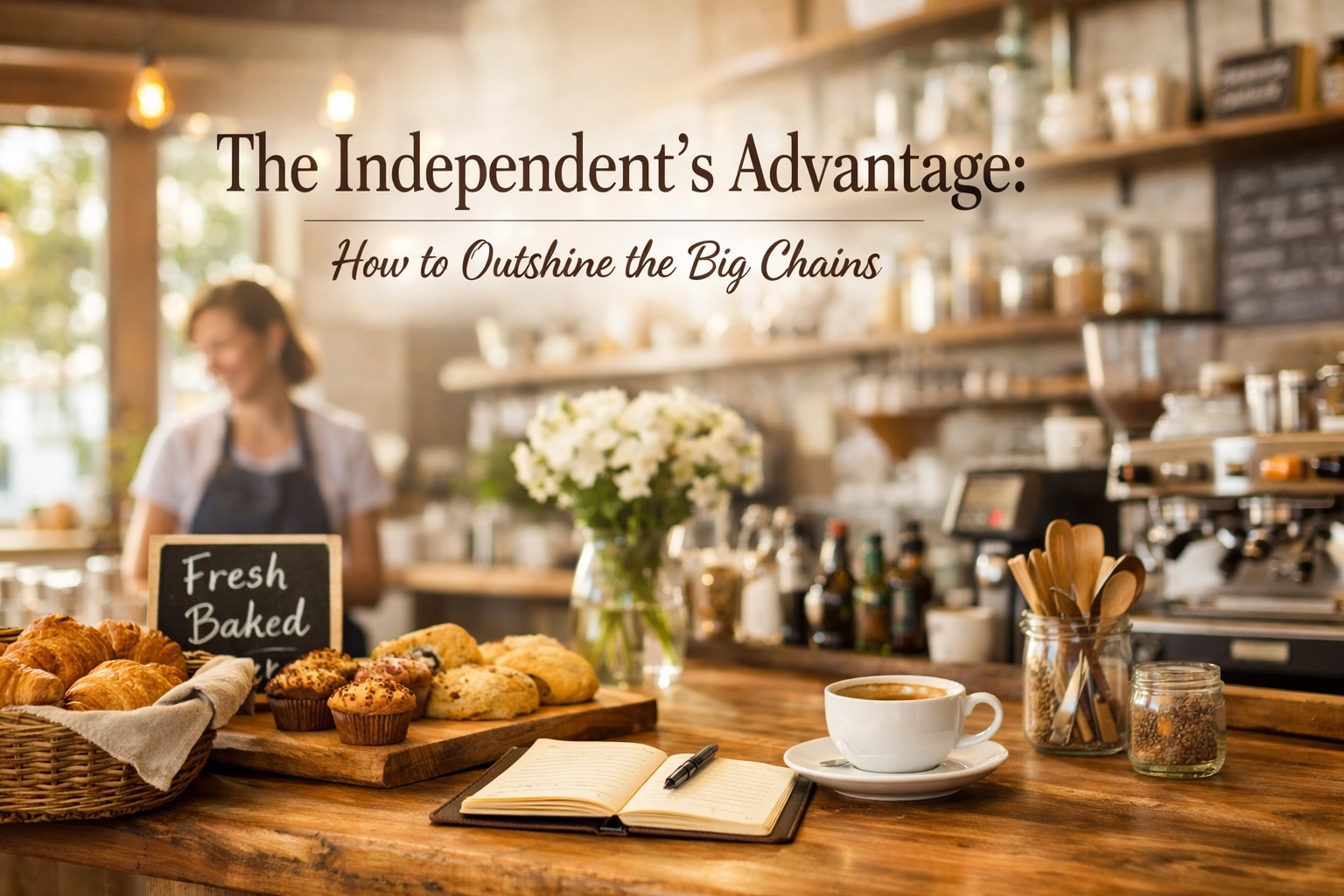
  • The Independent’s Advantage: How to Outshine the Big Chains

    The Independent’s Advantage: How to Outshine the Big Chains

    Let's be honest – competing with the big coffee chains can feel a bit daunting. They've got massive marketing budgets, economies of scale, and a recognizable logo on every high street corner. But here's the thing: being independent isn't a disadvantage. It's actually your secret weapon.

    The large chains might have resources, but you've got something they'll never replicate – authenticity, flexibility, and the ability to create genuine connections with your community. And when you combine those inherent strengths with quality specialty coffee and proper training, you're not just competing. You're outshining them.

    Your Superpowers: What Chains Can't Replicate

    The Personal Touch

    Walk into any chain coffee shop, and you'll get efficiency. Walk into a great independent, and you'll get recognition, conversation, and a flat white made exactly how you like it – remembered from last Tuesday.

    This isn't just nice to have. Research shows that 69% of customers actively appreciate the familiar atmosphere and personal connections at local establishments. Your baristas aren't just following a corporate script – they're building relationships. They remember that Sarah takes oat milk, that James always needs his coffee extra hot, and that the office team from across the road comes in at exactly 10:30 every morning.

    Barista creating latte art at independent coffee shop

    Chains have training manuals. You have people who actually care.

    Your Unique Identity

    Corporate chains are designed for consistency across hundreds of locations. Which means they're designed to be… well, bland. Safe. Inoffensive to everyone and exciting to no one.

    You? You can be eccentric. You can have that vintage espresso machine as a centerpiece. You can play music that actually fits your vibe. You can change your seasonal menu based on what your customers are genuinely asking for, not what some regional manager decided six months ago in a conference room 200 miles away.

    Your concept reflects your vision, your passion, and your community's personality. That's something customers are actively seeking – an alternative to the standardized experience they can get anywhere.

    Quality Without Compromise

    Here's where the rubber meets the road. While chains are often optimizing for cost-cutting and speed, you can optimize for quality. And your customers absolutely notice the difference.

    This is where partnering with a specialty roaster like us becomes genuinely strategic. When you're serving coffee that's been sourced with care, roasted with precision, and delivered fresh, you're offering something the chains simply can't match at their scale. The cup quality difference is tangible, and customers will pay for it.

    We work with independent cafes across the UK who've built their entire reputation on serving exceptional coffee. They're not trying to be the cheapest option – they're being the best option. And it works.

    Unique independent coffee shop interior with vintage decor and warm atmosphere

    The Economic Advantage Your Community Cares About

    There's a powerful story you should be telling: independent coffee shops recirculate 65.4% of their revenue back into the local economy, compared to just 34.5% for chains.

    That means when someone buys a coffee from you, they're supporting local jobs, local suppliers, and keeping capital within their community. You're not just a coffee shop – you're part of the economic ecosystem that makes the neighborhood thrive.

    People genuinely care about this. Use it in your marketing. Put it on your walls. Make it part of your story.

    Borrowing the Best from the Big Players

    Now, let's talk about what chains do get right – and how you can adopt those operational advantages without losing your soul.

    Consistency and Systems

    The chains have spent millions perfecting their operations. You don't need to reinvent the wheel. Implement standard operating procedures for your key processes. Create recipe cards for each drink. Establish clear quality benchmarks for your espresso extractions.

    This isn't about becoming robotic – it's about ensuring every customer gets the same excellent experience, regardless of which barista is working that shift.

    This is exactly why we offer professional barista training. Proper training creates consistency in your quality while allowing your team's personalities to shine through in service. Best of both worlds.

    Buying Power

    You might not have the purchasing volume of a 500-location chain, but you can join group purchasing organizations or work with suppliers who understand the value of supporting independents.

    We work on wholesale partnerships that recognize the reality of independent operations – we want you to succeed, because your success is our success. We're not trying to squeeze every penny. We're building long-term relationships.

    Marketing That Punches Above Your Weight

    You don't need a massive budget to build brand awareness. You need authenticity and strategy. Social media has leveled the playing field – a great Instagram post from an independent can reach just as many people as one from a chain, sometimes more because it feels genuine.

    Host community events. Partner with other local businesses. Create seasonal promotions that feel special, not corporate. Build a loyalty program that's about actual loyalty, not just data collection.

    Specialty coffee beans and fresh espresso shot showcasing quality

    The Quality Non-Negotiables

    If you're going to outshine the chains, these are your pillars:

    Your Coffee

    This is the foundation. You cannot compromise here. Your beans need to be freshly roasted, ethically sourced, and properly dialed in. We're obviously biased, but this is exactly what Limini specializes in – working with independent cafes to supply exceptional specialty coffee that becomes their competitive advantage.

    Check out what we're offering at liminicoffee.co.uk – whether you're looking for crowd-pleasing blends or exciting single origins that give you talking points with customers.

    Your People

    Invest in training. Seriously. A well-trained barista isn't an expense – they're your brand ambassador, quality controller, and customer experience creator all in one.

    Chains often rely on high turnover and basic training. You can offer your team proper development, recognition, and a sense of ownership. Staff who feel valued create customers who feel valued.

    Your Environment

    This doesn't mean expensive fit-outs. It means intentional atmosphere. Cleanliness, thoughtful music, comfortable seating, good lighting. The small details that make people want to stay, work, and return.

    Playing the Long Game

    The chains are optimizing for quarterly profits and expansion. You're building something sustainable and rooted in community.

    That means you can make decisions based on what's right for your customers and your values, not what looks good on a spreadsheet in head office. You can refuse to cut corners. You can experiment with a new brew method because you think your regulars will love it. You can close early for a staff training day because you're investing in quality.

    This long-term thinking, combined with operational excellence and uncompromising quality, is how independents don't just survive – they thrive.

    Professional barista team at independent coffee shop

    Your Action Plan

    Start with these strategic moves:

    1. Audit your quality – Is every cup meeting your standard? If not, fix your training and equipment first.

    2. Document your processes – Create SOPs for your key drinks and service standards.

    3. Elevate your coffee program – If you're not working with a specialty roaster who supports your vision, it's time to change. Explore how Limini can partner with your business.

    4. Train properly – Invest in your team's skills and knowledge. It pays back exponentially.

    5. Tell your story – Make sure customers know why choosing you matters, from the local economic impact to the quality difference in their cup.

    6. Build community – Events, collaborations, and genuine engagement turn occasional customers into loyal advocates.

    The Truth About Competition

    The big chains aren't your real competition. They're serving a different customer with different priorities. Your competition is complacency – the temptation to cut corners, skip the extra training session, or settle for "good enough" coffee.

    When you maintain relentless focus on quality, authentic connection, and operational excellence, you create something the chains can never touch: a coffee shop that people genuinely love, not just one they default to because it's familiar.

    You've got the advantage. Now use it.
  • The 4-Hour Workweek is Finally Real: How AI Does the Heavy Lifting for You

    The 4-Hour Workweek is Finally Real: How AI Does the Heavy Lifting for You

    You know that book. The one that promised you'd work four hours a week and spend the rest sipping cocktails on a beach somewhere.

    You tried. You really did.

    But the reality? You're drowning in the exact opposite. Email. Scheduling. Data entry. Customer follow-ups. Invoice chasing. Report generation. Meeting prep…

    The list never ends. And the actual work : the creative thinking, the strategy, the innovation that actually grows your business : gets pushed to "when I have time."

    Which is never.

    Here's the thing: Tim Ferriss wasn't wrong. He was just early.

    THE PROMISE IS FINALLY HERE

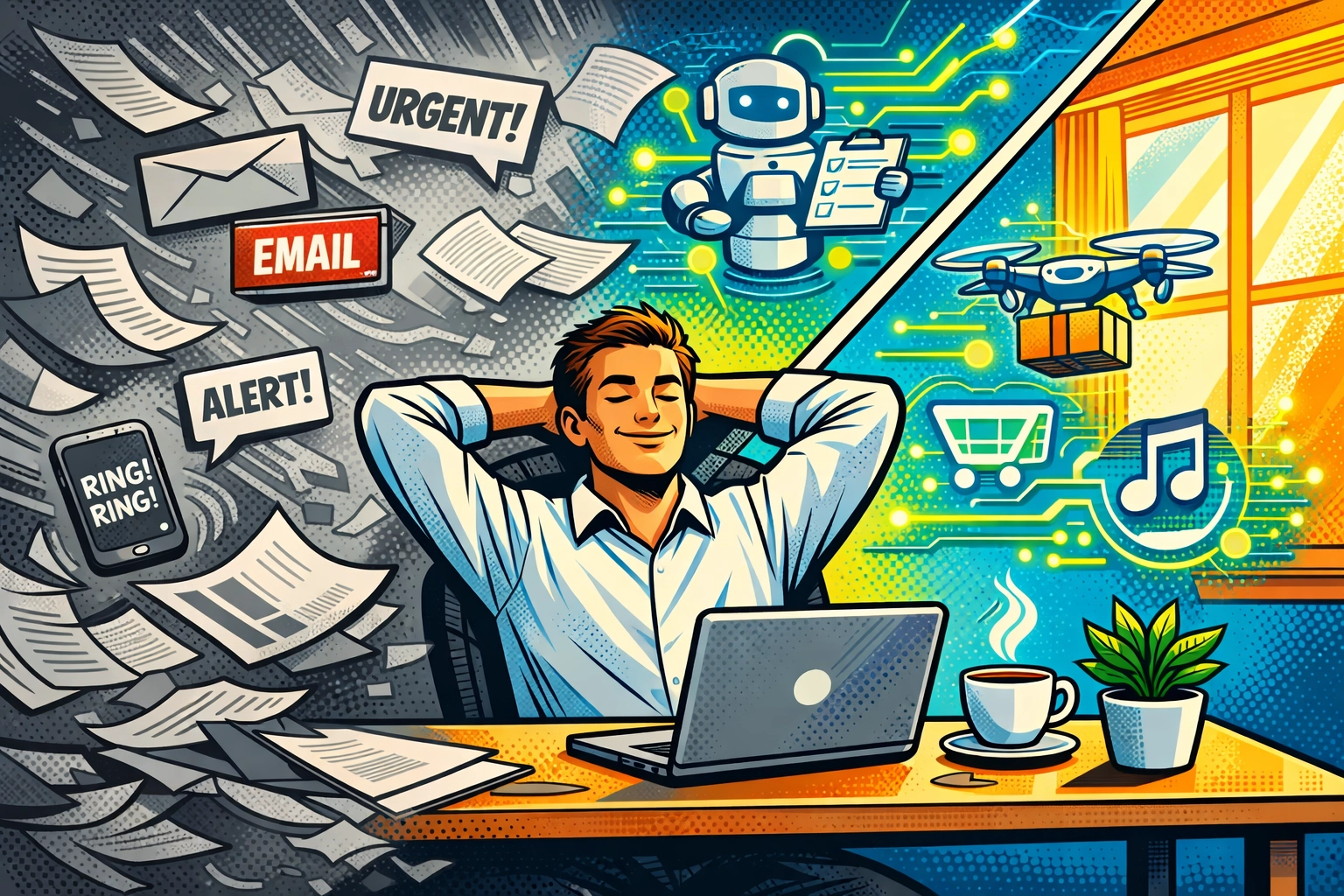
    Business owner at organized desk with AI automation handling chaotic tasks in background

    In 2026, the four-hour workweek isn't a pipe dream anymore. It's quietly becoming reality for business owners who figured out the secret.

    AI doesn't just "help" with your work. It does the work.

    Not the important stuff. The other stuff. The administrative quicksand that's been eating 80% of your day.

    While you sleep, AI is responding to customer inquiries. While you're in a meeting, it's organizing your CRM. While you're thinking through your next strategic move, it's handling expense reports, scheduling follow-ups, and prepping tomorrow's tasks.

    Companies are already proving this works. At Convictional, the CEO noted that employees are "way happier" while accomplishing the same volume of work : because AI handles the coding grunt work, generates marketing copy, and breaks down projects into manageable chunks. A law firm uses ChatGPT Pro to handle research, track billable hours, summarize calls, and plan client strategy.

    The cost? About $20 a month for AI virtual assistants. Less than a single lunch meeting.

    ☕ 7:00 AM : YOUR DAY ACTUALLY BEGINS

    You wake up. Check your phone.

    Normally, this is where the anxiety starts. The inbox explosion. The urgent Slack messages. The "quick question" that derails your entire morning.

    But today?

    Your AI assistant already triaged everything. Urgent client request? Handled with a personalized response pulled from your previous conversations. Scheduling conflict? Resolved : it moved the less important meeting and sent apologies. Three invoices that needed follow-up? Done at 6:47 AM.

    The chaos is gone before you even take your first sip of coffee.

    You scan the summary. Everything that actually needs you : your strategic input, your creative decision-making, your expertise : is clearly highlighted. Three items. That's it.

    The rest? Automated. Delegated to business automation tools that never sleep, never complain, and cost less than your monthly streaming subscriptions.

    9:00 AM : DEEP WORK, FINALLY

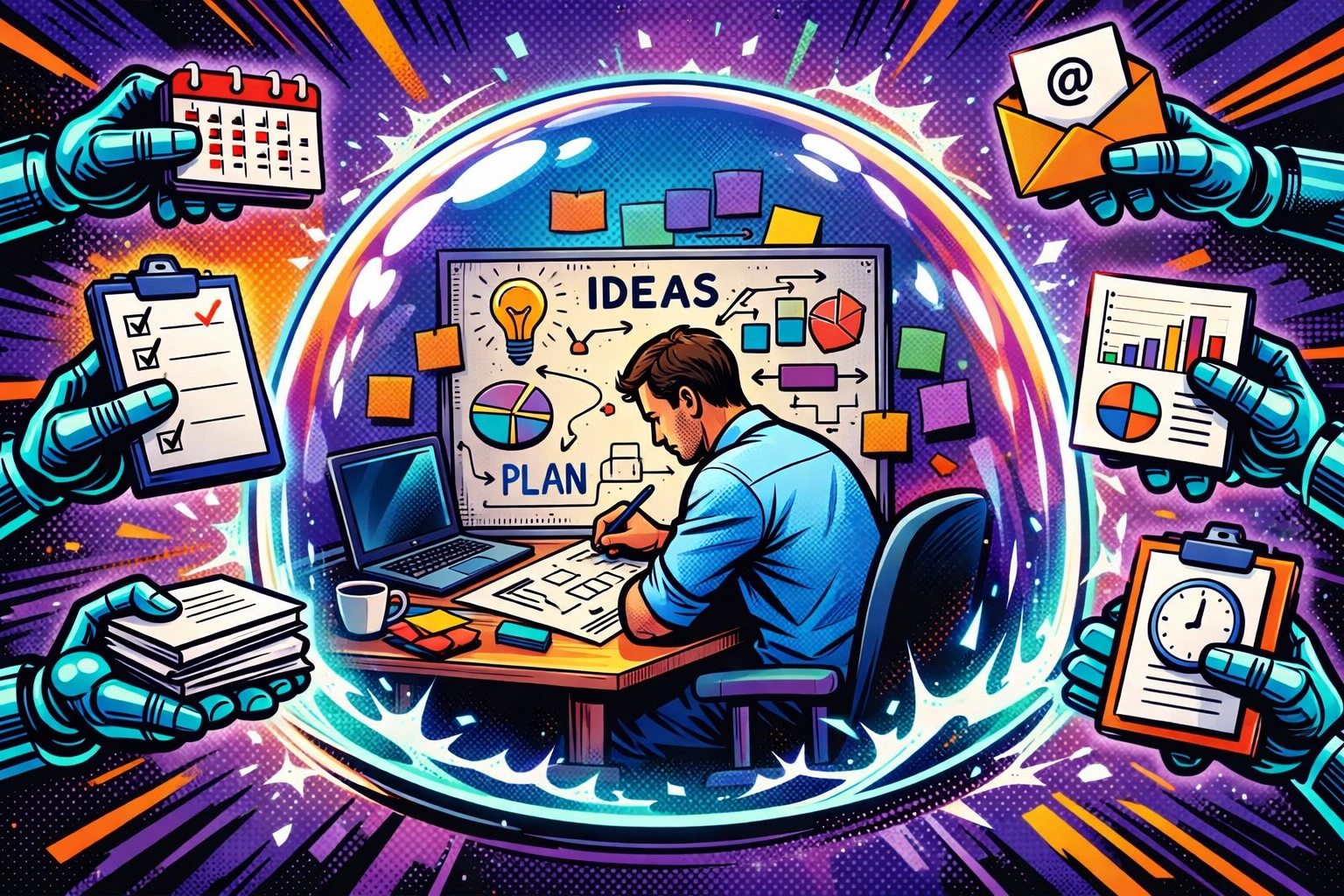
    Professional focused on deep work while AI automates admin tasks and scheduling

    You sit down at your desk. No email marathon. No administrative cleanup.

    Just… the work that matters.

    That new product strategy you've been thinking about? You dive in. Your mind is fresh. No interruptions. No context-switching between "CEO brain" and "admin assistant brain."

    AI is handling the mundane in the background. Customer support queries are being answered with your tone and knowledge base. Data from last quarter is being formatted into a readable report. Follow-up emails to prospects are being drafted and queued for your quick approval.

    You're not managing tasks. You're creating value.

    The irony? This used to feel impossible. Now it feels… normal.

    Roger Kirkness, CEO of Convictional, watched his team accomplish the same work volume while being "way happier." The secret wasn't working harder. It was letting AI automate admin tasks that consumed entire afternoons.

    11:30 AM : THE MEETING THAT DIDN'T WASTE YOUR TIME

    You join a client call. But here's what's different.

    The AI already prepped everything. Client history. Previous conversation notes. Outstanding action items. Relevant data points.

    You walk in prepared : without spending an hour preparing.

    During the call, your AI assistant is quietly taking notes. Capturing action items. Identifying follow-up tasks. When the call ends, you don't scramble to remember who's doing what.

    The summary is already in your inbox. Tasks are already assigned. Calendar invites are already sent.

    You just… move on to the next thing.

    1:00 PM : LUNCH (ACTUALLY LUNCH)

    Person enjoying lunch break while AI assistants handle emails and business automation

    You take a real lunch break.

    Not "eating at your desk while answering emails" lunch. Actual lunch.

    Because here's what changed: AI doesn't just help you work faster. It helps you stop working.

    While you're away, it's organizing tomorrow's priorities. Updating your CRM with today's interactions. Preparing reports you'll review later. Following up with leads who went quiet last week.

    JPMorgan Chase CEO Jamie Dimon predicts workweeks could shrink to 3.5 days within the next few decades. Zoom CEO Eric Yuan is targeting three- or four-day weeks within five years using "digital twins" : AI that handles email, messages, and meetings on your behalf.

    It sounds wild. But you're living a version of it right now.

    3:00 PM : THE CREATIVE BREAKTHROUGH

    You're back at your desk. Not exhausted. Not buried.

    Actually energized.

    That strategic problem you've been mulling? You crack it. Not because you suddenly got smarter. But because you finally had space to think.

    The employees at RocketAir deployed an AI tool that processes massive data sets quickly, freeing strategists and designers to focus on creative work. Boston College economist Juliet Schor notes there's "enough social consensus that people are exhausted and stressed" : and AI is the release valve.

    Your breakthrough doesn't happen in spite of technology. It happens because of it.

    AI handled the repetitive, time-consuming tasks that used to consume your cognitive load. Now your brain has room for the work that actually matters.

    🌙 5:00 PM : YOU'RE DONE

    Not "I'll finish this tonight" done. Actually done.

    Your AI assistant sends you an end-of-day summary. Everything that was urgent got handled. Everything that needs your input tomorrow is queued and prioritized. Follow-ups are scheduled. Invoices are sent. Reports are drafted.

    You close your laptop.

    The guilt you used to feel : like you're always behind, always scrambling : is gone.

    Employees at companies testing four-day workweeks reported using extra time for rest, community involvement, and creative projects. Paradoxically, this led to more breakthrough moments at work, not fewer.

    The four-hour workweek isn't about working less because you're lazy. It's about working smarter because you finally can.

    THE REALITY CHECK

    Business professional having creative breakthrough as AI handles administrative work

    Is it literally four hours? Not always.

    But here's what is real: you're not drowning anymore.

    The administrative quicksand that used to steal 30+ hours a week? AI handles it for roughly $20 a month through tools like ChatGPT and business automation platforms. One in three companies is investing at least $25 million in AI : not because it's trendy, but because the math works.

    A law firm uses generative AI for research and billable hour tracking. A marketing agency uses it for copywriting and project breakdowns. A consulting firm uses it for client planning and call summarization.

    These aren't futuristic scenarios. This is 2026. This is now.

    The companies winning aren't the ones with bigger teams or longer hours. They're the ones who figured out how to automate admin tasks and redirect human energy toward high-value work.

    YOUR MOVE

    Tim Ferriss wrote the book. AI wrote the sequel.

    The four-hour workweek isn't about escaping work. It's about reclaiming your time from the tasks that don't need you. The admin. The follow-ups. The data entry. The scheduling chaos.

    AI does the heavy lifting. You do the thinking.

    If you're ready to stop drowning in admin work and start focusing on what actually grows your business, see how Marblism makes it real. Business automation tools that handle the mundane while you handle the meaningful.

    The chaos isn't gone because you worked harder.

    It's gone because you finally stopped doing work that didn't need you in the first place.

  • Why Everyone Is Talking About Cloud-Native Hotel Management Software (And You Should Too)

    Cut the cables. Clear the clutter. Focus on guests.

    The hospitality industry is undergoing a quiet revolution. It’s not happening in the lobby or the kitchen: it’s happening in the "brain" of the hotel. Forward-thinking hoteliers are ditching the heavy, expensive servers tucked away in dusty back offices for something leaner, faster, and significantly more powerful.

    We believe technology should be the wind in your sails, not the anchor holding you back.

    Modern hospitality requires agility. You need to be able to change a rate, check a guest in, and assign a room from a tablet while walking through the lobby: or even from your phone while you’re off-site. Cloud-native platforms make this possible by moving your entire operation to the web.

    The results speak for themselves. Properties switching to cloud-native systems see a 25% boost in room-turn efficiency and save an average of 10 hours of administrative work every week. It’s about doing more with less, all from one innovative platform.

    Stop paying for the "Server Tax"

    Traditional hotel management systems are expensive. We’re not just talking about the software license. We’re talking about the "Server Tax": the hidden costs of hardware, cooling, IT consultants, and physical security.

    When your hotel PMS (Property Management System) lives on a physical machine in your building, you are responsible for its health. If the hard drive fails, your front desk stops. If the power goes out, your booking engine goes dark. That’s a lot of pressure for a business that should be focused on hospitality, not hardware maintenance.

    Minimalist hotel reception desk using a cloud-native PMS on a wireless tablet.

    We think your budget belongs in guest-facing areas, not server rooms.

    • Eliminate massive upfront capital expenditures (CapEx).
    • Switch to a predictable, scalable subscription model.
    • Remove the need for specialized on-site IT personnel.

    Cloud-native solutions like Mews operate on a simple principle: you pay for what you use. Updates happen automatically in the background. Security is handled by experts. Support is a click away. It’s a shift from owning a liability to subscribing to a service that grows with you.

    Automation: Your new favorite employee

    Let’s be honest: nobody gets into the hotel business because they love manual data entry. Yet, for years, that’s exactly what hotel staff have been doing. Re-typing credit card numbers, manually updating inventory on different channels, and printing out paper registration cards.

    Automation isn’t about replacing people; it’s about giving them their time back.

    A cloud-native hotel PMS acts as a central nervous system. It talks to your booking engine, syncs with your channel manager, and updates your CRM in real-time. When a guest books a room on an OTA (Online Travel Agency), the inventory is instantly adjusted everywhere else. No manual intervention. No double bookings. No stress.

    "Since we automated our night audit, our team finally has time to actually talk to the guests during the morning rush," says one boutique hotel manager. "It’s saved us at least two hours of clicking every single day."

    See how easy it is to automate:

    1. Connect your preferred distribution channels.
    2. Set your automated pricing rules.
    3. Let the system handle the mundane tasks.

    By leaning into automation, you ensure that your staff is focused on high-value interactions. They can be hosts again, not just data entry clerks.

    The guest journey starts before the lobby

    The modern traveler lives on their smartphone. They order food, book flights, and manage their lives through apps. Why should checking into a hotel be any different?

    Cloud-native software enables a seamless guest experience that starts long before they arrive at your door. With integrated self-check-in kiosks and mobile check-in options, guests can skip the line and go straight to their room. It’s about giving people choices.

    Hotel staff using a mobile PMS tablet to enhance the guest check-in experience.

    We believe the "standard" check-in process is ripe for disruption.

    • Send automated pre-arrival emails with check-in links.
    • Offer digital keys directly on guest smartphones.
    • Use self-check-in kiosks to reduce lobby friction during peak hours.

    This isn’t just about convenience; it’s about data. A cloud-integrated CRM captures guest preferences: like that extra pillow they requested last time: and makes that information available to every department. This allows for personalized upsells (think breakfast add-ons or room upgrades) that feel like thoughtful suggestions rather than sales pitches.

    Ready to upgrade your guest experience? Check out how Mews can help here: https://referrals.mews.com/umqHYIto

    Real-time data for real-time decisions

    Managing a hotel without real-time data is like driving a car with a blacked-out windshield and only the rearview mirror to guide you. You might know where you’ve been, but you have no idea what’s coming.

    Cloud-native systems provide a 360-degree view of your property (or properties) at any given second. Whether you’re looking at occupancy rates, RevPAR (Revenue Per Available Room), or housekeeping status, the data is live.

    A guest using a digital hotel key on a smartphone for seamless, contactless room access.

    We think data should be accessible, not trapped in spreadsheets.

    • Access your dashboard from any device, anywhere in the world.
    • Compare performance across multiple properties in a single view.
    • Identify booking trends before they become missed opportunities.

    This level of transparency is a game-changer for multi-property owners. You no longer have to wait for end-of-month reports to see how a specific location is performing. You can spot a dip in bookings on a Tuesday and launch a promotion via your CRM by Tuesday afternoon. That’s the power of being cloud-native.

    Security that actually sleeps

    Data breaches are a nightmare for any business, but in hospitality, they are catastrophic. Protecting guest payment details and personal information is a full-time job.

    Legacy systems are often the weakest link. They run on outdated operating systems and rarely receive security patches. Cloud-native platforms, however, are built with security as a foundation. They use enterprise-grade encryption and comply with global standards like GDPR and PCI-DSS by default.

    A hotel manager securely accessing property data remotely via a cloud-based PMS.

    "I used to worry about our server getting hacked or the building flooding," says Scott, an affiliate partner. "With a cloud system, I know the data is backed up in multiple locations and protected by the best security protocols available."

    Because cloud-native software is updated automatically, you are always running the most secure version of the platform. You don't have to wait for a technician to come out and install a patch. It happens while you sleep, ensuring your business and your guests are always protected.

    Scalability: From 10 rooms to 10,000

    One of the biggest frustrations with traditional software is that it doesn't scale well. If you want to add a new wing to your hotel or open a second location, you often have to buy more hardware and more licenses, and then figure out how to get the two systems to talk to each other.

    Cloud-native software is built to grow.

    Whether you’re a 10-room boutique or a global chain with 12,500 properties, the infrastructure is the same. Adding a new property to your portfolio is as simple as creating a new profile in the system. Everything: your booking engine, your channel manager, and your reporting: is instantly ready to go.

    Modern and historic architecture representing the scalability of a cloud-native hotel PMS.

    This flexibility also applies to the services you offer. Want to start selling co-working spaces or parking spots? A modern PMS allows you to manage any space, not just beds. It’s about maximizing the revenue potential of every square inch of your property.

    The transition is easier than you think

    Many hoteliers hesitate to switch because they fear the "down-time." They imagine days of closed doors and lost revenue while the new system is installed.

    In reality, switching to a cloud-native platform is remarkably fast. Because there is no physical hardware to install, most of the work happens behind the scenes.

    Follow these simple steps to modernize:

    1. Schedule a 30-minute demo to see the platform in action.
    2. Map out your current workflows and identify automation opportunities.
    3. Get your team trained via easy, online modules.

    Most properties are up and running within weeks, not months. The intuitive interface means your staff will pick it up in hours, not days. It’s designed to be as easy to use as the apps on your phone.

    The future is already here

    The conversation around cloud-native hotel management software is no longer about "if" it’s the future: it’s about how quickly you can get there. The competitive advantage goes to the hoteliers who can move faster, serve guests better, and operate more efficiently.

    By choosing a platform like Mews, you aren't just buying software; you're joining a community of innovators who believe that hospitality should be about people, not processes.

    Don't let legacy tech hold your business back. Embrace the cloud, automate the boring stuff, and get back to doing what you love: making your guests feel at home.

    Ready to see what the future looks like?
    Visit https://referrals.mews.com/umqHYIto to start your journey today. It’s time to get you earning more revenue and saving more time in no time.

  • 5 Steps to Automate Customer Support with AI and Reclaim Your Weekends (Easy Guide for Solopreneurs)

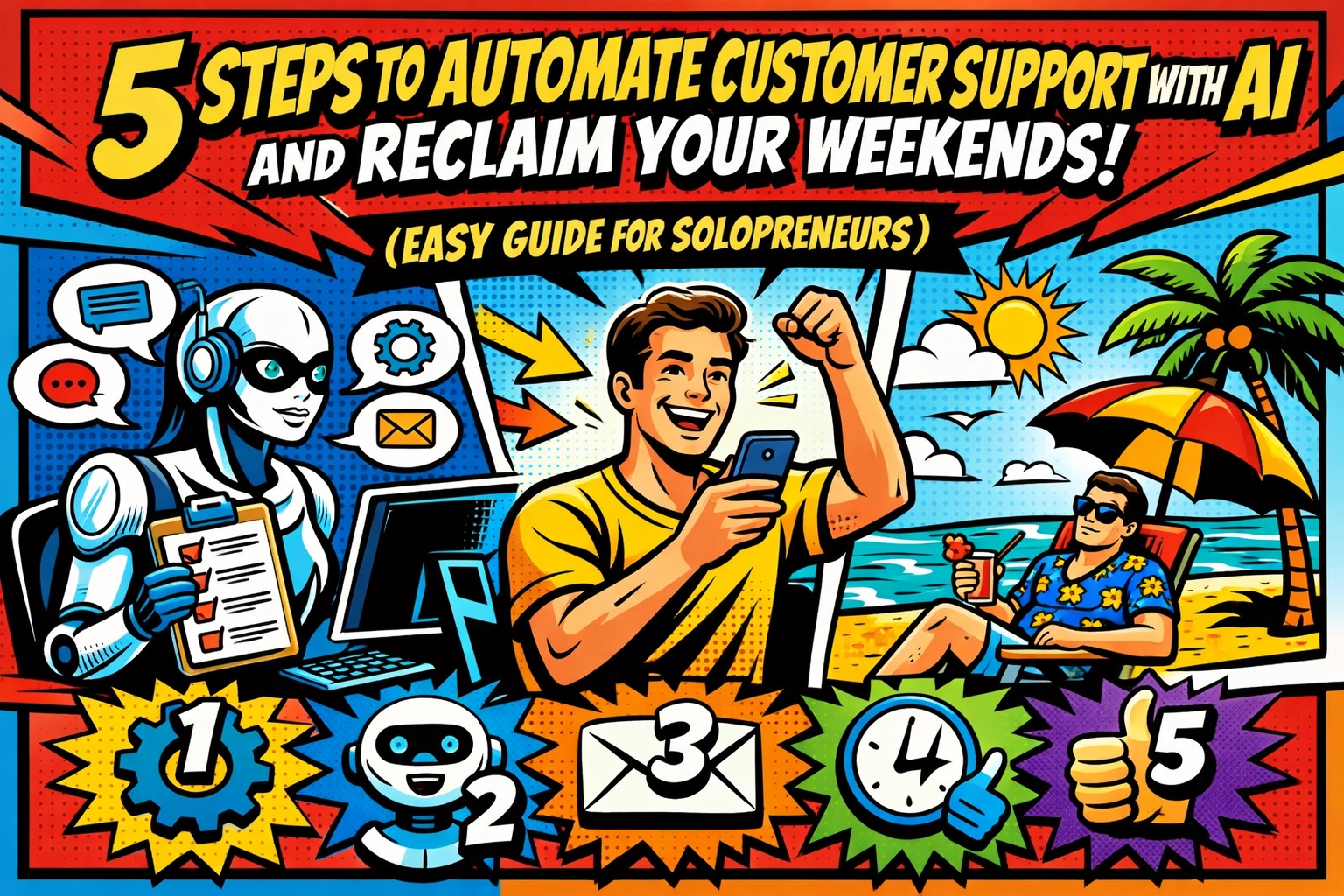
    5 Steps to Automate Customer Support with AI and Reclaim Your Weekends (Easy Guide for Solopreneurs)

    ☕ 7:00 AM.

    Your eyes aren't even fully open yet. You reach for your phone, not to check the weather, but to check the damage.

    The notifications are already screaming.

    "Where is my order?"
    "Can I get a discount?"
    "The link isn't working!"

    You haven't even had a sip of coffee, and you're already behind. Your "weekend" was supposed to start three hours ago, but here you are, typing out the same apology for the 400th time this month.

    You’re the CEO. The Founder. The Visionary. But right now? You’re just a glorified, unpaid call center worker for your own business. It’s exhausting. It’s draining. And honestly… it’s keeping you from actually growing.

    But imagine this instead.

    It’s Saturday morning. You wake up. Your phone is silent. No, you didn't turn it off. It’s just… quiet. Because while you were sleeping, someone, or something, was handling the chaos for you. Every "where is my stuff?" was answered. Every "how do I log in?" was solved.

    The work is done. And you didn't lift a finger.

    That’s the power of an ai virtual assistant for business. If you want your life back, you need to automate customer support with ai.

    Here is how you do it in five simple steps.


    STEP 1: DRAW A LINE IN THE SAND (AND STICK TO IT)

    ⌚ 9:00 AM.

    The first mistake most solopreneurs make is being too available. You think that by answering a DM at 11:00 PM on a Tuesday, you’re providing "great service."

    You’re not. You’re just training your customers to treat you like a 24/7 vending machine.

    You need boundaries.

    Decide right now: when are you "at work"? If it’s Mon-Fri, 9 to 5, then that needs to be etched in stone. Put it in your email signature. Put it on your "Contact Us" page.

    "Support Hours: Mon-Fri, 9 AM – 5 PM EST. We typically reply within 24 hours."

    It sounds simple. It sounds almost too basic. But the moment you define these hours, you give yourself permission to stop checking your phone during dinner. You aren't "ignoring" people. You're simply following the schedule you publicly set.

    When people know when to expect a reply, the anxiety, on both sides, disappears.


    STEP 2: BUILD YOUR FIRST LINE OF DEFENSE

    🤝 11:00 AM.

    Once you’ve set your hours, you need a gatekeeper. You don't need to hire a human for this. You just need a smart auto-responder.

    Think of this as your digital receptionist. When someone emails you, they shouldn't be met with silence. Silence breeds "Did you get my message?" follow-up emails. And follow-up emails are just more work for you.

    Your auto-responder should do three things:

    1. Acknowledge: "Got it! Thanks for reaching out."
    2. Manage Expectations: "I’m a one-person team, so I’ll get back to you personally within 1 business day."
    3. Redirect: "While you wait, check out our FAQ page here [Link], most questions are answered there!"

    A friendly AI virtual assistant robot at a desk sorting digital customer support emails efficiently.

    This tiny piece of automation stops the bleeding. It buys you time. It keeps the customer calm. And often, it solves the problem before you even see the email.

    If you want to see how deep this rabbit hole goes, check out what we're doing over at Marblism. We help you turn these manual headaches into hands-off systems.


    STEP 3: HIRE THE ROBOT (YOUR 24/7 AI CHATBOT)

    📱 2:00 PM.

    This is where the magic happens. This is where you actually automate customer support with ai.

    An ai virtual assistant for business isn't just a fancy "if/then" script. We’re past the days of those annoying "Press 1 for Sales" bots. Modern AI can actually understand what your customers are asking.

    Imagine a customer asks: "Hey, I bought the Pro plan but I can't find my receipt. Can you help?"

    The AI doesn't wait for you. It scans its data, finds the answer, and says: "Sure thing! You can find all your receipts in the 'Billing' tab of your dashboard. Here is a direct link: [Link]."

    Boom. Problem solved. Total time you spent: 0 seconds.

    AI chatbots can:

    • Answer pricing questions.
    • Handle refund requests (by gathering the right info first).
    • Troubleshoot common tech bugs.
    • Capture leads while you’re out for a run.

    Tools like the ones we highlight at https://marblism.link/scott-bowen are designed for solopreneurs. They cost less than your daily latte habit and work harder than any intern you’ll ever find.


    STEP 4: CREATE THE "HOLY GRAIL" KNOWLEDGE BASE

    🔍 5:00 PM.

    "The best customer service interaction is the one that never needs to happen."

    Read that again.

    If your customers can find the answer themselves, they are happier. They get the solution instantly. They don't have to wait for you to wake up or finish your lunch.

    You need a Knowledge Base. This isn't just a list of three questions. This is a searchable, organized library of everything someone might need to know about your business.

    Break it down into categories:

    • Billing & Subscriptions
    • Shipping & Delivery
    • Technical Setup
    • Product "How-To" Guides

    When you build this, your AI chatbot becomes ten times smarter. Why? Because the AI uses your Knowledge Base as its "brain." The more info you give it, the more questions it can answer without ever bothering you.

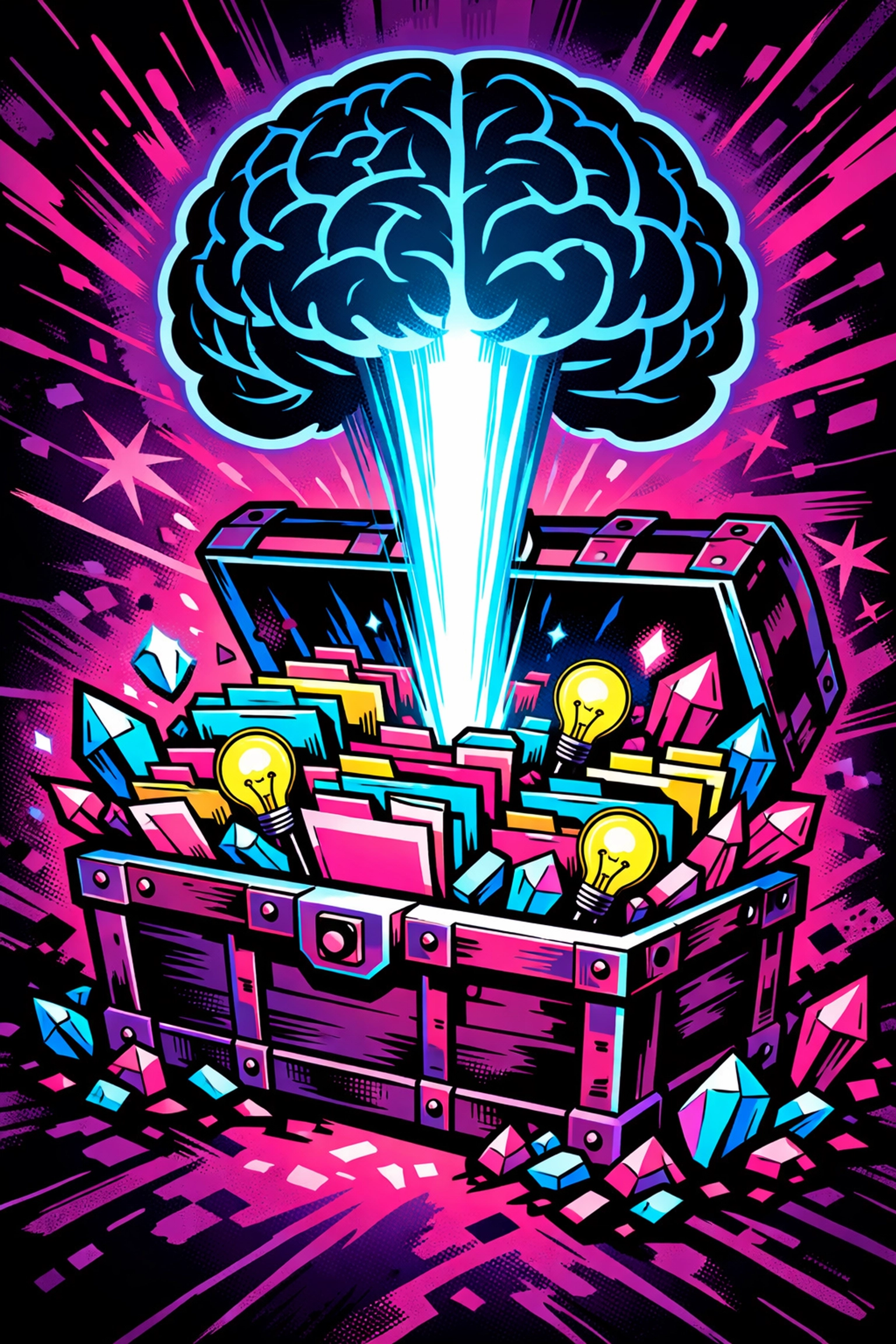
    A digital knowledge base treasure chest fueling an AI chatbot brain to automate customer support questions.

    Building this library might take a weekend of work now, but it will save you 52 weekends of work later. That’s a trade I’d take any day.


    STEP 5: BATCH THE REMAINING MESSAGES LIKE A PRO

    🌙 8:00 PM.

    Even with the best AI, some things will still need a human touch. A complex bug. A sensitive refund. A genuine "thank you" note.

    But you should never, ever handle these as they come in.

    If you answer every email the second it hits your inbox, you are living in "reactive mode." You can't build a business when you're constantly reacting.

    Instead, batch your support.

    Pick two times a day: maybe 10:00 AM and 4:00 PM. Spend 30 minutes clearing the deck. Use canned responses (pre-written templates) for the stuff that the AI couldn't quite handle.

    Open ticket. Click template. Tweak one sentence. Hit send.

    By the time 5:00 PM rolls around, your inbox is at zero, your AI is humming along, and you’re ready to actually enjoy your life.


    WHY THIS MATTERS RIGHT NOW

    You started your business for freedom. But if your inbox is your boss, you aren't free. You’re just an employee with a fancy title.

    Research shows that 80% of solopreneurs who adopt AI automation see a massive drop in administrative grunt work. Some even see their lead conversion jump by 25% because the AI is fast. It never misses a message. It never gets tired.

    It’s time to stop juggling and start scaling.

    Stop losing your Saturdays to "Where is my login?" emails. Use an ai virtual assistant for business to do the heavy lifting for you.

    Ready to see how easy it is to set up?

    Click here to see how Marblism can automate your world and give you your time back.


    FAQ: COMMON QUESTIONS FROM THE SKEPTICS

    Q: Won't my customers hate talking to a robot?
    A: They hate waiting for a human more. 80% of customers prefer an instant answer from a bot over waiting 24 hours for a human. If the bot is smart (which it will be), they’ll love it.

    Q: Is it expensive to automate customer support with AI?
    A: It's way cheaper than your time. Most AI tools for solopreneurs are very affordable. Think "Netflix subscription" prices, not "Corporate Enterprise" prices.

    Q: Do I need to know how to code?
    A: Nope. If you can send an email, you can set up these tools. Most are drag-and-drop.

    Q: What if the AI says something wrong?
    A: You control the "brain" of the AI. You tell it what to say. And if it’s ever unsure, it can simply say, "Let me get a human to look at this for you," and pass the ticket to you.


    THE BOTTOM LINE

    The "hustle" is a lie if it means you're tied to a desk answering the same five questions every day.

    You have the tools. You have the guide. Now you just need to make the move.

    Reclaim your weekends.
    Reclaim your focus.
    Start your automation journey right here.

    The Saturday morning pancakes are waiting. And this time, your phone is going to stay in the other room.

    Organized.
    Automated.
    Free.

    Scaling shouldn't be this easy… but here we are.

  • Pour Over 101: A Beginner’s Guide to Mastering the Perfect Brew

    There is something deeply satisfying about the ritual of a pour over. Unlike the frantic "hit a button and run" nature of a standard drip machine, the pour over demands a moment of your time. It’s the vinyl record of the coffee world: tactile, intentional, and capable of producing a much higher fidelity of flavor. We believe that if you want to truly taste the unique characteristics of a high-quality bean, this is the way to do it.

    Whether you’re a long-time espresso lover looking to branch out or a complete novice wondering why people spend five minutes pouring water in circles, we’ve got you covered. In this guide, we’re going to break down the science, the gear, and the technique required to brew a world-class cup right in your kitchen. And of course, you’ll need the right beans to start with, which you can find over at Limini Coffee.


    Why Choose Pour Over?

    So, why bother? Is it just for the aesthetics? Not at all. The beauty of manual brewing lies in the control. When you use a pour over dripper, you are the master of every variable: water temperature, flow rate, and immersion time.

    Because the water is constantly being filtered through the grounds and then out of the bottom, it extracts flavors differently than an immersion method like a French Press. You’ll notice a "cleaner" mouthfeel and much more distinct tasting notes. If you’re brewing a light-roasted Ethiopian Yirgacheffe, for example, a pour over will highlight those delicate floral and citrus notes that might get "muddy" in other brewers.

    We think it’s the best way to appreciate the hard work that goes into sourcing our coffee. When you buy specialty beans, you’re paying for those nuances: pour over ensures you actually get to taste them.


    The Essential Gear List

    Before we get into the "how," let’s talk about the "what." You don’t need a laboratory-grade setup, but there are a few non-negotiables if you want consistency.

    1. The Dripper

    There are dozens of styles out there. The Hario V60 is the gold standard for many because of its internal ribs and large exit hole, which allow for a lot of technique. Then there’s the Kalita Wave, which has a flat bottom and is a bit more "forgiving" for beginners. To be honest, we love both, but the V60 is a great place to start your journey.

    2. The Filter

    Paper filters are the most common. They do a brilliant job of catching the coffee oils and fine particles (fines), resulting in that signature clean cup. Just remember: always rinse your paper filter with hot water before adding the coffee to remove any papery taste.

    3. A Gooseneck Kettle

    This is the one piece of kit people try to skip, but it’s actually extremely important. A standard tea kettle glugs and splashes. A gooseneck kettle has a long, narrow spout that gives you surgical precision over where the water goes and how fast it gets there.

    4. A Digital Scale

    We cannot stress this enough: stop using scoops. Coffee beans vary in density. A scoop of a dark roast weighs less than a scoop of a light roast. If you want a perfect brew every single time, you need to measure by weight. We’re looking for grams here.

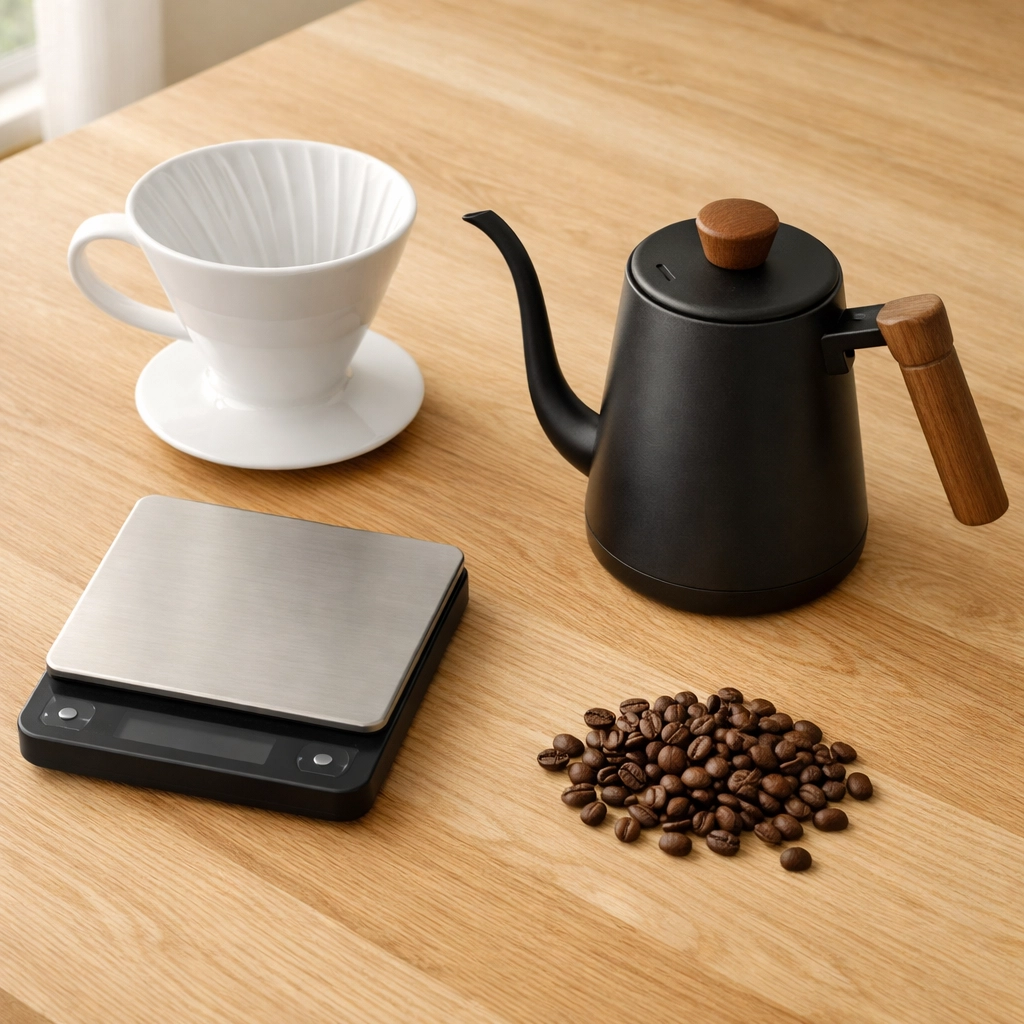
    Essential pour over coffee gear including a V60 dripper, scale, and gooseneck kettle on a wooden counter.


    The Golden Variables: Ratio and Grind

    If your coffee tastes like battery acid or bitter ash, it’s usually because one of these two things is off.

    The Ratio

    We generally recommend a starting ratio of 1:16. This means for every 1 gram of coffee, you use 16 grams (or milliliters) of water. For a single mug of coffee, that’s usually about 15g of coffee to 250g of water.

    If you like your coffee a bit "bigger" and bolder, you might try a 1:15 ratio. If you want it lighter and more tea-like, 1:17 is your friend. You can even use our coffee brewing calculator to do the math for you.

    The Grind

    For a pour over, you want a medium-coarse grind. Imagine the texture of sea salt or slightly gritty sand. If the grind is too fine (like espresso), the water won't be able to flow through, the brew will stall, and it will taste bitter and over-extracted. If it’s too coarse (like French Press), the water will rush through too fast, leaving you with a sour, watery mess.

    Freshness is also key. We always recommend grinding your beans right before you brew. You can find our latest fresh-roasted selections at Limini Coffee: the difference in aroma alone is worth it.

    Step-by-Step: The Perfect Pour

    Let’s get down to the actual brewing. Set your scale to zero, get your timer ready, and let's go.

    Step 1: Prep and Rinse

    Place your filter in the dripper and set it on top of your mug or carafe. Pour some hot water through the filter. This warms up your equipment and gets rid of that "cardboard" flavor. Discard the rinse water from the mug.

    Step 2: Add Your Grounds

    Add 15g of freshly ground coffee to the center of the filter. Give the dripper a gentle shake to level the grounds. This ensures the water hits everything evenly.

    Step 3: The Bloom

    Start your timer. Pour about 30-45g of water (roughly double the weight of the coffee) over the grounds. Do this quickly but gently, making sure all the grounds are wet. Now, wait for 30 to 45 seconds.
    You’ll see the coffee "puff up" and bubble. This is called the bloom. It’s the release of CO2 trapped in the beans. If your coffee doesn't bubble, it’s likely not fresh. (Another reason to check out our single origin reviews and grab a fresh bag!)

    A close-up of fresh coffee grounds bubbling during the bloom stage of a pour over brew.

    Step 4: The Main Pours

    Once the bloom is finished, start pouring in slow, concentric circles. Start from the center and move outward, then back toward the center. Avoid pouring directly onto the walls of the filter, as the water will just bypass the coffee (this is called "channeling").

    We like to do this in two or three pulses. Aim to have all 250g of water in the dripper by the 2:15 mark.

    Step 5: The Final Draw Down

    Give the dripper a very gentle stir or a tiny "swirl" to knock any grounds off the sides. Now, let gravity do the rest. The water should finish dripping through the bed of coffee by the 3:30 to 4:00 minute mark.

    If it finishes at 2 minutes, your grind is too coarse. If it’s still dripping at 5 minutes, your grind is too fine.


    Water Temperature Matters

    We often see people using boiling water straight off the stove. While you won't necessarily "burn" the coffee, water that is 100 ºC (212 ºF) can extract some of the harsher, more astringent compounds too quickly.

    The sweet spot for pour over is generally between 92 ºC and 96 ºC (198 ºF to 205 ºF). If you don't have a temperature-controlled kettle, just let your boiling water sit for about 60 seconds before you start pouring. This small adjustment can make a massive difference in the sweetness of your cup.

    A home barista using a gooseneck kettle to pour hot water for a precise manual coffee brew.


    Troubleshooting Your Brew

    Is your coffee not tasting like the "notes of jasmine and toasted caramel" promised on the bag? Don't worry, it happens to the best of us. Here’s how we fix common issues:

    • It tastes sour or salty: This usually means "under-extraction." The water didn't pull enough flavor out. To fix this, grind your coffee a bit finer next time, or use slightly hotter water.
    • It tastes bitter or dry: This is "over-extraction." You've pulled out the woody, bitter stuff. Try a coarser grind or slightly cooler water.
    • The brew is taking forever: Your grind is likely too fine, or you have too many "fines" (tiny dust-like particles) clogging the filter. A better quality grinder helps here.
    • It tastes weak/watery: You might need to adjust your ratio. Try using a bit more coffee next time (maybe a 1:15 ratio).

    If you want to dive deeper into the science of why coffee tastes the way it does, we actually offer barista training where we cover these variables in great detail.


    The Importance of Freshness

    At the end of the day, you can have the most expensive kettle and the perfect technique, but if your beans are stale, your coffee will be boring. Coffee starts losing its aromatic complexity almost immediately after roasting, and that process accelerates once it’s ground.

    That’s why we at Limini Coffee are so obsessed with roasting to order. We want you to open that bag and be hit with an aroma that fills the room. If you’re ready to put your new pour over skills to the test, grab a bag of something special from Scott’s affiliate link here.

    Freshly roasted medium-brown specialty coffee beans spilling from a burlap bag.


    Final Thoughts

    Mastering the pour over is a journey. Your first cup might be a bit "meh," but by your tenth cup, you’ll be noticing nuances you never thought possible in a black coffee. It’s a meditative process that rewards patience and precision.

    Remember, there is no "perfect" recipe: only the recipe that you enjoy the most. Feel free to experiment with different ratios and temperatures. After all, that is the beauty of coffee 🙂

    If you’re looking to upgrade your home setup or even thinking about starting your own café, we have plenty of resources on choosing espresso equipment and wholesale options to help you on your way.

    Happy brewing!

    A finished cup of clear, amber pour over coffee in a ceramic mug on a wooden table.

  • Coffee & Health: 5 Myths Debunked

    Coffee & Health: 5 Myths Debunked

    Look, we've all been there. You're enjoying your third cup of the day when someone hits you with, "Isn't that dehydrating?" or "You know that's bad for your heart, right?" And suddenly you're second-guessing your life choices over a simple brew.

    Here's the thing: coffee has been getting a bad rap for decades, and most of it is complete rubbish. Science has actually caught up, and the evidence is pretty clear – your daily coffee habit is probably doing you more good than harm. So let's tackle the five biggest myths that keep popping up and set the record straight once and for all.

    Myth 1: Coffee Is Dehydrating

    This one just won't die, will it?

    You've probably heard it a million times: "Coffee doesn't count toward your daily water intake because it's a diuretic." Well, we've got news for you. Moderate coffee consumption does not cause dehydration. Full stop.

    Here's why: Coffee is more than 95% water. The diuretic effect of caffeine – which is real, to be fair – is absolutely minimal compared to the total liquid content you're consuming. Recent studies have found no significant differences in hydration status between people who drink coffee and those who drink equal amounts of water.

    So that cup you're holding? It's contributing to your hydration, not working against it. Does caffeine make you pee a bit more? Sure. But the fluid you're taking in far outweighs what you're losing. Unless you're downing espresso shots by the dozen (which, let's be honest, we wouldn't recommend for other reasons), your hydration levels are just fine.

    Glass of water and coffee cup side by side showing coffee contributes to daily hydration

    Myth 2: Coffee Is Bad for Your Heart

    This myth has scared away more coffee lovers than we'd like to count, and it's time to put it to rest.

    Recent studies show absolutely no association between coffee consumption and increased cardiovascular disease risk. In fact, the opposite appears to be true. Moderate coffee consumption – we're talking 2 to 5 cups per day – has been associated with an 11% reduction in coronary heart disease risk.

    Even more impressive? A massive 2022 study based on over 500,000 UK residents found that consuming 2 to 3 cups of coffee daily was linked to significant reductions in cardiovascular disease and overall mortality. Not "no harm." Actual benefits.

    Now, we're not saying coffee is a magical cure-all. But if you've been worried that your morning ritual is slowly destroying your heart, you can breathe easy. The science just doesn't support that fear. Your heart is probably quite happy with your coffee habit, especially if you're drinking quality, freshly roasted beans like the ones we offer at Limini Coffee.

    Myth 3: Coffee Stunts Your Growth

    Remember being told as a kid that coffee would keep you short? Yeah, we heard that one too.

    There is absolutely no scientific basis for the claim that caffeine prevents growth in children. None. Zero. This myth has been floating around forever, and no one really knows where it came from, but it's definitely not rooted in evidence.

    No studies connect coffee consumption to growth impairment. While caffeine can act as a mild appetite suppressant, this doesn't translate into any meaningful effects on development or height. Kids grow based on genetics, nutrition, and overall health – not whether they snuck a sip of your latte.

    Should children be drinking coffee? That's a different conversation entirely, and one that's more about caffeine sensitivity and sleep patterns than growth. But if you're an adult who was told this as a child and still feels a bit guilty about your coffee consumption, you can officially let that one go.

    Hands holding coffee cup during peaceful morning routine promoting heart-healthy lifestyle

    Myth 4: Coffee Causes Digestive Issues

    If anything, this myth is backwards.

    Coffee actually supports digestive health. Moderate consumption of 3 to 5 cups per day stimulates the release of gastric acid, bile, and pancreatic enzymes, all of which help efficiently break down food. For many people, that morning cup literally gets things moving (if you know what we mean).

    Research also suggests that coffee consumption is associated with healthy gut microflora, likely due to the polyphenol compounds found in coffee. These are the same beneficial compounds you hear about in things like tea and dark chocolate – powerful antioxidants that support overall gut health.

    Now, we're not saying coffee works for everyone's digestive system. Some people are more sensitive and might experience discomfort, especially on an empty stomach or with particularly acidic coffees. But the blanket statement that "coffee causes digestive issues" just doesn't hold up. For most people, it's actually helping, not hurting.

    This is where quality matters, though. Specialty coffee that's been properly roasted and freshly prepared tends to be much gentler on the stomach than the stale, over-roasted stuff you might find elsewhere. When you're drinking fresh, quality beans, you're getting all those beneficial compounds without the harsh bitterness that can irritate sensitive stomachs.

    Myth 5: Adding Sugar Destroys Coffee's Health Benefits

    Here's one that might surprise you, especially if you've been forcing yourself to drink black coffee purely for health reasons.

    Sugar-sweetened coffee retains health benefits similar to black coffee. We know, we know – this goes against everything you've been told about "clean" coffee drinking. But a large UK Biobank study found that both unsweetened and sugar-sweetened coffee were associated with lower risk of cancer-related and cardiovascular mortality.

    Participants who drank moderate amounts of sugar-sweetened coffee showed significantly reduced mortality risk compared to non-coffee drinkers. The coffee itself – with all its polyphenols, antioxidants, and beneficial compounds – is doing the heavy lifting health-wise.

    Obviously, we're not suggesting you dump five spoons of sugar into every cup. Too much added sugar isn't great for anyone, regardless of what it's sweetening. But if you prefer your coffee with a bit of sweetness, you don't need to feel guilty about it from a health perspective. You're still getting the benefits.

    That said, when you start with really good coffee – the kind that's been carefully sourced, expertly roasted, and consumed fresh – you often don't need as much sugar anyway. Quality beans have natural sweetness and complexity that cheaper coffees just can't match. It's worth experiencing what specialty coffee actually tastes like before you automatically reach for the sugar bowl.

    Healthy breakfast with coffee, fresh fruit, and whole grains on wooden table

    Why Quality Matters More Than You Think

    So here's the thing we haven't mentioned yet: not all coffee is created equal when it comes to health benefits.

    The studies we've referenced are based on coffee consumption in general, but the quality of what you're drinking absolutely makes a difference. Stale, poorly stored coffee loses many of those beneficial compounds over time. Over-roasted coffee can be harsh and acidic. And low-quality beans might contain impurities or defects that definitely aren't doing your body any favours.

    When you choose specialty coffee that's been freshly roasted and properly stored, you're getting the maximum amount of those polyphenols, antioxidants, and beneficial compounds. You're also getting better flavour, which means you might need less sugar or cream to make it enjoyable. Fresh coffee from quality beans is genuinely a cleaner, better choice for your health.

    We've spent years perfecting our roasting process to bring out the best in every bean, and we always roast to order so you're getting coffee at its absolute peak. That's not just about taste – it's about getting all those health benefits in their most potent form.

    The Bottom Line

    Coffee isn't the villain it's been made out to be. It's not dehydrating you, destroying your heart, stunting anyone's growth, ruining your digestion, or losing all its benefits the moment you add a bit of sweetness.

    The evidence is pretty overwhelming: moderate coffee consumption is associated with numerous health benefits, from reduced cardiovascular disease risk to better digestive health to lower mortality rates. Your daily coffee habit is probably one of the better things you're doing for yourself, especially if you're drinking quality stuff.

    So the next time someone gives you grief about your coffee consumption, you've got the science on your side. And if you want to maximize those health benefits while enjoying genuinely delicious coffee, stock up on some fresh, expertly roasted beans and drink up without guilt.

    Your body (and your taste buds) will thank you.

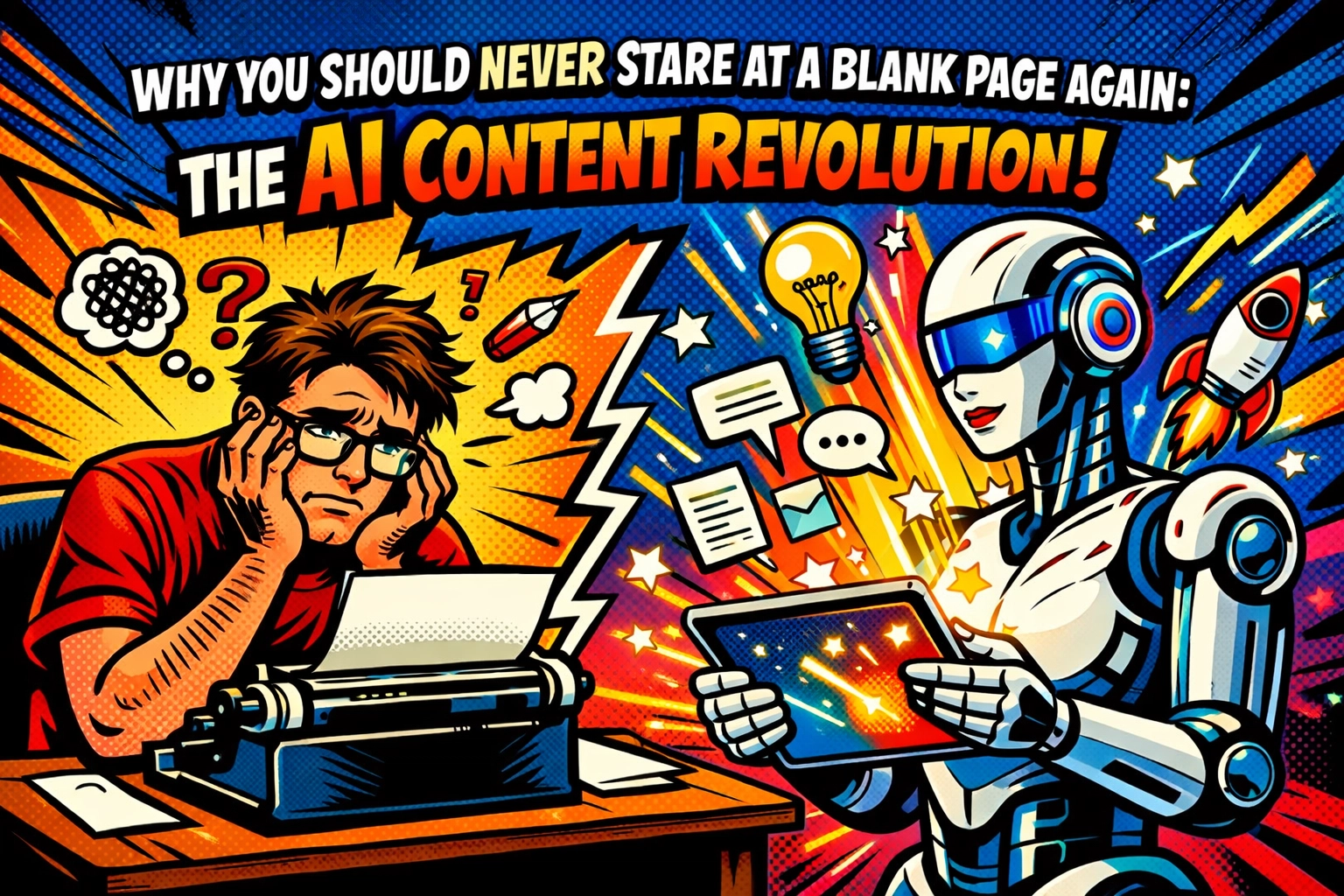
  • Why You Should Never Stare at a Blank Page Again: The AI Content Revolution

    Why You Should Never Stare at a Blank Page Again: The AI Content Revolution

    You know that feeling.

    The cursor blinks at you. Mocking. Waiting.

    You've got a blog post due. Social media captions to write. An email newsletter that should've gone out yesterday. And all you've got is… nothing. Just that blank screen and the slow creep of panic.

    Writer's block isn't writer's block anymore. It's business block. Revenue block. Growth block.

    Every hour you spend staring at that empty page is an hour you're not connecting with customers. Not building your brand. Not moving forward.

    But here's the thing : you're never supposed to start from zero anymore.

    THE OLD WAY WAS BROKEN

    Let's be honest about what content creation used to look like for small business owners.

    You'd sit down with good intentions. Maybe you'd open three browser tabs for "research." You'd read a few articles. Get distracted. Check your email. Come back to the blank page.

    Start typing. Delete it. Start again. Delete it again.

    Two hours later? You'd have a mediocre paragraph and a headache.

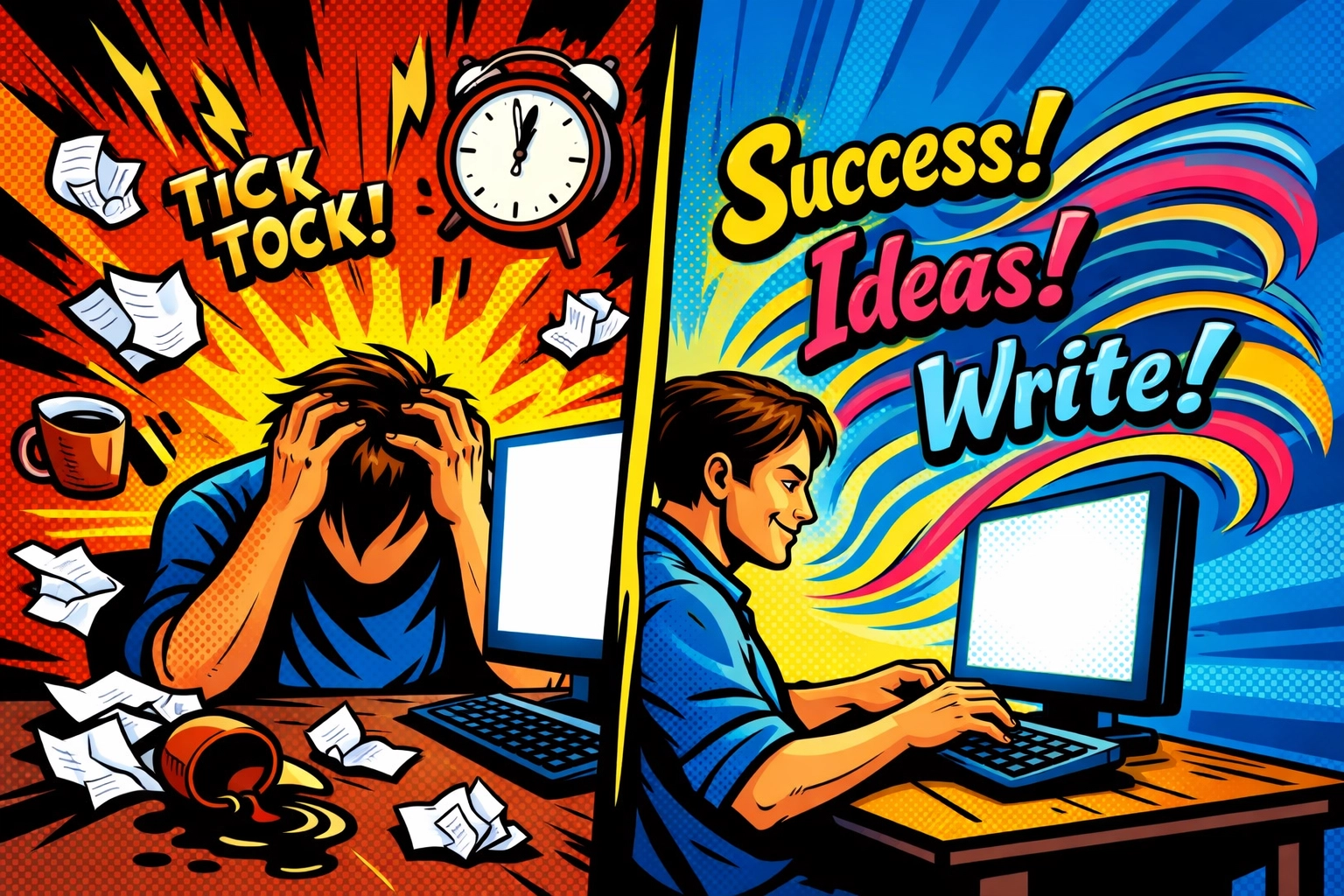
    Writer's block vs AI content creation: frustrated writer at blank screen transforms into confident content creator

    The traditional content creation process wasn't just slow : it was soul-crushing. You'd pour hours into a single blog post, knowing you needed to publish three more this week to stay competitive. The math didn't work. The energy didn't work.

    And the worst part? You're not a copywriter. You're a business owner who needs to create content on top of everything else you do.

    THE AI CONTENT GENERATOR CHANGES EVERYTHING

    Here's what most people miss about AI content generators for small business: they don't just write faster. They eliminate the paralysis.

    You're not staring at nothing anymore. You're starting with something.

    An ai content generator for small business handles the heavy lifting : the research, the structure, the first draft. You handle the magic : your unique voice, your specific insights, your brand personality.

    It's 9:00 AM on a Tuesday. ☕

    You need a blog post about your new service. In the old days, this would eat up your entire morning. Today?

    You open your AI content tool. You feed it a simple prompt: "Write a blog post about [your service] for small business owners who are tired of [their pain point]."

    Sixty seconds later, you've got a 1,200-word draft with a clear structure, relevant research, and SEO keywords already woven in.

    Is it perfect? No.

    Is it better than a blank page? Absolutely.

    You spend the next twenty minutes adding your stories. Your examples. Your personality. By 9:30 AM, you've got a published blog post and you're back to running your actual business.

    That's the revolution.

    SPEED ISN'T JUST CONVENIENT : IT'S COMPETITIVE

    Your competitors are publishing content. A lot of it.

    The businesses winning online right now aren't necessarily better than you. They're just more visible. More consistent. More present.

    AI business automation helps small business owners create content faster than traditional manual methods

    And they're not doing it by hiring expensive agencies or working 16-hour days. They're using ai business automation to scale their content output without scaling their stress levels.

    Think about it: What if you could publish daily instead of weekly? What if you could test five different email subject lines instead of agonizing over one? What if you could have fresh social media content ready to go for the entire week in under an hour?

    That's not a fantasy. That's Tuesday for businesses using AI content tools.

    THE WRITER'S BLOCK MYTH

    Here's something nobody talks about: writer's block isn't usually about creativity. It's about confidence.

    You freeze because you're not sure if what you're about to write is good enough. Smart enough. Different enough.

    But AI doesn't freeze. It just starts. And once there's something on the page, your brain can finally engage with it.

    You're not creating from nothing anymore : you're editing. Refining. Improving.

    That shift changes everything. Your perfectionism becomes productive instead of paralyzing. You're not generating content anymore. You're sculpting it.

    A client of mine used to spend three hours on every blog post. "I just couldn't get started," she told me. "I'd research forever because I felt like I didn't know enough to begin."

    Now? She uses an AI content generator to create the research summary and first draft. She spends thirty minutes adding her perspective and stories. Her blog went from monthly updates to weekly : and her organic traffic tripled in four months.

    The bottleneck wasn't her ability. It was the blank page.

    YOUR NEW CONTENT WORKFLOW

    Picture this instead:

    It's Monday morning. 🌅 You've got coffee, you've got focus, and you need to knock out content for the week.

    You spend fifteen minutes outlining topics in your AI tool. It generates five blog post drafts. You pick the three strongest and spend an hour total refining them : adding your voice, your examples, your calls to action.

    By noon, you've got three blog posts scheduled, six social media posts created from the blog content, and an email newsletter drafted.

    Three hours of work. A week of content.

    That's not cutting corners. That's ai business automation working exactly how it should : handling the repetitive work so you can focus on the strategic thinking.

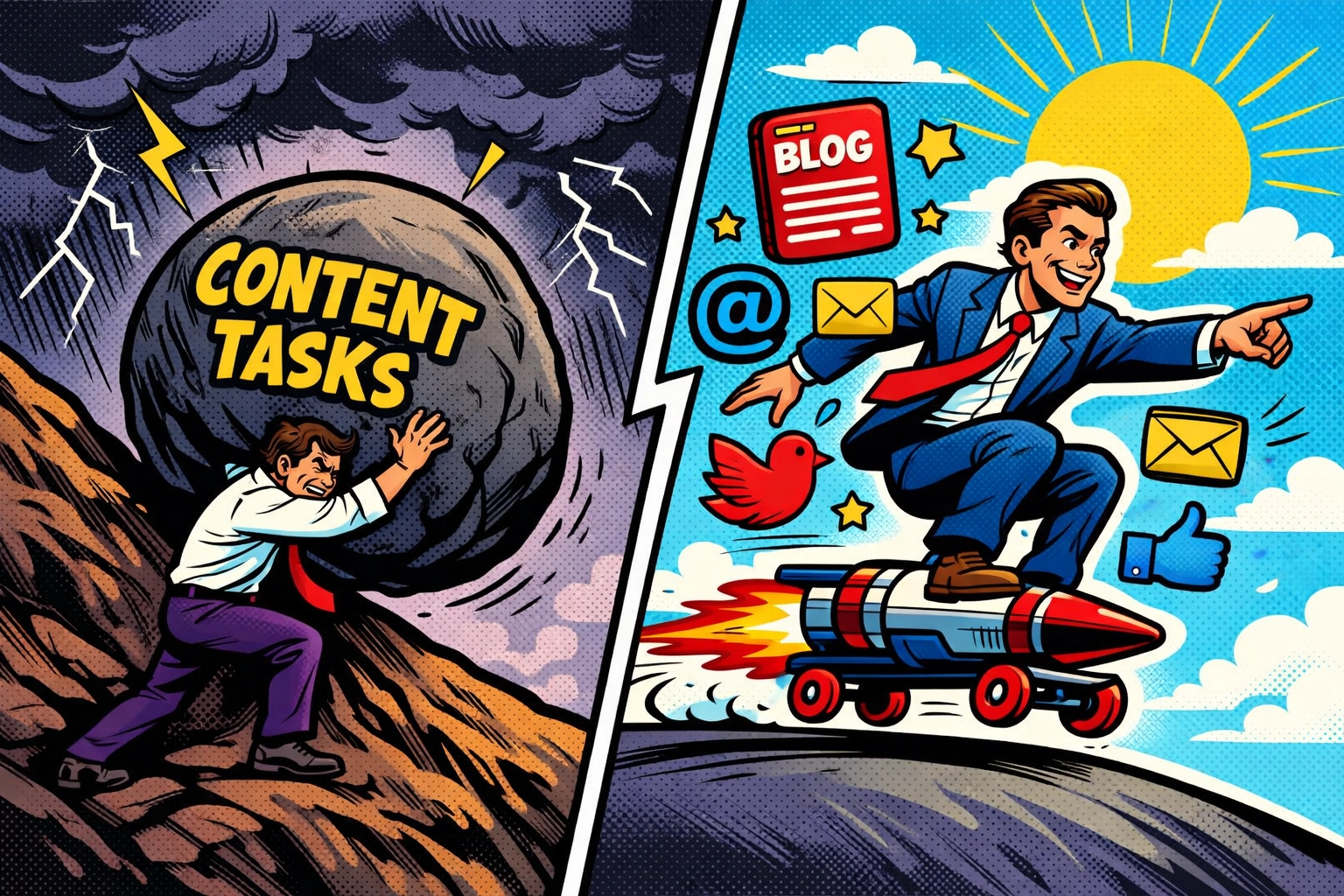
    Before and after using AI content generator: from drowning in blank pages to effortlessly creating content

    THE REAL SECRET: AI AS YOUR CREATIVE PARTNER

    The best AI content creators don't replace you. They multiply you.

    You still bring the insights. The stories. The personality. The AI just makes sure you never start from zero.

    It's like having a research assistant who pulls together all the relevant information, a junior writer who creates the first draft, and an SEO specialist who optimizes for search : all in one tool, ready whenever you need it.

    You're not losing your voice. You're finding it faster.

    WHAT THIS MEANS FOR YOUR BUSINESS

    More content means more touchpoints. More chances to connect. More opportunities to show up when your ideal customer is searching for answers.

    But beyond the volume, there's something else. When you're not drowning in content creation, you can actually be strategic about it.

    You can test different angles. Experiment with formats. Try new channels. All the stuff you knew you "should" do but never had time for? Suddenly it's doable.

    That's when things get interesting. When you stop playing defense with your content ("I need to get something published this week") and start playing offense ("What message would really move the needle right now?").

    THE MARBLISM DIFFERENCE

    Look, plenty of tools can generate content. But ai content generator for small business tools need to do more than just write : they need to understand your entire workflow.

    That's where platforms like Marblism come in. It's not just about cranking out blog posts. It's about integrating content creation into your actual business operations. AI that understands your customer journey. Your sales process. Your growth goals.

    When your content tool talks to your CRM, your project management system, and your customer data? That's when AI stops being a writing assistant and becomes a growth engine.

    Small business owner using AI content tools to efficiently manage multiple content pieces simultaneously

    GETTING STARTED (WITHOUT OVERWHELM)

    You don't need to overhaul everything tomorrow. Start simple:

    Pick one repetitive content task. Maybe it's your weekly newsletter. Or social media captions. Or blog post drafts.

    Use an ai content generator for small business to handle the first draft. You do the polish.

    Do that for two weeks. Notice how much time you get back. Notice how the blank page stops feeling like a threat.

    Then expand from there.

    The businesses winning with AI content aren't the ones with the fanciest tools or the biggest budgets. They're the ones who stopped treating content creation like a creative burden and started treating it like a system.

    You can write. You always could. You just needed to stop starting from nothing.

    READY TO NEVER SEE A BLANK PAGE AGAIN?

    The content revolution isn't coming. It's here. The only question is whether you're going to keep staring at empty screens or start using tools that meet you halfway.

    If you're ready to see how ai business automation can transform your content workflow (and get those hours back), check out what we're building at Marblism.

    Because the blank page? That's yesterday's problem.

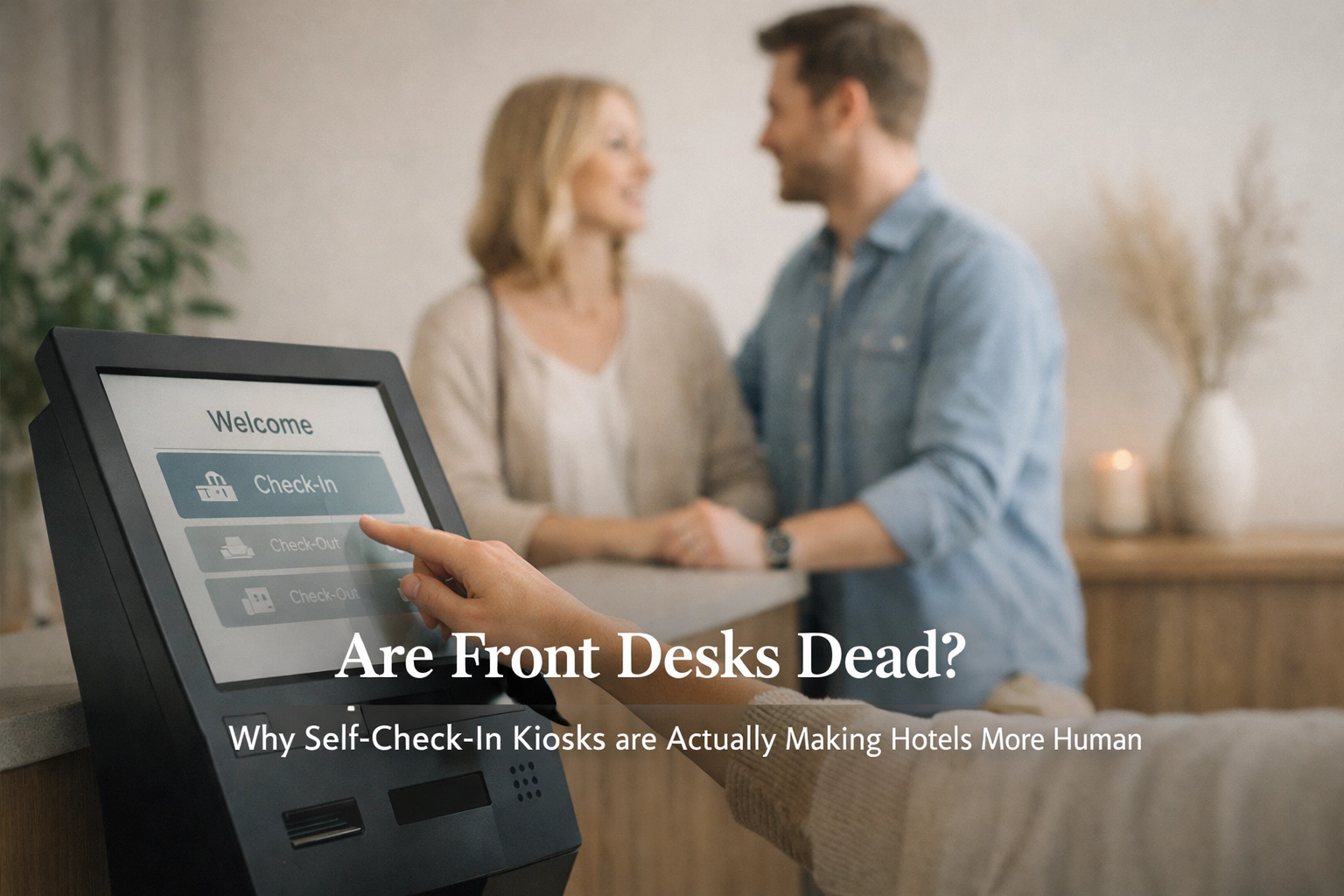
  • Are Front Desks Dead? Why Self-Check-In Kiosks are Actually Making Hotels More Human

    Are Front Desks Dead? Why Self-Check-In Kiosks are Actually Making Hotels More Human

    Automate the mundane. Empower your people. Transform the guest stay.

    The traditional hotel lobby is undergoing a radical transformation. For decades, the "front desk" has been a physical and psychological barrier: a massive slab of marble or wood separating the staff from the very people they are meant to serve. In 2026, we’re seeing that barrier finally crumble.

    But here is the irony: removing the desk doesn’t make the hotel less human. It does the exact opposite. By shifting the transactional weight to self-check-in kiosks and automated systems, you liberate your team to focus on what actually matters: genuine hospitality.

    At Mews, we’ve seen over 12,500 properties transition to a more fluid, tech-enabled way of operating. It’s not about replacing faces with screens. It’s about replacing data entry with eye contact. It’s all from one innovative platform.

    The Wall of Bureaucracy.

    We’ve all been there. You arrive at a hotel after an eleven-hour flight. You’re tired, you’re hungry, and you want to shower. Instead of a warm "Welcome, let me get you settled," you’re met with a person staring intently at a computer screen. They’re clicking. They’re typing. They’re asking for your passport, your credit card, and your signature on a piece of paper that will inevitably be scanned and shredded.

    This isn't hospitality. This is administrative friction.

    When your staff is tethered to a legacy hotel PMS (Property Management System), they aren't looking at the guest. They’re looking at a clunky interface from the 90s. The front desk becomes a workstation, and the guest becomes a task to be completed.

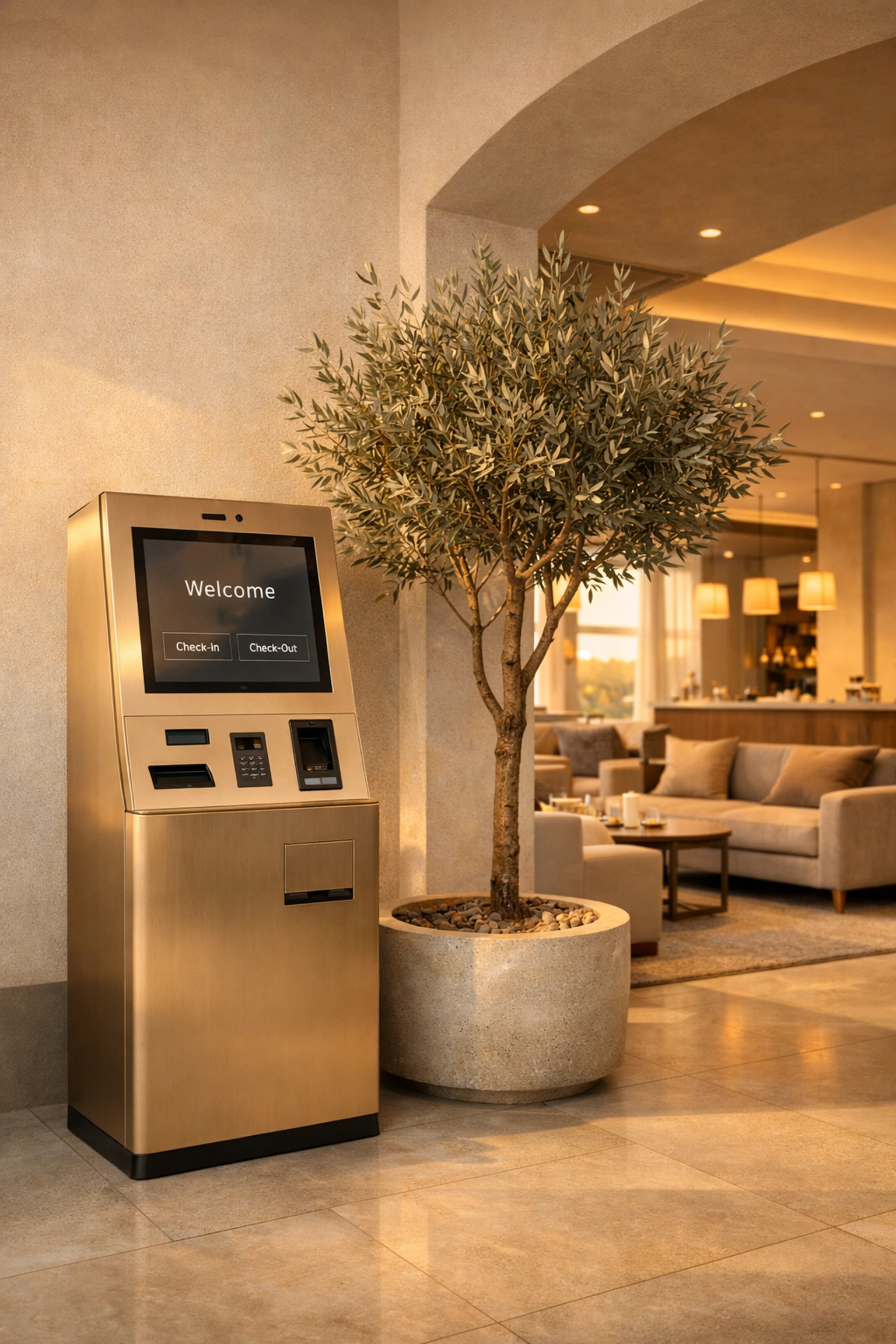
    Sleek minimalist self-check-in kiosk in a modern hotel lobby with an indoor tree.

    Hospitality vs. Data Entry.

    We believe that technology should be invisible. It should sit in the background, quietly handling the heavy lifting so your team can lead with empathy. When you implement self-check-in kiosks, you aren't just saving on labor costs; you’re reclaiming the lobby as a social space.

    • Eliminate queues. No one travels to stand in a line.
    • Reduce errors. Guests enter their own data, ensuring accuracy.
    • Boost revenue. Automated upselling at the kiosk is 20% more effective than verbal pitches.

    Why Kiosks are Human.

    It sounds like a contradiction, doesn’t it? How can a machine make an experience feel more "human"? The answer lies in the quality of the interaction. When the check-in process is automated, the role of the front desk agent evolves. They move from being "data entry clerks" to "experience curators."

    Instead of standing behind a counter, your staff can meet guests in the lounge with a welcome drink. They can walk them to the elevator. They can offer personalized recommendations because they aren't worried about the five people waiting in line to hand over their IDs.

    We think the best service is the one the guest chooses for themselves. Some guests want to talk. Others want to get to their room as fast as possible. Providing a self-check-in kiosk gives the guest the power of choice: and that is the ultimate form of modern service.

    The Tech Stack of the Future.

    To make this work, you need more than just a tablet in a stand. You need an ecosystem that talks to itself. A truly human-centric hotel relies on a cloud-native hotel PMS that integrates every touchpoint of the guest journey.

    1. The Booking Engine: It starts here. Your guest should be able to select their specific room and add-ons before they even arrive.
    2. The Channel Manager: Ensures your inventory is synced across all platforms, preventing the dreaded overbooking that ruins a guest's first impression.
    3. The CRM: Knows that Mr. Smith prefers a high floor and extra pillows, and automatically pushes that info to the kiosk for a personalized greeting.

    Hotel staff using a mobile tablet for personalized guest service in a stylish lounge.

    Real Numbers. Real Impact.

    The shift toward automation isn't just a "vibe": it's a proven strategy for growth and efficiency. In the current market, where labor costs are rising and margins are under pressure, the numbers tell a compelling story.

    • 70% reduction in check-in wait times.
    • 15% increase in ancillary revenue through digital upselling.
    • 10 hours a week saved per staff member on administrative tasks.
    • 25% higher guest satisfaction scores for properties using self-service tech.

    Beyond the Screen.

    We believe that the "front desk" isn't a place: it's a function. And that function can happen anywhere. With a mobile-first hotel PMS, your team can check guests in on a tablet while walking through the garden, or guests can do it themselves on their own smartphones before they even step foot on the property.

    This flexibility is what defines the Mews experience. We aren't just building software; we’re building freedom. Freedom for your guests to move at their own pace. Freedom for your staff to be the hosts they were hired to be.

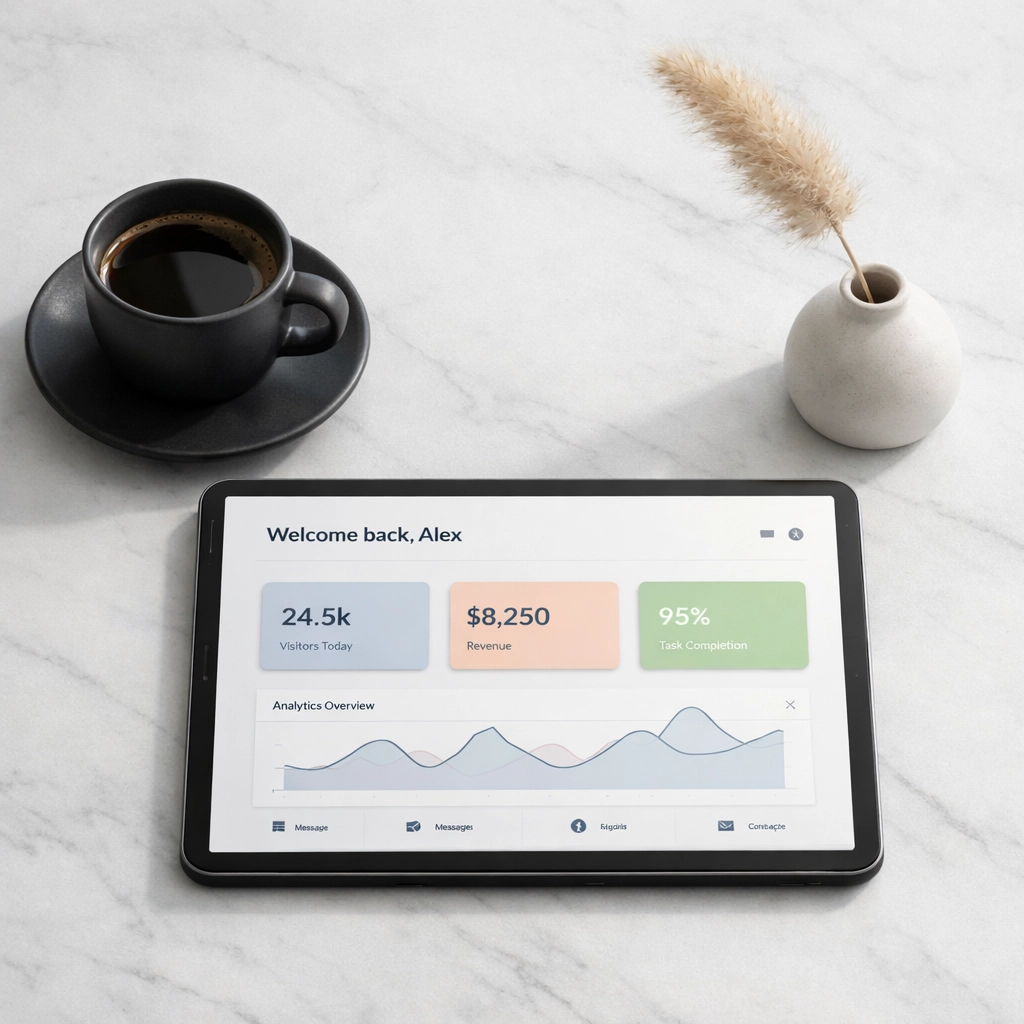
    Top-down view of a modern hotel PMS dashboard on a tablet in a clean minimalist office.

    Connecting the Dots.

    When you integrate your self-check-in kiosks with a powerful channel manager and booking engine, you create a frictionless loop. The guest books a stay, receives an automated "pre-arrival" email from your CRM, checks in via a kiosk in 60 seconds, and spends their saved time enjoying your amenities.

    This isn't a futuristic dream. It’s happening right now at thousands of Mews properties worldwide. We’ve designed our platform to be easy to use and even easier to scale. Whether you’re a boutique stay or a multi-property group, the goal remains the same: less friction, more connection.

    A New Era of Hospitality.

    The front desk isn't necessarily "dead," but its traditional form is definitely obsolete. The future of hospitality is open, mobile, and guest-led. It’s about removing the barriers: both physical and digital: that stand in the way of a great stay.

    By embracing self-check-in kiosks and cloud-native technology, you aren't losing the human touch. You’re finally giving it the space it needs to thrive.

    Ready to see how Mews can transform your property? We make the transition easy. Our team can get you up and running on a platform that actually works for you, not against you.

    Stop managing software and start managing experiences.

    Hotel guest using mobile check-in on a smartphone while on a sunny outdoor terrace.

    Explore the future of hospitality technology.
    Visit Mews and see how our automation-focused platform can help you reclaim your lobby and delight your guests. It’s time to move beyond the desk and into the future.

    Join the 12,500+ properties already leading the way. Get started today and get you earning revenue in no time.

    Book a demo and see Mews in action

  • Wholesale Specialty Coffee Secrets Revealed: What Experts Don’t Want You to Know

    Wholesale Specialty Coffee Secrets Revealed: What Experts Don’t Want You to Know

    So, you’re looking to dive into the world of specialty coffee. Maybe you’re a café startup founder with big dreams of a bustling shop, or perhaps you’re already running a business and feeling like your current beans just aren’t hitting the mark. We get it. The world of wholesale specialty coffee can feel a bit like a secret club where everyone speaks a different language (TDS, extraction yield, anaerobic fermentation: the list goes on).

    But here’s the thing: some of the "experts" in the industry aren't always keen to share the full picture. Why? Because the truth about what makes a great wholesale partnership usually involves more work and less "smoke and mirrors."

    At Limini Coffee, we believe in pulling back the curtain. We’ve been in the roasting game for a long time, and we’ve seen it all: the good, the bad, and the literally bitter. If you’re looking for wholesale coffee roasters who actually care about your success, you need to know what to look for beyond a fancy logo and a shiny bag.

    The Secret of the "Fresh" Roast Date

    Everyone talks about freshness, right? It’s the golden rule of specialty coffee. But what many large-scale coffee suppliers won't tell you is how they actually define "fresh."

    In the world of commodity coffee, "fresh" might mean the bag was sealed three months ago. Large commercial operations roast in massive, multi-ton batches. They have to. To keep costs down and supply lines moving, they roast a mountain of coffee, warehouse it, and ship it out as orders come in. By the time those beans reach your hopper, the volatile oils have started to oxidize, and the vibrant flavor notes have faded into a generic "coffee" taste.

    True specialty coffee roasters do things differently. We believe that coffee is a fresh agricultural product, like bread or produce. Ideally, you want coffee that has been roasted within the last few days, not the last few months.

    Freshly roasted specialty coffee beans cooling in an artisanal roastery for wholesale suppliers.

    When we roast at Limini, we’re aiming for that sweet spot. Generally, coffee needs a few days to degas (release CO2), but after that, it's a race against time. If your supplier isn't roasting to order, you’re already starting behind the curve. Fresh is best. It’s that simple. And if you’re looking for that peak flavor, check out how we do things at Limini Coffee.

    Why "Free" Equipment is Often the Most Expensive

    This is a big one for café startups. You’re looking at your budget, seeing the eye-watering price of a three-group espresso machine, and suddenly a supplier offers you a "free" machine if you buy their coffee. Sounds like a dream, right?

    Unfortunately, it’s often a bit of a trap.

    Nothing is ever truly free. When a supplier "gives" you a machine, they usually recoup that cost by charging you a significantly higher price per kilo for the coffee. You might end up paying £5 or £10 more per kilo than you would otherwise. Over a three-year contract, you could end up paying for that machine twice over.

    Even worse? You’re often locked into a contract with a single supplier. If their quality drops or their service becomes terrible, you’re stuck because they own the equipment on your counter. We prefer a different approach. We think it’s much better for a business to own its equipment or lease it independently. This gives you the freedom to choose the best coffee suppliers based on quality, not because you’re held hostage by a lease agreement.

    The Technical Reality: It’s Not Just About the Beans

    Let’s get a bit technical for a moment, because this is where the magic (and the mess) happens. You can have the best Ethiopian Yirgacheffe in the world, but if your water temperature is off or your pump pressure is wonky, it’s going to taste like dishwater.

    Many wholesale coffee roasters will drop off the bags and wish you luck. But a true partner understands the science. For example, did you know that the temperature of your milk is just as crucial as the coffee itself? We usually recommend aiming for around 140 °F / 60 ºC for that perfect silky microfoam. Go much higher, and you’re scalding the proteins; go lower, and it feels lukewarm to the customer.

    Then there’s the 9 BAR pressure rule. It’s the industry standard for a reason. If your machine isn't consistently hitting that 9 BAR mark, your extraction will be uneven. We’ve spent years exploring these variables because we want our coffee to taste as good in your café as it does in our cupping room.

    Why is this important? Because your customers can tell the difference. They might not know what 9 BAR means, but they know when a latte is "glossy" and "creamy" versus "thin" and "bubbly."

    Barista pouring micro-foamed milk into a specialty coffee latte with glossy texture and tulip art.

    Sourcing: The Difference Between "Specialty" and "Specialty-ish"

    The term "specialty coffee" is thrown around a lot these days, even by supermarket brands. But in the industry, it has a very specific meaning. To be graded as specialty, a coffee must score 80 points or above on a 100-point scale by a certified Q-Grader.

    The "secret" is that many suppliers use a tiny bit of high-scoring coffee in a blend and then call the whole thing "specialty." We find that a bit of a shame, to be honest.

    True specialty roasting involves meticulous sourcing. This means knowing exactly which farm the beans came from, what the altitude was, and how they were processed. Was it a "washed" process, which leads to a clean, bright acidity? Or a "natural" process, which can give you those heavy, funky, fruit-forward notes?

    We love Colombian coffees for their balance and brightness, but we also adore the floral complexity of a high-altitude Ethiopian. When you work with Limini Coffee, you’re getting transparency. We want you to know the story behind the bean so you can tell that story to your customers.

    Training: Your Secret Weapon

    You could have the most expensive machine and the most incredible beans, but if your barista doesn't know how to "dial in" the grind in the morning, the quality will be inconsistent. And consistency is the soul of a successful café.

    A common mistake we see is businesses investing all their money in the fit-out and none in the people. The "experts" might not mention that your staff will need ongoing training. The humidity changes? You need to adjust the grind. A new roast batch arrives? You need to adjust the grind.

    We believe that providing wholesale coffee is only half the job. The other half is support and education. This means teaching baristas about extraction times (usually aiming for that 25-30 second window) and how to identify a "channeled" shot. It’s about empowering your team to be experts themselves.


    The Hidden Costs of Poor Support

    Imagine it’s a busy Saturday morning. There’s a line out the door, and your grinder suddenly gives up the ghost. Who do you call?

    If your coffee supplier is just a logistics company that happens to sell beans, you’re in trouble. You’ll be told to "fill out a ticket" or wait until Monday. A true wholesale partner provides a safety net.

    When choosing between wholesale coffee roasters, ask them about their tech support. Do they have engineers? Do they carry spare parts? Do they actually answer the phone on a weekend? These are the things that keep your business running when things go wrong.

    Professional stainless steel espresso machine in a sunlit boutique café, the heart of a coffee business.

    Sustainability Isn't a Buzzword

    You’ve probably seen "Direct Trade" or "Ethically Sourced" on almost every coffee bag recently. It’s become a bit of a marketing requirement. But the secret is that not all "direct" relationships are created equal.

    Some roasters just buy from a large importer who has a "direct" label. We prefer to dig deeper. Sustainability means ensuring the farmers are paid a premium that actually allows them to invest back into their land and their families. This isn't just about being "nice": it's about the long-term survival of the coffee industry. If farmers can't make a living, they’ll stop growing specialty coffee, and we’ll all be stuck with lower-quality beans.

    When you buy from Limini Coffee, you’re supporting a supply chain that values the person at the start of the journey just as much as the person at the end.

    How to Choose the Right Partner

    So, how do you navigate all this? If you’re a café startup, here is our no-nonsense checklist for choosing a supplier:

    1. Taste the Coffee: Don't just look at the branding. Request samples. Cupping the coffee is the only way to know if it fits your brand.
    2. Ask About Roast Dates: Do they roast to order? If they can't tell you exactly when a batch was roasted, move on.
    3. Check the Training Options: Do they have a training lab? Will they come to your site?
    4. Audit Their Technical Support: What happens if your machine breaks? Get specific answers.
    5. Look for Transparency: Can they tell you the farm name, the altitude, and the processing method of their single origins?

    Choosing a supplier is like entering a marriage. You’re going to be talking to these people every week. You want someone who is helpful, knowledgeable, and: above all: passionate about what they do.

    Final Thoughts

    The specialty coffee industry can sometimes feel a bit intimidating, but it doesn't have to be. Once you look past the jargon and the "gatekeeper" attitudes, it's really just about great fruit, careful roasting, and precise preparation.

    We believe that every business, no matter how small, deserves access to incredible coffee and expert support. Whether you're just starting your journey or looking to level up your current offering, we're here to help. To be honest, we just love talking about coffee, and we love seeing our partners succeed even more.

    If you’re ready to see what a real wholesale partnership looks like, come and have a chat with us at Limini Coffee. We’ve got the beans, the machines, and the expertise to help you brew something truly special.

    Remember, the best coffee isn't just a product; it's the result of a whole lot of people caring about the tiny details. And that is the beauty of coffee 🙂

  • Stop Wasting Time on Admin: 7 Quick Hacks for Workflow Automation for Small Business

    Stop Wasting Time on Admin: 7 Quick Hacks for Workflow Automation for Small Business

    ☕ 7:00 AM.

    The sun isn’t even fully up, but your phone is already screaming. A notification about a missed invoice. A "quick question" from a client in your Demos folder. Three LinkedIn messages from people you don’t know.

    You haven't even had a sip of coffee, and you’re already behind.

    You didn't start this business to spend four hours a day moving data from one spreadsheet to another. You started it to create, to lead, and, let’s be honest, to actually enjoy your life. But right now? You’re a high-priced administrative assistant for your own company.

    It’s time to stop the bleeding.

    The secret isn't "hustling harder" or waking up at 4:00 AM. The secret is ai business automation. It’s about building a machine that works while you’re sleeping, eating, or finally taking that weekend trip you've been postponing for three years.

    Here are 7 quick hacks to get your time back.


    1. KILL THE "WHEN ARE YOU FREE?" DANCE

    📱 9:30 AM.

    You’re back and forth with a lead. "Are you free Tuesday at 2?" "No, how about Wednesday at 4?" "I can do Wednesday, but only if it’s before 4:30."

    Stop it. Just stop.

    Every minute you spend playing calendar tag is a minute you aren't closing deals. Business automation tools like Calendly or SavvyCal take this off your plate entirely. You send a link. They pick a spot. It shows up on your calendar. Done.

    But let’s level up. Use an AI tool to pre-qualify those meetings. If they don't meet your criteria, the meeting never even gets booked. You only talk to the people who are ready to buy.

    AI business automation robot organizing meeting calendars for a relaxed business owner.

    2. LET YOUR INBOX SORT ITSELF

    🔍 10:15 AM.

    Your inbox is a junk drawer. Important client updates are buried under newsletters and receipts.

    You don't need to manually archive every email. You can set up automated customer journeys using tools like Mailchimp or ActiveCampaign. When a new lead hits your site, they should get a personalized welcome sequence immediately. Not when you "get around to it" on Friday afternoon.

    AI can now even "read" your incoming mail. It can tag high-priority support tickets, draft a response based on your previous emails, and leave it in your drafts for a simple "click and send."

    The chaos is gone before you even take your first sip of mid-morning espresso.

    3. BANISH MANUAL DATA ENTRY (FOREVER)

    💻 11:45 AM.

    You’re copying a name from a contact form and pasting it into your CRM. Then you’re pasting it into your invoice software. Then you’re adding it to your mailing list.

    This is the fastest way to burn out.

    Enter Zapier or Make. These are the "glue" of the internet. They connect your apps so they talk to each other. When someone fills out a form on your site, Zapier can automatically create a lead in your CRM, send you a Slack message, and add them to a Google Sheet.

    No typing. No typos. No tears.

    If you want to see how this looks in the real world, check out what we're doing at https://marblism.link/scott-bowen. We turn complex workflows into a single click.

    4. PUT YOUR BILLING ON AUTOPILOT

    💰 1:30 PM.

    "Did they pay?"

    You shouldn't have to ask that. Chasing invoices is a vibe-killer. Tools like QuickBooks or FreshBooks can automate your entire financial lifecycle.

    Set up recurring invoices for your long-term clients. If a payment is late, let the software send the "friendly reminder" email. You don’t have to be the "bad guy" anymore. The bot handles the awkwardness while you keep the relationship professional.

    Business automation tools processing invoices and turning billing into steady revenue.

    5. THE "ONE-CLICK" APPROVAL SYSTEM

    🤝 2:45 PM.

    Your team is pinging you. "Can I buy this software?" "Is this graphic okay?" "Do you approve this copy?"

    If your business stops because you haven't checked Slack, you have a bottleneck. And the bottleneck is you.

    Use Slack’s Workflow Builder to create simple approval forms. Your team submits the request, you get a "Yes" or "No" button on your phone, and the decision is logged. No more long threads. No more "I forgot I said yes to that."

    6. STOP ASKING "IS IT DONE?"

    📋 4:00 PM.

    You’re checking in on a project. You send a text. Then an email. Then you check the shared drive.

    Stop.

    Project management tools like Asana, Trello, or Monday.com are your new best friends. But the trick is the automation inside them. When a task moves from "In Progress" to "Review," the right person should be notified automatically.

    You should be able to look at a dashboard and see the health of your business in ten seconds. If you have to ask for an update, your system is broken.

    Business owner using an automated dashboard to track project progress and workflow status.

    7. BUILD A RECURRING REVENUE ENGINE

    🌙 6:00 PM.

    The day is winding down. But for a smart business owner, the work is just beginning, automatically.

    Use custom workflow engines to trigger actions based on behavior. If a customer hasn't ordered in 30 days, send them a "We miss you" coupon. If a lead hits a specific page on your site three times, trigger a personal outreach task for your sales team.

    This is where ai business automation goes from "neat" to "game-changing." You aren't just saving time; you're making money while you’re at dinner.


    SCALING SHOULDN'T BE THIS HARD. BUT HERE WE ARE.

    Look, you can keep doing it all yourself. You can keep being the "everything person." But you'll eventually hit a ceiling. There are only so many hours in a day, and you're already using all of them.

    The difference between a "job you own" and a "business that works for you" is automation.

    At Marblism, we don't just talk about this stuff. We build it. We take the messy, manual parts of your day and turn them into streamlined, AI-powered systems that just… work.

    You don't need to be a coder. You don't need a degree in data science. You just need the right partner to help you flip the switch.

    Ready to stop babysitting your spreadsheets?

    See how we can transform your workflow in minutes.

    👉 Take the 3-minute interactive tour at Marblism


    YOUR AUTOMATION QUESTIONS, ANSWERED

    Q: Is automation expensive for a small business?
    No. Most of the tools mentioned have free or very low-cost tiers. The real expense is the hours of your life you're currently wasting on $15-an-hour tasks.

    Q: Will I lose the "personal touch" with my clients?
    Actually, you’ll improve it. Automation handles the boring stuff so you have more energy to be human when it actually matters. Nobody feels "valued" because you manually typed an invoice. They feel valued because you had time to have a meaningful strategy call with them.

    Q: Do I need to be a "tech person" to set this up?
    Nope. If you can use a smartphone, you can use modern business automation tools. Most of them are drag-and-drop. And if it gets too complex? That’s where we come in.

    Q: Where should I start?
    Start with the thing you hate doing most. If you hate scheduling, start there. If you hate billing, start there. Solve one pain point this week. Then move to the next.


    ☕ 7:00 PM.

    The sun is setting. Your phone is quiet.

    The invoices are sent. The leads are nurtured. The meetings are booked.

    You just send a thumbs-up to a Slack notification and close your laptop.

    The machine is running. And for the first time in a long time… you’re actually free.

    Scaling shouldn't be this easy. But here we are.

    https://marblism.link/scott-bowen