Blog

  • How to Build Your First AI Team in Under a Week (Without Hiring Anyone)

    How to Build Your First AI Team in Under a Week (Without Hiring Anyone)

    You need help.

    Not just any help , you need someone to handle customer emails. Someone to chase down leads. Someone to write that blog post you've been putting off for three weeks. Someone to schedule meetings without the seventeen-email back-and-forth.

    You pull up LinkedIn. Start browsing profiles. Calculate salaries in your head. £35k for a junior? £50k for someone decent? Plus benefits. Plus onboarding time. Plus the risk they'll quit in six months.

    The math doesn't work. But the work still needs doing.

    Here's the thing nobody tells you: you don't need to hire anyone.

    WHAT IF YOUR "TEAM" COULD START MONDAY?

    Forget job postings. Forget interviews. Forget three-month probation periods where you're not even sure if this is working.

    What if you could build a full team , customer support, sales development, content creation, admin coordination , in under a week? No HR paperwork. No desk space. No awkward small talk by the coffee machine.

    That's not a hypothetical. That's ai business automation working the way it should.
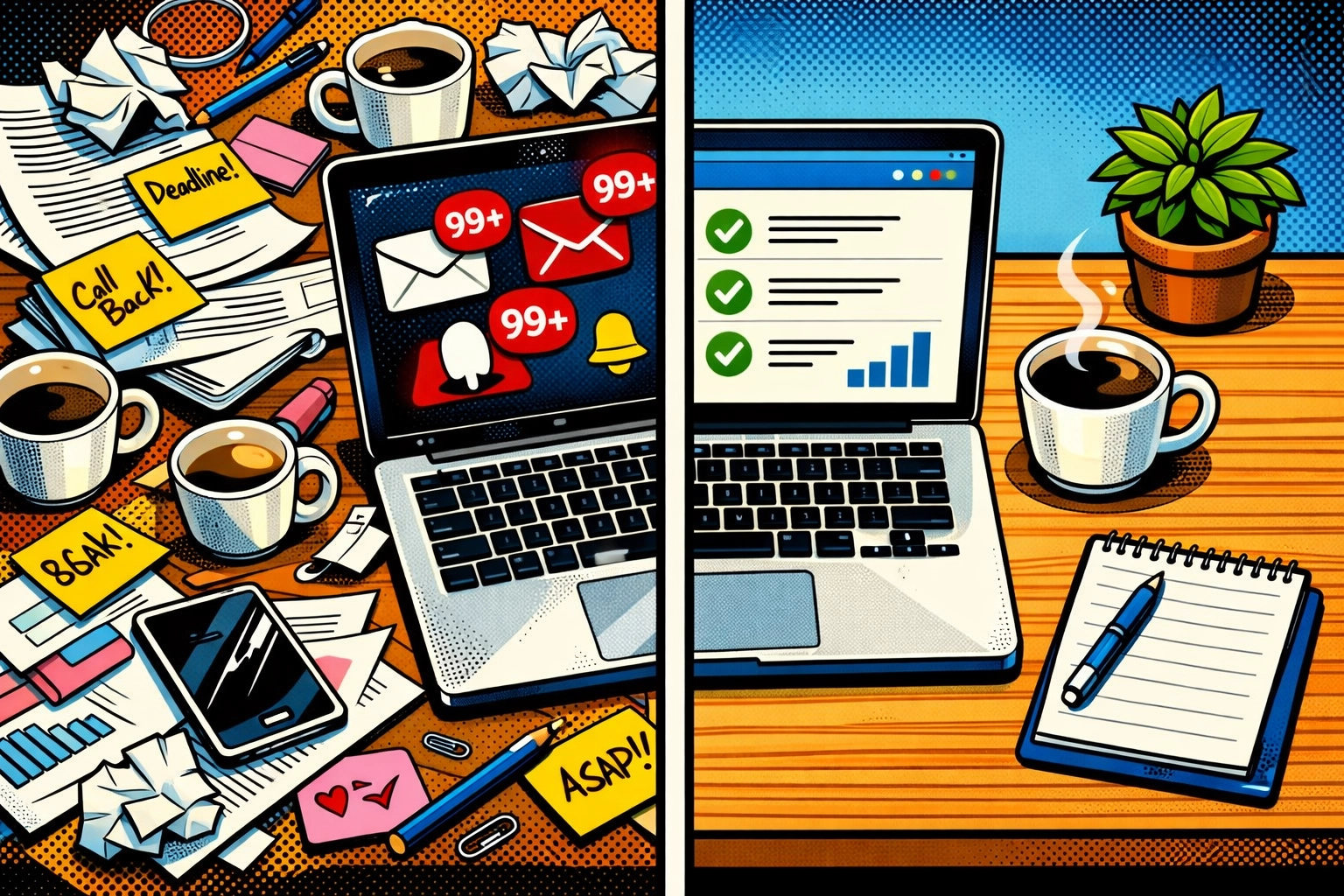
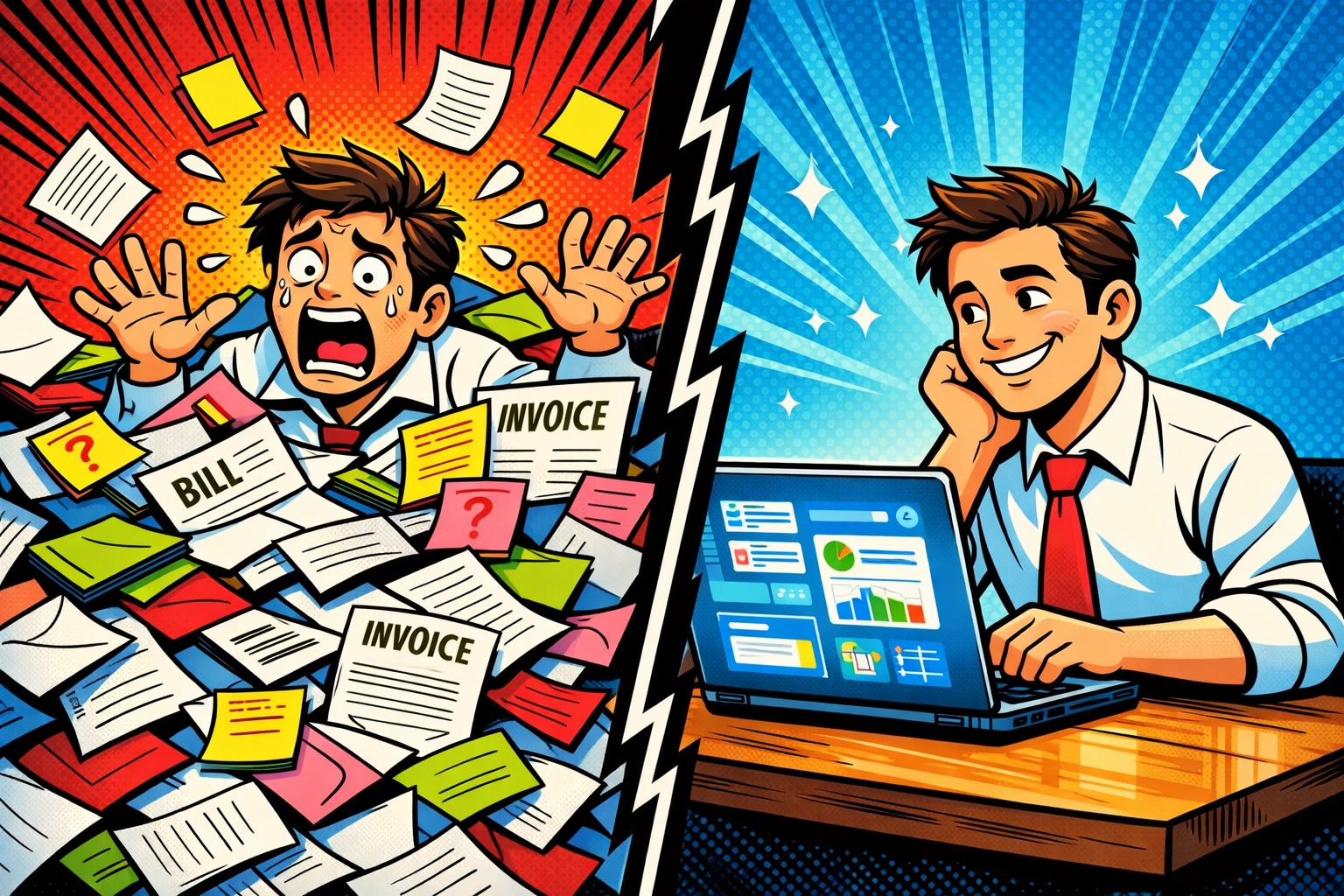
    Before and after AI business automation: chaotic desk transforms into organized workspace

    MONDAY: MEET YOUR NEW HIRES

    7:00 AM

    You open your laptop. Instead of 87 unread emails screaming for attention, you see this:

    "Good morning! I've already handled 12 customer queries overnight. Two need your personal attention , here are the summaries. The rest are resolved. Also, your calendar's cleared for deep work until 11."

    That's Eva. Your AI assistant for small business operations. She's been working while you slept.

    You scan the summaries. Both handled perfectly. You send quick approvals.

    The usual morning email panic? Gone.

    TUESDAY: YOUR SALES TEAM SHOWS UP

    📱 9:30 AM

    Your phone pings. "Found 8 new qualified leads based on your ideal customer profile. All contacted. Three replied already , I've moved them to 'warm' and suggested next steps."

    Stan's been busy. Your AI sales development rep doesn't sleep, doesn't take lunch breaks, and definitely doesn't forget to follow up.

    You click through. The outreach messages sound… good. Natural. Not like a robot wrote them. Each one's personalized based on the prospect's recent activity.

    One prospect replied: "Finally, someone who actually understands what we do. When can we chat?"

    You just schedule the call. Stan did everything else.

    AI team members handling customer service, sales, content creation, and scheduling tasks

    WEDNESDAY: CONTENT THAT DOESN'T SOUND LIKE AI VOMIT

    ✍️ 2:00 PM

    You've been putting off that blog post. Again. But your website needs content. Google needs content. Your potential customers need to find you somehow.

    "I've drafted three blog post options based on your recent customer conversations," Penny says. "They're written in your voice. Want to review?"

    You open the first one. It's… actually good? Not the generic, buzzword-stuffed garbage that screams "AI-generated." This reads like you wrote it. Because Penny learned your style.

    You make two minor edits. Hit publish.

    That's 45 minutes of work instead of four hours. And you didn't have to hire a content writer at £300 per post.

    THURSDAY: THE ADMIN WORK HANDLES ITSELF

    📅 4:30 PM

    Someone wants a meeting. Usually this means:

    • "When are you free?"
    • "How about Tuesday?"
    • "Actually Wednesday works better for me"
    • "Morning or afternoon?"
    • Seven more emails
    • A meeting scheduled for three weeks from now

    Not today.

    "Meeting with Sarah booked for Friday 10 AM. I've sent her the calendar invite and prep materials. You're already briefed on her company."

    That's Alex. Your AI admin coordinator. He handles scheduling, sends meeting prep, even writes follow-up emails based on your meeting notes.

    You didn't lift a finger.

    FRIDAY: YOUR TEAM'S ALREADY RUNNING

    🌙 6:00 PM

    You close your laptop. Check your metrics for the week.

    • 67 customer queries handled (only 4 needed your direct input)
    • 23 qualified leads contacted
    • 2 blog posts published
    • 11 meetings scheduled and prepped
    • Zero new hires made

    Your "team" cost less than one junior employee's salary. And they started Monday.
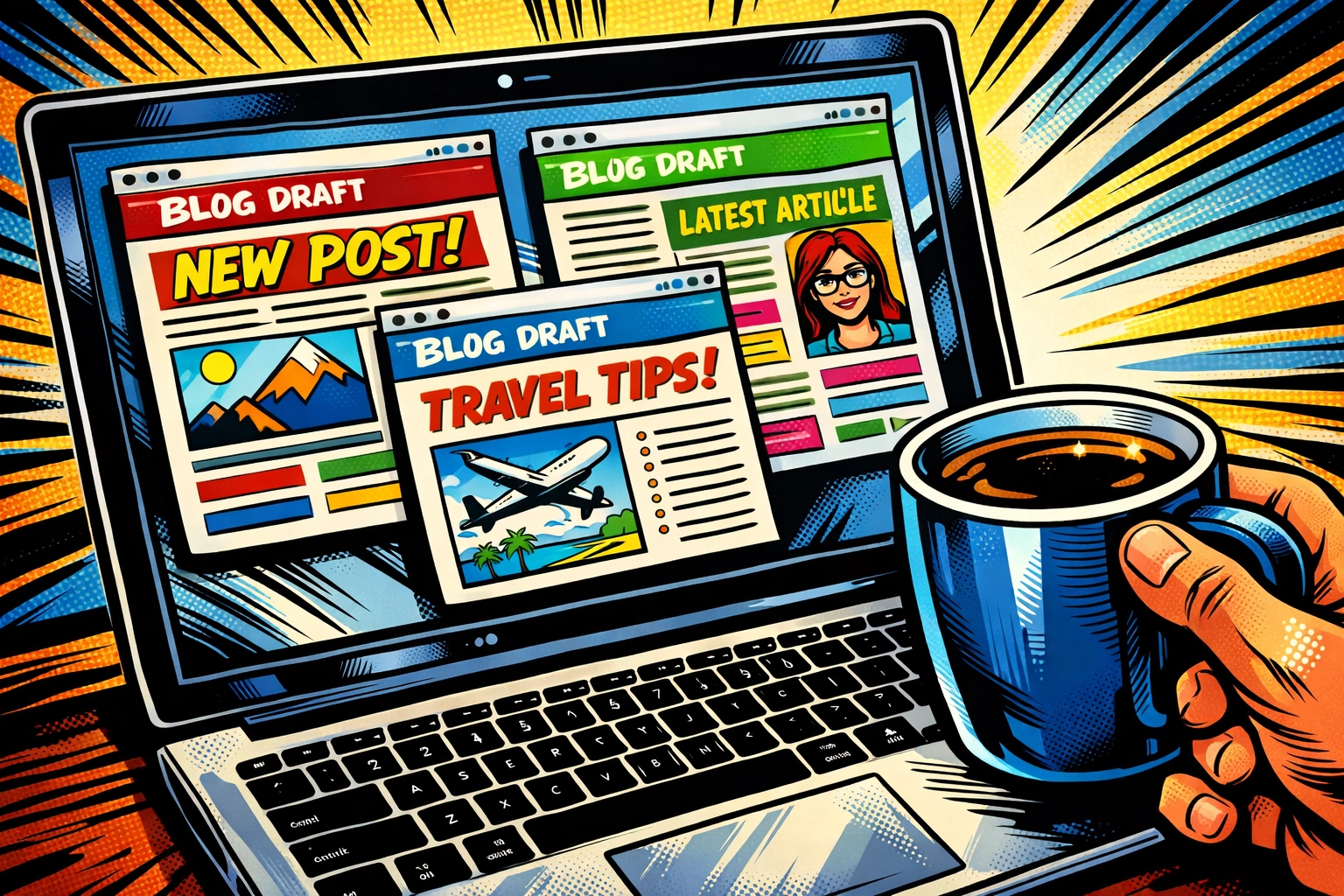
    AI assistant creating multiple blog posts quickly on laptop screen with automation tools

    THIS ISN'T SCIENCE FICTION. IT'S MARBLISM.

    Here's what actually happened: you didn't build individual AI tools that each do one thing. You didn't juggle five different platforms. You didn't become a prompt engineering expert.

    You got business automation tools that work together. Like an actual team.

    Eva, Stan, Penny, and Alex aren't separate products you had to stitch together with duct tape and API keys. They're built to collaborate. When a customer email needs a sales follow-up, Eva hands it to Stan. When Stan closes a lead, Penny writes the case study. When Alex schedules a meeting, everyone gets briefed.

    That's the difference between "AI tools" and an AI team.

    Most businesses try to automate with:

    • One chatbot for customer service
    • One tool for email marketing
    • One thing for social media
    • One platform for… something else

    Then they spend half their time moving information between all of them. That's not automation. That's just digital busywork.

    Marblism is different. Your AI team shares context. They pass information seamlessly. They actually work together.

    Which means you stop being the middleman in your own business.

    WHAT THIS ACTUALLY LOOKS LIKE

    You're not replacing humans with robots. You're replacing the work you shouldn't be doing anyway.

    The repetitive stuff. The admin tasks. The "I could train someone to do this in 20 minutes" work. The things that keep you busy but don't move the business forward.

    Your AI assistant for small business handles that layer. Completely.

    So you can do the work only you can do. Strategy. Relationships. The decisions that actually matter.

    Sarah, who runs a small consultancy, put it this way: "I went from drowning in admin to actually consulting again. It's like I hired three people but I didn't have to train anyone or worry about them calling in sick."

    THE WEEK-ONE SETUP

    Monday morning, you connect Marblism to your existing tools. Your email. Your CRM. Your calendar. Your website.

    No coding. No technical setup. You just… connect things.

    Then you tell your AI team what you need. In plain English. The same way you'd explain it to a new hire.

    "Handle customer support emails. Escalate anything urgent. Sound friendly but professional."

    "Find potential customers in [your industry]. Reach out with personalized messages. Track responses."

    "Write blog posts about [your topics]. Match my writing style. Post twice a week."

    That's it. You're not programming. You're managing.

    By Tuesday, your team's working. By Friday, you've forgotten what it was like to do all this yourself.

    Automated calendar scheduling with AI showing organized appointments and completed tasks

    THE MATH THAT ACTUALLY MAKES SENSE

    One junior employee: £35,000+ per year
    One Marblism AI team: A fraction of that

    But here's the real math:

    • Hours you save per week: 20-30
    • Revenue you can generate with those hours: Actually meaningful
    • Stress of managing human teams: Zero
    • Ability to scale without hiring headaches: Unlimited

    This isn't about replacing people. It's about not needing to hire for roles that shouldn't exist in the first place.

    Small businesses fail because they can't afford the team they need. Or they hire too fast and burn through cash. Or they stay small and the founder burns out doing everything.

    AI business automation solves that. Not with promises. With actual work done.

    START BUILDING YOUR TEAM

    You don't need a week. You could start today.

    Connect your tools. Brief your team. Watch them work.

    No job postings. No interviews. No "we'll get back to you in three months when you're fully trained."

    Just a team that shows up, does the work, and gets better the more they learn about your business.

    See exactly how it works at https://marblism.link/scott-bowen. Your AI team's waiting.

    The question isn't whether you can build this team in a week.

    It's whether you can afford another week without them.
  • Coffee Dropshipping UK: How to Start Your Online Brand Without the Inventory

    Coffee Dropshipping UK: How to Start Your Online Brand Without the Inventory

    So you want to start a coffee brand, but the thought of storing hundreds of kilos of beans in your spare room, managing inventory spreadsheets, and hand-packing orders at 2 AM doesn't exactly sound appealing?

    We get it.

    That's where coffee dropshipping comes in: and honestly, it's one of the most accessible ways to launch an online coffee business in the UK today. You get to build a brand, connect with customers, and sell quality specialty coffee without ever touching a single bag of beans. The roaster handles everything from sourcing to shipping, while you focus on what matters: marketing, building relationships, and growing your business.

    Let's walk through exactly how coffee dropshipping works in the UK, what you need to get started, and how to build something that actually stands out in a crowded market.

    What Is Coffee Dropshipping, Really?

    Coffee dropshipping is a business model where you sell coffee products under your own brand name without holding any physical inventory. Here's how it works:

    You create an online store and list coffee products with your branding. When a customer places an order, that order automatically goes to your dropshipping supplier (in this case, a coffee roaster). The roaster then roasts, packages the coffee with your custom labels, and ships it directly to your customer.

    You never see or handle the product. You never pay for inventory upfront. You only pay for the coffee when someone actually buys it.

    The beauty of this model? Minimal risk, low overhead costs, and the freedom to test different products, markets, and branding ideas without committing to bulk inventory orders. It's particularly brilliant for entrepreneurs who want to break into the specialty coffee space without the capital typically required to start a traditional coffee business.

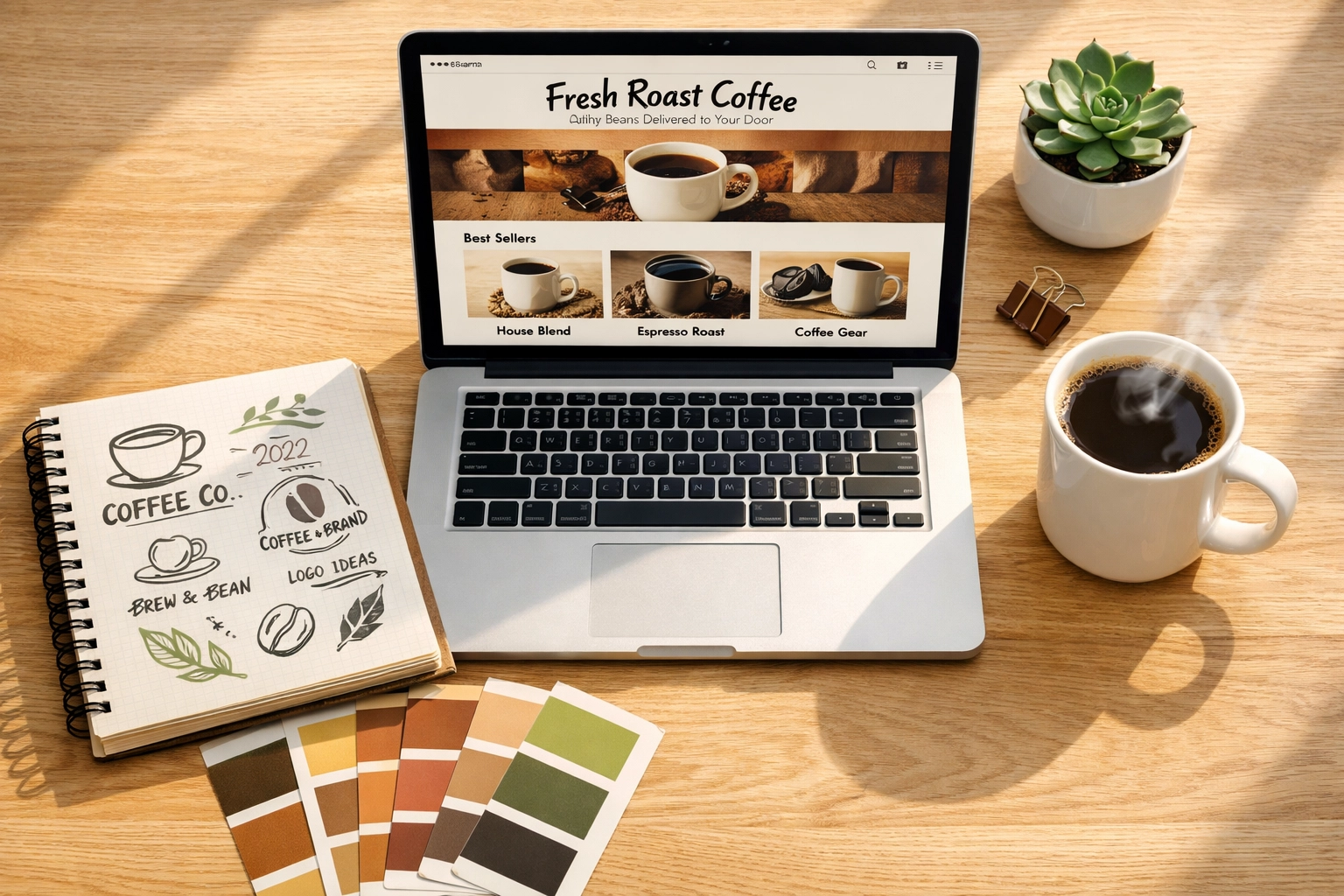
    Home office setup for starting a coffee dropshipping business in the UK

    Why Coffee Dropshipping Makes Sense in the UK

    The UK coffee market is booming. Specialty coffee has moved from niche cafés to mainstream consciousness, and consumers are increasingly buying quality beans online for home brewing. But here's the thing: most people don't want to buy from a faceless roaster. They want a brand they can connect with, a story they can believe in, and packaging that feels personal.

    That's your opportunity.

    Coffee dropshipping UK allows you to create that brand experience without the traditional barriers to entry. You're not competing on roasting expertise (your supplier handles that). You're competing on brand identity, customer experience, and how well you understand your target audience.

    And with a reliable UK-based dropshipping partner, you get fresh roasted coffee, fast delivery times, and the ability to offer genuinely high-quality products from day one.

    Step 1: Choose Your Dropshipping Supplier Carefully

    This is the most important decision you'll make. Your supplier is essentially your business partner: they're responsible for product quality, fulfillment speed, and ultimately, your customer's experience.

    When evaluating coffee dropshipping suppliers in the UK, look for:

    • Fresh roasting on demand: Coffee is best within 2-4 weeks of roasting. You want a supplier who roasts to order, not one shipping months-old stock.
    • White label capabilities: Can you use custom labels and packaging to build your brand?
    • No setup fees or monthly charges: Some suppliers require upfront investment. The best dropshipping models charge you only for the orders you actually place.
    • Reliable fulfillment: Fast, consistent shipping is non-negotiable. Your brand reputation depends on it.
    • Quality coffee selection: Make sure their product range aligns with what you want to sell: single origins, blends, different roast levels, grind options.

    We offer a white label dropshipping service at Limini Coffee with exactly this in mind. No setup fees, no monthly charges: you only pay for what you sell. We handle the roasting, packaging with your custom labels, and ship directly to your customers. It's designed to get you up and running quickly without the financial risk of traditional wholesale models.

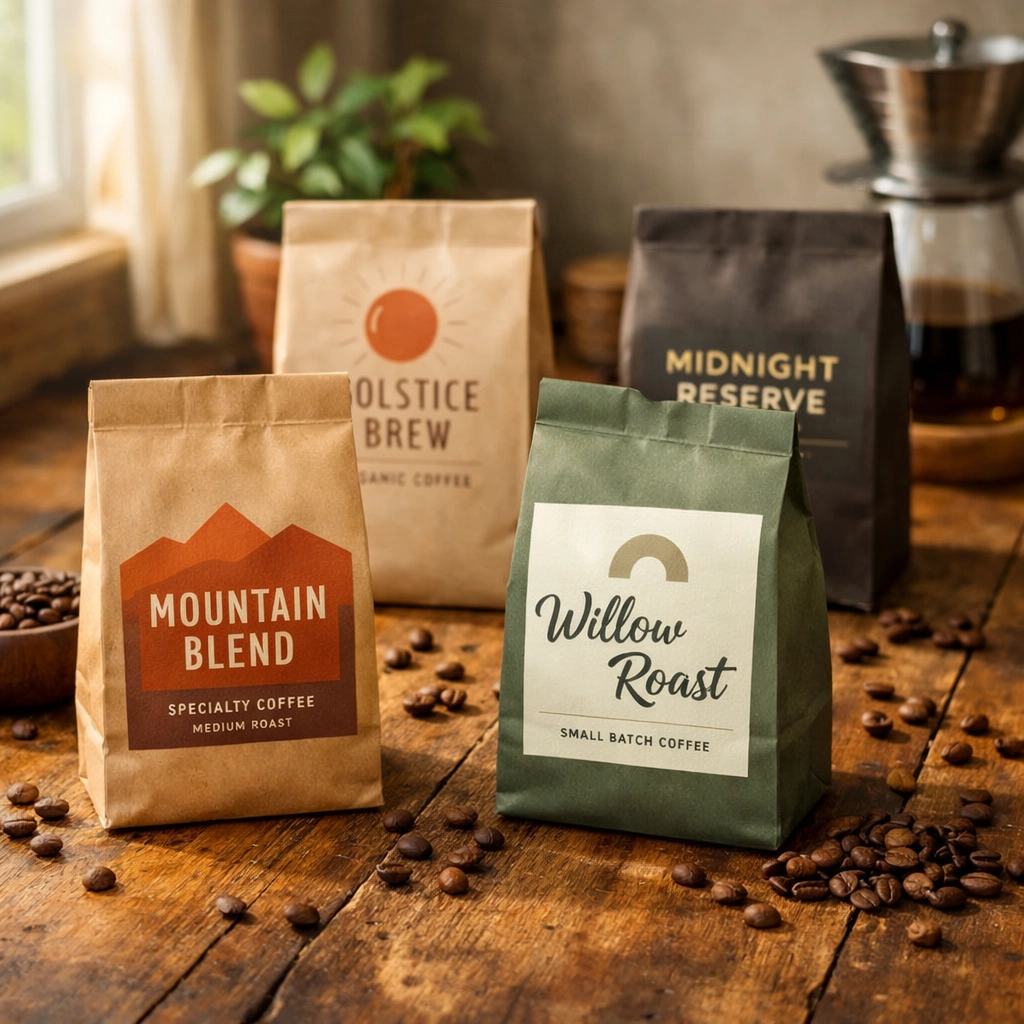
    Custom-labeled specialty coffee bags with unique brand designs for dropshipping

    Step 2: Design Your Brand Identity

    Here's where you get to be creative. Your brand is what sets you apart in a market full of coffee companies.

    Think about:

    • Who are you selling to? Busy professionals who want convenience? Home brewing enthusiasts who geek out over tasting notes? Eco-conscious consumers who care about sustainability?
    • What's your unique angle? Maybe you're focusing on rare single origins, supporting female coffee farmers, or creating subscription boxes with tasting notes and brewing guides.
    • What's your brand personality? Are you minimal and modern, rustic and artisan, bold and cheeky?

    Once you've nailed down your brand positioning, design your labels and packaging. Most white label suppliers have specific label dimensions: for example, we use 10 by 14 cm labels with space on the front for your design and batch codes printed on the back. You'll want to work with a graphic designer (or use tools like Canva if you're on a budget) to create something that represents your brand beautifully.

    Remember: your labels must include the product size (250g, 500g, or 1kg) and type (beans or ground) to comply with UK trading standards. Keep it clear and compliant.

    Step 3: Build Your Online Store

    Your website is your storefront, and thankfully, building one has never been easier. Most coffee dropshipping businesses use Shopify because it integrates seamlessly with dropshipping suppliers and handles everything from payments to order management.

    Here's what you need:

    • Professional product photography: Even if you're dropshipping, invest in quality images. Show the bags from different angles, lifestyle shots of coffee being brewed, close-ups of beans.
    • Compelling product descriptions: Don't just copy and paste supplier descriptions. Write in your brand voice. Include origin stories, tasting notes, brewing suggestions.
    • SEO optimization: Use keywords like "coffee dropshipping uk," "specialty coffee," "freshly roasted beans," and location-specific terms if you're targeting particular regions.
    • Clear shipping and returns information: Be transparent about delivery times and your policies.

    Most dropshipping suppliers integrate directly with Shopify, meaning when a customer orders from your site, the order automatically goes to the roaster for fulfillment. This automation is crucial: it means you can literally run your business from your phone.

    Managing an online coffee dropshipping store from a smartphone

    Step 4: Price Your Coffee Strategically

    Pricing is both an art and a science in the dropshipping model. You need to cover your supplier costs, your marketing expenses, and still make a profit: while remaining competitive in the market.

    Here's a rough framework:

    • Check your supplier's wholesale/dropshipping prices (typically £5-£8 per 250g bag for specialty coffee)
    • Research competitor pricing for similar quality coffee
    • Factor in your marketing costs (Facebook ads, influencer partnerships, etc.)
    • Aim for a markup of 50-100% depending on your positioning

    So if your supplier charges £6 per bag, you might sell it for £9-£12. Premium positioning allows for higher prices, but you need to deliver premium branding and customer experience to match.

    Don't race to the bottom on price. Compete on brand value, storytelling, and customer connection instead.

    Step 5: Market Your Coffee Brand

    You've got your supplier, your branding, and your website. Now comes the hard part: getting customers.

    Coffee dropshipping is a competitive space, so you need a solid marketing strategy:

    Social Media Marketing: Instagram and TikTok are gold for coffee brands. Share beautiful shots, brewing tips, behind-the-scenes content (even if you're dropshipping, you can share your brand story), and customer features.

    Email Marketing: Build an email list from day one. Offer a discount for first-time subscribers, then nurture them with brewing guides, coffee education, and exclusive offers.

    Content Marketing: Start a blog (like this one) covering topics your target audience cares about: brewing methods, coffee origins, equipment reviews. It builds authority and drives organic traffic.

    Paid Advertising: Facebook and Instagram ads can work well for coffee brands, especially when targeting interests like "specialty coffee," "home brewing," and "artisan food."

    Partnerships: Collaborate with food bloggers, lifestyle influencers, or complementary brands (think artisan bakeries or independent bookshops).

    The key is consistency. Building a brand takes time, but with dropshipping, you're not sinking money into inventory while you wait for traction.

    Important Operational Considerations

    A few practical things to keep in mind as you run your coffee dropshipping business:

    Order Placement: Most suppliers let you place orders through their website or via email. Some charge a small admin fee for email orders, so check the terms. If you're using our dropshipping service, orders can be placed directly through the site.

    Customer Communication: When your supplier ships the order, they'll provide tracking information. Share this with your customer, but don't include digital tracking that reveals your dropshipper's identity: it can undermine your brand.

    Quality Control: Even though you're not handling fulfillment, order samples regularly to check quality, packaging accuracy, and delivery times. Your reputation depends on what lands on your customer's doorstep.

    Customer Service: You're still responsible for handling customer inquiries, complaints, and returns. Build relationships with your supplier so you can resolve issues quickly.

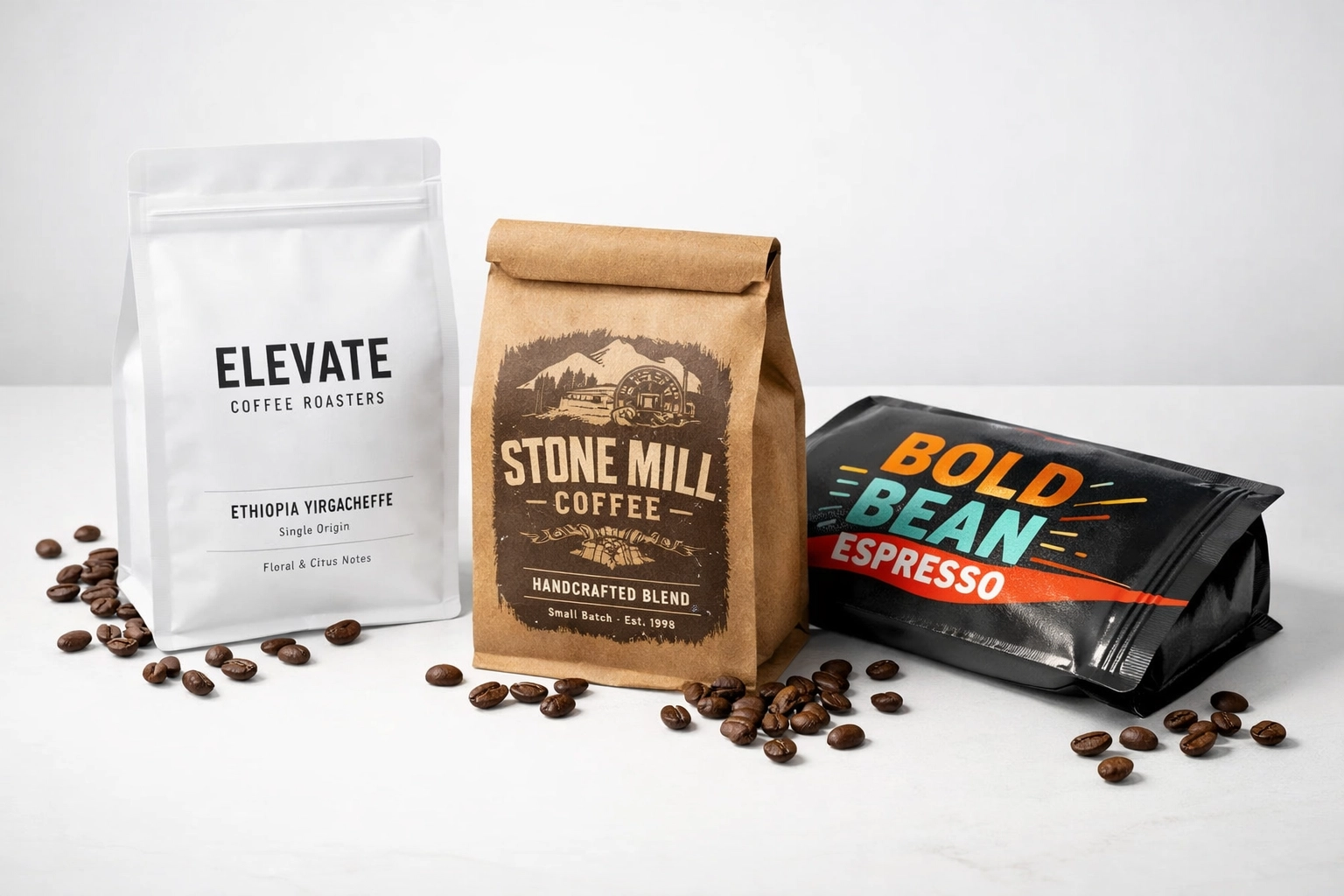
    Specialty coffee bags featuring various custom label designs and branding styles

    The Reality Check

    Coffee dropshipping isn't a get-rich-quick scheme. You're building a real business, which means:

    • It takes time to build brand awareness and customer loyalty
    • Marketing costs money (budget for ads, especially early on)
    • Competition is fierce: differentiation is everything
    • Profit margins can be tight until you scale

    But here's what makes it worthwhile: you get to test your business idea with minimal upfront investment. If your brand resonates, you can scale. If it doesn't, you haven't lost thousands on inventory sitting in a warehouse.

    And if things go well? You can eventually transition to buying wholesale, launching a subscription service, expanding into cafés and retail, or even starting your own roastery. Dropshipping is often the first chapter, not the whole story.

    Getting Started Today

    So where do you actually begin?

    Start by researching your target market. Who are you selling to, and what do they want? Then, find a reliable dropshipping partner who can deliver on quality and service. Design your brand identity and labels. Build a simple but professional website. List 3-5 core products to start: don't overcomplicate things early on.

    Then launch, learn, and iterate.

    The beauty of coffee dropshipping in the UK is that you can literally start this week. The barriers are low, the potential is real, and the specialty coffee market shows no signs of slowing down.

    If you're serious about building a coffee brand without the inventory headache, explore our white label dropshipping service. We're here to handle the roasting and fulfillment while you focus on building something special.

    Your coffee brand starts now. What story will you tell?

  • How to Choose the Best Coffee Suppliers for Coffee Shops in 2026 (Compared)

    How to Choose the Best Coffee Suppliers for Coffee Shops in 2026 (Compared)

    You know what's funny? Coffee shop owners and serious home brewers are looking for exactly the same thing when it comes to choosing where to buy their beans. Fresh, ethically sourced, expertly roasted coffee that actually tastes like something worth waking up for.

    So if you're wondering where to get your coffee in 2026, it's worth understanding what the pros look for in their suppliers. Because the same qualities that make a great wholesale coffee partner also make for an exceptional retail roaster for your home brewing setup.

    Why Supplier Choice Matters More Than Ever

    The coffee landscape has shifted dramatically. We've got 26 new specialty roasters that launched just this year, alongside established names that have been perfecting their craft for decades. That's brilliant for choice, but it also means you need to know what actually matters.

    Here's the thing: buying coffee isn't like buying milk. The difference between a mediocre roaster and an exceptional one will completely transform what ends up in your cup. We're talking night and day, not subtle variations.

    Freshly roasted coffee beans being poured from burlap sack showing artisanal roasting quality

    What Coffee Shops Look For (And Why You Should Too)

    When a café owner chooses a supplier, they're betting their entire business on consistency, quality, and reliability. Let's break down their criteria because they're surprisingly relevant for home brewers.

    Roasting Frequency and Freshness

    Coffee starts degrading the moment it's roasted. Not in a week. Not tomorrow. Immediately.

    The best suppliers roast frequently in small batches. This means your beans spend less time sitting in a warehouse and more time being, well, actually fresh. Coffee shops typically want beans within 3-7 days of roasting because they understand that peak flavour window.

    For home brewing, this matters just as much. If you're investing in a quality grinder and dialling in your technique, stale beans will sabotage everything. It's like trying to make a gourmet meal with ingredients that have been sitting in the back of the fridge for three months.

    Direct Sourcing and Traceability

    The transparency trend isn't going anywhere. Roasters like Counter Culture and Stumptown built their reputations on direct farmer relationships and complete traceability from cherry to cup.

    But why should you care about this for your morning brew?

    Because direct sourcing typically means better quality coffee reaches the roaster in the first place. When roasters have long-term relationships with farms, they get first pick of the harvest. They're not bidding on commodity lots at auction – they're working with producers who actually know where their coffee is going.

    This translates to more interesting single origins, better processing methods, and coffees that have genuine character. The kind of stuff that makes you actually want to try a pour over instead of just hitting the espresso button.

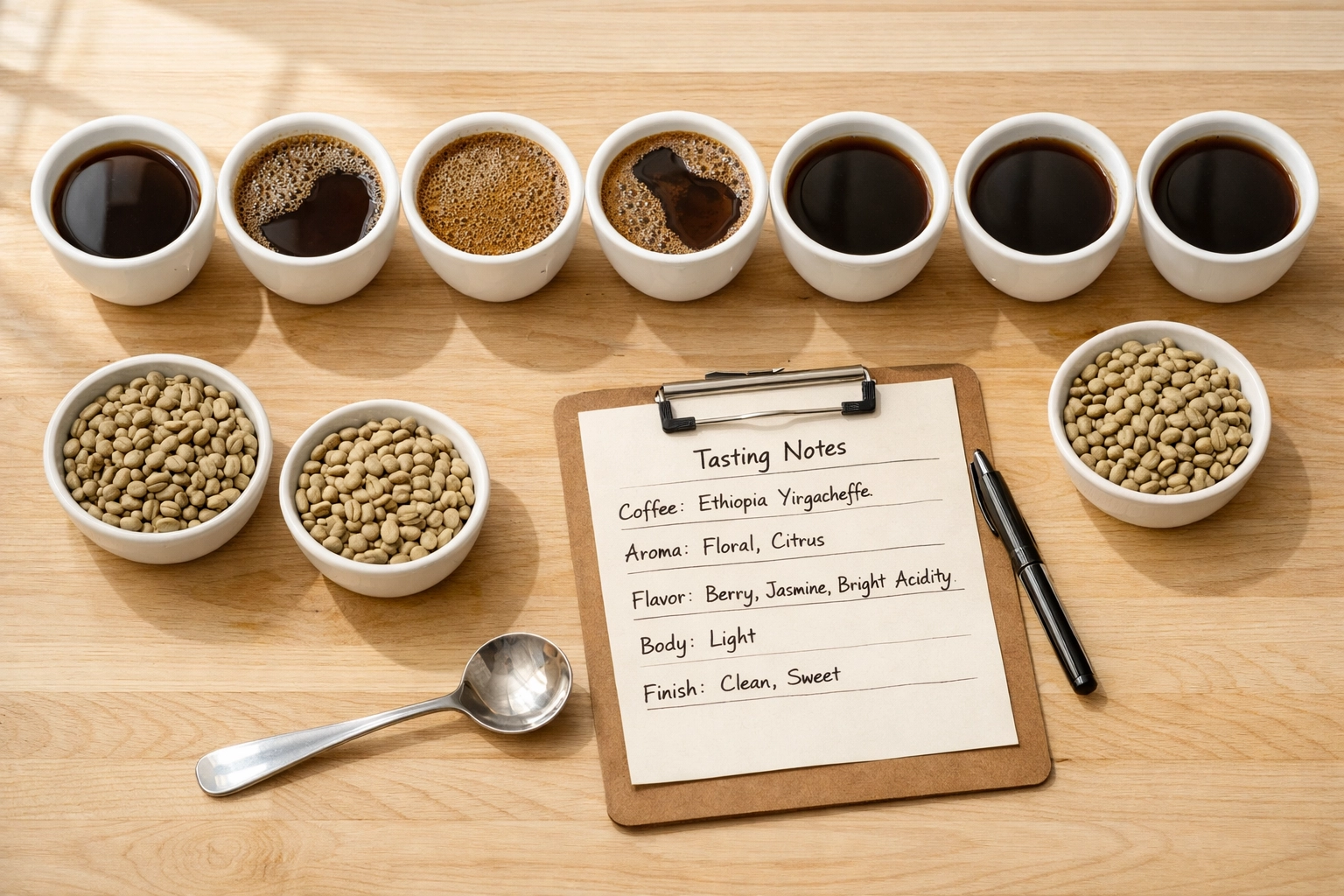
    Professional coffee cupping session with tasting notes for evaluating coffee supplier quality

    The Sourcing Spectrum: What's Available in 2026

    Let's compare the different types of suppliers you'll encounter.

    Large Established Roasters

    Think Peet's Coffee (since 1966) or similar heritage brands. These companies have the infrastructure, the buying power, and decades of experience.

    Advantages: Consistent quality, reliable supply chains, often excellent customer support, proven track record.

    The catch: Less flexibility, potentially less adventurous single origins, can feel corporate.

    Specialty Micro-Roasters

    The Pacific Northwest is absolutely packed with small-batch roasters who are obsessed with quality over scale. These are the folks experimenting with unusual processing methods, limited micro-lots, and roasting profiles that push boundaries.

    Advantages: Exciting coffees, often impeccable freshness, passionate about the craft, willing to educate customers.

    The catch: Can be inconsistent with supply, might run out of your favourite beans, sometimes pricing reflects the boutique nature.

    Regional Roaster Networks

    Some companies curate coffees from multiple small roasters, giving you access to variety without managing relationships with five different suppliers.

    Advantages: Diversity, discovery potential, supporting multiple small businesses.

    The catch: Variable freshness depending on turnover, less direct relationship with the actual roaster.

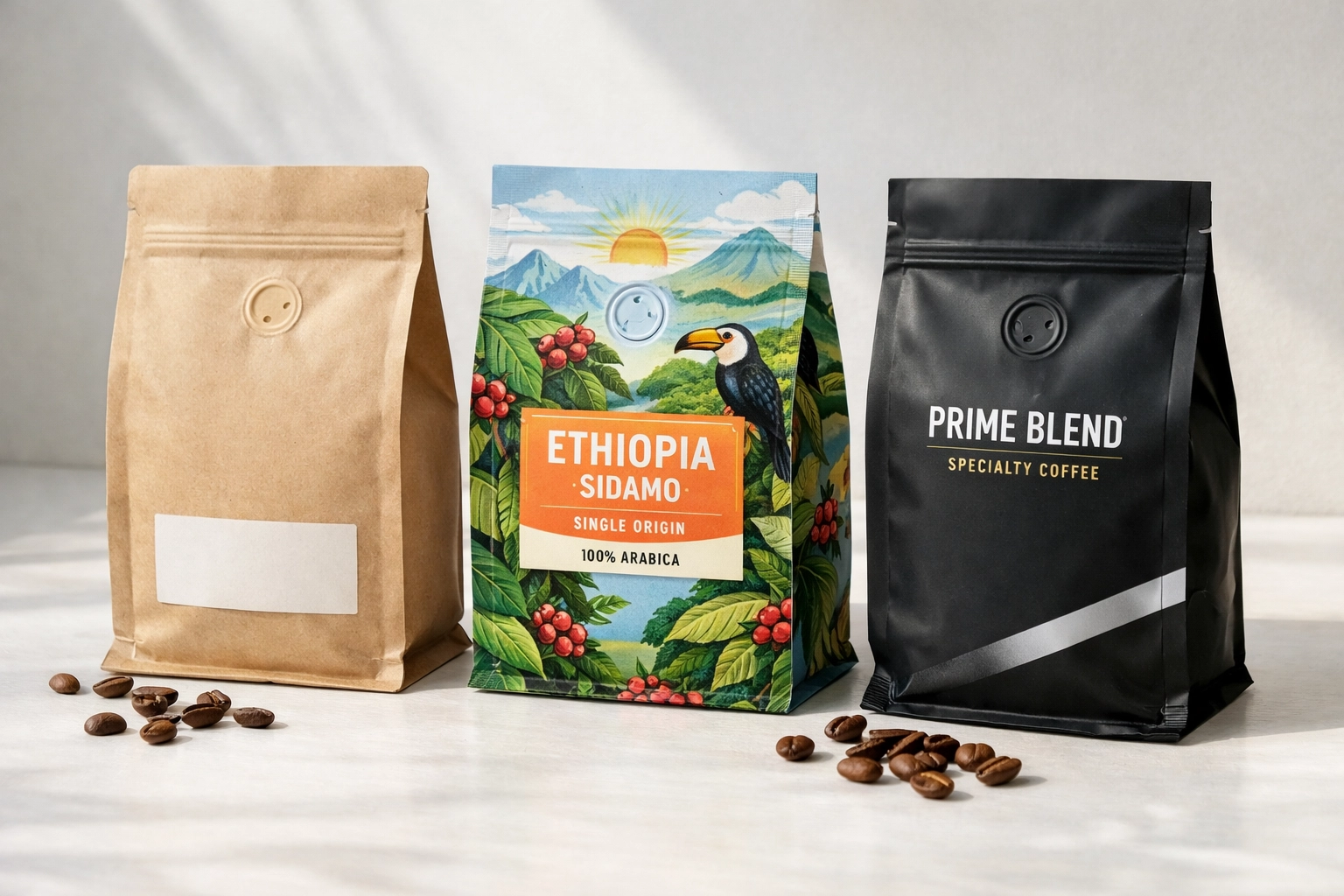
    Different specialty coffee packaging styles from various roasters and suppliers

    The Limini Coffee Approach

    We should mention what we do here at Limini Coffee because it's relevant to this whole conversation. We focus on specialty coffee with complete transparency about where we source our beans and how we roast them.
    If you're looking for a UK-based roaster that understands both the wholesale coffee shop market and the needs of serious home brewers, you can check out what we offer at Limini Coffee. We roast frequently in small batches, which means what arrives at your door is genuinely fresh, not something that's been sitting around.

    The beauty of choosing a roaster that supplies both cafés and home brewers is that they understand the full spectrum. They know what baristas need for consistency during a busy morning rush, but they also get that you want beans interesting enough to explore different brew methods on a lazy Sunday.

    Key Evaluation Criteria for 2026

    So how do you actually assess a coffee supplier? Here's what matters.

    Roast Date Transparency

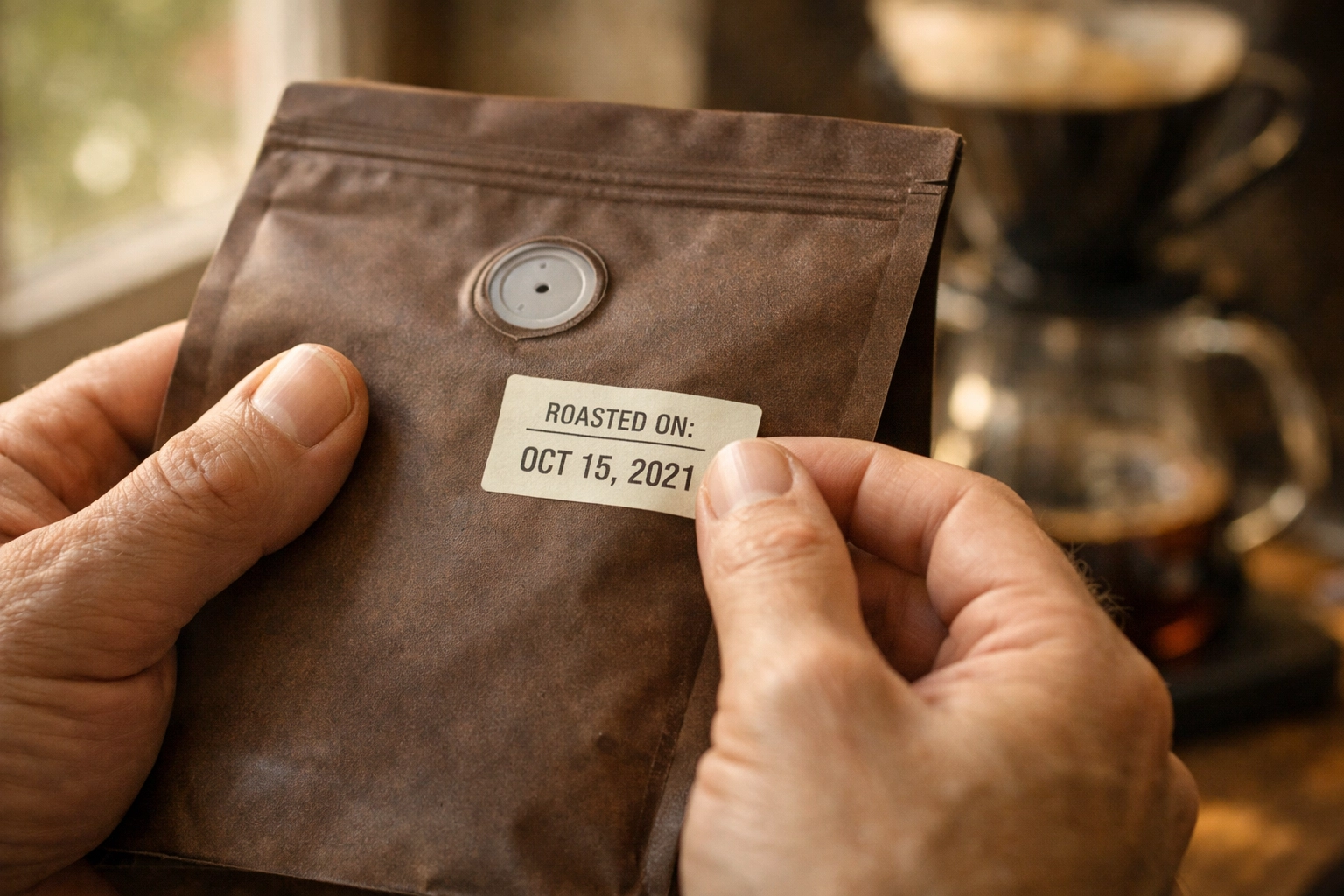
    If a bag doesn't have a roast date printed on it, walk away. Seriously. Any roaster worth their salt will proudly display when the coffee was roasted. Best-before dates mean nothing – you want the actual roast date.

    Origin Information

    You should be able to find out where the coffee came from. Not just "Colombia" but ideally the region, farm, or cooperative. The processing method (washed, natural, honey). The variety (Geisha, Bourbon, Caturra).

    This isn't coffee snobbery. It's about understanding what you're buying and being able to make informed choices.

    Roasting Philosophy

    Does the roaster lean toward lighter roasts that highlight origin characteristics? Or darker roasts with more body and chocolate notes? There's no wrong answer here, but you want their philosophy to match your preferences.

    We believe lighter roasts generally produce the best expression of single origin coffees, but that's our preference. The important thing is that your supplier is intentional about their approach.

    Checking roast date on coffee bag label for freshness verification

    Practical Considerations for Home Brewers

    Beyond the romantic stuff about origin and roast profiles, there are practical elements to consider.

    Order Quantities and Frequency

    Some roasters have minimum order requirements that make sense for cafés but are impractical for home use. You don't want to buy 5kg at once unless you're going through it quickly.

    Look for suppliers that offer smaller quantities (250g-1kg bags) and subscribe-and-save options if you drink coffee regularly. Fresh coffee delivered on a schedule beats remembering to reorder and potentially running out.

    Shipping and Packaging

    Coffee hates oxygen, light, and heat. Quality roasters use valve bags that allow CO2 to escape while preventing oxygen from getting in. They ship quickly and package carefully.

    If beans arrive in a paper bag with a twist tie, that's not protecting your investment.

    Customer Support and Education

    The best roasters want you to brew better coffee. They provide brewing guides, offer advice on dialling in, and actually respond when you have questions. This matters tremendously when you're experimenting with new brewing methods or trying to troubleshoot an extraction issue.

    Comparing Value vs. Cost

    Here's something coffee shops understand that many home brewers initially miss: the cheapest beans are rarely the best value.

    Let's do the math. A £15 bag of mediocre coffee that you tolerate versus an £18 bag of exceptional coffee that you actually look forward to drinking. That £3 difference works out to maybe 15p per cup. Fifteen pence for the difference between "fine I guess" and "genuinely delicious."

    When you consider the investment in your grinder, your brewing equipment, and your time, skimping on the actual coffee is counterproductive.

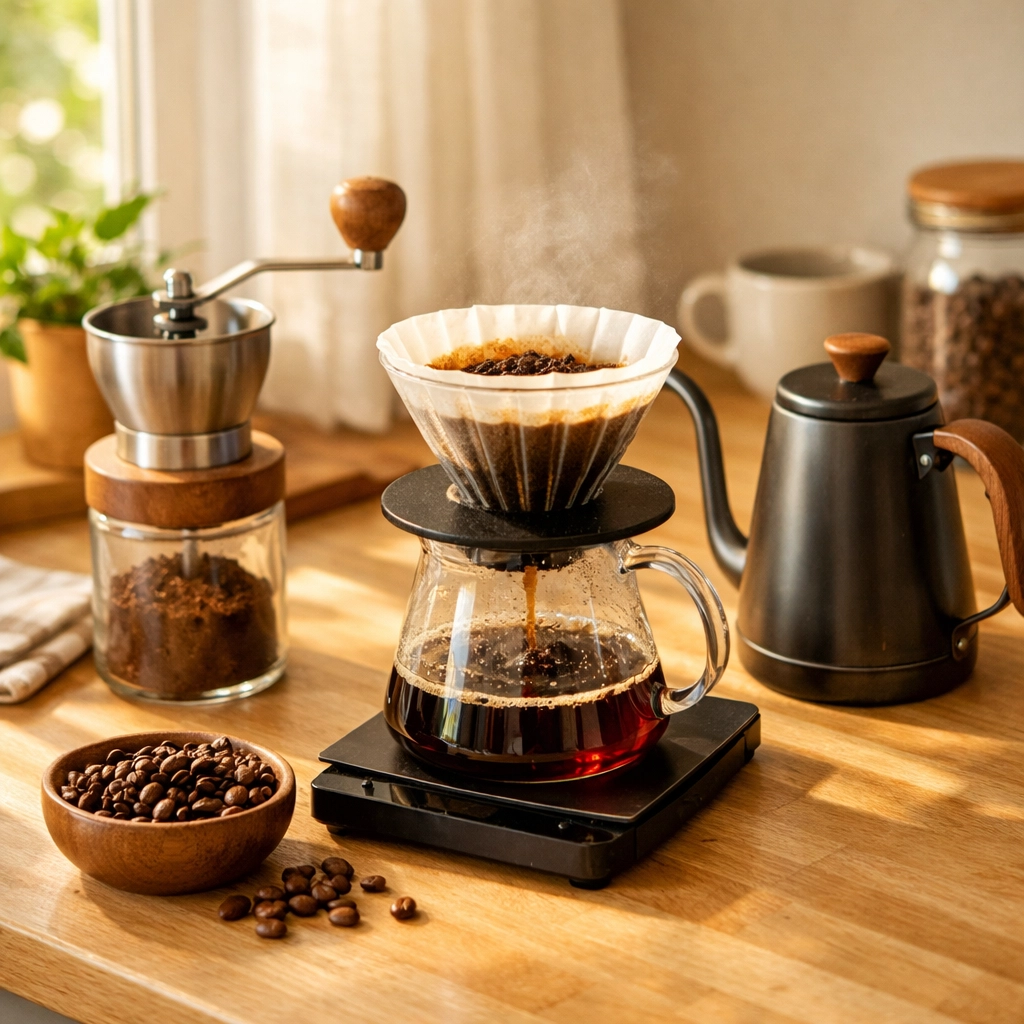
    Home coffee brewing setup with pour over dripper and fresh roasted beans

    The 2026 Reality Check

    With all these new roasters launching, there's never been more choice. But choice without criteria is just noise.

    Start with one or two roasters that align with your values and taste preferences. Build a relationship. Learn what you like about their offerings. Then branch out and experiment from that foundation.

    If you're serious about coffee at home, treat supplier selection with the same care that a café owner would. Because ultimately, you're both after the same thing: consistently excellent coffee that makes the ritual worthwhile.

    For those in the UK, having a reliable local roaster means fresher coffee and better customer service. You can explore our range and see if our approach matches what you're looking for at Limini Coffee.

    The right supplier won't just sell you beans – they'll make you a better home brewer in the process.

  • The 3pm Breakthrough: How Business Automation Tools Turn Your Slowest Hours Into Sales Machines

    You know that feeling around 3pm?

    Your coffee's gone cold. Your energy's flatlined. You're staring at your screen, wondering if you should refresh your inbox for the eighth time or finally tackle that proposal you've been avoiding since Tuesday.

    Meanwhile, your lead pipeline sits there. Quiet. Waiting.

    The afternoon slump is real. But here's what most business owners don't realize , while you're hitting the wall, your competition might not be slowing down at all.

    Not because they're superhuman.

    Because they're not the ones doing the work anymore.

    THE SLOWEST HOURS OF YOUR DAY

    Let's be honest about what happens between 2pm and 5pm.

    Replies slow to a crawl. Follow-ups get pushed to tomorrow. That warm lead who asked for pricing this morning? Still waiting. The customer support ticket that came in at 2:47? You'll get to it… eventually.

    You're not lazy. You're human.

    Your brain has limits. Your energy has a rhythm. And right around mid-afternoon, both decide they need a break whether you agree or not.

    But your business doesn't stop needing attention at 3pm. Leads don't pause their decision-making. Customers don't suspend their questions. Opportunities don't wait for you to finish your third coffee.

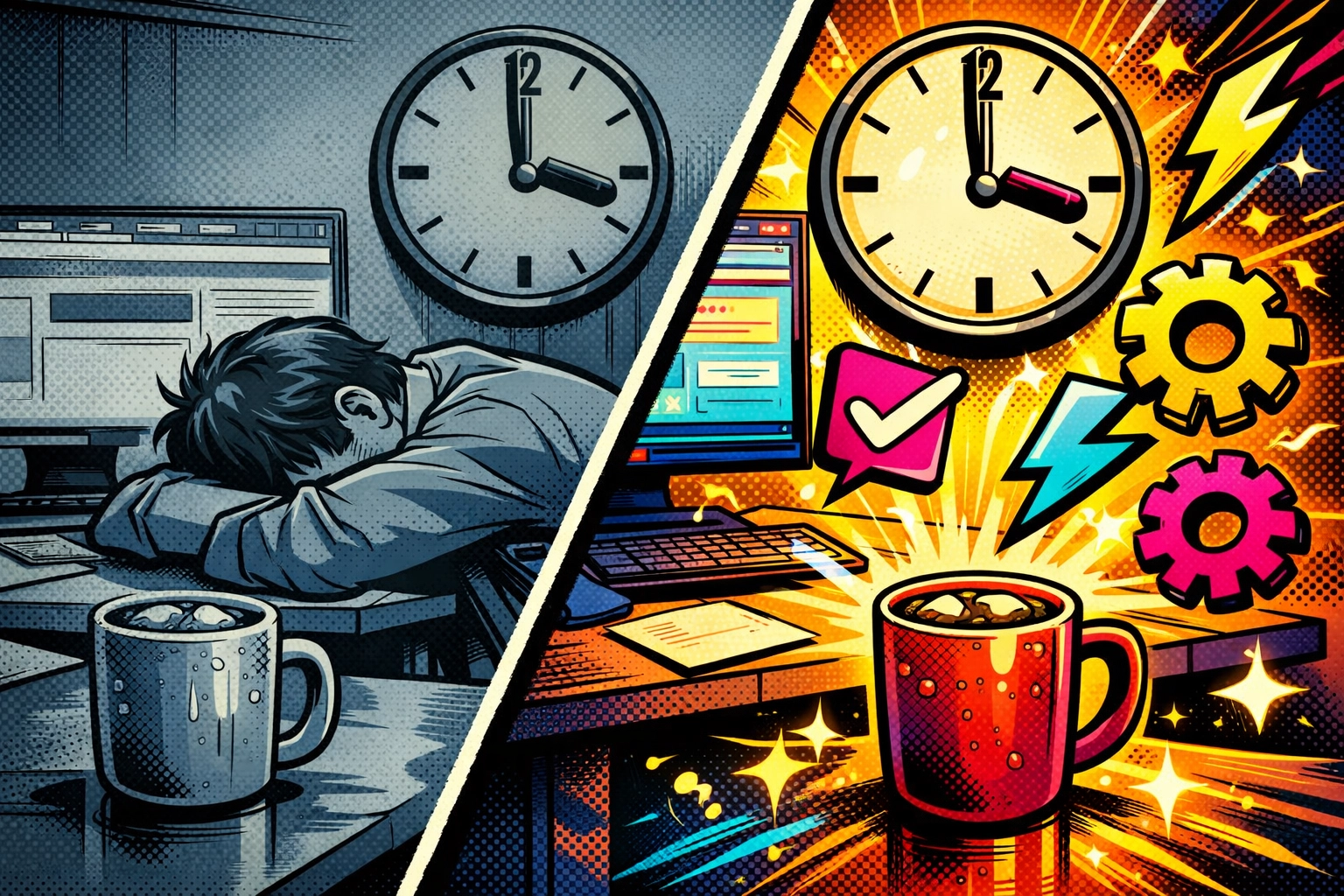
    Business owner experiencing 3pm slump vs energized automation with business automation tools

    WHAT IF THE WORK KEPT MOVING?

    Here's where business automation tools change everything.

    Imagine this: It's 3:07pm. You're in that post-lunch fog, deciding whether to tackle actual work or just "tidy your desk" for 20 minutes.

    Your phone buzzes.

    "Hey! Just qualified a new lead from your website. They're looking for exactly what you offer. Want me to send the intro email?"

    You tap "yes."

    Done. No writing. No second-guessing your tone. No wondering if you should wait until tomorrow when you're sharper.

    Your AI virtual assistant for business just handled it. While you were contemplating desk tidying.

    That lead gets their response in under 90 seconds. You look attentive, sharp, on top of things.

    You didn't do anything except tap a button.

    THE 3PM BREAKTHROUGH LOOKS LIKE THIS

    2:45 PM , A customer emails asking about their order status. You're mid-conversation with a supplier and don't see it.

    Your AI support assistant does. It checks the order system, confirms the shipping details, and sends a personalized response with tracking info.

    The customer replies: "Thanks so much for the quick response!"

    You still don't even know this happened.

    3:18 PM , You're staring at a spreadsheet, trying to remember what you meant to do with it. Your mind is… elsewhere.

    Your AI is triaging your inbox. Sorting. Categorizing. Flagging the urgent stuff. Filing the rest. When you finally look up at 4pm, the chaos is already organized.

    3:52 PM , A lead who went cold three weeks ago suddenly responds to a follow-up email. The one your automation sent yesterday. At the exact right time. With the exact right message.

    They want to book a call.

    You didn't even remember this lead existed. Your AI did.

    Smartphone notification from AI virtual assistant approving automated lead response

    AUTOMATE CUSTOMER SUPPORT WITH AI (WITHOUT SOUNDING LIKE A ROBOT)

    The biggest fear? Sounding robotic. Losing that personal touch.

    Here's the thing , good automation doesn't sound like automation.

    It sounds like someone who actually pays attention. Someone who remembers details. Someone who responds fast because they're not drowning in 47 other tasks.

    Your AI learns your voice. Your style. How you actually talk to customers.

    Then it handles the repetitive stuff:

    • Order status questions
    • Pricing inquiries
    • Basic troubleshooting
    • Appointment scheduling
    • Follow-up sequences

    The complex stuff? It routes to you. With context. With history. With everything you need to jump in without asking "wait, who is this again?"

    You get to be human where it matters. Your AI handles the rest.

    23% higher win rates. That's what businesses see when they use advanced automation versus basic tools. Not because they work harder. Because they never miss the moment.

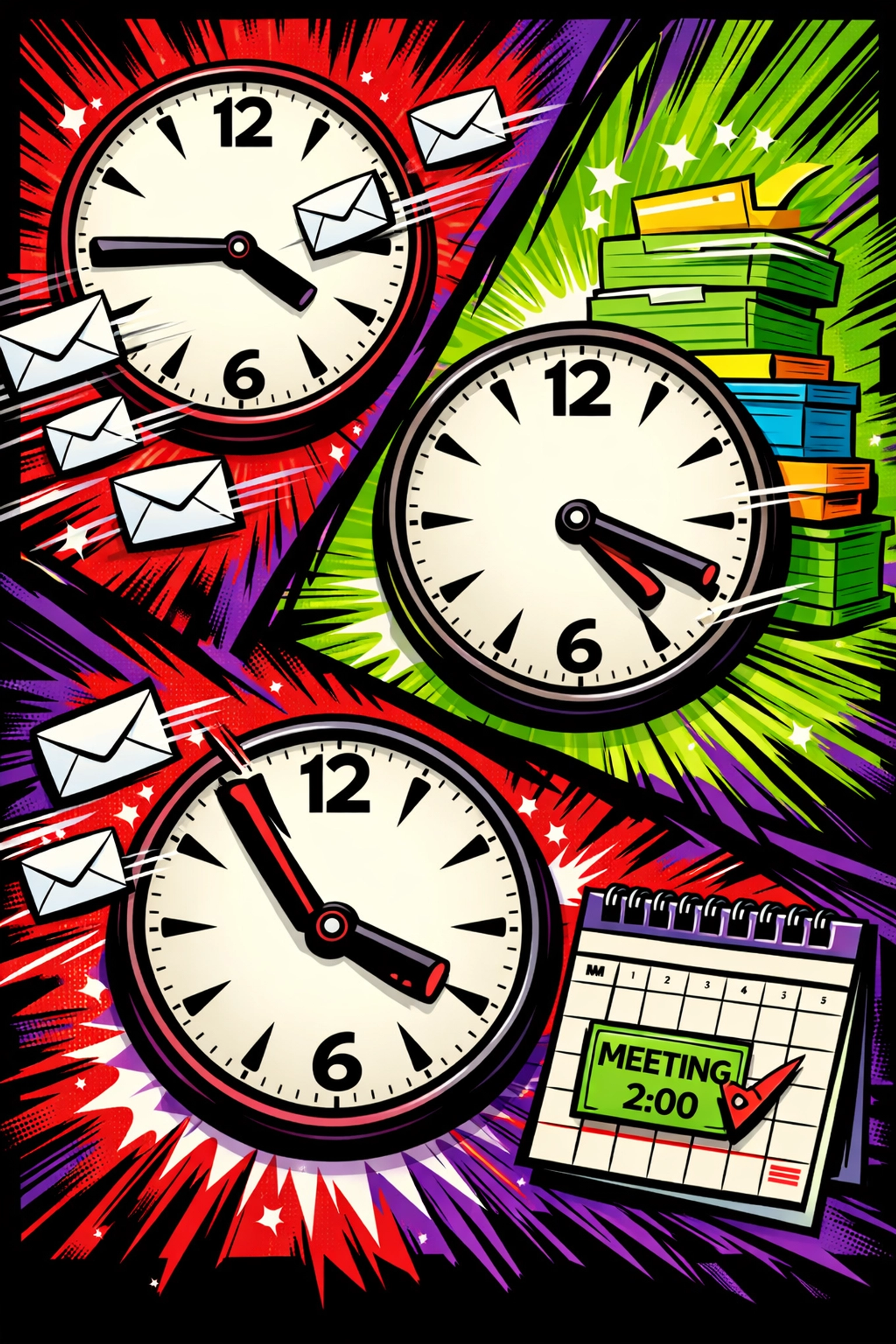
    Three clocks showing automated customer support and tasks running at 2:45 PM, 3:18 PM, and 3:52 PM

    THE HOURS YOU'RE NOT WORKING

    Here's the really good part.

    It's 6:30pm. You've closed your laptop. You're making dinner. Lights are off at the office.

    A website visitor shows up. Browses your services. Starts to leave.

    Your AI engages them in chat. Friendly. Helpful. Answers their questions. Offers to send them more info.

    They give their email.

    That's a lead you got while chopping vegetables.

    It's 11:47pm. You're asleep. A customer in a different timezone has a question.

    Your AI answers it. Accurately. Kindly. Completely.

    They're impressed. You're dreaming.

    Your business never stops being attentive. But you're not chained to your phone at midnight answering "what are your hours?" for the third time this week.

    THE DIFFERENCE BETWEEN BUSY AND PRODUCTIVE

    Most business owners confuse the two.

    Busy is responding to every email as it arrives. Productive is having the important ones handled before you even see them.
    Busy is manually following up with every lead. Productive is having a system that does it , perfectly, every time , while you focus on closing.

    Busy is working until 8pm to keep up. Productive is leaving at 5pm because the work continues without you.

    Business automation tools don't make you work faster. They make your business work smarter. Especially during those hours when you're not at your best.

    Laptop displaying AI chat automation handling customer support conversations

    WHAT THIS ACTUALLY LOOKS LIKE

    Sarah runs a consulting business. Solo. No team.

    Before automation, she spent 3-4 hours daily on admin. Email. Scheduling. Follow-ups. Data entry. The stuff that didn't make her money but had to get done.

    Her 3pm was the worst. Low energy. High to-do list. Slowly typing responses she could write in her sleep.

    Now? Her AI virtual assistant handles:

    • Initial client inquiries
    • Meeting scheduling (with automatic timezone detection)
    • Follow-up sequences for proposals
    • Invoice reminders
    • Basic support questions

    Her afternoons look different. She takes calls. She does strategy work. She actually thinks about growing her business instead of just maintaining it.

    She told us: "I used to hit a wall every afternoon. Now I barely notice the time because I'm not forcing myself through mindless tasks anymore."

    That's the breakthrough.

    YOUR NEXT MOVE

    You can keep pushing through the 3pm slump. Forcing yourself to stay sharp when your brain wants a break. Manually handling everything because "it's faster if I just do it myself."

    Or you can let the automation run while you focus on what actually needs your expertise.

    The work keeps moving. The leads keep getting responses. The customers keep getting support.

    You just stop being the bottleneck.

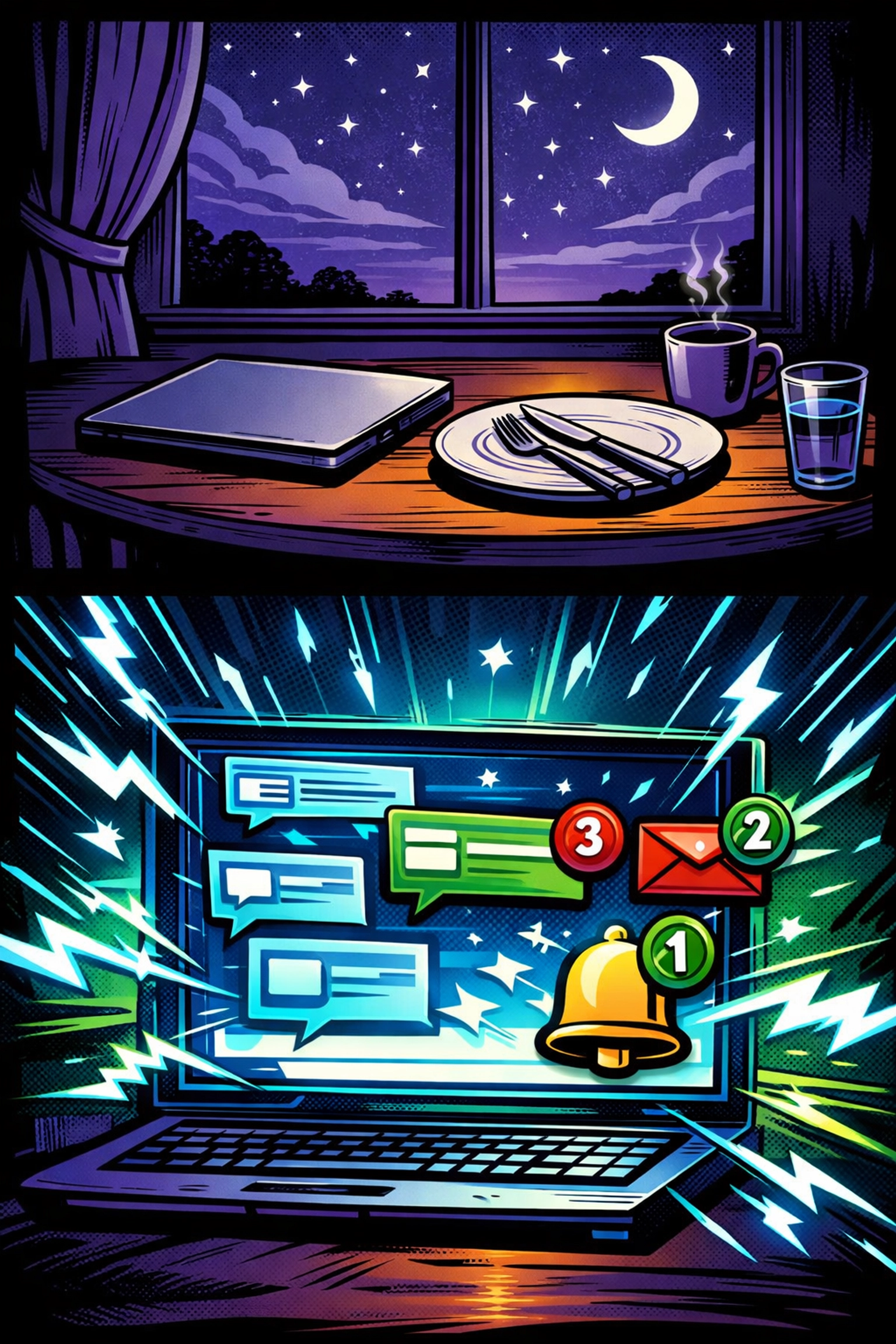
    Business automation working after hours while laptop is closed and owner is away

    THE QUIET COMPETITIVE ADVANTAGE

    Here's what nobody talks about.

    Your competitors are tired too. They hit the same afternoon wall. They miss the same late-night leads. They delay the same follow-ups.

    But if you're the one who responds in 90 seconds while they respond in 90 minutes… you win.

    If you're answering questions at 11pm (via AI) while they're letting it wait until morning… you win.

    If your 3pm is productive because automation is doing the heavy lifting… you win.

    It's not about working more hours. It's about making every hour count. Even the slow ones.

    Stop juggling. Start automating.

    The businesses that scale aren't working harder. They're working smarter. And they're doing it with AI virtual assistants that never need a coffee break.

    Your slowest hours could be your most productive. You just need the right team working them.

    Even if that team never gets tired, never takes a day off, and never hits the 3pm slump.

    See how it works. Because reading about it is one thing. Watching your business run itself? That's the real breakthrough.

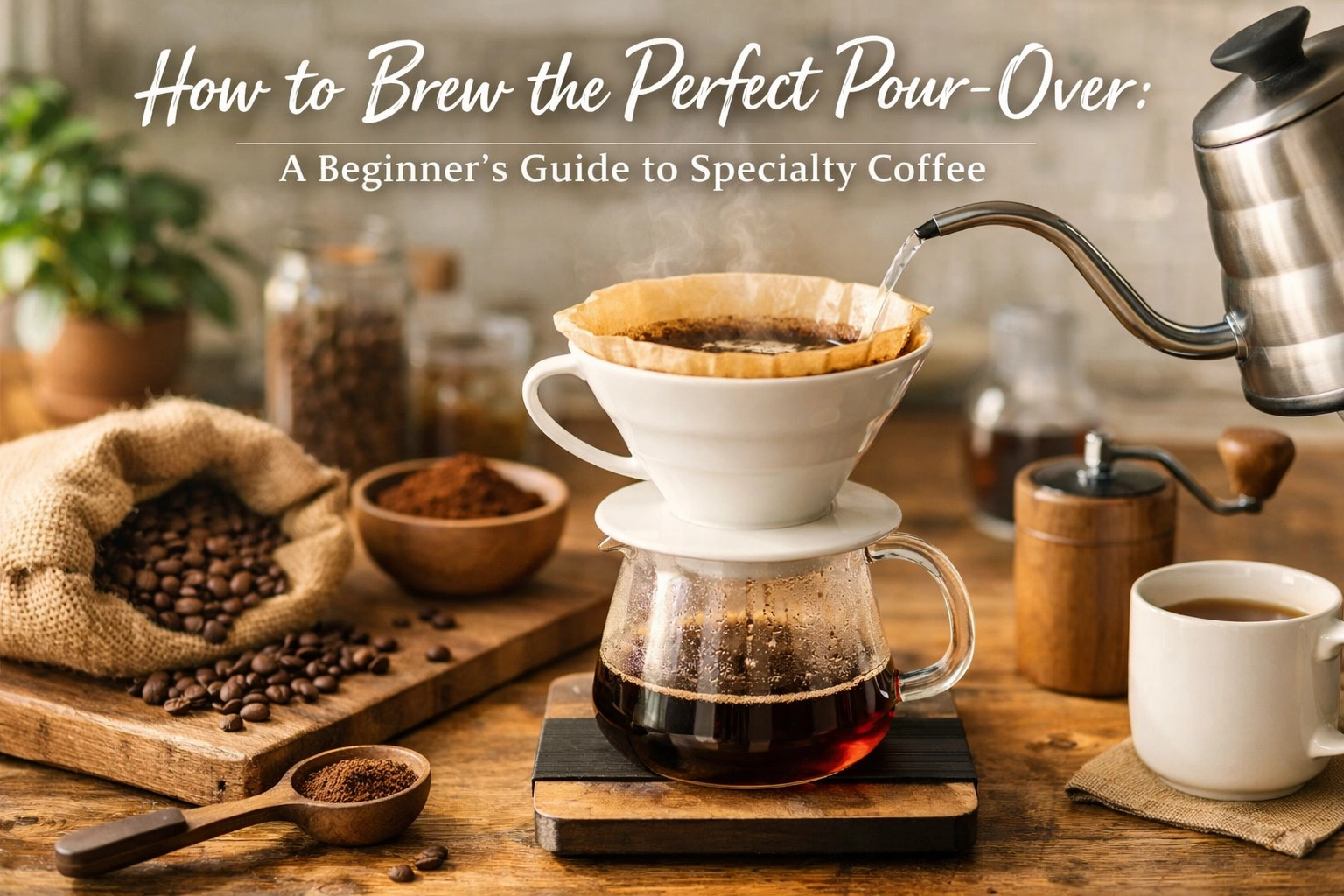
  • How to Brew the Perfect Pour-Over: A Beginner's Guide to Specialty Coffee

    How to Brew the Perfect Pour-Over: A Beginner's Guide to Specialty Coffee

    There's something beautifully simple about pour-over coffee. No buttons, no complicated machinery, just you, some freshly roasted beans, hot water, and a bit of technique. And honestly? Once you've tasted a properly brewed pour-over made with specialty coffee, there's no going back to the auto-drip.

    So let's get you brewing like a pro.

    What You'll Need

    Before we dive into the method, let's talk equipment. The good news is that pour-over brewing doesn't require a massive investment. Here's what you'll want:

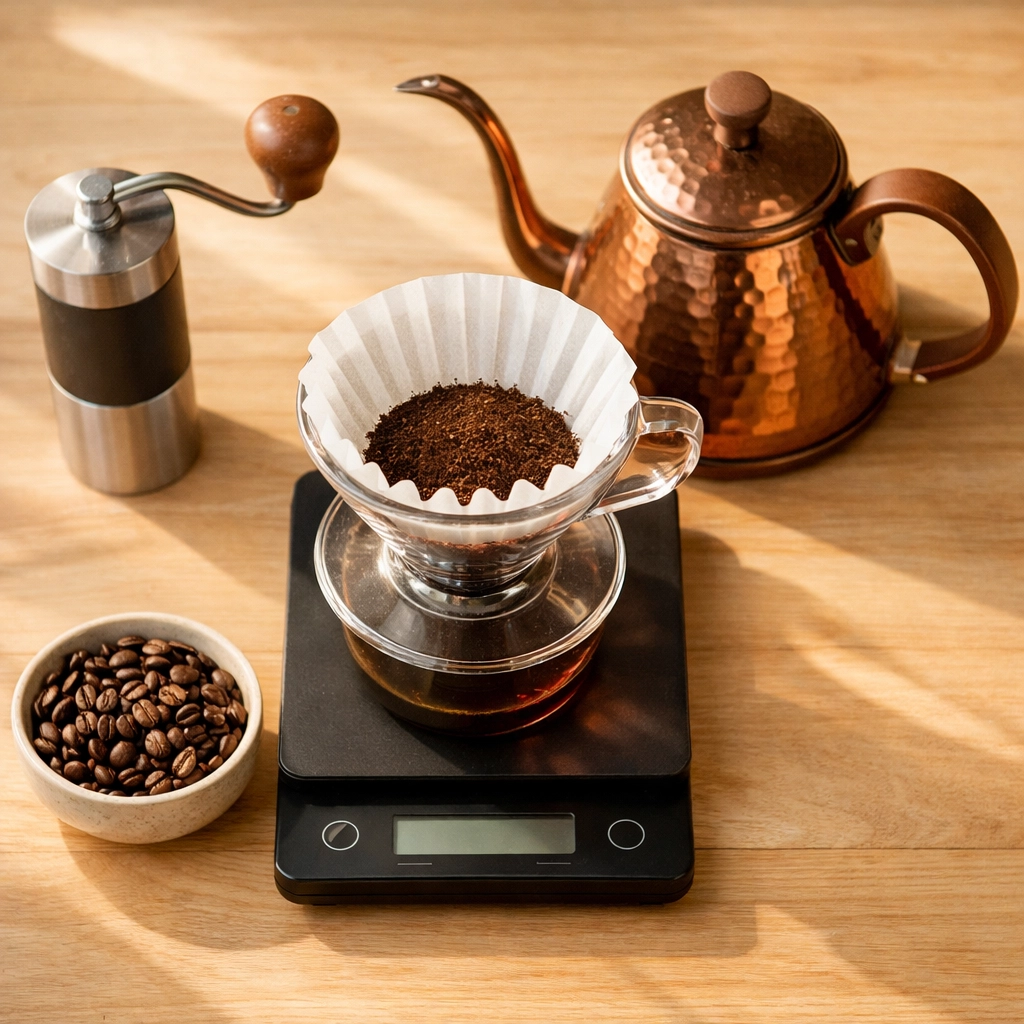
    • A pour-over brewer (Hario V60, Kalita Wave, or Chemex are all brilliant)
    • Paper filters (specific to your brewer)
    • A kettle (preferably gooseneck for better control)
    • Freshly roasted coffee beans (we'll get to this)
    • A grinder (burr grinder is ideal)
    • A scale (measuring by weight is crucial)
    • A timer (your phone works fine)

    The scale might seem fussy, but trust us on this, measuring by weight rather than volume makes all the difference in consistency.

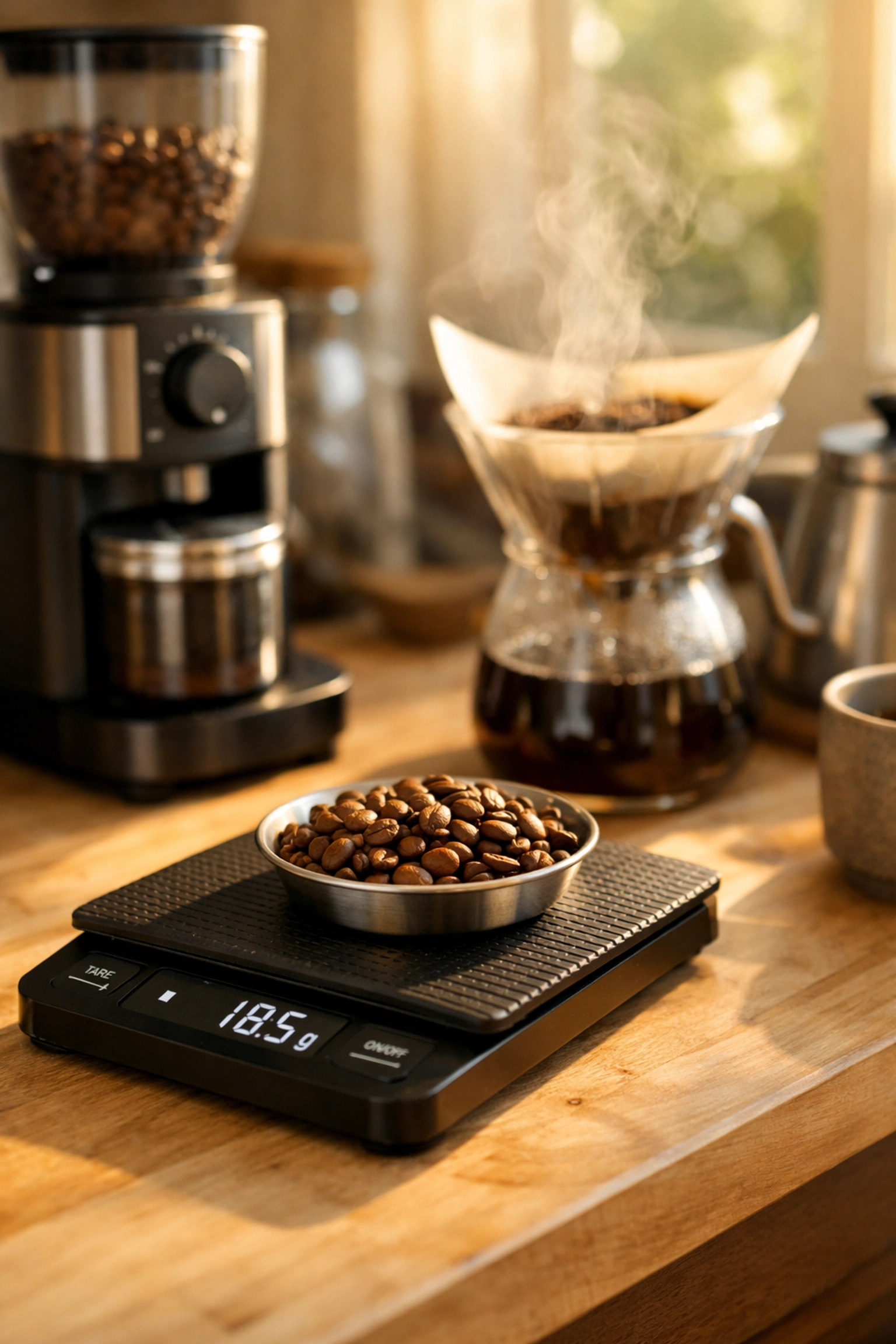
    Pour-over coffee brewing equipment including V60 dripper, gooseneck kettle, scale, and grinder

    The Coffee: Fresh is Best

    Here's the thing about pour-over: it's an incredibly clean, transparent brewing method. This means everything about your coffee comes through, the good and the not-so-good. Which is why starting with freshly roasted specialty coffee is so important.

    We're talking beans roasted within the last few weeks, not months. Those supermarket bags sitting on shelves since last year? Not going to cut it for pour-over. You want coffee that still has life in it, still has those carbon dioxide bubbles trapped inside from the roasting process.

    If you're looking for beans that'll really shine in your pour-over, we roast fresh batches throughout the week right here. Single origins work beautifully for this method, they let you taste the unique characteristics of each coffee-growing region.

    Grind Size: Medium-Fine is Your Friend

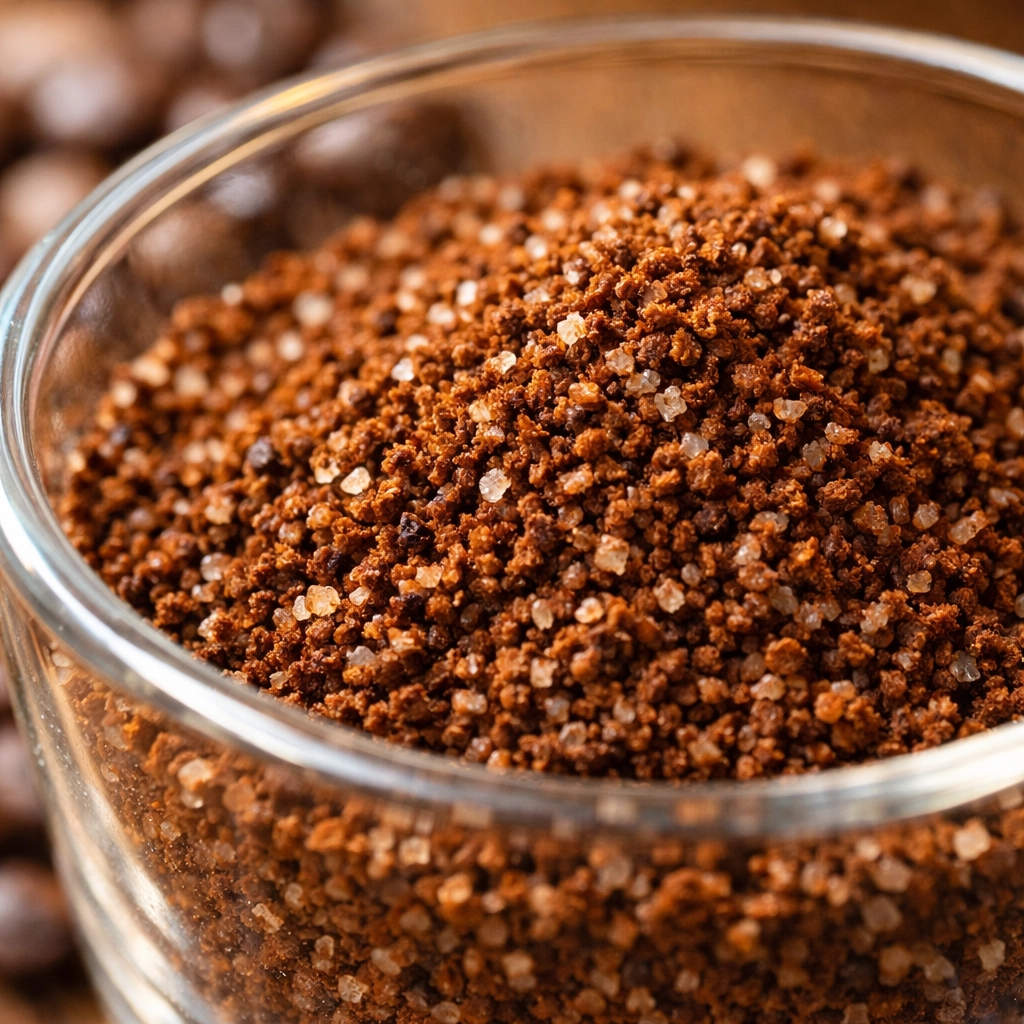
    Getting your grind right is extremely important. For pour-over, you're aiming for medium-fine, similar in texture to sea salt. Too fine and your brew time drags on, resulting in bitter, over-extracted coffee. Too coarse and the water rushes through too quickly, leaving you with weak, sour, under-extracted coffee.

    If you're using a burr grinder (which we highly recommend), start around the middle settings and adjust from there based on your results. Some coffees need slight tweaks depending on their roast level and origin.

    The Ratio: Keep It Simple

    Coffee-to-water ratios can feel overwhelming, but here's a straightforward starting point that works: 1:16 to 1:17.

    What does that mean? For every gram of coffee, you'll use 16 to 17 grams of water. So if you're brewing a single cup:

    • 20 grams of coffee to 320-340 grams of water
    • 25 grams of coffee to 400-425 grams of water

    Start with 1:16 if you prefer something a bit stronger and punchier. Use 1:17 if you like a cleaner, more delicate cup. You can always adjust once you've tasted the results.

    Medium-fine ground coffee showing ideal texture for pour-over brewing

    Water Temperature: Just Off the Boil

    Water temperature matters more than you might think. You're aiming for around 93°C (200°F), basically just below boiling. If you're using a regular kettle without temperature control, simply boil your water and let it sit for about 30 seconds before pouring.

    Why not boiling? Water that's too hot can scorch the coffee and extract harsh, bitter compounds. Water that's too cool won't extract enough, leaving you with flat, underwhelming coffee.

    The Brewing Process: Step by Step

    Right, let's get to the actual brewing. This is where the magic happens.

    Prep Your Brewer

    Place your filter in the brewer and rinse it thoroughly with hot water. This does two things: it removes any papery taste from the filter and preheats your brewer. Discard the rinse water before you start brewing.

    Add your ground coffee to the filter and give it a gentle shake to level the bed. You want an even surface for consistent extraction.

    The Bloom (0:00-0:45)

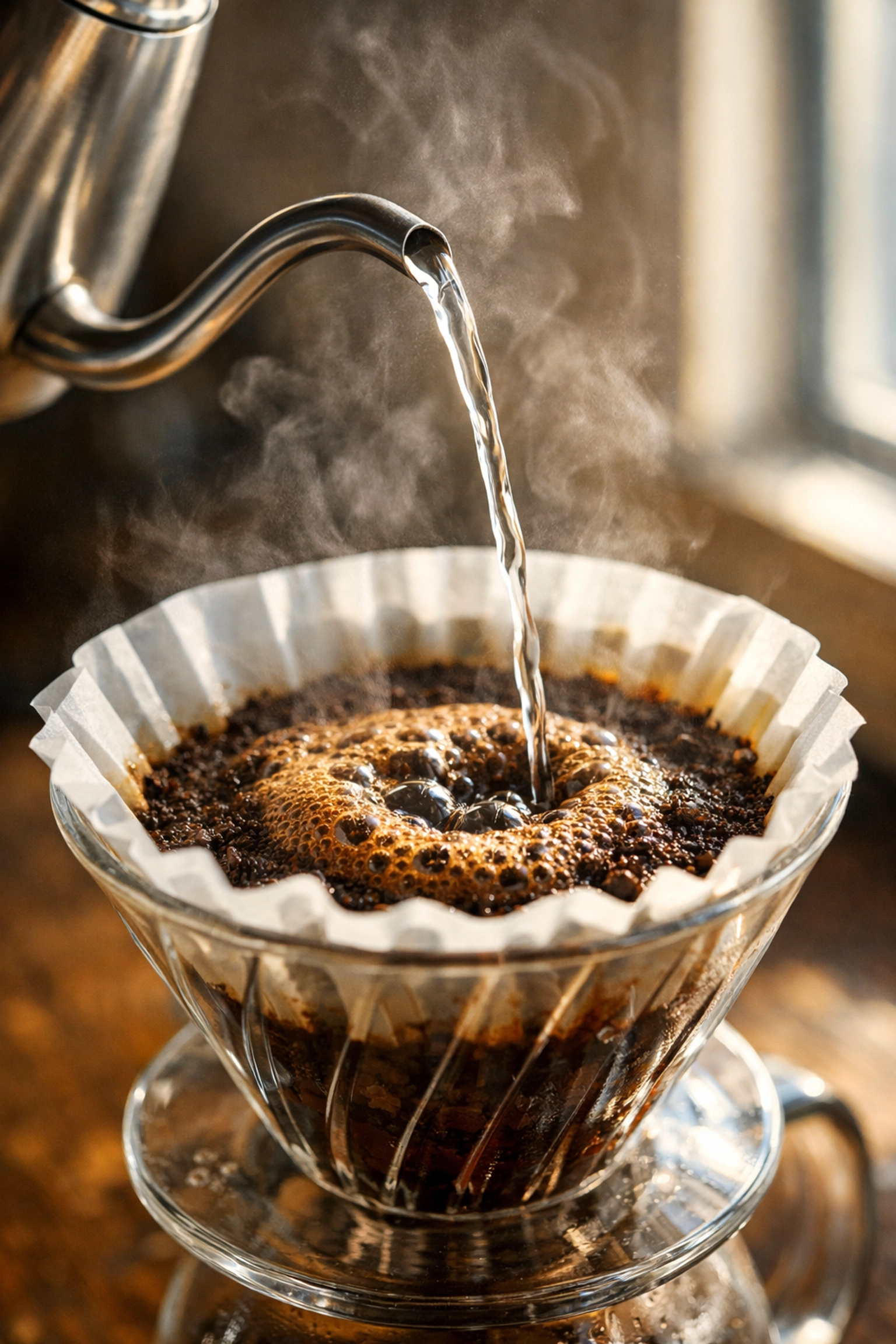
    This is the most important phase. Pour roughly double the weight of your coffee in water: so if you're using 20 grams of coffee, pour about 40 grams of water.

    Start in the center and work outward in slow, concentric circles, making sure all the grounds are saturated. You'll see the coffee bed rise and bubble: that's carbon dioxide escaping from the roasting process. Basically, this is the coffee "breathing."

    Let it sit for 30-45 seconds. This bloom phase allows those gases to escape, which dramatically improves extraction and flavour development. Skip this step and you're leaving flavour on the table.

    Coffee bloom phase with bubbling grounds during pour-over brewing

    Main Pours (0:45-2:30)

    After the bloom, it's time for your main pours. Instead of dumping all the water in at once, divide your remaining water into 3-4 equal pours at roughly 15-second intervals.

    Use the same spiral technique: start from the center, work your way outward in circles, then spiral back in. Keep the water level between half and two-thirds full during each pour. You want to maintain consistent contact between water and coffee without overwhelming the bed.

    Pour gently and steadily: aggressive pouring creates channels where water rushes through without extracting properly. Think of it like a gentle rain, not a torrential downpour.

    The Drawdown (2:30-3:30)

    Once you've added all your water, step back and let gravity do its work. The remaining water should drain through the coffee bed over the next minute or so.

    Your total brew time from first pour to final drip should land somewhere between 2:30 and 3:30 minutes. If it's draining much faster, your grind might be too coarse. If it's taking forever, your grind might be too fine.

    Tasting and Adjusting

    Now comes the best part: tasting your coffee. Let it cool slightly (coffee that's too hot masks flavour) and really pay attention to what you're tasting.

    Too bitter or harsh? Your grind might be too fine, or your water might be too hot. Try coarsing up your grind slightly.

    Too sour or weak? Your grind might be too coarse, or your water might be too cool. Go a bit finer with your grind.

    Uneven or muddy flavours? Your pouring technique might need work. Focus on keeping your pours slow and even.

    The beauty of pour-over is that you're in complete control. Small adjustments lead to big improvements.

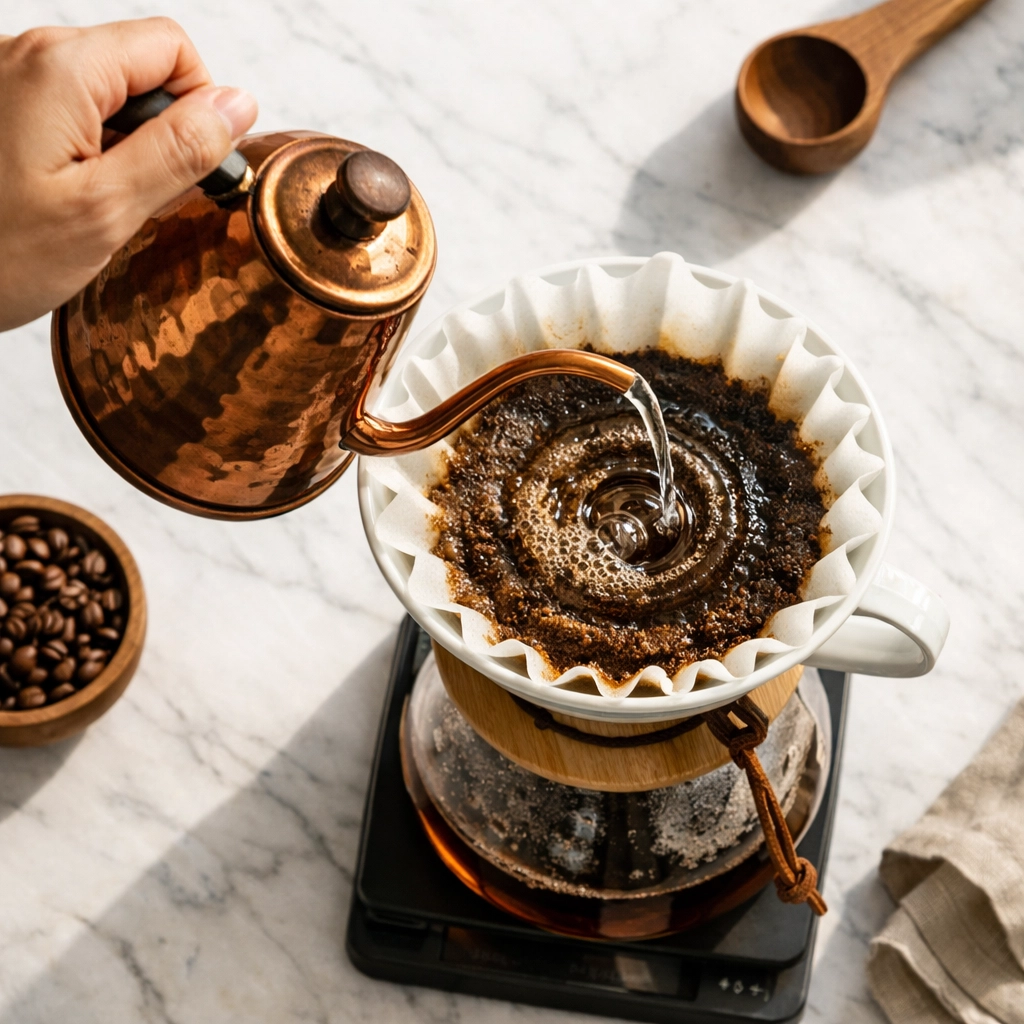
    Pouring water in circular motion over coffee grounds for pour-over brewing

    Why Specialty Coffee Makes the Difference

    We've mentioned this before, but it's worth repeating: specialty coffee absolutely shines in pour-over brewing. These are coffees that have been grown, processed, and roasted with serious care and attention. They have clarity, complexity, and character that you simply can't get from commodity-grade beans.

    When you're brewing a method this clean and transparent, those quality differences become incredibly obvious. A well-sourced Ethiopian natural will give you wild berry notes. A washed Colombian might deliver caramel sweetness and citrus brightness. A Kenyan coffee could punch you with blackcurrant and tomato acidity (in the best possible way).

    Final Thoughts

    Pour-over coffee isn't complicated: it's just intentional. You're taking a few extra minutes to be present with your coffee, to control the variables, to craft something delicious with your own hands.

    Will your first attempt be perfect? Probably not. But that's part of the fun. Each brew teaches you something. You'll start to notice how tiny changes affect the cup. You'll develop your own rhythm and technique.

    And honestly? Even a slightly imperfect pour-over made with fresh, quality beans beats almost any other brewing method on a good day.

    So grab some freshly roasted specialty coffee, set up your brewer, and give it a go. Take notes if you're feeling keen. Adjust and experiment. Most importantly, enjoy the process.

    That's the beauty of coffee: there's always something new to discover, one pour at a time.

  • Hotel PMS vs Hotel Management Software: Which Is Better For Your Property in 2026?

    Hotel PMS vs Hotel Management Software: Which Is Better For Your Property in 2026?

    Here's the truth: there's no difference.

    A hotel PMS (Property Management System) and hotel management software are the same thing. "PMS" is just industry shorthand for the software that runs your property: from check-ins to check-outs and everything in between.

    The real question isn't which term is better. It's which platform actually works for your property in 2026.

    What Changed (and Why Your Old System Isn't Cutting It)

    The hotel tech landscape shifted hard over the past few years. Properties running legacy systems are hemorrhaging time, money, and direct bookings to competitors who upgraded to modern, cloud-native platforms.

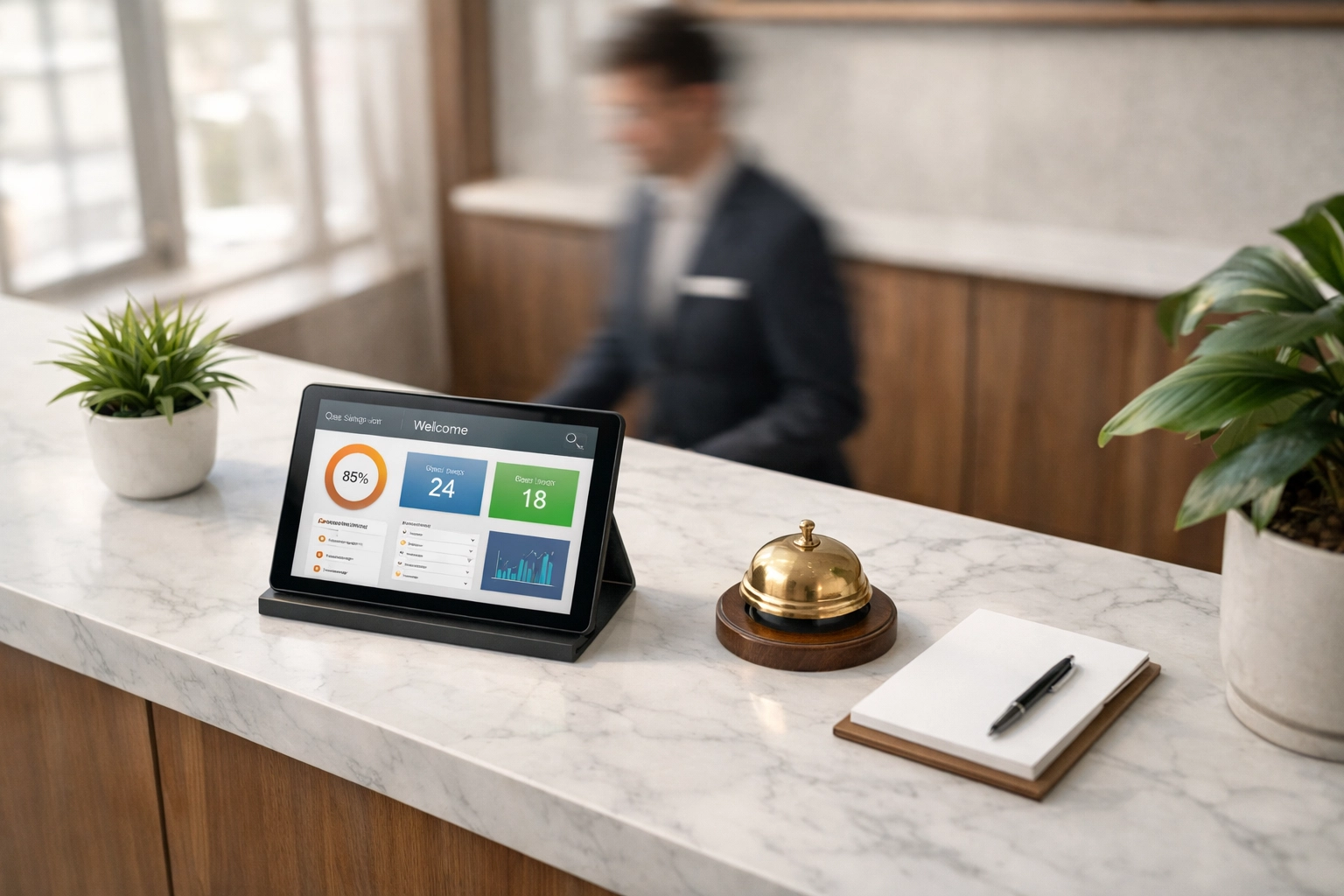
    Modern hotel PMS dashboard on tablet at reception desk showing cloud-based management interface

    The numbers don't lie. According to the 2026 PMS Impact Study, modern hotel property management systems now save hotels more than 500 hours of labor annually. That's over 12 weeks of work eliminated through automation alone.

    Even better? 91% of hotels report direct revenue growth after switching to modern platforms: driven by automated upsells, smarter pricing, and tools that actually capture direct bookings instead of losing them to OTAs.

    What Hotels Actually Need in 2026

    Forget the feature lists that read like phone books. Here's what matters when you're evaluating a hotel PMS:

    1. Built-in payments (60% of hoteliers prioritize this)
    Embedded payment processing means faster checkouts, automatic reconciliation, and one less vendor to deal with. No middleware. No integration headaches.

    2. Housekeeping and service tools (60%)
    Your housekeeping team shouldn't be running around with clipboards. Real-time room status updates, automated task assignments, and mobile access keep operations flowing.

    3. Reporting and business intelligence (48%)
    You need data you can actually use: not spreadsheets you have to build yourself. Revenue insights, occupancy trends, and forecasting should be built in, not bolted on.

    4. Cloud access and remote management (44%)
    Managing your property from your phone isn't a luxury anymore. It's table stakes. Cloud-native systems let you handle everything from anywhere.

    5. Mobile self-service tools (36%)
    Your guests want to skip the front desk. Mobile check-in, digital keys, and self-service upsells aren't just nice to have: they're expected.

    Comparison of legacy hotel management system versus modern cloud-native PMS platform

    The Cloud-Native Advantage

    Here's where most properties get it wrong: they think "cloud-based" just means accessing software through a browser instead of installing it locally.

    But truly cloud-native platforms like Mews are built differently from the ground up.

    Legacy systems were designed for on-premises servers in the 90s, then awkwardly ported to the cloud. They're slow, clunky, and require constant workarounds. Cloud-native platforms are designed for speed, flexibility, and seamless integrations from day one.

    The result? 92% of hotels reduce staff onboarding time from weeks to days with modern interfaces. Your team can learn the system in hours, not months.

    All-in-One vs. Frankenstack

    The old approach was to piece together a dozen different systems: one for PMS, another for channel management, another for CRM, another for payments, another for housekeeping.

    Sound familiar?

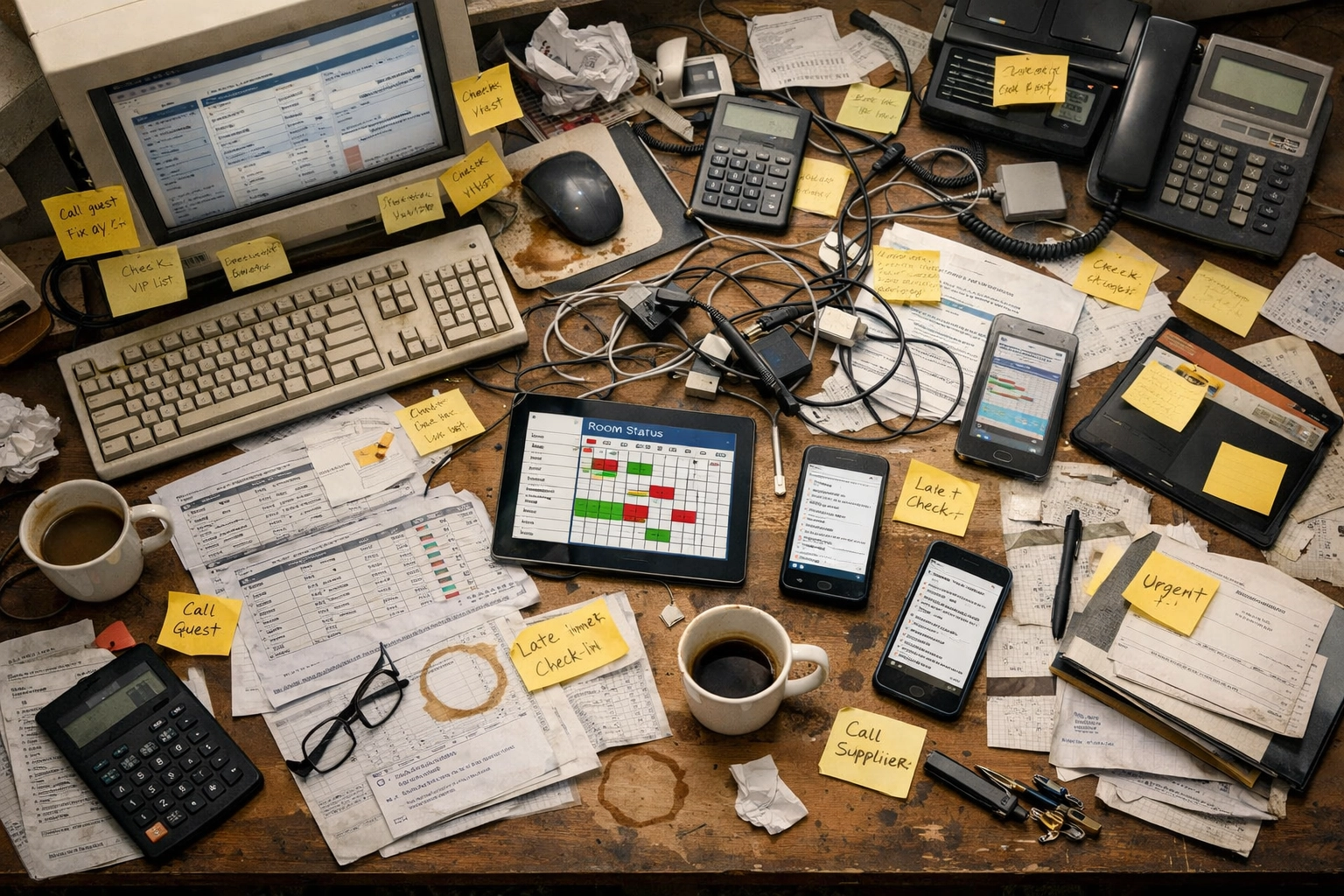
    Cluttered hotel office desk with multiple disconnected systems and software platforms

    That's a Frankenstack. And it's killing your efficiency.

    Every integration is another point of failure. Every vendor is another invoice, another support contract, another login to remember. Data doesn't sync properly. Features break when one system updates.

    Modern hotel management software consolidates everything into one platform. Mews gives you PMS, channel manager, booking engine, CRM, payments, housekeeping tools, and reporting: all natively built into a single system.

    No duct tape. No middleware. No integration fees.

    What Mews Actually Does Differently

    We think hotel software should work for you, not the other way around.

    That's why Mews is designed to automate the repetitive stuff and give you back time for what matters: running a better property and creating great guest experiences.

    Automation at the core

    • Automatic rate updates across all channels
    • Smart upsell prompts at booking and check-in
    • Automated emails and guest communications
    • Self-service check-in and checkout

    Genuinely easy to use

    • Intuitive interface your staff learns in hours
    • Mobile-first design for managing on the go
    • Clean dashboard with real-time insights
    • No IT team required

    Truly cloud-native

    • No servers, no installations, no updates to manage
    • Access from any device, anywhere
    • Built for speed and reliability
    • Seamlessly integrates with 700+ partners

    The Real Cost of Waiting

    Still running an old system? Here's what you're losing every month:

    Time. Your staff is drowning in manual tasks that modern systems automate. Every rate update. Every confirmation email. Every night audit report.

    Revenue. You're missing upsell opportunities, underselling rooms, and leaking bookings to OTAs because your direct booking engine is outdated or non-existent.

    Flexibility. Legacy systems lock you into rigid workflows. When you want to launch a new package, test a pricing strategy, or add a service, you're stuck waiting on customizations or workarounds.

    Modern hotel lobby with self-check-in kiosk and guests using mobile check-in technology

    Guest experience. Your guests expect mobile check-in, digital keys, and seamless experiences. If your PMS can't deliver that, they're noticing: and choosing your competitors next time.

    What to Look for in a Hotel Property Management System

    Shopping around? Here's your checklist:

    Cloud-native, not just cloud-hosted. There's a difference. Make sure the platform was built for the cloud from scratch.

    Native functionality, not integrations. The more features that are built in (not bolted on), the better. Payments, channel management, CRM: these should be native.

    Automation-first design. If you're still manually updating rates or sending emails, the system isn't modern enough.

    Mobile-ready. Both for staff and guests. If it doesn't work great on mobile, pass.

    Transparent pricing. Watch out for hidden fees, per-user charges, or nickel-and-diming for basic features.

    Real support. You need a team that actually helps when things go sideways: not just a ticketing system.

    Why Properties Choose Mews

    Over 5,000 properties worldwide run on Mews. Here's what they tell us:

    They switched because they were tired of juggling five different systems. Tired of slow support. Tired of software that felt like it was built in 2003.

    They stay because Mews actually makes their jobs easier. Check-ins are faster. Housekeeping runs smoother. Revenue grows. Staff onboarding takes hours, not weeks.

    Hotel manager transformation: from stressed with legacy system to relaxed with modern PMS

    And when they need help, they get an actual human who knows hospitality: not a generic support bot reading from a script.

    The Bottom Line

    Hotel PMS, hotel property management system, hotel management software: they're all the same thing. The terminology doesn't matter.

    What matters is choosing a platform that's built for 2026, not 1996.

    A system that automates the busywork. Captures direct bookings. Gives your guests a seamless experience. And doesn't require a PhD in computer science to operate.

    That's Mews.

    Want to see it in action? Book a demo and we'll show you exactly how Mews can transform your property. No pressure, no sales pitch: just a real look at what modern hotel management software actually does.

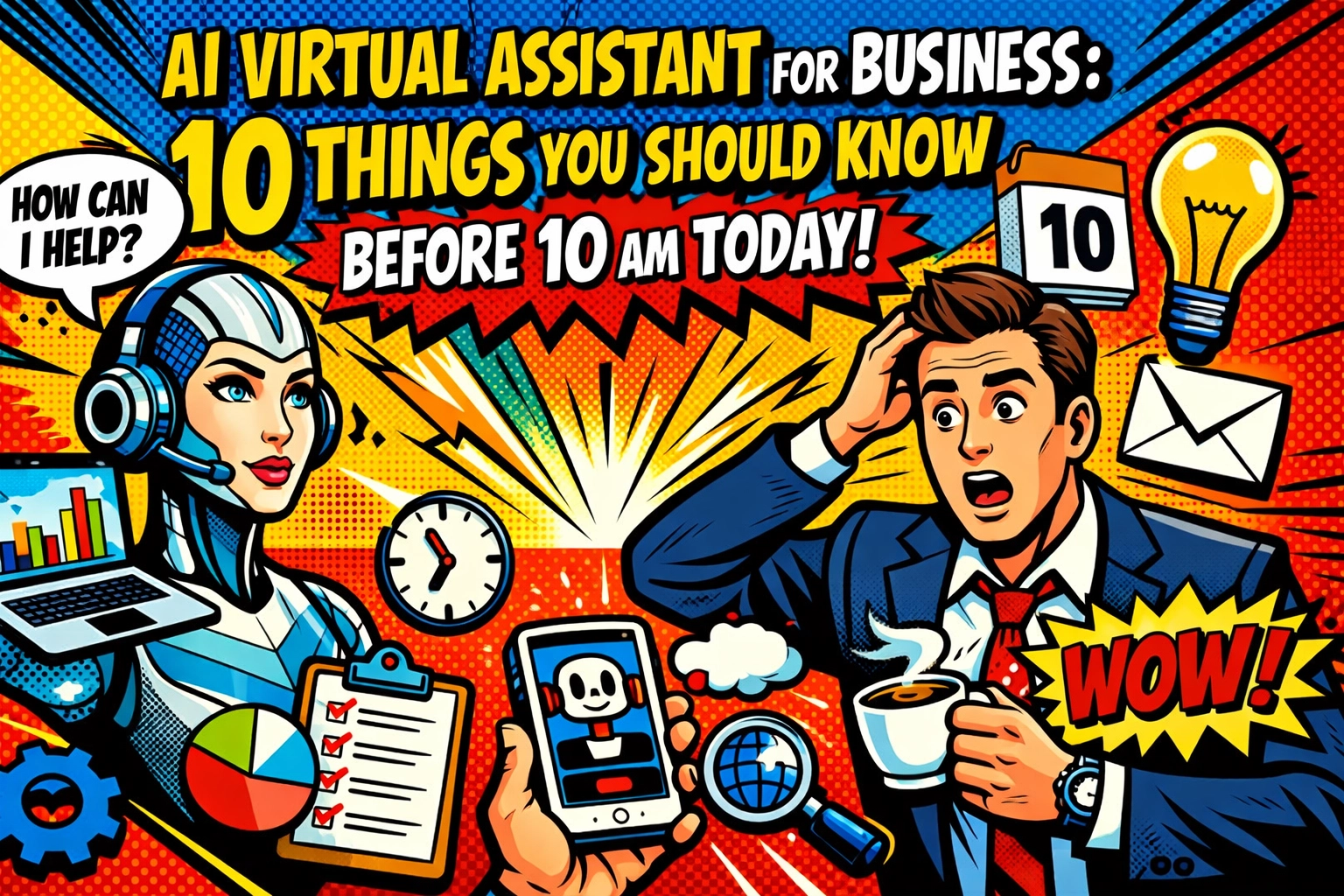
  • AI Virtual Assistant for Business: 10 Things You Should Know Before 10 AM Today

    AI Virtual Assistant for Business: 10 Things You Should Know Before 10 AM Today

    You're three espressos deep and it's only 9:47 AM.

    Your inbox is a war zone. Your phone's been buzzing since 7:15. Someone needs a quote. Someone else wants to reschedule. A third person is asking if you're open on Sundays (you've answered this 47 times this month alone).

    And you're wondering , again , if there's a version of business ownership that doesn't feel like you're permanently drowning in admin tasks.

    There is.

    But first, you need to know what an AI virtual assistant actually does. Not the marketing fluff. The real stuff. The things that'll change how you work before your morning coffee goes cold.

    1. THEY NEVER SLEEP (AND NEITHER SHOULD YOU HAVE TO)

    ☕ It's 2:13 AM. You're asleep. Your AI assistant? Handling a customer inquiry about pricing with the same precision it had at 2:13 PM.

    No overtime. No burnout. No "I'll get back to you tomorrow."

    While you're catching actual rest, your AI assistant is answering emails, scheduling appointments, and managing inquiries. It doesn't need breaks. It doesn't call in sick. It doesn't take long weekends.

    The inquiry that came in at midnight? Already sorted by the time you wake up.

    AI virtual assistant working 24/7 while business owner sleeps at night

    2. YOUR SUPPORT COSTS WILL DROP (DRASTICALLY)

    Here's a number that'll wake you up faster than that third espresso: businesses see support costs drop 40-60% in the first quarter after implementing AI virtual assistants.

    Not over years. Months.

    You're spending thousands on customer service right now , whether that's your time, a VA's time, or a full support team. An AI assistant handles the bulk of routine inquiries (the ones eating your entire Tuesday) while you focus on the complex stuff that actually needs your brain.

    Same quality. Fraction of the cost.

    3. WAIT TIMES BECOME A DISTANT MEMORY

    Remember calling a business and waiting eight minutes while a recorded voice tells you "your call is important to us"?

    Your customers remember too. And they hate it.

    AI assistants drop wait times from 8 minutes to under 30 seconds. They pick up instantly. They answer immediately. They don't put people on hold while they "check with a manager."

    Your customers get help. You get happy customers. Everyone wins.

    4. THEY UNDERSTAND HUMAN AWKWARDNESS

    📱 Here's what your customers actually say:

    "Hey, um, so like… when are you guys around?"

    "Are you open Sundays or…?"

    "What are your hours again? I think I asked before but…"

    They all mean the same thing: What are your business hours?

    Your AI assistant knows this. Intent recognition means it understands what people want even when they phrase it five different ways. It doesn't need perfect grammar or exact phrasing. It just… gets it.

    The way humans actually talk? Your AI assistant speaks that language fluently.

    Business automation reducing customer support costs dramatically

    5. SOME INDUSTRIES ARE ABSOLUTE GOLDMINES

    Healthcare. Hospitality. Retail. Financial services. Professional services.

    If you're in any of these, an AI virtual assistant isn't just helpful : it's transformative. These industries share something in common: high volumes of routine inquiries that follow predictable patterns.

    "What are your hours?"
    "Can I book an appointment?"
    "Do you have X in stock?"
    "What's your cancellation policy?"

    Questions your AI assistant can field in its sleep (which, remember, it doesn't need).

    But here's the truth: any customer-facing business with repetitive questions benefits. If you're answering the same thing more than twice a week, you need automation.

    6. THE SAFETY NET IS BUILT IN

    "But what if it doesn't know the answer?"

    Fair question. Here's the thing: AI assistants are designed with guardrails. When they encounter something uncertain, they transfer to a human smoothly. No awkward pauses. No robotic "I don't understand."

    Just: "Let me connect you with someone who can help with that specific question."

    And here's what surprises most business owners: the error rate for well-trained AI on routine queries is actually lower than human agents. No tired mistakes. No Monday morning fog. Just consistent, accurate responses.

    AI assistant understanding multiple customer inquiry variations on smartphone

    7. THEY ACTUALLY DO THINGS (NOT JUST TALK)

    ☎️ This is where it gets interesting.

    Your AI assistant doesn't just provide information. It takes action.

    Integration APIs connect it to your calendar, your CRM, your booking system, your order processing. So when someone says "I need to schedule an appointment," your AI doesn't just explain how to book one.

    It books it. Right then. Confirms it. Sends a reminder. Updates your calendar.

    While you're finishing that morning meeting.

    8. THE WINDOW IS CLOSING

    Real talk: within 12-18 months, having an AI virtual assistant won't make you stand out.

    It'll be table stakes.

    The minimum requirement just to compete.

    Right now, you're early. You can be the business that responds instantly while competitors make people wait. You can be the one with seamless support while others are still drowning in admin.

    But that advantage window? It's shrinking.

    The businesses moving now are building workflows and systems that'll compound over months. The ones waiting are watching that competitive gap widen.

    9. HUMANS + AI = UNSTOPPABLE

    Here's what nobody tells you about AI virtual assistants: they're not here to replace humans entirely.

    The emerging model that's crushing it? Hybrid.

    AI drafts responses, handles routine tasks, and manages initial inquiries. Human VAs review, refine, add personal touches, and handle complex situations.

    The result? Better than either approach alone. Your AI handles volume. Your human team handles nuance. Together, they create a support experience that feels both instant and thoughtful.

    You get the efficiency of automation with the warmth of human judgment. Best of both worlds.

    AI virtual assistant integrating with business tools and calendar systems

    10. YOU SCALE WITHOUT THE OVERHEAD

    🌙 Here's the math that changes everything:

    You invest three hours weekly managing your AI assistant. In return, you gain 15+ hours of execution capacity.

    That's not a typo.

    Your AI handles customer inquiries, appointment scheduling, follow-ups, and routine communications. You handle strategy, growth, and the work only you can do.

    No additional office space. No new equipment. No expanded payroll with all its complexity.

    Just multiplied capacity without inflated fixed costs.

    Your business grows. Your overhead doesn't.

    BEFORE YOUR COFFEE GETS COLD

    It's still morning. You've got that coffee (maybe it's even still warm). And now you know what an AI virtual assistant actually does.

    Not theory. Reality.

    The question isn't whether this technology works : thousands of businesses are already proving it does. The question is how much longer you want to spend answering "What are your hours?" while your competitors are scaling.

    Want to see what this actually looks like for your business? Check out how Marblism handles AI automation without the corporate complexity.

    Your future self : the one who isn't drowning in routine inquiries at 9:47 AM : will thank you.

    The early bird doesn't just get the worm. It gets the competitive advantage.

    And right now? You're still early.

  • Are Full-Time Hires Dead? How AI Business Automation Saves £30K+ Per Year

    Are Full-Time Hires Dead? How AI Business Automation Saves £30K+ Per Year

    You posted the job listing three weeks ago.

    You've interviewed seven candidates. Two ghosted you after the first round. One asked for £15K more than your budget. Another seemed perfect… until they casually mentioned they're "exploring other opportunities."

    And now you're sitting there, wondering: Is this even worth it?

    Here's the uncomfortable truth nobody wants to say out loud , hiring full-time employees in 2026 isn't just expensive. It's becoming borderline impractical for small businesses. The costs are skyrocketing. The talent pool is shrinking. And by the time you find someone decent, train them, and get them productive… they're already browsing LinkedIn for their next gig.

    But what if I told you there's a way to get the work done , better, faster, and for a fraction of the cost , without posting another Indeed listing?

    Let's talk numbers. Real numbers.

    THE REAL COST OF A FULL-TIME HIRE (SPOILER: IT'S NOT JUST THE SALARY)

    You think hiring someone at £30K sounds reasonable?

    Let's break down what that actually costs you:

    • Base salary: £30,000
    • National Insurance contributions: £3,200
    • Pension contributions (minimum 3%): £900
    • Recruitment costs: £2,500 (job boards, agency fees, your time interviewing)
    • Onboarding and training: £2,000 (conservative estimate)
    • Equipment and software: £1,200 (laptop, monitor, licenses)
    • Sick days and holidays (28 days statutory): £3,287 in lost productivity
    • HR admin and payroll: £800 annually

    Total first-year cost: £43,887.

    And that's assuming everything goes smoothly. No bad hires. No mistakes that cost you clients. No drama.

    Business owner overwhelmed by paperwork vs calm using AI business automation tools

    Now add the invisible costs:

    The two hours a week you spend managing them. The Slack messages at 10 PM because they can't find a file. The sick day that comes right when you need them most. The gradual decline in motivation after month six.

    You're not just paying for labor. You're buying a relationship that requires constant maintenance.

    WHAT IF YOUR "EMPLOYEE" NEVER CALLED IN SICK?

    Here's where it gets interesting.

    AI business automation doesn't take holidays. It doesn't need a pension. It doesn't browse TikTok for 90 minutes a day (yes, studies show the average employee wastes that much time).

    It just… works.

    Let's say you need someone to handle:

    • Customer support emails
    • Social media content scheduling
    • Lead qualification and follow-ups
    • Data entry and CRM updates
    • Report generation

    You could hire a full-time VA or junior assistant for £30K+. Or you could deploy AI-powered business automation tools that handle all of that for around £500-£1,200 per month.

    That's £6,000-£14,400 annually.

    Do the math. You've just saved £29,487 to £37,887 in year one alone.

    Calculator displaying employee hiring costs adding up to over £30K annually

    But here's the part that really gets me excited : the AI doesn't just replace the work. It does it better.

    Your AI assistant responds to customer emails in 30 seconds, not 3 hours. It never forgets a follow-up. It doesn't make typos in your client database. And it scales instantly when you need to handle 10x the volume.

    Try asking your £30K hire to do that.

    THE HIDDEN COSTS NOBODY TALKS ABOUT

    Let's get brutally honest for a second.

    When you hire someone, you're not just paying their salary. You're absorbing their mistakes.

    The email they sent to the wrong client. The deadline they missed because they "didn't see the Slack message." The passive-aggressive tension when you give feedback. The office politics. The "quiet quitting."

    I've watched business owners spend 10+ hours a week managing employees who were supposed to save them time.

    With ai business automation, you get:

    • Zero drama. The AI doesn't have feelings about your feedback.
    • Instant results. No training period. No learning curve.
    • 24/7 availability. It's working while you sleep.
    • Perfect execution. No "I forgot" or "I didn't realize."

    And when your business grows? You don't need to post another job listing. You just scale up your automation. No interviews. No onboarding. No awkward probation periods.

    You press a button. And it's done.

    REAL TALK: IS HIRING ACTUALLY DEAD?

    Look, I'm not saying you'll never need human employees. There are roles that genuinely require human creativity, strategic thinking, and relationship-building.

    But here's what the data shows: hiring freezes are everywhere in 2026. Organizations are making fewer, more selective hires. Entry-level positions are disappearing because companies realized AI can handle 80% of those tasks for 10% of the cost.

    The businesses that are thriving right now? They're the ones who figured out how to blend smart automation with lean, focused teams.

    They're not trying to hire five people. They're using AI to do the work of five people : and then hiring one exceptional human to oversee strategy.

    That's the shift. And if you're still operating like it's 2019, wondering why you can't find affordable talent… you're fighting the wrong battle.

    AI automation efficiently multitasking across multiple business tasks simultaneously

    WHAT £30K IN SAVINGS ACTUALLY BUYS YOU

    Let's bring this full circle.

    If you save £30K+ per year by automating instead of hiring, what could you do with that money?

    • Invest in growth. Run ads. Attend conferences. Build new products.
    • Pay yourself more. You started this business for freedom, remember?
    • Hire better when you actually need to. Save the salary budget for a rockstar, not a task-doer.

    Or here's a wild idea: save it. Build a buffer. Sleep better at night knowing you're not bleeding cash on overhead.

    The businesses that win in 2026 aren't the ones with the biggest teams. They're the ones that operate lean, move fast, and automate relentlessly.

    HOW TO GET STARTED (WITHOUT THE TECH HEADACHE)

    I know what you're thinking: "This sounds great, but I'm not a tech person. I don't have time to learn AI tools."

    Fair. And that's exactly why platforms like Marblism exist.

    Instead of cobbling together five different tools and spending weeks figuring out integrations, you get an AI-powered automation platform that's built for business owners, not developers. Customer support. Content creation. Lead management. Data workflows. All in one place.

    No coding. No tech degree required. Just results.

    Want to see how it works? Check out a demo here: https://marblism.link/scott-bowen

    You'll see exactly how businesses are replacing £30K hires with smart automation : and pocketing the difference.

    Chaotic office desk before and organized workspace after implementing business automation

    THE BOTTOM LINE

    Full-time hires aren't dead. But they're becoming a luxury, not a default.

    If you're still trying to solve every problem with headcount, you're paying 5-10x more than you need to. And you're dealing with all the baggage that comes with it : the management, the turnover, the mistakes, the drama.

    AI business automation isn't about replacing humans. It's about replacing the work that doesn't need a human. So you can focus on what actually matters: growing your business, serving your customers, and reclaiming your time.

    The math is simple. The ROI is undeniable. And the businesses that figure this out first? They're going to dominate the next decade.

    So here's my question for you: Are you ready to save £30K+ this year, or are you going to keep posting job listings and hoping for the best?

    Your move.

    👉 See how Marblism can automate your business in under 10 minutes: https://marblism.link/scott-bowen

  • How to Choose the Best Coffee Supplier for Your Business: A Practical Guide

    How to Choose the Best Coffee Supplier for Your Business: A Practical Guide

    Choosing the right wholesale coffee roaster for your café, restaurant, or coffee business isn't just about finding someone who'll ship you beans. It's about building a partnership that'll directly impact your customers' experience, your bottom line, and honestly, your sanity.

    We've seen too many businesses jump into relationships with coffee suppliers based purely on price, only to find themselves dealing with inconsistent quality, unreliable deliveries, or beans that taste like they've been sitting in a warehouse since 2019. So let's walk through what actually matters when you're vetting wholesale coffee roasters.

    Start With Quality (Obviously, But Hear Us Out)

    Quality sounds obvious, right? But here's where most people get it wrong – they don't dig deep enough to understand how their potential supplier defines and maintains quality.

    When you're talking to coffee suppliers, ask specific questions. What's their roasting schedule? How do they ensure batch-to-batch consistency? Where are they sourcing their green coffee from, and more importantly, why those specific origins?

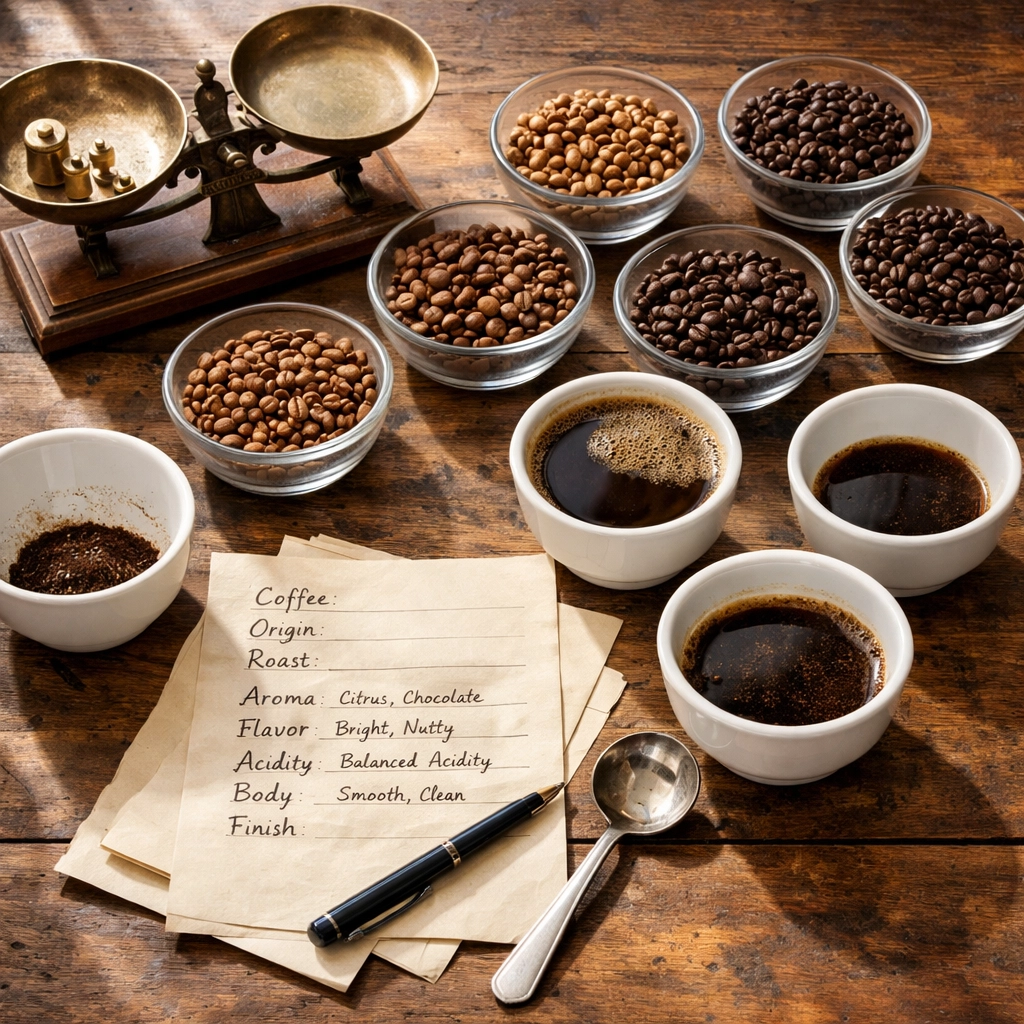
    Professional coffee cupping session testing wholesale coffee quality and consistency

    Request samples. Plural. Not just their flagship blend, but a range of what they offer – single origins, espresso blends, filter roasts. Taste them yourself, obviously, but also get your team involved. Your baristas will be working with this coffee every single day, and they'll notice things you might miss. Pay attention to flavor profiles, body, acidity, and how the coffee behaves under pressure (literally, when you're pulling shots).

    A reputable wholesale coffee roaster will be happy to send samples and walk you through their quality control processes. If they're cagey about their methods or hesitant to provide samples? That's a red flag the size of a coffee sack.

    Sourcing Practices Matter More Than You Think

    Understanding how your potential supplier sources their green coffee tells you a lot about what you're getting into.

    Are they working directly with producers, or are they buying through importers and distributors? Neither approach is inherently wrong, but it affects everything from price stability to quality consistency to how quickly they can respond to supply chain issues.

    We believe direct relationships with origin – or at least transparent partnerships with ethical importers – produce better results. When a roaster has invested time and resources into building relationships with specific farms or cooperatives, they're more invested in quality. They can tell you stories about the producers. They can explain why this particular Colombian tastes different from that one.

    Ask potential suppliers: How long have you worked with your current green coffee partners? What happens if there's a crop failure or quality issue at origin? Do you have backup sources, or will your customers be left scrambling?

    If a supplier can't answer these questions or gives vague responses about "buying what's available," that's another warning sign.

    Sustainability Isn't Just Marketing Fluff Anymore

    Your customers care about where their coffee comes from. And honestly, you should too.

    Look for coffee suppliers who can demonstrate genuine commitment to sustainability – not just certifications they've slapped on their website, but actual practices. Fair Trade, Rainforest Alliance, Organic certifications are great starting points, but dig deeper.

    How does this roaster support the farming communities they work with? Are they paying above fair trade minimums? Do they have long-term relationships that provide farmers with stable income? What about environmental practices – both at origin and in their own roastery?

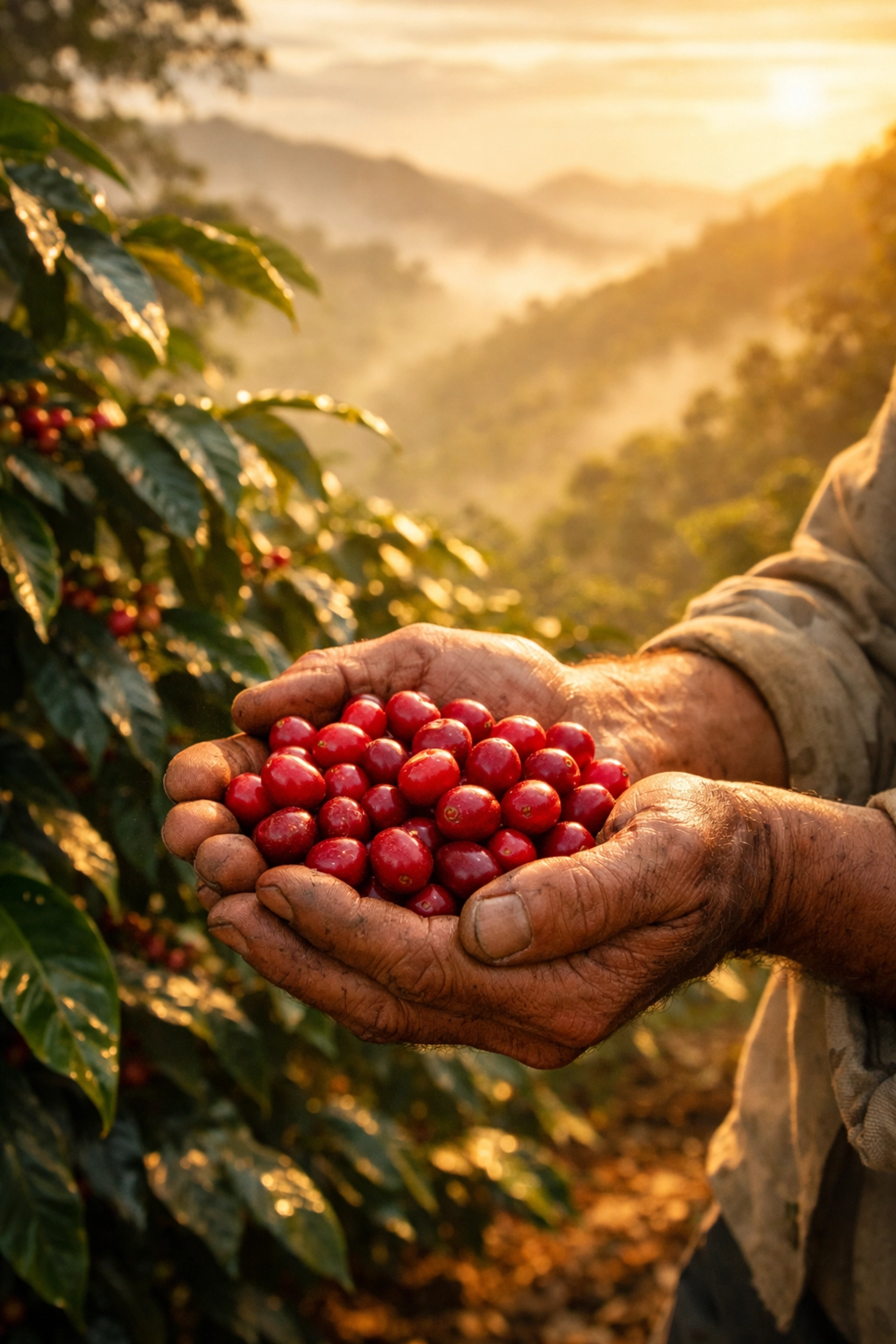
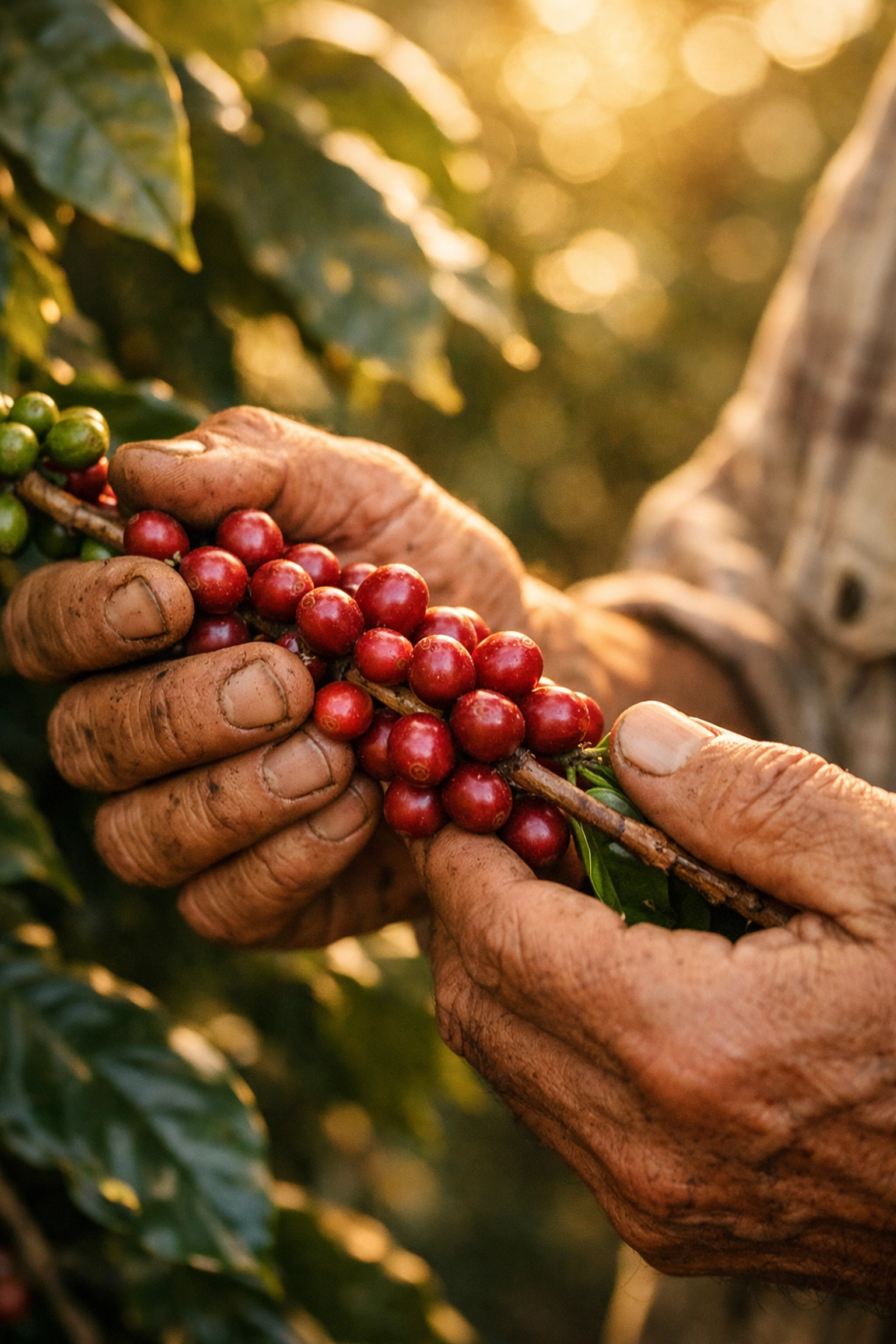
    Coffee farmer hands holding fresh coffee cherries from sustainable coffee farm

    These conversations matter because they tell you whether you're working with a supplier who thinks long-term or one that's just chasing the next trendy origin. The coffee industry has real sustainability challenges, and the wholesale coffee roasters who acknowledge this and work actively to address it are the ones worth partnering with.

    Range and Flexibility

    You need a supplier who can grow with your business.

    Maybe right now you're happy with two blends and a rotating single origin. But what happens in six months when you want to add a decaf, or you decide to create a signature house blend, or your customers start asking for lighter roasts?

    A good wholesale coffee roaster offers variety – different origins, roast profiles, and the flexibility to work with you as your needs evolve. They should have the capacity to create custom blends if that's something you're interested in down the line.

    But here's the thing – variety without reliability is useless. Your supplier needs to have a robust supply chain that can deliver consistently. Ask about their delivery schedules, minimum order quantities, and what happens if there's a disruption. Can they substitute a comparable coffee if your regular order is unavailable, or will you be left figuring it out yourself?

    The Real Cost of "Cheap" Coffee

    Let's talk about pricing, because this is where a lot of businesses make expensive mistakes.

    Yes, price per kilo matters. But it's not the only factor, and sometimes it's not even the most important one. When you're comparing coffee suppliers, you need to understand the full value proposition.

    Does the price include delivery? What about equipment support – will they help you dial in your grinder or troubleshoot extraction issues? Do they offer any marketing support or staff training? Some wholesale coffee roasters provide barista training as part of their service, which can save you thousands in external training costs.

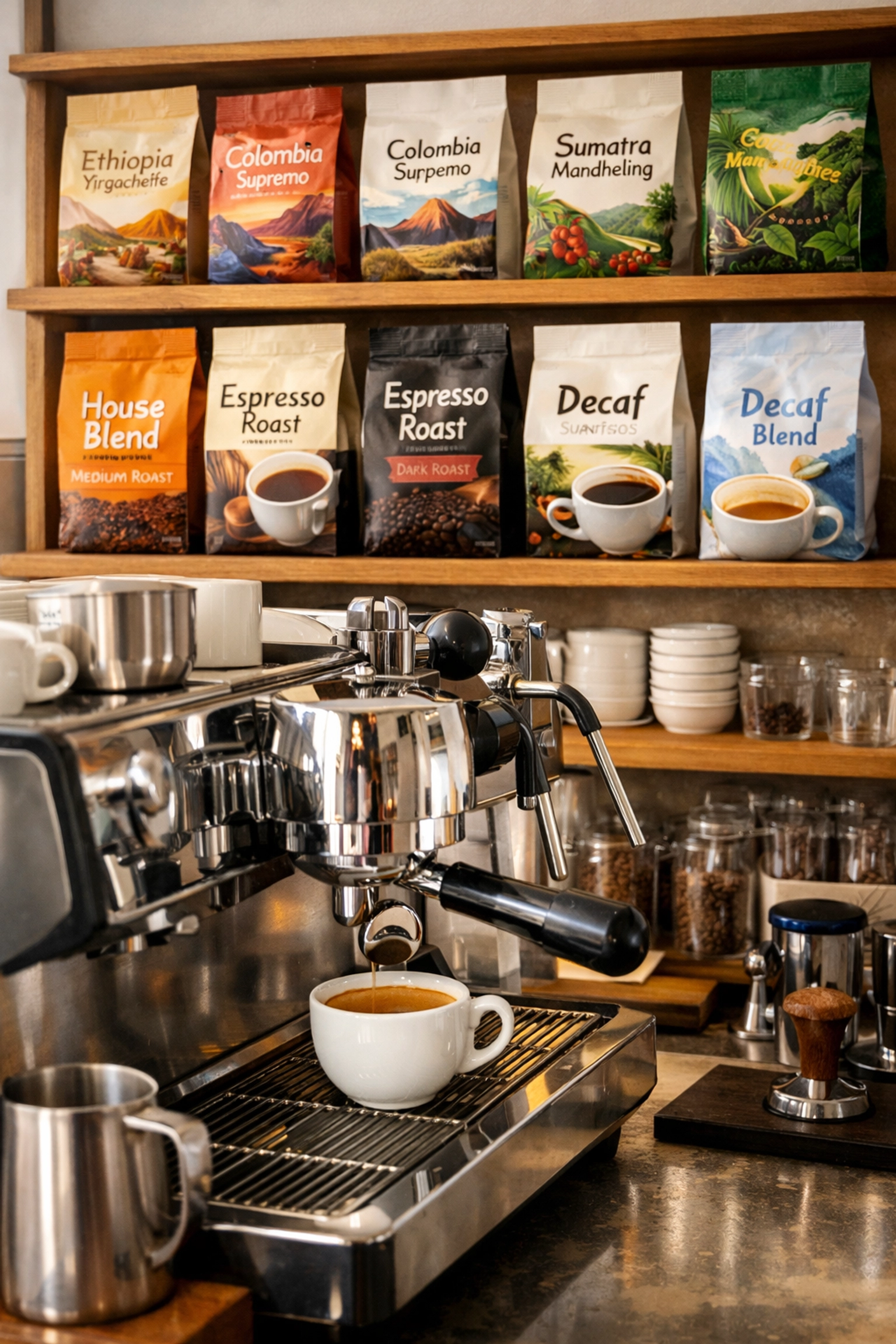
    Café counter displaying variety of wholesale coffee bags with espresso machine

    Ask about volume discounts and payment terms. Many suppliers offer better pricing if you're willing to commit to contracts, and those contracts often come with additional support and priority service. It's worth having that conversation.

    And be cautious of pricing that seems too good to be true. If market prices for Ethiopian coffee are rising but a supplier is offering unlimited quantities at rock-bottom prices, something doesn't add up. You're either getting lower quality beans, or they're cutting corners somewhere that'll come back to bite you.

    If you're looking to explore what specialty wholesale coffee should actually cost, take a look at what we offer at Limini Coffee – we're transparent about our pricing structure and what's included.

    Customer Support Can Make or Break You

    Here's something nobody talks about enough: your relationship with your coffee supplier will involve problems at some point. Equipment breaks down. Orders get delayed. You need a different roast profile. A bag arrives damaged.

    What separates great wholesale coffee roasters from mediocre ones is how they handle these situations.

    When you're vetting suppliers, pay attention to their responsiveness. How quickly do they reply to emails? Can you actually get someone on the phone? Do they have a dedicated account manager, or are you just another number in their system?

    Read online reviews. Ask other café owners about their experiences. If you can, get references from other businesses the supplier works with. Ask those references specific questions: How does this supplier handle problems? What's their average delivery reliability? Have they ever been let down?

    The Technical Stuff: Quality Control and Testing

    A professional wholesale coffee roaster should have robust quality control processes in place. This means regular cupping sessions to evaluate each batch, testing samples from their green coffee suppliers before committing to purchases, and having systems to catch and remove defects or foreign objects before roasting.

    Ask potential suppliers about their QC protocols. How often do they cup their coffees? What's their process for evaluating green coffee before it goes into the roaster? How do they ensure consistency between batches?

    We test every single batch that comes through our roastery, and we're happy to share our cupping notes and quality assessments with our wholesale partners. That level of transparency should be standard, not exceptional.

    Making Your Decision

    After you've done your research, requested samples, checked references, and had all these conversations, you should have a pretty clear picture of which coffee suppliers align with your business values and needs.

    Don't rush this decision. The relationship you build with your wholesale coffee roaster will affect every cup you serve, every customer interaction, and ultimately, your business success.

    Start with a trial period if possible. Order enough to properly evaluate the coffee and the service, but don't commit to a massive contract right away. See how the coffee performs in your café. Watch how your customers respond. Notice whether the supplier follows through on their promises about delivery times and customer support.

    And remember – this should feel like a partnership, not just a transaction. The best wholesale coffee roasters genuinely care about your success because they understand that your success is their success.

    Coffee quality testing setup with bean samples and cupping bowls for evaluation

    Your Next Steps

    Before you reach out to potential suppliers, get clear on what you actually need. How much coffee do you use per week? What flavor profiles work for your customer base? What's your budget, realistically, including delivery and any additional services you need?

    Make a shortlist of three to five coffee suppliers that seem promising. Reach out to each one with specific questions. Request samples. Talk to their other customers. Visit their roastery if that's possible – seeing their operation in person tells you a lot.

    Take your time with this. Switching coffee suppliers later is possible, but it's disruptive to your business and confusing for your customers. Get it right from the start, and you'll save yourself a lot of headaches down the line.

    If you're exploring your options and want to learn more about our approach to wholesale coffee and what we can offer your business, we'd love to chat. You can explore our wholesale services or reach out directly.

    The right coffee supplier is out there. You just need to ask the right questions to find them.
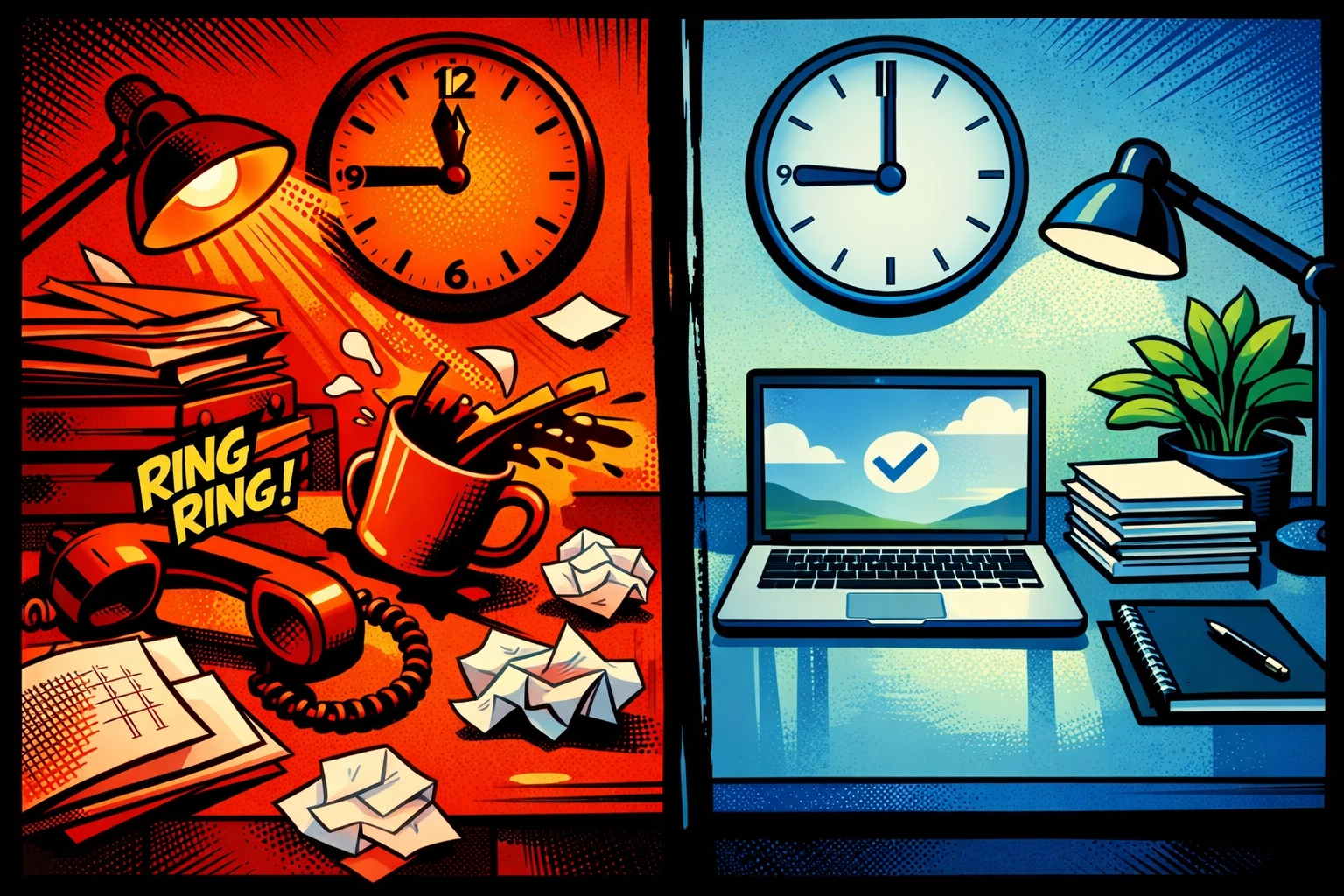
  • Why Coffee Prices Are Rising in 2026 (And What Your Coffee Shop Can Do About It)

    If you've noticed your favorite beans costing a bit more lately, you're not imagining things. Coffee prices have been on quite the journey over the past year or so, and it's affecting everyone from large café chains right down to us home brewers who just want a proper cup in the morning.

    So what's actually going on? And more importantly, what can you do about it without compromising on the quality you've come to love?

    The Perfect Storm That Hit Coffee Prices

    The coffee price surge isn't just one thing going wrong: it's several factors colliding at once. Think of it as a perfect storm, but instead of rain, we're dealing with drought, heat, and some seriously stressed coffee plants.

    Climate Chaos in the Coffee Belt

    Brazil and Ethiopia, two of the world's most critical coffee origins, have faced significant climate disruptions. We're talking droughts, unpredictable rainfall, and heat waves that have absolutely hammered harvest yields. Brazil, which produces about a third of the world's coffee, has been particularly affected.

    The cumulative damage from these climate events has fundamentally shifted the cost base of the entire industry. Even though Brazil received above-average rainfall in January 2026, the plants are still recovering from previous stress. Coffee trees don't just bounce back overnight: they need time.

    Coffee farmer harvesting ripe red coffee cherries affected by climate change in 2026

    The Futures Market Went Wild

    Here's where it gets technical, but stick with me. Coffee is traded as a commodity, and the price everyone references is called the ICE "C-price" for arabica beans. In February 2025, this price hit $4.41 per pound: more than double what it had been previously. That's a historic high.

    Why does this matter to you? Because when roasters like us at Limini Coffee buy green coffee, these futures prices directly influence what we pay. Even though prices have moderated to around $3 per pound recently, that's still significantly higher than the five-year average.

    Everything Else Got More Expensive Too

    Beyond just the coffee beans themselves, there's been sustained increases across the board: labor costs, energy bills, fuel for shipping, freight logistics, packaging materials. For roasters and home brewers alike, it's not just one thing: it's everything at once.

    This is why you can't just look at green bean prices and predict retail prices. Even when raw coffee costs ease a bit, all these other operational pressures keep final prices elevated.

    The Numbers Tell the Story

    Let's put this in perspective. Green coffee bean prices have risen approximately 115% on average. That's more than doubling. However, retail prices for roasted coffee have only increased about 17%.

    What does that mean? Roasters are absorbing a massive amount of margin compression to keep prices reasonable for customers. Ground roast coffee averaged over $9 per pound in the fourth quarter of 2025: and that's the roasters doing their best to soften the blow.

    Coffee price charts and market data showing rising futures costs for roasters

    What This Means for Your Home Brewing Setup

    So how does all this affect your morning ritual?

    First, the beans you love are going to cost more. There's no way around that basic fact. But the good news is that you have more control over your coffee costs than you might think.

    Quality Matters More Than Ever

    When coffee gets more expensive, the temptation is to go cheaper to save money. We get it. But here's the thing: you end up using more cheap coffee because it doesn't satisfy, and you're actually getting less value per pound.

    Premium specialty coffee from roasters who source ethically and roast skillfully gives you more flavor per gram. You can actually use less coffee per brew and still get incredible results. That's genuine value.
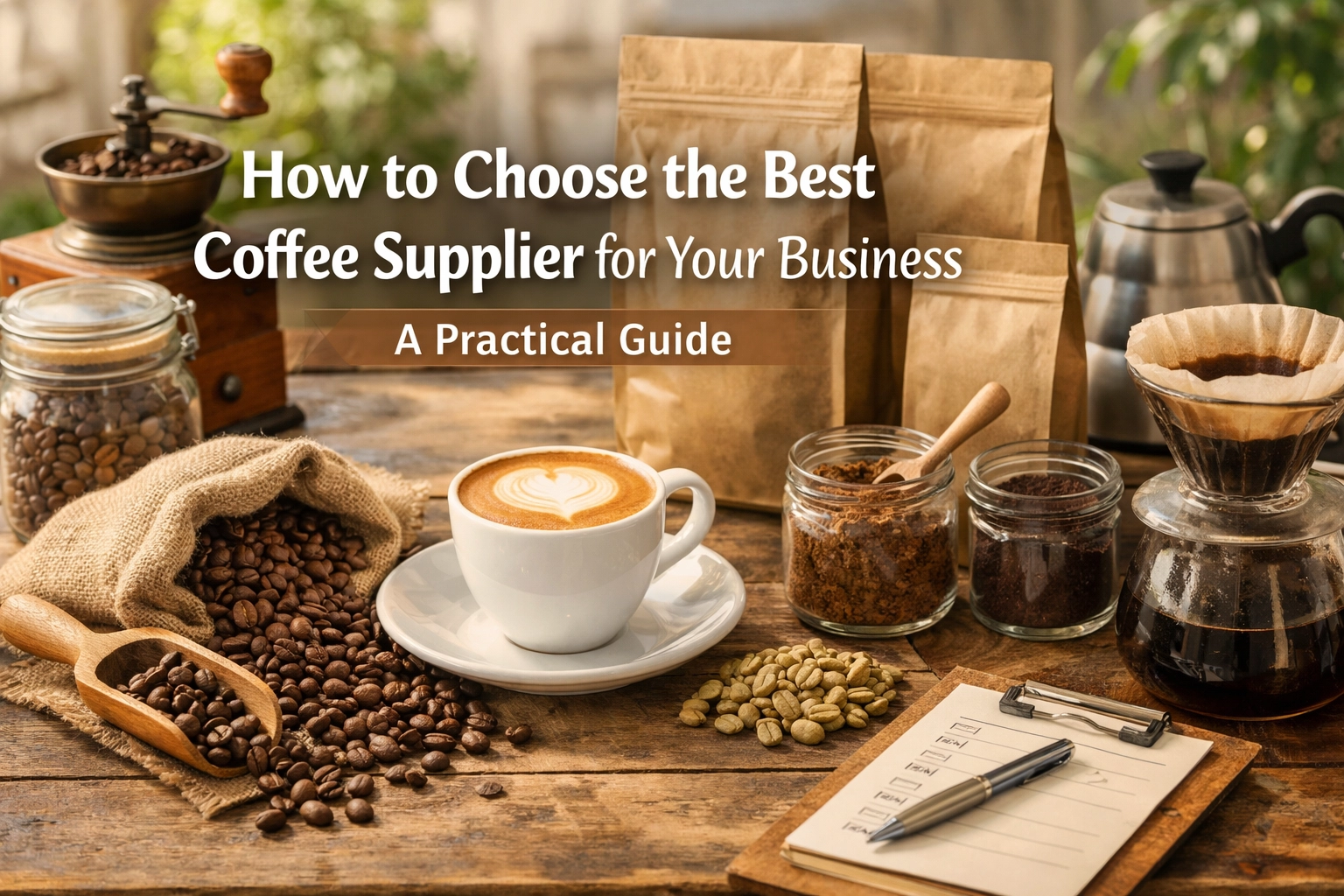

    Buy Smart, Not Just Cheap

    Consider buying directly from specialty roasters rather than grocery store brands. When you buy from a roaster like Limini Coffee, you're cutting out middlemen and getting fresher beans that will taste better and go further. Fresh is best, and it genuinely makes your coffee budget stretch.

    You might also want to explore different origins. As climate affects different regions, some origins become more affordable while maintaining excellent quality. Don't be afraid to try a new single origin: you might discover your new favorite and save money at the same time.

    Buy in Sensible Bulk

    If you find beans at a good price, consider buying a bit more than usual. Coffee beans stay fresh for several weeks when stored properly in an airtight container away from light and heat. Just don't go overboard: you still want to consume them within a reasonable timeframe for optimal flavor.

    Some roasters offer subscription services that can lock in pricing and ensure you never run out. The consistency can actually help with budgeting your coffee spending month to month.

    Practical Strategies for Right Now

    Brew More Efficiently

    This isn't about compromising quality: it's about precision. Use a scale to measure your coffee and water. Most home brewers eyeball it and end up using more coffee than necessary. The standard ratio is 1:16 (coffee to water), and hitting that consistently means you're not wasting precious beans.

    Our coffee brewing calculator can help you dial in the exact amounts you need for different brew methods.

    Store Your Beans Properly

    Nothing hurts more than watching expensive beans go stale because they weren't stored correctly. Use an airtight container, keep them in a cool dark place, and only grind what you need for each brew. Proper storage can extend the peak freshness window and ensure you're getting the most from every bag.

    Reduce Waste

    That slightly too-strong brew? Don't dump it: add a splash of hot water. Made too much coffee? Cold brew concentrate is calling. Getting creative with leftovers means you're extracting maximum value from every bean.

    Home coffee brewing station with precision scale measuring beans for efficient brewing

    There's Actually Good News Ahead

    Before you start rationing your morning cups, there's reason for optimism. Brazil's 2026 coffee production is forecast to climb 17.2% to a record 66.2 million bags. Vietnam's output is projected up 6%. This improved supply outlook has already started easing global concerns.

    The International Coffee Organisation's December price indicator declined 7.8% from November due to these better supply forecasts. So while we're not heading back to 2023 prices anytime soon, we're also not looking at continued dramatic increases.

    What we're likely to see is a stabilization: prices finding a new normal that reflects the genuine costs of producing incredible coffee in an era of climate uncertainty.

    Why This Isn't Actually Bad News

    Here's a perspective shift: higher coffee prices might actually be good for coffee in the long run.

    For too long, coffee farmers have been underpaid for their incredibly skilled work. When prices rise, more of that money can flow back to origin countries, funding better farming practices, investing in climate resilience, and ensuring the next generation wants to continue growing coffee.

    As home brewers who genuinely care about quality, supporting this more sustainable pricing structure means we're helping ensure amazing coffee will still exist for years to come.

    Your Home Coffee Bar in 2026

    So what should you actually do? Keep buying the coffee you love from roasters you trust. Be a bit more mindful about waste and brewing efficiency. Explore new origins as opportunities arise. And remember that even at higher prices, brewing at home still delivers incredible value compared to café prices.

    The coffee you brew at home: even with premium beans: works out to about £0.30-0.50 per cup. That café latte? Averaging £3.59. You're still winning.

    The key is focusing on value over price. Cheaper coffee that doesn't satisfy isn't a bargain: it's just expensive disappointment. Premium beans from quality roasters deliver the experience you're actually paying for.

    And if you're looking for a roaster that balances exceptional quality with fair pricing, we'd love to welcome you to the Limini Coffee family. We've weathered these market changes by maintaining our commitment to sourcing brilliant beans and roasting them to bring out their best.

    Coffee prices might be higher than they were, but the coffee itself? Still absolutely worth it.