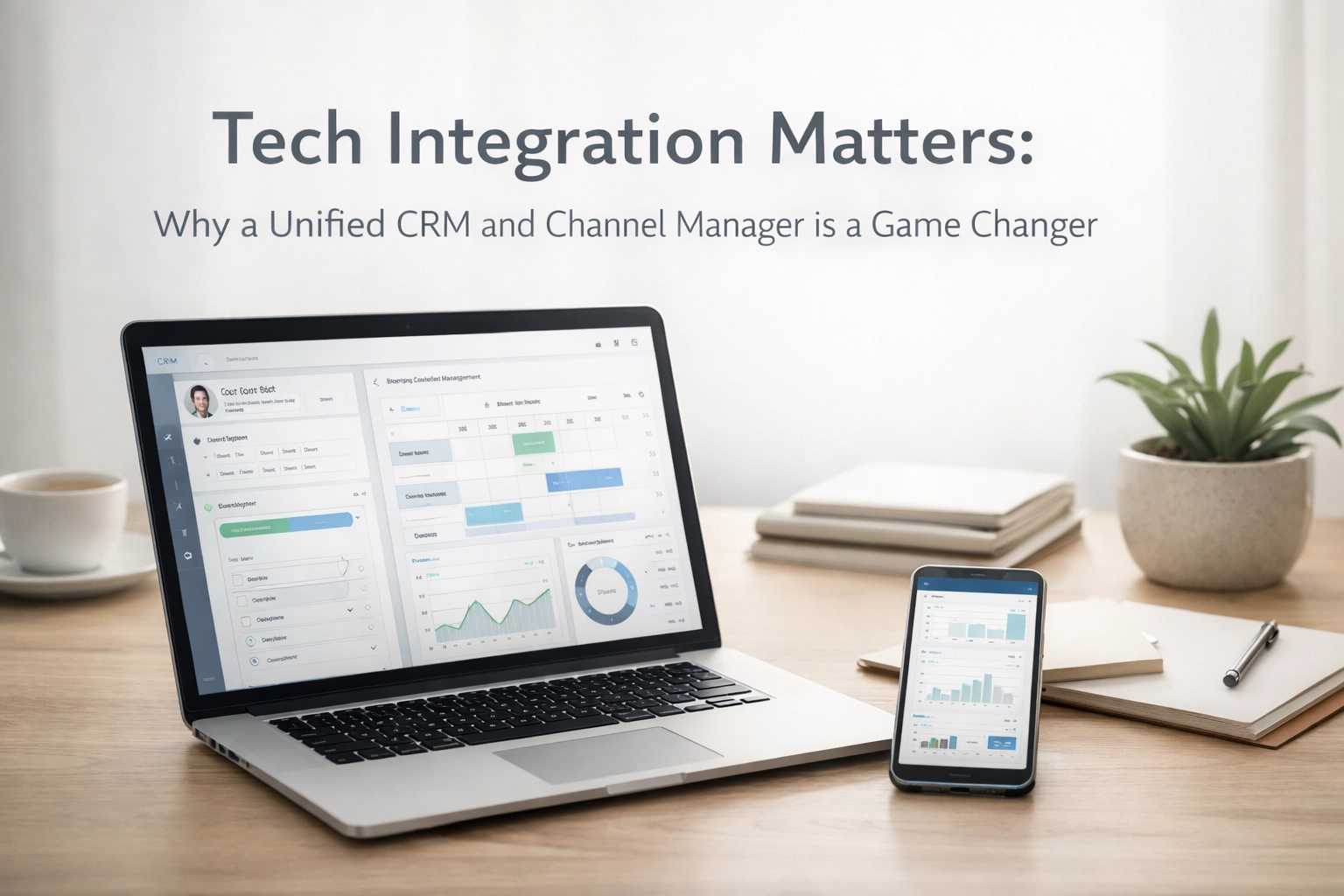
Move faster. Sell smarter. Delight guests.
30% fewer manual touches and 15 minutes saved per reservation is the kind of shift teams feel in week one, not quarter four.
When your CRM and channel manager run as one, you stop juggling tools and start running the entire guest journey, all from one cloud-native platform.
The integration problem nobody has time for
Your day doesn’t fall apart because your people aren’t good. It falls apart because your systems don’t talk.
One tab for the channel manager. One for your hotel PMS. Another for the booking engine. Then a CRM (or a spreadsheet pretending to be one). Suddenly, “quick” tasks turn into copy-paste marathons:
- Rate updates become a scavenger hunt
- Guest preferences live in someone’s inbox
- Campaigns go out without real context
- Teams argue about which data is “right”
And while you’re doing that, your guests are doing what guests do, booking where it’s easiest, messaging on whatever channel they prefer, and expecting you to remember them.
Unified CRM + channel manager. What changes?
You don’t need more software. You need fewer gaps.
A unified CRM and channel manager setup gives you a single source of truth, guest data, booking data, channel performance, and messaging context connected end-to-end. No silos. No duplicate records. No “hang on, I’ll check another system.”
Here’s what it unlocks in real operational terms:
1) One guest profile. Every channel. Every time.
We believe guest experience starts with memory, real memory, not “I think I’ve seen that name before.”
With unified data, your team sees:
- Past stays and preferences
- Communication history (no repeats)
- Source channel and booking behavior
So when someone books via an OTA, extends via email, and asks a question via chat, your staff isn’t starting from zero each time.
“We stopped asking guests to repeat themselves. It sounds small, but it saved us about 10 hours a week and the vibe at the desk got way calmer.”
2) Rate, inventory, and guest value stop competing
When your channel manager runs in its own bubble, it’s great at distribution, but blind to relationship value.
A unified approach connects:
- Revenue decisions (rates, restrictions, availability)
- Guest context (repeat guest, corporate, long-stay)
- Conversion levers (direct booking offers, upgrades)
So you’re not just “selling nights.” You’re building smarter demand, especially when your booking engine and CRM can react to real guest signals.
3) Automation becomes safe (because the data is clean)
Automation is only as good as the data feeding it. When CRM and channels are disconnected, automation turns into awkward moments, wrong name, wrong offer, wrong timing.
Unified systems reduce those risks because:
- Profiles are consistent
- Segments are accurate
- Triggers fire on real events (not guesses)
That’s how you get automation that feels personal, not robotic.
The silent killer: data fragmentation
Let’s be blunt. Fragmented data drains money quietly.
When guest and booking data live in separate systems, you get:
- Duplicates (“John Smith” x 4)
- Missing context (preference notes vanish)
- Conflicting numbers (occupancy doesn’t match pickup)
And then the work begins: reconciling spreadsheets, updating notes twice, double-checking availability, cleaning lists for campaigns.
A unified CRM + channel manager setup eliminates the “which system is correct?” question. There’s one answer. Every time.
Omnichannel isn’t a buzzword, your guests already live there
Guests don’t care which tool you use. They care that you answer quickly and consistently.
They’ll:
- Book on an OTA at 11pm
- Message you on Instagram the next morning
- Call at lunch
- Ask for late checkout at check-in
If those touchpoints don’t connect, the guest experience feels disjointed. Like your hotel is run by four different teams who never met.
Unified CRM + channel manager integration supports an omnichannel experience because the conversation has continuity, same context, same preferences, same person.
And yes, that directly impacts reviews.
Where this hits hardest: your daily workflow
This is where integration pays off: in the unglamorous stuff.
Less rekeying. Fewer errors. Faster training.
We think the best tech disappears into the workday. It shouldn’t require a “systems translator” on every shift.
When systems unify, you cut:
- Manual data entry
- Channel-by-channel updates
- “Can you send me that guest info?” pings
That makes onboarding easier too. New team members learn one workflow, not a patchwork.
Cleaner handoffs between teams
Front office, revenue, and marketing tend to operate like separate planets. Integration pulls them into the same orbit.
- Revenue sees channel pickup alongside guest value
- Marketing segments using real booking behavior
- Front office gets preferences without digging
No extra meetings. No extra admin. Just clarity.
How it connects to the hotel PMS, booking engine, and self-check-in kiosks
Integration isn’t just about CRM + channel manager. It’s about what those two unlock across your stack.
Hotel PMS: operations finally match distribution
Your hotel PMS is where the stay actually happens: arrival, room assignment, payments, extensions, upgrades. When it’s connected to channel and CRM data, you get a live operational picture that’s also commercially smart.
Think:
- Fewer overbooking headaches
- More confident room moves
- Upsells based on real guest history
Booking engine: direct conversion with real personalization
Your booking engine should do more than take reservations. With CRM context, it can support smarter direct offers: based on stay patterns, preferences, and loyalty signals.
Not complicated. Just practical:
- Repeat guest? Show a room type they liked last time
- Long-stay pattern? Offer a better weekly rate
- Corporate guest? Highlight flexible invoicing
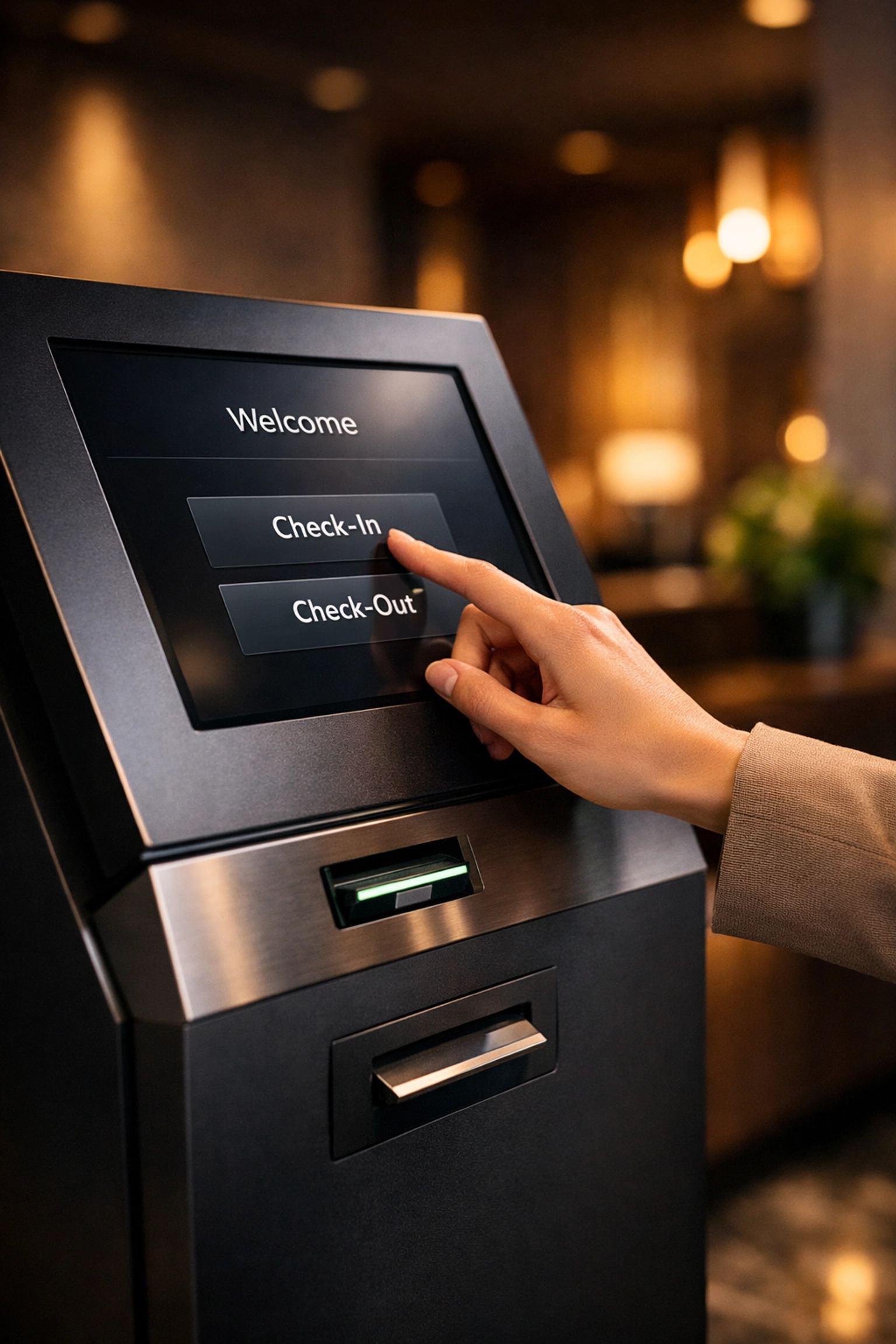
Self-check-in kiosks: speed without losing the “human”
Self-check-in kiosks win when they’re connected to clean, unified guest profiles. Otherwise, they become a fancy queue.
When kiosk workflows tie into your PMS + CRM data:
- Guests verify details once
- IDs and payments flow cleanly
- Staff step in only when it matters
You get the best of both worlds: fast arrival and a more focused welcome.

The real win: personalization at scale
Personalization sounds expensive: like you need more staff or more time.
You don’t. You need connected data.
When your CRM and channel manager work together, you can run simple personalization that actually lands:
- Pre-arrival messages that match booking source and stay type
- Upgrade offers timed to real availability
- Post-stay outreach based on what the guest used (spa, breakfast, parking)
It’s not “Dear Valued Guest.” It’s “Hey Sam: parking is reserved, and late checkout is ready.”
“We used to send one generic pre-arrival email. Now it’s segmented, automated, and we’re seeing 12% more paid upgrades without extra work.”
A quick reality check: what “unified” should mean
Not every integration is real integration. Some are just data dumps.
A unified setup should mean:
- Real-time sync, not nightly exports
- Shared guest profiles, not separate records
- Workflow automation, not just reporting
If your team still has to copy info from one place to another, it’s not unified. It’s just connected “on paper.”
What to look for in a unified platform
You’re busy. So here’s the shortlist.
1) Cloud-native foundation
We believe cloud-native matters because hospitality doesn’t sit still: rates move, demand spikes, and teams work from everywhere.
Cloud-native systems deliver:
- Faster updates
- Better reliability
- Less IT overhead
2) Easy to use (for real humans)
A platform can be powerful and still be a pain. Don’t accept that tradeoff.
Easy-to-use means:
- Fewer clicks
- Clear workflows
- Minimal training time
3) Automation-first, not automation-as-an-add-on
Automation shouldn’t be a premium feature you’re afraid to touch.
Look for:
- Simple triggers
- Clear approvals
- Reporting that proves it’s working
That’s how teams trust automation: and keep using it.
30-minute action plan: map your gaps fast
Want to know if unified CRM + channel manager integration will move the needle for you? Run this quick audit.
- List every place guest data lives (PMS, CRM, inbox, OTA extranets).
- Track one reservation from booking to checkout: write down every manual touch.
- Count channel updates needed for a single promo (rates, restrictions, content).
- Identify repeats (duplicate profiles, double notes, double entry).
- Pick one workflow to automate this month (pre-arrival, upgrades, review requests).
If you find more than 20 manual touches in that reservation journey, integration isn’t a “nice to have.” It’s a revenue and sanity issue.
Where Mews fits in
Mews is built for hotels that want to move fast: without building a fragile tech tower.
We’re cloud-native, easy to use, and automation-focused by design. That means less busywork, cleaner guest journeys, and a setup your team won’t fight.
If you want to explore how a modern platform approach can simplify your stack and help you scale, grab the link here: https://referrals.mews.com/umqHYIto
The takeaway you can use today
Unified CRM + channel manager isn’t a “tech project.” It’s an operating model.
- One source of truth
- One connected guest journey
- One workflow your team can actually run
And when it’s done right: tied into your hotel PMS, booking engine, and self-check-in kiosks: you stop spending time managing systems and start spending time running the hotel.
Leave a Reply