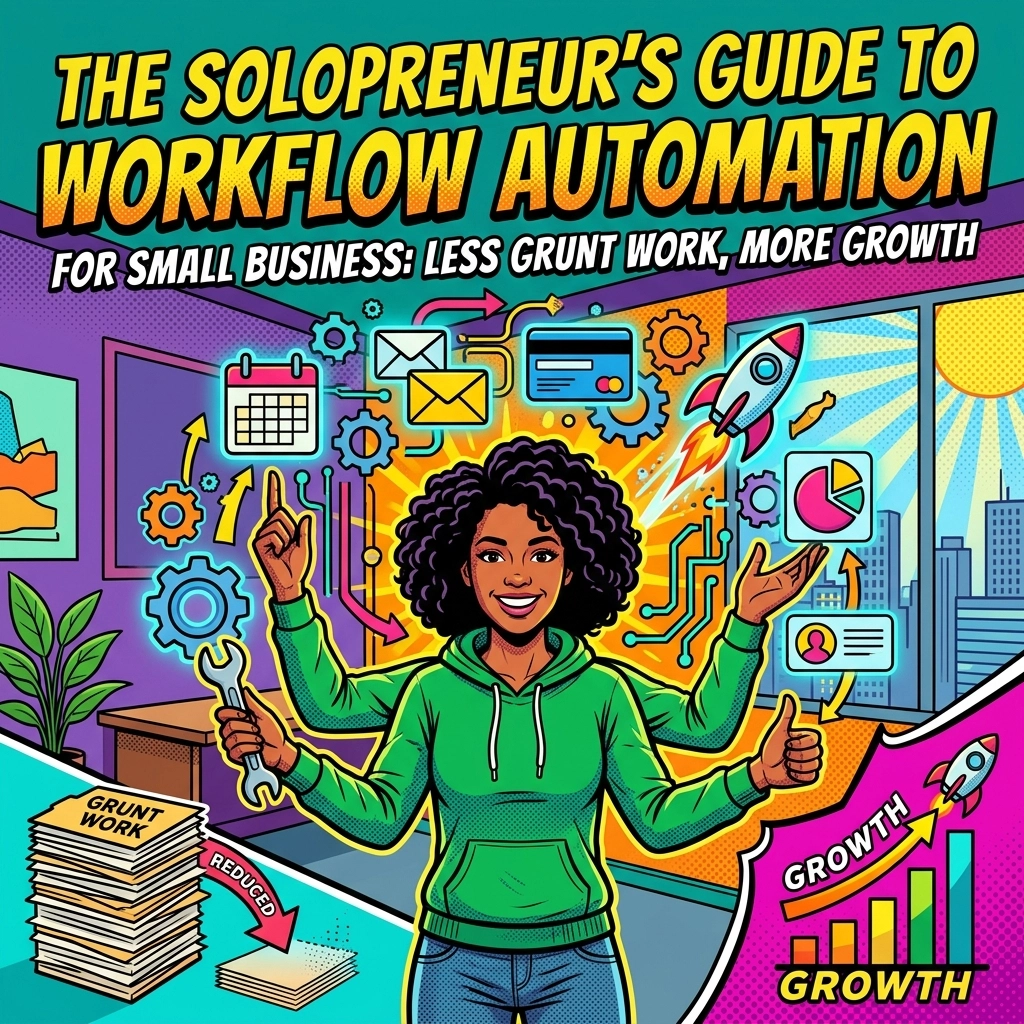
Workflow Automation for Small Business: Stop Doing the Busy Work
☕ 7:30 AM. The house is quiet. The coffee is hot. You open your laptop, ready to conquer the world, or at least finish that big project.
But then… it happens.
Your inbox is a crime scene. Three clients are asking for the same onboarding document. Your calendar is a jigsaw puzzle with missing pieces. You spent two hours yesterday manually copying data from a lead form into a spreadsheet, and guess what? You’ve got five more waiting for you today.
By 10:00 AM, you’re not a CEO. You’re a high-priced data entry clerk.
This is the "Busy Work Trap." It’s the invisible ceiling that stops small businesses from becoming big businesses. But there’s a way out that doesn't involve hiring a 10-person team or working until 2:00 AM.
THE TRUTH ABOUT WORKFLOW AUTOMATION
Workflow automation sounds like something for Silicon Valley giants with massive IT budgets. It’s not. For a solopreneur, it’s simply setting up "If This, Then That" rules so your software talks to each other while you do the actual work.
Think of it as building a digital assembly line.
Instead of you manually moving a lead from your website to your CRM, sending them a welcome email, and then creating a task in your project manager… the system just does it.

YOUR 30-DAY ESCAPE PLAN
You can’t automate your entire business in an afternoon. If you try, you’ll just create a faster way to make mistakes. Follow this roadmap instead:
Days 1-7: The Audit
Stop working for a second. Look at everything you did last week. What happened more than three times? What felt like a chore? If it has clear rules and happens often, it’s a candidate for automation.
Days 8-14: The First Win
Pick one thing. Just one. Maybe it's meeting scheduling. Instead of the back-and-forth "Does Thursday at 2:00 work for you?" dance, set up an automated scheduler. You send a link. They pick a time. The calendar invite and Zoom link appear magically. You just saved four emails per client.
Days 15-30: Connecting the Dots
Start linking your tools. When a client pays an invoice, have your system automatically send the "Getting Started" guide. When someone fills out a contact form, have their details pop up in your Slack or via text.
SCALING WITHOUT THE STRESS
The goal isn't to be "techy." The goal is to be free. When you implement workflow automation for small business, you aren't just saving time, you're buying back your mental energy.
You stop wondering "Did I send that invoice?" because the system already did. You stop worrying about leads falling through the cracks because the automation is holding the net.
Scaling shouldn't be this easy. But here we are.
Ready to stop the manual grind? Check out how Scott Bowen and Marblism make this transition seamless.
Why Your Business Needs an AI Virtual Assistant (Before Your Competitors Get One)
📱 11:15 PM. You’re finally in bed, scrolling through LinkedIn. You see a competitor, the one who started six months after you, announcing their third major partnership this quarter.
How are they doing it? They have the same 24 hours you do. They don't seem smarter. They definitely don't seem to be working harder.
The difference? They aren't doing it alone. And they didn't hire an expensive agency either.
They got an AI virtual assistant.
THE INVISIBLE EMPLOYEE
An AI virtual assistant for business isn't just a chatbot that says "Hello, how can I help you?" on your homepage. It’s a sophisticated layer of intelligence that lives inside your operations.
While you’re sleeping, it’s qualifying leads.
While you’re in a meeting, it’s drafting your social media posts based on your brand voice.
While you’re taking a weekend off, it’s analyzing your sales data to tell you which product is actually making you money.

WHY AI BEATS THE TRADITIONAL VA
Don't get it wrong, human assistants are great. But they have limits. They need sleep. They have "off" days. They cost a full-time salary.
An AI assistant:
- Never sleeps. 3:00 AM inquiry from a lead in London? Handled.
- Is infinitely scalable. It can talk to one person or 1,000 people simultaneously without breaking a sweat.
- Costs a fraction of a hire. You get executive-level support for the price of a few lattes.
THE "AFTER" STATE: CALM COMPETENCE
Imagine a Tuesday morning.
☕ 9:00 AM. You sit down. Your AI assistant has already sorted your inbox into "Action Required," "Information Only," and "Trash." It has prepared a summary of your meetings for the day.
🤝 1:00 PM. A potential high-ticket client pings your site. The AI engages, answers three technical questions about your service, and books a call on your calendar for tomorrow. You didn't even touch your phone.
🌙 6:00 PM. You close your laptop. The day is done. The work is finished. There are no "oops, I forgot" moments lingering in the back of your mind.
THE COMPETITIVE EDGE IS SHRINKING
The window of opportunity to use AI as a secret weapon is closing. Soon, having an AI virtual assistant for business will be as standard as having an email address.
Right now, it’s your edge. It’s how you out-work, out-think, and out-scale businesses ten times your size. If you wait until everyone else has one, you’re not gaining an advantage: you’re just playing catch-up.
Stop being the bottleneck in your own company.

THE BOTTOM LINE
You didn't start a business to spend your life in spreadsheets and admin panels. You started it to create, to lead, and to grow. AI is the leverage that lets you get back to that.
The grunt work is optional. The growth is waiting.
See the future of your business with Scott Bowen at Marblism.
EMPLOYEE OF THE MONTH. EVERY MONTH.
Scaling doesn't have to hurt. It just has to be smart.
Leave a Reply