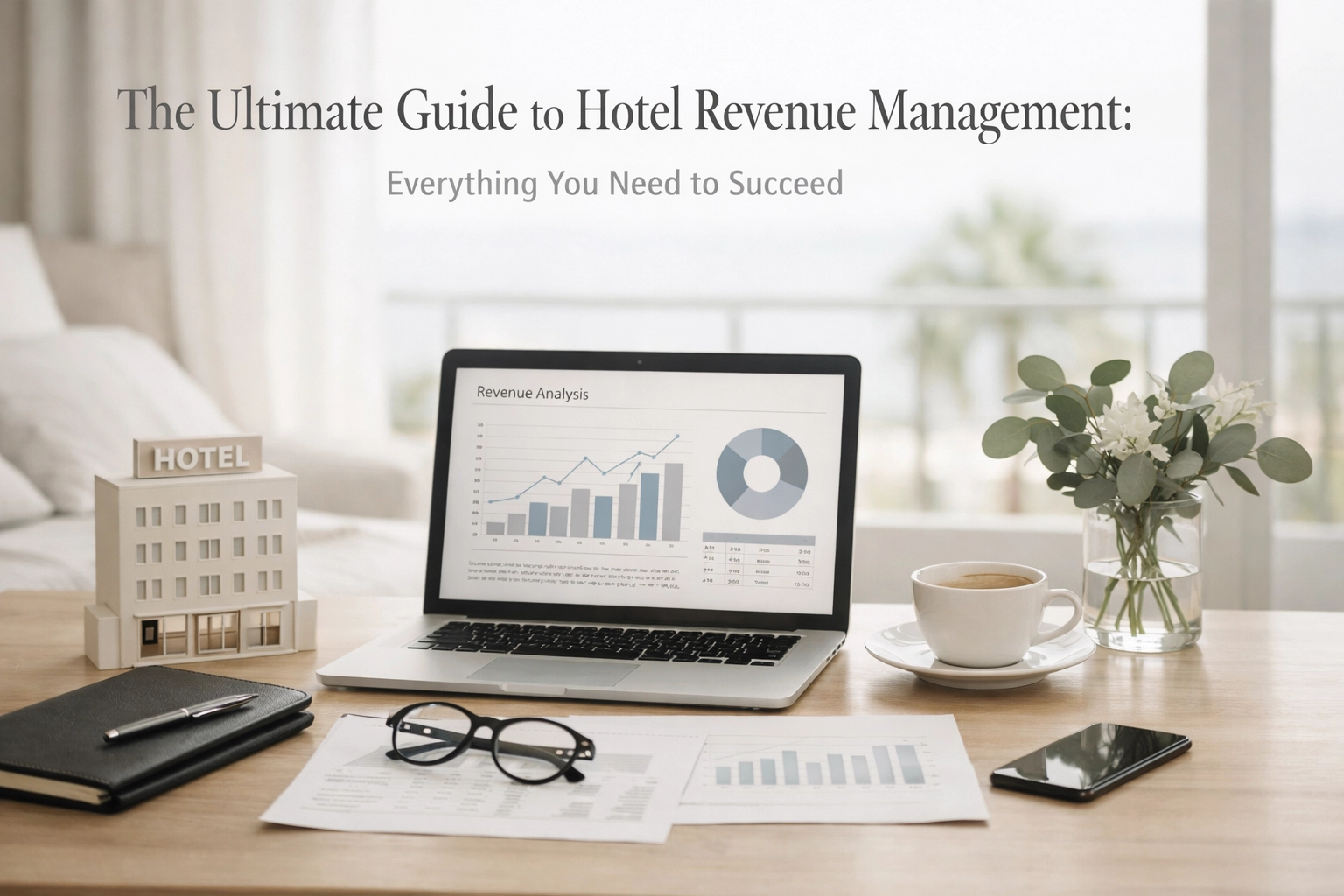
Sell smarter. Earn more. Stress less.
In 2026, hotel revenue management isn’t just about tweaking prices when a local festival comes to town. It’s the high-speed engine driving your entire property’s success. It’s the difference between a "No Vacancy" sign that makes no money and a thriving, high-margin business that delights guests.
We believe that data should do the heavy lifting so you can focus on the humans. It’s about getting the right room to the right guest at the exact right moment: all from one innovative platform.
The shift from occupancy to profitability
For a long time, the industry was obsessed with RevPAR (Revenue Per Available Room). It was the golden metric. But let’s be real: high occupancy doesn’t always mean high profit. If you’re filling every room but paying 25% in OTA commissions and ignoring your operational costs, you’re just busy: not necessarily profitable.
Modern revenue management prioritizes Net RevPAR and TRevPAR (Total Revenue Per Available Room).
- Net RevPAR: What’s left after you pay the booking middleman.
- TRevPAR: Every cent a guest spends, from the minibar to the spa.
- Profitability-first: We think occupancy is a vanity metric; profit is the reality.

Dynamic pricing is the new standard
If your rates are static, you’re leaving money on the table. Period. The market moves fast: faster than any human manual update could ever keep up with. Dynamic pricing allows your property to breathe with the market.
We believe in continuous adjustments. This means your rates respond in real-time to:
- Local demand surges and booking pace.
- Competitor inventory shifts.
- Hyper-local market trends and weather patterns.
Advanced hotels are now using AI-driven algorithms that update prices thousands of times a day. It’s not "set it and forget it"; it’s "set it and let it evolve." By the time you’ve finished your morning coffee, your PMS should have adjusted your rates fifty times to match the morning's booking velocity.
Segmentation: Not all guests are created equal
Treating every guest the same is a missed opportunity. High-level revenue management requires slicing and dicing your audience to understand who they are and what they value.
- The Direct Booker: Your VIP. They cost you less than 5% in acquisition. Reward them with early access or a better view.
- The Business Traveler: They value speed and F&B credits over a 10% discount.
- The Last-Minute Scorer: High urgency, mobile-first. Use them to fill the final gaps, but don't let them dictate your baseline.
Strategic segmentation allows you to stop blanket discounting. Instead of lowering the price for everyone, you offer a specific perk to the person most likely to buy it. This protects your brand integrity and your bottom line.

Monetizing the "Between" spaces
Why should revenue stop at the room rate? One of the biggest trends for 2026 is the monetization of time and flexibility.
We believe every minute of your property’s availability is an asset.
- Early Check-in/Late Check-out: If the room is sitting empty, why not charge a small fee for a guest to arrive at 10 AM?
- Attributes, not just categories: Sell the specific "quiet corner room" or the "balcony with a view" for a premium, rather than just a "Standard Double."
- Co-working and Day Use: Turn underutilized lobbies or rooms into productive spaces for locals during the day.
This is "Attribute-Based Selling." It moves away from rigid room types and toward a modular guest experience. It turns your hotel into a flexible ecosystem of revenue streams.
The tech stack: The heartbeat of your strategy
You can’t run a 2026 revenue strategy on a 2010 tech stack. Data silos are the enemy of profit. If your Property Management System (PMS) doesn't talk to your Revenue Management System (RMS) or your CRM, you’re flying blind.
A unified platform allows for:
- Seamless Data Flow: Your RMS sees a booking the second it happens in the PMS and adjusts accordingly.
- Automated Personalization: Your marketing team knows exactly which high-value guests to target for a direct-booking campaign.
- Real-time Business Intelligence: No more exporting CSV files. You see your performance as it happens.
"Switching to an integrated system saved our team 15 hours a week in manual data entry. Now, we spend that time actually strategizing on how to grow our brand."
AI and the future of automation
The word "AI" is everywhere, but in revenue management, it’s actually doing the work. In 2026, AI isn't just a chatbot; it's a predictive powerhouse. It identifies patterns humans miss: like a subtle shift in booking lead times from a specific geographic region: and adjusts your distribution strategy before you even notice the trend.
Automation allows for "Revenue Marketing." This is where your revenue goals and your marketing spend align perfectly. Instead of spending money on generic ads, you’re spending on ads for the specific dates and segments where you need a boost.
Actionable steps to elevate your revenue today
Ready to stop guessing? Start with these simple, high-impact moves:
- Audit your channels: Look at your net contribution from OTAs versus direct. If an OTA is taking 20%, ask yourself if you’re doing enough to capture that guest directly next time.
- Implement upsells early: Don't wait for the front desk. Offer room upgrades and breakfast add-ons in the confirmation email and the web check-in flow.
- Check your parity: Ensure you aren't being undercut by third parties. Rate parity is essential for maintaining guest trust and direct booking health.
- Get the right tools: If your current PMS feels like a chore, it’s holding you back. Explore how a modern, cloud-native solution can automate the boring stuff.
Managing a hotel is hard enough. Your technology should make the "revenue" part feel like the easiest part of your day. By focusing on total profit, leveraging automation, and treating every guest as a segment of one, you’re not just surviving the market: you’re leading it.
See how Mews can transform your property into a revenue-generating machine. It’s simple, it’s fast, and it’ll get you earning revenue in no time.
Schedule a 30-minute chat and see what the future of hospitality looks like.

Leave a Reply