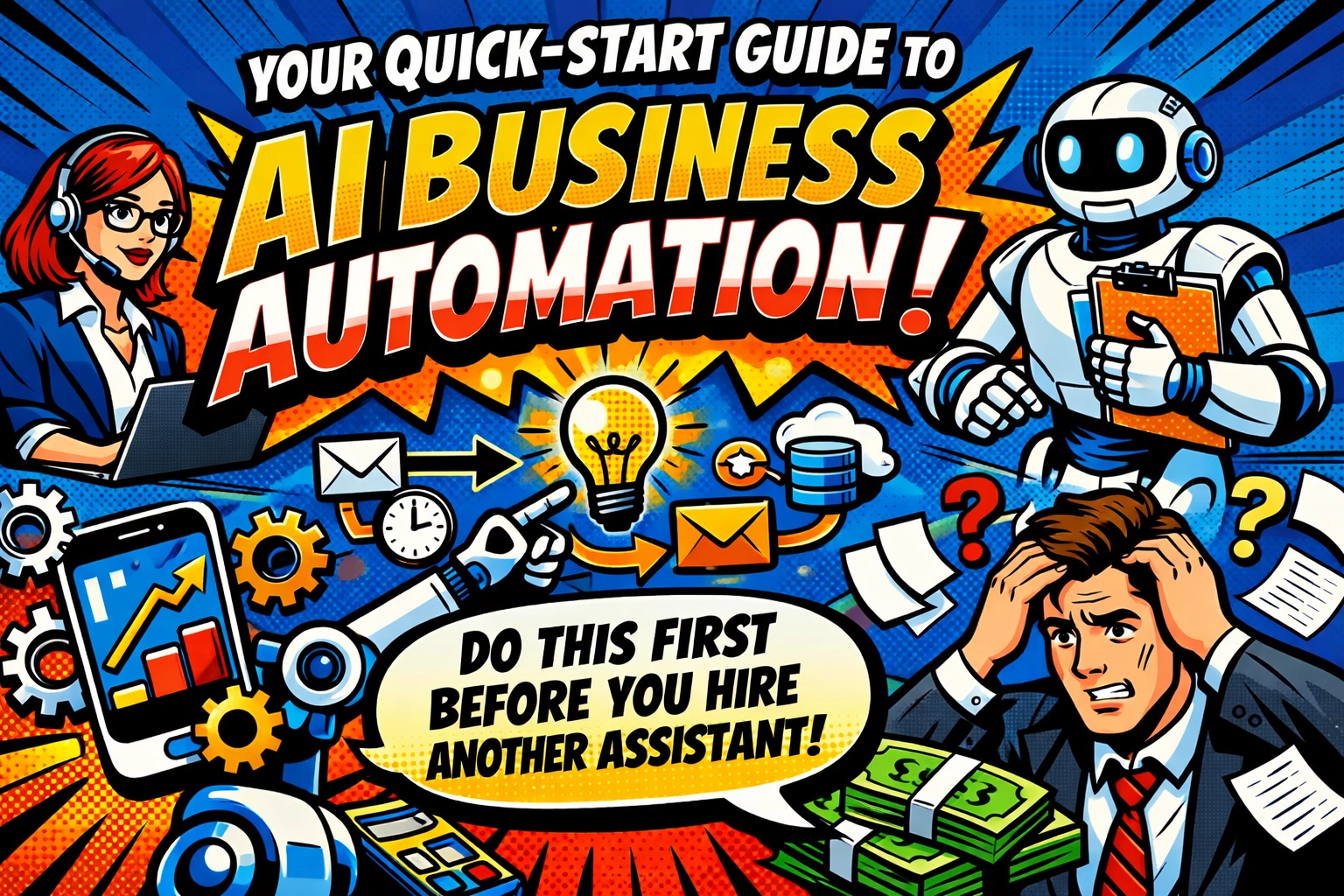
☕ 7:00 AM.
Your eyes aren't even fully open, but your thumb is already scrolling.
There are fourteen unread emails. Three of them are "urgent" requests for meetings you don’t have time for. One is a client asking for an invoice you already sent last Tuesday. Two are LinkedIn notifications from people trying to sell you… well, exactly what you’re trying to sell others.
You feel that familiar tightening in your chest.
"I just need another me," you mutter into your coffee. "I need to hire an assistant. Someone to handle the grunt work so I can actually think."
Stop right there.
Before you post that job listing on Upwork…
Before you commit to a $1,500 monthly retainer for a virtual assistant…
Before you spend three weeks training a human to do something a machine can do in three seconds…
You need to look at AI business automation. Because, let’s be honest: hiring another person often just means you have another person to manage.
STOP JUGGLING AND START MAPPING
The biggest mistake small business owners make? They try to automate their entire business in a single weekend.
They buy five different business automation tools, get overwhelmed by the "if-this-then-that" logic, and go back to their manual spreadsheets by Monday morning.
You don't need a total overhaul. You need a win.
You need to find the one thing that makes you want to throw your laptop out the window. That repetitive, soul-sucking task that eats at least five hours of your week.
Is it data entry?
Is it scheduling?
Is it moving leads from an email into your CRM?
Identify it. Name it. Then, prepare to kill it.

THE FIVE-HOUR RULE: YOUR WEEK 1 MISSION
📱 9:15 AM.
You’re staring at a spreadsheet. You’re copying names from a website and pasting them into a Google Sheet. It’s mindless. It’s boring. And it’s costing you exactly what you can’t afford: your focus.
This is where AI business automation becomes your best friend.
Your first week shouldn't be about "implementing." It should be about "documenting."
Every time you do a task that feels like a robot could do it… write it down.
Every time you say, "I'll just do this real quick," but it takes 20 minutes… write it down.
At the end of the week, look at your list. Find the task that consumed the most time. If it takes five hours or more, that is your primary target.
You aren't looking for a "genius" AI yet. You’re looking for a digital bridge.
PICK YOUR WEAPONS (NO CODING REQUIRED)
🔍 11:30 AM.
You’re searching for solutions. You see terms like "API integrations" and "Python scripts." Your brain starts to itch.
Don't panic.
Modern business automation tools are built for people who hate code. You don't need to be a developer to build a powerhouse system. You just need to know which tool fits the job.
- Zapier: Think of this as the "universal translator" for your apps. It connects over 5,000 different tools. If you want an email to trigger a Slack message, Zapier is your go-to. It’s the most beginner-friendly starting point for AI business automation.
- Make.com: This is Zapier’s big brother. It’s more visual and a bit more powerful. If your workflow has a lot of "branches" (e.g., "If the client is from New York, do X; if they are from London, do Y"), Make is your playground.
- ChatGPT/Claude: This is the "brain." Use this for the tasks that require a bit of creative thinking, summarizing meetings, drafting replies, or categorizing customer feedback.
But here’s the secret: tools are useless if you don't have a plan. That’s why we recommend checking out the frameworks at https://marblism.link/scott-bowen. It’s the shortcut to seeing how these pieces actually click together in a real business.

EMPLOYEE OF THE MONTH. EVERY MONTH.
🤝 1:00 PM.
Lunch is over. Normally, this is when you’d start "The Afternoon Slump." You’d spend two hours cleaning up your CRM because your leads are a mess.
But imagine this instead…
A new lead fills out a form on your website.
Within milliseconds, an AI business automation tool (like a Zap) catches that lead.
It sends the data to ChatGPT, which writes a personalized "get to know you" email based on the lead's industry.
The email is sent to your drafts.
A task is created in your project management tool to follow up.
You didn't lift a finger.
The chaos is gone before you even take your first sip of afternoon tea.
This isn't just about saving time. It’s about consistency. A human assistant gets tired. A human assistant has bad days. AI doesn't get a "3 PM energy crash." It just executes.
THE PILOT PROJECT: START SMALL TO WIN BIG
You don't need a complex 50-step workflow. You need a "Pilot."
Choose one tiny process.
Maybe it’s your "New Client Onboarding."
When a contract is signed, the AI could:
- Create a folder in Google Drive.
- Send a "Welcome" email.
- Add the client to your newsletter list.
- Notify you in Slack.
It sounds simple. But when you stop doing those four things manually for every single client? You gain back your sanity.
And once you see it work once… you’ll start seeing automation opportunities everywhere. It’s addictive. You’ll realize that scaling shouldn't be this easy. But here we are.

A DAY IN THE LIFE: THE AUTOMATED VERSION
Let’s re-run your day, but this time, you’ve put AI business automation to work.
☕ 8:00 AM: You wake up. No scrolling. Why? Because your AI assistant (let’s call her Penny) has already sorted your inbox. The spam is gone. The "quick questions" have been answered by an AI chatbot. Your "Must-Read" folder has only three items.
📱 10:30 AM: You finish a client call. You hit "Stop Recording." An automation automatically sends that recording to an AI tool that transcribes it, summarizes the action items, and emails them to the client. You just send a thumbs-up.
🥗 12:30 PM: You’re actually eating lunch. Away from your desk. Your phone isn't buzzing. Behind the scenes, your lead generation tools are finding new prospects and warming them up.
🌙 5:00 PM: You close your laptop. The "To-Do" list for tomorrow is already generated. You aren't "catching up" on admin. You’re done.
The day begins with calm. It ends with satisfaction.
WHY MARBLISM IS YOUR SECRET WEAPON
Look, we get it. Building these systems can feel like learning a second language. You know you need it, but you don't want to spend your weekends watching YouTube tutorials on "How to map a JSON string."
That’s where we come in.
At Marblism, we don't just talk about AI business automation; we live it. We help you bridge the gap between "I have too much work" and "My business runs itself."
If you’re ready to stop being the bottleneck in your own company, you need to see what’s possible when you stop hiring humans for robot jobs.
Check out our specialized resources and start your automation journey here: https://marblism.link/scott-bowen.
YOUR QUESTIONS, ANSWERED (MINUS THE JARGON)
"Is AI going to replace my team?"
No. It’s going to replace the parts of their jobs they hate. It allows your team to do "human" work, strategy, empathy, and creativity, while the machines handle the data.
"Isn't this expensive?"
Actually, most business automation tools have free or very low-cost entry points. Compare a $20/month Zapier subscription to a $3,000/month salary. The math is pretty clear.
"What if the AI makes a mistake?"
That’s why we start with "Human-in-the-loop" systems. The AI drafts the email; you hit send. The AI categorizes the data; you do a quick weekly check. You stay in control.
"I'm not a tech person. Can I really do this?"
Yes. If you can use a smartphone, you can use modern AI tools. It’s about logic, not code.
THE LAST WORD
Before you hire that next assistant… give yourself two weeks.
Two weeks to audit your time.
Two weeks to test one automation.
Two weeks to see if a $30 piece of software can do the work of a 40-hour-a-week employee.
You might find that you don't need more people. You just need better pipes.
The future of your business isn't about working harder.
It’s about working… less.
Start your shortcut to a hands-off business today at https://marblism.link/scott-bowen.
Scale smarter. Not louder.
Leave a Reply