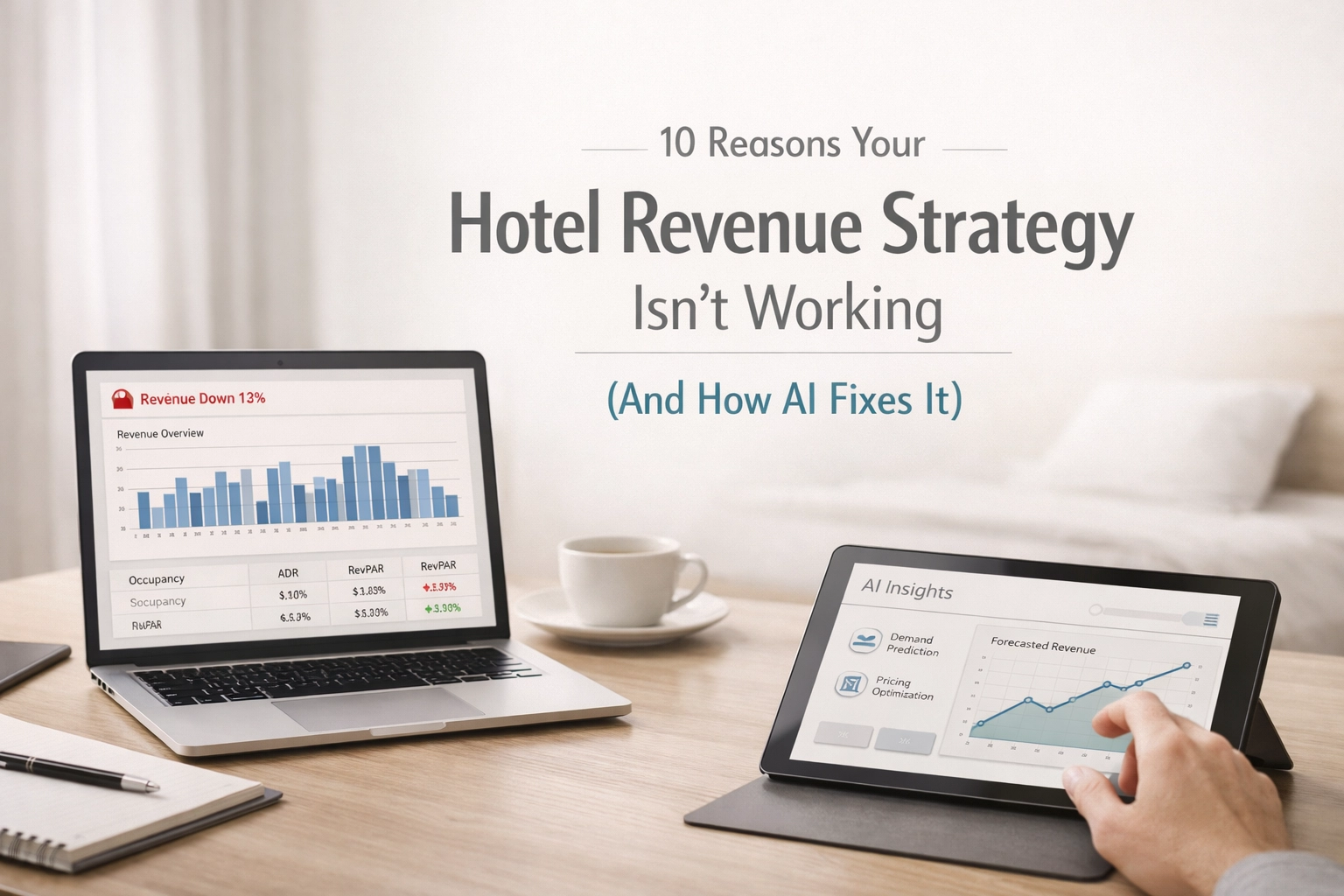
Transform your performance. Boost your bottom line. Automate your operations.
The hospitality landscape is shifting faster than a last-minute weekend booking. If you’re still relying on spreadsheets, gut feelings, and once-a-month strategy meetings, you aren't just behind: you’re leaving money on the table. We believe that technology should empower hoteliers to focus on what matters most: the guest. But right now, fragmented data and legacy systems are standing in the way of true profitability.
Modern revenue management isn't about setting a price and hoping for the best. It’s about agility. It’s about intelligence. It’s about a unified tech stack that thinks as fast as your guests do.
Here are 10 reasons your current strategy might be stalling, and how the right hotel management software powered by AI can turn things around.
1. You’re Obsessed with ADR While Ignoring Profitability
Focusing solely on your Average Daily Rate (ADR) is a dangerous game. High rates look great on paper, but they don't tell the full story. If those high rates come with massive OTA commissions or high cancellation risks, your net revenue suffers.
How AI fixes it:
AI-driven revenue tools don't just look at the price. They analyze the cost of acquisition for every booking. By looking at the "Net RevPAR," AI helps you prioritize the channels that actually put money in your pocket, not just the ones that make your rates look impressive.
- Analyze net-profit per booking.
- Prioritize low-commission channels.
- Balance occupancy with acquisition costs.
2. Your Ancillary Revenue is an Afterthought
Your hotel is more than just a collection of beds. If your revenue strategy only focuses on room inventory, you’re missing out on the "Total Revenue" potential of your property. Breakfast, spa treatments, parking, and late check-outs are often managed in silos, if they’re managed at all.
How AI fixes it:
A modern hotel pms uses AI to identify patterns in guest behavior. It knows that a guest booking a luxury suite is 60% more likely to book a spa treatment if prompted at the right time. AI automates these upsell opportunities throughout the guest journey, turning a standard stay into a high-value experience.

3. One Size Fits No One (The Segment Problem)
Treating all demand as a single block is a relic of the past. A business traveler booking two days out has vastly different price elasticity than a family booking three months in advance. Uniform pricing across all segments means you’re either pricing yourself out of the market or leaving money on the table.
How AI fixes it:
AI excels at micro-segmentation. It analyzes booking windows, device types, and geographical data to offer the right price to the right person. Instead of a blanket discount, AI applies surgical precision to your pricing strategy, ensuring you capture maximum value from every guest type.
4. The "Panic Discount" Death Spiral
When occupancy looks low for the coming weekend, the instinct is to slash prices. We think this is a mistake. Constant discounting erodes your brand value and trains your guests to never pay full price. It’s a race to the bottom that nobody wins.
How AI fixes it:
AI doesn't panic. It uses predictive modeling to understand if that "slow" weekend is actually just a late-booking trend in your local market. Instead of dropping rates, AI might suggest targeted value-adds or wait for the high-value, last-minute demand it knows is coming based on historical data.
"We used to spend hours debating whether to drop rates. Now, the AI handles the heavy lifting, and our RevPAR has jumped by 15% in six months." : Operations Manager, Boutique Collection
5. You’re Letting OTAs Drive the Bus
OTAs are a great tool, but they shouldn't be your masters. Relying too heavily on third-party platforms means paying 15-25% in commissions and losing control of the guest relationship. If your strategy is just "following OTA recommendations," you’re working for them, not yourself.
How AI fixes it:
AI helps you reclaim your independence. By analyzing your direct booking data, AI identifies the best moments to push direct-only offers or loyalty perks. It ensures your hotel management software is always one step ahead, keeping your best rates on your own site while still maintaining presence where it matters.

6. Your Forecasting is Stuck in the Past
If you’re still doing a "monthly forecast," you’re already behind. Demand changes by the hour. A sudden weather shift, a new concert announcement, or a flight cancellation can change your demand profile instantly. Static plans can't keep up.
How AI fixes it:
Continuous forecasting is the new standard. AI never sleeps. it monitors external demand drivers: like local events, airline capacity, and even weather patterns: in real-time. It adjusts your pricing and inventory 24/7, ensuring your strategy is always relevant to the current market.
- Real-time demand monitoring.
- Automated price adjustments.
- Proactive inventory management.
7. The Great Internal Wall (Siloed Data)
Revenue management doesn't happen in a vacuum. If your marketing team is running ads for a weekend that’s already at 90% occupancy, you’re wasting money. If your sales team is booking groups at a deep discount during a high-demand period, you’re losing out.
How AI fixes it:
AI acts as the single source of truth. By integrating your hotel pms with your marketing and sales tools, AI ensures everyone is looking at the same data. It aligns your commercial teams so that marketing spend is directed toward low-demand periods and sales efforts are focused on high-value accounts.
8. Rate Parity is a Mess
Manual updates lead to errors. If a guest finds a lower rate on a random OTA than on your direct site, you’ve lost their trust (and likely their booking). Keeping rates consistent across dozens of channels is a full-time job that humans aren't built for.
How AI fixes it:
Automation is the heart of rate parity. AI-driven channel managers update all platforms simultaneously the second a change is made. It constantly audits your distribution landscape, flagging discrepancies before they cost you a booking.

9. You’re Making Decisions Without Buy-In
A revenue strategy is only as good as its implementation. If your front desk or leadership team doesn't understand the "why" behind the pricing, they won't support it. "Revenue management theatre": where you have the tools but don't actually use them: is a common pitfall.
How AI fixes it:
AI takes the emotion out of the room. It provides clear, data-backed reasoning for every recommendation. When you can show leadership a 30-minute report that clearly visualizes the "why" and the expected "ROI," getting buy-in becomes effortless. It turns "I think" into "I know."
10. Your Tech Stack is Holding You Back
Legacy systems are the silent killers of revenue. If your PMS doesn't talk to your Revenue Management System (RMS), or if you’re manually entering data between platforms, you’re prone to errors and delays. Real-time visibility is impossible with a fragmented tech stack.
How AI fixes it:
Innovation starts with a cloud-native platform. A modern hotel management software like Mews is designed to be the heart of your hotel. It integrates seamlessly with AI tools, allowing data to flow freely. This connectivity means you can automate the boring stuff and spend your time on high-level strategy.

See what Mews can do for you
We believe that the future of hospitality is automated, intelligent, and guest-centric. The shift from reactive to proactive revenue management isn't just a trend: it's a necessity for survival.
Are you ready to stop guessing and start growing? Transitioning to a smarter way of working is easier than you think.
3 steps to a better strategy:
- Audit your current tech stack for data gaps.
- Schedule a demo to see how AI-driven insights can work for your specific property.
- Get your team onboard with a platform that makes their jobs easier.
Explore how the right hotel pms can transform your revenue strategy and get you earning more in no time. All from one innovative platform.