Personalize. Automate. Scale.
In 2026, the guest experience isn't defined by the thread count of the linens or the marble in the lobby. It’s defined by how invisible the technology feels. We’ve moved past the era of clunky chatbots and "smart" mirrors that didn't actually do anything. Today, AI in hospitality is the silent engine driving every interaction, turning a standard stay into a tailored journey.
Leading properties are seeing a 35% increase in guest satisfaction scores simply by removing the friction points that used to be "just part of the industry." Waiting in line? Gone. Repeating your pillow preference? A thing of the past. It’s all managed through a unified, innovative platform.
The end of the front desk friction
We believe the lobby should be a place for a welcome drink, not a place to stand in line with a suitcase. The old-school check-in process was a barrier between your guest and their relaxation.
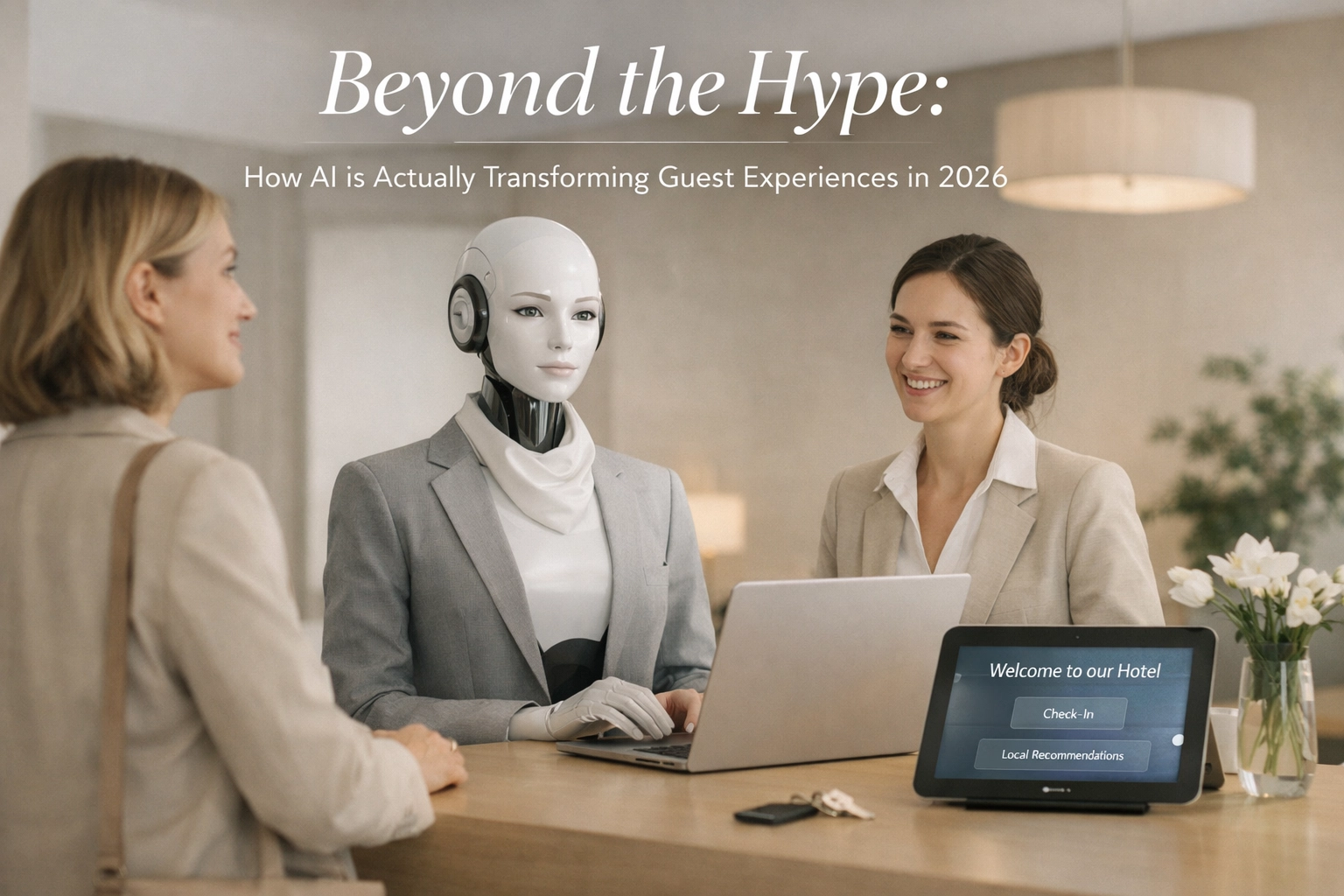
In 2026, hotel guest experience technology has evolved to make the "arrival" completely fluid. AI-driven systems now handle identity verification and payment processing long before the guest steps onto the property.
- Biometric recognition: Fast-track arrivals with opt-in facial or fingerprint recognition.
- Instant digital keys: Room assignments and keys are pushed to smartphones the moment a room is ready.
- Smart queuing: If a guest does need help, AI predicts peak flow and alerts staff to be present before the line even forms.
"We stopped seeing the 'check-in huddle' entirely," says one boutique hotel manager in London. "The AI handles the admin, and our team handles the humans. It’s easily saved our front-of-house team 15 hours of data entry every single week."

Personalization that actually feels personal
For years, "personalization" was a marketing buzzword. In 2026, it’s a standard operational requirement. True AI in hospitality means the building itself remembers who is walking through the door.
We think your room should know you better than your own bedroom does. When a guest returns to a brand or even a partner property within a network, the environment adapts. The temperature is exactly 21 degrees. The lighting is dimmed to their preferred 40%. The TV doesn't show a generic welcome screen; it displays their favorite streaming apps, already logged in and ready to go.
- Contextual environments: Rooms adjust lighting and sound based on the time of day and the guest’s previous habits.
- Predictive amenities: If a guest always orders a late-night decaf, the room’s smart assistant offers it before they even have to ask.
- Multilingual mastery: Voice-activated controls now support over 100 languages with native-level fluency, making every guest feel at home regardless of where they’re from.
The transition from a "room" to an "experience" is what separates the winners from the losers in the current market. If your tech doesn't remember that a guest prefers extra towels on every visit, you're already behind.
Booking as a conversation, not a chore
Remember the days of opening fifteen browser tabs to compare prices, amenities, and locations? Those days are dead. Hotel guest experience technology in 2026 has collapsed the booking funnel into a single, intelligent conversation.
Guests are now using AI agents to do the heavy lifting. A traveler simply says, "Find me a quiet, dog-friendly spot in the Cotswolds with a spa and a high-speed EV charger for next weekend," and the AI presents a curated, bookable itinerary. It doesn't just show a list of links; it explains why a specific property fits those needs.

This shift means that properties must have clean, structured data. If your AI can’t communicate with the guest’s AI, you simply won't appear in the search results. It’s no longer about SEO; it’s about AIO (AI Optimization). Properties using modern management software are already winning this race by ensuring their inventory and amenities are perfectly indexed for these conversational queries.
To see how the most innovative hotels are staying visible in this new landscape, you can explore the latest in hospitality tech here.
24/7 Service without the overhead
The "concierge" is no longer a person behind a desk with a binder. It’s an omnipresent, intelligent layer of service. In 2026, 82% of hotels have integrated AI assistants that handle 90% of guest inquiries instantly.
The beauty of this isn't just the speed, it's the consistency. A guest asking for a restaurant recommendation at 3:00 AM gets the same high-quality, personalized response as someone asking at 3:00 PM. These systems aren't just reciting a list; they’re analyzing local reviews, current traffic, and the guest’s dietary preferences to make a real recommendation.
- Instant gratification: No more "on hold" music for room service or housekeeping requests.
- Revenue generation: AI concierges suggest relevant upsells, like a spa opening or a late checkout, at the exact moment the guest is most likely to say yes.
- Proactive problem solving: If the AI detects a guest is struggling with the Wi-Fi or the AC, it can trigger a maintenance ticket before the guest even complains.
"It’s not about replacing people," says Scott, an industry veteran. "It’s about making sure your people aren't stuck answering the same question about breakfast times 50 times a day. It lets them be creative again."

From points-based loyalty to experience-based loyalty
The old model of loyalty was transactional. Stay ten nights, get one free. In 2026, guests don't care about points as much as they care about being known. AI in hospitality has enabled a shift toward "operationalized loyalty."
When the data is clean and the systems are connected, loyalty is expressed through the stay itself. It’s the surprise upgrade because the system saw it was your anniversary. It’s the gym being reserved for your preferred time slot because the AI knows you work out at 6:00 AM.
- 82% of hoteliers report that AI has directly increased their repeat booking rate.
- 40% reduction in guest complaints related to "missed preferences" or communication gaps.
- 12,500+ properties are already leveraging these data-driven insights to outperform traditional loyalty programs.
We believe that when you remove the friction, loyalty happens naturally. You don't need a plastic card in your wallet when the hotel feels like it was built specifically for you.
Empowering the human element
Perhaps the most surprising trend of 2026 is that AI has made hotels feel more human, not less. By automating the mundane, repetitive, and administrative tasks, staff are finally free to focus on what they do best: hospitality.
We see a future where the role of a hotel employee shifts from "data entry clerk" to "experience curator." Instead of staring at a screen while a guest waits, staff are engaging in real conversations. They are greeting guests by name (thanks to a quick prompt on their wearable device) and offering thoughtful, local touches that an AI can't replicate: like a hand-drawn map to a hidden local trail or a story about the building's history.

This is the real transformation. AI provides the foundation of efficiency and data, but the humans provide the soul. The most successful hotels in 2026 are those that use technology to step out of the way, allowing for genuine human connection to flourish.
The competitive edge is digital
The "hype" phase of AI is over. We are now in the execution phase. The properties that continue to rely on manual processes, legacy software, and siloed data are finding it increasingly difficult to compete with the seamless, personalized experiences offered by AI-integrated hotels.
If your guest experience feels the same as it did in 2019, you’re losing ground every day. The technology is no longer a luxury; it’s the standard.
Ready to see how your property can move beyond the hype and start delivering the future of hospitality? Check out what’s possible with the right platform.
The future of guest experience isn't coming: it's already checked in. It’s time to make sure your property is ready to welcome it.