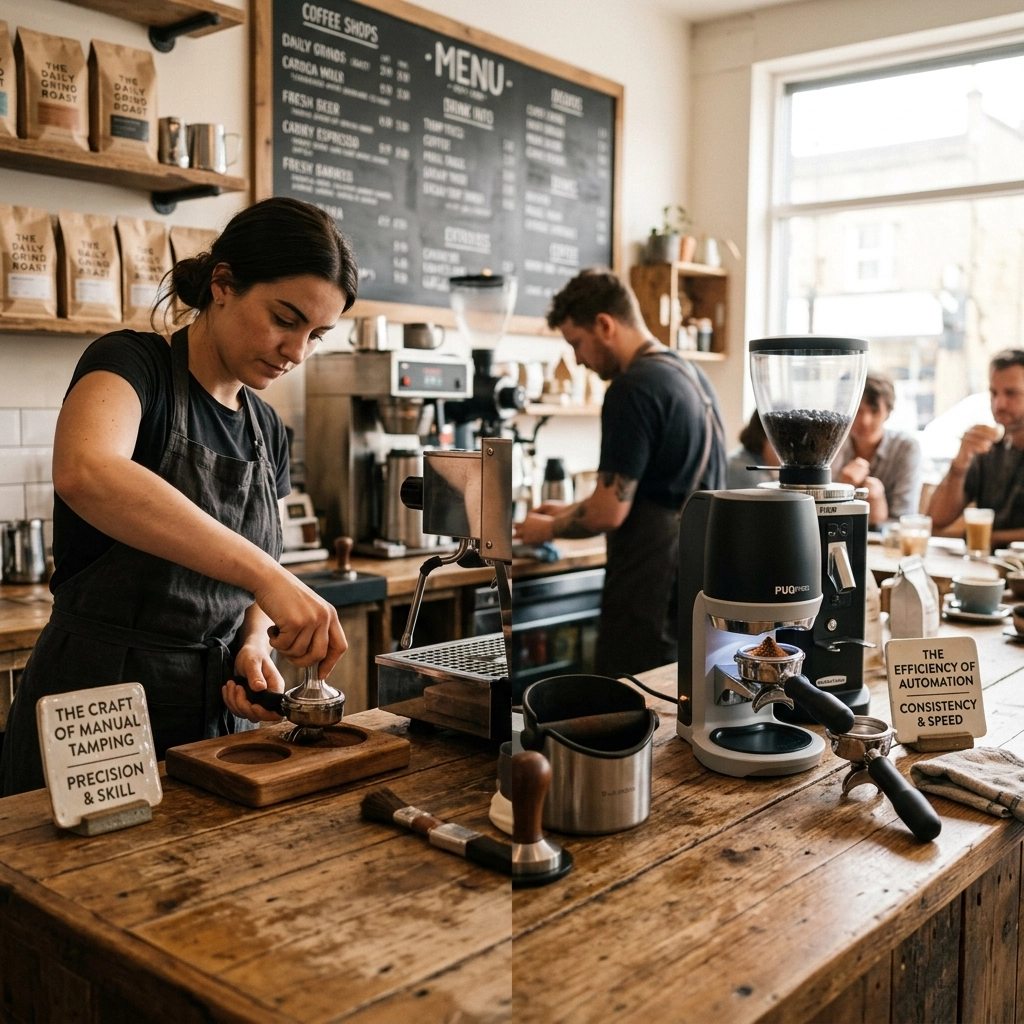
You are standing behind the bar. It is 8:30 AM on a Tuesday, and there is a line of caffeine-deprived commuters snaking out the door. Your hopper is full, your milk is cold, and your steam wand is ready to purr. But here is the question: as you dose that portafilter, are you reaching for a traditional hand tamper, or are you sliding it into an automated machine that does the heavy lifting for you?
Deciding on your coffee shop set up is one of the most important steps in your journey, and the "Manual vs. Auto" tamping debate is a hot one. It’s not just about gadgets; it’s about workflow, consistency, and: believe it or not: the long-term health of your baristas' wrists.
Whether you are looking for wholesale speciality coffee or just trying to figure out which piece of shiny equipment to buy next, we are here to help you weigh up the pros and cons. Let’s dive into the nitty-gritty of tamping.
Why Does Tamping Even Matter?
Before we get into the "how," let’s quickly talk about the "why." Why do we bother squashing coffee grounds into a puck in the first place?
Basically, it comes down to resistance. When the water hits the coffee at 9 BAR of pressure, it wants to find the path of least resistance. If your coffee bed is loose, uneven, or slanted, the water will blast through the gaps (this is what we call "channeling"). This results in a shot that is watery, sour, and generally quite sad.
Proper tamping ensures the coffee is compressed into a level, uniform puck. This forces the water to work its way through every single ground, extracting all those lovely oils and flavours we want in our crema. So, the goal is always the same: a perfectly level surface and consistent density.

The Case for Manual Tamping: The Traditionalist’s Choice
There is something undeniably romantic about manual tamping. It is the "theatre" of coffee. When a customer sees a barista carefully leveling the grounds and applying a firm, steady press, it signals craft and care.
The Pros
- Tactile Feedback: You can literally feel the coffee. You know if the basket is slightly overfilled or if the grounds feel a bit coarser than usual.
- Lower Initial Cost: A high-quality manual tamper will set you back anywhere from £30 to £150. Compare that to an automated tamper which can easily cost £500 to £1,000+. For a new coffee shop set up on a budget, this is a huge factor.
- Flexibility: Different coffees and different portafilters sometimes require a slightly different touch. Manual tamping allows an experienced barista to make those micro-adjustments on the fly.
- The "Vibe": Let’s be honest, it looks cool. If your shop is all about the artisanal, slow-bar experience, a manual tamper fits that aesthetic perfectly.
The Cons
- The Consistency Gap: This is the big one. If you have three different baristas working, you have three different tamping styles. One might press with 15kg of force, another with 20kg. One might have a slight tilt to the left. These tiny variations lead to inconsistent shots.
- Physical Strain: Tamping 200, 300, or 500 times a day is hard on the body. Repetitive Strain Injury (RSI) is a very real thing in the specialty coffee world.
- Training Time: It takes time to teach someone how to tamp perfectly level every single time. It’s a skill that requires muscle memory.
The Rise of the Robots: Automated Tamping
In the last few years, automated tampers like the Puqpress have become a staple in high-volume specialty cafes. Instead of a human doing the work, you simply slide your portafilter into a cradle, a sensor detects it, and a piston compresses the coffee to a pre-set pressure.
The Pros
- Unrivalled Consistency: The machine doesn’t get tired. It doesn’t have a "bad Friday." Whether it’s the first shot of the day or the five-hundredth, the pressure and the level are exactly the same. This means your espresso recipe stays dialed in for longer.
- Speed and Workflow: It’s fast. While the machine is tamping (which takes about 1.5 seconds), the barista can be reaching for the milk pitcher or starting the timer. Over a busy shift, those seconds add up.
- Ergonomic Bliss: Say goodbye to "barista wrist." By removing the repetitive physical motion of tamping, you are looking after your team’s long-term health.
- Easy for Beginners: You can train a new staff member to use an automated tamper in about 30 seconds. This makes it much easier to maintain quality even when you are short-staffed.
The Cons
- The Price Tag: They are an investment. You have to ask yourself if the equipment supply budget can stretch to include one.
- Maintenance: It’s another electronic device that needs cleaning and occasional servicing. If it breaks during a rush, you’d better have a manual tamper as a backup!
- Counter Space: They take up a bit of room next to your grinder, which can be a challenge in tiny café setups.

Comparing the Two: At a Glance
| Feature | Manual Tamping | Automated Tamping |
|---|---|---|
| Consistency | Variable (Human error) | Extremely High (Mechanical precision) |
| Price | £30 – £150 | £500 – £1,200 |
| Speed | 5-10 seconds | 1.5 – 2 seconds |
| Ergonomics | High risk of strain | Low risk (No manual force) |
| Skill Required | Significant training | Minimal |
| "Theatre" | High (Looks artisanal) | Low (Functional/Techy) |
Which One Is Right for Your Coffee Shop Set Up?
So, how do you choose? We’ve helped hundreds of people with building a coffee shop, and the answer usually depends on your volume and your goals.
Go Manual If…
You are running a small, low-volume "destination" café where you only serve a few dozen coffees a day. If you have the time to focus on every single shot and you really value the traditional ritual of espresso making, manual is great. It’s also the right choice if you are just starting out and need to keep your initial equipment costs as low as possible. You can always upgrade later!
Go Automated If…
You are a high-volume shop doing 15kg+ of coffee a week. If you have a queue out the door every morning, an automated tamper is a life-saver. It ensures that even when your baristas are stressed and moving at 100mph, the quality of the coffee doesn't slip. It’s also the best choice if you have a high turnover of staff or multiple part-time baristas, as it guarantees a "standard" that isn't dependent on individual skill levels.

How Limini Coffee Can Support You
We don't just roast amazing beans; we are also here to help you get the most out of your equipment. Whether you decide to go the manual route or embrace the robots, we offer comprehensive barista training that covers the fundamentals of tamping, extraction, and milk science.
If you are currently planning your coffee shop set up, why not reach out? We can help you choose the right espresso equipment for your specific space and budget. We've seen what works (and what doesn't) in the real world, and we’re always happy to share that experience.
The Final Verdict
To be honest, we’ve seen a massive shift toward automation in the industry, and we think it’s generally a good thing. It’s not about taking the "soul" out of coffee; it’s about using technology to solve the most common problems in a busy café: inconsistency and physical strain.
However, if you are a master of the craft and love the feel of a precision-engineered manual tamper in your hand, there is absolutely nothing wrong with that. Some of the best espressos we’ve ever tasted were tamped by hand.
The beauty of coffee is that there isn't just one "correct" way to do things. It's about finding the balance that works for your business, your team, and your customers.
If you’d like to learn more about the technical side of tamping, we have a deep-dive article on tamping that explains the physics in much more detail. And if you're ready to start sourcing the best beans for your new setup, don't forget to check out our latest roasts.
Whatever you choose, just remember: keep it level, keep it consistent, and most importantly, keep it tasty! 🙂