
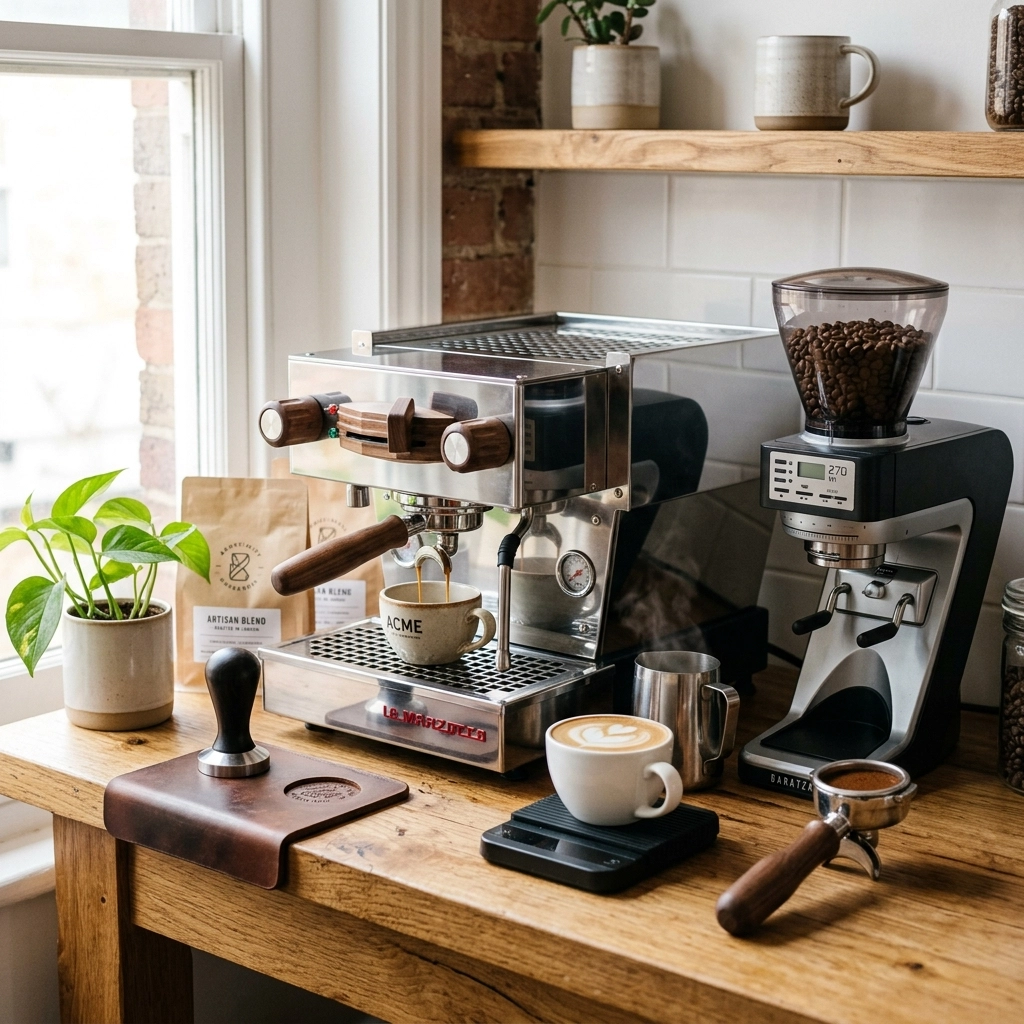
So, you’ve decided to take the plunge. You’re tired of the watery pods, the inconsistent high-street chains, and the "good enough" cafeteria coffee. You want the real deal. You want that thick, syrupy, tiger-striped espresso that tastes like a dream and makes your kitchen smell like a boutique roastery.
We get it. Here at Limini Coffee, we live for that perfect shot. But we also know that stepping into the world of home espresso can feel a bit like trying to pilot a spacecraft. There are endless machines, grinders that cost more than a second-hand car, and enough jargon to make your head spin.
The truth is, building a home espresso setup is a journey. It’s about finding the balance between your budget, your counter space, and how much of a "coffee nerd" you really want to be. Whether you’re looking for a quick morning latte or you want to spend your Saturdays obsessing over extraction yields, we’ve put together this guide to help you build the ultimate setup.
And hey, if you want to skip the guesswork and get the best beans delivered to your door to test out your new gear, you can find our full range right here.
The Golden Rule: The Grinder is Everything
If you take only one thing away from this guide, let it be this: Your grinder is more important than your espresso machine.
We know, it sounds counterintuitive. You want the shiny machine with the levers and the gauges. But the machine is essentially just a fancy kettle with a pump. The grinder is what determines the quality of your extraction. Espresso requires an incredibly fine, incredibly consistent grind. If your grounds are uneven, the water will find the path of least resistance (we call this "channelling"), and your coffee will taste sour, bitter, and generally disappointing.
For a practical electric setup, we often recommend something like the Baratza Encore ESP. It’s designed specifically to handle the fine range needed for espresso without breaking the bank. If you’re really looking to level up, look into flat burr grinders which tend to produce a more uniform particle size, resulting in a clearer, more distinct flavour profile.

Choosing Your Espresso Machine
Once you’ve budgeted for a solid grinder, it’s time to look at the machine. We tend to categorise home setups into three main tiers:
1. The Manual Purist (The "Hands-On" Approach)
If you love the ritual and want total control, a manual lever machine like a Flair is a fantastic entry point. It’s affordable, portable, and forces you to learn the physics of espresso. You provide the pressure with your own arm. It’s a bit of a workout, but the shots can be world-class once you nail the technique.
2. The Practical Enthusiast
This is where most people start. Machines like the Breville Bambino Plus are incredibly popular because they heat up in seconds and are very forgiving. They use a thermoblock (a heating element that heats water on demand) rather than a traditional boiler. While they might lack the "theatre" of a commercial machine, they are brilliant for getting a great coffee before work without a 20-minute wait time.
3. The Aspiring Barista (The "Prosumer" Level)
Now we’re talking. If you want a machine that looks and acts like the ones we use in our training centre, you’re looking for a prosumer machine. Think E61 group heads, dual boilers, and PID controllers (which is basically cruise control for your water temperature). These machines offer incredible thermal stability, meaning your first shot tastes exactly like your fifth.
If you’re curious about how these high-end machines actually function under the hood, you might find our guide on La Spaziale workings really interesting. It’s a deep dive into the engineering that makes pro machines so consistent.
The "Holy Trinity" of Accessories
You’ve got the machine and the grinder. You’re done, right? Not quite. To get café-style results, you need a few essential tools to ensure consistency. In the world of espresso, consistency is the name of the game.
The Digital Scale
You cannot eyeball espresso. A difference of 0.5 grams of coffee can completely change the taste of your shot. You need a scale that is accurate to 0.1g and, ideally, fits under your portafilter. We weigh the dry coffee going in and the liquid espresso coming out. This is the only way to know if you're actually hitting your targets.
The Precision Tamper
Most machines come with a flimsy plastic tamper. Throw it away. You need a heavy, stainless steel tamper that fits your basket perfectly (usually 58mm for pro machines or 51/54mm for entry-level ones). When you tamp, you’re looking to compress the coffee into a level, solid puck. Aim for about 15kg (30 lbs) of pressure, but the most important part is that it's level. You can read more about the finer points of tamping here.
The WDT Tool
WDT stands for Weiss Distribution Technique. It sounds fancy, but it’s just a handle with some thin needles. You use it to stir the coffee grounds in your portafilter before tamping. This breaks up clumps and ensures the coffee is distributed evenly. It’s a simple step that almost guarantees a better extraction.

The Secret Ingredient: Freshly Roasted Beans
You could have a £10,000 setup, but if you’re using oily, stale beans from the supermarket, your coffee will taste like burnt rubber. Espresso is a high-pressure extraction that magnifies every single flavour: good and bad.
We believe that "fresh is best" isn't just a slogan; it's a rule. Ideally, you want to use beans that were roasted between 7 and 30 days ago. This gives the coffee time to "degas" (release carbon dioxide) so it doesn't taste overly acidic, but keeps the volatile oils intact for that beautiful crema.
Whether you like a chocolatey, nutty traditional espresso or a bright, fruity single-origin, sourcing your coffee from a speciality roaster makes all the difference. If you want to see what we've been roasting lately, grab a bag from our shop.
Dialing In: The Barista’s Workflow
"Dialing in" is the process of adjusting your grind size and dose to get the perfect extraction. It can be frustrating at first, but it’s incredibly satisfying when it clicks. Here is our basic starting recipe:
- Dose: 18g of dry coffee in the basket.
- Yield: 36g of liquid espresso out (a 1:2 ratio).
- Time: 25 to 30 seconds.
- Temperature: 92°C to 94°C (approx. 200°F).
If your shot comes out in 15 seconds, it’s going to taste thin and sour. This means your grind is too coarse: the water is rushing through. You need to grind finer.
If the machine is struggling and only a few bitter drops come out after 40 seconds, your grind is too fine. The water can't get through. You need to grind coarser.
It’s worth using a coffee brewing calculator to help keep track of these ratios while you're learning. And if you're wondering why that golden foam on top looks different every time, check out our article on crema to understand what it actually tells you about your shot.

Mastering the Milk
If you’re a fan of lattes or flat whites, the steam wand on your machine is your new best friend. The goal is "microfoam": milk that looks like wet paint with no visible bubbles.
The secret is all in the proteins and fats. When you steam milk, you’re doing two things: introducing air (stretching) and creating a whirlpool (incorporating). You only want to "stretch" the milk until the pitcher reaches body temperature, then you bury the wand and let the vortex turn those big bubbles into silky microfoam.
We’ve written a whole piece on understanding milk that explains the science behind it, and another on the differences between a latte, cappuccino, and flat white so you know exactly what you’re aiming for.
Maintenance: Keep It Clean
A dirty machine makes bad coffee. It’s as simple as that. Coffee oils are hydrophobic (they repel water) and they go rancid very quickly. If you don’t clean your group head and steam wand, your expensive single-origin coffee will just taste like old, bitter oil.
- Daily: Purge your steam wand after every use and wipe it with a damp cloth. Backflush your group head with water at the end of the day.
- Weekly: Use a dedicated espresso cleaner (like Puly Caff) to backflush the machine and soak your portafilters.
- Monthly: Descale your machine if you live in a hard water area.
Speaking of water, remember that espresso is 90% water. If your tap water tastes bad, your coffee will too. We recommend using filtered water to protect your machine’s boiler from scale buildup and to help the bright flavours of the coffee shine through.

Creating Your Coffee Nook
Finally, think about your workflow. You want your grinder next to your machine, your knock box (for the used pucks) within easy reach, and your scales right there on the drip tray. A well-organised space makes the process a joy rather than a chore.
Some people call it the "theatre" of coffee: the steam, the smell, the clink of the portafilter. It’s a beautiful ritual. If you’re thinking about going beyond a home setup and maybe opening a small shop one day, we have some great resources on building a coffee shop and even the theatre of the service itself.
But for now, focus on the basics. Get a great grinder, buy some fresh Limini Coffee beans, and start practicing. You’ll be pulling shots that put your local café to shame in no time.
If you ever feel stuck or want to fast-track your skills, come and see us for some barista training. We love helping people turn their coffee obsession into a craft. Happy brewing!